Kamehameha graduating class, 1911.

KAMEHAMEHA SCHOOL

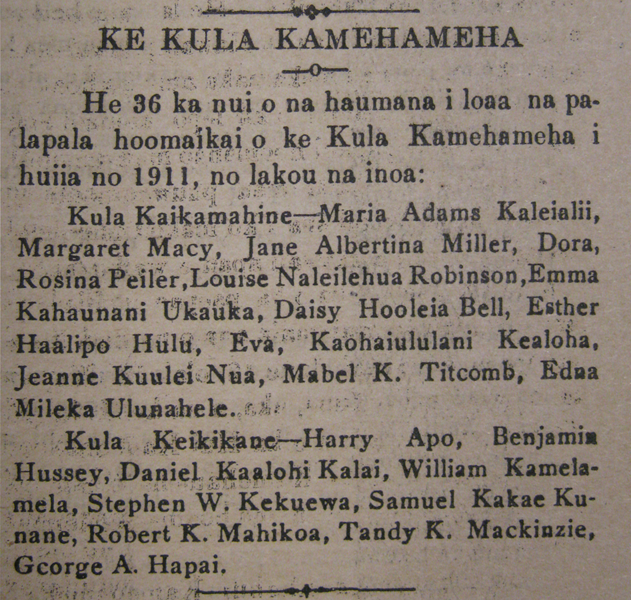
36 students received their diplomas from the joint Kamehameha Schools for 1911, and their names are:

Girls School—Maria Adams Kaleialii, Margaret Macy, Jane Albertina Miller, Dora Rosina Peiler, Louise Naleilehua Robinson, Emma Kahaunani Ukauka, Daisy Hooleia Bell, Esther Haalipo Hulu, Eva Kaohaiululani Kealoha, Jeanne Kuulei Nua, Mabel K. Titcomb, Edna Mileka Ulunahele.

Boys School—Harry Apo, Benjamin Hussey, Daniel Kaalohi Kalai, William Kamelamela, Stephen W. Kekuewa, Samuel Kakae Kunane, Robert K. Mahikoa, Tandy K. Mackinzie, George A. Hapai.

(Au Hou, 6/7/1911, p. 23.)

KE KULA KAMEHAMEHA

Ke Au Hou, Buke 2, Helu 23, Aoao 23. Iune 7, 1911.

A Hawaiian dies far away from home, 1917.

Passed Away.

It was from the steamer Ventura that news was heard of the passing of a Hawaiian mother well known by those of Hilo and Honolulu, that being Mrs. Meleana Keomailani Kenuwe, and her bones will be left in foreign lands where she lived for a long time, for 17 or more years. She left her beloved community of her homeland in 1888 to go live with her daughters, Jessie Kamokukaha Wilson and Mrs. Mary Kinoole Shotlz. Her sons-in-law worked planting fruits in the county of Santa Clara, an area in California that is fifty miles from San Francisco. She was born in Honolulu in 1829, and died at 76 years old. Mrs. Caroline Paakaiulaula Bush of this town is her younger sister, and here also is her son Alfred Kapahukapu Kenway. She has ten surviving grandchildren and ten great-grandchildren. How sad for that beloved mother who has passed; she is a native and well-acquainted with living in the Lanipili rains of Hilo. When her daughters were young, she was a travel companion of the Lady Treasurer of this Aloha Aina newspaper [Emma Nawahi], and she was a favorite in the bosom of that beloved lady who has passed on. Aloha no. That path which she has taken is one we must all take. The Aloha Aina shares in the sorrow of the family of that beloved mother who has gone.

[It is good to note that sometimes there is the same Hawaiianization for different haole names. When one hears Kenuwe, we would usually think Greenwell, but here we see that it is what Hawaiians called Kenway.

It is also good to remember that there are at times more than one Hawaiianization for a single haole name.]

(Aloha Aina, 7/8/1905, p. 5)

O Mrs. Meleana Kenuwe Ua Hala.

Ke Aloha Aina, Buke XI, Helu 27, Aoao 5. Iulai 8, 1905.

Death of Mary Ann Kaaumokulani Kinoole Pitman Ailau, 1905.

DIED.

AILAU—In Hilo, Hawaii. February 11, 1905. Mrs. Mary Ann Kaaumokulani Kinoole Pitman Ailau, daughter of the High Chiefess Kinoole and the late Benjamin Pitman, and widow of John Keakaokalani Ailau, aged 67 years.

Mrs. Ailau was known from one end of the group to the other, and in Boston and many of the Atlantic watering places.

She was born at Hilo 67 years ago, and with the exception of a number of years spent in Boston and New England completing her education, she always resided in the islands. She was a daughter of Benjamin Pitman a capitalist, who resided both in Hilo and Honolulu. The Pitman home was at the corner of Alakea and Beretania streets, on the site now occupied by the C. Q. Yee Hop building.

The Pitmans came here from Boston, where they were well connected. Mrs. Ailau’s father-in-law also resided here for a number of years. Her father married the High Chiefess Kinoole, daughter of the High Chief Hoolulu. Continue reading

Hawaiian returns home to Hilo after living in Boston for 50 years, 1917.

RETURNED ONCE AGAIN TO THE LAND OF HIS BIRTH

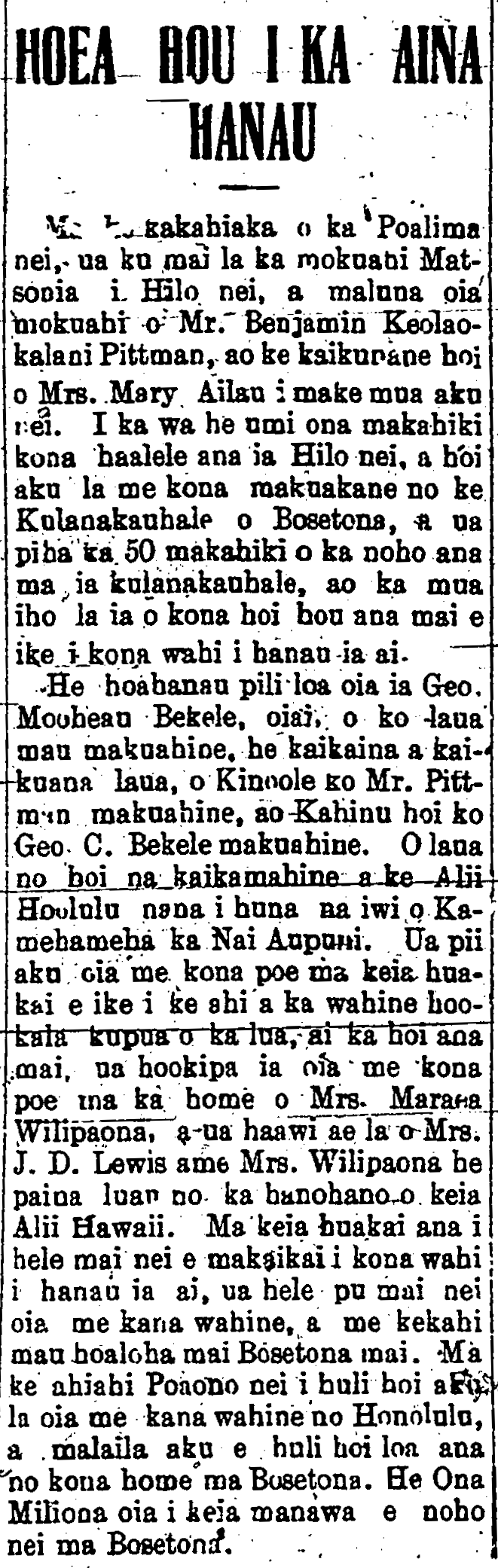
In the morning of last Friday, the steamship Matsonia docked in Hilo nei, and aboard the ship was Mr. Benjamin Keolaokalani Pitman [Pittman], the brother of the recently deceased Mrs. Mary Ailau. He left left Hilo when he was 10 years old, and went back with his father to the city of Boston, and he has lived there for a full 50 years, and this is the first time he has returned to see the place where he was born.

He is a direct cousin to George Mooheau Beckley, as their mothers were sisters; Kinoole is Mr. Pitman’s mother, and Kahinu is George C. Beckley’s. The two of them were daughters of the Alii Hoolulu who hid the bones of Kamehameha Ka Na’i Aupuni. He [Pittman] went with his people on a tour to see the fire of the enchanting woman of the pit, and on their return, they were entertained at the home of Mrs. Maraea Wilipaona [? Mrs. Maria Wilfong], and Mrs. J. D. Lewis and Mrs. Wilfong put on a luau to honor this Hawaiian Alii. On this trip of his to his homeland, accompanying him were his wife and some friends from Boston. On Saturday evening, he and his wife left for Honolulu, and from their they will return to his home in Boston. He is now a Millionaire living in Boston.

[Unfortunately, the digital images of the Hoku o Hawaii newspaper are only available online from 5/31/1917, and so the issue in which this story appears is not available yet (along with the ten years of newspapers that come before it).]

(Hoku o Hawaii, 2/8/1917, p. 2)

HOEA HOU I KA AINA HANAU.

Ka Hoku o Hawaii, Buke 11, Helu 37, Aoao 2.

Hawaiian boys headed to China to play music, 1916.

[Found under: “LOCAL AND GENERAL”]

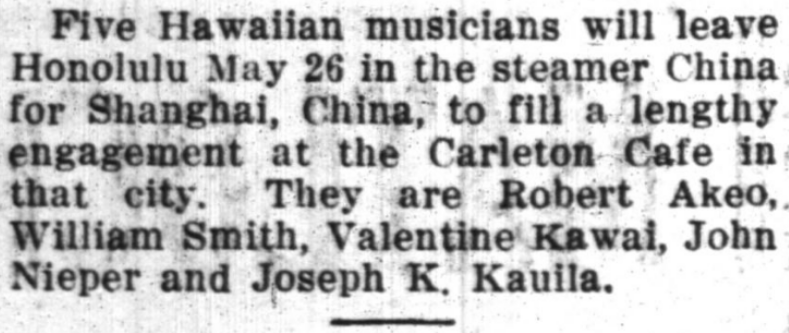
Five Hawaiian musicians will leave Honolulu May 26 in the steamer China for Shanghai, China, to fill a lengthy engagement at the Carleton Cafe in that city. They are Robert Akeo, William Smith, Valentine Kawai, John Nieper and Joseph K. Kauila.

(Honolulu Star-Bulletin, 5/9/1916, p. 3)

Five Hawaiian musicians...

Honolulu Star-Bulletin, Volume XXIII, Number 7511, Page 3. May 9, 1916.

Hawaiians singing in far away China, 1917.

THERE IS GREAT DELIGHT IN HAWAIIAN MUSIC IN CHINA.

In a letter written by Robert Akeo, a Hawaiian boy who travelled to Shanghai, China, with his companions to sing under contract, it is seen that there is much admiration for Hawaiian music in China, because their contract to play there was over long ago, and yet, they are constantly being asked to satisfy the desires of those people for Hawaiian music and hula.

It seems in order to fulfill the wishes of Shanghai’s people for hula, one of the boys was made into a woman by putting on women’s clothing, and he would dance with one of his fellow boys, while the rest of them play music, and they sing and dance at the same time.

There are some thousands of people in Shanghai who have no knowledge of Honolulu, but after hearing the singing voices, and seeing the act of those young ones, the desire to come visit Honolulu and see the Paradise of the Pacific grew within them.

(Kuokoa, 2/2/1917, p. 8)

NUI KA HIALAAIIA O NA MELE HAWAII MA KINA.

Ka Nupepa Kuokoa, Buke LV, Helu 5, Aoao 8. Feberuari 2, 1917.

Hawaiian Music, an editorial, 1911.

How Hawaiian Music is Being Misconstrued!

Perhaps the thoughts of the Kuokoa may not be the same as those of others about the way Hawaiian music is being sung these days, but because we hold dear listening to the beauty and the sweet sounds along with the joy of the voices, therefore the Kuokoa takes up this matter.

It is not something that we Hawaiians should criticize, that singing is something we are proud of, and something that makes this race famous all around the world, by tourists who visit Hawaii nei and hear us singing our enjoyable and entertaining songs, as well as by singing groups being seen travelling about America.

If we were to turn back in time, to many years past, when the Kawaihau Glee Club and many other groups were famous for singing, we will see when comparing them to those performing today, the differences between them; our admiration will be taken by the singing of the old days, which many groups in some places around Hawaii nei still practice that way of singing Hawaiian songs.

Our Hawaiian mele are composed with their many kaona, and it is by how they are sung, if it is not made clear by the lyrics, that give appreciation and admiration to the listener, from Hawaiians to those that don’t know our language, because it is only through the melody of the song that that listener is entertained.

These days however, our singers are following haole style singing; and when songs that we are used to hearing along with their tunes which fill us with energy and enthrallment are changed, when listening to that it is like ridicule, for we are not used to hearing that kind of melody, and Hawaiian songs are not famous for that style of singing.

Our people, from the men to the women are talented with fine singing voices; it is a talent not widely spread amongst other people of the world, but it is not by the the way some people now are singing, but by singing songs as they were sung in years past.

Perhaps the vibrato and the slow and drawn out of singing matches haole songs of this age, but by changing the way Hawaiian songs are sung in this way, we at the Kuokoa are not mistaken when we say that it is insulting to the listener.

We don’t wish to call this person or that one not a good singers, but should we want our goal to be to preserve this fame through song, there is only one arena for us to stand before the other races, that is through expressing what God has given to every Hawaiian man and woman, without mimicking or emulating what other people are doing; lest what is seen by us as good becomes something that is not good.

We have nothing to say to those who are studying music in books; that will be a great benefit to some, but the good seen in one aspect will not get better by changing another aspect; so it is with our Hawaiian music, by changing how they are sung, it will not make them better.

Each and every Hawaiian is the true witness, and they are the perfect judge to weigh what we now discuss, not to criticize or to assail upon someone with words of persecution, but for our affection of the grandeur and true beauty of Hawaiian mele which each and every one of us all love and cherish.

[On a somewhat related topic about tradition and kuleana and mele, there is a very thought-provoking essay for composers and non-composers alike, by Kainani Kahaunaele, printed in The Value of Hawaii 2: Ancestral Roots, Oceanic Visions, just recently out. In fact, if you haven’t got your copy yet, there are many stories by a wide range of writers in there that we should look at, and perhaps the many moolelo within the collection will then push us into thinking what we ourselves feel the value of Hawaii nei is and where we should be headed and what it is we need to do to get us there.]

(Kuokoa, 9/8/1911, p. 4)

PEHEA E HOOHEPAIA MAI NEI NA HIMENI HAWAII!

Ka Nupepa Kuokoa, Buke XLVII, Helu 36, Aoao 4. Sepatemaba 8, 1911.

The pioneers of the Hawaiian Homes Lands in Kalamaula, Molokai, 1922.

Eight Ohana will Head First to the Homestead Lands at Molokai

The Hawaiian Homes Commission Chose those People who were Thought to be Appropriate for Going First to the Lands of Kalamaula, Molokai

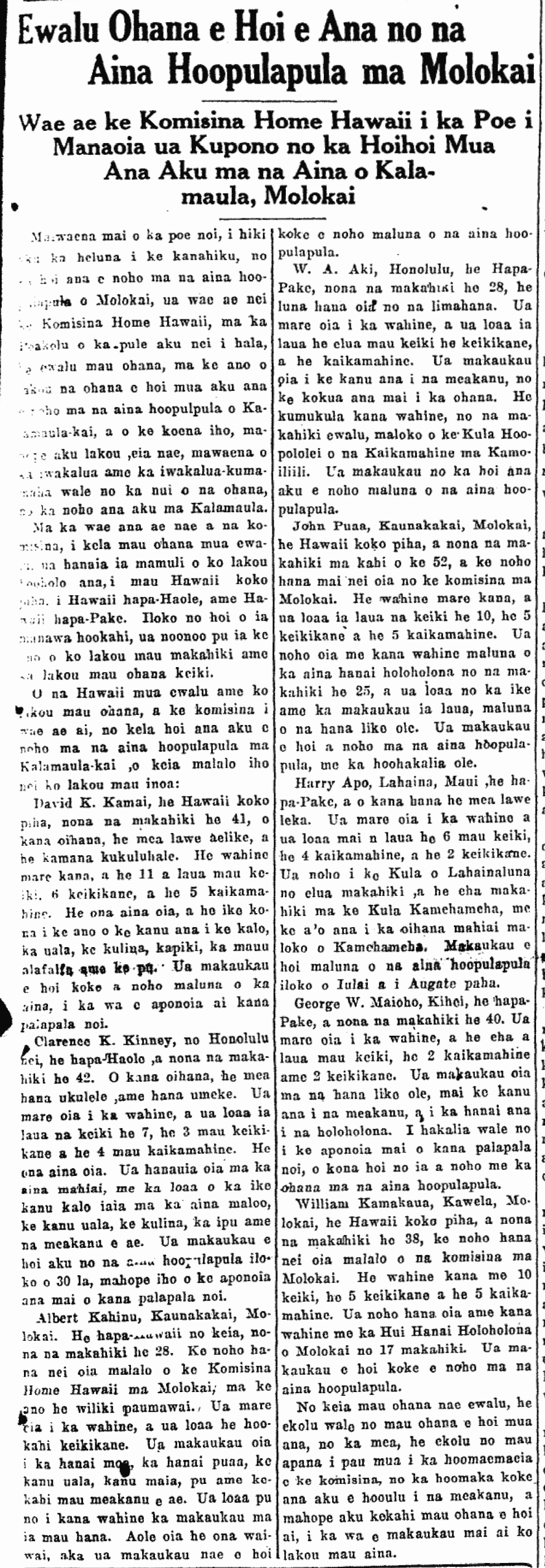
Amongst the applicants that reached seventy in number, to go back to the homestead lands of Molokai, the Commissioner of Hawaiian Homes chose  last week Wednesday, eight families as the first to go to live on the homestead lands of Kalamaula Kai, and the rest, they will go later, however, only between twenty and twenty-four families total will live at Kalamaula.

In the selection of the commission of those eight families, it was done with them choosing full-blooded Hawaiians, hapa Haole, and hapa Chinese. At the same time, considered were their ages and the children in their families.

The first eight Hawaiians and their families which were selected by the commission to go to the aina hoopulapula at Kalamaula Kai are here named below:

David K. Kamai, a full-blooded Hawaiian who is 41 years old, his occupation is a contractor and a carpenter. He has a wife and they have 11 children, 6 boys and 5 girls. He is a land owner and he has knowledge of taro cultivation, sweet potato, corn, cabbage, alfalfa grass and melons. He is prepared to go at once and live on the land when his application is approved.

Clarence K. Kinney [Clarence W. Kinney], of Honolulu nei, is a hapa Haole, and is 42 years old. His occupation is an ukulele maker and a maker of umeke. He is married, and they have 7 children, 3 boys and 4 girls. He is a land owner. He was born on farm lands, with knowledge of dry land taro cultivation, sweet potato planting, corn, melon and other crops. He is ready to go to the aina hoopulapula in thirty days after his application is approved.

Albert Kahinu, Kaunakakai, Molokai. He is a hapa Hawaii that is 28 years old. He is employed by the Hawaiian Homes Commission on Molokai as a water pump engineer. He is married and they have one son. He knows how to raise chicken and pig, and how to plant sweet potato, banana, melon, and other crops. His wife is also knowledgeable in that kind of work. He does not own property, but is prepared to go at once to live on the homestead lands.

W. A. Aki, Honolulu, is a Hapa Chinese, and is 28 years old; he is an overseer of laborers. He is married and they have two children, a son and daughter. He is knowledgeable about planting crops to assist his family. His wife has been a school teacher for eight years at the Girls’ Correctional School at Kamoiliili. They are ready to go live on the aina hoopulapula.

John Puaa, Kaunakakai, Molokai, is a full-blooded Hawaiian, and is 52 years old; he is employed by the commission at Molokai. He is married, and they have 10 children, 5 boys and 5 girls. He has lived with his wife on a ranch for 25 years, and the two are knowledgeable at various work. They are prepared to go live on homestead lands without delay.

Harry Apo, Lahaina, Maui, is a hapa Chinese, and he works as a letter carrier. He is married, and they have 6 children, 4 girls and 2 boys. He lived at Lahainaluna School for two years, and four years at Kamehameha School, learning farming at Kamehameha. He is ready to move to the aina hoopulapula in July or August perhaps.

George W. Maioho, Kihei, is a hapa Chinese, and is 40 years old. He is married, and they have four children, 2 girls and 2 boys. He is capable of all sorts of work, from planting crops to raising livestock. He will go at once after his application is approved to live on the aina hoopulapula with his family.

William Kamakaua, Kawela, Molokai, is a full-blooded Hawaiian, and is 38 years old; he is employed by the commission on Molokai. He is married with 10 children, 5 sons and 5 daughters. He worked along with his wife on Molokai Ranch for 17 years. He is prepared to live on the homestead lands.

Of these eight families, only three will go first, because only three of the lots have been so far cleared by the commission to be farmed at once, and thereafter, other families will go when their lots are ready.

[There was a nice article in this month’s Ka Wai Ola, on page 5, about a remembrance of the first settlers of the Hawaiian Homes lands at Kalamaula. Here are more families that were chosen, listed in the Kuokoa on 8/17/1922.

Here is perhaps a more detailed article on the eight found in the Kuokoa on 7/6/1922, p. 2.]

(Kuokoa, 7/6/1922, p. 1)
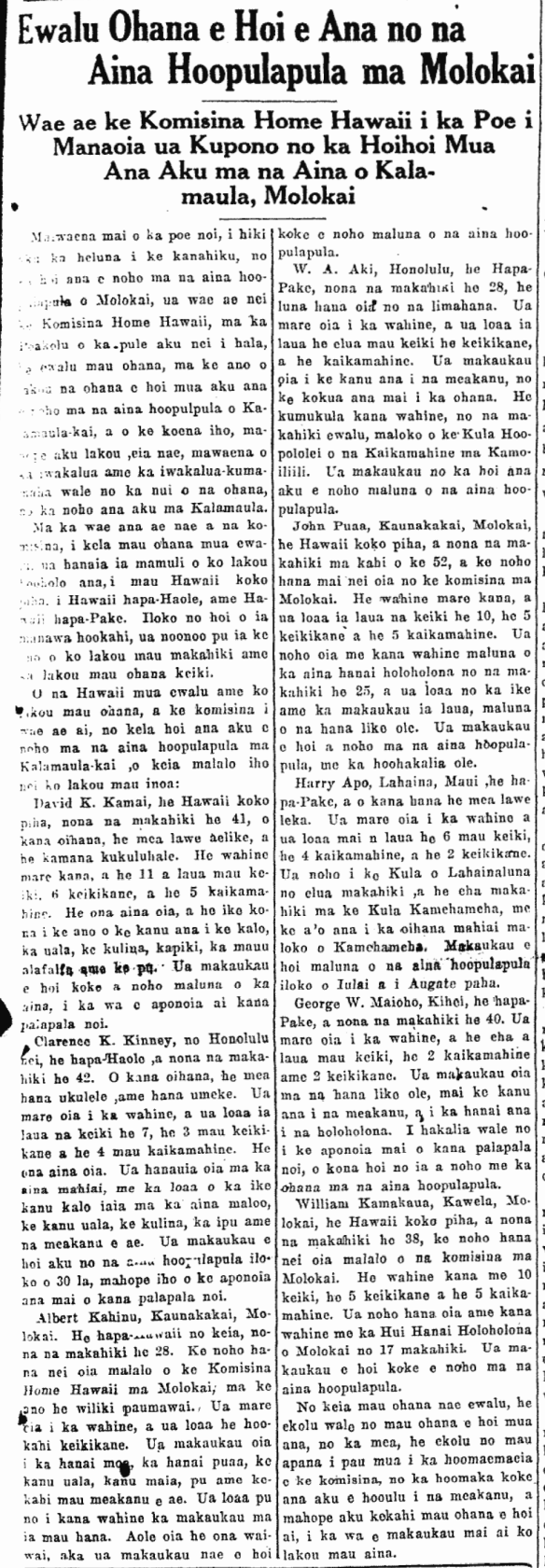
Ewalu Ohana e Hoi e Ana no na Aina Hoopulapula ma Molokai

Ka Nupepa Kuokoa, Buke LXI, Helu 27, Aoao 1. Iulai 6, 1922.

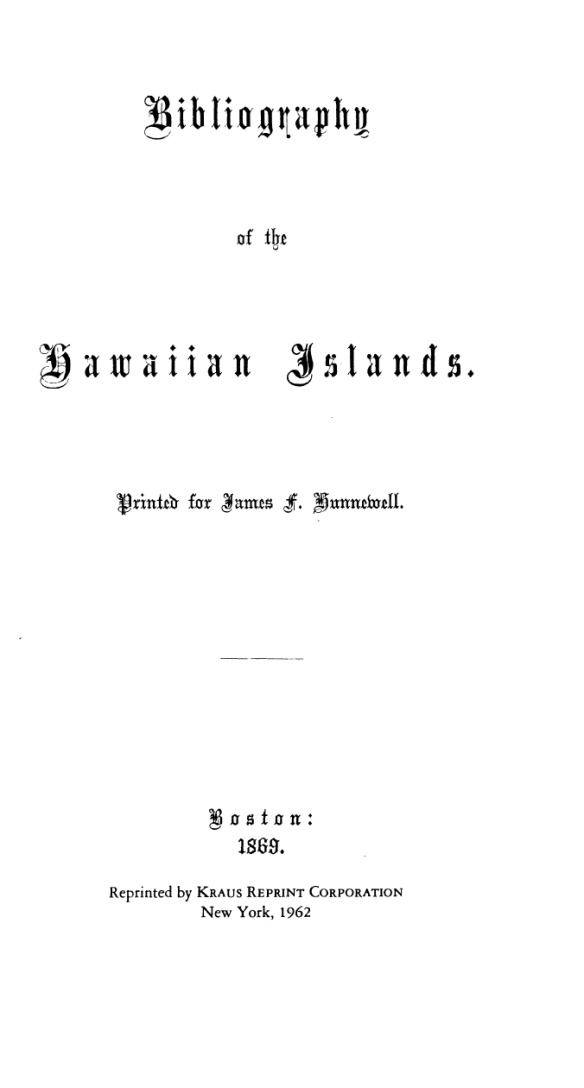
Hawaiian Language Imprints, Judd, Bell, and Murdoch, 1978.

This is a nice bibliography of Hawaiian-language material written between 1822 and 1899 compiled by Bernice Judd, Janet E. Bell, and Clare G. Murdoch in 1978. What is nice about this is that it lists where known copies at the time were located. Unfortunately, this online copy is not easily searchable like the 1869 Bibliography of the Hawaiian Islands in the last post. If you do a search, you will only be pointed to the word in the typescript, but if you want to know where it appears on the image of the original, you will only be pointed to the page where it appears. There is supposed to be another copy on Project Gutenberg, but the file seems to be corrupt. On Project Gutenberg, you would be able to do a word search against the image of the original with it highlighting the word or phrase searched for.

Hawaiian Language Imprints, 1822-1899.

Hawaiian Language Imprints, 1822-1899.