Fred Malulani Beckley Kahea passing on traditional knowledge, 1922.

[Found under: “Nuhou Kuloko”]

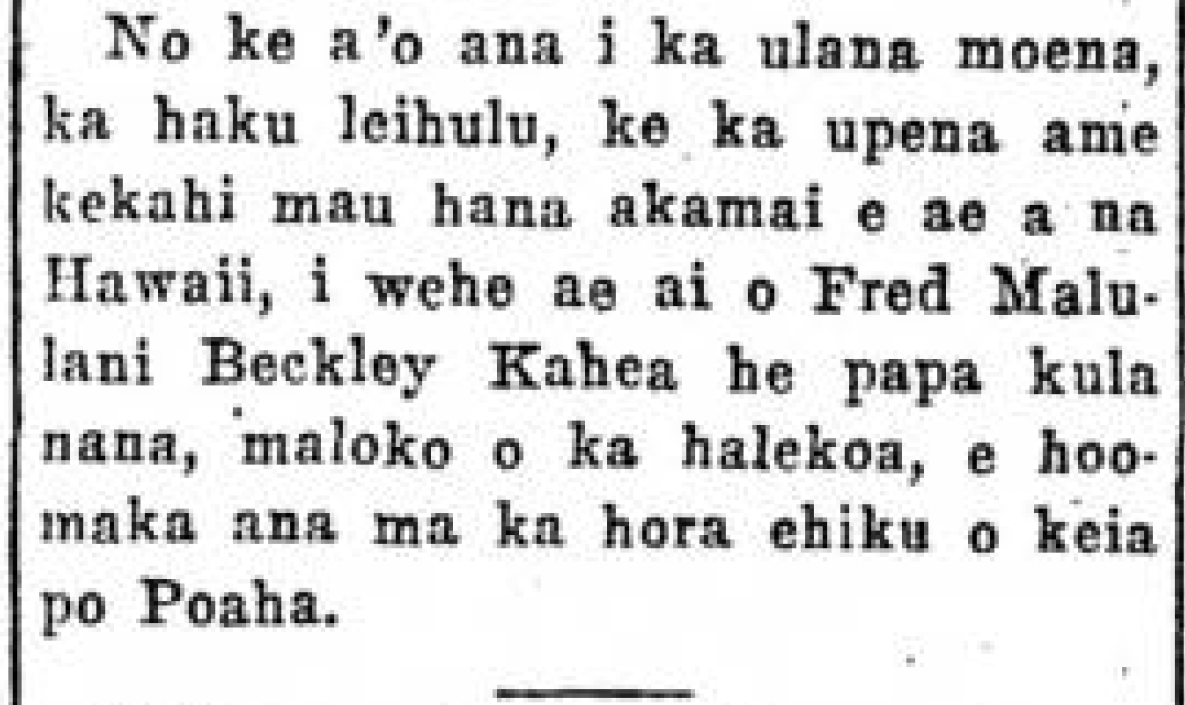
In order to teach mat weaving [ulana moena], feather lei making [haku lei hulu], net tying [ka upena], and other Hawaiian skills, Fred Malulani Beckley Kahea initiated himself a class in the armory, beginning at seven o’clock this Thursday night.

[I was reminded of this article by the recent post by Nanea Armstrong-Wassel about Fred Malulani Beckley Kahea and traditional featherworkers.

F. M. B. Kahea not only taught his class at the armory, but he also was the sharing his knowledge in the construction of kahili when they were made for Governor Farrington in 1928.]

(Kuokoa, 12/7/1922, p. 8)

No ke a'o ana...

Ka Nupepa Kuokoa, Buke LXI, Helu 49, Aoao 8. Dekemaba 7, 1922.

Reforesting Puu Ohia, Oahu, 1900.

PERTAINING TO GROWING SANDALWOOD.

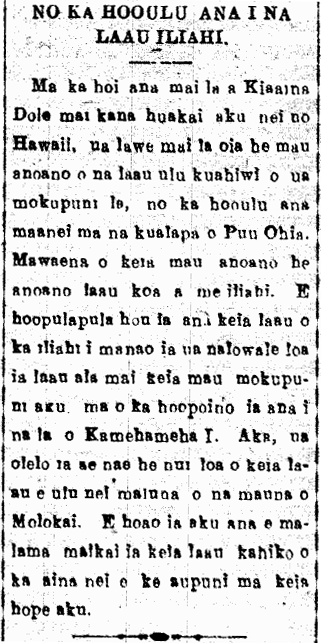
On the return of Governor Dole from his travels to Hawaii, he brought back some seed of trees growing in the mountains of that island to grow here on the ridges of Puu Ohia [Tantalus]. Among these were koa and iliahi seeds. This tree, the iliahi, will be increased; it was believed no longer existing on these islands because of abuse during the days of Kamehameha I. However, it is said that there is a great number of these trees growing in the mountains of Molokai. From here forth, the government will try to care well for these ancient tree of the land.

(Aloha Aina, 8/25/1900, p. 5)

NO KA HOOULU ANA I NA LAAU ILIAHI.

Ke Aloha Aina, Buke VI, Helu 34, Aoao 5. Augate 25, 1900.

Special piano built, 1901.

PIANO MADE WITH HAWAIIAN WOOD.

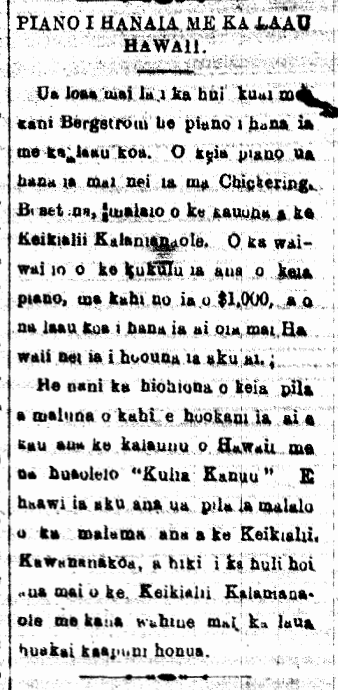
Bergstrom Music Company [hui kuai mea kani Bergstrom] received a piano made with koa wood. This piano was made in Chickering, Boston under the order of Prince Kalanianaole. The cost for the building fo this piano was about $1,000, and the koa wood it was made from was sent from Hawaii nei.

The look of this instrument is lovely, and above where it is played is placed the crown of Hawaii and the words “Kulia Kanuu.” The instrument will be placed under the care of Prince Kawananakoa when the Prince Kalanianaole and his wife returns from their trip around the world.

[Does anyone know if this piano still exists? I sure hope so.]

(Aloha Aina, 2/2/1901, p. 5)

PIANO I HANAIA ME KA LAAU HAWAII.

Ke Aloha Aina, Buke VII, Helu 5, Aoao 5. Feberuari 2, 1901.

The latest from Kohala, 1879.

News of the Apaapaa Winds.

To My Constant Desire, Ka Nupepa Kuokoa.

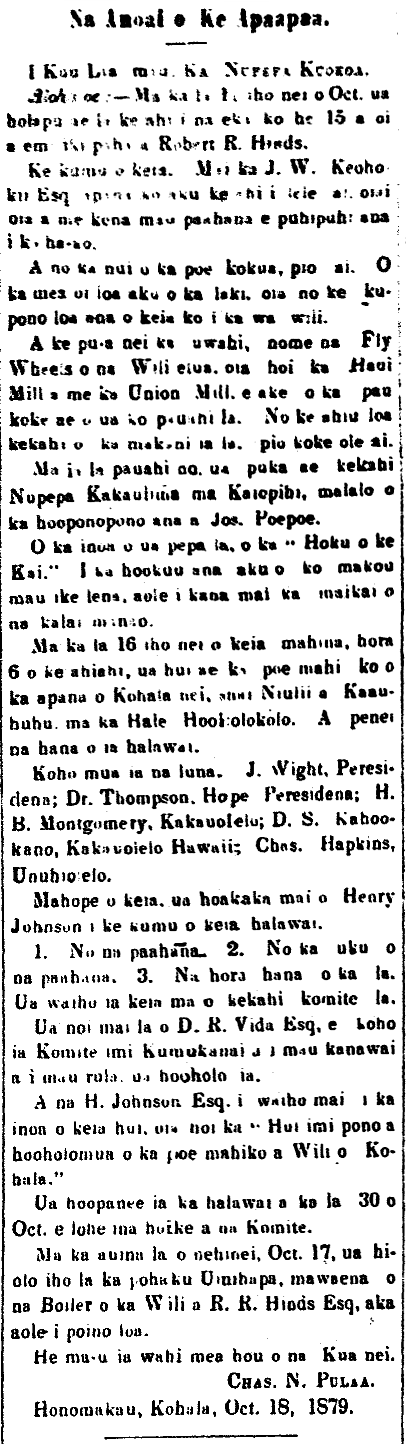
Aloha oe:—On this past 11th of Oct., fire engulfed more or less 15 acres of Robert R. Hind’s.

This is the cause. The fire jumped from the property of J. W. Keohokii, Esq., while he and his workers were burning the leaves of the sugarcane.

And it was extinguished because of all of those assisting. The luckiest thing was that the cane was all ready to be milled.

While the smoke was billowing, the Fly Wheels of the two Mills spun, that being Haui Mill [Hawi Mill] and Union Mill,  hoping to quickly take care of that burning cane. Because of the terribly wild winds that day, it was not put out quickly.

On that very day of the fire, a Handwritten Newspaper at Kaiopihi under the editing of Joseph Poepoe was issued.

The name of that paper is “Hoku o ke Kai.” When we examined it, the discussions were outstanding.

On the past 16th of this month, at 6 o’clock in the evening, the sugar plantation people of the district of Kohala, from Niulii to Kaauhuhu, met at the Court House. And this is what happened at that meeting.

The officers were chosen first. J. Wight, President; Dr. Thompson, Vice President; H. B. Montgomery, Secretary; D. S. Kahookano, Hawaiian Secretary; Charles Hapkins [Charles Hopkins], Translator.

After this, Henry Johnson explained the purpose of this meeting.

1. Pertaining to the laborers. 2. Pertaining to the wages of the laborers. 3. The work hours per day. This was left to a committee.

D. R. Vida, Esq., asked that a Committee be selected to  form a constitution, laws, and rules; the motion was passed.

H. Johnson, Esq. put forth the name of this organization, that being “Hui imi pono a hooholomua o ka poe mahiko a Wili o Kohala” [Association seeking rights and progress for the workers of the plantations and Mills of Kohala].

The meeting was adjourned until the 30th of Oct. to hear the report of the Committee.

Yesterday afternoon, Oct. 17, a brick fell between the Boilers of the Mill of R. R. Hind, Esq., but there were no serious injuries.

Those were a few news items from here in the Back areas.

Charlse N. Pulaa.

Honomakua, Kohala, Oct. 18, 1879.

(Kuokoa, 10/25/1879, p. 3)

Na Anoai o Ke Apaapaa.

Ka Nupepa Kuokoa, Buke XVIII, Helu 43, Aoao 3. Okatoba 25, 1879.

Milk from Pukoo, Molokai, 1922.

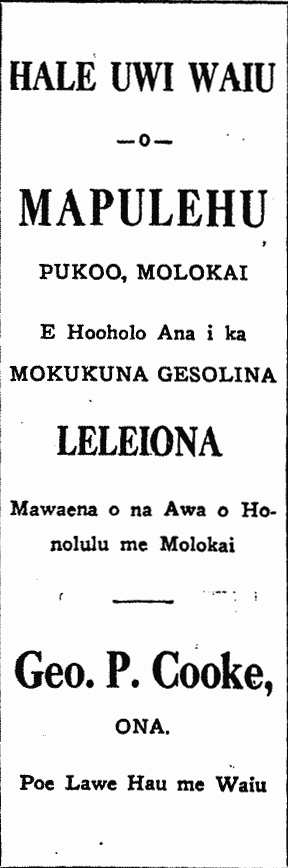
MAPULEHU DAIRY

PUKOO, MOLOKAI

Delivered aboard the

GASOLINE SCHOONER

LELEIONA

Between the Ports of

Honolulu and Molokai

Geo. P. Cooke,

OWNER.

Deliverers of Ice and Milk

(Kuokoa, 3/17/1922, p. 4)

HALE UWI WAIU

Ka Nupepa Kuokoa, Buke LXI, Helu 11, Aoao 4. Maraki 17, 1922.


Mrs. J. P. Kahanamoku passes on, 1936.

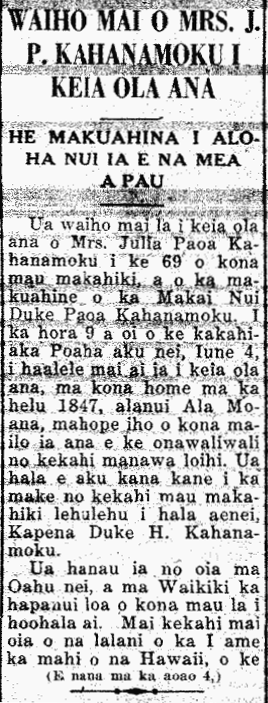
MRS. J. P. KAHANAMOKU SETS THIS LIFE ASIDE

SHE WAS A MOTHER GREATLY BELOVED BY ALL

Mrs. Julia Paoa Kahanamoku left this life at 69 years old, and she is the mother of Sheriff Duke Paoa Kahanamoku. At 9 o’clock or so in the morning of this past Thursday, June 4, she left this life behind, at her residence at 1847 Ala Moana Road, after going into a decline through weakness for a long time. Her husband preceded her in death many years ago, Captain Duke H. Kahanamoku.

She was born here on Oahu, and she spent most of her life in Waikiki. She descended from the lines of the I and Mahi of Hawaii, …

(Alakai o Hawaii, 6/11/1936, p. 1)

WAIHO MAI O MRS. J. P. KAHANAMOKU I KEIA OLA ANA

Ke Alakai o Hawaii, Buke 9, Helu 9, Aoao 1. Iune 11, 1936.

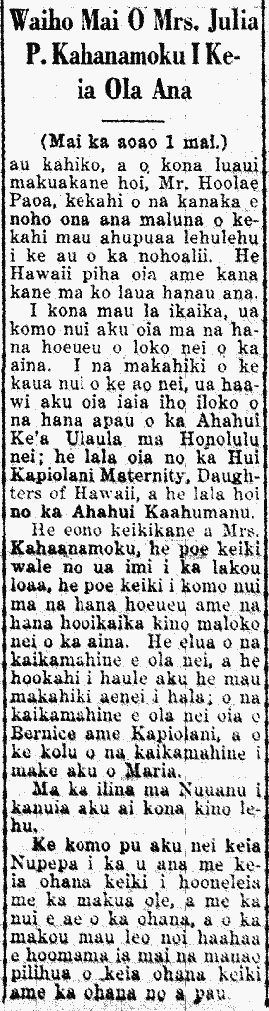
…from ancient times, and her birth father, Mr. Hoolae Paoa, was one of the people who oversaw many ahupuaa during the monarchy. She was a full Hawaiian by birth, as well as was her husband.

During her healthy days, she participated in many promotional activities in this land. During the years of the great world war [WWI], she put herself out doing all the work of the Red Cross [Ahahui Ke’a Ulaula] in Honolulu;* she was a member of the Kapiolani Maternity Association, Daugthers of Hawaii, and a member of the Kaahumanu Society [Ahahui Kaahumanu].

Mrs. Kahanamoku had six sons, boys who each went off to find his own fortune, boys who participated greatly in promotional activities as well as body-strengthening events in this land. She has two girls who are living, and one who passed some year ago; the ones living are Bernice and Kapiolani, and the third who died was Maria.

Her ashes were buried at the cemetery in Nuuanu.

This Newspaper joins in on the grieving with this family of children who are bereft of their parents, as well as the rest of the family; and we humbly beseech that the sad thoughts of this family of children and all of the ohana as well be lightened.

*It is no surprise that Duke himself was knitting warm clothes for the Red Cross!

(Alakai o Hawaii, 6/11/1936, p. 4)

...au kahiko, a o kona luaui makuakane...

Ke Alakai o Hawaii, Buke 9, Helu 9, Aoao 4. Iune 11, 1836.

Duke H. Kahanamoku, father of the world-famous Duke P. Kahanamoku, passes on, 1917.

DUKE K. KAHANAMOKU LEAVES THIS LIFE BEHIND.

Thursday last week, Duke K. Kahanamoku [Duke H. Kahanamoku] grew weary of this worldly life, the father of the swimming champion of Hawaii nei, at his home at 1847 Ala Moana Road, Waikiki.

On that day mentioned, Kahanamoku went swimming at the ocean that afternoon for his health, and upon his return, he lay to rest before dinner, saying that he was feeling dizzy; and a few minutes thereafter, his life breath left him and he went to where all must go. It is said that the cause of his death was heart disease.

Duke K. Kahanamoku was born in this town on the 21st of July, 1869, and so he made 48 years old on this past 21st of July. The reason Kahanamoku was named “Duke” is because he was born on the day that the Duke of Edinburgh arrived in Honolulu nei, on that very year and day.

Duke K. Kahanamoku, who died, was employed in the police department here in Honolulu nei under William P. Jarrett as a bicycle officer, recorder of offenses, and sergeant, until he became police captain for an entire watch, and for some unknown reason, Kahanamoku left the police force and began to work once more with William P. Jarret at Kawa as a prison guard.

Duke K. Kahanamoku left behind a wife and six sons and three daughters grieving for him on this side of the dark river [muliwai eleele].

From Ke Aloha Aina, we join the family who are saddened for your loved one, but God will lighten all your burdens, for it is He who creates and He who takes away. It is His will that be done, not that of the children of man.

(Aloha Aina, 8/10/1917, p. 1)

HAALELE MAI O DUKE K. KAHANAMOKU I KEIA OLA ANA

Ke Aloha Aina, Buke XXII, Helu 32, Aoao 1. Augate 10, 1917.

Duke runs for reelection as sheriff of the city and county of Honolulu, 1936.

Duke Kahanamoku Asks Sheriff Re-election On Basis of Present Record

Kahanamoku, scion of one of the few remaining full-blooded Hawaiian families in the islands, was responsible for returning the sheriff’s office, for the first 25 years of city and county government always held by a Democrat, to the Democratic fold after it had lapsed momentarily into the hands of the Republicans with results that are too well known and too well remembered by every resident of Hawaii to repeat here.

Perhaps the most famous living exponent of the Hawaiian race is Duke P. Kahanamoku, who first spread the name of the Territory over the newspapers and magazines of the world by his swimming prowess and is now seeking re-election as sheriff of the city and county of Honolulu on the Democratic ticket.

For Sheriff

DUKE P. KAHANAMOKU

The Duke first took the world by storm when, and absolutely unknown, he went to the quadrennial Olympic games as one of the American team and made a clean sweep of all the swimming events in which he was entered, establishing several world’s records that stood for many years. He repeated this performance in the following Olympic games and ruled supreme in acquatic affairs until his voluntary retirement from active competition.

On his return to Hawaii the gratitude of the citizens of the Territory was expressed in the form of a public fund which was used to provide a residence for the Kahanamoku family.

The Duke declares in his speeches that he carries on the duties of sheriff of the city and county in the clean and sportsmanlike manner which distinguished his athletic career.

Despite inadequate appropriations provided for the greatly needed new construction at the city and county jail, which is under the jurisdiction of the sheriff’s office, Kahanamoku has established an efficient record in the conduct of this institution—a record on which he is asking renomination at re-election.

“I am a man of few words,” the Duke declares. “When I was representing Hawaii against the best swimmers in the world, I never predicted that I would win any particular race—but I think I won my share. It is the same with the present race for the sheriff’s office.”

[Duke seems to have followed in the footsteps of his father. Duke P. Kahanamoku’s father, Duke K. Kahanamoku served in various positions in the police department, ultimately reaching the rank of captain.]

(Alakai o Hawaii, 9/24/1936, p. 1)

Duke Kahanamoku Asks Sheriff Re-election On Basis of Present Record

The Hawaii Democrat, Volume 9, Number 24, Page 1. September 24, 1936.

Atomic bomb destroys Hiroshima, 1945.

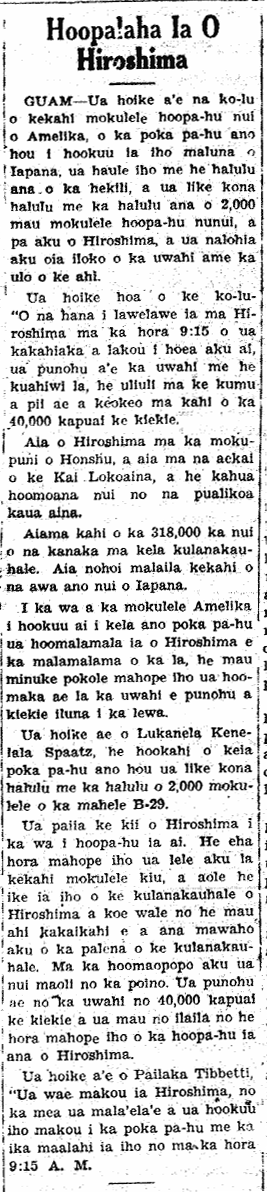
Hiroshima is Leveled

GUAM—The crew of a large American bomber reported of a new type of bomb released above Japan; it fell with the rumbling of thunder, and it was like the strength of 2,00 large bombers; and it hit Hiroshima which disappeared in smoke and the red of fire.

The crew also stated, “The action taken upon Hiroshima at 9:15 in the morning when they arrived, the smoke rose like a mountain, dark at the base and rose to white, reaching about 40,000 feet in height.

Hiroshima is on the island of Honshu, and is on the shore of the Inland Sea [Kai Lokoaina], and it is a large camp for the soldiers of the army.

The population of that city was 318,000. And also one of the major ports of Japan is located there.

When the American aircraft released the bomb, Hiroshima was lit up with the light of the sun, and a few minutes later, smoke began to billow high into the sky.

Lieutenant General Spaatz said the strength of one of those new bombs was equal to the strength of 2,000 B-29 planes.

A picture of Hiroshima was taken when it was bombed. Four hours later, a spy plane flew over, and the city of Hiroshima could not be seen except for a few fires burning outside of the city limits. The great destruction was clear. The smoke billowed up 40,000 feet high, and it remained for hours after the bombing of Hiroshima.

The Pilot Tibbett said, “Hiroshima was chosen because it was clear, and we released the bomb with clear vision at 9:15 A. M.

[70 years ago… Let’s learn from history.]

(Hoku o Hawaii, 8/15/1845, p. 1)

Hoopalaha Ia O Hiroshima

Ka Hoku o Hawaii, Volume XL, Number 16, Aoao 1. Augate 15, 1845.

Chiefs and officers of the nation, 1844.

CALENDAR

The following is a list of the principal Chiefs, Officers of His Majesty’s Civil Administration; of the Chiefs entitled to rank, and of the present incumbents in the more important local offices, which will be corrected as occasion may require:—

Members of the Hon. Privy Council of State.

G. P. JUDD, Secretary of State for Foreign Affairs.
JOHN RICORD, Attorney General.
JOHN II, of the Treasury.
JOHN YOUNG, Counsellor.
TIMOTHY HAALILIO, of the Treasury.

Governors of the Respective Islands.

M. KEKAUONOHI, Kauai.
J. A. KUAKINI, Hawaii.
KEONI ANA, Maui.
M. KEKUANAOA, Oahu.
W. P. LELEIOHOKU, Acting Governor of Hawaii.

Associate Judges of the Supreme Court.

A. PAKI,
J. KAPENA,
C. KANAINA,
KAAUWAI.

Nobles.

J. A. Kuakini,
M. Kekuanaoa,
M. Kekauonohi,
W. P. Leleiohoku,
A. Keliiahonui,
Ruta,
Keoni Ana,
Keohokalole,
Alapai,
C. Kanaina,
A. Paki,
Joani Ii,
Konia,
T. Haalilio.

Princes and Chiefs eligible to be Rulers.

Alexander Liholiho, Heir Apparent to the Crown.
Moses Kekuaiwa, Expectant Gov. of Kauai.
Lot Kamehameha, Expectant Gov. of Maui.
William Lunalilo,
Jane Loeau,
Victoria Kamamalu,
James Kali, Expectant Premier.
Peter Young Kaeo,
Belinda Pauahi [Bernice Pauahi],
Emma Rooke,
David Kalakaua,
Abigail Maheha,
Polly Paaaina,
Elizabeth Kekaniau [Elizabeth Kekaaniau],
Lydia Kamakaeha.

Executive Officers of Government.

DAVID MALO, Superintendent of Schools at Maui.
KEIKENUI,  do.  do.  Oahu.
KAHOOKUI,  do.  do.  Kauai.
BARENABA,  do.  do. Hawaii.
KAPAE,  do.  do.  do.
JAMES J. JARVES, Director of Public Printing.
P. KANOA, Member of Treasury Board.
J. R. VON PFISTER, Secretary to dito.
G. L. KAPEAU,  do.  do.
WILLIAM PATY, Collector and Harbor Master of the Port of Honolulu.
T. C. B. ROOKE, Port Physician.
ROBERT BOYD, High Sheriff.
LOUIS GRAVIER, Prefect of Police and Superintendant of Public Houses in Honolulu.
MIKEKAI, Captain of Police of Honolulu.
HENRY SWINTON, Prefect of Police and Superintendant of Public Houses in Lahaina.
HOONAULU, Captain of Police at Lahaina.
EDWARD HAWKS, Collector of the Port of Lahaina.
ISAAC LEWIS, Harbor Master of  do.

Judges of Inferior Courts.

Halai,
Waolani,
Honokaupu,
Halali,
Kuhia, Judges of Honolulu.

Other parts of Oahu.

J. Kahananui,
Kahauolono,
Gideona Laanui,
Kahele,
Kaapuiki.

Inferior Judges of Maui.

Kuakamauna,
Kamakini, for Lahaina.

Inferior Judges of other parts Maui.

Kanae,
Helehewa,
Ii,
Keaweiwi,
Ulunahele.

Inferior Judges of Kauai.

Daniela Oleola,
Manano,
Solomona Koolua,
Naakakai,
James Young.

Collectors of Internal Revenue—Oahu.

Hooliliamanu,
Keliihuluhulu,
Kuaana,
Kulepe,
Keliiwaiwaiole.

Collectors of Internal Revenue—Kauai.

Kaanaana,
Wana,
Amala,
Naumu,
Kauakahi.

Collectors of Internal Revenue—Maui.

Ilae,
Kaihealani,
Kaenaena,
Kenui,
James Nowliens,
Manu.

Collectors of Internal Revenue—Hawaii.

Naahi,
Kuwaihoa,
Kapipi,
Kaiwi,
Kapau.

(Polynesian, 7/20/1844, p. 1)

CALENDAR.

The Polynesian, New Series, Volume 1, Number 9, Page 1. July 20, 1844.