Hawaiian Pine purchases Lanai, 1922.

LANAI GOES TO THE HAWAIIAN PINEAPPLE COMPANY

Last Tuesday the deal went through for Hawaiian Pineapple Company to purchase the land, the animals, and all equipment of Frank F. Baldwin and Harry A. Baldwin upon the Island of Lanai.

After paying the agreed price of $1,100,000, the retention of the old head managers and the members of the board of supervisors [papa alakai] of the Lanai Company, Ltd., of each of their positions was approved.

All of the rights of the Lanai Company has accrued to the Hawaiian Pineapple Company, and a number of new leaders have been chosen for that company, those being: James D. Dole, president; Kenneth B. Barnes, secretary; R. S. West, treasurer.

The entirety of Lanai is owned by the Lanai Co., Ltd, except for 1,000 acres, some kuleana lands, and all animals, cows, sheep, structures and other equipment of the ranch.

The new company will continue ranching, however, according to what is clearly understood, it will begin to plant pineapple on approximately 20,000 acres of chosen land, when the time is right.

The first thing planned by the Hawaiian Pine Company is to farm on land bought in Waialua this year while put aside the lands on Lanai until the right time comes to farm there. What it must do prior to farming pineapple is to build a pier, roads, and housing for the laborers, and if that happens, then pineapple from that island will hit the market in 1927.

(Kuokoa, 12/7/1922, p. 1)

LILO O LANAI I KA HAWAIIAN PINEAPPLE COMPANY

Ka Nupepa Kuokoa, Buke LXI, Helu 49, Aoao 1. Dekemaba 7, 1922.

Makalei Cave, North Kona, Hawaii, 1924.

ENJOYMENT OF TIME

DESCRIPTION OF MAKALEI

This is a cave to the south of the hill of Akahipuu, and it was there that a man named Ko’amokumoku-o-hueia [Ko’amokumokuoheeia] lived, who came from Koolau and settled here, living as a newcomer.

And he lived here with his family: his wife, whose name was Kahaluu; and their two daughters; and one young son named Makalei.

And it was for this boy that this cave is called the cave of Makalei until this day.

While this man was living here, he began to farm taro, sweet potato, banana, sugar cane, and awa; and it all appeared to be well watered.

The natives of the area came to him and said, “The problem with this land is the water; it is a land without water, and you have to get water from the cave, but the places to store water here are kapu and cannot be fetched from in secret; if you are caught, you will be killed by the one who the water belongs.

Ko’amokumoku-o-heeia heard this talk of the locals, and this caused him to contemplate about where he and his family could get their water; and therefore, he made a reservoir [pa-o wai ?] for himself, and when the rains returned, water would fill receptacles [haona] then be held in the reservoir.

While living there with the family, one day, the boy went to relieve himself at a ravine behind their house, and while he was throwing the old waste into a plain old hole, right then wind blew out from that hole, and Makalei examined it and saw this deep, dark hole.

This boy was however not frightened at all; he stood up and went to where his father was farming and said:

“I went over there to defecate, but this is the astonishing thing, there was a lot of wind coming from that pit, maybe it is a hole of winds.”

“Where?” the father asked. “Down there,” and the father went to see.

When Ko’amokumoku-o-heeia reached the area and cleared away the stones covering the hole, he saw that it was a deep cave and wind rose from it as if it came from the mountains.

He turned and said to the child, “We have our place to hold water for our life here in this land without water, and I will make a hole for us to defecate in.”

The mouth to the cave was finished off nicely and there they defecated; while one side of the opening was made so that a person could enter.

No kamaaina knew of this cave, and he did not tell his wife, and nor did he talk of it again to his son; he totally refused to speak of the things pertaining to this cave.

One day, he entered the cave and saw the great vastness, and that he could walk upright without his head touching the wall above, and there was a lot of water dripping down; he decided to make containers [waa] of ohia, and containers of wiliwili.

In the night he fetched wiliwili and carried it on his back inside the cave, and it was inside of the cave that he dug until he made the opening of the wiliwili water container; the ohia chosen was dug out by the farmer and he carried it on his back into the cave. The inside of the cave grew criss-crossed with water troughs of wiliwili and ohia; there was just so many of the water containers that continued to be fitted inside.

When the dry season of this land returned as always, he did nothing other than farm, and he had ample water and had no problems with it.

It was at night that he fetched water and filled containers and gourds [olo], until the reservoir was full, and this was their drinking water for the month, and so forth.

The locals were suspicious about where these people go their water from, being that they did not see the source of their water, and they spoke often about the water of these malihini.

This cave still remains, and the entrance is very small but made like the entrance to a house, but within is very spacious and the walls are very tall.

When Maguire lived at Huehue, a great water catchment was built inside of the cave and a pipe was laid from the catchment until his house because he wanted cold water like ice water; also, pipes were laid above the catchment so that more water would go into it.

The story of this boy, Makalei is a beautiful one, along with his father, and it is a very long story; and should the writer have time to write this touching entertainment, then Makalei will be seen, the one whose name this cave is named after, Makalei Cave.

Here we will list the famous storied places [wahi pana kaulana] of these ahupuaa, from the sea until the summit of the mountain of Hualalai. With their names that they were called by the people of old.

1. Kileo hill.

2. Kaaialalaua.

3. Kapuukao.

4. Pahulu.

5. Moanuiahea.

6. Puumamaki.

7. Puuiki.

8. Puukoa.

9. Kaiwopele [Kaiwiopele].

10. Puuuhinuhinu.

11. Kahuaiki.

12. Kamawae.

13. Hikuhia, in the uplands of Napua.

14. Uau pooole [Uaupooole].

15. Na hale o Kaua [Nahaleokaua].

16. Kipuka o Oweowe.

17. Pualala.

18. Kawahapele.

19. Keoneeli.

20. Hinakapoula.

21. Kalulu.

22. Na puu Mahoe [Napuumahoe].

23. Kumu mamane [Kumumamane].

24. Kaluamakani.

25. Pohokinikini.

26. Hopuhopu.

27. Kipahee.

28. Hanakaumalu.

29. Kapuu o Honuaula [Honuaula Hill].

30. Ka puu o Hainoa [Hainoa Hill].

31. The summit of Hualalai and the pit of Milu.

32. Kipahee.

33. Makanikiu, Hill.

The pit of Milu [lua o Milu] spoken of is the pit which Hikuikanahele went to fetch Kawelu under the [Nuu ?] of Milu, the chief of the dark night; this is the round pit atop the summit of Hualalai which still remains to this day; it is a very deep hole and if you drop a rock down the pit, you will not hear the rattling of the rock.

The width of the mouth of this pit is perhaps about 6 to 7 feet in my estimation as I am familiar with those regions.

The water of Kipahee is a pit which goes down and reaches a spring.

It is not rippling water from which to scoop water out of, but it is moss [limu] which you collect until the container is full and then return to the top.

Climbing back up is troublesome; should you try to go straight up thinking you will exit immediately, you won’t be able to because you will keep sliding back until you are sitting after exhaustion from sliding down. In order to return to the top with ease, you have to climb zigzag, turning to the right and then to the left, and that is how you climb back to the top easily.

(Not complete.)

[This article continues into the next issue (6/5/1924, p. 4) and is signed: “Ka Ohu Haaheo I na Kuahiwi Ekolu. Kona Hawaii, April 30 1924.”]

(Hoku o Hawaii, 5/29/1924, p. 4)
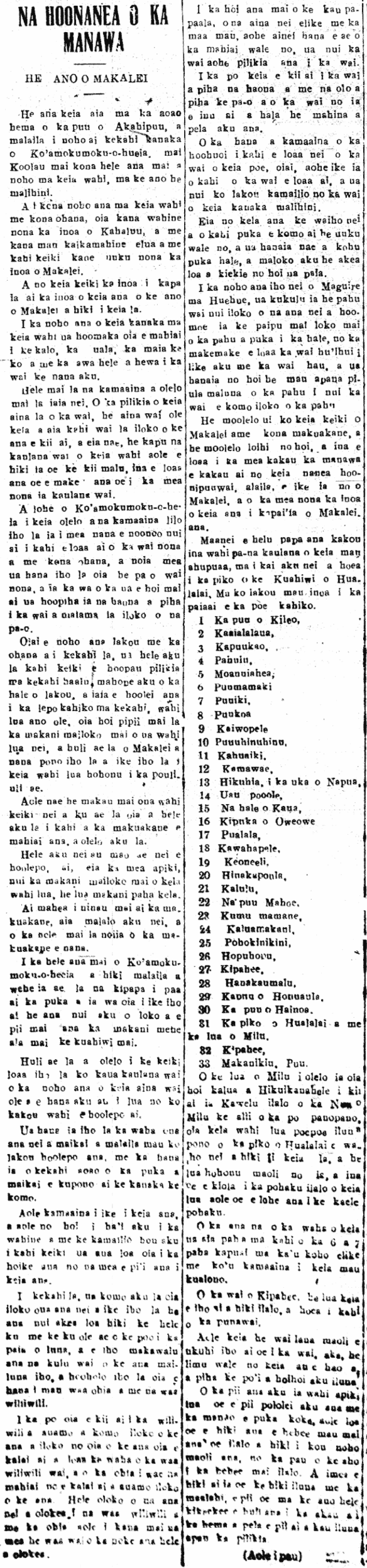
NA HOONANEA O KA MANAWA

Ka Hoku o Hawaii, Buke XVIII, Helu 1, Aoao 4. Mei 29, 1924.

Rising food prices: Will politicians ever learn? 1923 / timeless.

REASONS FOR THE RISING COST OF FOOD.

There is perhaps no other more important question pertaining to the life of man than that of the cost of food. How many people have sat down and thought to themselves about the reasons for the rising costs and ways to lessen their living expenses.

If we consider that there is no man on earth that can live without food, then we can find a reason; and through thought and careful consideration, we can figure out the major reasons for the rise in food prices.

First of all, for nations who rely upon other nations or other lands to supply their food, their food will be expensive, and food price stability will not be realized. But for a land that produces its own food, and exports the excess to nations who are lacking, they will see a fall in their food costs.

With these facts, we can move forward. Here we are in Hawaii, growing two major crops, however these two things are not main dishes which give sustenance to the body, but they are just treats. They being sugar and pineapple. We are putting our efforts into these two things and this nation draws its income from it; however, at the same time, we are forgetting about the foods necessary for the body, and because we are so focused on chasing after money, we assume that these funds will supply us with food for nourishment.

The problem with our focus on the pursuit of money, is that we neglect looking after the actual things that are necessary for our bodies, the main staples. We are purchasing our food from foreign nations, while we are in pursuit of making money. When the nations which we rely upon to get our food have a small harvest, this is the time we will see an increase in the costs of food. It will rise because of the small amount of food growing in those countries in which we rely upon from where we get our food.

The second detriment to us in relying on the outside for feeding us is that when the shipping costs rise to ship in the food to us, there will be another set back, and that will be another reason the costs will rise. And should the occasion arise when there is war, or the lack of ships to bring our food, then the prices will shoot up; or there will be times when there is no food, because there will be no means to get the food.

And when the shipping costs rise, it will not be the sailors who will be in trouble, but it will be those who eat the food. For with the increase in the costs to the ship owners for pay for the sailors, or the ship builders perhaps, the ship owners will add on some pennies to the shipping charges, and when this comes to the hands of the consumer, he will understand that the expense to ship food here by boat resulted in an increase in the price of food; and the one paying the exorbitant prices for those foods is you, who eat them. And when the person is eating, he will see that the price of salmon here has risen.

And another factor in the rise of food costs is the number of people who eat the food, in a country that does not produce its own food. With the increase in population, the number of mouths will increase, so there will be less, or just doing without; and as a result of this lack, and to remedy it, the outside is relied upon to make up for this, and this is a problem bigger than all others. There may be a great amount of food brought in, but in comparison to the number of those who eat the food, that food is only a little, which is the main reason for the rise in food costs.

Therefore, we have come to where we can see where the problem lies. First, we do not grow staples. Second, although we have fertile land upon which we can grow food, we just grow things that bring in money and go without growing main foods.

What are staples? Vegetables and meat. These two things are staples. Other things are just treats, and man can live without them.

Here is Hawaii, a land where all foods can be grown which people eat here, along with the condiments. During the times of our ancestors, they had ample food so that they became big and strong. But these days, we are not planting staples. The Chinese and Japanese have come with their foods, with rice being the main food. This rice can be grown here in Hawaii nei. The haole came with their thing, the Irish potato and bread. Potatoes are being grown here now. As for flour, in the year 1849 or there about, Hawaii supplied California with flour. Wheat was grown in Kula, Maui, and on Molokai. Today, wheat can be grown should we desire. And if it is not possible, this is not a problem, because we are satisfied with other foods that can take its place.

And today, should we Hawaiians consider joining together in the growing of food, we will have the best food, and we will have produce that will help lessen the cost of food, as a result of this increase in the number of farmers.

The raising of livestock is also something needed, for that is a staple. Cows, pigs, goats, sheep, chicken, and the fishes of the sea. There is a lot of land now lived on by wild goats. If they were domesticated goats, then we’d have that meat, but because it is wild, and hard to get, it will not be enough for us; all the while the wild goats are feeding off of the fields which is for the sustenance of domesticated goats; some people are going into this profession.

The main thing that will lessen the costs of our food that we eat is the increasing of the growing of those foods; the joining into the growing of these things, because the quality of soil of this land is sufficient to grow these things. And let us look to making money through that, and not solely from treats.

We Hawaiians are supplied with land where we can enter into the occupation of growing food. There is probably no piece of land in Hawaii where staples cannot be grown. The land of Molokai has been opened up. The land of Kalamaula has enough water to grow food whenever it is desired. The lands upland of Palaau and Hoolehua will be opened up. These lands have soil good enough to grow Irish potatoes and corn.

Melons and other things can be grown which can support pig farming. With these staple foods, the farmer and those that raise livestock will receive good money from the mouths of those who live here, while being relied upon by those from outside to supply their food. Maybe the food won’t be cheaper, but you will have your food, O Farmer, with ease, and your family will be supplied, without it all being consumed; and the leftover, you can sent out to be purchased by those in pursuit of making money.

When foreign nations don’t have enough to send food to Hawaii, or when there are not enough ships, or if this nation enters into war, you and your family will have enough food, and you will get a higher price, because there will not be enough food imported. For these reasons, let us Hawaiians recognize these fields of gold stretched out before us, and let us grab it and harvest its many blessings. The seeking of one’s livelihood from the soil was the first way of life of the earliest men. And we know that there is no greater occupation than this. You are independent. You will have enough staple foods. You will have enough money, and with this money, you will have things that you do not grow. Clothes and things that make your life pleasant.

[I dedicate this to all the awesome farmers out there, both big and small (and fishermen and ranchers and dairy people for that matter). Also to the farmers’ markets, and establishments who support them. And to you, the people who try to buy local first. Conversely, I would like all of you politicians and others who think that agricultural lands and farmers are not important, to think about the big picture before another 89 years pass by. At this rate, we will be leaving the next generations with a very dismal way of life.]

(Kuokoa, 2/15/1923, p. 2)

NA KUMU PII O NA MEAAI.

Ka Nupepa Kuokoa, Buke LXII, Helu 7, Aoao 2. Feberuari 15, 1923.

D. S. K. Pahu writes from the Philippines, 1912.

OUR LETTER FROM THE PHILIPPINES.

THAT BOY TELLS HIS FATHER OF THE GREAT AMOUNT OF GOVERNMENT LAND.

Baguio, Benguet, Philippines.

O My Beloved Father:

Here we are, the two of us, now living in the mountains. We got back on the 17th. Live here is good; the air is brisk, and the only trees that grow in abundance on this mountain are pine. I am thinking that we will be here until the last week of June.

It is not certain whether I will stay here for a full three years. This is a fertile land if you have a lot of money. I met up with a haole man who is the secretary of a Filipino organization here, and he wants me to write about sugar in Hawaii and to publish it in the local papers. He tells me that there are vast and much government lands that are left unfarmed because of lack of funding. If I want land, he can definitely help me to ask for government land. Looking at the worth of sugar in Hawaii, I believe that money can be made through this endeavor. there are a lot of sugar lands here, however, the sugar mills are decrepit and sugar has been pushed to the side; the people here do not understand the sugar industry as they do in Hawaii. That is what makes me want to write about sugar. Here’s something else: Hawaii’s people have their eyes set on here, and a couple of weeks ago, a haole man came from Hawaii to look at the land here with the intent of building a modern sugar mill like in Hawaii. If everything goes well, I am determined to leave this job and to start a large sugar plantation here, and I’ll return to Hawaii to work out the selling of shares [kea] and the purchase of a mill and so forth; I have written to some people in Honolulu about this venture, and if things go well, I will come home to Hawaii in two years, but if they do not go well, I suppose I will wait it out.

I saw the Exposition here [Philippine Exposition held in Manila, February 3–11, 1912], and there are many goods from here. Sugar, coconuts, manila rope, rice, gold, silver, charcoal, and so forth were the things on display. The wood of this land is beautiful, used to make chairs and tables. One of the tables was 10 feet long across the middle, and 40 feet long across the edges, made out of one tree without the addition of other boards. The performances by school children was full of beauty; the lace, household furnishings, hats, clothing, and so forth were lovely and fine. Better than Hawaii.

With aloha from the daughter and from me as well.

Me.

D. S. K. PAHU.

(Aloha Aina, 7/27/1912, p. 1)

KA MAKOU LETA MAI MANILA MAI.

Ke Aloha Aina, Buke XVII, Helu 30, Aoao 1. Iulai 27, 1912.

On the decline of native birds, 1871.

Locals of the Tuahine Rain are no more.

O Ke Au Okoa:—Aloha to you:

I am sending you a small gift atop your outstretched foundation, should your captain and Editor be so kind, and it will be for you to take it to the shores of these islands so that my newspaper-reading companions may see it, it being the letters placed above: “Some Locals of the Tuahine Rain¹ are no more,” and it has been ten or more years which they have not been seen.

And my friends are probably puzzled about these locals that have gone missing, and you, our old-timers, are all likely saying, not them, here they are, and some people have passed away, but we knew of their passing; but the departure of these kamaaina which I speak of was not witnessed. And this is it, the kamaaina birds of our uplands: the Iwi, the O-u, the Akakane, the Amakihi, the Oolomao, the Elepaio; these are the native birds of these uplands who have disappeared.

And some of you may be questioning, what is the reason for this disappearance? I tell you, it is because of the spread of the evil birds from foreign lands, in our plains, mountains, ridges, valleys, cliffs, forests, terraced taro patches, seashores, and rivers; that is why these kamaaina have gone, because of the spreading of these evil birds among us, and they are damaging the crops, and the food from the forests; rice planted by some are being eaten by these evil birds; and the bananas of the forests are all eaten up by these birds.

What do we gain from these evil birds being spread in Hawaii, and protecting them so that they are not killed? I say that we gain nothing from these evil birds which are hurting our native birds and crops and foods from the forests; because in the past, before the spread of these birds, if a kamaaina of this land wanted to go into the mountains to get thatching or some shrimp, or some oopu, they did not pack food with them, because they thought that there was food in the mountains, like banana, hawane fruit, and uhi; banana would ripen on the plant and then fall, without anything damaging them, but now, the bananas don’t ripen on the plant; they are eaten by these banana-eating mu [mu ai maia] of the forest; bananas don’t ripen, and [now] when you go into the mountains, there is just the oka-i [blossom container of bananas] left and the bananas are lost to these birds; and the kamaaina birds are gone. Where to? Perhaps they all went to Hawaii island.

And I say without any hypocrisy, the decrease of this people was because the arrival of the evil haole to Hawaii nei; it was they who spread the evil sicknesses: gonorrhea [pala] and syphilis [kaokao]. Smallpox [hepera] and leprosy [mai pake] are the reasons that our lahui was decimated, because of the arrival of the evil haole; if all the people who came to Hawaii were like the people who brought the light [missionaries],  then this lahui would not have decreased in number; so too with the arrival of the evil birds to Hawaii nei, which hurt our native birds and plants; this is like the decrease of our lahui with the arrival of the evil haole who spread gonorrhea and syphilis and similar diseases.

Therefore, I feel aloha for the kamaaina birds of my beloved land because they are all gone, and the youngsters of these days question, what are those birds like? They are tiny birds with beautiful voices, and their feathers as well, and they were an enjoyment in our childhood; when times of strong winds arrived, all the birds of the mountains would alight and show up at the doors of the houses which was entertaining for us to watch them flitting amongst the leaves of the ilima in our childhood and they were a playmate in our youth.

Before the arrival of these birds, there was a great abundance of Iwi, Amakihi, Akakane, O-u, Oolokela, and Elepaio, right here above us, atop the clumps of aliipoe, bushes of hau, noni trees, and more upland, the number of birds was amazing, atop the flowers of lehua of the mountain apples, and on the Ahihi and the Lehua Kumakua;  those uplands were so enjoyable but these days, they have all vanished, maybe because there were aggravated by these evil birds.

Here is another thing; if only the coming session of the Legislature could revise the law pertaining to birds from foreign lands, for there are destructive birds that have been imported as well from foreign lands.

And this is a supplication to you, O Ke Au Okoa. With aloha to the one who steers you, and also to the boys of the Government Printing Press. The boy from the uplands is turning back for the Tuahine rain of the land is spreading about.

T. N. Penukahi.

Manoa, June 24, 1871.

¹Tuahine [Kuahine] is the famous rain of Manoa.

(Au Okoa, 6/29/1871, p. 3)

He mau wahi kamaaina no ka ua Tuahine, ua nalowale.

Ke Au Okoa, Buke VII, Helu 11, Aoao 3. Iune 29, 1871.

Niihau purchased for $10,800. 1864.

The Haole are Really Working Niihau.

O Kuokoa Newspaper; Aloha to you:—I met up with the newspaper article under News of Hawaii, in Issue 15 of the 9th of April, about the selling of Niihau to Mr. James Francis Sinclair, for $10,800, along with the lands of Kuakanu, which are the konohiki lands of Halewela and Kahuku, which the Government sold to the one named above, along with the konohiki lands, and this whole island has gone to the haole; perhaps you all and those others as well have heard that Niihau was sold, along with those penny-pinching folks who don’t get the shining beacon of Hawai nei through the Kuokoa Newspaper. And it is we who know of the great, who know of the small, and who know of the wide, that knows of the selling from Kii to Kawaihoa, from the Makahuena Point to Pueo Point; everything upon the land is bought and there is nothing left for us, the Hawaiians, under the haole owners.

Their Way of Living: They are pleasant and good, and speak nicely with the people, but they are not very proficient in the Hawaiian language. The haole say, “mahope aku kumaki” [?] There are ten Hawaiians, caretakers [hoaaina] of the land, chosen from amongst the locals, but two are from elsewhere, they are newcomers, one from Hawaii and the other from Maui, and including them there are ten caretakers. Here are each of their names which the haole selected: A. Puko, D. Kauki, Hetesia, J. H. Kanakaiki, P. R. Holiohana, H. Haokaku, Mose Kanohai, Ioela, Kapahee and Pouli; Kanakaiki is from Napoopoo, Hawaii, and Holiohana is from Hana, Maui, and are locals from there. Those caretakers are in charge of the three work days every month just like the konohiki of the chiefs, should there be work by haole owner to be done.

Their Number: Mr. James Francis Sinclair them total twelve in number; two brothers, three sisters, five children, one mother, and one in-law, which totals twelve; they live in Kununui; they are religious, with one God, but their religion is very different; their houses were constructed in Britain and brought to Niihau: three houses, one currently stands, and two more to follow; we appreciate how nice and beautiful it is to see.

Dealing with the Animals: There are two horses per man and woman, and should there be three, it is killed, and so forth; as for dogs, there are none left, they were all killed, from the big ones to the small ones because sheep were being killed, and so the government is without money from the dog tax, also the goats were all killed. You Kauai people who own horses and sheep, get them quick, don’t dawdle, or they will be taken by the haole.

Things Grown by the People.

The Hawaiians consume what they produce, and they also assist with the land owners in the watering of the sweet potato, ke pola akaakai [?], and chickens, as long as they were pleasant, or else that was that.

On the Number of Sheep

Set loose on Niihau are the sheep which you have perhaps seen in our Newspaper; as for the count, you probably have not heard; this is the truth as to the abundance or dearth: the number of sheep is 3,400, with 1,400 belonging to the Hon. W. Webster and 2,000 belonging to the King; there is no end to their desire for sheep.

Sugar Cane Cultivation.

Niihau will be planted with sugar cane if the test on one acre goes well; and if the cane grows nicely, then planting will commence, but if it doesn’t grow, that’s it, because it is an arid land.

This is an undesirable land for those foreigners seeking to make money because it is dry and scorched by the sun, and crops die; but here are people who are after wealth, and they tell us, the locals, that this is very valuable land for sheep and cane; our good friend, H. M. Whitney, the local of Waimea and Niihau, along with his parents, are familiar with this island and its extreme heat in the Makalii months [summer]. I will stop writing as the Naulu rain of Niihau is falling. With aloha.

P. R. Holiohana.

Kihalaui, Niihau, May 2, 1864.

[This P. R. Holiohana (later it seems he goes by the name P. R. Holi) writes in to the newspapers often from Niihau on a number of subjects.]

(Kuokoa, 6/4/1864, p. 1)

Hana io ka Haole ia Niihau.

Ka Nupepa Kuokoa, Buke III, Helu 23, Aoao 1. Iune 4, 1864.

A small window into Koolauloa and Koolaupoko—150 years ago, 1862.

Rice and Gold.

Some days ago, we had reason to travel about Koolaupoko and Koolauloa, and because of the many wonderful and beneficial things for the people we witnessed in our travels, we are publishing what we saw before us.

PERTAINING TO KEKELE.

We saw some Loi perfect for growing rice; however, we are sad to state that they were fallow and it was not weeded, they were just left wild. Fine is the road from the pali of Nuuanu until

KANEOHE

In this land, it is green from one side to the other, which attests to the non-lazy lifestyle of the people there; the land has ample water, but one thing which saddened us a bit was the seeing of some loi that were left fallow next to the river there on the Heeia side, which caused us to ponder, “Why are these loi not farmed, and planted with rice? They are fine loi supplied and full of water, very good for rice growing. Does our lack of faith and our desire to while away our time still persist? We must discard those feelings, and heed the land, and it will supply us with items that will make this life pleasant. We left that place feeling sad, and travelled on to

HEEIA.

There is not much we saw there, and we went on quickly to

KAHALUU.

There, our eyes were shown things that eased our hearts because of our great joy, when we saw that the kamaaina there did work, and that they did much farming. The one who is leasing the land has started to plant rice; there are perhaps six or more acres. But the somewhat sad thing is the majority of the land suitable for rice cultivation in that Ahupuaa, are just left there without being all farmed; when will it be that if the time is right, we will quickly make up our minds to grasp opportunities to make ourselves rich? Time keeps going quickly. And what of us? Here is what we say, to wake up and to plant your unused loi with rice.

KAALAEA

A haole there is planting rice, and we hear that it is going well; because he resides there, the work is progressing, and our hopes go with him and those others that are working at this valuable endeavor for us Hawaiians and the nation of our beloved Alii.

WAIAHOLE TO KAAAWA.

Waiahole is the first place, in our knowledge, that planted rice; when we began to walk upon the soil of that ahupuaa, our hearts were filled with joy at the sights of that place, and reaching Waikane, all the loi were being farmed, as if it was just one huge farm; we thought to ask who was it that was farming the area, and we were told Messrs. Judd and Wilder (Kale of Kauka and Waila) [Kale of Kauka must be Charles Hastings Judd, the son of Kauka (Gerrit Parmele Judd); so many loi were finely built, and it seemed like almost thirty or more acres; they had thirty-five workers. We see the immediate benefits of growing rice, being that these men were hired, and got paid for their labor, and all this is because of rice; many subjects of the King were provided with jobs, and as a result, perhaps some of those people were prevented from acts which would have caused them to suffer difficulties and problems, because their minds are taken up by work. There are many Loi farmed in Waikane, by J. Fuller (J. Pula), and they are being reworked. The road from Waiahole to Waikane is horrible; it is swampy, and we hear that a horse sunk on this street and its throat was cut. The lower part is boggy, but it is dry on the surface of the earth. There is a fine wooden house standing in Kualoa belonging to Charles Hastings Judd, along with a horse shed, and a carriage house; that place is beginning to become a town.

KAAWA.

This land has a fine appearance, but we did not see a single person who started to grow rice; that is where Mr. Wilder (Waila) resides with a nice wooden house there, with other connected buildings, and life there is luxurious. The road from Kualoa until this land is not good, and in our travels, it was terribly slippery because rain had fallen upon it. After leaving that land and the adjoining lands, we arrived at

KAHANA.

We saw nothing new there, but they did have some rice fields which were located in the uplands; we did not go to see it for ourselves, we just heard of them from the kamaaina; J. M. Kapena and Asing Apakana are the ones doing the farming.

PUNALUU.

This is the rice growing lands of Dr. [Seth] Ford (Kauka Poka) them; they built a wooden house for themselves and a halau for the workers who number 35, and they work without any complaints. Dr. Ford them slaughter two cows as meat for their men for a week. The area that was plowed up is between thirty and forty acres and it is ready to be planted with rice. The work there progresses due to the good treatment by the bosses to their workers; they are anxious to work for Dr. Ford. We all know that if we treat others well, we will be treated well and with aloha.

HAUULA.

We saw some well-farmed land to the southwest of the Church, and the land all about is green. This shows the benefits of the recent showers.

“HOWLAND’SVILLE,” LAIE.

We arrived there at 4 in the evening, and met pleasantly with the Konohiki of that land, and rested our limbs at his house. Captain H. S. Howland (Haulani), the Konohiki of that land is starting to build a wooden house there. Here however is the problem, that being the long wait for the lumber and the other house building materials, because of the delay and the inattentiveness of the captains of the ships that travel there; we believe that if there was a ship that went regularly to Koolaupoko and landed at the harbor of Koolauloa, the materials needed for the Owners [of land] would always be there. After making a start at the home of the landowner, we went to the houses of those living on the land, and we were urged on by an astonishing idea, to question the people of that area about their life under their new landlord. And we are happy to report to our friends, their answer was that their life was very pleasant, without any admonishments or reproach; and because of their great aloha and appreciation for Capt. Howland, they went and gave him many gifts—taro, pig, chicken, and many other things, without pay; it was as if he was a native-born alii; also, they all went quickly to assist him, with things that Capt. Howland needed, on their own accord, without being coerced by him. One kamaaina of that area did not touch work in the least when the land was under the previous Konohiki, but with Capt. Howland, he came to work industriously without complaint, but enthusiastically, without being forced to. The new Land owner of Laie lives together with the people of his land, like brothers of the same family. How pleasant is the life of people like that!

The reason for their love is because their landlord gives them many things, and does not just burden them, or put a restriction on plants or things from the sea. The one who owns the land just wants to live together in peace, and to search for together things that will benefit them all. How could there be no appreciation and love if we treat others well? It is good to remember this, to remind us to treat others with aloha, so that we are loved, when the day comes where we will be blessed to become land owners.

GOLD IN KAHALUU.

There was so much commotion amongst the Hawaiians and haole at the news that there was Gold in Kahaluu; there were many people who came from Honolulu to the place where Gold was thought to be. Many Hawaiians from Koolaupoko came with Oo, Pickaxes, Shovels and other things, preparing them to dig.

When it was heard that there was real Gold on that land, the news flew from house to house like firebrand. Those who first spotted it went immediately, making ready with dynamite powder. However, before those people who first witnessed the Gold reached Kahaluu, the news reached the people of that land, and they were roused. Therefore, about 60 kanaka maoli and 2 haole got together with weapons to expel all those who came to that area thought to have Gold. So when the haole came that wanted to ascertain the truth or falsehood of the Gold of that place, they were sent away.

Following that time, a hole was bored into a rock to place dynamite and explode to see if there was Gold within it or not. People stood together there waiting in anticipation for the rock to break.

In the evening of the 18th, the hole dug in the rock was finally deep enough, and it was blasted, and the rock was shattered, the tiny pieces flew. There was however no Gold found. Many pieces were taken to Honolulu, and were looked at by experts, but there was no Gold found.

[Under all the disparaging comments and the obvious push for rice cultivation, you can glean some historical information of what the windward side of Oahu looked like a 150 years ago. There are followup articles in the papers speaking of how the true gold of Hawaii is found through farming the land…

For more information on the history of rice in Hawaii, see: RICE IN HAWAII: A GUIDE TO HISTORICAL RESOURCES, compiled and annotated by Karol Haraguchi.]

(Kuokoa, 2/22/1862, p. 2)

Ka Raiki a me ke Gula.

Ka Nupepa Kuokoa, Buke I, Helu 13, Aoao 2. Feberuari 22, 1862.

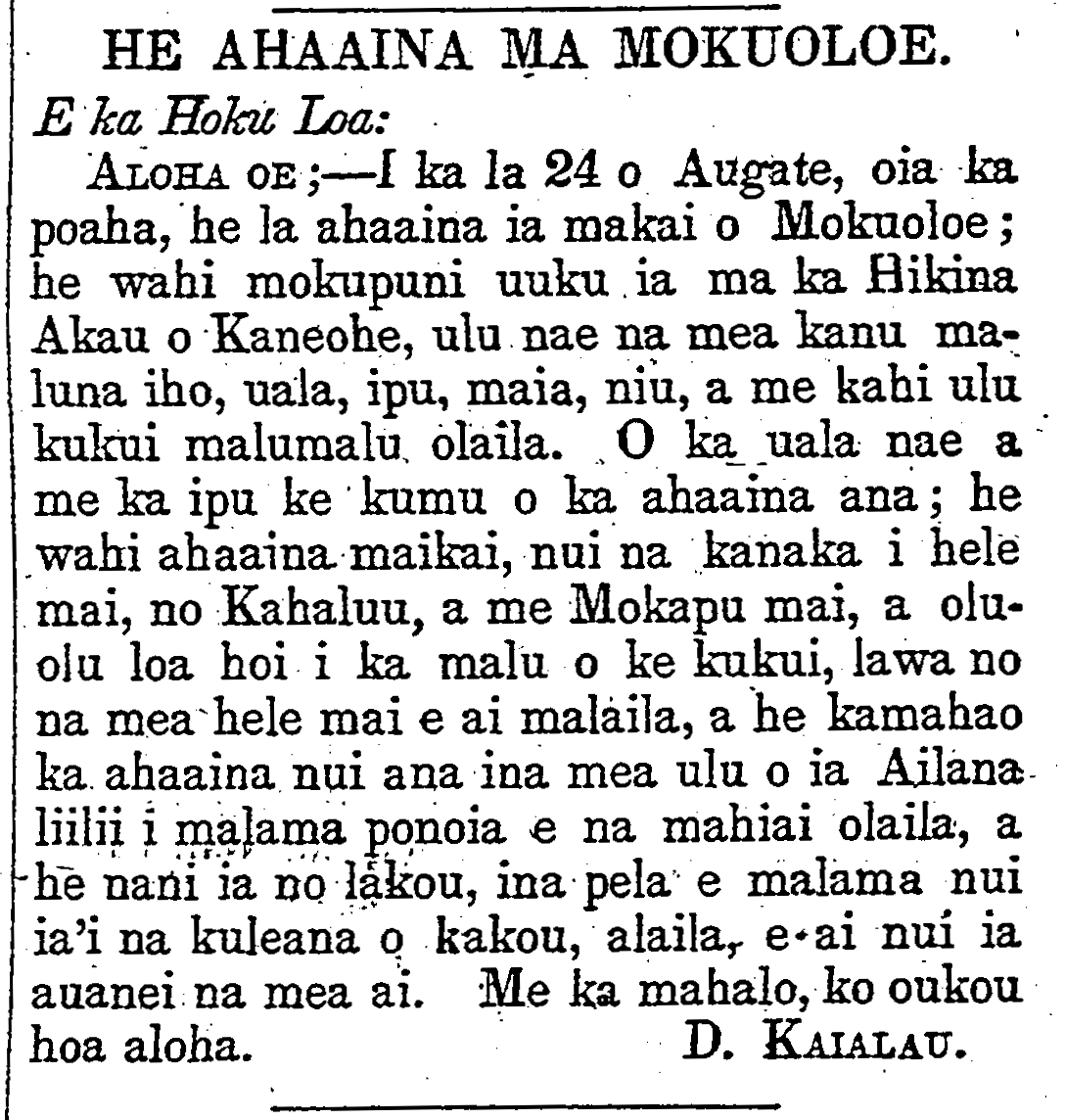
Description of Moku o Lo‘e (Coconut Island) and a lesson on sustainable living. 1859.

FEAST AT MOKUOLOE.

O Hoku Loa:

Aloha oe:—The 24th of August, which was a Thursday, was a day of party at the shore of Mokuoloe; it is a small island to the Northeast of Kaneohe, and yet plants grow upon it: sweet potato, gourd, banana, coconut, and its shady kukui grove. The focus of the feast was the sweet potato and gourd; it was a fine party, with many people who came from Kahaluu, and Mokapu, and it was very pleasant in the shade of the kukui, with enough food for all that came; the great spread of produce well-cared for by the farmers of this tiny Island was astonishing, and it would be a good thing if all our own lands were taken care of in the same way, then we’d in time be feasting off of the fruits. With mahalo, your friend.

D. Kaialau.

[For more on Moku o Lo’e, see the recent publication: Moku o Lo’e: A History of Coconut Island.

The images for Hoku Loa will hopefully be put up online soon!]

(Hoku Loa, 9/1859, p. 9)

HE AHAAINA MA MOKUOLOE.

Ka Hoku Loa, Buke I, Helu 3, Aoao 9. Sepatemaba, 1859.