On Hooulu Lahui, 1876.

SATURDAY, MARCH 4.

REPOPULATION.

The following is the text of the memorial of citizens which was presented to His Majesty on Tuesday last, by a committee of signers:

To His Majesty the King,

Sire:—We, the undersigned, subjects and residents of this kingdom and friends of your Royal Person, in view of what we deem a grave condition of public affairs, take the liberty to address you in a spirit of frankness and loyalty in order to point out the danger that threatens the state, and at the same time the necessary measures to avoid the national peril.

We desire to say at the outset, that we are prompted to take part in this address not only on account of a loyal and friendly regard for Your Majestyʻs person, but also by reason of our strong desire to see maintained, with ample honor and prosperity, the Independence of the Hawaiian Kingdom.

The propriety of according the privileges of independent sovereignty to a state so much reduced in people as Your Majestyʻs dominions is very much questioned, and the discussion is most detrimental to the dignity and permanence of the throne. This question was even raised in past years, when Hawaii numbered far more souls than at this time within her borders. When the commissioners of Kamehameha III presented the claims of this archipelago for recognition as an independent state to the Government of Great Britain in 1843, they were met at first with a peremptory refusal from Lord Aberdeen, the British foreign minister, on the ground that the state of Hawaii was a mere chieftaincy under foreign influences, and too small to be entitled to diplomatic courtesies and treaty making powers. And if such a view could be taken of our state thirty-three years ago, when we numbered about one hundred thousand people, what must be thought of our capability for independence now when perhaps we number barely fifty thousand souls, natives and foreigners all told? Continue reading

Re-population in the eyes of the haole, 1876.

Palapala Hoopii i ka Moi.

Ka Hooulu Lahui.

[This memorial urging re-population of the nation was probably an English document, translated here into Hawaiian. For the English and the interesting list of signatures, see the following post.]

(Kuokoa, 3/18/1876, p. 1)

Palapala Hoopii i ka Moi.

Ka Nupepa Kuokoa, Buke XV, Helu 12, Aoao 1. Maraki 18, 1876.

More on fishponds, 1901

FISH PONDS.

The most interesting of the fishery resources of the islands are the fish-ponds. This is the only place within the limits of the United States where they are found on such an immense scale and put to such general and beneficent use. The time of the building of many of these ponds goes back into the age of fable, the Hawaiians, for instance, attributing the construction of one of the most ancient, the deep-water fish-pond wall at the Huleia River on Kauai, to the Menehunes, a fabled race of dwarfs, distinguished for cunning industry and mechanical and engineering skill and intelligence. Many of the very old ponds are still in practical use and look as though they would last for centuries yet. As the ponds were originally owned by the kings and chiefs, it is very probable that most of them were built by the forced labor of the common people. There is a tradition amongst the natives that Loko Wekolo (Wekolo pond), on Pearl Harbor, Oahu, was built about 250 years ago, and that the natives formed a line from the shore to the mountain and passed the lava rock from hand to hand till it reached the shore where the building was going on without once toughing the ground in transit. As the distance is considerably over a mile, this speaks well for the density of the population at that time.

The ponds are found principally in the bays indenting the shores of the islands, the common method of construction having been to build a wall of lava rock across the narrowest part of the entrance to a small bay or bight of land and use the inclosed space for the pond. They were also built on the seashore itself, the wall in this case being run out from two points on the shore, some distance apart, in the shape of a half-circle. Most of the Molokai fish ponds were built in this manner. A few were constructed somewhat interior and these are filled by the fresh-water streams from the mountains or by tidal water from the sea carried to them by means of ditches. Most of the latter are on Oahu, near Honolulu. The Nomilo fish pond at Lawai, on Kauai, is formed from an old volcanic crater with an opening toward the sea, across which a wall has been built, and as the opening is below the surface of the sea the tide plays in and out when the gates are opened.

In the sea ponds the walls are about 5 feet in width and arc built somewhat loosely in order that the water can percolate freely. The interior ponds have dirt sides generally, although a few have rock walls covered with dirt, while others have rock walls backed with dirt. The sea ponds generally have sluice gates which can be raised or lowered, or else which open and close like a door. In the interior ponds there are usually two small bulkheads with a space about 8 feet square between them. Each of these has a small door which usually slides up or down. When the tide is coming in both doors are opened and the fish are allowed to go in freely. When the tide turns the doors are closed. When the owner wishes to remove any of the fish he generally opens the inner door when the tide is ebbing. The fish rush into the narrow space between the bulkheads, from which they are dipped out by means of hand dip nets. In the sea ponds the gate is opened when the tide is coming in and when it turns it is closed.

There is usually a small runway, built of two parallel rows of loosely piled stones from the gate to about 10 feet into the pond. As the fish congregate in this runway when the tide is going out, it is very easy to dip out the supply needed for market. Seines and gill nets are also swept around the inside of the ponds at times in taking fish from them, and as they are quite shallow this is done easily.

The sea ponds usually contain only the amaama, or mullet, and the awa. In the fresh and the brackish water ponds gold-fish, china-fish, oopu, opai [opae], carp, aholehole, and okuhekuhe are kept. Practically no attempt at fish-culture is made with these ponds. Besides the fish which come in through the open gates, the owner usually has men engaged at certain seasons of the year in catching young amaama and awa in the open sea and bays, and transporting them alive to the fish ponds. They are kept in the ponds until they attain a marketable size, and longer frequently if the prices quoted in the market are not satisfactory. They cost almost nothing to keep, as the fish find their own food in the sea ponds. It is supposed that they eat a fine moss which is quite common in the ponds.

There are probably not more than one-half the number of ponds in use to-day that there were thirty years ago. There are numerous reasons for this, the principal ones being as follows:

1. The native population is dying off rapidly, and where there were prosperous and populous villages in the early years of the last century there is practically a wilderness now. Owing to this depopulation there would be no sale for fish in the immediate neighborhood of the ponds there, the only place where it could be sold owing to the difficulty in transporting fish any distance without the use of ice, and the ponds would naturally be allowed to go to decay, the walls breaking down from the action of storms, and the sea filling them with sand when they are located on the immediate shore. This condition of affairs is especially prevalent on Molokai.

2. Two of the important crops of the islands are rice and taro. As both must be grown in a few inches of water, and are very profitable crops, a number of the interior ponds were turned into rice fields and taro patches. Oahu has shown the greatest changes in this regard.

3. On Hawaii ponds were filled up by the volcanic lava flows of 1801 and 1859. The Kamehameha fish pond, which was filled up in this manner in 1859, was said to have been the largest on the islands. Only traces of it are now to be found on the beach.

4. At Hilo, on Hawaii, some ponds, mostly quite small, are so filled with the water hyacinth that it is impossible to work them any more. This year a few of the best of these were cleaned out, but as there is very little money to be made out of them, and their ownership is in dispute, there is but little desire to do much to build them up.

5. Other ponds have been filled up to make way for building operations and for other purposes. This is especially true of ponds in and around Honolulu and Lahaina. There used to be a number of fish ponds on Lanai, but they have all been allowed to fall into decay.

A number of ponds are kept up by their owners merely as private preserves, as it were, the fish taken from them being either consumed by the owner’s household or given to friends. These are scattered all over the islands.

The following is a rough list of the fish ponds still in existence, or traces of which remain, together with their area and a statement so far as possible of their present condition. There is no great claim to accuracy in this list, as many of the ponds are in inaccessible regions of the islands, and in such cases the writer was obliged to depend upon others for reports as to their present condition:…

[For the rest of this report showing the locations, names, and sizes of the many loko i’a across the Hawaiian Islands, and fish produced at the time of the report, etc., etc., see: U. S. Commission of Fish and Fisheries, Part XXVII, Report of The Commissioner for the Year Ending June 30, 1901.

The fish pond report is a section of Commercial Fisheries of the Hawaiian Islands, by John N. Cobb, Agent of the United States Fishing Commission, which runs from page 381 to 499.

Also of interest (actually the whole report is interesting), is  Preliminary Report on an Investigation of the Fishes and Fisheries of the Hawaiian Islands, by David Starr Jordan and Barton Warren Evermann, which is found from page 353 to 380. ]

Democratic candidates, 1910.

W. S. EDINGS, For Senator

M. E. SILVA, For Supervisor

E. K. RATHBURN, 4th District

SOLOMON MEHEULA, For Representative, 4th District

W. P. JARRETT, For Sheriff

CHARLES H. ROSE, For Deputy Sheriff of Honolulu

H. H. PLEMER, For Supervisor

WADE WARREN THAYER, For City and County Attorney

F. COSTA BENEVEDES, For Representative, 4th District

J. S. KALAKIELA, For Senator

W. M. McCLELLAN, For Supervisor

E. H. F. WOLTERS, For Representative, 4th District

J. C. ANDERSON, For Auditor

EDWARD HANAPI, For Senator

FRED TURRILL, For Representative, 4th District

M. C. PACHECO, For Supervisor

[This is an interesting group of Democratic candidates for the race in 1910.]

(Democrat, 11/5/1910, p. 4)

PAGE 4

The Democrat, Volume I, Number 11, Page 4. November 5, 1910.

Hawaiians slighted? 1914.

THE CONTEMPT FOR HAWAIIANS IS CLEAR

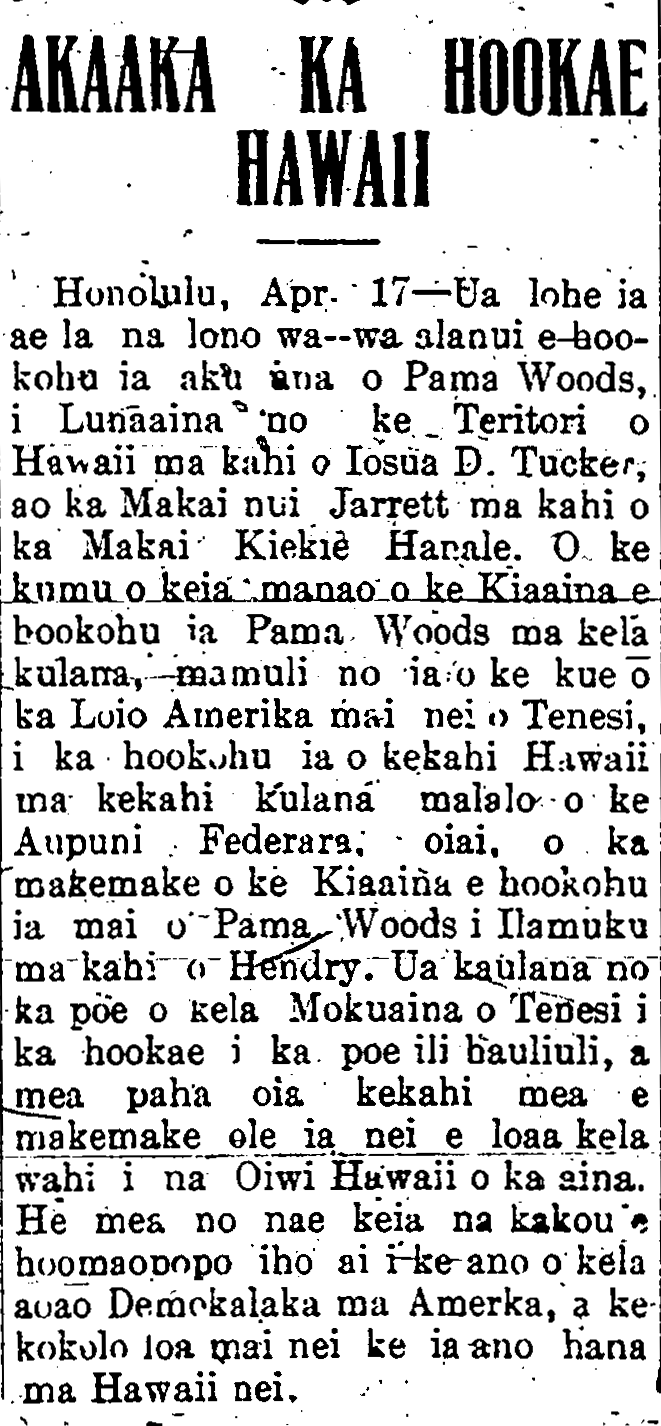
Honolulu, Apr. 17—We hear from the word that is buzzing on the streets that Palmer Woods [Pama Woods] has been selected as Land Commissioner [Lunaaina] for the Territory of Hawaii in place of Joshua D. Tucker [Iosua D. Tucker], and Sheriff Jarrett [Makai nui Jarrett] in place of High Sheriff Henry [Makai Kiekie Hanale]. The reason for this decision by the Governor to select Palmer Woods for this position was because of the objection by the United States Attorney from Tennessee to select a Hawaiian in a position under the Federal Government, although the Governor wanted to appoint Palmer Woods as Marshall [Ilamuku] in place of Hendry. The people of the state of Tennessee are infamous for their contempt of people of dark skin, and perhaps that is one reason that place does not desire Native Hawaiians. Through this we should recognize the nature of the Democrats in America, as this sort of action creeps all the way here to Hawaii nei.

[For some reason, the first 11 and a half years of Hoku o Hawaii (including the issue in which you can find this article) is not available yet online!]

(Hoku o Hawaii, 4/23/1914, p. 3)

AKAAKA KA HOOKAE HAWAII

Ka Hoku o Hawaii, Buke 8, Helu 46, Aoao 3. Aperila 23, 1914.

Kahikina Kelekona, John G. M. Sheldon, editor of the Hawaii Holomua, arrested for speaking, 1893.

LIBERTY OF THE SUBJECT.

Has Anybody Any Rights Under the Provisional Government?

Argument of the Question in the Circuit Court.

John G. M. Sheldon, editor of the Holomua, who is deprived of his liberty under a warrant issued by the President of the Provisional Government, was produced in the First Circuit Court before Judge Frear, at 11 o’clock this forenoon, under a writ of habeas corpus. Attorney-General Smith and F. M. Hatch appeared for the Government, and C. W. Ashford, C. Creighton, A. Rosa and J. L. Kaulukou for the prisoner.

Mr. C. W. Ashford argued for the discharge of the prisoner, speaking to the following effect: There was no authority vested in the Executive and Advisory Councils to issue warrants of arrest. President Dole had no right in the Proclamation of the Provisional Government to issue a warrant of arrest. The Government could not go behind that proclamation, he presumed. “We the People of the Hawaiian Islands” gave him no such power. If “We the People of the Hawaiian Islands” had intended to exercise that power they would have given it to him. The Proclamation stated that the President’s duties were to preside over the meetings of the Executive Council. Mr. Dole now holds no judicial position in these islands. He did hold such position before, but resigned it to become President of the Provisional Government. If that warrant, of President Dole was valid, then there was no security of liberty for any man, woman or child under these tropic skies. There was then nothing to prevent any resident of this country being consigned to a dungeon or bound in irons. It should be known whether the Provisional Government had such tremendous powers. He was not making a covert attack on the late revolution. He believed in the sacred right of revolution, and he considered the late revolution was a good thing. But it might not be good if the Provisional Government introduced anarchy and despotism. Some persons were led by their philosophy to believe that a beneficent despotism was the best form of government, and he believed that members of this school of philosophy had seats in the Advisory Council. Continue reading

On Aloha Aina, 1893.

“Breathes there a man with soul so dead,
Who never to himself hath said,
This is my own my native land.”
(Scott.)

Many of those who support honestly the present state of affairs, have done so in the full hope and belief, that thereby the flag of their country—the Stars and Stripes—will float over the land in perpetuity. Not a single Hawaiian, however, even those few whose signatures to annexation petitions (not 200 in number and mostly convicts.) have been bought or forced by necessity from them, desires to see any foreign flag replace his own. Continue reading

More Hawaiian-Language in English newspapers, 1922.

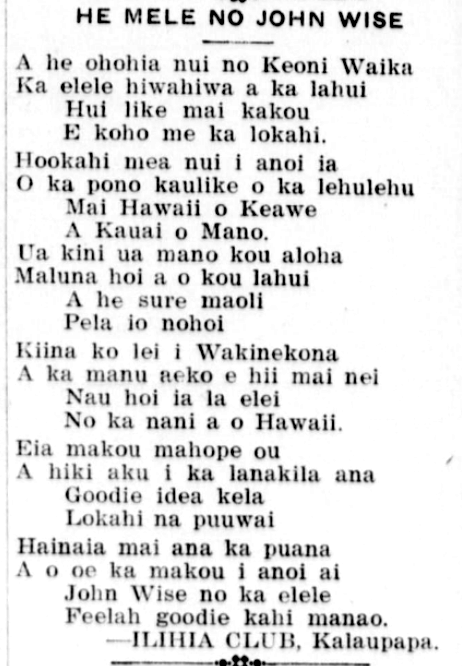
HE MELE NO JOHN WISE

A he ohohia nui no Keoni Waika
Ka elele hiwahiwa a ka lahui
Hui like mai kakou
E koho me ka lokahi.

Hookahi mea nui i anoi ia
O ka pono kaulike o ka lehulehu
Mai Hawaii o Keawe
A Kauai o Mano.

Ua kini ua mano kou aloha
Maluna hoi a o kou lahui
A he sure maoli
Pela io nohoi.

Kiina ko lei i Wakinekona
A ka manu aeko e hii mai nei
Nau hoi ia la elei
No ka nani a o Hawaii.

Eia makou mahope ou
A hiki aku i ka lanakila ana
Goodie idea kela
Lokahi na puuwai.

Hainaia mai ana ka puana
A o oe ka makou i anoi ai
John Wise no ka elele
Feelah goodie kahi manao.

—ILIHIA CLUB, Kalaupapa.

[Chronicling America only has newspapers up to 1922. I am not sure how much longer Hawaiian-Language articles appear in the Maui News, but it is pretty interesting to see that they did appear until at least 1922. Here is a political song written for Keoni Waika, the renaissance man, John Wise.]

(Maui News, 11/3/1922, p. 8)

HE MELE NO JOHN WISE

Semi-Weekly Maui News, 22nd. Year, Number 1215, Page 8. November 3, 1922.

Custom House, 1895.

Custom House of Honolulu.

We are adorning these columns of the Kuokoa with a picture of the grand Hale Oihana Dute of Honolulu nei, at the corner of Fort [Papu] and Allen [Alani] Streets. this building was built during the reign of Kamehameha IV., and it was added to at various times when it was found that it was not adequate for the incoming goods to be stored, so it has become very long and wide. This is the entrance [makaha] into the nation, where goods from foreign lands are stored, and duty is collected on taxable items, and not only that, the owners pay a fee for care of their goods in this building by the government. There is a big force of government employees in this bureau under the Department of Finance [Oihana Waiwai], starting with the collector-general and the deputy-collector, and down to the secretary and the storekeeper, guards, and so forth. The money expended to rebuild or perhaps extend this entrance comes from the revenues of the growing public funds due to the duties charged by this entity.

(Kuokoa, 3/16/1895, p. 2)

Ka Hale Oihana Dute o Honolulu.

Ka Nupepa Kuokoa, Buke XXXIV, Helu 11, Aoao 2. Maraki 16, 1895.

Kuhio’s “Four Horsemen,” a translation from the time! 1939.

The Four Horsemen

The above picture was taken at Honolulu a few years before the passage of the Rehabilitation Law. There were four of these Hawaiians, and a few days after the return of the Delegate Prince Kuhio from Washington, assembled at Pualeilani at Waikiki to discuss the subject “Rehabilitation of the Hawaiians and after that discussion, these men went to town and had their picture taken at the William’s Gallery on Fort Street, as it was the Prince’s wish, so that he can show to his fellow congressmen at Washington his backers that brought up this important matter for rehabilitating its people, known to be decreasing, during the session of the Hawaii legislature, if the measure is allowed by congress. They are sitting. Prince Kuhio, standing, from left to right, Rev. S. L. Desha, Sr., John C. Lane and H. L. Holstein.

Continue reading