Writing on the wall, 1894.

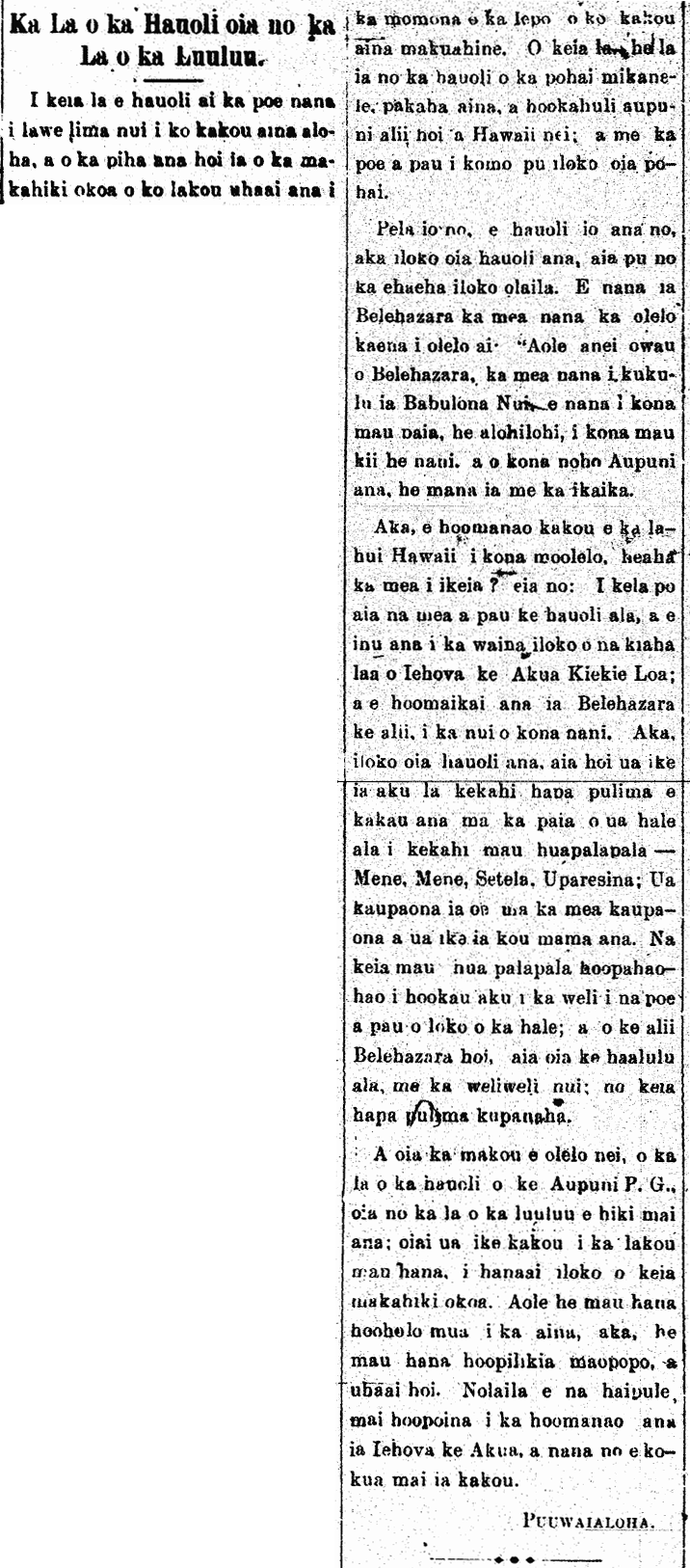
The Day of Happiness is a Day of Sadness.

On this day, those who took our beloved land by force rejoice, and it makes a full years since they’ve feasted wastefully of the fertile soil of our mother land. This day is one of happiness for the circle of missionaries, plunderers of land, and overthrowers of the Hawaiian Kingdom, as well as for those who enter join their circle.

It is true, they will indeed rejoice; however, along with this joy, there is hurt within. Look at Belshazzar [Belehazara] the one whose boast went, “Am I not Belshazzar, the builder of the Great Babylon? Look at its shiny walls, its beautiful images, and its Throne has authority and might.”

However, let us recall, O Hawaiian Lahui, his story; what is known? it is this: That night, everyone was joyous, and drinking wine from cups sacred to Jehovah, Almighty God; and they praised Belshazzar for his great beauty. However, while the rejoicing was going on, there was seen part of a hand writing some words on the wall of the house—Mene, Mene, Setela, Uparesina; You have been weighed on the scales and have been found wanting. It was these astonishing words which caused a fear to fall over everyone in the house; and as for the king Beshazzar, he was shaking with trepidation at this amazing portion of a hand.

And that is what we are saying: the day of joy of the Government of the P. G. [Provisional Government], is the day that sadness will come; for we have seen their actions done over the past year. They were not actions done to move this land forward, but actions that were clearly harmful as well as squandering. Therefore O Pious Ones, do not forget to remember Jehovah, God, and he shall help us.

Puuwaialoha [“Loving-heart”]

(Leo o ka Lahui, 1/17/1894, p. 2)

Ka La o ka Hauoli oia no ka La o ka Luuluu.

Ka Leo o ka Lahui, Buke II, Helu 856, Aoao 2. Ianuari 17, 1894.

Competing rallies, 1893.

O HAWAIIAN LAHUI!

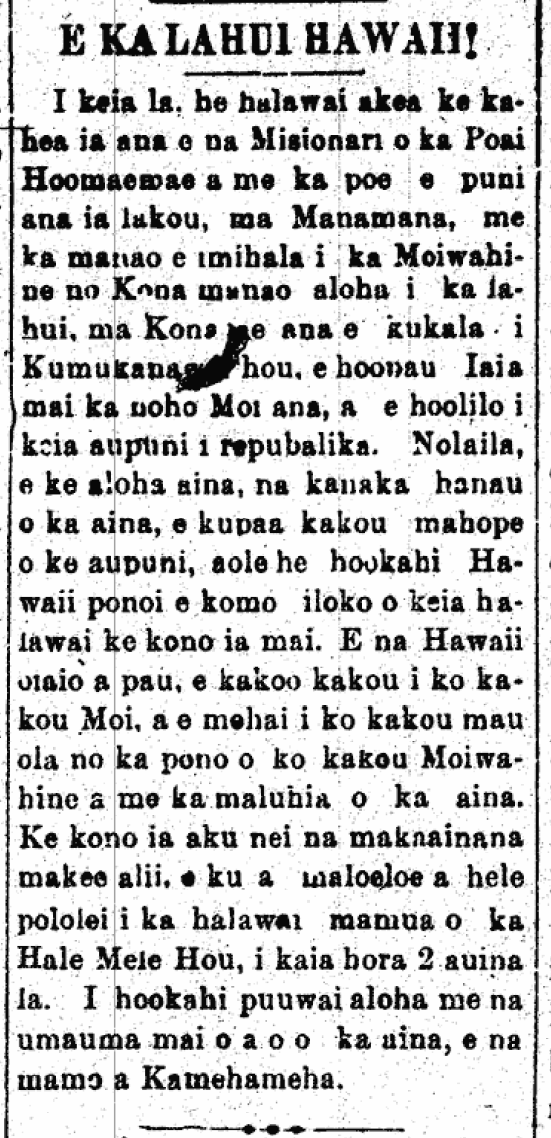
Today, there is a rally being called by the Missionaries of the Reformist Party [Poai Hoomaemae] and those who favor them, at Manamana, with the intent to bring harm to the Queen for Her aloha she has for the lahui, in Her proclaiming a new Constitution; by ending Her reign and making this nation a republic. Therefore, patriots, those born of this land, stand strong behind this nation; there shall not be a single true Hawaiian who will participate in this gathering, should they be invited. All of you true Hawaiians, let us stand behind our Sovereign and give our lives for the rights of our Queen and peace over the land. Those citizens who love their alii are called to join together to march straight to the rally fronting the Opera House [Hale Mele Hou] at 2 o’clock in the afternoon. With one heart of aloha and breasts side by side all across the land, you descendants of Kamehameha.

(Leo o ka Lahui, 1/16/1893, p. 2)

E KA LAHUI HAWAII!

Ka Leo o ka Lahui, Buke II, Helu 623, Aoao 2. Ianuari 16, 1893.

Anonymous accusations against a Catholic priest in Kalawao, 1874.

The deeds of the Catholic teacher in Kalawao.

We are printing below the deeds of a certain Catholic priest amongst the leprosy patients in Kalawao:

1. Clothes—The clothes donated by the brethren of Honolulu for the needy leprosy patients of Kalawao, that is what the Catholic teacher is using to lure the people of the Evangelical faith [hoomana Euanelio] to join the Catholic religion. While he goes around doing his converting, and when they hear him they convert, but should they be steadfast, the teacher will say, “Should you join the Catholic faith, I will give you the clothing and things that you lack, should you desire.” By this action, some agree to join; there have been many converted over the clothes. This is the cunning way [kumu hinu ?] of the Catholic priest.

2. Wooden staff—The Catholic teacher constantly carries a staff in his hand, and it is with this that he converts people to his faith. This is what he does. For that person or persons who are resolute against being converted over clothes, they are struck by the cane of the Catholic teacher. This is what he does with the cane, and he converts them.

3. The church house—The church in Kalaupapa is of the Catholics.¹ He uses this church to convert some people to his religion. This is basically what he does. When the church was completed in Kalaupapa, the Catholic teacher when to the houses to convert people; the Catholic teacher said, “What is your faith.” “I’m a Calvinist [Kalawina],” that being a Protestant of the Evangelist faith, said the person in response. “That is a faith without any church,” said the Catholic teacher.”We are fine without a church; we hear that our kahu is coming and will hold services at the homes of brethren, and if we are in good health, we will attend the services,” he answered. “That’s no good, for here is our church, you all should come in, and then I’ll give you people clothes, and things you need, should you all desire,” replied the Catholic teacher. With this and everything else said in that conversation, some people converted, and some others remained steadfast behind the truth of the Gospel.

4. The cemetery.—The cemetery of the Catholics recently constructed here in Kalawao is one of the things used by that Catholic teacher and the Catholic disciples to convert people to their side. This Catholic teacher saw that the people were troubled with dead bodies left out, eaten up by pigs; and he was intent on converting the people to his belief, and therefore, he ordered Honolulu to send over several bundles of pine lumber; it arrived recently and is now standing here in Kalawao like a net to catch stupid fish who stray and are caught. So too is this graveyard; there are two faiths who come in, and they are left until the day they rise; who will they be for?

5. Extreme Unction [Ukione].—This act, Extreme Unction, is one of the most heinous acts which the Catholic teacher is doing here in Kalawo, and we all agree that this is akin to thievery. This is what he does. For those who don’t convert over clothes, or the rod, or the church, or the cemetery, he practices Extreme Unction on them. When the Catholic teacher sees or hears of a that a patient has grown weak, one that is from another faith, he goes to them constantly to urge them, and because the patient grows weary, he submits, whereupon the Catholic teacher performs the Extreme Unction; and when the patient recovers, he protests this improper deed of the Catholic teacher; this happens often; some people protest, and other mistakenly submit. From what we’ve seen, the Catholic teacher by these actions is like a yellow-eyed cat spying on its enemy, the mouse. And we believe that these actions of the Catholic teacher are not right in his sacred and faithful position.

Here is another new important thing we are witnessing. On the night of the 22nd of Dec. of the year 1873, at maybe 10 o’clock of that night, Kaiakoili (m) died, he was a brethren of the church of Kawaiahao, and he contracted leprosy and lived here in Kalawao, and was a member of the Siloama Church, and this was his faith until the day he died. However, on the night shown above, during his last hours, he was Baptized [Babetema ia] by Kulia (f), who is a disciple of the Catholic faith, but he was Baptized when he was dead.

Leprosy Patient.

¹St. Philomena Church

(Kuokoa, 1/17/1874, p. 1)

Na hana a ke kumu Pope ma Kalawao.

Ka Nupepa Kuokoa, Buke XIII, Helu 3, Aoao 1. Ianuari 17, 1874.

A Kanikau for Mrs. Fidelia Church Coan, done in Hawaiian and English! 1872.

[Translation.]

A Dirge for Mrs. Coan,

Composed by request for the Church and friends at Hilo.

Tune, A Mother’s Kiss,—Golden Robin.

1.

What hand is this stretched from above,
From where kind Spirits blend?
It is a hand let down in love
To bear away a friend.
A stranger friend she came to us
From homes beyond the seas,
And moved by love she staid with us
To teach us words of peace.

2.

Long she abode in our domain,
And domiciled with us;
A Mother teacher she became,
A kind and tender nurse;
A mother dear and much beloved,
A guide both safe and sure
O’er verdant fields with flowers perfumed,
By waters still and pure.

3.

Look upward, lo! what sight is this?
A shining cloud appears,
It floats, and thence an angel’s voice
Falls on our listening ears;
O friend beloved, there’s waiting nigh
An angel carr for thee;
Take passage, and ascend on high,
To the world though long’st to see.

4.

Hark! hark! what notes are these we hear?
they are deep sorrow’s wails;
They roll, and swell, and fill the air,
And echo o’er the hills—
The angel choir has borne away
From children weeping here
A mother whom they loved to obey,
A mother teacher dear.

5.

Our mournful tears are flowing fast,
And falling here and there,
For thee, our mother in days past,
Our leader kind and dear.
We bend in sorrow o’er one loved,
Our grief for thee is great—
Thou came’st, and we together moved;
But now we separate.

6.

Hark! hark! what bell is tolling thus?
It is a mournful bell:—
Gather together in God’s house—
It is the funeral knell.
We listen and together come,
Dear friends the summons heed;
And draped mourning, to the tomb
We march with sorrow’s tread.

7.

Mournful we move, and all are hush!
Angels are looking on,
And Jesus comes to walk with us,
And comfort those who mourn.
The hills and vales, and streams that flow,
Together with us mourn.
The loved one’s form is lower’d, and lo!
The clouds are dak’ning round!

8.

But look again, the clouds have flown,
And light breaks thro’ the gloom;
A voice exhorts with gentle tone,
O cease, ye friends, to mourn.
The dear and much beloved one
Lies not in this drear tomb,
She’s risen and to heaven has gone,
With Jesus she’s at home.

Hawaii.

[Unuhiia.]

He Kanikau no Mrs. Koana,

I hakuia ma ke noiia mai no ka ekalesia a me na makamaka o Hilo.

Leo, A Mother’s Kiss,—Golden Robin.

1.

He lima aha e o nei
Mai luna mai ke ao?
He lima kii e lawe ae
Kekahi hoahanau.
He hoa malihini nei
Mai kahi loa mai no,
Aloha nae a noho mai
I kumu no kakou.

2.

Ua noho a loihi no,
A kamaaina pu,
A lilo i makua ao,
A hanai ia kakou;
Makuwahine makamae,
A alakai maikai
Ma kahi kula uli e,
A ma na wai maemae.

3.

E nana, e, heaha nei?
He ao olino e,
Ke kau la, a noloko mai
He leo hea mai;
Ke hoa aloha, ke ku nei
He kaa anela nou;
E ee maluna, a pii ae,
Pii i ke ao ma o.

4.

Hamau! he lohe aha nei?
He olo pihe no;
O olo ae, a kupinai
Maluna o na puu—
Ua kai na anela aulii,
Mai na keiki ae,
I ka makua aloha e,
Makua ao maikai.

5.

Ke kahe nei a helelei
Na u waimaka e
Nou, ka makua aloha e,
Ko makou alakai—
Ke haalou nei, a hu ka uwe,
Pau mako e makou!
Hoea a noho pu maanei,
Kaawale nae ano.

6.

Hamau! he bele aha nei?
He bele kanikau—
E hui ma ka halawai
Hoolewa kupapau.
Ke hui nei na hoahanau,
Na hoaaloha pu;
Paa i ka lole kanikau,
A nauwe u kakou.

7.

Ke nauwe kanikau hamau—
Nana na anela,
Me Iesu hoi ke hele pu,
A, nana e hoona.
Na puu, na awawa a kahawai
Ke kanikau pu no.
Ka mea aloha ua nalo ae,
Pouli mai na ao!

8.

E nana hou, ua hee na ao,
Poha he lama e;
He leo paipai olu no,
E pau, e pau ka uwe—
Ka mea aloha makamae,
Aole ia maanei.
Ua lele i ke ao maikai
Me Iesu e maha’i.

Hawaii.

[I thought to post this piece because it is one of the few examples where the author/composer did both the Hawaiian and English version. It is interesting to look at the two compositions side by side. This is a kanikau written for Fidelia Church Coan who arrived in Hawaii along with her husband, Titus Coan, on June 6, 1835. They were stationed in Hilo, and she ran a boarding school there for girls.

The composer who calls himself “Hawaii,” is a prolific translator of English hymns into Hawaiian in the Kuokoa newspaper. Could this possibly be Lorenzo Lyons? Would anyone have any information on this?]

(Kuokoa, 11/2/1872, p. 7)

[Translation.] A Dirge for Mrs. Coan...

Ka Nupepa Kuokoa, Buke XI, Helu 44, Aoao 7. Novemaba 2, 1872.
Catholic clergy arrive, including someone named Damien, 1864.

[Found under: “NEWS OF HAWAII NEI.”]

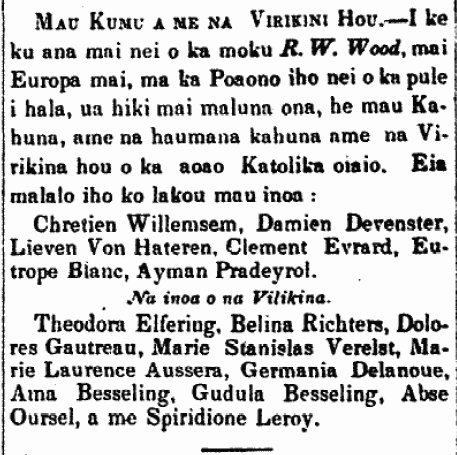
New Teachers and Nuns.—With the docking of the ship R. W. Wood, from Europe, on the Saturday of this past week [March 19, 1864], arrived aboard her was some new Priests and some student priests and Nuns [Virikina] of the Roman Catholics [Katolika oiaio]. Here below are their names:

Chretien Willemsem, Damien Devenster [De Veuster], Lieven Von Hateren, Clement Evrard, Eutrope Bianc, Ayman Pradeyrol.

The names of the Nuns.

Theodora Elfering, Belina Richters, Dolores Gautreau, Marie Stanislas Verelst, Marie Laurence Aussera, Germania Delanoue, Arna Besseling, Gudula Besseling, Abse Oursel, and Spiridione Leroy.

(Kuokoa, 3/26/1864, p. 2)

Mau Kumu a me na Virikini Hou.

Ka Nupepa Kuokoa, Buke III, Helu 13, Aoao 2. Maraki 26, 1864.

I wonder what became of these… 1843.

OLD IDOLS OF HAWAII NEI.

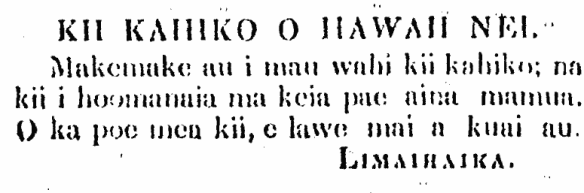
I want some ancient idols [kii]; the idols that were worshiped in these islands before. Those who have the, bring them to me, and I will purchase them.

Armstrong [Limaikaika].

(Nonanona, 11/28/1843, p. 68)

KII KAHIKO O HAWAII NEI.

Ka Nonanona, Buke 3, Pepa 14, Aoao 68. Novemaba 28, 1843.

Response to changes happening in the Kingdom, 1888.

COMMON OPINION¹

PREPARING THE MOVEMENT FOR THE GOOD OF HAWAII.

The opinion printed below this heading comes from letters received from our friends. All criticism for those opinions fall upon those who wrote the letters, and not upon us. (Editor)

O Mr. Editor:—I ask for your patience, being that I am a true Hawaiian.

Whereby two-thirds or more of this lahui are of the opinion to form an appropriate Association for the benefit of the Hawaiians and the foreigners.

Whereby the Cabinet of Ministers in power now stands upon sand, where when the rain beats down and the wind blows, it will fall, and that shall be their fate.

Whereby this Cabinet of Missionary Ministers are in government positions without the confidence of two-thirds or more of the people residing here and some who are observing from elsewhere.

Whereas the circle of Missionaries intends to long hold the power in the workings of the Government, while clearly going against the laws of this land.

And Hawaii intends to look after its own good, without fear of the opposition facing it. Whereas all enlightened Hawaiians know that they have this responsibility.

Therefore, they have no desire for the power of the Governmental offices of their beloved land to be put to waste by this circle, and to have them [the ministers] enter Hawaii into a debt that cannot be repaid.

Along with the other heads that they are appointing; and they are the major power, and they are the King. And the negligent laws they pass have power over this tiny lahui.

Whereas I speak with truth in enlightened manner. Whereas the laws not approved by the King, and not signed by him; they have no power to become law over this lahui.

Therefore, time is near for Hawaii to consider, and to discuss what is right, and of the advancement of its efforts, its land, and the King.

O Editor, I shall constantly fill your paper with delicacies, should this topic above receive your kindness.

With Appreciation

S. W. B. K.——

Manoa, Nov. 6, 1888.

[Anybody have an idea who S. W. B. K. from Manoa is?]

¹”Na Manao Laulaha” is a regular column in Ke Alakai o Hawaii.

(Alakai o Hawaii, 11/10/1888, p. 4)

NA MANAO LAULAHA

Ke Alakai o Hawaii, Buke I, Helu 45, Aoao 4. Novemaba 10, 1888.

Workings of the Provisional Government, 1893.

INDEPENDENCE DAY OF THE PORTUGUESE.

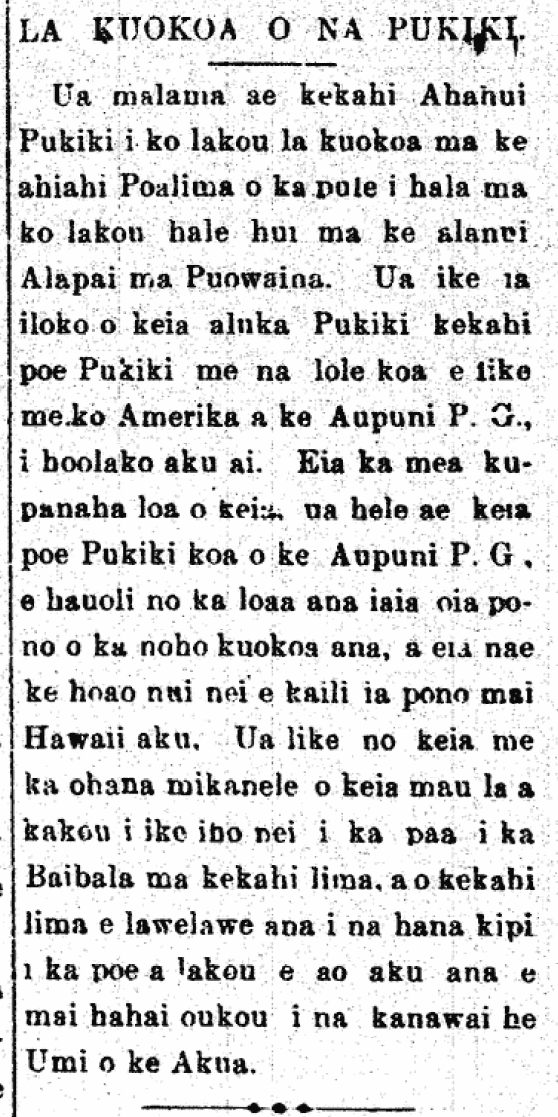
An Association of the Portuguese honored their independence day on the evening of Friday last week, in their club house on the streets of Alapai and Punchbowl [Puowaina]. Amongst this group of Portuguese were seen some with soldier uniforms like that of the Americans that were supplied by the P. G. This is the astonishing thing about this: these Portuguese soldiers of the Government of the P. G. went to celebrate their independence, and yet they are insistently trying to wrench that right from Hawaii. This is like the missionary family of these days who we’ve seen holding the Bible in one hand while with the other hand, carrying out treachery to the people to whom they taught not to break the Ten laws of God.

(Leo o ka Lahui, 12/4/1893, p. 2)

LA KUOKOA O NA PUKIKI.

Ka Leo o ka Lahui, Buke II, Helu 826, Aoao 2. Dekemaba 4, 1893.

Question put out to the public, 1843.

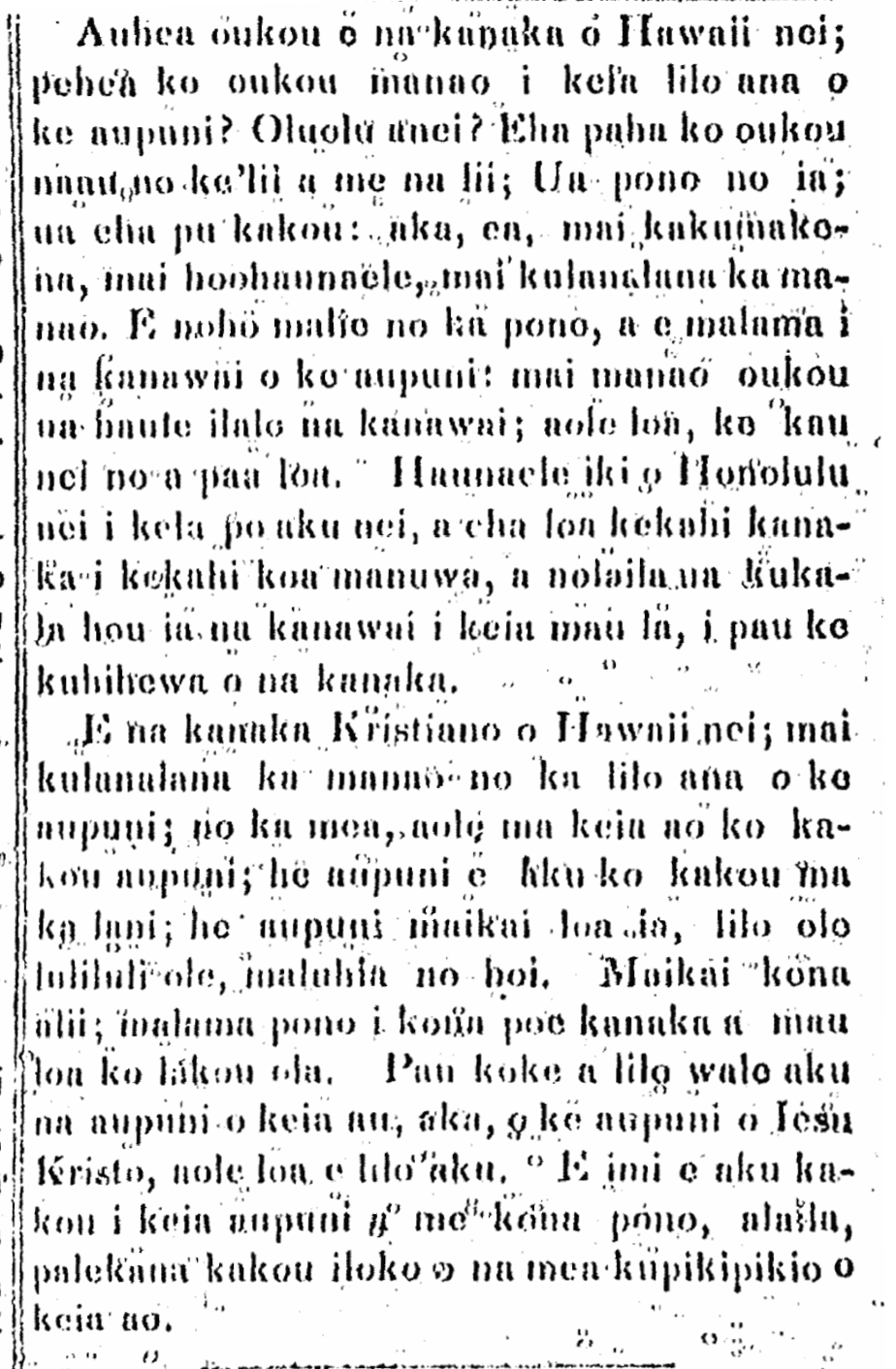
Here me O People of Hawaii nei; what do you all think of this cession of the kingdom? Is it fine? Your heart probably aches for the king and all the alii; That is how it should be; we are all hurting; however, do not grieve, do not revolt, do not let your resolve waver. We must remain calm and abide by the laws; don’t think that the laws have fallen, not at all, they are still totally in effect. There was a small disturbance in Honolulu the other night, and some men severely injured some of the sailors from the warship, and therefore the laws are being announced once again these days, so that the confusion of the people will end.

O Christian people of Hawaii nei, do not feel uncertain over the cession of the nation; our kingdom does not lie in this world, we have a different kingdom in the heavens; it is a great kingdom which is permanent, and unshakeable, and peaceful. Its king is good; he watches over his people, and they live forever. The nations of this world end quickly and are gone forever, but the kingdom of Jesus Christ will never end. Let us search after this kingdom and its righteousness, and we will be saved from the turbulence of this world.

[This editorial is probably by Richard Armstrong (Limaikaika), missionary and editor of Ka Nonanona.]

(Nonanona, 3/7/1843, p. 100)

Auhea oukou e na kanaka o Hawaii nei...

Ka Nonanona, Buke 2, Pepa 20, Aoao 100. Maraki 7, 1843.

On the decline of native birds, 1871.

Locals of the Tuahine Rain are no more.

O Ke Au Okoa:—Aloha to you:

I am sending you a small gift atop your outstretched foundation, should your captain and Editor be so kind, and it will be for you to take it to the shores of these islands so that my newspaper-reading companions may see it, it being the letters placed above: “Some Locals of the Tuahine Rain¹ are no more,” and it has been ten or more years which they have not been seen.

And my friends are probably puzzled about these locals that have gone missing, and you, our old-timers, are all likely saying, not them, here they are, and some people have passed away, but we knew of their passing; but the departure of these kamaaina which I speak of was not witnessed. And this is it, the kamaaina birds of our uplands: the Iwi, the O-u, the Akakane, the Amakihi, the Oolomao, the Elepaio; these are the native birds of these uplands who have disappeared.

And some of you may be questioning, what is the reason for this disappearance? I tell you, it is because of the spread of the evil birds from foreign lands, in our plains, mountains, ridges, valleys, cliffs, forests, terraced taro patches, seashores, and rivers; that is why these kamaaina have gone, because of the spreading of these evil birds among us, and they are damaging the crops, and the food from the forests; rice planted by some are being eaten by these evil birds; and the bananas of the forests are all eaten up by these birds.

What do we gain from these evil birds being spread in Hawaii, and protecting them so that they are not killed? I say that we gain nothing from these evil birds which are hurting our native birds and crops and foods from the forests; because in the past, before the spread of these birds, if a kamaaina of this land wanted to go into the mountains to get thatching or some shrimp, or some oopu, they did not pack food with them, because they thought that there was food in the mountains, like banana, hawane fruit, and uhi; banana would ripen on the plant and then fall, without anything damaging them, but now, the bananas don’t ripen on the plant; they are eaten by these banana-eating mu [mu ai maia] of the forest; bananas don’t ripen, and [now] when you go into the mountains, there is just the oka-i [blossom container of bananas] left and the bananas are lost to these birds; and the kamaaina birds are gone. Where to? Perhaps they all went to Hawaii island.

And I say without any hypocrisy, the decrease of this people was because the arrival of the evil haole to Hawaii nei; it was they who spread the evil sicknesses: gonorrhea [pala] and syphilis [kaokao]. Smallpox [hepera] and leprosy [mai pake] are the reasons that our lahui was decimated, because of the arrival of the evil haole; if all the people who came to Hawaii were like the people who brought the light [missionaries],  then this lahui would not have decreased in number; so too with the arrival of the evil birds to Hawaii nei, which hurt our native birds and plants; this is like the decrease of our lahui with the arrival of the evil haole who spread gonorrhea and syphilis and similar diseases.

Therefore, I feel aloha for the kamaaina birds of my beloved land because they are all gone, and the youngsters of these days question, what are those birds like? They are tiny birds with beautiful voices, and their feathers as well, and they were an enjoyment in our childhood; when times of strong winds arrived, all the birds of the mountains would alight and show up at the doors of the houses which was entertaining for us to watch them flitting amongst the leaves of the ilima in our childhood and they were a playmate in our youth.

Before the arrival of these birds, there was a great abundance of Iwi, Amakihi, Akakane, O-u, Oolokela, and Elepaio, right here above us, atop the clumps of aliipoe, bushes of hau, noni trees, and more upland, the number of birds was amazing, atop the flowers of lehua of the mountain apples, and on the Ahihi and the Lehua Kumakua;  those uplands were so enjoyable but these days, they have all vanished, maybe because there were aggravated by these evil birds.

Here is another thing; if only the coming session of the Legislature could revise the law pertaining to birds from foreign lands, for there are destructive birds that have been imported as well from foreign lands.

And this is a supplication to you, O Ke Au Okoa. With aloha to the one who steers you, and also to the boys of the Government Printing Press. The boy from the uplands is turning back for the Tuahine rain of the land is spreading about.

T. N. Penukahi.

Manoa, June 24, 1871.

¹Tuahine [Kuahine] is the famous rain of Manoa.

(Au Okoa, 6/29/1871, p. 3)

He mau wahi kamaaina no ka ua Tuahine, ua nalowale.

Ke Au Okoa, Buke VII, Helu 11, Aoao 3. Iune 29, 1871.