Kamehameha Glee Club on stage, 1912.

THE TWO OF US IN THE JOYFUL NIGHT OF HALALII

In K. P. Hall [Knights of Pythias Hall], tomorrow night, Saturday, the people of town will hear for themselves the singers of the Island of Keawe, known by the name “Kamehameha Glee Club,” because on that night, those singers will entertain with their deep voices, pleasing the girls of Honolulu nei so that they will not be able to sleep at night because of the beauty and sheer vigor.

Their fame of this glee club of the students of Kamehameha and Hawaiian teachers is only heard of, but during this concert of the Hawaiian Band Organization to be soon held; actually seen is the swaying of all those who listen to them; the ears tingle, making the singers of this town no match [lihi launa ole] for them.

This glee club has been travelling around Hawaii from one place to another, with much acclaim; songs that have become commonplace [paku-a] and not fun to listen to are like brand new songs when these boys sing them, and that is how they have gained fame. Continue reading

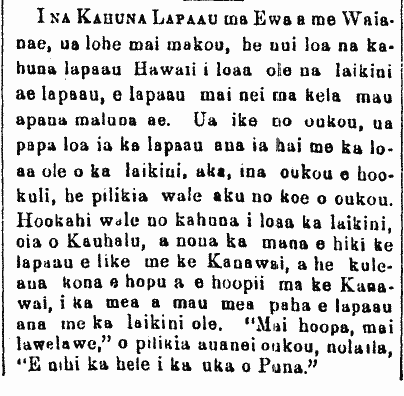
Licensed kahuna and non-licensed kahuna, 1875.

[Found under: “Nu Hou Kuloko.”]

To the Medical Kahuna in Ewa and Waianae, we have heard that there are many Hawaiian medical kahuna without licenses to practice medicine who are treating patients in those districts. You know that the treating of others without a license is prohibited, and if you do not listen, you will be in trouble. There is but one kahuna who is licensed, and that is Kauhalu; and he has the power to arrest and sue under Law the one or ones who doctor people without license. “Don’t touch, don’t undertake this,” or you will face troubles, therefore, “Beware when treading in the uplands of Puna.”¹

¹”E nihi ka hele i ka uka o Puna,” is a famous warning given by Hiiaka to her aikane Wahineomao. It became used as a general warning to be careful of what you are doing.

(Kuokoa, 9/19/1874, p. 2)

I na kahuna lapaau...

Ka Nupepa Kuokoa, Buke XIII, Helu 38, Aoao 2. Sepatemaba 19, 1874.

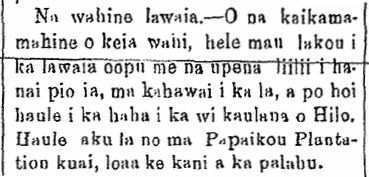
Fishing for oopu and wi in Puepaku, Hilo, 1878.

[Found under: “NA MEA HOU O PUEPAKU, HILO.” by J. Kanaeholo]

Fishing women.—The girls of this area [Pueopaku, Hilo], go fishing often for oopu with small arched nets at the river in the daytime, and at night they go down to pick the famous wi of Hilo. They head down to Papaikou Plantation to sell them, and they come into the cry of the turkey [palahu].¹

¹Whereas the cry of the nene, “unele, unele,” is associated with lacking, the cry of the turkey, “pokeokeo,” is associated with riches.

(Ko Hawaii Pae Aina, 10/26/1878, p. 1)

Na wahine lawaia.

Ko Hawaii Pae Aina, Buke I, Helu 43, Aoao 1. Okatoba 26, 1878.

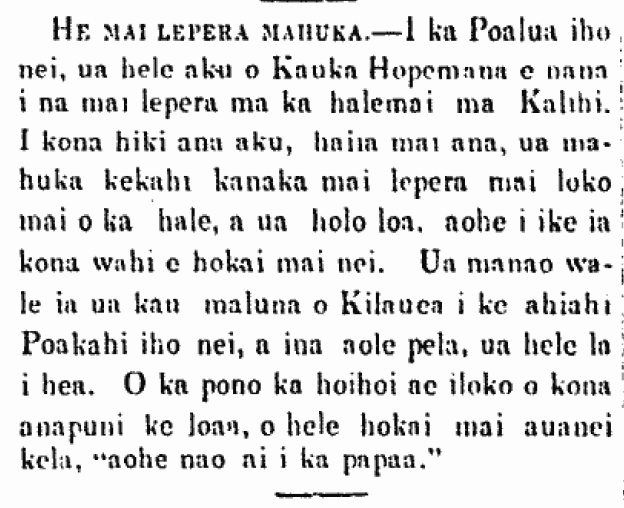
Leprosy patient escaped, 1867.

[Found under: “NU HOU KULOKO.”]

Leprosy patient escaped.—This past Tuesday, Dr. Hoffman [Kauka Hopemana] went to see the leprosy patients at the hospital in Kalihi. When he arrived, he was told that one of the patients escaped, and ran away, and it is not known where he is hiding. It is thought that he boarded the Kilauea on Monday evening, but if that is not the case, where could he have gone. It would be best if he is returned within his confines should he be found, or he will be lost, and that will be very dangerous.

(Kuokoa, 4/13/1867, p. 2)

He mai lepera mahuka...

Ka Nupepa Kuokoa, Buke VI, Helu 15, Aoao 2. Aperila 13, 1867.

Letter from Iosepa, Utah, 1913.

Word From Utah.

Iosepa, Toole County, Dec. 19, 1912.

Solomon Hanohano, Editor of the Kuokoa, Aloha oe:—Because we want to know of the news from our birth lands, we decided to subscribe to the Kuokoa. As the new year is arriving, it would be a means for us to see the news of our home and the progress of the political scene or its regression, as well as the victories or discouragements of our fellow makaainana.

This is an important year for the country, being that the great power of the nation has gong to the Democrats; the important question is this: Will the poor citizens of the land really benefit, or will they once again perhaps drift about like during Cleveland’s presidency, but it will be time that tells.

If those who were elected actually carry out what they promised with their lips to the people, then benefits will indeed result, however if it is like what Isaia said: “This people draweth nigh unto me with their mouth, but their heart is far from me.” Then those words of that old kamaaina of Lahaina will appear: “He says, when oh when will that happen.”¹ Recognized are the wealthy, and ignored are the poor. [Ikeia aku la no na kii maka nunui, nana oleia iho la na wahi kii maka liilii]. Continue reading

Kawelo story, 1909 / 2009.

The Great Story

OF

KAWELO

The Foremost and the Powerful, the One Who Put
Down the Strength of Kauahoa, the Youthful Hero of Hanalei;

TO WHOM BELONGED THE FAMOUS CLUB KUIKAA,
AND HIS WAS THE TRIPPING CLUB-WIELDING WIFE,
KANEWAHINEIKIAOHA

The writer of this Moolelo gives first his New Year Aloha to the friends and companions of the Pride of the Nation [Ke Kuokoa Home Rula], before putting before them a short explanation about things pertaining to this story. Continue reading

Transfer of treasures of the National Museum to the Bishop Museum, 1891.

SLIPPING AWAY.

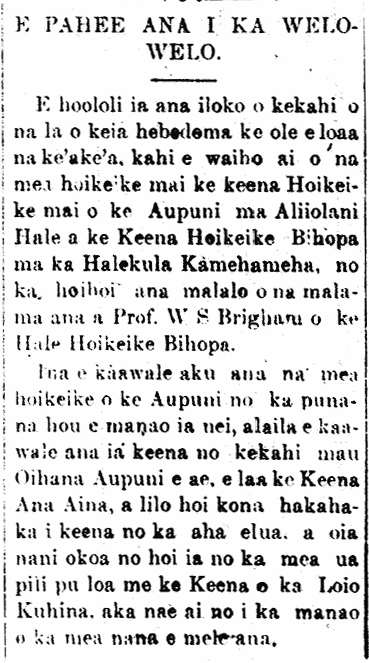
Barring any obstacles, during some of the days of this week, the location of the artifacts housed in the National Museum Office at Aliiolani Hale will be transferred to the Bishop Museum Office at Kamehameha School, to go under the care of Prof. W. S. Brigham of the Bishop Museum.

If the artifacts of the Nation are moved to their intended new nest, then that office will be open for other Government Agencies, like the Department of Land Survey, and its space will become an office for the two houses, and that is great because it is directly adjacent to the Attorney General’s Office; but this all depends on the decision of the one who sings.

(Leo o ka Lahui, 1/26/1891, p. 3)

E PAHEE ANA I KA WELOWELO.

Ka Leo o ka Lahui, Buke II, Helu 115, Aoao 3. Ianuari 26, 1891.

Language, 2014.

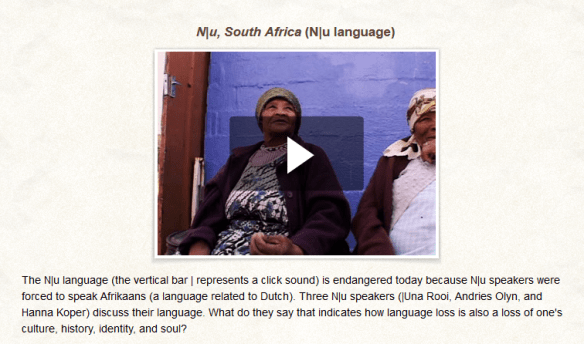
Here is something to think about. The olelo noeau is indeed true, “Make ke kalo a ola i ka palili.” (The oldsters die, but they live on through their offspring.)* Language however is something that needs to be consciously worked at, for if we let it disappear, “when you cover him with dirt, language is not like a plant that grows again…”

*The old taro stalk dies, but lives on through the shoots. Also seen as “Make ke kalo, ola i ka naio.”

Birthday of the Queen, 1902.

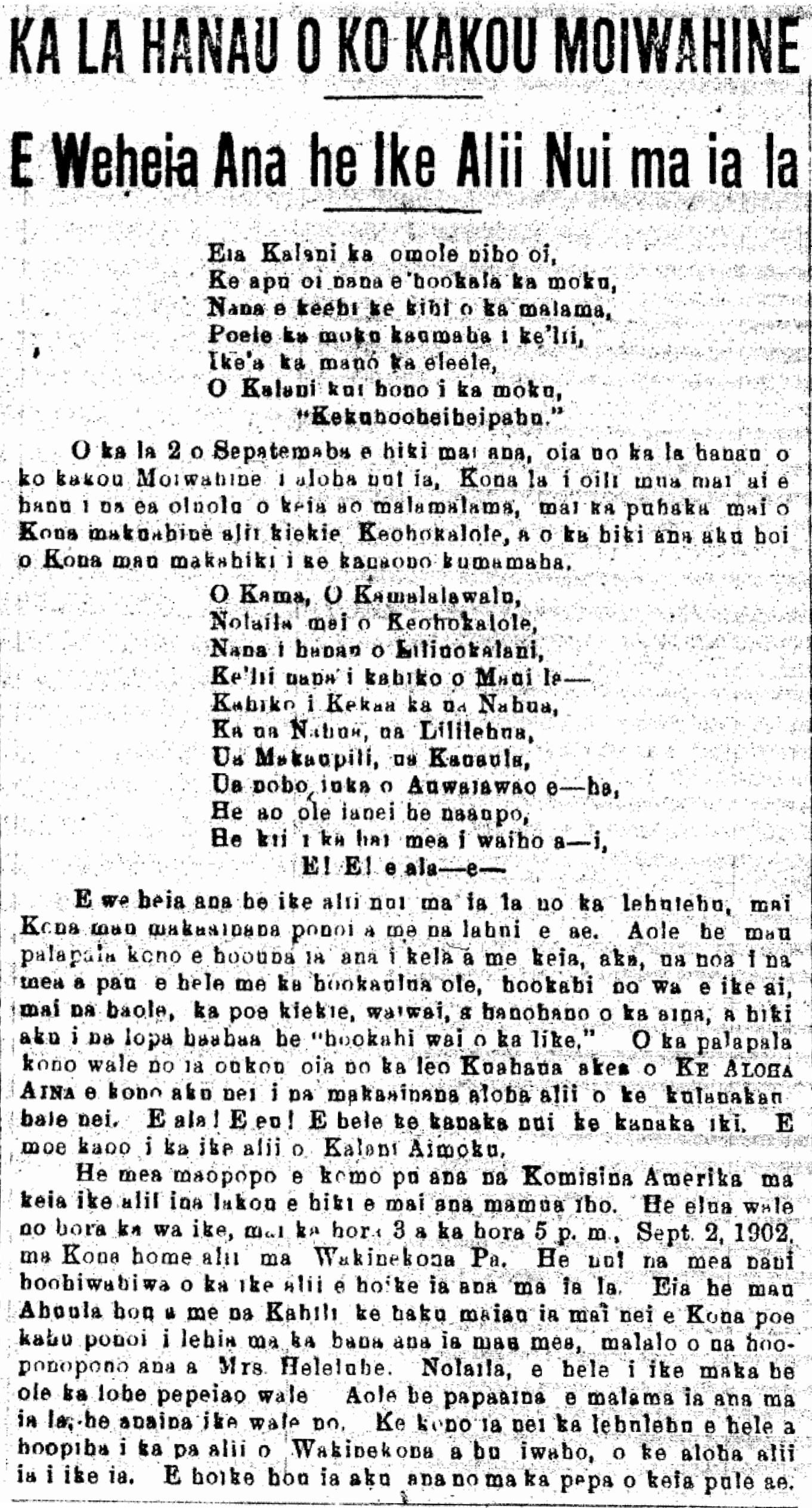
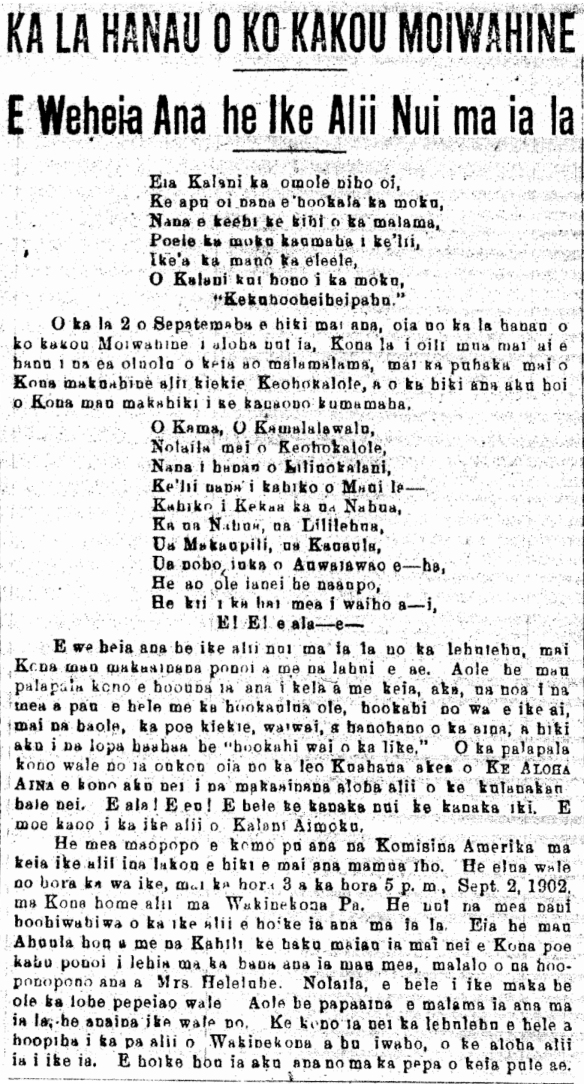
THE BIRTHDAY OF OUR QUEEN

There Will be a Great Royal Audience on That Day

Eia Kalani ka omole niho oi,
Ke apu oi nana e hookala ka moku,
Nana e keehi ke kihi o ka malama,
Poele ka moku kaumaha i ke’lii,
Ike’a ka mano ka eleele,
O Kalani kui hono i ka moku,

“Kekuhooheiheipahu.”

The coming 2nd of September is the birthday of our dearly beloved Queen, the day that She first arrived and breathed in the sweet air of this world of light, from the loins of Her mother, high chiefess Keohokalole, and She has now reached the age of sixty-four.

O Kama, O Kamalalawalu,
Nolaila mai o Keohokalole,
Nana i hanau o Liliuokalani,
Ke’lii nana i kahiko o Maui la—
Kahiko i Kekaa ka ua Nahua,
Ka ua Nahua, ua Lililehua,
Ua Makaupili, ua Kauaula,
Ua noho iuka o Auwaiawao e—ha,
He ao ole ianei he naaupo,
He kii i ka hai mea i waiho a—i,
E! E! e ala—e—

There will be a great royal audience for the people that day, from Her own makaainana to the people of other ethnicities. There will not be invitations sent out to each person, but it is open to all without hesitation, and there will be but one audience, from the haole, the rich and prestigious of the land all the way to the humble peasants; they are all the same. The only invitation to you all will be this public Announcement by the Aloha Aina inviting all those of this town who have aloha for the monarch. Rise! Get going! Go forth, big man and little man. File along to the royal audience with the Queen.

It is understood that the American Commissioners [the Subcommittee on Pacific Islands and Porto Rico] will be present at this royal audience if they arrive before then. The audience will only be for two hours, from 3 to 5 p. m., Sept. 2, 1902, and Her royal residence at the grounds of Washington Place [Wakinekona Pa]. There will be many beautiful adornments displayed that day at the royal audience. There are new Feather Capes [Ahuula] and Kahili being skillfully crafted by Her own attendants who are skilled at the making of such things, under the guidance of Mrs. Heleluhe. So go and see for yourself, and not just hear about it. There will  not be a meal presented that day, only an audience. The public is invited to go a fill the yard of Washington Palace until it overflows, showing the love for the alii.  This will be shown once more in the paper of this coming week.

(Aloha Aina, 8/23/1902, p. 1)
KA LA HANAU O KO KAKOU MOIWAHINE

Ke Aloha Aina, Buke VIII, Helu 34, Aoao 1. Augate 23, 1902.