“Missionary Herald,” 1821–.

 Here is another reference available online. This publication was put out by the American Board of Commissioners for Foreign Missions (ABCFM), reporting home to America on their work throughout the world. Of particular interest to us is what they say about Hawaii. Here for instance is an article appearing in the year of the overthrow, 1893.

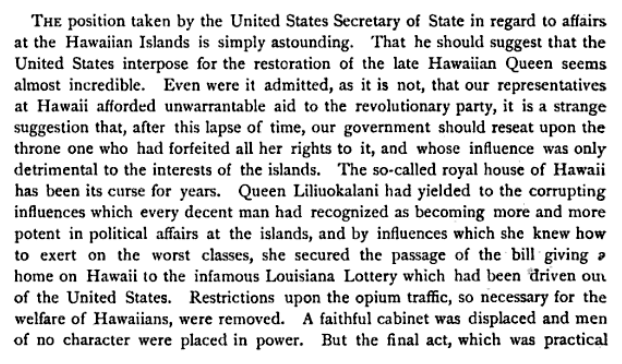
The position taken by the United States Secretary of State in regard to affairs at the Hawaiian Islands is simply astounding. That he should suggest that the United States interpose for the restoration of the late Hawaiian Queen seems almost incredible. Even were it admitted, as it is not, that our representatives at Hawaii afforded unwarrantable aid to the revolutionary party, it is a strange suggestion that, after this lapse of time, our government should reseat upon the throne one who had forfeited all her rights to it, and whose influence was only detrimental to the interests of the islands. The so-called royal house of Hawaii has been its curse for years. Queen Liliuokalani had yielded to the corrupting influences which every decent man had recognized as becoming more and more potent in political affairs at the islands, and by influences which she knew how to exert on the worst classes, she secured the passage of the bill giving a home on Hawaii to the infamous Louisiana Lottery which had been driven out of the United States. Restrictions upon the opium traffic, so necessary for the welfare of Hawaiians, were removed. A faithful cabinet was displaced and men of no character were placed in power. But the final act, which was practical…

(Missionary Herald, 12/1893, p. 510.)


The position taken...

The Missionary Herald, Volume LXXXIX, Number XII, Page 510. December 1893.

…suicide of the monarchy, was the attempt on her part to abrogate the Constitution and by sheer force establish a new one of her own making. Even her subservient ministers refused to endorse the scheme, yet she insisted upon it and sought to incite the populace to stand by her in her autocratic plans. It was then that all the better classes united as one man and deposed her. Never was there a revolution more warranted by facts, never was one more peacefully accomplished, and a queen of worthless character was set aside and the monarchy by its own act came to an end. If Minister Stevens or the commander of the Boston erred in judgment in any transaction, which we are not prepared to admit, yet there is no valid ground for the interference of our government to reverse the revolution months after it was consummated. We do not speak here of the political question as to what it is expedient for the United States to do in reference to a protectorate or to annexation. Opinions of these points may differ, but it would seem as if there were no room for difference of opinion in regard to this question of reestablishing the old monarchy on Hawaii. The best portion of her citizens have asked for some form of connection with the United States. Our government has a perfect right to say yes or no to all these proposals. And the Provisional Government at Honolulu has a right to say to us, “Either accept our proposal or hands off.” We regret to be obliged to speak in such terms of propositions that come from our national administration. We certainly should not do so did we not believe that any attempt to restore the Hawaiian Queen to her throne would be a gross outrage, and would be followed by the most serious consequences to the moral and religious interests of the islands, as well as to their material prosperity. We cannot think that our people will tolerate any intervention which has for its object the replacing upon the throne of a sovereign whose influence will be only for evil.

(Missionary Herald, 12/1893, p. 511.)
Continue reading

Kahikina Kelekona, John G. M. Sheldon, editor of the Hawaii Holomua, arrested for speaking, 1893.

LIBERTY OF THE SUBJECT.

Has Anybody Any Rights Under the Provisional Government?

Argument of the Question in the Circuit Court.

John G. M. Sheldon, editor of the Holomua, who is deprived of his liberty under a warrant issued by the President of the Provisional Government, was produced in the First Circuit Court before Judge Frear, at 11 o’clock this forenoon, under a writ of habeas corpus. Attorney-General Smith and F. M. Hatch appeared for the Government, and C. W. Ashford, C. Creighton, A. Rosa and J. L. Kaulukou for the prisoner.

Mr. C. W. Ashford argued for the discharge of the prisoner, speaking to the following effect: There was no authority vested in the Executive and Advisory Councils to issue warrants of arrest. President Dole had no right in the Proclamation of the Provisional Government to issue a warrant of arrest. The Government could not go behind that proclamation, he presumed. “We the People of the Hawaiian Islands” gave him no such power. If “We the People of the Hawaiian Islands” had intended to exercise that power they would have given it to him. The Proclamation stated that the President’s duties were to preside over the meetings of the Executive Council. Mr. Dole now holds no judicial position in these islands. He did hold such position before, but resigned it to become President of the Provisional Government. If that warrant, of President Dole was valid, then there was no security of liberty for any man, woman or child under these tropic skies. There was then nothing to prevent any resident of this country being consigned to a dungeon or bound in irons. It should be known whether the Provisional Government had such tremendous powers. He was not making a covert attack on the late revolution. He believed in the sacred right of revolution, and he considered the late revolution was a good thing. But it might not be good if the Provisional Government introduced anarchy and despotism. Some persons were led by their philosophy to believe that a beneficent despotism was the best form of government, and he believed that members of this school of philosophy had seats in the Advisory Council. Continue reading

On Aloha Aina, 1893.

“Breathes there a man with soul so dead,
Who never to himself hath said,
This is my own my native land.”
(Scott.)

Many of those who support honestly the present state of affairs, have done so in the full hope and belief, that thereby the flag of their country—the Stars and Stripes—will float over the land in perpetuity. Not a single Hawaiian, however, even those few whose signatures to annexation petitions (not 200 in number and mostly convicts.) have been bought or forced by necessity from them, desires to see any foreign flag replace his own. Continue reading

Political prisoners released by the Provisional Government, 1895.

Political Prisoners.

This past Thursday, Independence Day [La Kuokoa] and also Day of Thanksgiving to God for the deceitful ones, some political prisoners were released, they being W. H. Rickard [W. H. Rikada], T. B. Walker [T. B. Waka], Toma Pule, Kauai, D. Damien [D. Damiena], R. Palau, and Apelahama. As for the haole, after the two of them were read their pardons,  they were given the thanks of President Dole and some Hawaiians as well.¹ Some other political prisoners were no released, but perhaps will be released some time in the future.

¹See correction in comment below.

(Makaainana, 12/2/1895, p. 1)

Na Pio Kalaiaina.

Ka Makaainana, Buke IV—Ano Hou, Helu 23, Aoao 1. Dekemaba 2, 1895.

Nora Rickard of Honokaa turns 90, 1938.

Mother Rickard Celebrates her birthday

MRS. RICKARD

On Sunday, March 6, “Mother” Nora Rickard of Honokaa celebrated her 90th birthday, after living until local on the Island of Keawe for 71 years. She was born in Devonshire, England, and left there when she was 19 years old and went to America on a sailboat travelling under Cape Horn [Kaipo Hone], a trip that took five months.

“Mother” Rickard is the first white woman who lived in Honokaa. She is still strong and spry, even if she is very old. Pertaining to her trip from England, she says: Continue reading

Queen Victoria letter to Sanford Dole, 1894.

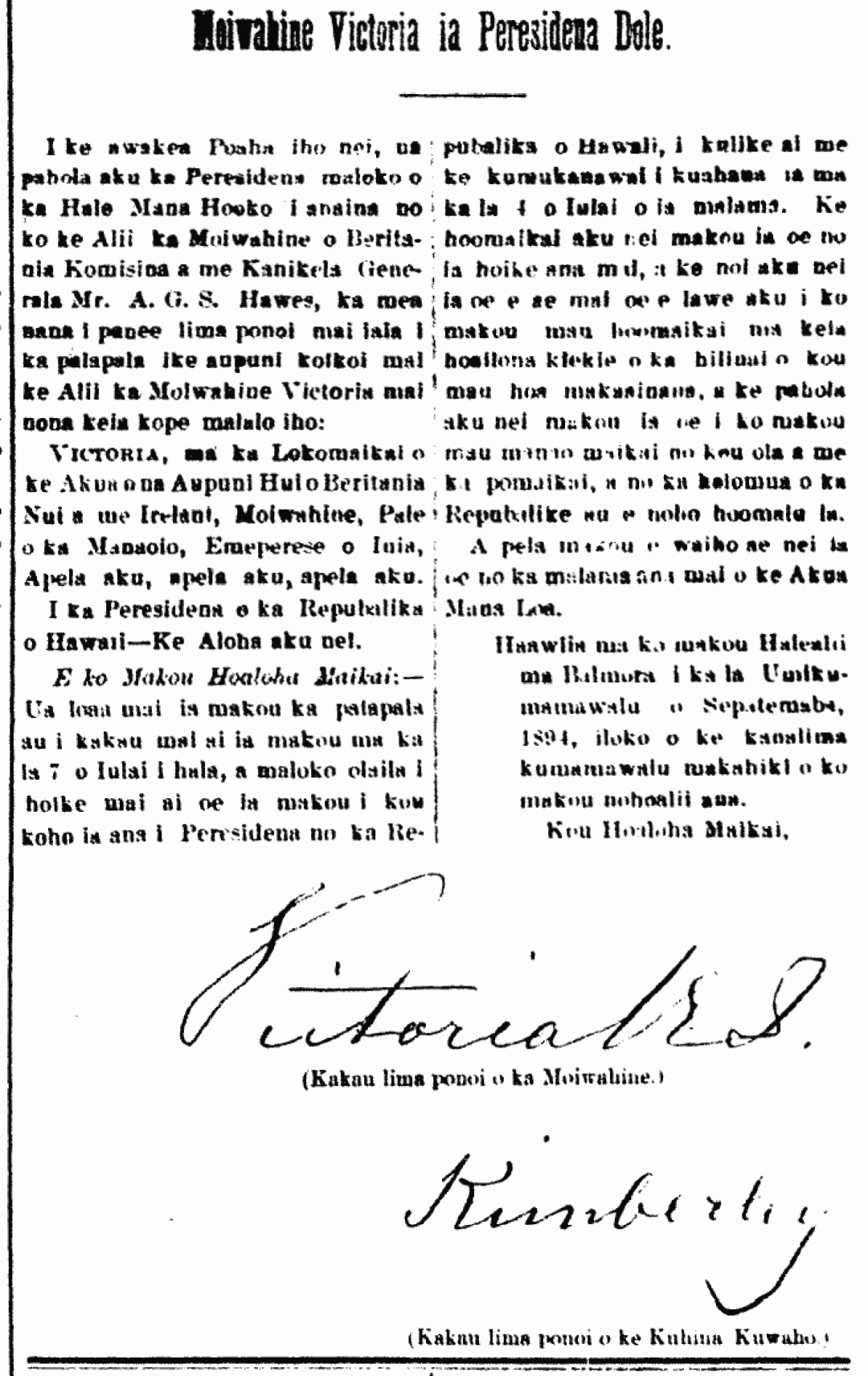
Queen Victoria to President Dole.

At midday of this past Thursday, the President gave an audience in the Executive Building [Iolani Palace] for the Queen of Britain’s Commissioner and Consul General, Mr. A. G. S. Hawes, who handed over to him personally this important national greeting from the Royal one, Queen Victoria.

Victoria, by the grace of God, of the United Kingdom of Great Britain and Ireland, Queen Defender of the Faith, Empress of India, and so forth, and so forth, and so forth.

To the President of the Republic of Hawaii, Sendeth Greeting!

Our Good Friend! We have received the letter which you addressed to us on the 7th day of July last, in which you informed us that you had been elected President of the Republic of Hawaii, in accordance with the constitution which was proclaimed on the 4th of that month. We thank you for this communication, and we request you to accept our congratulations on this distinguished mark of the confidence of your fellow citizens;and we offer you our best wishes for your health and welfare, and for the prosperity of the Republic over which you preside.

And so we commend you to the protection of the Almighty.

Given at Our Court at Balmoral the nineteenth day of September 1894, in the 58th year of our reign.

Your good friend,

(Signed by the Queen’s own hand.)

(Signed by the Minister of Foreign Affairs’ own hand.)

[The queen seems to have been led to believe that Dole had the support of “his fellow citizens”…]

(Kuokoa, 11/17/1894, p. 2)

Moiwahine Victoria ia Peresidena Dole.

Ka Nupepa Kuokoa, Buke XXXIII, Helu 46, Aoao 2.

The Queen’s Protest, 1893.

KUKALA KUE A KE ALIIAIMOKU.

“O wau, Liliuokalani, ma ka lokomaikai o ke Akua, malalo o ke Kumukanawai o ke Aupuni Hawaii, Moiwahine, ma keia ke hoike paa nei i Ko’u kue i kekahi hana a mau hana paha a pau i lawelawe ia e kue ana Ia’u iho a me ke Aupuni Kumukanawai o ke Aupuni Hawaii e kekahi poe e koi ana ua kukulu lakou he Aupuni Kuikawa no ka manawa no keia Aupuni.

“Ke ae wale nei no Au mamuli o ka mana oi ikaika o Amerika Huipuia nona hoi ke Kuhina Elele Nui, ka Meamahaloia John L. Stevens, ua kauoha aku i na koa o Amerika Huipuia e hoopae ia mai ma Honolulu, a ua kukala ae e kokua no oia i ua Aupuni Kuikawa ʼla no ka Manawa i oleloia.

“Nolaila, i mea e kaupale aku ai i na hookuia ana o na puali i hoolawa ia me na lako kaua, a malia paha o hoopoino ia ke ola; nolaila, malalo o keia Kuahaua Kue a i kauhola ia hoi e ua mana ikaika ʼla, ke ae wale nei no Au e panee aku i Ko’u Mana a hiki i ka manawa a ke Aupuni o Amerika Huipuia, mamuli o na mea oiaio e waiho ia aku ai imua ona, e hoololi ai i na hana a kona Luna Aupuni a e hoonoho hou Ia’u maluna o ka mana A’u e koi nei ma ke ano Aliiaimoku o ka Paeaina Hawaii.”

“Hanaia ma Honolulu, i keia la 17 o Ianuari, M. H. 1893.”

“[Kakauinoaia:]

LILIUOKALANI, R.

Samuel Parker,
Kuhina o ko na Aina E.

Wm. H. Cornwell,
Kuhina Waiwai.

Jno. F. Colburn,
Kuhina Kalaiaina.

A. P. Peterson,
Loio Kuhina.

“Ia S. B. Dole a me kekahi poe e ae o ke Aupuni Kuikawa no ka Manawa o ka Paeaina Hawaii.”

[The Queen’s protest was printed in entirety the very next day in the Hawaiian-Language Newspaper, Hawaii Holomua. Images of this paper are unfortunately not available online, and it is only word searchable at nupepa.org, and not at papakilodatabase.com, but click the link below for an image of the page in which the protest was printed.

For English, see for instance: p. 120 of Report of Commissioner to the Hawaiian Islands, 1893.]

(Hawaii Holomua, 1/18/1893, p. 2)

HawaiiHolomua_1_18_1893_2

A mele for the counter revolution, 1895.

KAALAWAI.

Kumaka ka ike’na ia Kaalawai
I ka peki wawae i ke kula loa
Mea ole ka loa a oia kula
Me ke kai hone mai i ka iliili
Me he ‘la a e i mai ana
Imi ia e ka pono o ka aina
Ilaila ohohia kuu manao
I ka ike ana aku i na hoa
Hooho Wilikoki me ka leo nui
Imua kakou a lanakila
Lana mai ka manao Nou e ka Lani
E hoi hou ana i ke Kalaunu
Eia makou ke paa nei
Mamuli o ke aloha i ka aina
O ke kani makawalu a na pu
Pau ka manaolana no ka ohana
Haina ia mai ana ka puana
No ka poe i aloha i ka aina.

Hakuia e
S. Kanehe.
Kawa.

KAALAWAI.
In plain sight was Kaalawai
Treading across its wide plains
The extent of that field is of no consequence
With the sea that whispers atop the pebbles
As if saying
Let pono for this land be sought out
There my mind is elated
To see my comrades
Wilcox cheers with voice aroar
Forward to victory!
Our belief is for You, O Heavenly One
That you will return to the Throne
Here we are, unyielding
Faithfully patriotic
With gunfire ringing out from all directions
No more do we hope to see our families
Let the refrain be told
For the patriotic ones.
Composed by S. Kanehe.
Kawa. [The prison]

[There was a man named Herman K. Kanehe, who was one of many patriots sentenced to 5 years at hard labor and a fine of $5000. But i could not find out information on this S. Kanehe.

It is also interesting to note that this composition is reminiscent of another composition known widely today…]

(Oiaio, 3/22/1895, p. 3)

KAALAWAI.

Ka Oiaio, Buke VII, Helu 3, Aoao 3. Maraki 22, 1895.

Updated Elepaio Story, 1894.

DON’T WORRY.

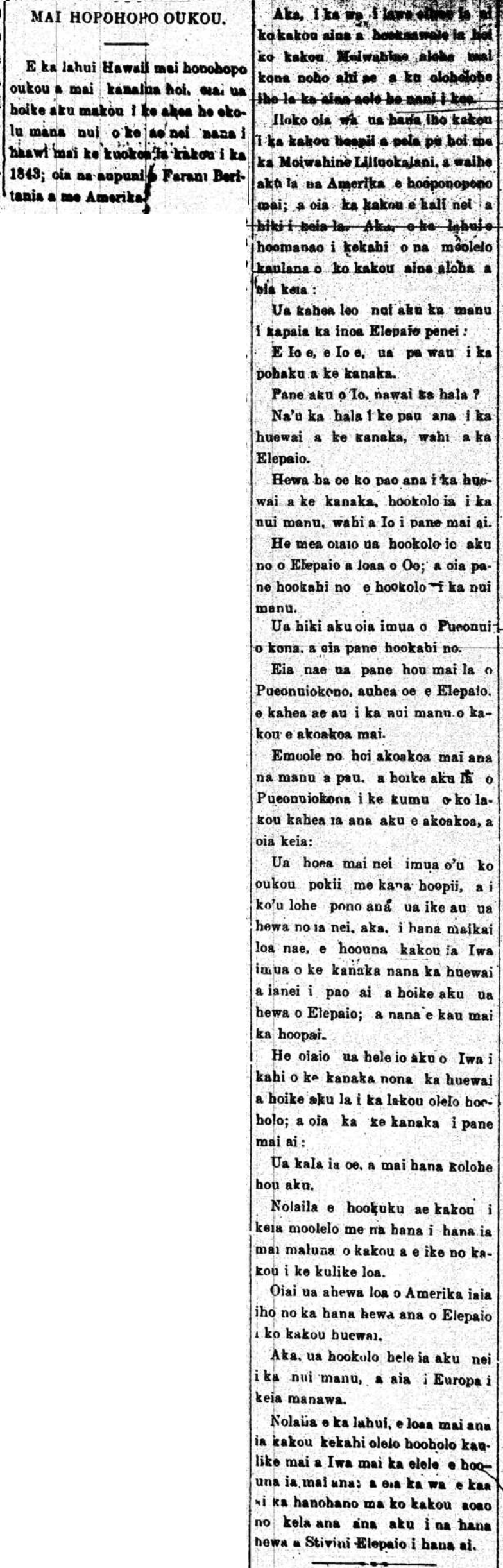
O Hawaiian people, don’t worry and don’t be uncertain. for we have publicly shown that there are three great powers of the world who have granted independence to us in 1843, that being France, Britain, and America.

But when our land was stolen and our beloved Queen was taken from her throne and our land stood bare without any beauty remaining,

During that time, we composed our protest, along with Queen Liliuokalani, and left if for America to make right; and it for this that we wait until today. But O Nation, do recall one of the famous stories of our beloved land, this being:

The bird called Elepaio called out loudly:

“O Io, O Io, I was hit by the rock of the man.”

Io answered, “Who was at fault?”

“I was wrong for pecking at the huewai of the man,” answered Elepaio.

“You are indeed at fault for puncturing the huewai of the man; let it be judged by the many birds,” was Io’s answer.

It was so, Elepaio was judged; he came upon Oo, and his answer was the same, that it be judged by the many birds.

Elepaio arrived before Pueonuiokona, and his answer was the same.

But Pueonuiokona went on to say, “Say Elepaio, I will call our many fellow birds to come together.”

In no time, all the birds came together, and Pueonuiokona revealed the reason for them being called to assemble, like this:

“Before me appeared your younger sibling with his protest, and when I heard correctly, I knew he was wrong, however, the best thing to do would be for us to send Iwa before the man to whom belonged the huewai that Elepaio pecked, and to tell him that Elepaio was guilty, and it is for him to set the punishment.”

And it was so, Iwa went to the place of the man to whom belonged the huewai, and told him of their decision; this is what the man said:

“You are forgiven, and don’t do anymore harmful acts.”

So we compare this story with the actions carried out upon us, and we see that they are exactly the same.

For America totally blames itself for the wrong done by Elepaio to our huewai.

But it is going around being judged by the many birds, and is currently in Europe.

So therefore, O Nation, we will receive a fair judgement from Iwa, the messenger that is being sent; and that will be when the dignity shall be awarded to our side through the judgement of the crimes carried out by Stevens Elepaio.

(Leo o ka Lahui, 10/11/1894, p. 2)

MAI HOPOHOPO OUKOU.

Ka Leo o ka Lahui, Buke II, Helu 1047, Aoao 2. Okatoba 11, 1894.

Probably the earliest known version of a song well known today, 1894.

ALOHA O HAWAII.

He aloha Hawaii moku o Keawe
Aina a ka nani me ka maluhia
Hookuku au me Kaleponi
Hawaii ka oi o na Ailana
Na Ausekulia i kono mai ia’u
E naue i ka aina malihini
Aina kamahao i ka’u ike
Ua uhi paapu ia e ka noe
Ike i ka hau hookuakea i ka ili
Hoopumehana i ke ahi kapuahi
Ka iniki a ke anu me he ipo ala
E koi mai ana ia’u e hoi
Ilaila hoi hope ko’u manao
He kaukani mile ko’u mamao
Hu mai ke aloha no ka aina
No ka poi uouo kaohi puu
Haina ia mai ana ka puana
Ke aloha aina ko’u lei ia

Emalia Kaihumua.

Hale Hoikeike Hawaii. Kapalakiko

[This was written while Emalia Kaihumua was performing at the Hawaiian Exhibit [Hale Hoikeike Hawaii] at the California Midwinter International Exposition held in San Francisco. Looking back at was happening at the time in her homeland while she was “a thousand miles away”, it is very heart wrenching to see the many references to home and returning and finally the haina: “Let the refrain be told, Patriotism is my lei.”]

(Leo o ka Lahui, 4/27/1894, p. 3)

ALOHA O HAWAII.

Ka Leo o ka Lahui, Buke II, Helu 929, Aoao 3. Aperila 27, 1894.