Observations from an Englishman, 1893.

From a Travelling Englishman.

From the time I arrived in Honolulu until today, I’ve heard often of matters pertaining to those referred to as the circle of missionaries, and the dimness of their ideas; I’ve observed their actions very carefully.

I saw today in the Advertiser [Avalataisa] about the party being given for Captain Wiltse, and how they will sit at this party for two hours and a half with just wine to drink and nothing to eat.

Giving a banquet for a high ranking Captain without serving Glasses of Champaigne [Kamapeni] during all that time is like acting out Hamlet without the ghost.

This will not become something that is greatly ridiculed, but this goes back to the way of life of the old Missionaries, with  their humbling station of evil thoughts.

On the day after this party, I saw that Queen Liliuokalani was sent an invitation under the name Mrs. J. O. Dominis, and this is something quite vile by the Committee who did it; Should the Committee think that are considered adults, then it was improper of them to have sent such an invitation to the Queen.

The first thing taught to schoolchildren in Britain is not to kick a man when he falls down. But this is a woman they are kicking, and that woman is Queen Liliuokalani. This is action that can be called despicable of the meanest form, and should this Committee want to be freed of these words, then they must explain it from their side, or this contemptible act will be carried upon their backs.

Charles G. Nottage.

Hawaiian Hotel [Hotele Hawaii], Feb. 28, 1893.

[Perhaps this was meant to say that there was no wine, and only sparkling water? The article he seems to be talking about is found here on the Chronicling America site. PCA 2/28/1893, p. 2.

There is also reference to a separate party that he was invited to. The Queen is mentioned as “Mrs. J. O. Dominis”. This can be found also at Chronicling America, PCA 2/25/1893, p. 4.]

(Leo o ka Lahui, 3/3/1893, p. 3)

Mai Kekahi Haole Pelekane Kaahele Mai.

Ka Leo o ka Lahui, Buke II, Helu 654, Aoao 3. Maraki 3, 1893.
Leleiohoku, the Prince Regent, 1874.

THE FIRST PUBLIC SPEECH

By His Highness

THE ALII WILLIAM PITT LELEIOHOKU,

Before the Citizens at Ewa, Oahu.

[Ewa’s makaainana are surely very proud that they were victorious, hearing the words from His Highness, the Chief, and the Crowned Prince of the Nation, W. P. Leleiohoku, on Saturday, April 25, 1874. Because of the excellence of the content, and that this is the very first of his speeches, and because of the great desire and admiration for it, therefore, we are putting it before the public to admire it for themselves, to see the intelligent expression from the Young Prince. Ed.]

O Citizens:—My naau¹ is filled with joy to see upon your faces this day, a sign telling me that your loving hearts are encouraged by the astute remarks of our King spoken of in his royal address pertaining to one of the foundations of His Kingdom, that being

“The Increase of the Lahui.”

The is an important question which our King puts before you, and not just you, but before all of the citizens of His Kingdom from Hawaii to Kauai; it is a wide, deep, and lingering question. And this is the appropriate time for us to raise this question to consider it, being that the lahui continues to decrease, from the conditions as shown in the dark ages gone by.

As I speak on the subject of this question, let us look to the future, and consider the character of the One who asked this question, that being our current King. He did not simply take up [lawe kamako²] this endeavor, or do it on his own; he carefully considered it, trusting in your patience in helping Him in search out means to rejuvenate this lahui. Continue reading

Hawaiian medical kahuna and haole doctors, 1871.

Answer to W. P. Waha.

Mr. Editor; Aloha oe:

Perhaps it is well that I explain in your newspaper a thought responding to W. P. Waha of Honomaele Uka, Hana, Maui.

In the newspaper, Kuokoa, Buke 10, Helu 27, of the 8th of this past July, Waha published an opinion pertaining to the Practice of Hawaiian Medicine. From what I saw searching from beginning to end; this is what I mainly got out of it, that “he is jealous, malicious, and a slanderer, ” and so forth. You just chomp your mouth like a wild shark of the sea saying, “All of the Hawaiians are dying because of whom? Yes! They are dying because of you Heads of the Government!” If that is the intent of the questioner, then I ask of you, “Is that indeed true?” Let us all look at the thoughts of this malicious inciter, being that the Heads of our Nation are not looking to kill off the Hawaiian Lahui, and ways to kill them, but it is you, and it is you yourselves who offer yourselves off to die; and you enjoy grumbling to our Heads of Government. Take a short look at this, you fault finder; During the past session of the Legislature, in the year 1870, $4,000 was put to teach Hawaiian youths Medicine, and in the month of November of last year, the government chose the proper person in which they trust, as a teacher for the school, and it is being taught now. There is no other reason for this action except because of the aloha for you, O Hawaiian people.

Take another look; some Hawaiian medical kahuna are licensed, so that they can practice medicine in the country and areas where there are no doctors. The ignorant and uneducated practitioners are being sued. If you look at these actions by our Government Heads, it appears as if they are concerned that our Lahui will perish. Continue reading

Theresa Owana Wilcox Belliveau and the Estate of Pauahi and Liliuokalani, 1918.

FIGHTING OVER THE ESTATE OF PAUAHI

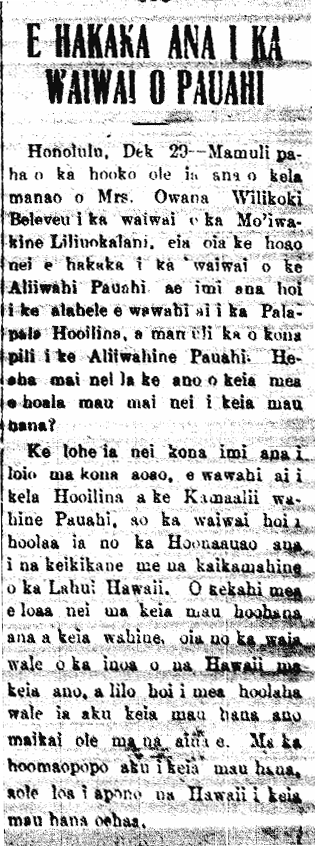
Honolulu, Dec. 29—Perhaps it is because the desires of Mrs. Owana Wilcox Beleveu [Belliveau] were not appeased over the estate of Queen Liliuokalani that here she is fighting over the estate of the Aliiwahine Pauahi and she is trying to find a way to break the Will, as if she is related to Chiefess Pauahi. What does she expect by starting all of this?

It is heard that she is looking for an attorney on her side to break the Will of Princess Pauahi, and the money to be dedicated to Educate the boys and girls of the Hawaiian Lahui. Something that will result through this action by this woman is the dishonor to the name of Hawaiians, and this improper action will be something reported in other lands. When they find out about  this, Hawaiians will definitely not approve of this deceitful act.

(Aloha Aina, 1/3/1918, p. 2)

E HAKAKA ANA I KA WAIWAI O PAUAHI

Ka Hoku o Hawaii, Buke 12, Helu 32, Aoao 2. Ianuari 3, 1918.

Chinese New Year, 1929.

THESE ARE THE NEW YEAR DAYS OF THE FLOWER PEOPLE¹ OF CHINA

Just as usual with the Chinese people, they will again this year, celebrate their one important day of the year known by them as the Konohi day.

These past years however, they have split up and some of them celebrate the day we celebrate, that being the 1st of January, while some celebrate their day from ancient times. It is a day when some of our people go quickly about celebrating the konohi at houses of the Chinese, and they are a welcoming people to those who visit their homes on that day.

There is but one humbug thing about that day, that is they do not sleep that night and wake up everyone with their sounding off fireworks from night to day, and it is bad for those who have to go work the next day.

¹China is referred to in Hawaiian as the “Aina Pua,” or the “Flower Land.”

(Alakai o Hawaii, 2/14/1929, p. 2)

O NA LA KONOHI KEIA O KA LAHUI PUA O KINA

Ke Alakai o Hawaii, Buke 1, Helu 42, Aoao 2. Pepeluali 14, 1929.

Pedestrians and Drivers need to be vigilant! 1917.

[Found under: “Nuhou Kuloko”]

One must be very careful when crossing from one side of the street to the other, because the automobiles speed by without paying attention to the people on the street.

[It seems like there are more and more accidents out lately. Please be careful out there!!]

(Aloha Aina, 12/14/1917, p. 4)

He mea pono e akahele...

Ke Aloha Aina, Buke, XXII, Helu 50, Aoao 4. Dekemaba 14, 1917.

Pidgin from down in Kalaupapa, 1882.

NEWS OF MOLOKAI.

O Greatest Prize of the Hawaiian Nation, the lightning that flashes over the cliff brows of the islands. Greeting between us.

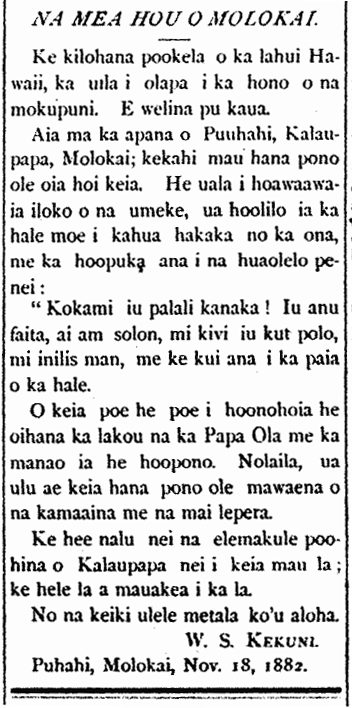
In the area of Puuhahi, Kalaupapa, Molokai, there were deplorable incidences, and those where these. There was sweet potato being fermented in pots, and this made the dormitory into a place of fighting because of drunkenness, along with the speaking of these words:

“Kokami iu palali kanaka! Iu anu faita, ai am solon, mi kivi iu kut polo, mi inilis man,” while he punched the wall of the building.

These are people who were appointed with positions from the Board of Health [Papa Ola] with the thought that it would be of help. Then this reprehensible thing happened between the locals [kamaaina] and the leprosy patients.

The gray-haired old men of Kalaupapa are surfing these days, and the land is being left fallow in the sun [??? ke hele la a mauakea (?? mahakea) i ka la.]

To the metal type-setting boys goes my aloha.

W. S. Kekuni.

Puhahi, Molokai, Nov. 18, 1882.

[Any ideas what is being said in pidgin? I will post what I think it says tomorrow morning.]

(Kuokoa, 12/9/1882, p. 3)

NA MEA HOU O MOLOKAI.

Ka Nupepa Kuokoa, Buke XXI, Helu 49, Aoao 3. Dekemaba 9, 1882.

Letter from Iosepa, Utah, 1913.

Word From Utah.

Iosepa, Toole County, Dec. 19, 1912.

Solomon Hanohano, Editor of the Kuokoa, Aloha oe:—Because we want to know of the news from our birth lands, we decided to subscribe to the Kuokoa. As the new year is arriving, it would be a means for us to see the news of our home and the progress of the political scene or its regression, as well as the victories or discouragements of our fellow makaainana.

This is an important year for the country, being that the great power of the nation has gong to the Democrats; the important question is this: Will the poor citizens of the land really benefit, or will they once again perhaps drift about like during Cleveland’s presidency, but it will be time that tells.

If those who were elected actually carry out what they promised with their lips to the people, then benefits will indeed result, however if it is like what Isaia said: “This people draweth nigh unto me with their mouth, but their heart is far from me.” Then those words of that old kamaaina of Lahaina will appear: “He says, when oh when will that happen.”¹ Recognized are the wealthy, and ignored are the poor. [Ikeia aku la no na kii maka nunui, nana oleia iho la na wahi kii maka liilii]. Continue reading

Olelo Hawaii, 1896.

THE HAWAIIAN LANGUAGE WILL BE FORGOTTEN.

Those Hawaiian youths who are being trained by us in the English language cannot write correctly at all the Hawaiian language of their own land of birth.

We have seen some children like this. And we are very regretful in seeing this; they are being made unintelligent in their Mother tongue of their land, so that their thought are turned over totally to the land of those who are teaching them.

When they are asked, “What about you? Can you write in Hawaiian?” They will reply, “No! the haole teachers don’t give us time to write in the language of Hawaii nei, and that is why I can’t read and write in Hawaiian.” That is how the majority of the Hawaiian children will be in the future.

We feel great remorse that the Hawaiian children will be denied intimate knowledge of the Mother tongue of their own land.

There is no Lahui that is denied this right, amongst all the great nations of this world. Therefore, do not let the Hawaiian language be forgotten.

(Aloha Aina, 7/11/1896, p. 2)

E POINA ANA KA OLELO HAWAII.

Ke Aloha Aina, Buke II, Helu 28, Aoao 2. Iulai 11, 1896.

On the state of the Hawaiian Language, 1920.

PERTAINING TO THE HAWAIIAN LANGUAGE.

Mr. Editor of the Nupepa Kuokoa, Aloha oe:—In the Kuokoa of Friday, May 21, 1920, I saw your thoughts supporting Mr. Coelho on the Hawaiian Language, and about the lack of use of the Hawaiian language in some churches and Hawaiian organizations when they meet; English is what is spoken in meetings; not because Hawaiian is not understood, but because of their great embarrassment in speaking Hawaiian; there is English and it is attractive to speak, yet all the while they understand that it is not appropriate at all to be speaking in English.

It isn’t in some churches and Hawaiian associations that it is not spoken, but in markets, on streets, in homes in which true Hawaiians live, and all around this island of Oahu, only a very tiny fraction of true Hawaiians speak the Hawaiian language; most of the men, women, and children, all they speak is English.

It is not something that I’ve heard from a friend; no, I have seen it with my own eyes, and heard it with my own ears; a Hawaiian father and a Hawaiian mother, and children born of their loins, born here in Hawaii, yet the strange thing is that the language they speak is English, and not Hawaiian.

Who are the true Hawaiians that are snuffing out the Hawaiian language? The ones that are too haughty and the ones who are too ashamed to speak in Hawaiian, like with some churches and some Hawaiian organizations that don’t want to speak Hawaiian when they meet.

I do not oppose the speaking of English or other languages perhaps that we true Hawaiians know; it is a great benefit that we can converse in those languages, but the problem is that we’ve abandoned the Hawaiian language.

How can we Hawaiians say that we defend dearly [makee] the Hawaiian lahui from dying off and from coming into great difficulties if we do not cherish our mother tongue? Continue reading