Z. P. K. Kawaikaumaiikamakaokaopua’s treatise on canoe building, 1922.

CANOE BUILDING AND ITS CHARACTERISTICS.

(Written by Z. P. K. Kawaikaumaiikamakaokaopua.)

Canoe building is one of the greatest trades; it is with great knowledge and thought that this is done. And when the important high chiefs of Napoopoo were living, they being Kamakau; Kahalau; Kanuha; Kekukahiko; and Kanihomauole, the son of Kiilaweau; Kanihomauole decided to go to Maui in search of a number of canoe building kahuna for himself. And that alii Kanihomauole did indeed go with some attendants from his royal court.

When they went, they landed at Hana, Maui. Kaahumanu was there living at the time, and was married (hoao) with Kamehameha, who was away on Oahu. And because it was heard often that Kanihomauole was the child of Kiilaweau, the alii of highest blood, and that he was kin to Kamehameha, the Conqueror of the Nation, they were welcomed along with those who came, they being Kahula, Kamaka, Naili Sr., Keaka and Puuki.

The queen asked, “why have you come?” The alii Kanihomauole replied, “I have come in search of a kahuna kalaiwaa for myself, and I have come to see the two of you to get my kahuna kalaiwaa.” “Yes, you will have one. Let us remain until Papa Keeaumoku and the boy Kamehameha returns; they will be back tomorrow.” And they waited, and spent the night, and those that came were treated well by the kamaaina of the place.

[This is how the piece on canoes by Kalokuokamaile begins on 10/26/1922, and it continues on in the Kuokoa until 2/15/1923. This is one of the many priceless translations appearing in the Bernice Pauahi Bishop Museum’s Hawaiian Ethnographic Notes (HEN) Collection.  HEN: Newspapers, October 26, 1922.

Kalokuokamaile was very prolific. This series is then followed by yet another, this time on net making!]

(Kuokoa, 10/26/1922, p. 7)
KE KALAIWAA ANA AME KONA MAU ANO.

Ka Nupepa Kuokoa, Buke LXI, Helu 43, Aoao 7. Okatoba 26, 1922.
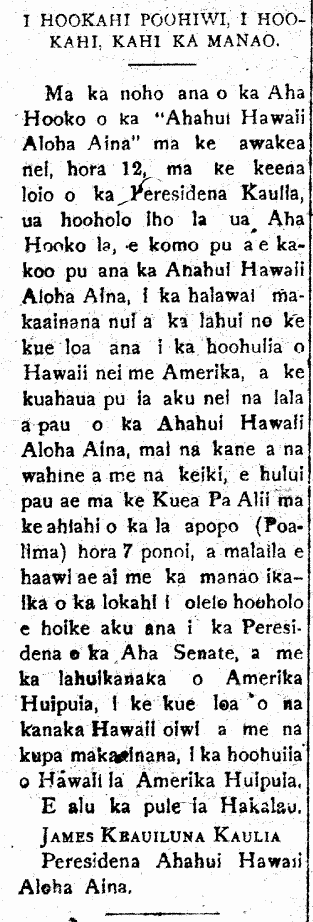
I hookahi, kahi ka manao, 1897.

LET US BE OF ONE SHOULDER,¹ LET US BE OF UNIFIED THOUGHT.

At the meeting of the Executive Committee of the “Ahahui Hawaii Aloha Aina” [Hawaiian Patriotic League] at noon, 12 o’clock, at the attorney’s office of President Kaulia, the said Executive Committee decided that the Patriotic League will join and support the great rally of the makaainana of the lahui to absolutely protest the annexation of Hawaii to America, and it is announced to all of the members of the Hawaiian Patriotic League, from the men, to the women, to the children, to assemble at the Palace Square [Kuea Pa Alii] tomorrow evening (Friday) at exactly 7 o’clock, and there will be presented with insistence and unity, the resolution informing the President of the Senate and the people of the United States, that the native Hawaiians and the long-time makaainana protest the annexation of Hawaii to the United States of America.

Let us combine our prayers to overcome Hakalau. [E alu ka pule ia Hakalau.]²

James Keauiluna Kaulia

President of the Ahahui Hawaii Aloha Aina.

¹Hearkening to the idea of “I hookahi umauma, i hookahi poohiwi, a i hookahi puuwai.” [Let us be of one chest, one shoulder, and of one heart.] Also from earlier that year, see by Samuel K. Kamakaia, “Nai Wale no Oukou A’oe Pau.”

²According to Mary Kawena Pukui’s Olelo Noeau (115): “A sorcerer at Hakalau once created havoc in his own and other neighborhoods. Many attempts to counter-pray him failed until a visiting kahuna suggested that all of the others band together to concentrate on the common enemy. This time they succeeded.”

(Aloha Aina, 10/9/1897, p. 3)

I HOOKAHI POOHIWI, I HOOKAHI, KAHI KA MANAO.

Ke Aloha Aina, Buke III, Helu 41, Aoao 3. Okatoba 9, 1897.

Z. P. K. Kawaikaumaiikamakaokaopua’s treatise on kalaiaina, 1921–1922.

WHAT KALAIAINA IS.

(Written by Z. P. K. Kawaikaumaiikamakaokaopua).

Introduction.

God gave all men wealth [waiwai]; He gave land to grow food, He gave trees to build houses and to assist in great works, He gave all growing things to fulfill the desires of men, He gave us hands and strength to work and administer the land and all things that will bring us wealth.

But when man lived in ignorance, they were very poor. The things God gave him were not made into wealth. He lived in caves or shacks, or crude and dirty structures. His clothes were leaves, or animal hide, or tree bark; he hunted wild animals for food and plants that grew wild in the forest; he did not imitate the ant who prepared a lot of food. That is how ignorant men lived poorly. They did not know where to obtain wealth. The saw the wealth of foreign lands, and were amazed at the great wealth of other lands. They did not understand that God spread upon all lands things to make great wealth.

That is why kalaiaina is important. There are many facets of that word. The soil in which farmers farm is aina. The ocean in which fishing is done is aina. The public mart is aina. Canoe carving is aina. House building is aina. Everything done to bring wealth to many people is called aina. Administering to the different aina is how to gain wealth and it was called kalaiaina by the writers of old. Continue reading

Mele about news heard over the telephone wires, 1921.

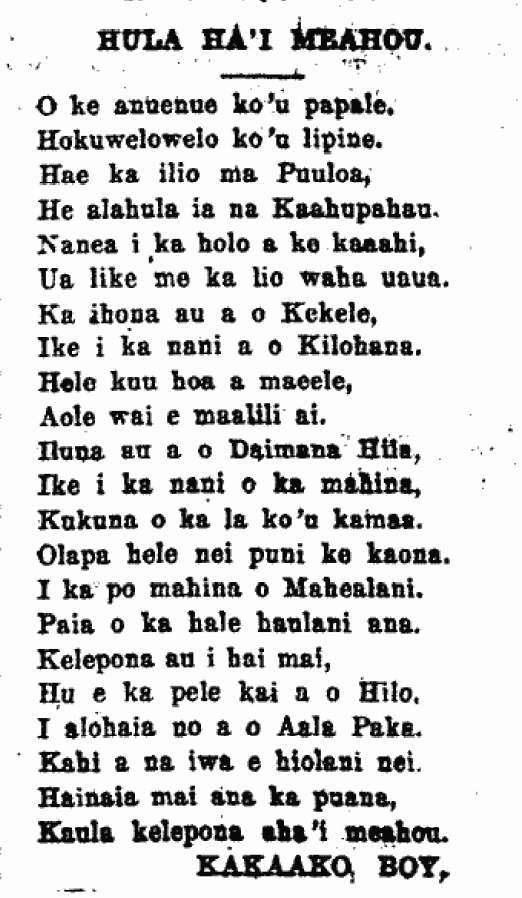
HULA HA’I MEAHOU.

O ke anuenue ko’u papale,
Hokuwelowelo ko’u lipine,
Hae ka ilio ma Puuloa,
He alahula ia na Kaahupahau,
Nanea i ka holo a ke kaaahi,
Ua like me ka lio waha uaua,
Ka ihona au a o Kekele,
Ike i ka nani a o Kilohana.
Hele kuu hoa a maeele,
Aole wai e maalili ai.
Iluna au a o Daimana Hila,
Ike i ka nani o ka mahina.
Kukuna o ka la ko’u kamaa,
Olapa hele nei puni ke kaona.
I ka po mahina o Mahealani,
Paia o ka hale haulani ana.
Kelepona au i hai mai,
Hu e ka pele kai a o Hilo.
I alohaia no a o Aala Paka,
Kahi a na iwa e hiolani nei.
Hainaia mai ana ka puana,
Kaula kelepona aha’i meahou.

KAKAAKO BOY.

[I wonder if this mele preceded or followed the song we know today as “Kukuna o ka La”.]

(Kuokoa, 11/11/1921, Section 2, p. 1)

HULA HA'I MEAHOU.

Ka Nupepa Kuokoa, Buke LIX, Helu 45, Mahele Elua, Aoao 1. Novemaba 11, 1921.

“Missionary Herald,” 1821–.

 Here is another reference available online. This publication was put out by the American Board of Commissioners for Foreign Missions (ABCFM), reporting home to America on their work throughout the world. Of particular interest to us is what they say about Hawaii. Here for instance is an article appearing in the year of the overthrow, 1893.

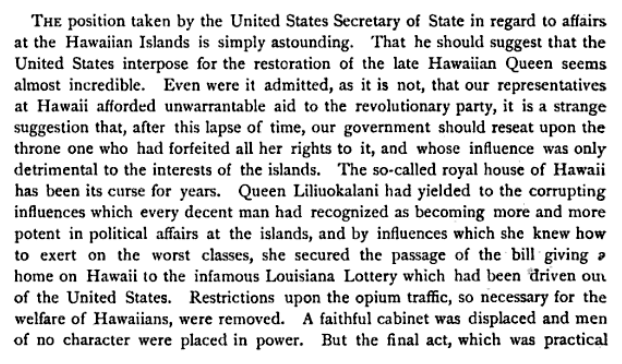
The position taken by the United States Secretary of State in regard to affairs at the Hawaiian Islands is simply astounding. That he should suggest that the United States interpose for the restoration of the late Hawaiian Queen seems almost incredible. Even were it admitted, as it is not, that our representatives at Hawaii afforded unwarrantable aid to the revolutionary party, it is a strange suggestion that, after this lapse of time, our government should reseat upon the throne one who had forfeited all her rights to it, and whose influence was only detrimental to the interests of the islands. The so-called royal house of Hawaii has been its curse for years. Queen Liliuokalani had yielded to the corrupting influences which every decent man had recognized as becoming more and more potent in political affairs at the islands, and by influences which she knew how to exert on the worst classes, she secured the passage of the bill giving a home on Hawaii to the infamous Louisiana Lottery which had been driven out of the United States. Restrictions upon the opium traffic, so necessary for the welfare of Hawaiians, were removed. A faithful cabinet was displaced and men of no character were placed in power. But the final act, which was practical…

(Missionary Herald, 12/1893, p. 510.)


The position taken...

The Missionary Herald, Volume LXXXIX, Number XII, Page 510. December 1893.

…suicide of the monarchy, was the attempt on her part to abrogate the Constitution and by sheer force establish a new one of her own making. Even her subservient ministers refused to endorse the scheme, yet she insisted upon it and sought to incite the populace to stand by her in her autocratic plans. It was then that all the better classes united as one man and deposed her. Never was there a revolution more warranted by facts, never was one more peacefully accomplished, and a queen of worthless character was set aside and the monarchy by its own act came to an end. If Minister Stevens or the commander of the Boston erred in judgment in any transaction, which we are not prepared to admit, yet there is no valid ground for the interference of our government to reverse the revolution months after it was consummated. We do not speak here of the political question as to what it is expedient for the United States to do in reference to a protectorate or to annexation. Opinions of these points may differ, but it would seem as if there were no room for difference of opinion in regard to this question of reestablishing the old monarchy on Hawaii. The best portion of her citizens have asked for some form of connection with the United States. Our government has a perfect right to say yes or no to all these proposals. And the Provisional Government at Honolulu has a right to say to us, “Either accept our proposal or hands off.” We regret to be obliged to speak in such terms of propositions that come from our national administration. We certainly should not do so did we not believe that any attempt to restore the Hawaiian Queen to her throne would be a gross outrage, and would be followed by the most serious consequences to the moral and religious interests of the islands, as well as to their material prosperity. We cannot think that our people will tolerate any intervention which has for its object the replacing upon the throne of a sovereign whose influence will be only for evil.

(Missionary Herald, 12/1893, p. 511.)

Continue reading

Island Princesses, 1908.

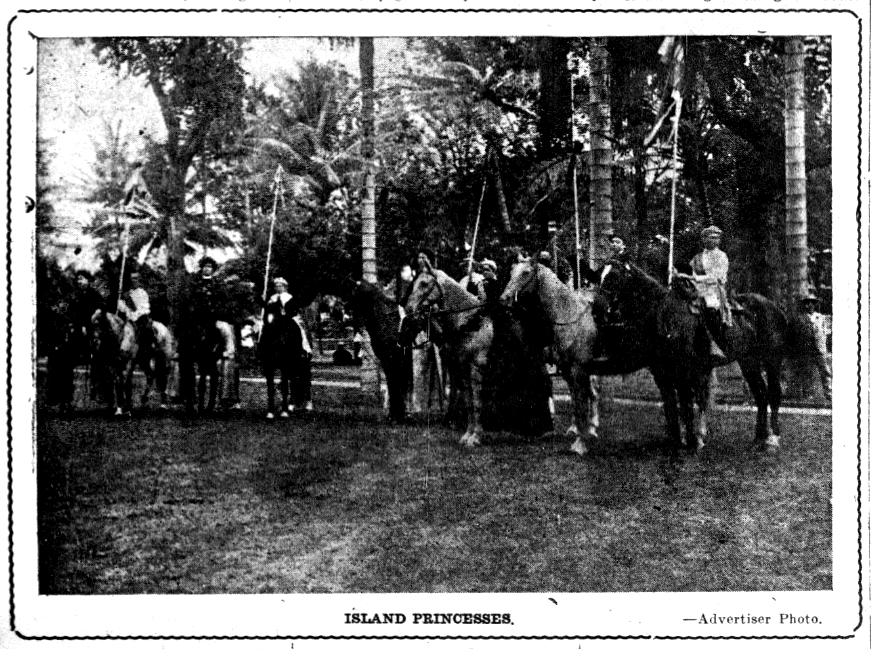
ISLAND PRINCESSES.

ISLAND PRINCESSES.

Pacific Commercial Advertiser, Volume VI, Number 269, Page 2. February 23, 1908.

THE PA-U RIDERS.

Thirty-four pa-u riders came cantering along in four sections of color: yellow, red, orange and pink, led by Judge Andrade and Mrs. Puahi. The Kaonohiokala Club sent fifteen horse women and the Wakinekona Club eighteen equestiennes. A brave sight they made with their long pa-us fluttering in the breeze and their garlands showing bright in the sunshine.

Several of the older riders were in the parade, ladies who wore the pa-u in the pleasure-loving days of the monarchy. Very dignified were these elderly dames and very well they rode. The younger women were out for fun and they certainly had it, galloping wherever there was room to and urging their steeds on with merry shouts. The riders included the following from the Kaonohiokala Club: Mrs. Puahi, Mrs. Kaumaka, Mrs. Dias, Mrs. Kaluapapakini, Mrs. Kailianu, Mrs. Nakapaahu, Mrs. Irene Silva, Mrs. Kauwa, Mrs. Haalou, Miss Lucy Woodward, Mrs. M. Hoonani, Mrs. Maluae, Mrs. Anehilo Keama, Mrs. Stahle, Mrs. Johnson; and the following members of the Wakinekona Club: Mrs. Horn, Mrs. Kapio, Mrs. Liau, Mrs. Aiwohi, Mrs. Jackson, Mrs. Pumehia, Mrs. Mahi, Mrs. Isaac, Mrs. Fairman, Mrs. Kekuewa, Mrs. Kapulani, Mrs. Tuck Williams, Miss Kekua, Miss M. Hao, Mrs. Emakai, Miss Marie Hiram, Miss Julia Lui, Miss Mary Wood. Continue reading

More pāʻū riders, 1909.

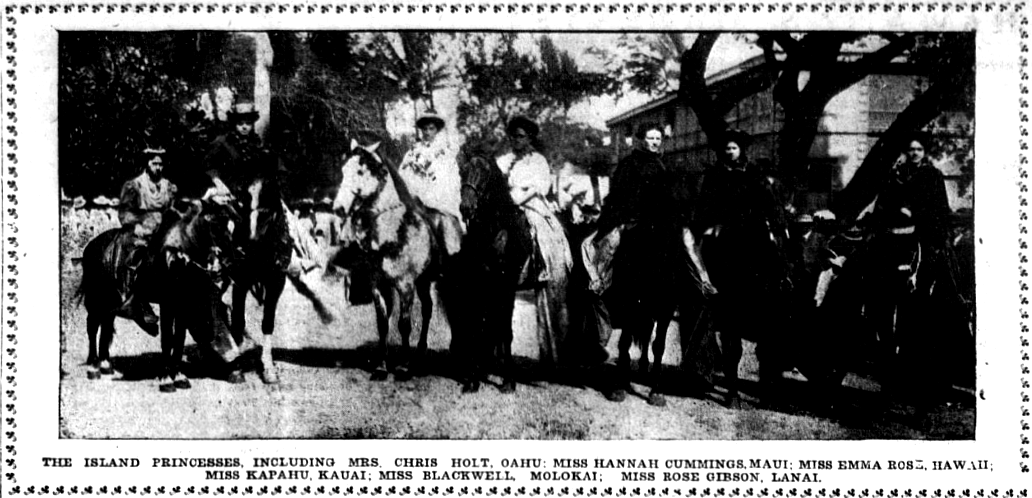
THE ISLAND PRINCESSES, INCLUDING MRS. CHRIS HOLT, OAHU; MISS HANNAH CUMMINGS, MAUI; MISS EMMA ROSE, HAWAII; MISS KAPAHU, KAUAI; MISS BLACKWELL, MOLOKAI; MISS ROSE GIBSON, LANAI.

(Hawaiian Gazette, 2/23/1909, p. 5)

THE ISLAND PRINCESSES...

Hawaiian Gazette, Volume LI, Number 120, Page 5. February 23, 1909.

Hawaiian Hotel on Hotel Street, 1899.

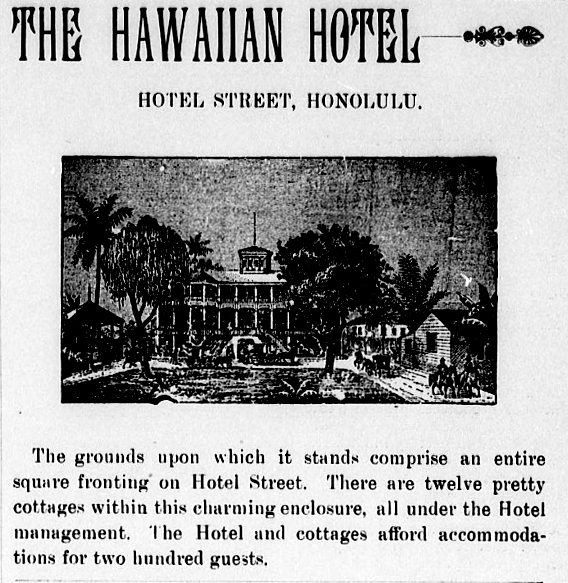
THE HAWAIIAN HOTEL

HOTEL STREET, HONOLULU.

The grounds upon which it stands comprise an entire square fronting on Hotel Street. There are twelve pretty cottages within this charming enclosure, all under the Hotel management. The Hotel and cottages afford accommodations for two hundred guests.

(Austin’s Hawaiian Weekly, 6/24/1899, p. 11)

THE HAWAIIAN HOTEL

Austin’s Hawaiian Weekly, Volume I, Number 2, Page 11. June 24, 1899.

Hawaiian Language classes on Maui, 1941.

TEACHES MAUI HAWAIIAN CLASS

J. P. COCKETT

 J. P. Cockett, county treasurer of Maui, is successfully conducting a class for the study of the Hawaiian language at Wailuku, which has a total enrollment of 33.

The class is now in an advanced stage and the students are making very satisfactory progress according to Mr. Cockett.

The membership consists of the following: Frank Suzuki, Hawley Seiler, Mr. and Mrs. J. T. Correa, D. A. Correa, Mary D. Ah Sam, Mr. and Mrs. G. Furukawa, Mrs. H. Stibbard, Thomas Furukawa, Violet Chong, Ululani Collins, Elaine Matsumoto, C. Lindsay, Mrs. Abbie Baldwin, Misses Ah Lum and Mum Kyau Hew, B. Evelyn Miswander, M. Jane Gray, Miss Mildred Dean, Jack Marnie, K. Kawahara, G. Shimanuki, R. R. Omori, Mr. and Mrs. Ted Chung, Sylvester Correa, Alfred C. Franco, William A. Adams, Bella R. Martin, A. W. Langa and M. L. Carmichael.

(Star of Hawaii, April 30, 1941, p. 4)

TEACHES MAUI HAWAIIAN CLASS

The Star of Hawaii, Volume XXXVI, Number 1, Page 4. April 30, 1941.

Restoration Anthem, 1843.

The following hymn was sung by various circles on the day of the Restoration; as well as after the Temperance Picnic, given by His Majesty, to Foreign Residents and Naval Officers, (English and American,) at his Country Residence in Nuuanu Valley, August 3d.

RESTORATION ANTHEM.

Tune, ‘God Save the King.’

Hail! to our rightful King!
We joyful honors bring
This day to thee!
Long live your Majesty!
Long reign this dynasty!
And for posterity
The sceptre be!

Hail! to the worthy name!
Worthy his Country’s Fame
Thomas, the brave!
Long shall they virtues be,
Shrined in our memory
Who came to set us free,
Quick oe’r the wave!

Hail! to our Heavenly King!
To Thee our Thanks we bring,
Worthy of all;
Loud we thine honors raise!
Loud is our song of praise!
Smile on our future days,
Sovereign of all!

July 31, 1843.  Edwin O. Hall.

[This post may be just a little early this year, but it is good to not just remember momentous events like Ka La Hoihoi Ea just one day of the year. Last year, the Hawaiian Historical Society put up handwritten lyrics of this mele on their Facebook page on the 27th of July. Here we find it in print, just a few days following its being penned by Edwin O. Hall!]

(Temperance Advocate and Seamen’s Friend, 8/11/1843, p. 42)

RESTORATION ANTHEM.

Temperance Advocate and Seamen’s Friend, Volume I, Number VIII, Page 42. August 11, 1843.