Hauoli La Hanau, e Mary Kawena Pukui! 1964.

Isle Scholar Celebrates Birthday With New Work

By MARY COOKE

Mary Kawena Pukui, dean of Hawaiian scholars, has two reasons to celebrate today.

It’s her 69th birthday, and the English-Hawaiian Dictionary, part of a project for which she started the research 30 years ago, is just out.

It is a companion volume of the Hawaiian-English Dictionary published in 1957. On both works her collaborator was Dr. Samuel H. Elbert of the University of Hawaii who studied the language with her. Both were published by the University Press.

“IT IS such a relief,” Kawena began in the light, unhurried conversational tones of a Hawaiian tutu, “to have the dictionaries finished.”

But her dark eyes sparkled with the intensity of the scholar as she added, “now I can go ahead with the Kamakau.”

She explained that some years ago she translated the writings on Hawaiian religion, arts and crafts by the early Hawaiian author, Samuel Kamakau. Now she is reviewing the work for publication with Dorothy Barrere of the Bishop Museum.

“AND THERE are lots of other things I want to do, too,” she said with characteristic forward-looking zeal.

Kawena is modest about looking backward. But the record shows 40 years of persistent, scholarly accomplishment as researcher, translator, compiler and writer of authentic Hawaiiana.

Thirty-seven titles in Bishop Museum listings covering ethnology, sociology, natural history and linguistics are the work of Mary Pukui alone or in collaboration with scientists and other writers.

HER MOTIVATION is the urgency she feels to research and record all possible knowledge of the indigenous culture of Hawaii.

When she began writing and translating years ago she started a card file of Hawaiian words “for whoever would do a new Hawaiian dictionary… I never thought I was going to be the one to do it,” she said.

Her source material was Hawaiian newspapers and magazines, the Hawaiian Bible, catechisms and religious writings of all denominations, legends, folk lore, chants and writings of early native scholars.

Legal terms and land law terms were translated, and from the modern Hawaiian vocabulary, such contemporary words as “air raid” and “blackout” were also included.

KAWENA, with Eleanor Williamson of the Bishop Museum, also traveled remote areas of the Islands with a tape recorder to garner all she could from living memories about pronunciation and meanings of words.

She says the Hawaiian language frequently is complicated by multiple meanings.

Advertiser Photo by Charles Okamura

MARY KAWENA PUKUI Continue reading
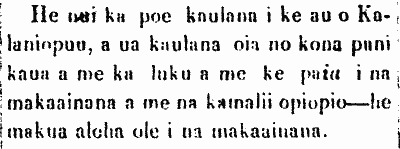
Kalaniopuu’s fame as told by S. M. Kamakau, 1867.

[Found under: “KA MOOLELO O KAMEHAMEHA I.”]

He nui ka poe kaulana i ke au o Kalaniopuu, a ua kaulana oia no kona puni kaua a me ka luku a me ka paia i na makaainana a me na kamalii opiopio—he makua aloha ole i na makaainana.

There were many famous ones during the era of Kalaniopuu, and he himself was well known, as someone who loved war, and massacring, and the striking of the makaainana and small children—he was a father who had no aloha for the makaainana.

[Although Kamakau describes many a chief as “war loving,” he describes Kalaniopuu as particularly cruel. This passage can be found in “Ruling Chiefs of Hawaii,” page 115.]

(Kuokoa, 2/23/1867, p. 1)

Kuokoa_2_23_1867_1.png

Ka Nupepa Kuokoa, Buke VI, Helu 8, Aoao 1. Feberuari 23, 1867.

Some of the battles of Kalaniopuu, 1866.

[Found under: “Ka Moolelo o Kamehameha I.”]

The battles between Kalaniopuu, the King of Hawaii, with Kahekili, the King of Maui.

The years 1775, 1776, 1777, 1778, and 1778. Kalaniopuu went to war at Kaupo on Maui, with his Alii, his war Officers, and his soldiers. Kalaniopuu first went to war at Kaupo, and he tortured the makaainana of Kaupo by clubbing their foreheads with his war club [newa]. This battle was called Kalaehohoa [“Clubbing-of-the-Forehead”] Continue reading

More on the parentage of Kalaniopuu from S. M. Kamakau, 1867.

[Found under: “KA MOOLELO O NA KAMEHAMEHA”]

A GENEALOGY

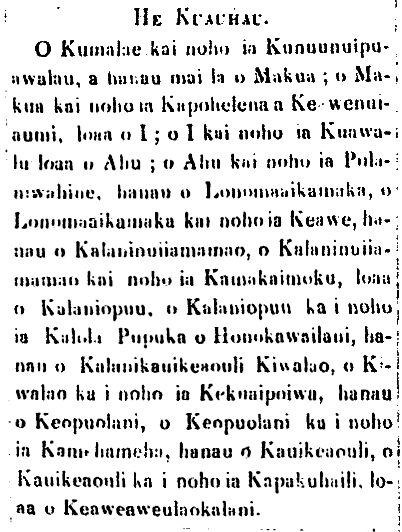
Kumalae dwelt with Kunuunuipuawalu, and born was Makua; Makua dwelt with Kapohelena, child of Keawenuiaumi, and born was I; I dwelt with Kuawalu, born was Ahu; Ahu dwelt with Piilaniwahine, and born was Lonomaaikanaka; Lonomaaikanaka dwelt with Keawe, born was Kalaninuiamamao, Kalaninuiiamamao dwelt with Kamakaimoku, born was Kalaniopuu; Kalaniopuu dwelt with Kalola Pupuka o Honokawailani, born was Kalanikauikeaouli Kiwalao; Kiwalao dwelt with Kekuiapoiwa, born was Keopuolani; Keopuolani dwelt with Kamehameha, born was Kauikeaouli; Kauikeaouli dwelt with Kapakuhaili, born was Keaweaweulaokalani.

(Kuokoa, 11/16/1867, p. 1)

Kuokoa_11_16_1867_1

Ka Nupepa Kuokoa, Buke VI, Helu 46, Aoao 1. Novemaba 16, 1867.

The parentage of Kalaniopuu, 1867.

[Found under: “KA MOOLELO O KAMEHAMEHA I.”]

It is said that Kalaniopuu was the child of Peleioholani, the King of Oahu, and that he was called Kalaniopuu, that being Kaleiopuu, the lei of Kualii, that is the tooth of the whale and whale ivory made smooth in the shape of a chicken spur [opuu], and that is what was the royal adornment of the alii of Oahu—this was not the case with Hawaii Island [who wore tongue-shaped lei niho palaoa]. Continue reading

The meeting of Kalaniopuu and Cook, 1867.

[Found under: “KA MOOLELO O KAMEHAMEHA I.”]

The Era of Kalaniopuu, 1779. Pertaining to the Death of Captain Cook, that is Lono.

On the 24th of January, Kalaniopuu and his warriors returned from Maui and landed at Awili in Kaawaloa, and stayed at Hanamua at Keaweaheulu’s place, but they were also on Maui at war with Kahekili.

Kalaniopuu saw the many women were at the ocean on the ship to prostitute themselves [hookamakama], so Kalaniopuu forbade women from going down to the ship. And the haole saw that the women were not coming to the ship, so the haole went into the uplands of Napoopoo and at Kahauloa, and on this side of Kaawaloa to solicit prostitution, and the women received a great amount of foreign rubbish [opala]. Continue reading

Kamakau’s story of Lonoikamakahiki, 1871.

[Found under: “KA MOOLELO HAWAII: NA S. M. KAMAKAU.”]

Pertaining to Lonoikamakahiki: Lonoikamakahiki was the child of Keawenuiaumi, the alii of Kau and Puna, and reigned over the entirety of those sections of Hawaii. He married a chiefess, Kaikilanikohepanio, from amongst the granchildren of Laeanuikaumanamana, and from the two of them were born the sons, Keawehanauikawalu and Kaihikapumahana, and the two of them became ancestors of chiefs and commoners. When Lono ruled, he was a chief who did not listen to nor heed the advice of his kahuna and counselors [kakaolelo], so some of his counselors left to find a good master [haku]. And that is why Lanahuimihaku folks left, to find a master who would follow and listen to their advice; they searched for a haku for themselves, and they lived went to live with Kailikapuakuihewa on Oahu, believing that he was a chief who was upright and who listened to everything the kahuna and kakaolelo instructed….

[S. M. Kamakau’s telling of the story of Lonoikamakahiki ran from 1/12/1871 to 2/2/1871 in the newspaper Au Okoa. It can be found in Ruling Chiefs, pp. 47–63.]

(Au Okoa, 1/12/1871, p. 1)

AuOkoa_1_12_1871_1.png

Ke Au Okoa, Buke VI, Helu 39, Aoao 1. Ianuari 12, 1871.

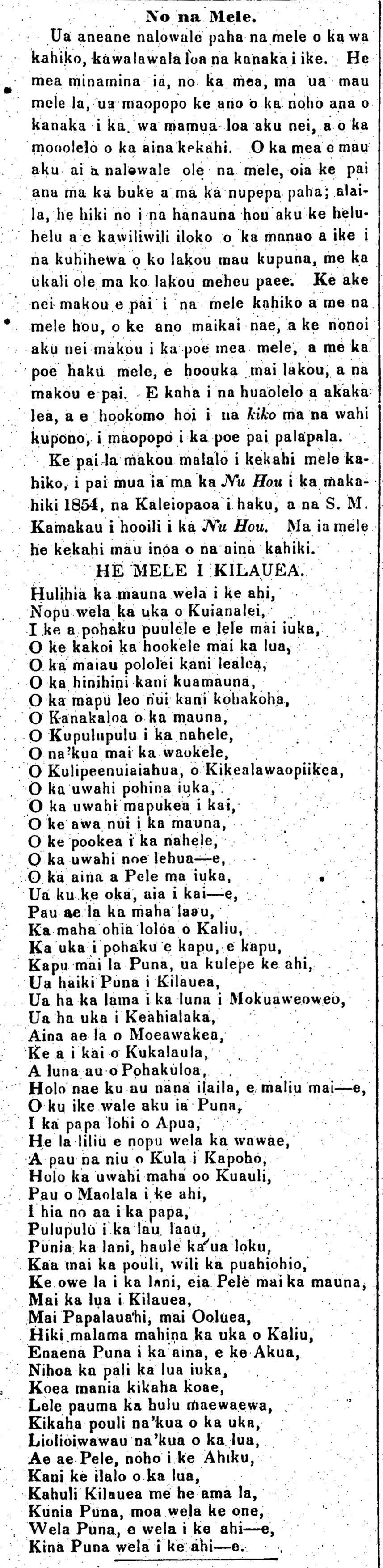
More on mele, 1860.

Pertaining to Mele

Perhaps the mele of old are almost all lost; those who know them are but few. This is something to be regretful of for in those mele, one can understand the way of life of the people of very long ago, and the stories of the land as well. The means for these mele to continue and not to be lost is by printing them in books and newspapers perhaps; in that way, the new generations can read them and contemplate over it and see the misconceptions of their kupuna and to not follow in their misguided ways. We wish to print the old mele and new mele, as long as they are good, and we ask of those who have mele and the composers of mele to send them to us and we will print them. Write the letters very clearly, and insert punctuation where they should be so that the printers understand.

We are printing below an old mele previously printed in Nu Hou in 1854, composed by Kaleiopaoa and submitted to the Nu Hou by S. M. Kamakau. In the mele there are foreign place names.

HE MELE I KILAUEA.

Hulihia ka mauna wela i ke ahi,
Nopu wela ka uka o Kuianalei,
I ke a pohaku puulele e lele mai iuka,
O ke kakoi ka hookele mai ka lua,
O ka maiau pololei kani lealea,
O ka hinihini kani kuamauna,
O ka mapu leo nui kani kohakoha,
O Kanakaloa o ka mauna,
O Kupulupulu i ka nahale,
O na’kua mai ka waokele,
O Kulipeenuiaiahua, o Kikealawaopiikea,
O ka uwahi pohina iuka,
O ka uwahi mapukea i kai,
O ke awa nui i ka mauna,
O ke pookea i ka nahele,
O ka uwahi noe lehua—e,
O ka aina a Pele ma iuka,
Ua ku ke oka, aia i kai—e,
Pau ae la ka maha laau,
Ka maha ohia loloa o Kaliu,
Ka uka i pohaku e kapu, e kapu,
Kapu mai la Puna, ua kulepe ke ahi,
Ua haiki Puna i Kilauea,
Ua ha ka lama i ka luna i Mokuaweoweo,
Ua ha uka i Keahialaka,
Aina ae la o Moeawakea,
Ke a i kai o Kukalaula,
A luna au o Pohakuloa,
Holo nae ku au nana ilaila, e maliu mai—e,
O ku ike wale aku ia Puna,
I ka papa lohi o Apua,
He la liliu e nopu wela ka wawae,
A pau na niu o Kula i Kapoho,
Holo ka uwahi maha oo Kuauli,
Pau o Maolala i ke ahi,
I hia no aa i ka papa,
Pulupulu i ka lau laau,
Punia ka lani, haule ka ua loku,
Kaa mai ka pouli, wili ka puahiohio,
Ke owe la i ka lani, eia Pele mai ka mauna,
Mai ka lua i Kilauea,
Mai Papalauahi, mai Ooluea,
Hiki malama mahina ka uka o Kaliu,
Enaena Puna i ka aina, e ke Akua,
Nihoa ka pali ka lua iuka,
Koea mania kikaha koae,
Lele pauma ka hulu maewaewa,
Kikaha pouli na’kua o ka uka,
Liolioiwawau na’kua o ka lua,
Ae ae Pele, noho i ke Ahiku,
Kani ke ilalo o ka lua,
Kahuli Kilauea me he ama la,
Kunia puna, moa wela ke one,
Wela Puna, e wela i ke ahi—e,
Kina Puna wela i ke ahi—e.

(Hae Hawaii, 3/21/1860, p. 204)

No na Mele.

Ka Hae Hawaii, Buke 4, Ano Hou.—Helu 51, Aoao 204. Maraki 21, 1860.

Rufus Anderson, “Hawaiian Islands: Their Progress and Condition Under Missionary Labors,” 1865.

Anderson’s Writings About Hawaii nei.

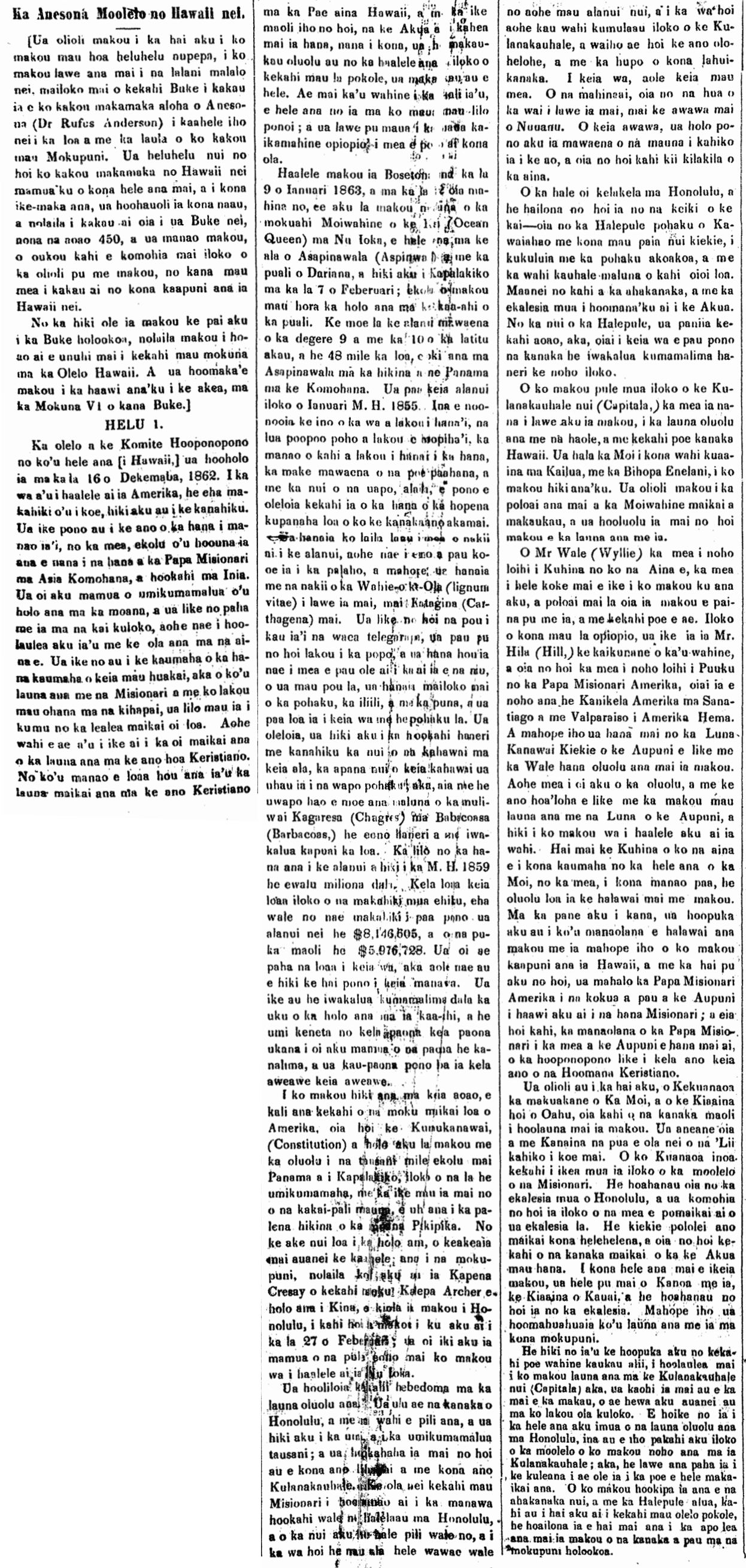
(We are pleased to tell you, our dear readers, that we are taking the lines below from a Book written by our beloved friend, Anesona (Dr. Rufus Anderson) who travelled the width and breadth of our Islands. Our friend read greatly about Hawaii nei before coming here, and when he saw it for his own eyes, his heart was gladdened, and therefore, he wrote this Book of 450 pages, and we believe that you all will also join in the pleasure along with us, for what he wrote about his travels around Hawaii nei.

Because we are unable to print the Book in its entirety, therefore, we tried to translate some chapters into Hawaiian. And we are beginning to provide it for the public from Chapter VI of his Book.)

[This is the introduction to a translation of Rufus Anderson’s “Hawaiian Islands: Their Progress and Condition Under Missionary Labors” which appears as a serial in the Kuokoa from 1/19/1865 to 6/8/1865. The English is available on Google Books here. It is interesting that this serial describing travels through the archipelago is immediately followed by Kamakau’s serial on travels describing famous places, kupua, and ancient alii from Hawaii to Niihau.]

(Kuokoa, 1/19/1865, p. 1)

Ka Anesona Moolelo no Hawaii nei.

Ka Nupepa Kuokoa, Buke IV, Helu 3, Aoao 1. Ianuari 19, 1865.

William Hyde Rice’s Hawaiian Legends in English, 1923.

[From the Preface of “Hawaiian Legends by William Hyde Rice”]

The collection of Hawaiian legends of which a translation is given in the following pages represents the work of many years by William Hyde Rice of Kauai. However, it is only within the last few years that Mr. Rice has translated the legends from his Hawaiian manuscripts. He has tried to make his version as literal as possible, preserving at the same time the spirit of the original Hawaiian, its flavor, rhythm, and phrasing. He has avoided adding modern embroidery of fancy, as well as figures of speech foreign to the Hawaiian language and to its thought and expression.

….

Mr. Rice has been exceptionally well prepared for this work, as he has been familiar with the Hawaiian language from his earliest childhood. In fact until he was twenty, he never thought in English but always in Hawaiian, translating mentally into his mother tongue. In 1870 when he became a member of the House of Representatives, during the reign of Kamehameha V, Governor Paul Kanoa and S. M. Kamakau, the historian, both well-known Hawaiian scholars, gave Mr. Rice much help with his Hawaiian, especially teaching him the proper use of various complicated grammatical constructions, and explaining obscure variations in pronunciation and meaning.

The sources of the legends in this collection are varied. A number of the stories Mr. Rice remembers having heard as a child, and now rare ones were gathered in later years. Many are from more than one source, but have corresponded even in details, and almost word for word. The legend of Kamapuaa, for instance, is one of the first which Mr. Rice remembers hearing. When a boy, the places mentioned in this story were pointed out to him: the spot where the demi-god landed, where he found the hidden spring, and where he rooted up the natives’ sugar-cane and sweet potatoes. The story of “The Small Wise Boy and the Little Fool” he has also been familiar with since childhood. The places mentioned in this tale can likewise be pointed out.

Most of the legends are from Kauai sources, but a number have been gathered from the other islands of the group. Whenever Mr. Rice heard of an old Hawaiian who knew any legends, he went to him, sometimes going to several to trace a special story, as for instance, the “Jonah and the Whale” story, “Makuakaumana”, which after a long search he finally procured from Mr. Westervelt. This curious story seem to be more modern than the others of the collection. While hunting for a reliable version of this story, Mr. Rice incidentally heard the story of “Manuwahi” at Heeia from an old Hawaiian.

“The Bird Man”, “Holuamanu”, “The Destruction of Niihau’s Akua”, and “The Girl and the Mo-o”, were obtained from Mr. Francis Gay, who is one of the best living scholars of the Hawaiian language. The Niihau legend was heard from several other sources as well. Mr. Gay also gave the legends of the “Rainbow Princess” and the “Shrimp’s Eyes”; the ti plants mentioned in the latter legend can still be pointed out, growing at the mouth of a little valley near Holuamanu. The Hawaiian manuscript of part of the Menehune story was obtained from J. A. Akina, while the story of the “Rain Heiau” was told to him in 1912 by a man named Naialau, who has since died at Kalaupapa. “How Lizards Came to Molokai” and Paakaa and Ku-a-paakaa” were told Mr. Rice by a man from Hawaii named Wiu, while the Rev. S. K. Kaulili, who is still living at Koloa, Kauai, gave him the most complete version of the “Rolling Island”.

During Mr. George Carter’s term as Governor, a reception was given in his honor, at Hanalei, where Mr. Rice was much interested in the very fine oli (chanting) of an old Hawaiian, named Kaululua. From him he obtained a number of legends, including that of “Ulukaa” from corresponding versions of other already in his collection. Other legends have been lost forever on account of ill-timed ridiculing by some chance companion, for Mr. Rice has found that the old people who know the legends are very sensitive, and when they find an unsympathetic auditor, refuse to continue their stories.

[It is often just as important to read the front matter and the back matter of a book than simply heading straight to the main text itself. Many times you can learn a lot of important information.

The stories credited to W. H. Rice found in the Hoku o Hawaii are probably the ones Rice collected over the years.]

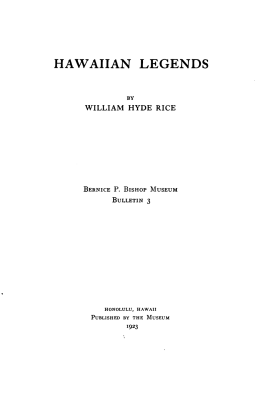
(Rice, William Hyde. “Hawaiian Legends. Bernice P. Bishop Museum Bulletin 3.” Honolulu: The Museum, 1923.)

Hawaiian Legends

Hawaiian Legends by William Hyde Rice