Description of native flora, 1857.

Hard Wood.

O Hae Hawaii:

Aloha oe: this is a new tree I have seen, this tree grows in the uplands of Nuu, in Kaupo. The name of this tree is Kea, and it is a useful tree. You, the reader may ask, “What is good about this tree?” And this is why it is good, because of its solidness; it is very strong, it is the strongest tree growing in this archipelago; its body is black and it very strong, its leaves are like that of the Uhiuhi. This tree is good for house building; if the wood is put into dirt, it doesn’t rot. The natives of Kaupo say that some houses are over 25 years old and there is no rot, and some are over forty years old. It is a familiar tree in Kaupo. But because it is so solid, it is stronger than metal, in that if you put metal into the earth and many years go by, it deteriorates; not so of this wood. This is the reason I am getting the word out, so that my friends will know that this is a good wood for building in dirt, like in Lahaina, Honolulu, Hilo, and other places.

The locals say that it is only in Kaupo that this tree grows, and not any other place on Maui; there are other known strong-wooded trees like Kapua [Pua?], Mamani, and Aalii, but none are like this. Aloha amongst us.

Beniamina.

Kipahulu, Maui, Hawaii, Nov. 5, 1857.

(Hae Hawaii, 11/18/1857, p. 133 & 34)
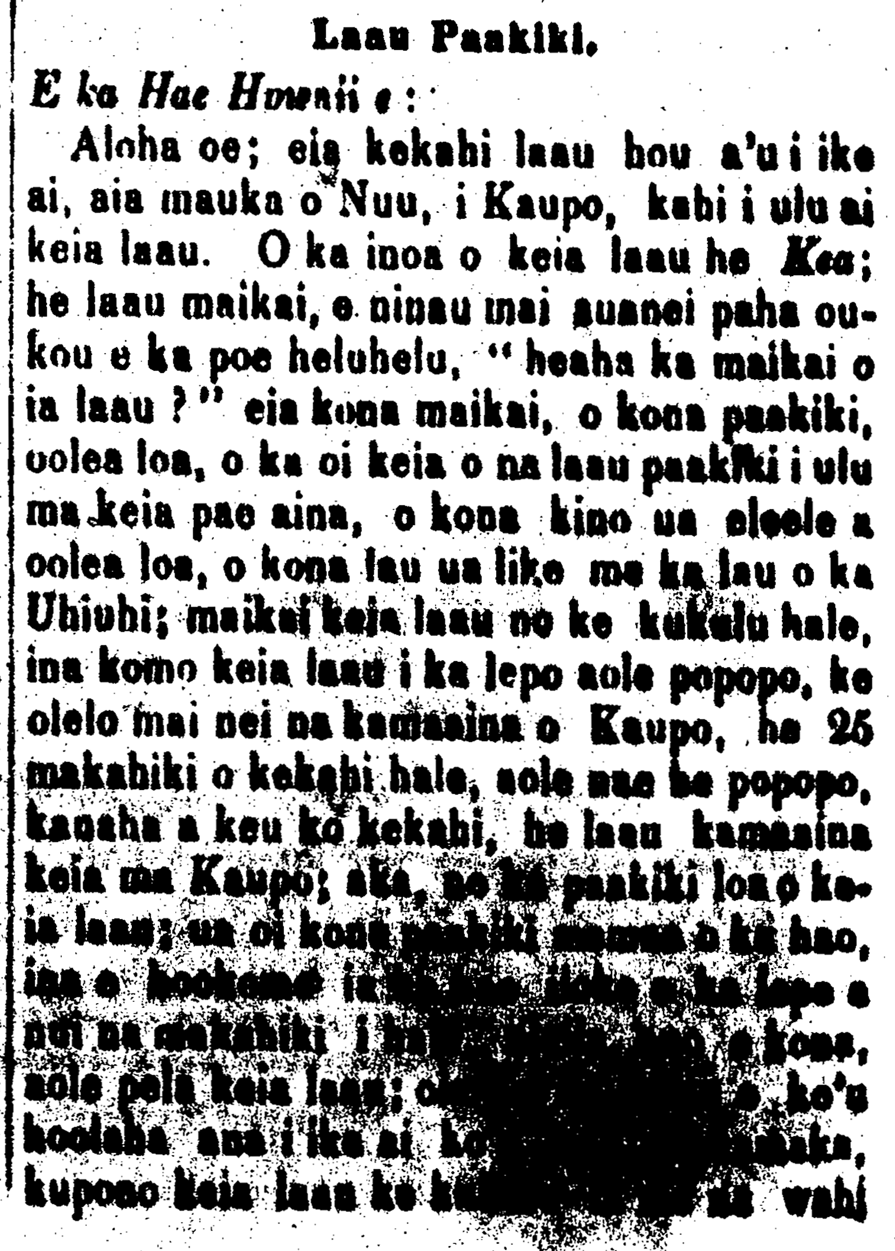
Laau Paakiki.

Ka Hae Hawaii, Buke 2, Ano Hou----Helu 34, Aoao 133. Novemaba 18, 1857.
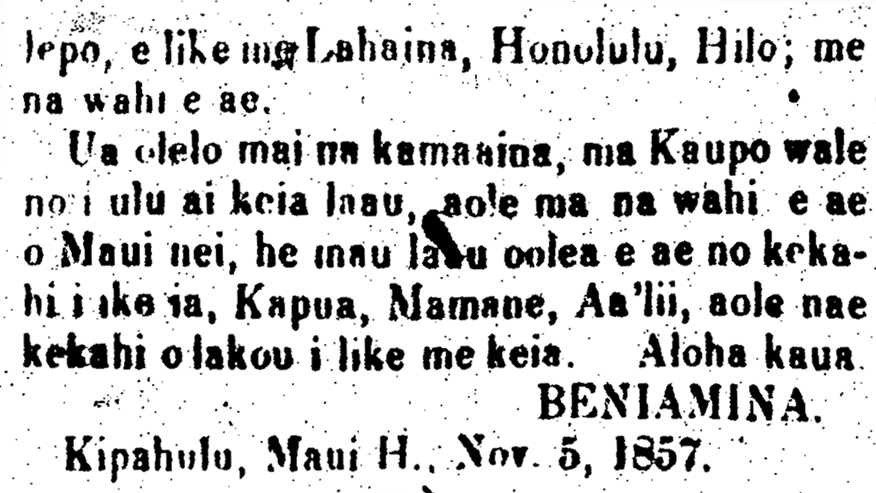
Laau Paakiki (hoomau ia).

Ka Hae Hawaii, Buke 2, Ano Hou----Helu 34, Aoao 134. Novemaba 18, 1857.
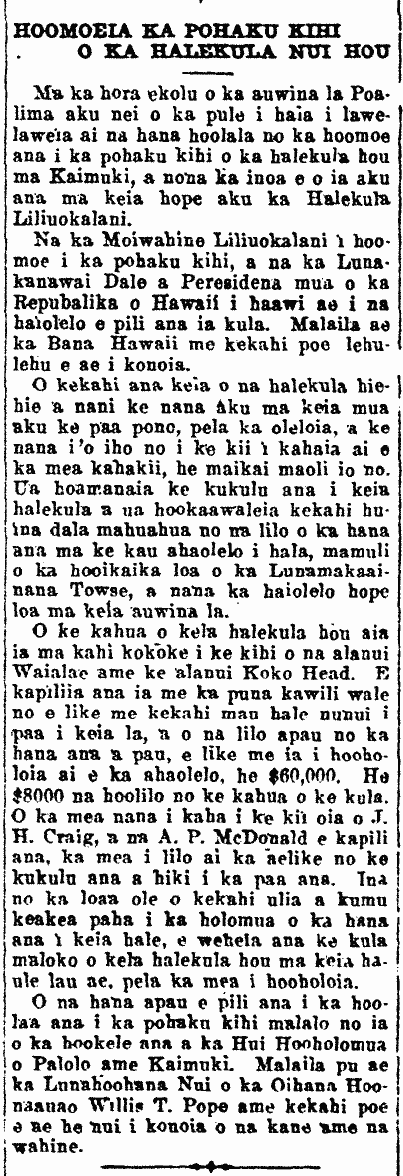
Laying of the cornerstone of Liliuokalani School, 1912.

The Cornerstone of the New Great School is Laid.

At three o’clock on the afternoon of last Friday (4/12/1912), a ceremony was conducted to lay the cornerstone of the new school house in Kaimuki, that will be called hereafter, Liliuokalani School.

Queen Liliuokalani laid the cornerstone, and Legislator Dole, and former President of the Republic of Hawaii gave a speech about the school. The Hawaiian Band was there along with many invited guests.

When it is completed, this will be one of the most distinguished and beautiful schools, according to what is being said. And when you look at the artist’s rendering, it is indeed splendid. Authorization for building and funds were set aside in the previous session of the Legislature, through the efforts of Legislator Towse, and it was he that gave the final speech that afternoon.

The grounds of this school is near the corner of Waialae and Koko Head. It is being constructed of cement, like many of the great buildings being built these days. And the entire costs will be, as decided by the legislature, $60,000. $8000 was spent to purchase the land. The artist who drew the rendering was J. H. Craig. A. P. McDonald is the one doing the constructing; he received the contract to build the school to completion. Should there be no accidents or hinderances to the progress, the school will be unveiled this coming fall, as per what was decided.

Everything concerning the dedication of the cornerstone fell under the Improvement Club of Palolo and Kaimuki. Present also the head of the DOE, Willis T. Pope, as well as many men and women invited to attend.

[Although sadly this school has been closed, I hear there will be a 100th year celebration of the laying of the cornerstone to be held on the Queen Liliuokalani School grounds, on the 12th of April, with gates opening at 3:00 p. m.

See also from Chronicling America these related articles in English:

Evening Bulletin, 4/13/1912, p. 11,

Hawaiian Gazette, 4/16/1912, p. 7.

And about the actual opening of the school:

Hawaiian Gazette, 10/15/1912, p. 7.]

(Kuokoa, 4/19/1912, p. 6)

HOOMOEIA KA POHAKU KIHI O KA HALEKULA NUI HOU.

Ka Nupepa Kuokoa, Buke XLVIII, Helu 16, Aoao 6. Aperila 19, 1912.

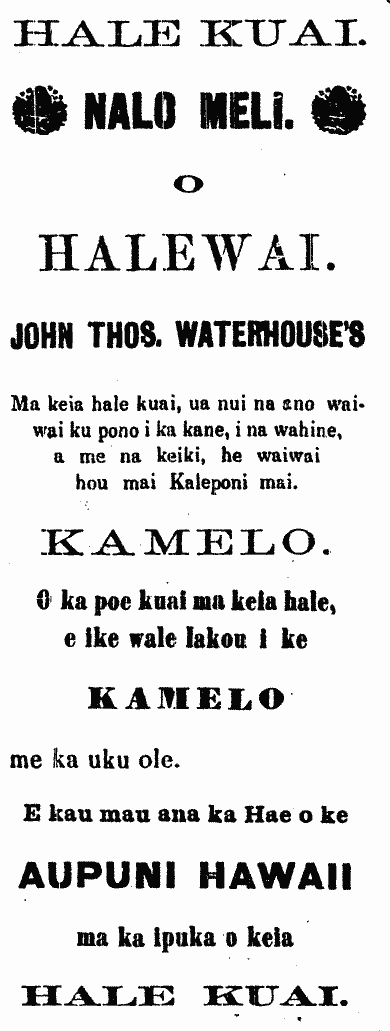
Ad from the first issue of Kuokoa, 1861.

NALO MELI [Bee]

SHOP

of

HALEWAI.

JOHN THOMAS WATERHOUSE’S

At this store, there are many items for men, women, and children; new goods from California.

CAMEL

Those who make purchases from this store will see the

CAMEL

at no cost.

Always flying is the Flag of the

HAWAIIAN NATION

at the entrace of this

STORE.

[Notice how “Halewai” [lit., water house] is what they called John Thomas Waterhouse. Later for Waterhouse you will also see Walakahausi and Walakahauki.

The images to the left and right of “Nalo Meli” are of a bee hive with bees flying above it.

OH, and yes, it seems there was a camel…]

(Kuokoa, 10/1861, p. 3)

HALE KUAI.

Ka Nupepa Kuokoa, Buke I, Helu 1, Aoao 3. Okatoba, 1861.

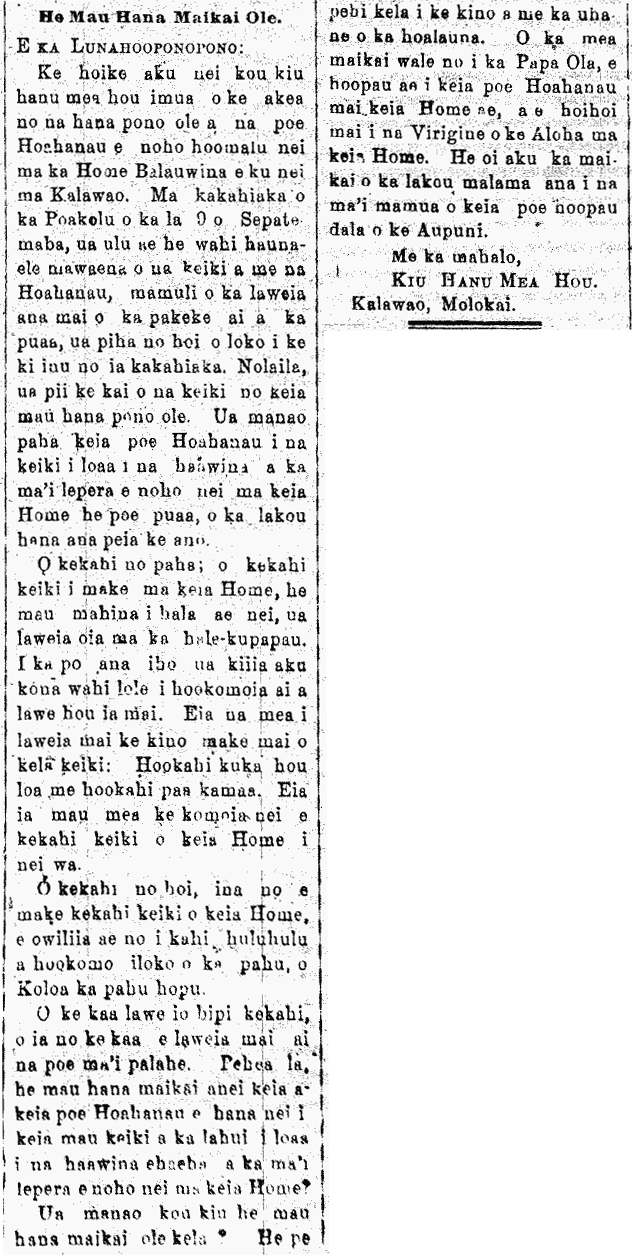
Criticism of treatment at Baldwin Home, 1896.

Improper Acts.

Editor:

Your news-sniffing detective reports before all, the improper actions of the Brothers [Hoahanau] overseeing the Baldwin Home [Home Balauwina] in Kalawao. On Wednesday morning, the 9th of September, there was a uprising between the boys and the Brothers because the pig feed bucket was brought filled with tea to drink that morning. So the boys were incensed at that mistreatment. These Brothers must have thought that those boys inflicted with leprosy at that Home were pigs, and that is why they did that kind of thing.

Here is another thing: one of the boys who died at the Home some months ago was taken to the mortuary. That night, his clothes he was wearing were fetched. Here are the items taken from the body of the dead boy: One brand new suit, and a pair of shoes. These things are being worn now by another boy of the Home.

One more thing, if a boy of the Home dies, he is wrapped up in a blanket and put in a box and taken to Koloa [?].

The cart used to transport beef is another thing; that is the cart used to transport the patients with rotting sores. Is this something proper that the Brothers are doing to these boys of the lahui who are afflicted with this suffering from leprosy living in the Home?

Your detective believes that it is not right. It is killing the body and the soul of their neighbor. The Board of Health [Papa Ola] should remove these Brothers from the Home and return the Sisters [Viregine] of Aloha to this Home. Their care of the patients was much better than that of these people who waste the Government’s money.

With appreciation,

News-Sniffing Detective

Kalawao, Molokai.

(Makaainana, 11/9/1896, p. 3)

He Mau Hana Maikai Ole.

Ka Makaainana, Buke VI----Ano Hou, Helu 19, Aoao 3. Novemaba 9, 1896.

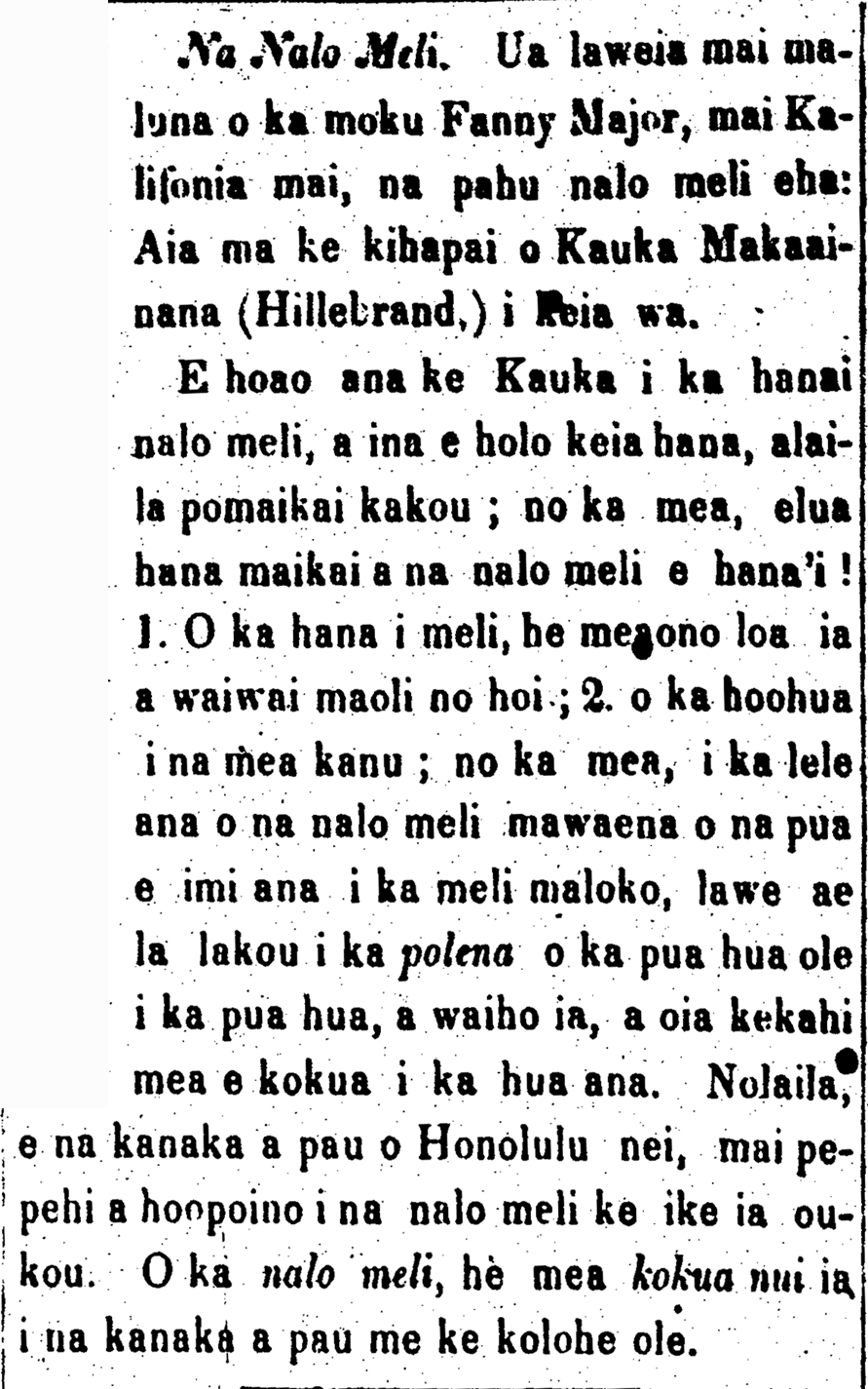
Honey Bees introduced, 1857.

Honey Bees [nalo meli]. Brought upon the ship Fanny Major from California were four boxes of bees. Currently they are in the garden of Dr. Hillebrand [Kauka Makaainana].

The doctor will attempt raising the bees, and should this progress, we will be blessed, because there are two good things done by bees. 1. They make honey, which is very delicious and valuable. 2. They make plants fruit, because when bees fly to flowers in search of the nectar within, it takes with them pollen from non-fruiting flowers to fruiting flowers and deposit it, and that is what helps fruiting. Therefore, all you people of Honolulu nei, do not kill or abuse the bees when you see them. Bees are a great help to all, without any harm.

[According to Senior Scientist and Cultural Advisor at The Nature Conservancy of Hawai’i, Sam Ohu Gon III, “In the big picture, in our modern agricultural world, honeybees are vital, but we should never forget our little-known native bees…”]

(Hae Hawaii, 11/18/1857, p. 134)

Na Nalo Meli.

Ka Hae Hawaii, Buke 2, Ano Hou.----Helu 34, Aoao 134. Novemaba 18, 1857.
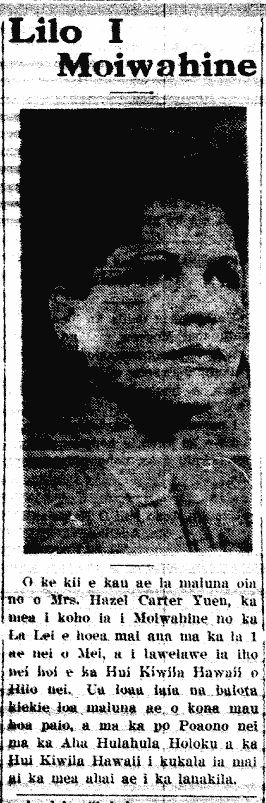
May Day Queen, 1941.

Became Queen

The picture above is of Mrs. Hazel Carter Yuen, the one chosen as Queen for the upcoming Lei Day, the 1st of May, held by the Hawaiian Civic Association [Hui Kiwila Hawaii] of Hilo. She received the most ballots from amongst her running mates, and on the night of this past Saturday at the Holoku Ball of the Hawaiian Civic Association the one who took the win was announced.

(Hoku o Hawaii, 4/9/1941, p. 1)

Lilo i Moiwahine

Ka Hoku o Hawaii, Buke XXXV, Helu 50, Aoao 1. Aperila 9, 1941.

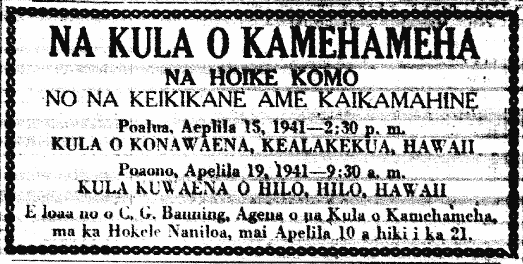
Entrance exams for Kamehameha Schools, 1941.

KAMEHAMEHA SCHOOLS

ENTRANCE EXAMS

FOR BOYS AND GIRLS

Tuesday, April 15, 1941—2:30 p. m.

KONAWAENA SCHOOL, KEALAKEKUA, HAWAII.

Saturday, April 19, 1941—9:30 a. m.

HILO INTERMEDIATE SCHOOL, HILO, HAWAII

C. G. Banning, Agent for the Kamehameha Schools will be available at the Naniloa Hotel from April 10 until the 21st.

(Hoku o Hawaii, 4/9/1941, p. 2)

NA KULA O KAMEHAMEHA

Ka Hoku o Hawaii, Buke XXXV, Helu 50, Aoao 2. Aperila 9, 1941.

Lunalilo’s Crypt overgrown by weeds? 1894.

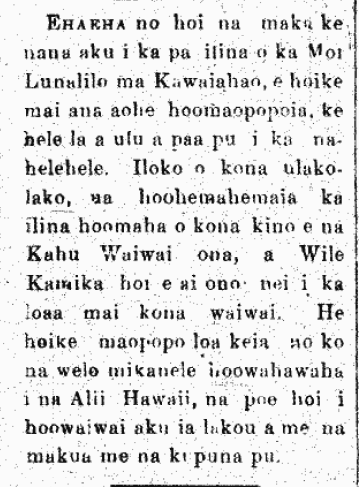
It is painful to see the cemetery of King Lunalilo at Kawaiahao, showing that it is not remembered, for it is overgrown by weeds. In its wealth, the crypt where his body is laid to rest was left to waste by his Trustees, along with Wile Kamika [William Owen Smith] who feasts off of his pay from the trust. This is proof of the missionary descendents’ [welo mikanele] contempt for the Alii of Hawaii, the people who made them wealthy and also their parents and grandparents.

(Makaainana, 3/19/1894, p. 4)

Ehaeha no hoi na maka...

Ka Makaainana, Buke I----Ano Hou, Helu 12, Aoao 4. Maraki 19, 1894.

Renovation of Kawaiahao Cemetery, 1867.

[Found under: “LOCAL NEWS”]

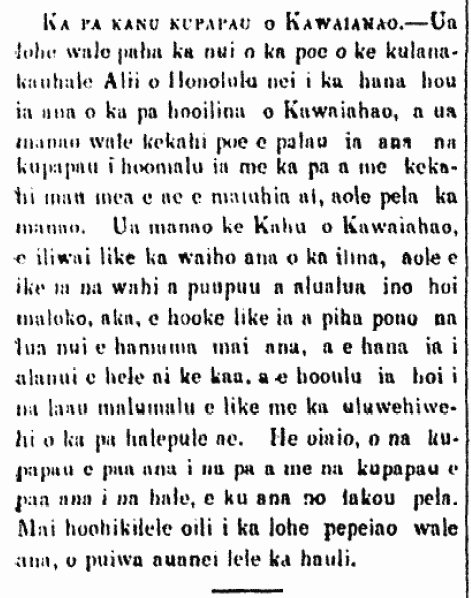
Graveyard of Kawaiahao.—Most of the people of the Capital City of Honolulu have perhaps heard that the cemetery of Kawaiahao is being renovated, and some people have imagined that the bodies laid there to rest, along with the yard and other things at peace there will be plowed up, but this is not the case. The Kahu of Kawaiahao wants to flatten out the graveyard so that there are no humps or holes, to flatten out and fill in the depressions that lay open, and also to make a road for carts to travel on, and to grow shade trees like the greenery of other church yards. It is the truth, the bodies that lay in the yard and the bodies in the crypts will remain as is. Don’t get worked up over what you hear, lest you be shocked.

(Kuokoa, 4/27/1867, p. 3)

Ka pa kanu kupapau o Kawaiahao...

Ka Nupepa Kuokoa, Buke VI, helu 17, Aoao 3. Aperila 27, 1867.

Vital Statistics, 1912.

MARRIAGES.

Lui Hoana Koo to Josephine Marianna Ku, Feb. 29.
Joseph Haole Kealakai to Anna Kaluawai, Feb. 29.
Fred Colburn to Helen Dutro, Mar. 2.

BIRTHS.

To Harry Lee Kwai and Hattie Alapai, a daughter, Feb. 27.
To Nameless and Helen Kamaka, a daughter, Feb. 27.
To Mr. and Mrs. John Ke, a son, Feb. 27.
To Joaquin G. de Silva, a son, Feb. 28.
To Hilo and Hannah Frye, a daughter, Feb. 29.
To Hale and Helen Kanoho, a daughter, Mar. 1.
To Mr. and Mrs. Sol Burke, a daughter, Mar. 5.

DEATHS.

Alexander McCandless, at Queen’s Hospital, Feb. 25
K. M. Koahou, at Makala Boat House [?], Feb. 27.
George N. Shaw, on Ilaniwai Street, Feb. 28.
A baby of William Kuekue, on Queen Street, Feb. 29.
A baby of Charles Kahawai, on Halekauwila Street, Feb. 29.
Pekelo Kinikini, on Dowsett Lane, Feb. 29.
Henry M. Kaeo, on 2nd Avenue, Mar. 3.
Julia Hilo, a the Children’s Hospital, Mar. 4.
Hattie Keala, on Manoa Street, Mar. 5.
Keauloa, at Lunalilo Home, Mar. 6.

(Kuokoa, 3/8/1912, p. 8)

NA MARE / NA HANAU / NA MAKE

Ka Nupepa Kuokoa, Buke XLVIII, Helu 10, Aoao 8. Maraki 8, 1912.