Artifacts from the 1895 Counter-Revolutionary War, 1912.

TWO ARTILLERY SHELLS FOUND AT KAPIOLANI

A Prisoner Found it While Digging up Dirt This Past Monday.

IT WAS BROUGHT TO SHOW

They were ammunition of the Monarchial Government Which Got There in the Revolutionary War.

Outside of Kapiolani Park last Monday, two artillery shells were found when the prisoners were in the middle of digging in the area where they are working; they are huge artillery that would have injured many if they had received those evil pills.

It was only by chance that the two shells were found, and it was lucky that the prisoner did not suffer injury when he came upon the shells as he hit one of them while digging with his pick; if it had blown up at that time, it would have been disaster, but that did not happen.

After the inmate perceived this solid thing that he was digging with his pick, he figured it was probably a rock or something, and put down his pick and began to dig with his hands.

While digging with his hands, he spotted something shiny like metal, and he kept at it until out from the dirt amazingly came two artillery shells from the same place.

A Chinese man who saw these two huge shells brought them here in town after wrapping them in newspapers so that they would not explode when knocking against something.

When it was understood where these shells appeared, there was confirmation from those who participated in the Civil War of 1895 that they were taken from the palace grounds by the soldiers of the government while the Hawaiian troops were gathering at the outskirts of Diamond Head.

(Kuokoa, 3/8/1912, p. 1)
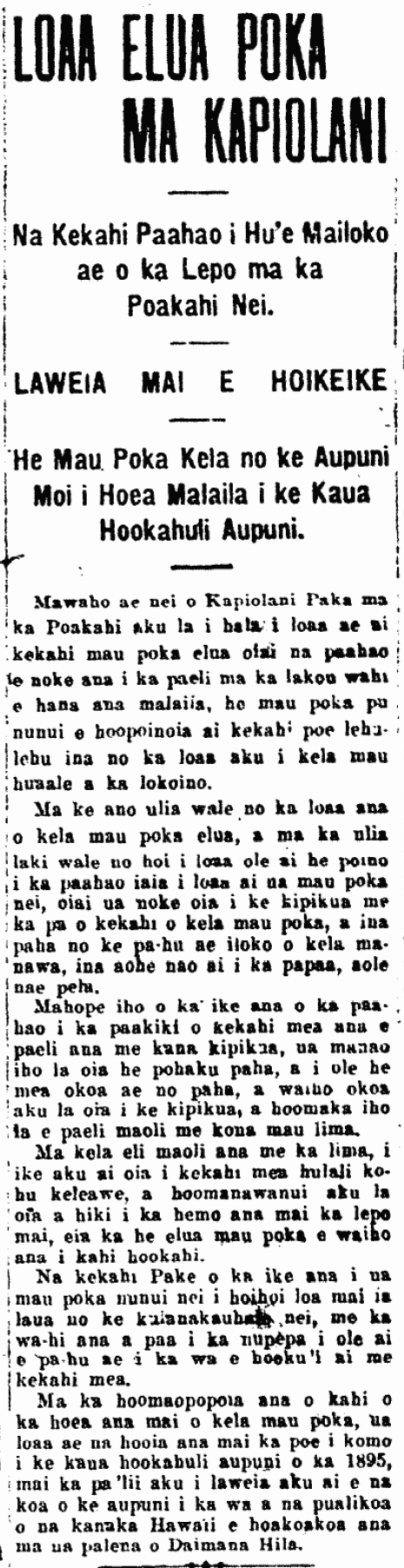
LOAA ELUA POKA MA KAPIOLANI

Ka Nupepa Kuokoa, Buke XLVIII, Helu 10, Aoao 1. Maraki 8, 1912.
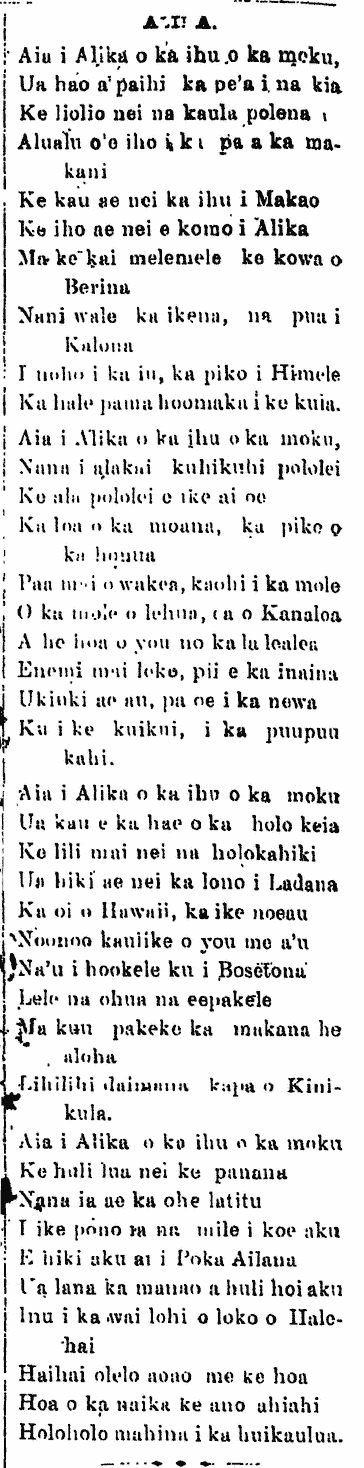
More “Alika”! 1893.

ALIKA.

Aia i Alika o ka ihu o ka moku,

Ua hao a paihi ka pe’a i na kia

Ke liolio nei na kaula polena

Alualu ole iho i ka pa a ka makani

Ke kau ae nei ka ihu i Makao

Ke iho ae nei e komo i Alika

Ma ke kai melemele ke kowa o Berina

Nani wale ka ikena, na pua i Kalona

I noho i ka iu, ka piko i Himele

Ka hale pama hoomaka i ke kuia.

Aia i Alika o ka ihu o ka moku,

Nana i alakai kuhikuhi pololei

Ke ala pololei e ike ai oe

Ka loa o ka moana, ka piko o ka honua

Paa mai [?] o wakea, kaohi i ka mole

O ka mole o lehua, oa [?] o Kanaloa

A he hoa o you no ka la lealea

Enemi mai loko, pii e ka inaina

Ukiuki ae au, pa oe i ka newa

Ku i ke kuikui, i ka puupuu kahi.

Aia i Alika o ka ihu o ka moku,

Ua kau e ka hae o ka holo keia

Ke lili mai nei na holokahiki

Ua hiki ae nei ka lono i Ladana

Ka oi o Hawaii, ka ike noeau

Noonoo kaulike o you me a’u

Na’u i hookele ku i Bosetona

Lele na ohua na eepakele [eepakeke]

Ma kuu pakeke ka makana he aloha

Lihilihi daimana kapa o Kinikula.

Aia i Alika o ka ihu o ka moku,

Ke huli lua nei ke panana

Nana ia ae ka ohe latitu

I ike pono ia na mile i koe aku

E hiki aku ai i Poka Ailana

Ua lana ka manao a huli hoi aku

Inu i ka wai lohi o loko o Halehai

Haihai olelo aoao me ke hoa

Hoa o ka naika ke ano ahiahi

Holoholo mahina i ka huikaulua.

[It is interesting how this might be divided into 4 stanzas of 10 lines, each beginning with “Aia i Alika o ka ihu o ka moku”. I wonder if it was sung differently than today. The Hawaiian-Language Newspapers are filled with mele: those we are familiar with today (often full of variations), as well at those that have been lost (temporarily) over time!]

(Lei Momi, 7/1/1893, p. 4)

ALIKA

Ka Lei Momi, Buke I, Helu 9, Aoao 4. Iulai 1, 1893.

“Alika” variant, 1898.

ALIKA SONG.

1st

Ma ke kai Melemele

Ke kowa a o Berina

O ka hale lau Pama

A o make i ke kula.

Hui: Aia i Alika

E ka ihu o ka moku

Ua hao a paihi

Na pe’a i ka makani

Ke liuliu nei

Na kaula likini

Alualu ole iho

Ka pe’a i ka makani.

2nd

A oi kau aku

Ka newa i ko piko

Kaa e ka huila

Niniu i ka makani.

[Here is a variant of a mele still popular to this day! I wonder if it was sung to the same tune as we hear it sung now…]

(Loea Kalaiaina, 1/31/1898, p. 1)

ALIKA SONG

Ka Loea Kalaiaina, Buke II, Helu 5, Aoao 1. Ianuari 31, 1898.

More donations for the anti-annexation petitions committee, 1898.

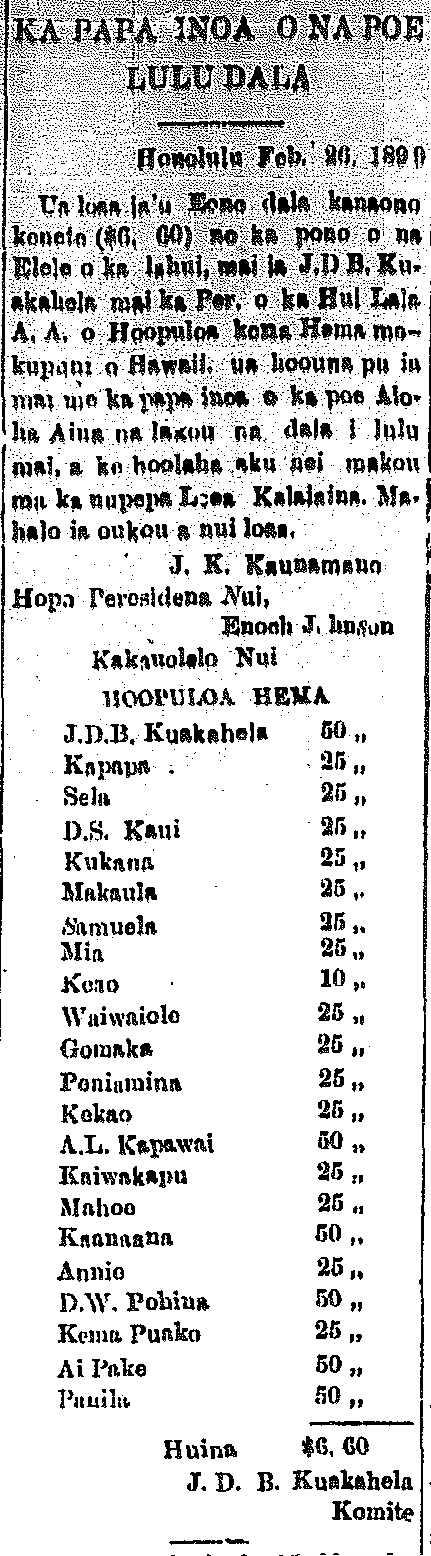
LIST OF DONORS

Honolulu, Feb. 26, 1898.

I have Six dollars and sixty cents ($6.60) for the well-being of the Representatives of the nation, from J. D. B. Kuakahela from the Pres. of the Members of the Patriotic League of Hoopuloa, South Kona, Island of Hawaii; it was sent along with a list of names of the Patriots who donated the money, and we are publishing it in the newspaper Loea Kalaiaina. Thank you very much to you all.

J. K. Kaunamano

Vice President,

Enoch Johnson

Head Secretary.

SOUTH HOOPULOA

J. D. B. Kuakahela, 50 ”

Kapapa, 25 ”

Sela, 25 ”

D. S. Kaui, 25 ”

Kukana, 25 ”

Makaula, 25 ”

Samuela, 25 ”

Mia, 25 ”

Keao, 10 ”

Waiwaiole, 25 ”

Gomaka, 25 ”

Peniamina, 25 ”

Kekao, 25 ”

A. L. Kapawai, 50 ”

Kaiwakapu, 25 ”

Mahoe, 25 ”

Kaanaana, 50 ”

Annie, 25 ”

D. W. Pohina, 50 ”

Kema Puako, 25 ”

Ai Pake, 50 ”

Pauila, 50 ”

Total, $6.60

J. D. B. Kuakahela

Committee.

(Loea Kalaiaina, 3/21/1898, p. 3)

KA PAPA INOA O NA POE LULU DALA

Ka Loea Kalaiaina, Buke II, Helu 12, Aoao 3. Maraki 21, 1898.

Donations for the commission carrying the anti-annexation petitions to America, 1898.

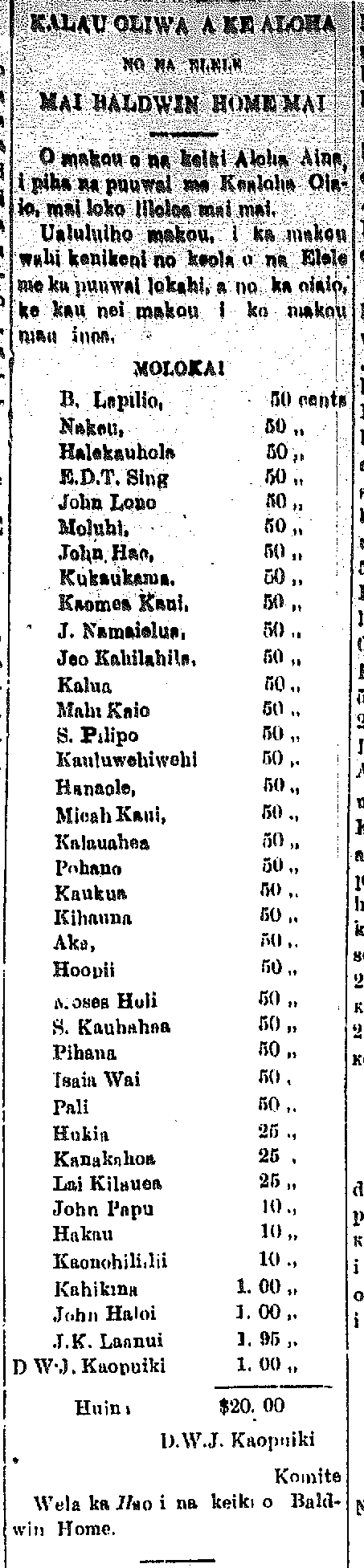
OLIVE LEAVES OF ALOHA

FOR THE REPRESENTATIVES

FROM BALDWIN HOME

We are the Aloha Aina boys whose hearts are full of true aloha from deep within.

We are donating our few cents for the well-being of the Representatives with unified hearts and to attest to this, we affix our names.

MOLOKAI.

B. Lapilio, 50 cents

Nakeu, 50 ”

Halekauhola, 50 ”

E. D. T. Sing, 50 ”

John Lono, 50 ”

Moluhi, 50 ”

John Hao, 50 ”

Kukaukama, 50 ”

Kaomea Kaui, 50 ”

J. Namaielua, 50 ”

Jeo Kahilahila, 50 ”

Kalua, 50 ”

Mahi Kaio, 50 ”

S. Pilipo, 50 ”

Kauluwehiwehi, 50 ”

Hanaole, 50 ”

Micah Kaui, 50 ”

Kalauahea, 50 ”

Pohano, 50 ”

Kaukua, 50 ”

Kihauna, 50 ”

Ake, 50 ”

Hoopii, 50 ”

Moses Holi, 50 ”

S. Kauhahaa, 50 ”

Pihana, 50 ”

Isaia Wai, 50 ”

Pali, 50 ”

Hukia, 25 ”

Kanakahoa, 25 ”

Lai Kilauea, 25 ”

John Papu, 10 ”

Hakau, 10 ”

Kaonohiliilii, 10 ”

Kahikina, 1.00 ”

John Haloi, 1.00 ”

J. K. Laanui, 1.95 ”

D. W. J. Kaopuiki, 1.00 ”

Total: $20.00

D. W. J. Kaopuiki

Committee.

The boys of Baldwin Home are speedy.

[The newspaper Ka Loea Kalaiaina (and many other Hawaiian-Language Newspapers) are for some reason still not available online in searchable text form or even in image form. This is unfortunate, for although most people are familiar with the anti-annexation petitions (“Kū‘ē Petitions”), many have not seen the many lists of donations collected from all over the islands for the expenses of the commission carrying the petition to Washington D. C.

This particular list of donors and donations are from Kalawao! These patients were forced to live isolated from mainstream society, and yet they remained staunch patriots!!

This image is difficult to read, and I hope that clear images of these pages will be made, so if they are typed out to be word-searchable online, people will be able to find their kupuna—it will be near impossible to find a name if there is an “@” somewhere within it…]

(Loea Kalaiaina, 3/14/1898, p. 3)

KALAU OLIWA A KE ALOHA

Ka Loea Kalaiaina, Buke II, Helu 11, Aoao 3. Maraki 14, 1898.

Mothers’ Day should be everyday, but… 1912.

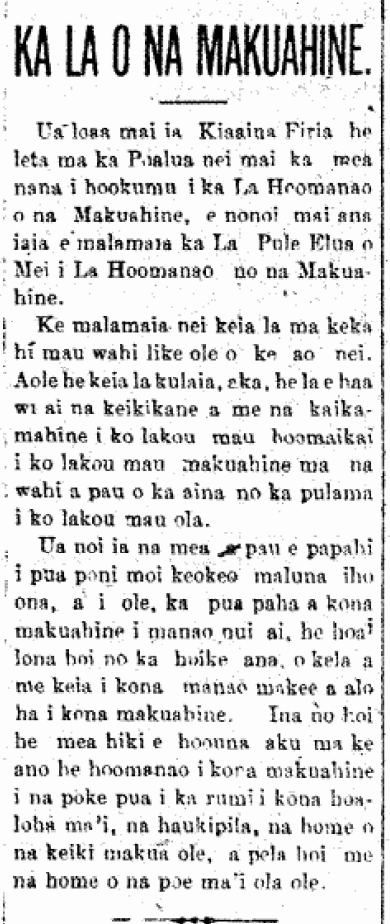
DAY FOR MOTHERS.

Governor Frear received a letter this past Tuesday from the person who started Mothers’ Day [Julia Ward Howe?], asking him to make the second Sunday of May a Day to Remember Mothers.

This day is celebrated in places all over the world. This is not a holiday, but it is a day where boys and girls all over the land give their thanks to their mothers and cherish their lives.

Everyone is asked to adorn themselves with a white carnation, or a flower which their mother is fond of, which will be a show from each and everyone of their affection and love for their mother. If possible, send in remembrance of a mother a bouquet of flowers to the room of a sick friend, or the hospital, or the orphanage home, and also to the home for the incurable.

(Aloha Aina, 3/9/1912, p. 4)

KA LA O NA MAKUAHINE.

Ke Aloha Aina, Buke XVI, Helu 10, Aoao 4. Maraki 9, 1912.

More on Orramel Gulick, 1874.

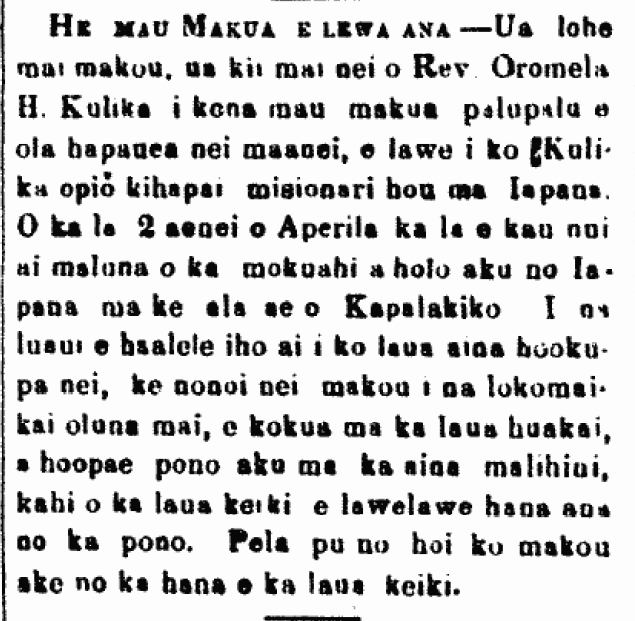
[Found under: “Local News”]

Parents will be voyaging—We hear that Rev. Orramel H. Gulick came to get his weak parents [Peter Johnson Gulick and Fanny Hinckley Thomas Gulick] living here in a feeble state to take them to the young Gulick’s [Luther Halsey Gulick] new missionary parish in Japan.It is on the coming 2nd of April that they will all board the steamship to make their journey to Japan by way of San Francisco. To his parents who are leaving this land which they grew accustomed, we hope for blessings from above, to help them on their journey, and to give them safe landing at this foreign land, where their child works for righteousness. So too is our hopes for the endeavors of their child.

[For more on Orramel Hinckley Gulick, see also: The Pilgrims of Hawaii, by Rev. and Mrs. Orramel Hinckley Gulick (1918).]

(Kuokoa, 3/14/1874, p. 2)

He mau Makua e lewa ana...

Ka Nupepa Kuokoa, Buke XIII, Helu 11, Aoao 2. Maraki 14, 1874.

More criticism of hula, 1874.

[Found under: “Local News”]

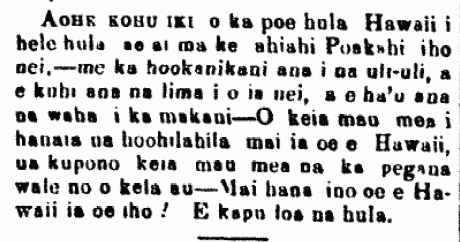
Not appropriate at all were the Hawaiian dancers who went around doing hula on this Monday evening—rattling their uliuli, their hands pointing this way and that, and their mouths huffing away in the wind—These things that were done shame you, O Hawaii; this kind of thing is appropriate only for the pagan of the past—O Hawaiians, stop hurting yourselves! Hula is strictly banned.

(Kuokoa, 3/21/1874, p. 3)

Aohe kohu iki...

Ka Nupepa Kuokoa, Buke XIII, Helu 12, Aoao 3. Maraki 21, 1874.

One of many congratulatory messages to the newly elected king, Kalakaua, 1874.

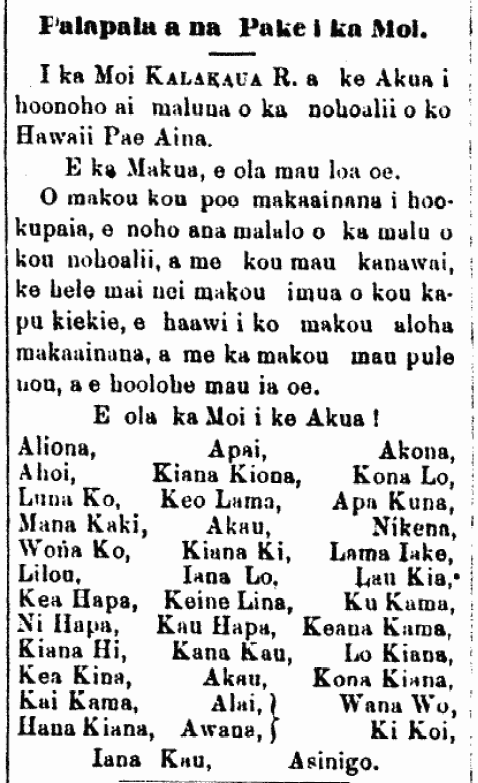
Letter from the Chinese to the King.

To King Kalakaua Rex, whom God has placed on the throne of the Hawaiian Archipelago.

Oh Father, long may you live.

We are your citizens who have been naturalized, living in under the protection of your rule and your laws; we come before your high kapu, to offer you our aloha from your citizens, as well as our prayers for you, and we shall always heed you.

Let the King live Through God!

Aliona, Apai, Akona, Ahoi, Kiana Kiona, Kona Lo, Luna Ko, Keo Lama, Apa Kuna, Mana kaki, Akau, Nikena, Wona Ko, Kiana Ki, Lama iake, Lilou, Iana Lo, Lau Kia, Kea Hapa, Keine Lina, Ku Kama, Ni Hapa, Kau Hapa, Keana Kama, Kiana Hi, Kana Kau, Lo Kiana, Ke Kina, Akau, Kona Kiana, Kai Kama, Alai, Wana Wo, Hana Kiana, Awana, Ki Koi, Iana Kau, Asinigo.

(Kuokoa, 3/21/1874, p. 1)

Palapala a na Pake i ka Moi.

Ka Nupepa Kuokoa, Buke XIII, Helu 12, Aoao 1.

More news out of Lahainaluna, 1874.

[Found under: “Local News”]

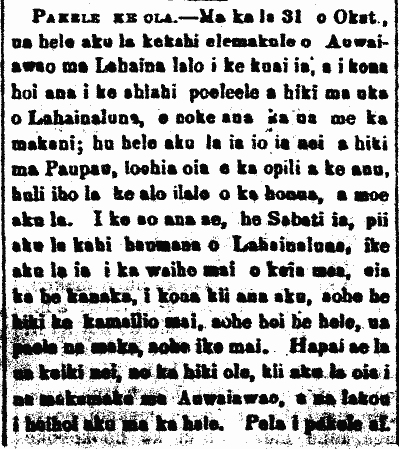
Life is saved.—On the 31st of Oct., an old man from Auwaiawao went to Lahainalalo to go shop, and when he was returning in the evening, it was dark and he reached Lahainaluna; the rain kept falling and the wind kept blowing; the old man wandered here and there until Paupau, and he was numbed with cold and fell face down to the ground and slept. In the morning, it was a Sunday, a student from Lahainaluna was walking up and spotted this thing, come to find out it was a man; when he went to fetch him, the man couldn’t speak, or walk, his eyes were blackened and he couldn’t see. The boy went to carry him, but because he couldn’t, he went to get friends from Auwaiawao, and they carried the man back to his home. That is how he survived.

(Kuokoa, 12/5/1874, p. 2)

Pakele ke ola.

Ka Nupepa Kuokoa, Buke XIII, Helu 49, Aoao 2. Dekemaba 5, 1874.