John Ioane Ukeke, in his earlier days! 1880

CHINESE THEATER!

OPENING

A GRAND CONCERT!

Of all types of Hawaiian Music, on the night of the

SATURDAY NIGHT, THE 26TH OF THIS MONTH!

AT THE

Chinese Theater!

SEASIDE OF AINAHOU.

There will be some Mele performed with Native Hawaiian instruments, and some with Haole instrments.

By the Famed One

MR. JOHN IOANE UKEKE!

IS THE ORCHESTRATING.

THE PERFORMANCE.

1. IPU PERFORMANCE [LEALEA PAIPU]—4 girls whose steps are like flashes of lightning.

2. CHEST SLAPPING PERFORMANCE [LEALEA PA-I-UMAUMA]—3 boys with swift hand motions.

3. MODERN PERFORMANCE [LEALEA HOU LOA]—4 dolls. The dolls will do a Hula Olapa, and their hand motions will be like those of a human.

4. UKEKE PERFORMANCE [LEALEA UKEKE]—Mr. John Ioane will show his total skill with the metal ukeke (Jew’s harp) with Hawaiian songs and Haole songs—He will exert himself with his ukeke playing in all fashions—[It doesn’t help that the image is not clear, but cannot make out the next line and a half. Anyone?] and your hearts will be captured.

5. ULIULI PERFORMANCE [LEALEA ULIULI]—2young children. They will show the fluttering and rattling of this thing, the Uliuli.

6. BANJO PERFORMANCE [LEALEA BANJO]—S. Kalama will exhibit his full skill at the Banjo; and its sound is like the ten-stringed lyre of Mahone [this is probably a reference to a story running in the Kuokoa: “KA MOOLELO O BERIANA KA WIWO OLE A ME MAHONE KE KOA” (4/26/1879–11/20/1880)]

FIVE MINUTE BREAK.

7. ACCORDIAN PERFORMANCE [LEALEA KOLIANA]—Henere [Henry] will show his skill at playing the Accordian, and the sounds he makes: Chinese, hoaeae, oli and the musical scale [pakoli]; it will make the crowd laugh and your sides will hurt.

8. OHELO PERFORMANCE [LEALEA OHELO]—2 women. They will show their abilities at this amusement. This is the amusement of the alii of the olden days that they greatly enjoyed.

9. KUI PERFORMANCE [LEALEA KUI]—2 women. These two ladies will display their readiness at this amusement while from their mouths come mele.

10. UKEKE PERFORMANCE [LEALEA UKEKE]—Mr. John Ioane will show his playing of the ukeke with Mele of the King; and this sweet voice of the ukeke will be accompanied by the steps of some girls doing lele this way and that.

11. MODERN PERFORMANCE [LEALEA ANO HOU]—The Famous Mr. Ioane will show once again some new things that will have the audience in stitches.

The doors will open at 7 P. M. Performances begin at 8.

ENTRANCE FEE: $1.00, $ .50. Tickets [Balota ?] available from hand of those in charge as well as at the entrance.

(Ko Hawaii Pae Aina, 6/26/1880, p. 2)
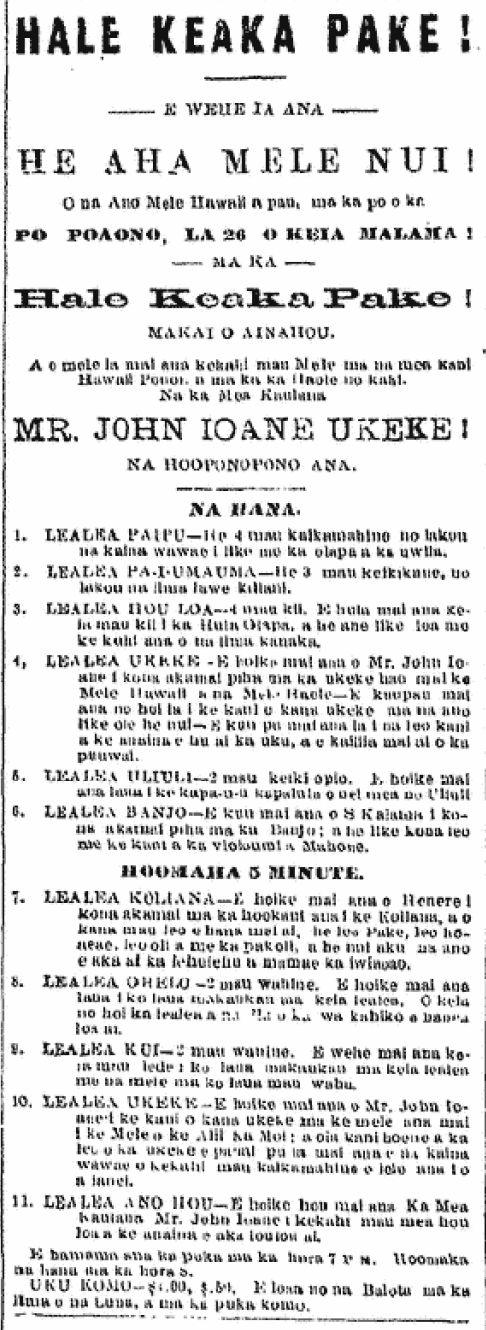
HALE KEAKA PAKE!

Ko Hawaii Pae Aina, Buke III, Helu 26, Aoao 2. Iune 26, 1880.
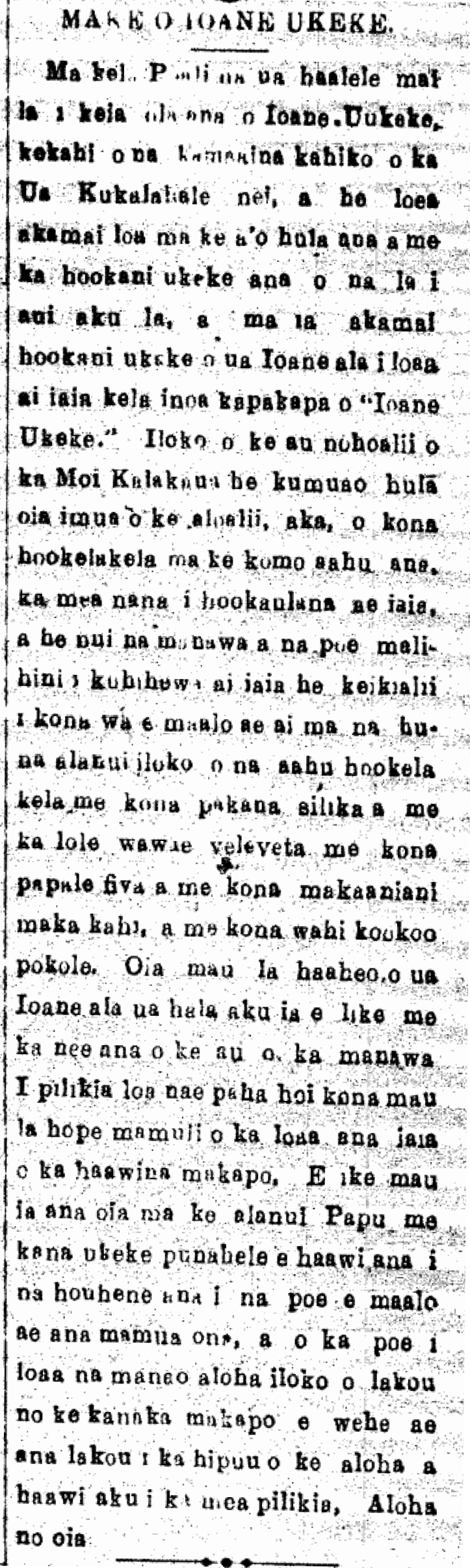
One more on the passing of Ioane Ukeke, 1903.

IOANE UKEKE HAS DIED.

Last Friday, Ioane Ukeke left this life, he was one of the old-time kamaaina of the Kukalahale Rain [famous rain of Honolulu], and he was a skilled expert at teaching hula and playing the ukeke in the days gone by, and it is because of Ioane’s skill at playing the ukeke that he received the nickname “Ioane Ukeke.” During the reign of King Kalakaua, he was a hula teacher [kumuao hula] in the royal court, but what made him famous was his showing off in costume, and there was many a time when foreigners mistook him for a prince when he passed by the street corner [huna alanui? huina alanui?] in his stylish attire and his silk waist [pakana ?] and velvet slacks with his beaver hat and monocle, with his short cane. Those proud days of Ioane have gone with the flow of time. He faced difficulties in his latter days, because of blindness. He was always seen on Fort Street with his favorite ukeke serenading those passing by before him, and those who felt aloha for this blind man would undo the tie of aloha and gave a helping hand to the impaired one. Aloha for him.

(Aloha Aina, 5/9/1903, p. 6)

MAKE O IOANE UKEKE.

Ke Aloha Aina, Buke IX, Helu 19, Aoao 6. Mei 9, 1903.

Famed Dandy, Ioane Ukeke, is no more. 1903.

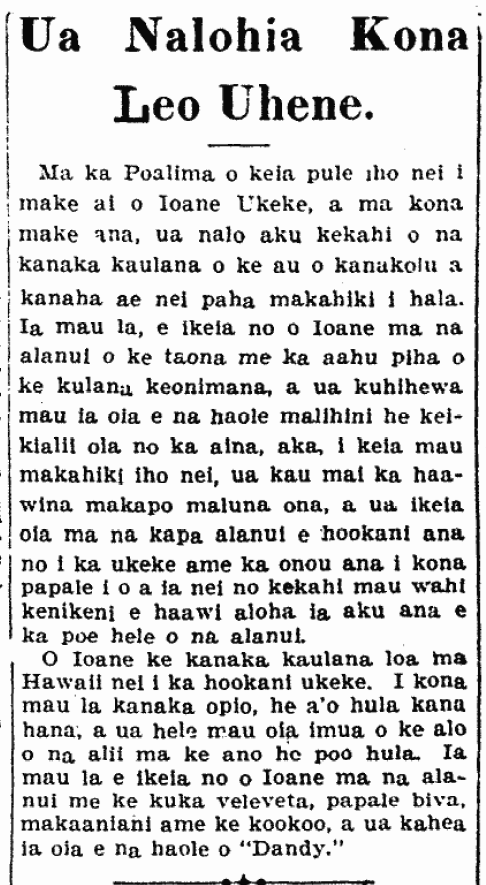
His Joyous Voice is Gone.

On Friday of this past week [5/1/1903], Ioane Ukeke died, and with his death, so too has one of the famous people of thirty or forty years ago left. Those days, Ioane was seen on the streets of town in full attire of a gentleman, and he was often mistaken by the foreign haole, as a prince of the land; but these past years, he went blind, and he was seen on the street sides playing the ukeke and sticking out his hat this way and that for some coins given charitably by the passersby.

Ioane is very famous in Hawaii for his playing of the ukeke. In his youth, he was a hula teacher [a’o hula], and he often went before the court of the alii as a hula leader [poo hula ?]. In those days, Ioane was seen on the streets in a velvet suit, beaver hat, glasses and a cane; he was called “Dandy” by the haole.

(Kuokoa, 5/8/1903, p. 6)

Ua Nalohia Kona Leo Uhene.

Ka Nupepa Kuokoa, Buke XLI, Helu 19, Aoao 6. Mei 8, 1903.

Lava destroys the village of Hoopuloa, Kona. 1926.

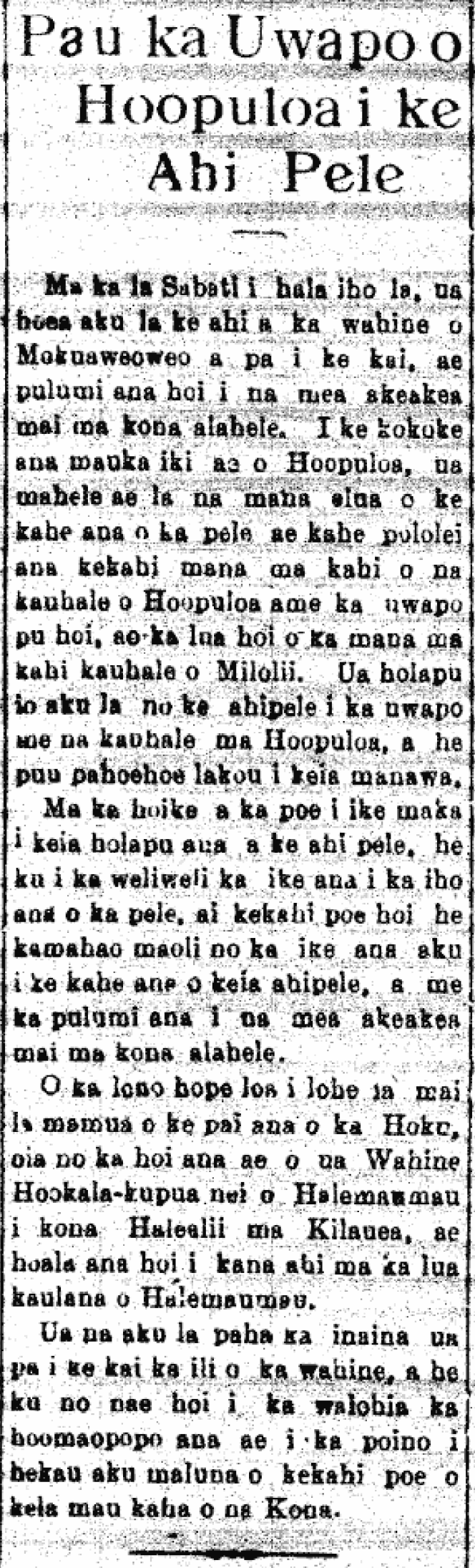
The Harbor of Hoopuloa is Destroyed by Lava.

On this past Sunday [4/18/1926], the fire of woman of Mokuaweoweo appeared and reached the sea and it swept aside the things blocking its path. When it got close to the upland of Hoopuloa, the flow of lava separated into two, and one of the flows went straight for the village of Hoopuloa and the harbor, and the second flow went towards the village of Milolii. The fiery lava engulfed the harbor and village of Hoopuloa, and now they are but a heap of pahoehoe lava.

According to eyewitnesses of this engulfing lava, it was frightening seeing the lava coming down, and others say that it was truly awesome watching the flowing lava and its sweeping aside of all obstructions in its path.

The last word heard before the the Hoku went to the press was that this Wondrous Woman of Halemaumau returned to her Palace at Kilauea, and she is bringing to life her fires at the famed crater of Halemaumau.

Perhaps her rage has been quenched as the skin of that woman has touched the sea, but the memory of the tragedy which befell the people of that section of Kona is heartbreaking.

[And check out this awesome picture of the tragic event taken by Tai Sing Loo, put up by the Hawaiian Historical Society!]

(Hoku o Hawaii, 4/20/1926, p. 2)

Pau ka Uwapo o Hoopuloa i ke Ahi Pele

Ka Hoku o Hawaii, Buke XIX, Helu 48, Aoao 2. Aperila 20, 1926.

Kuhio and the Hawaiian Civic Clubs. 1918.

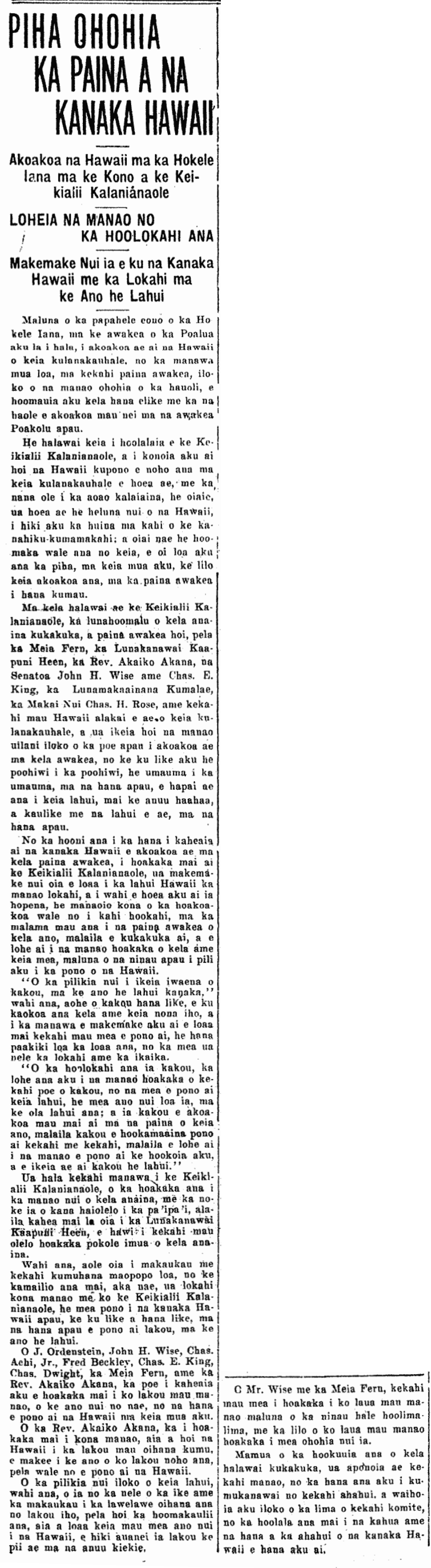
THE PARTY OF HAWAIIANS  WAS FILLED WITH ENTHUSIASM

Hawaiians Gathered at the Young Hotel at the Invitation of Prince Kalanianaole

HEARD WAS IDEAS FOR UNIFICATION

Desired that Hawaiians Stand Together as a People

On the sixth floor of the Young Hotel, at noon this past Tuesday, the Hawaiians of this town gathered for the first time, for a luncheon amid enthusiasm and joy, and this will be a regular thing, like the haole regularly meet at noon on Wednesdays.

This was a meeting organized by Prince Kalanianaole, and Hawaiians of good standing who live here in town were invited to attend, without attention being paid to political affiliation; it is true, many Hawaiians came, and the total number was about seventy-one; and being that this is just the beginning, it will be more full in the future, should this gathering at lunch become a regular thing.

At this meeting was Prince Kalanianaole, the chairman of this meeting and luncheon, and also Mayor Fern, Circuit Judge Heen, Rev. Akaiko Akana, Senators John H. Wise and Charles E. King, Representative Kumalae, Sheriff Charles H. Rose, and some other Hawaiian leaders of town; and everyone gathered there that afternoon seemed spirited to stand shoulder to shoulder, chest to chest, in all things; to lift this lahui from the low level to be equal with the other ethnicities in all aspects.

In order to move forward the agenda for which the Hawaiians gathered at that luncheon, Prince Kalanianaole explained that he greatly wished that the Hawaiian people would think as one, and as a means to that ends, he believes that meeting together in one place by holding regular luncheons of that sort, is where you’d discuss things and hear explanation from different people on all questions regarding the well-being of Hawaiians.

“The great problem seen amongst us, as a people,” according to him, is that we don’t cooperate; we all stand independently, and when we want good works to be done, it is very hard to accomplish for we lack unity and strength.

“Unifying ourselves, and listening to people talk about things that will benefit this lahui is very important for the perpetuation of the lahui; and as we gather regularly at meals of this sort, we will become familiar with each other, and we will hear ideas that should be carried out, and we will be seen as a lahui.”

Some time was spent by Prince Kalanianaole explaining the goals of that gathering while his speech was encouraged by applause, then he called up Circuit Judge Heen to give a few words of clarification before the crowd.

According to him, he was not prepared with a clear topic to talk about, however, he was in agreement with Prince Kalanianaole; all Hawaiians must stand together and work as one in all endeavors that will better themselves as a lahui.

J. Ordenstein, John H. Wise, Charles Achi, Jr., Fred Beckley, Charles E. King, Charles Dwight, Mayor Fern, and Rev. Akaiko Akana were called to explain their overall thoughts as to what is to be done to benefit Hawaiians from here forth.

Rev. Akaiko Akana shared his thoughts; when Hawaiians go back to their traditional occupations [?] and cherish their way of life, that is the only way Hawaiians will be blessed.

The big problem with this lahui, according to him, is the lack of knowledge and readiness to go into business for themselves and so too with being economical; when these important things are acquired by Hawaiians, they will be able to climb to a high level.

Mr. Wise and Mayor Fern were some who spoke of their ideas on the question of leasing a building [?], and their ideas were heard with much enthusiasm.

Before the meeting was adjourned, one idea was approved, to draft a constitution for a club, and to place it in the hands of a committee to lay out the foundation and mission that this association of Hawaiians would carry out.

(Kuokoa, 11/29/1918, p. 1)

PIHA OHOHIA KA PAINA A NA KANAKA HAWAII

Ka Nupepa Kuokoa, Buke LVI, Helu 48, Aoao 1. Novemaba 29, 1918.

Kapihe and his prophecy. 1862.

The Story of Kapihe.

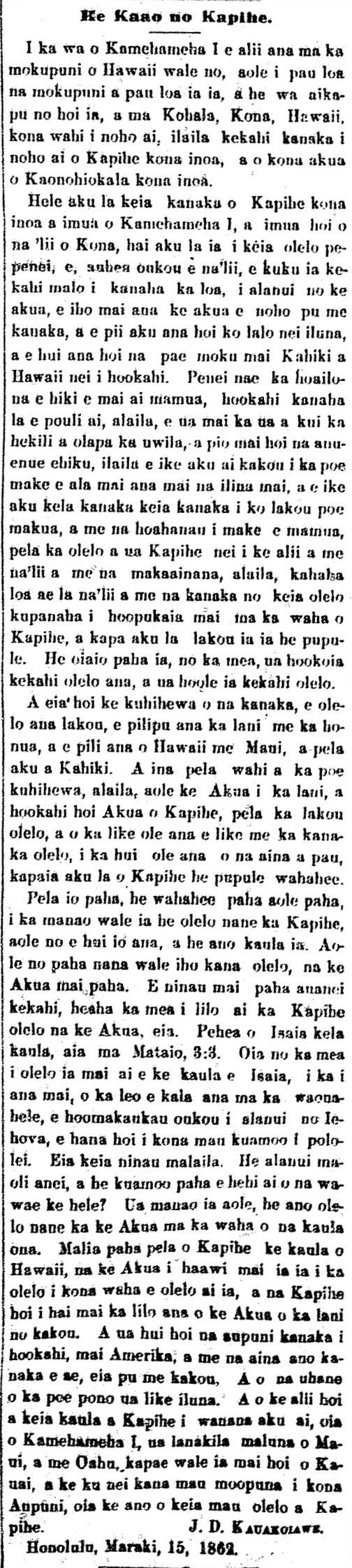
When Kamehameha I was ruler over only Hawaii Island, and not all of the islands were his, and while the eating kapu was still enforced, and while he was living in Kohala, Kona, Hawaii, it was there that a certain man lived named Kapihe, and his god was called Kaonohiokala.

This man named Kapihe went before Kamehameha I and before the alii of Kona, and he said these words, “Listen, O Chiefs, a malo will stand, forty in length, as a path for the god; the god will come down and live with man, and what is down here will rise up above, and the archipelago from Kahiki* all the way to Hawaii will be joined as one. This is the sign that will come before this: there will be forty days of darkness and then rain will fall and thunder will crash and lightning will flash and seven rainbows will arch; there we will see the dead rise from the graves and all people will see their parents and hoa hanau [siblings, cousins] who died earlier.” And that is what Kapihe said to the King, alii, and makaainana. The chiefs and commoners were astounded at these shocking words spoken by Kapihe, and they called him crazy. This perhaps is the truth, for some of his predictions came true and others were denied.

This is how people are mistaken, they say, the heavens and earth will come together, and Hawaii and Maui will join together, and so too with Kahiki. And if that is the case, according to the mistaken ones, then God is not in heaven, and there is but one God, and that is Kapihe; that is what they said, and because all of the lands did not merge together as the they were saying, Kapihe was called a lying, crazed person.

Perhaps that is so, perhaps he was a liar, and perhaps not; it might be thought that Kapihe’s was a riddle and the land would not literally join together, and that he was a prophet. Perhaps his words were not his alone, but from God. Someone might ask, how did Kapihe’s words come from God, and here is the answer. What of Isaiah, that prophet, in Matthew 3:3? For this is what was spoken by the prophet Isaiah, ‘The voice of the one crying in the wilderness: ‘Prepare ye the way of Jehovah, make his paths straight.'” Here is the question there. Is it a real road, and is it a path that will be tread on by feet? It is believed not, but that it was a riddle from God through the mouth of his prophet. Maybe so too it was of Kapihe, the prophet of Hawaii; God gave the words for his mouth to speak, and Kapihe spoke what God of the heavens gave to us. And the nations of man joined as one, from America, and the other inhabited lands, they are here together with us. And the souls of the righteous are the same up above. The alii of whom Kapihe predicted was Kamehameha I, who was victorious over Maui and Oahu, and Kauai was left, and his grandchildren now rule over his Kingdom. This is the nature of Kapihe’s words. J. D. Kauakoiawe

Honolulu, March 15, 1862.

*Kahiki usually refers to foreign lands.

(Hoku o ka Pakipika, 3/20/1862, p. 1)

Ke Kaao no Kapihe.

Ka Hoku o ka Pakipika, Buke I, Helu 26, Aoao 1. Maraki 20, 1862.

Bad weather on Kauai. 1862.

Great Flooding in Waimea.

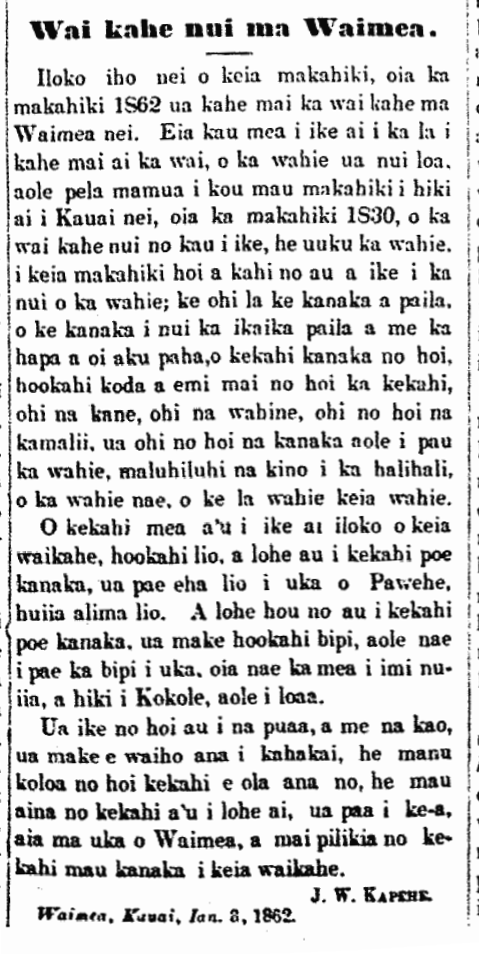
During this year, 1862, there was flooding here in Waimea. This is what I saw on the day of the flood, a lot of kindling; it wasn’t like that before in the years since I arrived here to Kauai, that being 1830; in the floods I’ve witnessed, there was only a little kindling. This year is the first time I’ve seen so much wood for fire; people were gathering it up and making piles. A strong man would have a pile and a half or more, and another would have a cord or less. Men would gather, women, and children too; people gathered it up, but there was no end to it; your body would get tired from carrying the wood, and yet the kindling, it would still be remain here and there.

Another thing I witnessed in the flood was a horse, and I hear from some other people that four horses came ashore at Pawehe; all together that makes five horses. And from some other people I hear that a cow died but did not wash up ashore, but was searched carefully for all the way until Kokole, but was not found.

I’ve seen pigs and goats that were dead, laying on the shore, and there are some ducks still alive; there are places which I’ve heard that are obstructed in the uplands of Waimea, and some people almost got in trouble in this flood.

J. W. Kapehe,

Waimea, Kauai, Jan. 3, 1862.

(Kuokoa, 3/22/1862, p. 2)

Wai kahe nui ma Waimea.

Ka Nupepa Kuokoa, Buke I, helu 17, Aoao 2. Maraki 22, 1862.

Poi description in English. 1909.

[Found under: “Our English Items”]

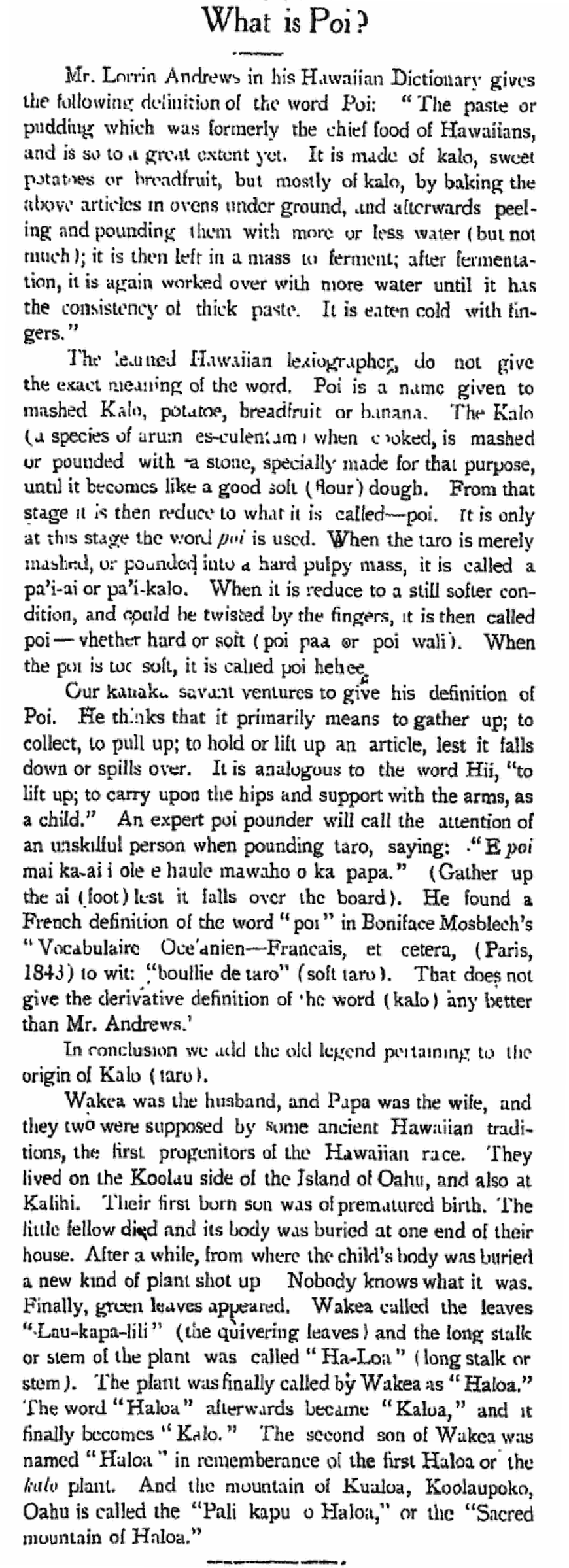
What is Poi?

Mr. Lorrin Andrews in his Hawaiian Dictionary gives the following definition of the word Poi: “The paste or pudding which was formerly the chief food of Hawaiians, and is so to a great extent yet. It is made of kalo, sweet potatoes or breadfruit, but mostly of kalo, by baking the above articles in ovens under ground, and afterwards peeling and pounding them with more or less water (but not much); it is then left in a mass to ferment; after fermentation, it is again worked over with more water until it has the consistency of thick paste. It is eaten cold with fingers.”

The learned Hawaiian lexiographer [lexicographer] do not give the exact meaning of the word. Poi is a name given to mashed Kalo, potatoe, breadfruit or banana. The Kalo (a species of arum ex-culentum [arum esculentum] when cooked, is mashed or pounded with a stone, especially made for that purpose, until it becomes like a good soft (flour) dough. From that stage it is then reduce to what is called—poi. It is only at this stage the word poi is used. When the taro is merely mashed, or pounded into a hard pulpy mass, it is called a pa’i-ai or pa’i-kalo. When it is reduced to a still softer condition, and could be twisted by fingers, it is then called poi—whether hard or soft (poi paa or poi wali). When the poi is too soft, it is called poi hehee.

Our kanaka savant ventures to give his definition of Poi. He thinks that it primarily means to gather up; to collect, to pull up; to hold or lift up an article, lest it falls down or spills over. It is analogous to the word Hii, “to lift up; to carry upon the hips and support with the arms, as a child.” An expert poi pounder will call the attention of an unskillful person when pounding taro, saying: “E poi mai ka ai i ole e haule mawaho o ka papa.” (Gather up the ai (foot [food]) lest it falls over the board). He found a French definition of the word “poi” in Boniface Mosblech’s “Vocabulaire Oce’anien—Francais, et cetera, (Paris, 1843) to wit: “boullie de taro” (soft taro). That does not give the derivative definition of the word (kalo) any better than Mr. Andrews.

In conclusion we add the old legend pertaining to the origin of Kalo (taro).

Wakea was the husband, and Papa was the wife, and they two were supposed by some ancient Hawaiian tradition, the first progenitors of the Hawaiian race. They lived on the Koolau side of the Island of Oahu, and also at Kalihi. Their first born son was of premature birth. The little fellow died and its body was buried at one end of their house. After a while, from where the child’s body was buried a new kind of plant shot up. Nobody knows what it was. Finally, green leaves appeared. Wakea called the leaves “Lau-kapa-lili” (the quivering leaves) and the long stalk or stem of the plant was called “Ha-Loa” (long stalk or stem). The plant was finally called by Wakea as “Haloa.”

(Kuokoa Home Rula, 1/1/1909, p.1)

What is Poi?

Kuokoa Home Rula, Buke VII, Helu 1, Aoao 1. Ianuari 1, 1909.