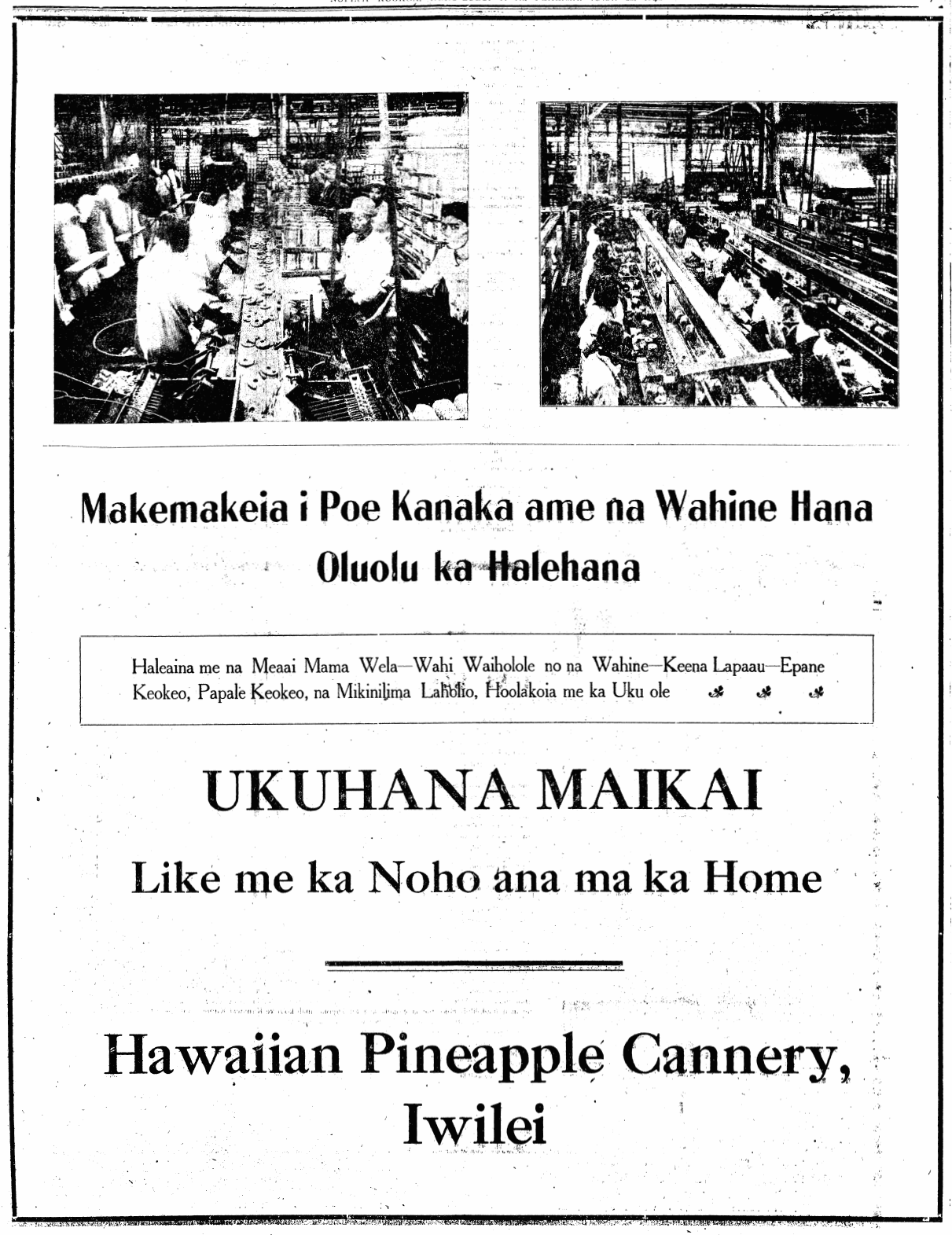
“Just like being at home!” Hawaiian Pine cannery, 1918.

Wanted are Men and Women Workers

Nice Place to Work

Cafeteria with Hot Snacks–Clothes Lockers for the Women–Dispensary–White Aprons, White Hats, Rubber Gloves, Provided at No Cost.

Good Wages

Just like Being at Home

Hawaiian Pineapple Cannery, Iwilei

(Kuokoa, 7/26/1918, p. 7)

Makemakeia i Poe Kanaka...

Ka Nupepa Kuokoa, Buke LVI, Helu 30, Aoao 7. Iulai 26, 1918.

The dwindling numbers of the Hawaiian hawk, 1889.

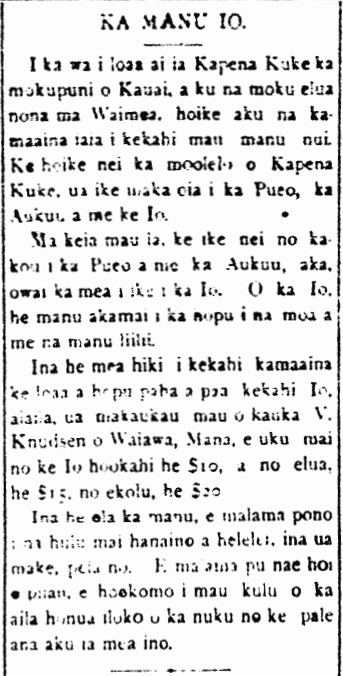
THE IO BIRD.

When Captain Cook came upon the island of Kauai and his two ships docked in Waimea, the kamaaina showed him a number of large birds. Captain Cook’s journals say that he saw a Pueo, an Aukuu, and an Io.

These days, we see indeed the Owl [Pueo] and Heron [Aukuu], but who sees the Hawk [Io]? The Io is skilled at snatching chickens and small birds.

If some kamaaina is able to find and catch an Io, V. Knudsen of Waiawa, Mana, is always prepared to pay $10 for it; and for a pair, $15; and for three, $20.

If the bird is live, be careful with the feathers and do not harm them and have them fall off; and so too if it is dead. Also be careful lest it rots, and put a few drops of kerosene in its beak to ward off rotting.

(Kuokoa, 3/30/1889, p. 2)

KA MANU IO.

Ka Nupepa Kuokoa, Buke XXVIII, Helu 12, Aoao 3. Maraki 30, 1889.

One of the biggest early influences on Hawaiian music in Japan starts here, 1909.

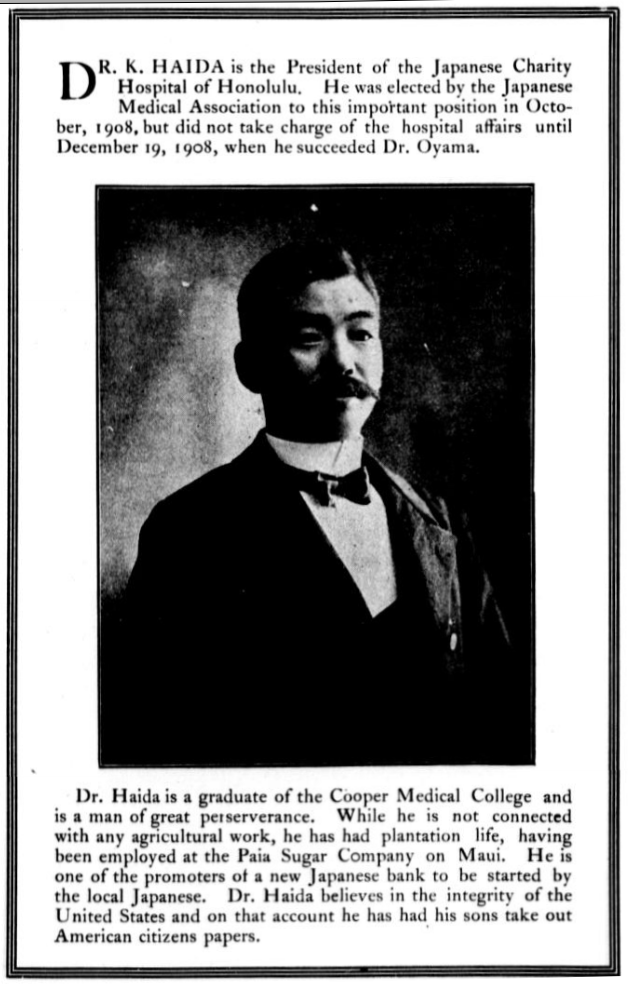
DR. K. HAIDA [Katsugorō Haida] is the President of the Japanese Charity Hospital of Honolulu. He was elected by the Japanese Medical Association to this important position in October, 1908, but did not take charge of the hospital affairs until December 19, 1908, when he succeeded Dr. Oyama.

Dr. Haida is a graduate of the Cooper Medical College and is a man of great perseverance. While he is not connected with any agricultural work, he has had plantation life, having been employed at the Paia Sugar Company on Maui. He is one of the promoters of a new Japanese bank to be started by the local Japanese. Dr. Haida believes in the integrity of the United States and on that account he has had his sons take out American citizen papers.

[See also this article on Yukihiko Haida returning to Hawaii in 1933 from Japan to study Hawaiian music.

And also see this article put up by the Nihon Ukulele Association on Yukihiko (Harry) Haida.]

(Evening Bulletin, 3/25/1909, p. 44)

DR. K. HAIDA...

Evening Bulletin Industrial Edition, 1909, p. 44.

I hewa no ia oe la, i kou awihi maka ana mai! 1911.

FAULTED FOR WINKING.

Because the Hawaiian musicians who are in Denver continuously wink at the haole women who frequently dine in the hotel which hired the boys to sing regularly, and most of the women are smitten and are truly entranced by some of the boys, therefore there have been many a complaint to the police about them, to the point where the hotel was ordered to immediately stop contracting those musicians.

When the women and their companions arrive at the hotel, the musicians are always singing songs about women, and therefore some of the women are delighted at this, and the boys are constantly winking.

As they are always seen doing this, there has been numerous complaints to the police department demanding that the hotel throw out the band; the hotel agreed, but only after their contract to sing and play music there was over.

The kinds of songs were not complained about, nor how they sang; only one thing was the cause of the complaints, that being the constant winking of the boys to the women, for by doing this, there have been singers who have married girls of high-class families.

[…pii e ke kai i kumu pali!]

(Kuokoa, 2/17/1911, p. 6)

HOOHALAHALAIA NO KA AWIHI MAKA.

Ka Nupepa Kuokoa, Buke XLVII, Helu 7, Aoao 6. Feberuari 17, 1911.

Storied places of Kiholo and Luahine Wai, 1923.

THE PLEASURES OF TIME

Luahine Wai

It is a big pool close to Kiholo and Laemano. It is a famed bathing spot for the alii of old. Its waters are numbing, and it is said that one cannot swim its circumference because it is cold like ice water.

It is said that within this pond is a hole where you enter into a hidden cave where the bones of the old chiefs are laid. It is said that Kamehameha’s bones are there as well. As for the truth of it all, it is not certain, until some living person enters this hidden cave; then there will be a witness to verify what is in this cave.

This pond is about 5 fathoms deep at its deepest, which is at its center, where it is very cold. And if you dive to the bottom, you will soon feel your body grow cold, and you won’t be able to stay there long. You will shoot up and swim for the edge.

A person that dives down to that deep area will turn red, like the red of coral [? puko’a] Continue reading

Kamehameha graduating class, 1926.

The Students of Kamehameha Schools Who Graduated This Year 1926.

1. Juliette Blake, 2. Alice Leialoha, 3. Edwin Stone, 4. Harry Chang, 5. Arthur Ahulii, 6. Samuel Vida, 7. Charles Buchanan, 8. Daniel Lansing, 9. Daniel McGregor, 10. Florence Smith, 11. Thurza Drake (class president Girls’ school), 12. George Groves, 13. Charles Travis, 14. George Naumu, 15. Evelyn Cooper, 16. Piilani Yates, 17. Helen Lani, 18. Evelyn Clark, 19. Dinah Dunn, 20. Paul Keaka, 21. Charles Aiden, 22. Henry Reinhardt, 23. Emma Woodward, 24. Elizabeth Leal, 25. Henry Kaahea, 26. Henry Young (class president Boys’ school), 27. Rogers Whitmarsh, 28. Edward Chang, 29. William Poka, 30. Walter Ahulii, 31. George Cummings, 32. Daisy Pa, 33. Bertha Mahikoa.

(Kuokoa, 6/17/1926, p. 2)

Na Haumana o na Kula Kamehameha i Puka i Keia Makahiki 1926

Ka Nupepa Kuokoa, Buke LXV, Helu 24, Aoao 2. Iune 17, 1926.

History and the kahu hanai of Kamehameha, 1911.

RESPONSE OF O-U KA MAKA O KA WAUKE OI OPIOPIO.

O Mr. Editor of the Kuokoa. With appreciation: Please allow my clarification pertaining to the person who raised Kamehameha I. which was shown in the newspaper Kuokoa Home Rula of the past 10th of February, 1911, which said that it was Naeole who raised him. Forgive me for my late response, but I just received the issue of the aforementioned newspaper from a friend last week, and so that the true person who raised Kamehameha I. is known, who is not Naeole, that is the reason I am disseminating this information without the intent to show my relation to royal genealogy, being that it is shameful to speak haughtily; there are many now living who are related to alii and who prize the alii genealogist who are written in the books about the relatives of the parents of Kamehameha I., and here they are:

Keaweikekahialiiokamoku (m) dwelt with Kalanikauleleiaiwi (f), born was Keeaumoku (m).

Keeaumoku (m) dwelt with Kamakaimoku (f), born was Keoua (m), the father of Kamehameha I.

Here is the mother’s side; Kalanikauleleiaiwi (f) dwelt with another kane, Kauauanuiamahi (m), born was Haae (m).

Haae (m) dwelt with Kekelaokalani (f), born was Kekuiapoiwa (f), the birth mother of Kamehameha I.

Kamehameha I was born of Kekuiapoiwa (f) at Ainakea, Kohala, Hawaii. They were living there at the time, and that is where King Kalakaua searched for and built the statue of Kamehameha I, and that is the truth; that is what I heard from my kupuna; he was not born on a canoe and not in Halawa or Kokoiki as it is being fabricated. Here is the story of his birth: Continue reading

Scenes from the Kamehameha Day celebration, 1919.

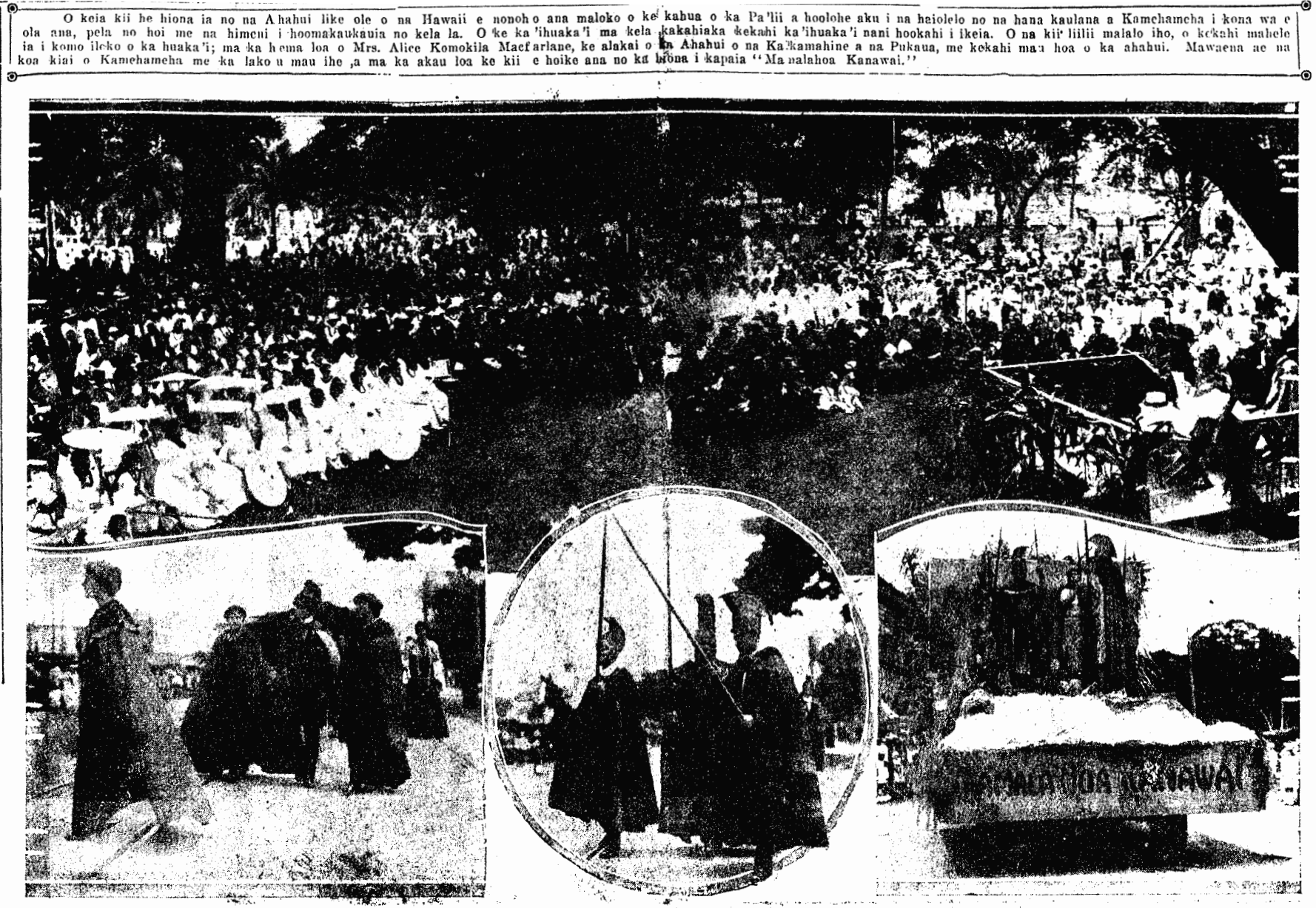
The picture [on the top] shows the various Hawaiian Societies seated on the Palace Grounds and listening to the speeches of the famous deeds of Kamehameha in his lifetime, and also the songs prepared for the day. The parade of the morning was one of the most beautiful parades seen. The small pictures below show parts of the parade; on the far left is Mrs. Alice Kamokila Macfarlane, the head of the Daughters of Hawaiian Warriors [Ahahui o na Kaikamahine a na Pukaua], along with some of the members. In the middle are the guards of Kamehameha armed with their spears, and on the far right is a picture showing the scene called “Mamalahoa Kanawai.”

[Don’t forget to turn out for or tune into the Kamehameha Parade of 2014!]

(Kuokoa, 6/13/1919, p. 1)

O keia kii he hiona...

Ka Nupepa Kuokoa, Buke LVII, Helu 24, Aoao 1. Iune 13, 1919.

Words of comfort in the face of the passing of Nahienaena? 1837.

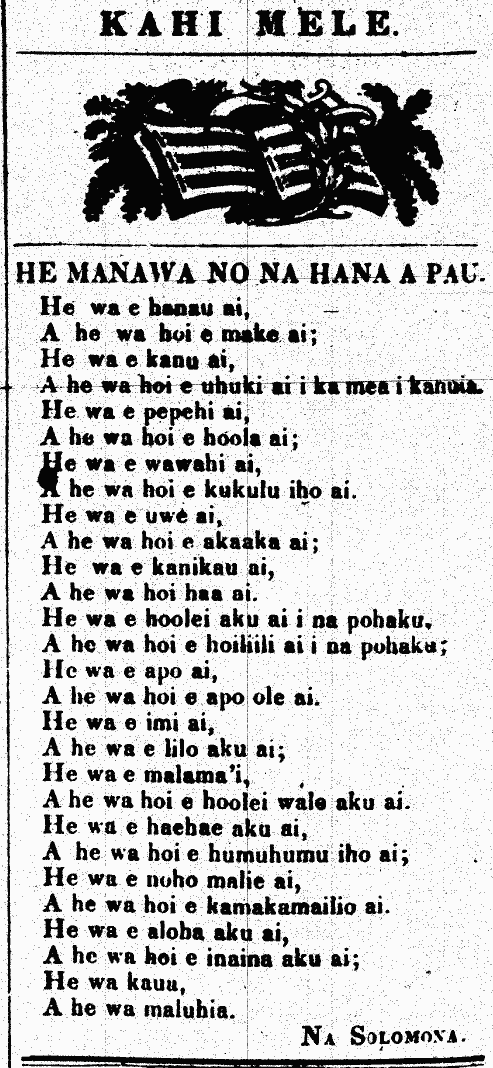
HE MELE.

HE MANAWA NO NA HANA A PAU.

He wa e hanau ai,
A he wa hoi e make ai;
He wa e kanu ai,
A he wa hoi e uhuki ai i ka mea i kanuia.
He wa e pepehi ai,
A he wa hoi e hoola ai;
He wa e wawahi ai,
A he wa hoi e kukulu iho ai.
He wa e uwe ai,
A he wa hoi e akaaka ai;
He wa e kanikau ai,
A he wa hoi [e] haa ai.
He wa e hoolei aku ai i na pohaku,
A he wa hoi e hoiliili ai i na pohaku;
He wa e apo ai,
A he wa hoi e apo ole ai.
He wa e imi ai,
A he wa e lilo aku ai;
He wa e malama’i,
A he wa hoi e hoolei wale aku ai.
He wa e haehae aku ai,
A he wa hoi e humuhumu iho ai;
He wa e noho malie ai,
A he wa hoi e kamakamailio ai.
He wa e aloha aku ai,
A he wa hoi e inaina aku ai;
He wa kaua,
A he wa maluhia.

Na Solomona.

A Mele.

THERE IS A TIME FOR ALL THINGS.

A time to be born,
And a time to die;
A time to plant,
And a time to pluck up that which is planted;
A time to kill,
And a time to heal;
A time to break down,
And a time to build up;
A time to weep,
And a time to laugh;
A time to mourn,
And a time to dance;
A time to cast away stones,
And a time to gather stones together;
A time to embrace,
And a time to refrain from embracing;
A time to get,
And a time to lose;
A time to keep,
And a time to cast away;
A time to rend,
And a time to sew;
A time to keep silence,
And a time to speak;
A time to love,
And a time to hate;
A time of war,
And a time of peace.

By Solomon.

(Kumu Hawaii, 2/15/1837, p. 76)

KAHI MELE.

Ke Kumu Hawaii, Buke 2, Pepa 19, Aoao 76. Feberuari 15, 1837.

Funeral procession of Nahienaena, 1837.

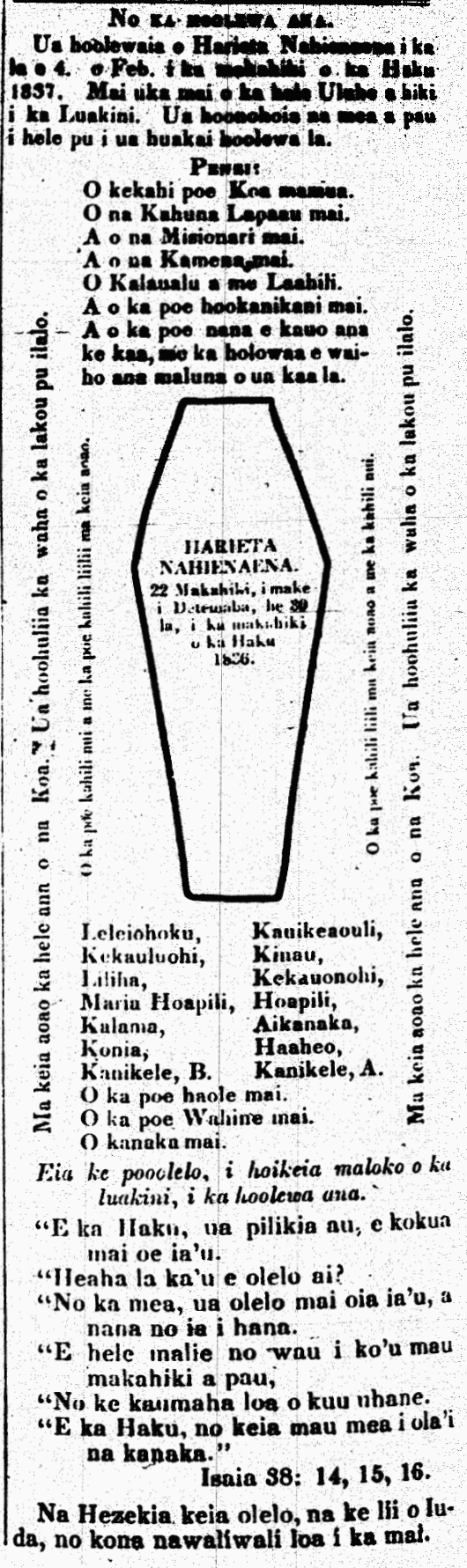
Pertaining to the Funeral.

A funeral was held for Harieta Nahienaena on the 4th of Feb. in the year of the Lord 1837. In the uplands of Hale Uluhe to the Church. Everyone in the procession were arranged.

In this manner:

Soldiers in the front.
Followed by the Doctors.
Then the Missionaries.
The Carpenters.
Kalaualu and Laahili.
The musicians.
And those that pulled the cart and the coffin which was placed on the cart.

[On the left side:]

On this side walked the Soldiers. The mouths of their guns were faced down.

Those with large kahili and small kahili on this side.

[On the right side:]

Those with large kahili and small kahili.

The Soldiers walked on this side. The mouths of their guns were faced down.

HARIETA NAHIENAENA.

22 Years, died on December 30, in the year of the Lord 1836.

Leleiohoku, Kauikeaouli,
Kekauluohi, Kinau,
Liliha, Kekauonohi,
Maria Hoapili, Hoapili,
Kalama, Aikanaka,
Konia, Haaheo,
Consul, B., Consul, A.
Then the haole
Then the Women
men.

This is the sermon that was given at the church at the funeral.

“O Lord, I am oppressed; undertake for me.

“What shall I say?

“He hath both spoken unto me, and himself hath done it.

“I shall go softly all my years.

“In the bitterness of my soul.

“O Lord, by these things men live.”

Isaiah 38: 14, 15, 16.

These words were of Hezekiah, the king of Judea, when he was very weak because of sickness.

(Kumu Hawaii, 2/15/1837, p. 74)
No ka hoolewa ana.

Ke Kumu Hawaii, Buke 2, Pepa 19, Aoao 74. Feberuari 15, 1837.