Pretty darned romantic, 1881.

Kalakaua to Kapiolani!

The King of the Archipelago to His Queen.

Composed aboard the Oceanic, Feb. 16, 1881.

On the Meridian of Honolulu,

At 33° Latitude, 157° 30′ Longitude.

O ka ike lihi aku i na ae one ma o,
Ka ko’u mau maka e ake nei,
Me ka pule e hoea hou au ilaila,
Mai ae i ka’u upu e ko ole!

O na nalu huakea lelehuna,
O ia ae one; he aloha au,
A ke huli kuu alo no ka huakai home,
E nalo na manao hele auwana.

E kuu aloha e kali ala, nou ko’u haupu,
Me ka lei maile ma kou a-i!
O, e hai mai, e ke kai kupikio inaina,
A hea pau kau kokohi ana ia’u?

Ano, o ka hui me oe, he mea hiki ole,
Oiai ua okia e ke kai nui,
E puana aku nae au e ka ipo aloha,
He manaolana ko’u e hui hou kaua.

O kou aloha me ka manao oiaio,
Ke kiai ma ko’u alahele,
A ke ike au i ka poepoe honua,
I makana na’u ia aloha.

[A glimpse of the sandy strand beyond,
Is what my eyes now long for,
With a prayer that I arrive there once more,
Do not allow my hopes to go unfulfilled!

The white misting waves,
Of that sandy shore; is my love,
I turn and face the road home,
Gone are my thoughts of roaming.

O My dear that waits, for you are my recollections,
With a maile lei about your neck!
Oh, tell me, O Angry wild sea,
When will you stop restraining me?

I cannot be with you right now,
For we are separated by the great ocean,
But I proclaim, O Dear sweetheart,
I hope to be with you again.

Your aloha and your faith,
Guide me on my path,
And as I see the world,
A gift to me is that aloha.]

(Elele Poakolu, 4/20/1881, p. 5)

Kalakaua ia Kapiolani!

Ka Elele Poakolu, Buke II, Helu 7, Aoao 5. Aperila 20, 1881.

More on mele, 1860.

Pertaining to Mele

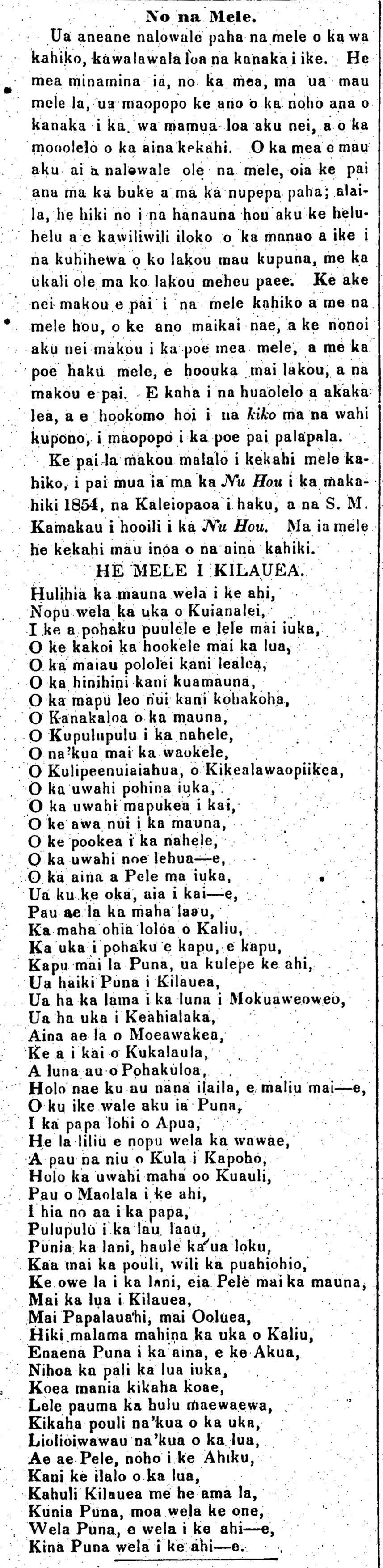
Perhaps the mele of old are almost all lost; those who know them are but few. This is something to be regretful of for in those mele, one can understand the way of life of the people of very long ago, and the stories of the land as well. The means for these mele to continue and not to be lost is by printing them in books and newspapers perhaps; in that way, the new generations can read them and contemplate over it and see the misconceptions of their kupuna and to not follow in their misguided ways. We wish to print the old mele and new mele, as long as they are good, and we ask of those who have mele and the composers of mele to send them to us and we will print them. Write the letters very clearly, and insert punctuation where they should be so that the printers understand.

We are printing below an old mele previously printed in Nu Hou in 1854, composed by Kaleiopaoa and submitted to the Nu Hou by S. M. Kamakau. In the mele there are foreign place names.

HE MELE I KILAUEA.

Hulihia ka mauna wela i ke ahi,
Nopu wela ka uka o Kuianalei,
I ke a pohaku puulele e lele mai iuka,
O ke kakoi ka hookele mai ka lua,
O ka maiau pololei kani lealea,
O ka hinihini kani kuamauna,
O ka mapu leo nui kani kohakoha,
O Kanakaloa o ka mauna,
O Kupulupulu i ka nahale,
O na’kua mai ka waokele,
O Kulipeenuiaiahua, o Kikealawaopiikea,
O ka uwahi pohina iuka,
O ka uwahi mapukea i kai,
O ke awa nui i ka mauna,
O ke pookea i ka nahele,
O ka uwahi noe lehua—e,
O ka aina a Pele ma iuka,
Ua ku ke oka, aia i kai—e,
Pau ae la ka maha laau,
Ka maha ohia loloa o Kaliu,
Ka uka i pohaku e kapu, e kapu,
Kapu mai la Puna, ua kulepe ke ahi,
Ua haiki Puna i Kilauea,
Ua ha ka lama i ka luna i Mokuaweoweo,
Ua ha uka i Keahialaka,
Aina ae la o Moeawakea,
Ke a i kai o Kukalaula,
A luna au o Pohakuloa,
Holo nae ku au nana ilaila, e maliu mai—e,
O ku ike wale aku ia Puna,
I ka papa lohi o Apua,
He la liliu e nopu wela ka wawae,
A pau na niu o Kula i Kapoho,
Holo ka uwahi maha oo Kuauli,
Pau o Maolala i ke ahi,
I hia no aa i ka papa,
Pulupulu i ka lau laau,
Punia ka lani, haule ka ua loku,
Kaa mai ka pouli, wili ka puahiohio,
Ke owe la i ka lani, eia Pele mai ka mauna,
Mai ka lua i Kilauea,
Mai Papalauahi, mai Ooluea,
Hiki malama mahina ka uka o Kaliu,
Enaena Puna i ka aina, e ke Akua,
Nihoa ka pali ka lua iuka,
Koea mania kikaha koae,
Lele pauma ka hulu maewaewa,
Kikaha pouli na’kua o ka uka,
Liolioiwawau na’kua o ka lua,
Ae ae Pele, noho i ke Ahiku,
Kani ke ilalo o ka lua,
Kahuli Kilauea me he ama la,
Kunia puna, moa wela ke one,
Wela Puna, e wela i ke ahi—e,
Kina Puna wela i ke ahi—e.

(Hae Hawaii, 3/21/1860, p. 204)

No na Mele.

Ka Hae Hawaii, Buke 4, Ano Hou.—Helu 51, Aoao 204. Maraki 21, 1860.

The importance of mele, 1860.

Pertaining to Mele!

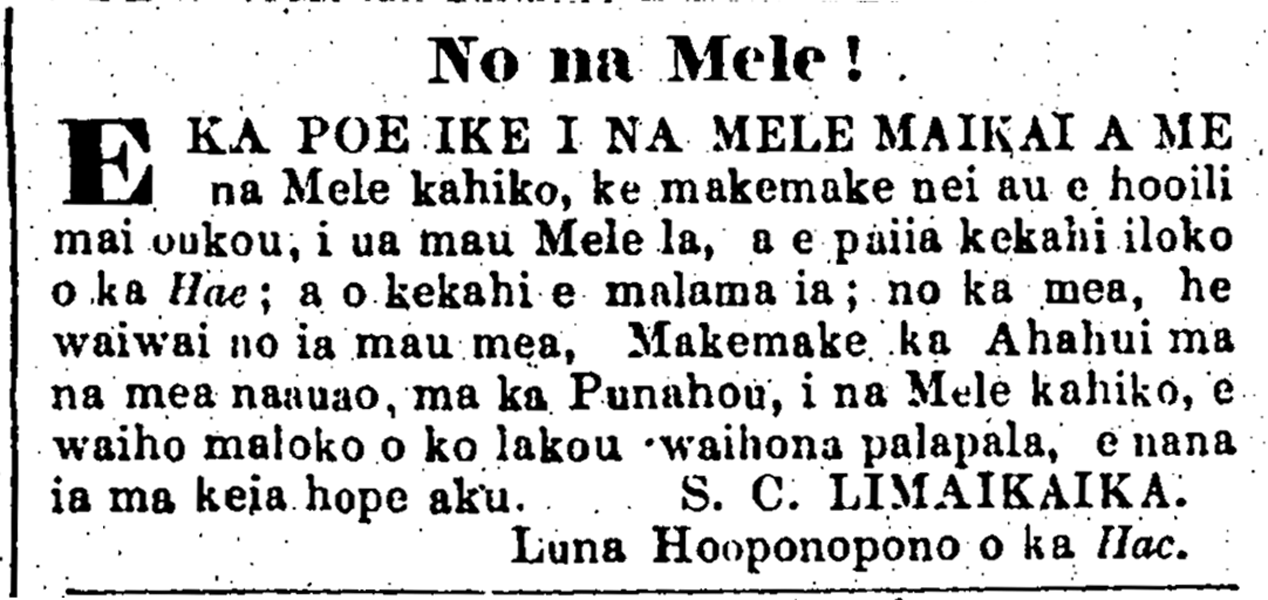
O PEOPLE THAT KNOW FINE MELE AND the old Mele, I want you all to send those Mele in, and some will be published in the Hae [Ka Hae Hawaii]; and some will be kept; for those things are valuable. The Philomathian Society [?? Ahahui ma na mea naauao]  at Punahou is wanting old Mele to put into their archives to be looked at at a later date. S. C. Armstrong [S. C. Limaikaika].

Editor of the Hae.

(Hae Hawaii, 3/21/1860, p. 203)

No na Mele

Ka Hae Hawaii, Buke 4, Ano Hou.—Helu 51, Aoao 203. Maraki 21, 1860.

Samuel K. Kekoowai on the Daughters of Hawaii and Hanaiakamalama, 1923.

HANAIAKAMALAMA

This is a building near the end of the route of the electric car, and it stands on a hill.

As a result of the graciousness of one of the members of the Daughters of Hawaii [Ahahui o na Kaikamahine o Hawaii], this writer [Samuel K. Kekoowai] was introduced to Mrs. J. Swanzy, the leader of this association, and by her kindness I was welcomed to see the walls of that house which is filled with beautiful decorations of the monarchy, and their images hanging from the walls, set up almost like the museum of Kamehameha [Bernice Pauahi Bishop Museum].

This group, the Daughters of Hawaii, upholds the name of Queen Emma Kaleleonalani, and her birthday is cherished by them, and the writer observed the commemoration held by the association which holds dear the name placed upon them, the Daughters of Hawaii.

In the story told to me within the house, Kaleleonalani was raised by her hanai guardian [kahu hanai], Dr. Rooke [Kauka Luka], until she married Liholiho Kamehameha 4, however, there is another version that I have been told by another.

On that 20th day of this June, I saw the back room totally filled with those who came, from the members to visitors, and most were whites and there were a few Hawaiians [??? a o-a na Hawaii].

The story of the circuit of Queen Emma Kaleleonalani around Oahu nei was told, beginning at Waimanalo at the place of John Cummins [Keoni Kamaki], and to Kaneohe at the place of Wainui Pii, and then on to Waikane at the place of Kameaaloha; at Kahana there was a Chinese named Apakana, on to Punaluu there was Naili, to Laie at the place of Kupau, to Kahuku at the place of Kaluhi, to Waialua at the place of Kaiaikawaha. Continue reading

A mele by the “Solomon” of Hawaii, William J. Sheldon, 1918.

A MELE FOR THE HAWAIIAN BOYS.

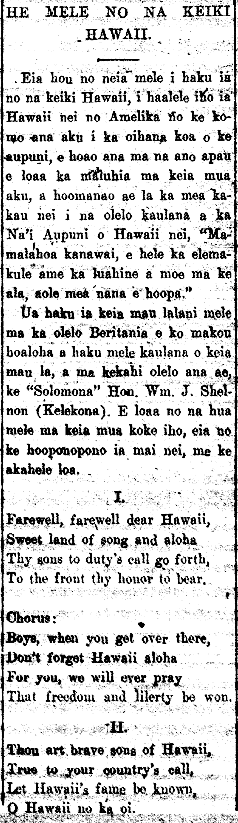
Here again is this mele which was composed for the Hawaiian boys who just left Hawaii for America to join the armed forces of the nation, to try all means to obtain peace in the future, and the composer recalls the famous words of the Conqueror of the Nation of Hawaii nei, “Law of the Splintered Paddle: let the old men and the old women go and lie by the roads, no one is to disturb them.”

These lines of mele were composed in English by our friend and famous composer of songs of these days, and in other words, the “Solomon,” Hon. William J. Sheldon (Kelekona). The music will be available soon as it is now being edited with great care.

I.

Farewell, farewell dear Hawaii,
Sweet land of song and aloha
Thy sons to duty’s call go forth,
To the front thy honor to bear.

Chorus:

Boys, when you get over there,
Don’t forget Hawaii aloha
For you, we will ever pray
That freedom and liberty be won.

II.

Thou are brave sons of Hawaii,
True to your country’s call,
Let Hawaii’s fame be known,
O Hawaii no ka oi.

(Aloha Aina, 6/21/1918, p. 2)

HE MELE NO NA KEIKI HAWAII.

Ke Aloha Aina, Buke XXIII, Helu 25, Aoao 2. Iune 21, 1918.

A pair of patriotic mele by John G. M. Sheldon, 1893.

KE KUOKOA PUKA LA.

He malihini hoi keia,
E auwana hele ae nei,
Aihemu manienie,
Ai uhini o ka nahele.

O ke ano iho la no ia,
Malimali i kinohou,
A ku ae i ka moku,
Ko-we-iu-Kanaka.

O ko lakou ano iho la ia,
O hoolilo aina ma,
Mai punihei aku,
I ka mali hoohui aina.

[The Daily Kuokoa Newspaper¹

This is a newcomer
Wandering about
Devouring until barren
Eater of grasshoppers in the wilderness.

That’s its nature
Sweet words at first
Then taking rule of the land
“Go away you Kanaka.”

That is how they are
Those who will turn over the land
Don’t get tricked
By the sweet-talking annexationists.

¹Nupepa Puka La Kuokoa me Ko Hawaii Pae Aina i Huiia was a daily pro-annexation Hawaiian-Language newspaper that ran from 1/26/1893 through 1896.

KA’U MELE.

Pehea la e hiki ai,
Ia’u ke uumi iho,
I ko’u aloha e ka aina hanau,
Nau wau i hoohua mai.

O kou kuakoko no’u ia,
Eha oe, no’u ia eha,
Mailani oe ia’u, he milimili,
I ole ai kakou, ma o ka Haku.

E ka Haku—e—Puuhonua,
Kalahea o ko ke ao nei,
Ina ua hewa au, ke noi nei au,
Ma Ou ‘la, e ola au.

Kahikina Kelekona.

[My Song

How would it be possible
For me to hold back
My aloha, O Land of my birth,
You gave birth to me.

Your birth pangs are for me
When you are pained, those pains are for me
You treasure me, as something dear
We live through the Lord.

O Lord, O Refuge
Redeemer of this world
If I am wrong, I beseech
Through You, let me live.

Kahikina Kelekona.]

(Hawaii Holomua, 1/25/1893, p. 2)

KE KUOKOA PUKA LA.

Hawaii Holomua, Buke III, Helu 446 [146], Aoao 2. Ianuari 25, 1893.

“Kuu Moi,” a patriotic mele by Clarence E. Edwords, 1896.

Kuu Moi.

Oh Lydia, Heaven born child of the sun!
Liliuokalani, aloha, kuu Moi!
True sovereign of the sun kissed isles of the sea,
Let it not be said that they race is now run.
How shall the intruders for their crimes atone?
For the vile indignities cast upon thee?
Oh, what, indeed, should the fit punishment be
For those who so basely robbed thee of thy throne?
Even now with stones they children are fed;
Aye, but it were better that they should be dead
Than pledged allegiance to the foreign born band,
Or take subsistence from their accursed hand.
Akua mana loa forbid it be said
That thy people deserted their native land.

Clarence E. Edwords.

[Does anyone know the story of Clarence E. Edwords?? There are some nice references to what is happens with the patriots of the Royal Hawaiian Band choosing to eat stones before pledging allegiance to the Provisional Government. Ellen Predergast composes “Mele Ai Pohaku,” and Clarence E. Edwords composes “Kuu Moi.”]

(Makaainana, 7/13/1896, p. 1)

Kuu Moi.

Ka Makaainana, Buke VI—-Ano Hou, Helu 2, Aoao 1. Iulai 13, 1896.

Political Mele for Mark Robinson, 1930.

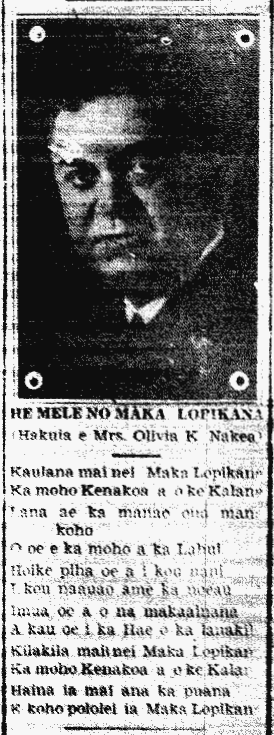
HE MELE NO MAKA LOPIKANA

(Hakuia e Mrs. Olivia K. Nakea)

Kaulana mai nei Maka Lopikana
Ka moho Kenakoa a o ke Kalana
Lana ae ka manao ona mana koho
O oe e ka moho a ka Lahui
Hoike piha oe a i kou nani
I kou naauao ame ka noeau
Imua oe a o na makaainana
A kau oe i ka Hae o ka lanakila
Kilakila mai nei Maka Lopikana
Ka moho Kenakoa a o ke Kalana
Haina ia mai ana ka puana
E koho pololei ia Maka Lopikana

[A SONG FOR MARK ROBINSON

(Composed by Mrs. Olivia K. Nakea)

Famous is Mark Robinson
The Senatorial candidate of the County
The voters are hopeful
That you are the representative of the Lahui
Reveal fully of your beauty
Of your expertise and wisdom
You appear before the people
Displaying the flag of victory
Majestic is Mark Robinson
The Senatorial candidate of the County
Let the refrain be told
Vote straight away for Mark Robinson]

(Alakai o Hawaii, 7/9/1930, p. 1)

HE MELE NO MAKA LOPIKANA

Ke Alakai o Hawaii, Buke 3, Helu 10, Aoao 1. Iulai 9, 1930.

A Song for Duke Kahanamoku, 1912.

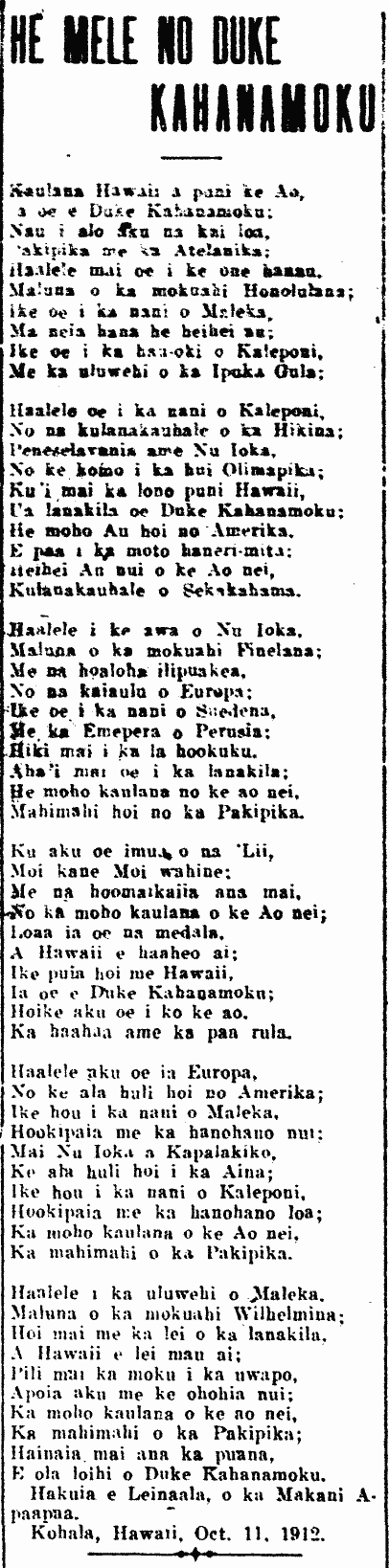
HE MELE NO DUKE KAHANAMOKU

Kaulana Hawaii a puni ke Ao,
Ia oe e Duke Kahanamoku;
Nau i alo aku na kai loa,
Pakipika me ka Atelanika;
Haalele mai oe i ke one hanau,
Maluna o ka mokuahi Honolulana;
Ike oe i ka nani o Maleka,
Ma neia hana he heihei au;
Ike oe i ka hau-oki o Kaleponi,
Me ka uluwehi o ka Ipuka Gula;

Haalele oe i ka nani o Kaleponi,
No na kulanakauhale o ka Hikina;
Peneselavania ame Nu Ioka,
No ke komo i ka hui Olimapika;
Ku’i mai ka lono puni Hawaii,
Ua lanakila oe Duke Kahanamoku;
He moho Au hoi no Ameria,
E paa i ka moto haneri-mita;
Heihei Au nui o ke Ao nei,
Kulanakauhale o Sekokahama.

Haalele i ke awa o Nu Ioka,
Maluna o ka mokuahi Finelana;
Me na hoaloha ilipuakea,
No na kaiaulu o Europa;
Ike oe i ka nani o Suedena,
Me ka Emepera o Perusia;
HIki mai i ka la hookuku,
Aha’i mai oe i ka lanakila;
He mohokaulana no ke ao nei,
Mahimahi hoi no ka Pakipika.

Ku aku oe imua o na ‘Lii,
Moi kane Moi wahine;
Me na hoomaikaiia ana mai,
No ka moho kaulana o ke Ao nei;
Loaa ia oe na medala,
A Hawaii e haaheo ai;
Ike puia hoi me Hawaii,
Ia oe e Duke Kahanamoku;
Hoike akuu oe i ko ke ao,
Ka haahaa ame ka paa rula.

Haalele aku oe ia Europa,
No ke ala huli hoi no Amerika;
Ike hou i ka nani o Maleka,
Hookipaia me ka hanohano nui;
Mai Nu Ioka a Kapalakiko,
Ke ala huli hoi i ka Aina;
Ike hou i ka nani o Kaleponi,
Hookipaia me ka hanohano loa;
Ka moho kaulana o ke Ao nei,
Ka mahimahi o ka Pakipika.

Haalele i ka uluwehi o Maleka,
Maluna o ka mokuahi Wilhelmina;
Hoi mai me ka lei o ka lanakila,
A Hawaii e lei mau ai;
Pili mai ka moku i ka uwapo,
Apoia aku me ke ohohia nui;
Ka moho kaulana o ke ao nei,
Ka mahimahi o ka Pakipika;
Hainaia mai ana ka puana,
E ola loihi o Duke Kahanamoku.

Hakuia e Leinaala, o ka Makani Apaapaa.

Kohala, Hawaii, Oct. 11, 1912.

[A SONG FOR DUKE KAHANAMOKU

Hawaii is renowned world around,
For you, O Duke Kahanamoku,
You faced the great seas,
The Pacific and the Atlantic,
You left your birth sands,
Aboard the steamer Honolulan,
You witnessed the beauty of America,
In this pursuit of swimming competitions,
You saw the icy cold of California,
And the verdure of the Golden Gate.

You left behind the beauty of California,
For the cities in the east,
Pennsylvania and New York,
To join the Olympic team,
The news reached all over Hawaii,
That you were victorious, O Duke Kahanamoku,
You are on the American Swimming team,
You hold the 100-meter record,
In the great Swimming Contest of the World,
In the City of Stockholm.

You left New York Harbor,
Aboard the steamer Finland,
With your fair-skinned friends,
For the cities of Europe,
You witnessed the beauty of Sweden,
And the Emperor of Persia,
The day of the contest arrived,
You took the victory,
The famed champion of the world,
Mahimahi* of the Pacific.

You stood before the Monarchs,
King and Queen,
While being congratulated,
For the famed champion of the World,
You received medals,
For which Hawaii is proud,
Recognized along with Hawaii,
You, O Duke Kahanamoku,
You show the people of the world,
Humility and decorum.

You left Europe,
On the return trip to America,
To see again the beauty of Maleka,
You were welcomed with great pomp,
From New York to San Francisco,
On the road back home,
You witnessed once more the beauty of California,
You were welcomed with much honor,
The famed champion of the World,
Mahimahi of the Pacific.

Leaving behind the verdure of America,
Aboard the steamship Wilhelmina,
Returning with the lei of victory,
Of which Hawaii will forever wear,
The ship touches the dock,
You were embraced with such enthusiasm,
The famed champion of the world,
Mahimahi of the Pacific,
Let the story be told,
Long live Duke Kahanamoku.

Composed by Leinaala, of the Apaapaa Wind.

Kohala, Hawaii, Oct. 11, 1912.

*A mahimahi is a fish that is a fierce swimmer.

[The Duke Paoa Kahanamoku exhibit at the Bishop Museum begins in a week (August 9 to November 30)! I hear there will be a lot of cool things to see and experience…]

(Kuokoa, 10/18/1912, p. 5)
HE MELE NO DUKE KAHANAMOKU

Ka Nupepa Kuokoa, Buke XLVIII, Helu 42, Aoao 5. Okatoba 18, 1912.

Restoration Day celebration, day number 3! 1844.

THIRD DAY, AUGUST 2D.

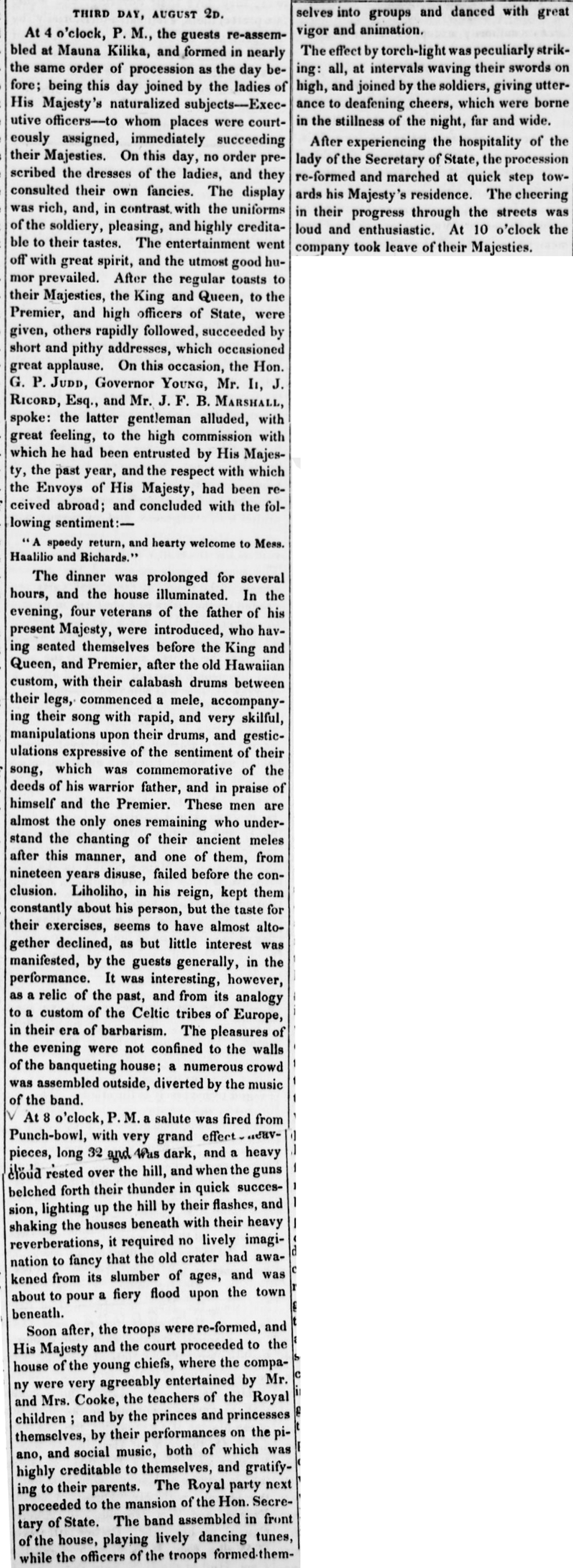
At 4 o’clock, P. M., the guests re-assembled at Mauna Kilika, and formed in nearly the same order of procession as the day before; being this day joined by the ladies of His Majesty’s naturalized subjects—Executive officers—to whom places were courteously assigned, immediately succeeding their Majesties. On this day, no order prescribed the dresses of the ladies, and they consulted their own fanices. The display was rich, and, in contrast with the uniforms of the soldiery, pleasing and highly creditable to their tastes. The entertainment went off with great spirit, and the utmost good humor prevailed. After the regular toasts to their Majesties, the King and Queen, to the Premier, and high officers of State, were given, others rapidly followed, succeeded by short and pithy addresses, which occasioned great applause. On this occasion, the Hon. G. P. Judd, Governor Young, Mr. Ii, J. Ricord, Esq., and Mr. J. F. B. Marshall, spoke: the latter gentleman alluded, with great feeling, to the high commission with which he had been entrusted by His Majesty, the past year, and the respect with which the Envoys of His Majesty, had been received abroad; and concluded with the following sentiment:—

“A speedy return, and hearty welcome to Mess. Haalilio and Richards.”

The dinner was prolonged for several hours, and the house illuminated. In the evening, four veterans of the father of his present Majesty, were introduced, who having seated themselves before the King and Queen, and Premier, after the old Hawaiian custom, with their calabash drums between their legs, commenced a mele, accompanying their song with rapid, and very skillful, manipulations upon their drums, and gesticulations expressive of the sentiment of their song, which was commemorative of the deeds of his warrior father, and in praise of himself and the Premier. These men are almost the only ones remaining who understand the chanting of their ancient meles after this manner, and one of them, from nineteen years disuse, failed before the conclusion. Liholiho, in his reign, kept them constantly about his person, but the taste for their exercises, seems to have almost altogether declined, as but little interest was manifested, by the guests generally, in the performance. It was interesting, however, as a relic of the past, and from its analogy to a custom of the Celtic tribes of Europe, in their era of barbarism. The pleasures of the evening were not confined to the walls of the banqueting house; a numerous crowd was assembled outside, diverted by the music of the band.

At 8 o’clock, P. M. a salute was fired from Punch-bowl, with very grand effect [not legible because of fold in paper] cloud rested over the hill, and when the guns belched forth their thunder in quick succession, lighting up the hill by their flashes, and shaking the houses beneath with their heavy reverberations, it required no lively imagination to fancy that the old crater had awakened from its slumber of ages, and was about to pour a fiery flood upon the town beneath.

Soon after, the troops were re-formed, and His Majesty and the court proceeded to the house of the young chiefs, where the company were very agreeably entertained by Mr. and Mrs. Cooke, the teachers of the Royal children; and by the princes and princesses themselves, by their performances on the piano, and social music, both of which was highly creditable to themselves, and gratifying to their parents. The Royal party next proceeded to the mansion of the Hon. Secretary of State. The band assembled in front of the house, playing lively dancing tunes, while the officers of the troops formed themselves into groups and danced with great vigor and animation.

The effect by torch-light was peculiarly striking: all, at intervals waving their swords on high, and joined by the soldiers, giving utterance to deafening cheers, which were borne in the stillness of the night, far and wide.

After experiencing the hospitality of the lady of the Secretary of State, the procession re-formed and marched at quick step towards his Majesty’s residence. The cheering in their progress through the streets was loud and enthusiastic. At 10 o’clock the company took leave of their Majesties.

(Polynesian, 8/10/1844, p. 47)

THIRD DAY, AUGUST 2D.

The Polynesian, New Series, Volume 1,—Number 12, Page 47. August 10, 1844.