Restoration Day celebration by true patriots, 1894.

LA HOIHOI EA.

Fitting Remembrances for that Great Day.

This past Tuesday, July 31, was the day that the independence and the beloved flag of this land was restored after being seized and forcefully taken by Lord George Paulet [Lo Keoki Pauleti] on February 25, 1843, without orders from his Nation, and Rear-Admiral Thomas [Hope-Adimerala Kamaki] was the one who restored it on this day in that very year, five months and some days after it was stolen. This day is celebrated by all true patriots with many feasts all over the place.

In the early morning, the Royal Hawaiian Band [Puali Puhiohe Lahui] went to entertain the Alii, the Monarch, at Washington Place. When they entered the yard after marching from Emma Square [Ema Kuea], the door was swung open and they marched to the Ewa corner of the house and began to play. The Alii came out and sat on the lanai on that side. The songs that were played were full of reverence, awe, and joy. Outside before the front yard were the masses, and children climbed the fence and went inside. From what we saw, the crowd was looking intensely to try and maybe get a glimpse of the Alii, showing that the songs by the band wasn’t what they desired, but it was the sight of the face and the appearance of the Ruler that they were after, as it is sung: “Our desire is but for our Alii, The one we care for.” [“O ke Alii wale no ka makou makemake, O ka luhi o maua me ia nei.”]

After the music was over, the Alii stood and spoke briefly before these people who stood steadfast behind her, with words of encouragement. She stressed that the lahui keep the peace, like her statement of January 14, 1893, for the welfare of her people, and that it would be but a few more days before, according to assurances she received, that she will once again have them [? e kikoo hou mai ai oia ia lakou] go back to their lives just as before. The Alii had as well some words filled with aloha, and there was not one from amongst the members of the band who did not shed tears; some shed great many tears while blowing their noses into handkerchiefs.

That night, on the grounds of the Hawaiian Hotel [Hotele Hawaii], they gave an open concert to entertain the public, and just as was seen at the performance they put on earlier, so too was this one, and it was very well attended. Those who attended were very happy, there being perhaps 3000, from men to women, from the old to they young, and from those of high stature to low. They played without electric lights, but were illuminated by Japanese lanterns and their pewter lanterns. It would appear as if they were totally thwarted by the Government [P. G.], but in fact it was the deceitful ones who were disappointed, because they were all the more delighted. There was a single wealth-seeking haole [kolea kauahua] that we saw sitting on the lanai of the Hotel, on the Waikiki side, with his mouth wide open, maybe because he witnessed the unmatched beauty of that great night of entertainment, that person was the one with a maimed hand from Boston.

[Let the story never be forgotten. Ua mau ke ea o ka aina i ka pono!]

(Makaainana, 8/6/1894, p. 1)
LA HOIHOI EA.

Ka Makaainana, Buke II—-Ano Hou, Helu 6, Aoao 1. Augate 6, 1894.
Looking back at their time spent at Lahainaluna, 1904.

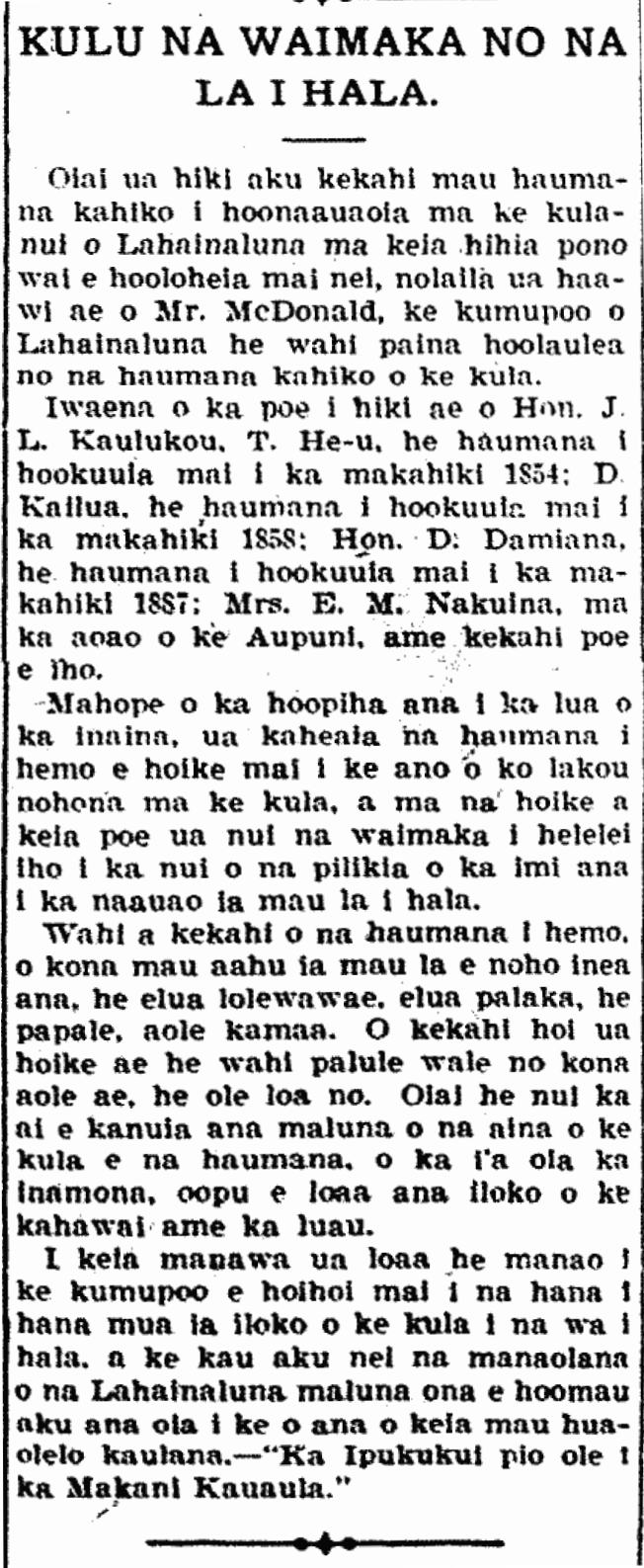
TEARS SHED FOR THE DAYS GONE BY.

Being that some of the old students educated at Lahainaluna College are involved in this water rights case, Mr. McDonald, the principal of Lahainaluna, gave a small party for the old students of the school.

Amongst those who attended were the Hon. J. L. Kaulukou, T. He-u, students who graduated in 1854; D. Kailua, a student who gradutated in 1858; Hon. D. Damiana, a student who graduated in 1857; Mrs. E. M. Nakuina, from the side of the Government; and some other people.

After the stomachs were filled, the graduates were called up to talk about their life at the school, and as a result of the words of these people, much tears were shed because of the great troubles faced in search of education in those days gone by.

According to one of the graduates, his clothes in those days of hardship was just two pants, two palaka, a hat, and no shoes. Another said that he had just one shirt and no other, none at all. Being that there was much food planted on the school property by the students, fish was the relish, the oopu that were caught in the rivers, and the luau.

Currently, the principal is thinking about going back to the work done in the schools in days past, those of Lahainaluna have placed their hope upon him, that he will have this famous saying go on.—”Ka ipukukui pio ole i ka Makani Kauaula.”¹

¹The famous epithet for Lahainaluna School: “The light not extinguished by the Kauaula winds.”

(Kuokoa, 5/13/1904, p. 5)

KULU NA WAIMAKA NO NA LA I HALA.

Ka Nupepa Kuokoa, Buke XLII, Helu 20, Aoao 5. Mei 13, 1904.

I hookahi, kahi ka manao, 1897.

LET US BE OF ONE SHOULDER,¹ LET US BE OF UNIFIED THOUGHT.

At the meeting of the Executive Committee of the “Ahahui Hawaii Aloha Aina” [Hawaiian Patriotic League] at noon, 12 o’clock, at the attorney’s office of President Kaulia, the said Executive Committee decided that the Patriotic League will join and support the great rally of the makaainana of the lahui to absolutely protest the annexation of Hawaii to America, and it is announced to all of the members of the Hawaiian Patriotic League, from the men, to the women, to the children, to assemble at the Palace Square [Kuea Pa Alii] tomorrow evening (Friday) at exactly 7 o’clock, and there will be presented with insistence and unity, the resolution informing the President of the Senate and the people of the United States, that the native Hawaiians and the long-time makaainana protest the annexation of Hawaii to the United States of America.

Let us combine our prayers to overcome Hakalau. [E alu ka pule ia Hakalau.]²

James Keauiluna Kaulia

President of the Ahahui Hawaii Aloha Aina.

¹Hearkening to the idea of “I hookahi umauma, i hookahi poohiwi, a i hookahi puuwai.” [Let us be of one chest, one shoulder, and of one heart.] Also from earlier that year, see by Samuel K. Kamakaia, “Nai Wale no Oukou A’oe Pau.”

²According to Mary Kawena Pukui’s Olelo Noeau (115): “A sorcerer at Hakalau once created havoc in his own and other neighborhoods. Many attempts to counter-pray him failed until a visiting kahuna suggested that all of the others band together to concentrate on the common enemy. This time they succeeded.”

(Aloha Aina, 10/9/1897, p. 3)

I HOOKAHI POOHIWI, I HOOKAHI, KAHI KA MANAO.

Ke Aloha Aina, Buke III, Helu 41, Aoao 3. Okatoba 9, 1897.

More on Emma Nakuina, W. T. Brigham, and the Bishop Museum, 1897.

NOT COURTEOUS

Treatment of Ladies at Bishop Museum.

An Open Protest to the Trustees of the Kamehameha Schools.

MR. EDITOR:—The undersigned with three other ladies, Hawaiians of the highest respectabily, standing and position, with five little children, were sitting this morning in the shade of the Kamehameha Museum enjoying the fine showing made by the naval men drilling on the College campus. Chairs had been offered by a Kamehameha graduate, he placing them on the grass plot adjoining the Museum. After a little while, Mr. Brigham, the curator of the Museum, drove by within a few feet of us. He scowled most savagely at us. In a few minutes a Portuguese workman came to order us away from the place.

As it has invariably been the custom to throw the College grounds open to the public when any sort of a public or semi-public show is taking place within its precincts, we did not pay any attention to his orders, thinking it a piece of officiousness on the part of an ignorant person, and the man went away. After a while the man re-appeared and ordered us off again, saying he was acting by Brigham’s orders, and to use force if necessary. He took hold of the chair of the wife of a prominent official and tipped it partly over. She sprang up to avoid a fall, as did two other ladies. I, being at the very corner of the building and a little in advance of the others did not perceive the man until he had taken hold of my chair and had partly spilled me on my knee. I turned around to protest, when he grabbed my arm and pulled me out of my chair, saying “you get out of this, those are my orders from Mr. Brigham. If you don’t go yourself, I make you go. Mr. Brigham don’t allow any one to get on this grass.”

There were quite a number of carriages standing around, occupied by spectators of the drill.

The actions of the Portuguese were so rough and insulting that the attention of quite a number were attracted to our forcible ejectment. Continue reading

Devastating earthquake and tsunami, 1868.

Terrifyingly Powerful Earthquake

Please place this in some open area of your columns; the story of this huge earthquake mentioned above, in the District of Puna, and perhaps other places as well.

When I turned back with my travel companions on the road from Kapapala, we didn’t reach our home (Kahaualea), but between those places we were met with an earthquake, leaning this way and that as we groped around for something solid to hold on to, and one of my friends saw the ground before us splitting open, whereupon he cried out and stood elsewhere; as for me, I tipped over and heard up close the rumbling of the earth, and I said to my companions, “What is happening to us?” One of us answered, “Maybe this is an earthquake that is causing us this fright.” I then said, “How awesomely frightening; if the ground rumbles and splits open and we are swallowed up, then we are all dead, just like the Anak [Anaka] people who were swallowed in the earth.

The length of the earthquake upon us was like six minute, and when it was over, we headed back while constantly seeing at the places where the earth split open in the road; some were the size of a man’s foot, and were several inches wide at some places. And when we reached out houses, the ohana was there who experienced the same thing. I saw our eating house [hale paina] (a stone building) which collapsed; and the dishes were all broken.

It was as if the damage seen was from the earthquake, but it also came from the sea; we went down to the shore (where much of our houses were). When we looked, we saw the boats were smashed in little pieces, and inland, the earthquake made houses topple, the stone walls of the church collapse, house fences fall, fish ponds dry up; some survived. Toward the sea, five canoes were splintered, some house fences fell, and the water entered some houses where people lived. It was all messed up.

For those whose lives were in danger, when the water entered their houses, a man named Kapai got up with his two children and ran out, but they were taken by the sea and died, so too with some women and their children, they were beaten by the sea; some people with their daughter escaped by running and climbing a hala tree. Auwe! Auwe! in dire straits. Make haste O Ke Au Okoa, speed on the wings of the wind to report of this frightening news here in Puna and perhaps elsewhere as well. B. H. M. Kailiwahine.

Kaukeano, Puna, Hawaii, April 12, 1868.

P. S. It was on the 2nd of April, at maybe 5 in the evening that the tremors began, and it did not let up at all until the setting of the sun, and at dawn, the earthquakes were strong. B. H. M. K.

(Au Okoa, 4/16/1868, p. 3)

He olai nui Weliweli.

Ke Au Okoa, Buke III, Helu 52, Aoao 3. Aperila 16, 1868.

Napua Stevens back home, 1938.

CAME BACK HOME

The picture above is a picture of that kamaaina girl of Hilo nei, Miss Harriet Napua Stevens, formerly of Hilo and who is now staying in Honolulu and heard nightly at the Young Hotel [Hokele Iana] singing with the Band of Giggi Royce [Gigi Royce] of Honolulu. Continue reading

Iolani Luahine turns one year old, 1916.

Luau Party.

On January 30, 1916, Miss Julia N. Luahine gave a party at her home on 312 Ilaniwai Street, to celebrate the first birthday of her hanai granddaughter, Harriet Iolani Makekau, which was resplendent [ohuohu Halemano i ka lau lehua] and attended by many [lei Kohala i ka nuku na kanaka]. Continue reading

Olelo Noeau, 1922.

PROVERBS.

In order for us to hold on to all of the olelo noeau and all of the ingenious deeds of the Hawaiian people, we very much want everyone to assist the Bishop Museum in their collecting and explaining of wise and witty sayings known amongst this race.

So that this endeavor will move forward, whenever an ancient olelo noeau comes to mind, or perhaps a riddle, do write it down and send it to the museum; and if not to there, send it directly to the Kuokoa with clarification of its hidden meaning or deep wit.

Here are some olelo noeau sent from the museum to this newspaper:

He ala iki ko kahuna.

Aohe pau o ka ike i kau halau.

Aohe hookahi halau i a’oia ai.

He maia ke kanaka, a ka la e hua mai ai, hua.

O-u i ka maka o ka wauke o i opiopio.

Aohe ipukai pau i ka iole.

Aohe malama pau i ka iole.

Aole e nalo na iwi o ke alii kolohe. E nalo na iwi o ke alii maikai. Oluna, olalo, okai, ouka, o ka hao pae, ko ke alii.

Ua mau ke ea o ka aina i ka pono.

E hele ka elemakule, ka luahine, ame ke keiki a moe i ke ala.

Ola na iwi o kaua.

Hiamoe loa ke kane, nana wale ka wahine.

Mai noho a hele kikaha aku.

Ua hala i Kauai, i Kalalau.

Aohe pilo uku.

I ke alo iho la no ka ulu a o ka hala no ia.

He ohu ke aloha, aohe kuahiwi kau ole.

Ono kahi ao luau me ke aloha pu kekahi.

Pa mai, pa mai ka makani o Hilo: waiho ka ipu iki, homai ka ipu nui.

Ka i ke pohuehue, ha’i ka nalu.

Monia, monia, alealea i ke kumu pihapiha: Lawea mai!

O kau ola ia, e Ku ame Hina; O ko’u ola ho’i ia. I ka olua pulapula i keia ao. Amana, ua noa.

Pua ka neneleau momona ka wana.

Pala ka hala, momona ka uhu.

[And presumably from the responses came the publication we all know today as “‘Ōlelo No‘eau: Hawaiian Proverbs and Poetical Sayings”. Some of the examples above are included with different phrasing, while others appear not to have been included. If you don’t have a copy of this publication, it is a must have!]

(Kuokoa, 9/14/1922, p. 5)

NA OLELO NIEAU.

Ka Nupepa Kuokoa, Buke LXI, Helu 37, Aoao 5. Sepatemaba 14, 1922.

More on the missionaries, 1894.

Missionary Descendants Show Their Knowledge of Hula Ku’i.

In the Advertiser of 2/7/1894, was shown that at New Haven, United States of America, on the past 17th of January 1894, there was held a party to commemorate the anniversary of the government by the P. G. Those present were: J. R. Kauka [James Robert Judd?], G. S. Walakahauki [George S. Waterhouse], C. M. Kuke [C. Montague Cooke, Jr.?], W. D. Balauina [William D. Baldwin], A. M. Atherton, A. S. Knudsen, J. A. Waila [James Austin Wilder], H. A. Balauina [Harry A. Baldwin], and F. Hastings.

Before drinking to the delight at the Cabinet of Ministers of Cleveland, the young missionaries danced a hula ku’i to a hapa haole song. When the music started, the youths among them who knew how to hula ku’i jumped up immediately and danced and started to sway! …the mixed poi of Poniuailana goes the limit; there you go!—answer the call!—…¹

KE MELE HULA-KUI.

Kaulana mai nei o Mr. Cleveland,
Anti-Annexation no ia ia,
Ua olelo Cleveland i Mr. Willis,
E hele ana oe e Honolulu,
Aia hiki ana oe malaila,
E kipaku oe i ka P. G.
A komo oe Liliuokalani,
Maluna o kona throne!”
Ua hai mai Peresidena Dole,
E noho oe Malie”
Pilikia loa no Alapaki Willis,
E hoka no o Mr. Cleveland.

A MELE HULA KU’I

Famed is Mr. Cleveland,
An Anti-Annexationist is he,
Cleveland said to Mr. Willis,
[“]You are going to Honolulu,
When you get there,
Banish the P. G.
And place Liliuokalani,
Upon her throne!”
President Dole spoke,
[“]You just sit still.”
Albert Willis is perplexed,
Mr. Cleveland is thwarted.

The adeptness at the hula ku’i by these missionary descendants was seen first hand here in Honolulu, along with the girls carrying ukulele.

There you go! Mixed up is the cultivated taro with the wild! The white is smeared; the black gets the score.

What is this S. E. Bishop!—Look to New Haven! Your people’s hula ku’i dancer descendants were  gyrating away!

You missionaries, don’t be hypocritical.

¹…kuupau na ai hoowali o Poniuailana; o—ia!—e, o!—…

[Does anyone have more information on the “Kuupau na ai hoowali o Poniuailana” phrase?]

(Nupepa Ka Oiaio, 2/9/1894, p. 3)

Hoike na Mamo Mikanele i ko lakou ike hula-kui.

Nupepa Ka Oiaio, Buke VI, Helu 6, Aoao 3. Feberuari 9, 1894.

The first Kamehameha Day out in the country, continued, 1872.

At Wailuku.

The children of the Hawaiian nation celebrated this day to commemorate the day believed to be the incorrect [? kupaewa] day of birth of the old chief who passed on, the one who joined Hawaii nei together to become one.

Here below are the activities done in celebration on that day. A crowd gathered at the protestant church in Wailuku; people were separated into those who were born during the time of Kamehameha I, who had a separate seating section, and so too of the people of Kamehameha IIʻs time, and all the way until those of Kamehameha Vʻs time; when looking about, a majority of the audience was born in the time of Kamehameha III.

The program was opened with the singing of a hymn to Almighty God; Hymn 33 and Mr. Napue gave a prayer; there was a second Hymn 196, and that came to an close. J. A. Napela [J. H. Napela] served as the Chairman, and spoke about things of Kamehameha Iʻs time and his deeds, his strength, and so forth. This was the first speech, and it was given for the commemoration, appropriately done by one who is well-immersed in the ways of those times.

Speech number two. C. P. Kealakai, teacher of Halehaku; his speech was about the one being commemorated; his main topic which he expounded upon was aloha for God.

Speech number three. D. H. Hakuole, teacher of Kauaula; his speech was about Opukahaia, and not about the remembrance of Kamehameha I.

Speech number four. Kamoku, a student of the theological seminary; this speech was on the mark [pilipono ka la i papaenaena] and did not go astray; it was the first delightful speech for the audience.

Speech number five. A. Keohokalole, audience member from the island of Maui; this was a speech suited for the learned; the items were woven skillfully together, and was fitting to the program.

Speech number six. I donʻt have the name; it was a speech that was not pertinent to the topic; he was made to sit down by the Chairman.

Speech number seven. Mr. Kaleohano; the speech was about electricity, but it was related to the topic. He spoke about these famous words before the audience, because the haole sugar farmers don’t recall the words of the alii, Kamehameha V, who said: “If I had a million dollars in my pocket, I would be able to demolish these sugar mills for their contempt of the royal proclamation.

Speech number eight. P. Kaluna, teacher of Papohaku, it was electric; it was apparent that his speech showed his great thought for the celebration of the day.

Speech number nine. Kawelau, teacher of the district of that famous rain, the Ukiukiu [of Makawao]; I will not say that he wasn’t electric, but it was somewhat like speech number four.

Speech number ten. Nahunahupu; this was a speech not appropriate for the person who was being commemorated that day.

Speech number eleven. D. Mamaki, teacher of Lahaina; this was a fine speech.

After this speech was over, that concluded the activities of the day. Everyone proceeded down to the place of N. Kepoikai, Esq. There, they were supplied with every type of Hawaiian food, along with haole food, all except liquor. This feast was appreciated for its peaceful nature and great pride, well-suited for gentlemen. The majority of those who partook in the food were government school teachers of the from all around Maui.

[This is a continuation of “Day Commemorating Kamehameha I.” There is one more section describing the celebration held at Kailua, Kona, with quite a display of whale ivory! I will try to get that up sometime in the future.]