John Ioane Ukeke, in his earlier days! 1880

CHINESE THEATER!

OPENING

A GRAND CONCERT!

Of all types of Hawaiian Music, on the night of the

SATURDAY NIGHT, THE 26TH OF THIS MONTH!

AT THE

Chinese Theater!

SEASIDE OF AINAHOU.

There will be some Mele performed with Native Hawaiian instruments, and some with Haole instrments.

By the Famed One

MR. JOHN IOANE UKEKE!

IS THE ORCHESTRATING.

THE PERFORMANCE.

1. IPU PERFORMANCE [LEALEA PAIPU]—4 girls whose steps are like flashes of lightning.

2. CHEST SLAPPING PERFORMANCE [LEALEA PA-I-UMAUMA]—3 boys with swift hand motions.

3. MODERN PERFORMANCE [LEALEA HOU LOA]—4 dolls. The dolls will do a Hula Olapa, and their hand motions will be like those of a human.

4. UKEKE PERFORMANCE [LEALEA UKEKE]—Mr. John Ioane will show his total skill with the metal ukeke (Jew’s harp) with Hawaiian songs and Haole songs—He will exert himself with his ukeke playing in all fashions—[It doesn’t help that the image is not clear, but cannot make out the next line and a half. Anyone?] and your hearts will be captured.

5. ULIULI PERFORMANCE [LEALEA ULIULI]—2young children. They will show the fluttering and rattling of this thing, the Uliuli.

6. BANJO PERFORMANCE [LEALEA BANJO]—S. Kalama will exhibit his full skill at the Banjo; and its sound is like the ten-stringed lyre of Mahone [this is probably a reference to a story running in the Kuokoa: “KA MOOLELO O BERIANA KA WIWO OLE A ME MAHONE KE KOA” (4/26/1879–11/20/1880)]

FIVE MINUTE BREAK.

7. ACCORDIAN PERFORMANCE [LEALEA KOLIANA]—Henere [Henry] will show his skill at playing the Accordian, and the sounds he makes: Chinese, hoaeae, oli and the musical scale [pakoli]; it will make the crowd laugh and your sides will hurt.

8. OHELO PERFORMANCE [LEALEA OHELO]—2 women. They will show their abilities at this amusement. This is the amusement of the alii of the olden days that they greatly enjoyed.

9. KUI PERFORMANCE [LEALEA KUI]—2 women. These two ladies will display their readiness at this amusement while from their mouths come mele.

10. UKEKE PERFORMANCE [LEALEA UKEKE]—Mr. John Ioane will show his playing of the ukeke with Mele of the King; and this sweet voice of the ukeke will be accompanied by the steps of some girls doing lele this way and that.

11. MODERN PERFORMANCE [LEALEA ANO HOU]—The Famous Mr. Ioane will show once again some new things that will have the audience in stitches.

The doors will open at 7 P. M. Performances begin at 8.

ENTRANCE FEE: $1.00, $ .50. Tickets [Balota ?] available from hand of those in charge as well as at the entrance.

(Ko Hawaii Pae Aina, 6/26/1880, p. 2)
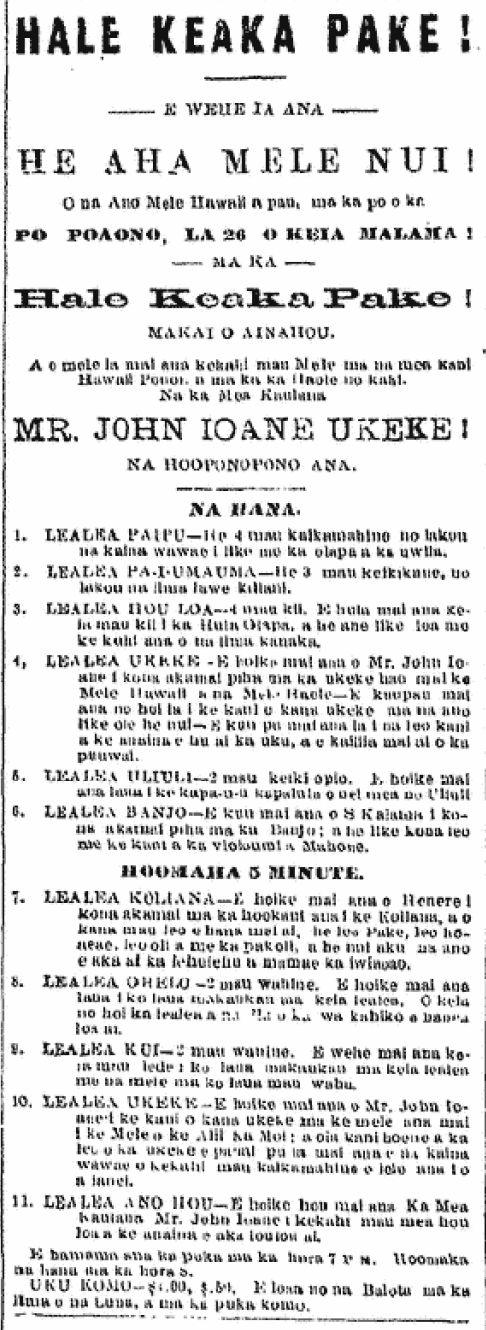
HALE KEAKA PAKE!

Ko Hawaii Pae Aina, Buke III, Helu 26, Aoao 2. Iune 26, 1880.
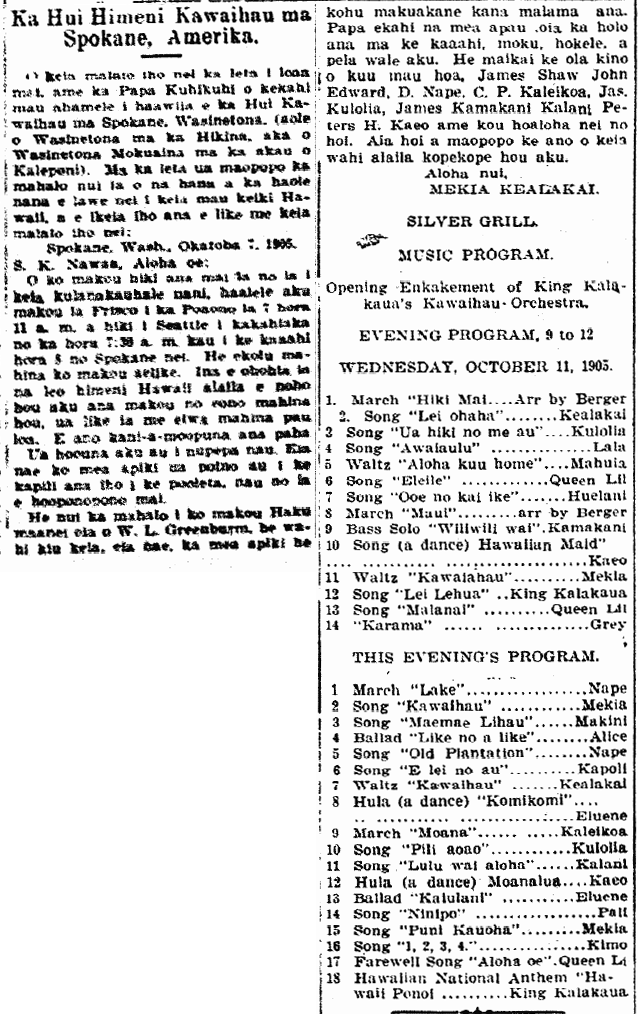
Kawaihau Glee Club performs in Washington State. 1905.

The Kawaihau Glee Club in Spokane, America.

Here below is a letter received as well as a program from some performances given by the Kawaihau Glee Club at Spokane, Washington (not Washington in the East, but Washington State to the North of California). It is apparent from the letter that the actions of that haole taking these Hawaiian boys around is much appreciated, and this is seen as below:

Spokane, Wash., October 7, 1905.

S. K. Nawaa, Aloha to you:

We’ve arrived in this beautiful town, we left Frisco on Saturday the 7th [?] at 11 a. m. and got to Seattle in the morning, at 7:30 a. m. boarded the 8 o’clock train for Spokane. Our contract is for 3 months. If they are taken by the sound of Hawaiian music, we will stay on for another 6 months, which would make 9 months total. Perhaps we will be like old grandparents by then.
I have sent a newspaper to you. But here is the thing, I had problems with the postage, so you will have to take care of it.
We really are thankful for our Boss here, W. L. Greenburn [?], he is an investigator. The one problem is that he treats us as if he is our father. Everything is first class, from the train, to the boat, to the hotel, and so forth. My friends, James Shaw, John Edward [Edwards?], D. Nape [David Nape], C. P. Kaleikoa, James Kulolia, James Kamakani, Kalani Peters, H. Kaeo and me, your friend as well, we are all in good health. As soon as I get acclimated to how it is here, I will write again.
Much Aloha,
Mekia Kealakai.

SILVER GRILL
MUSIC PROGRAM
Opening Enkakement of King Kalakau’s Kawaihau Orchestra.
EVENING PROGRAM, 9 to 12

WEDNESDAY, OCTOBER 11, 1905.

1 March “Hiki Mai” Arr by Berger
2 Song “Lei ohaha” Kealakai
3 Song “Ua hiki no me au” Kulolia
4 Song “Awaiaulu” Lala
5 Waltz “Aloha kuu home” Mahuia
6 Song “Eleile” Queen Lil
7 Song “Ooe no kai ike” Huelani
8 March “Maui” arr by Berger
9 Bass Solo “Wiliwili wai” Kamakani
10 Song (a dance) Hawaiian Maid” Kaeo
11 Waltz “Kawaiahau” Mekia
12 Song “Lei Lehua” King Kalakaua
13 Song “Malanai” Queen Lil
14 “Karama” Grey

THIS EVENING’S PROGRAM.

1 March “Lake” Nape
2 Song “Kawaihau” Mekia
3 Song “Maemae Lihau” Makini
4 Ballad “Like no a like” Alice
5 Song “Old Plantation” Nape
6 Song “E lei no au” Kapoli
7 Waltz “Kawaihau” Kealakai
8 Hula (a dance) “Komikomi” Eluene
9 March “Moana” Kaleikoa
10 Song “Pili aoao” Kulolia
11 Song “Lulu wai aloha” Kalani
12 Hula (a dance) Moanalua Kaeo
13 Ballad “Kaiulani” Eluene
14 Song “Ninipo” Pali
15 Song “Puni Kauoha” Mekia
16 Song “1, 2, 3, 4.” Kimo
17 Farewell Song “Aloha oe” Queen Li
18 Hawaiian National Anthem “Hawaii Ponoi King Kalakaua

[I am assuming that they copied the program as it was printed out in Washington…]

(Kuokoa, 11/3/1905, p. 5)

Ka Hui Himeni Kawaihau ma Spokane, Amerika.

Ka Nupepa Kuokoa, Buke XLIII, Helu 44, Aoao 5. Novemaba 3, 1905.

Kawaihau Glee Club off to San Francisco. 1905.

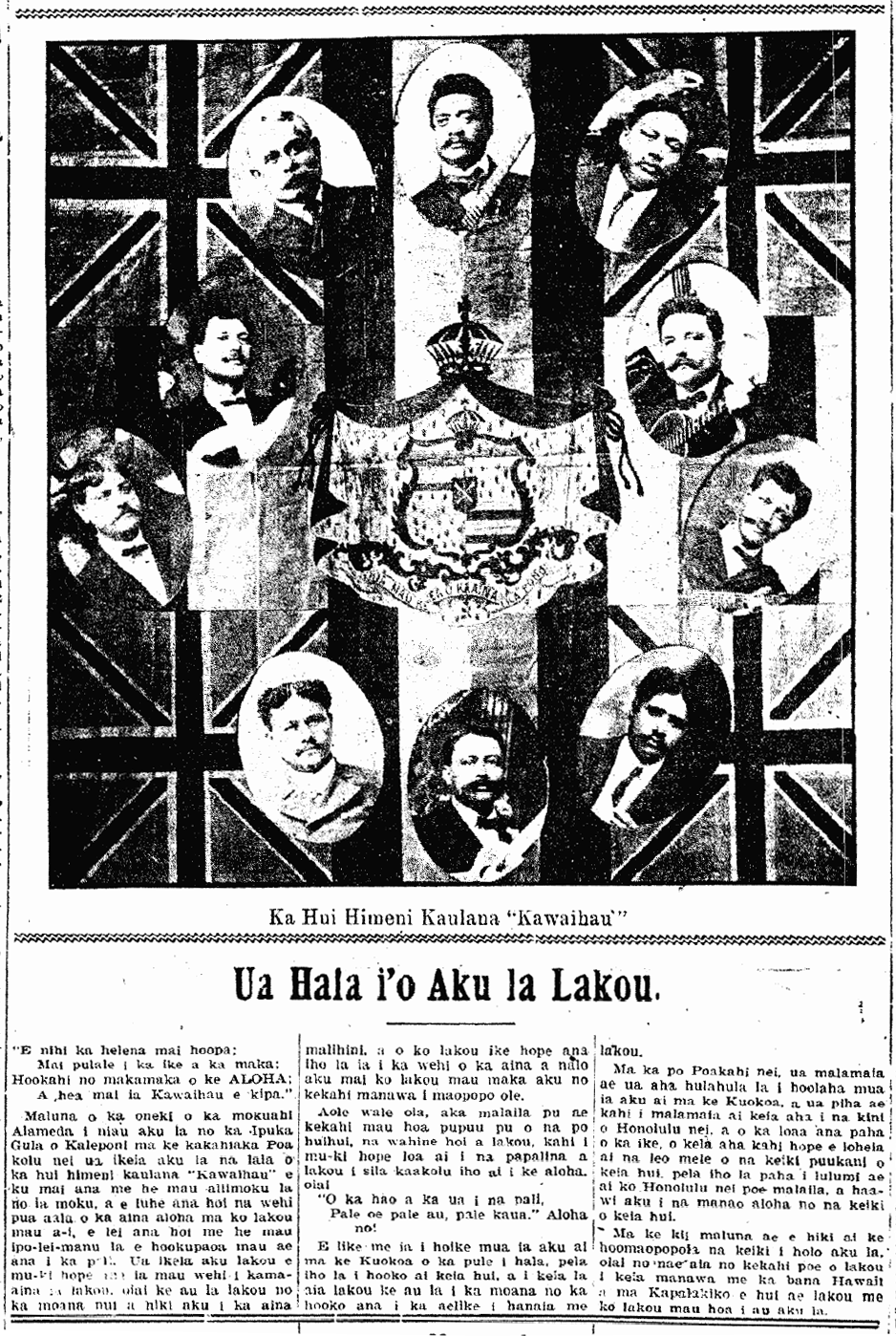
The Famous Singing Group “Kawaihau”

They Left for Afar.

“E nihi ka helena mai hoopa; [Tread carefully, don’t touch;]
Mai pulale i ka ike a ka maka [Don’t get excited by what the eye sees:]
Hookahi no makamaka o ke ALOHA [There is but one companion, that is ALOHA];
A hea mai ia Kawaihau e kipa. [Calling out to Kawaihau to come visit.]”¹

Aboard the deck of the steamship Alameda that moved swiftly on to the Golden Gate of California on the morning of Wednesday was seen the members of the famed singing group “Kawaihau” standing like officers of the ship while garlands of fragrant flowers of the beloved land hung about their necks; they wore the lei like a beloved sweetheart ever imbuing fragrance in their bosom. They were seen inhaling for the last time the adornment familiar to them as they were leaving for the great sea headed for foreign lands; and they were seeing for the last time the verdure of the land which disappeared from their eyes for who knows how long.

Not just them, but also there were the companions to curl up together in the cold nights—their wives, there to kiss their cheeks for the last time, which they sealed threefold with love, as

“O ka hao a ka ua i na pali [The assault of the rain in the cliffs]
Pale oe, pale au, pale kaua.” Aloha no! [I fend off, you fend off, we both fend off.”² Aloha!]

Just as reported earlier in the Kuokoa of last week, so did this group carry out, and today they are travelling over the ocean to fulfill the contract made with them.

This past Monday that dance advertised earlier in the Kuokoa was held, and the venue where the event took place was filled with the multitudes of Honolulu; perhaps they knew that this gathering would be the last they’d hear the singing of the performers of this group, and that is probably why Honolulu’s people thronged there and gave their aloha to the boys of the band.

In the picture above, you can see the boys who went, although some of them are currently with the Hawaiian Band in San Francisco and will meet up with their companions who left.

¹Play on the chorus of Kalakaua’s “E Nihi ka Hele.”
²Anyone know what mele this might come from?

[This is who played at that huge wedding celebration in Pauoa attended by Kaiulani in 1898 (the articles posted yesterday)]

(Nupepa Kuokoa, 9/22/1905, p. 1)

Ua Hala i'o Aku la Lakou

Ka Nupepa Kuokoa, Buke XLIII, Helu 38, Aoao 1. Sepatemaba 22, 1905.

Kamehameha III, Kauikeaouli’s birthday, a little late. 1907.

Day of Remembrance

of the

King Kauikeaouli

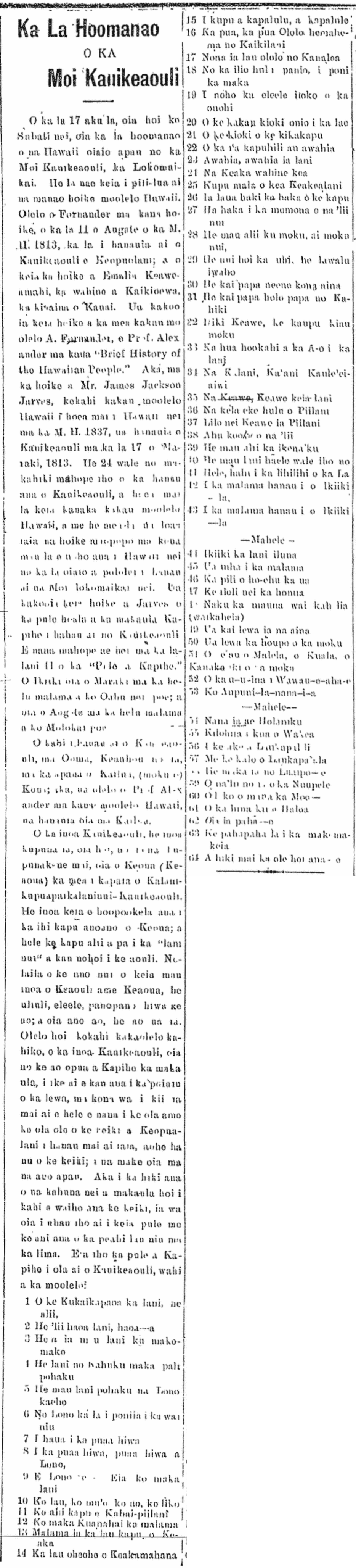
This past 17th, Sunday, was the day of remembrance for all true Hawaiians, of the King Kauikeaouli, the Benevolent one. There are two different historical accounts of this day. Fornander states in his account that Kauikeaouli was born of Keopuolani on 11 August 1813, and that this information was from Emalia Keaweamahi, the wahine of Kaikioewa, the governor of Kauai. This date of A. Fornander is supported by Prof. Alexander in his “Brief History of the Hawaiian People.” However, in the account of Mr. James Jackson Jarves, a scholar of Hawaiian history who arrived here in Hawaii nei in 1837, Kauikeaouli was born on 17 March 1813. This historian arrived here but 24 years after the birth of Kauikeaouli, and it would seem that he obtained clear information about the true birth date of the Benevolent King, while he was living here. This statement by Jarves is supported by the reviving prayer that Kapihe offered for Kauikeaouli. Look below at line 11 [42?] in the “Pule a Kapihe.” Ikiiki is the month of March according to the reckoning of Oahu people, and according to Molokai people it is August.

Kauikeaouli was born at Ooma, Keauhou, in Kailua, in the moku of Kona. However, Prof. Alexander, in his history of Hawaii, says Kauikeaouli was born in Kailua.

The name Kauikeaouli is a name from his ancestors, that being the name of his grandfather, Keoua (Keaoua), the one called Kalanikupuapaikalaninui Kauikeaouli. This name puts on high the sacred kapu of Keoua–his chiefly kapu extends above and touches the great heavens, and rests upon the dark clouds. So therefore, the importance of the names Keaouli and Keaoua, is the dark, black, thick, esteemed cloud. This cloud is a rain cloud. A Orator of the old times said that the name Kauikeaouli is the bank of clouds that Kapihe, the prophet, saw spread high in the heavens when he was called to go to see if the child that Keopualani gave birth to was alive or not alive. He was not breathing and was totally lifeless. However, when this kahuna and prophet arrived to where the child was placed, he offered this prayer while waving a coconut frond in his hand. This is the prayer by which Kapihe made Kauikeaouli live, according to the story:

1 O ke Kukaikapaoa ka lani, ae alii,

2 He ‘lii haoa lani, haoa—a

3 He a ia m u lani ku makomako

4 He lani no Kahuku maka pali pohaku

5 He mau lani pohaku na Lono kaeho

6 No Lono ka la i poniia i ka wai niu

7 I haua i ka puaa hiwa

8 I ka puaa hiwa, puaa hiwa a Lono,

9 E Lono—e. Eia ko maka lani

10 Ko lau, ko mu’o, ko ao, ko liko

11 Ko alii kapu e Kahai-piilani

12 Ko maka Kuanahai ka malama

13 Malama ia ka lau kapu o Keaka

14 Ka lau oheohe o Keakamahana

15 I kupu a kapalulu, a kapalule

16 Ka pua, ka pua Ololo hemahema no Kaikilani

17 Nona ia lau ololo no Kanaloa

18 No ka ilio hulu panio, i poni ka maka

19 I noho ka eleele iloko o ka onohi

20 O ke kakau kioki onio i ka lae

21 O ke kioki o ke kikakapu

22 O ka i’a kapuhili au awahia

23 Awahia, awahia ia lani

24 Na Keaka wahine kea

25 Kupu mala o kea Keakealani

26 Ia laua haki ka haka o ke kapu

27 He haka i ka momona o na ‘lii nui

28 He mau alii ku moku, ai moku nui,

29 He nui hoi ka uhi, ka lawalu iwaho

30 He kai papa neenekona aina

31 He kai papa holo papa no Kahiki

32 I iki Keawe, ke kaupu kiau moku

33 Ka hua hookahi a ka A-o i ka lani

34 Na Kalani Ka’ani Kauleleiaiwi

35 Na Keawe, Keawe keia lani

36 Na kela eke hulu o Piilani

37 Lilo nei Keawe ia Piilani

38 Ahu kooka o na ‘lii

39 He mau alii ka ikena ‘ku

40 He mau lani haele wale iho no

41 Hele, hahi i ka lihilihi o ka La

42 I ka malama hanau i o Ikiiki—la

43 I ka malama hanau i o Ikiiki—la

—Mahele—

44 Ikiiki ka lani iluna

45 Ua uiha i ka malama

46 Ka pili o ho-ehu ka ua

47 Ke iloli nei ka honua

48 Naku ka mauna wai kali lia (waikaheia)

49 Ua kai lewa ia na aina

50 Ua lewa ka houpo o ka moku

51 O e au o Malela, o Kuala, o Kanaka ki o a moku

52 O ka u-u-ina i Wawau-e-aha-o

53 Ko Aupuni-la-nana-i-a

—Mahele—

54 Nana ia ae Holaniku

55 Kilohiia i kua o Wakea

56 I ke ake a Laukapalili

57 Me ke kalo o Laukapalala

58 He maka ia no Luaipo—e

59 O na ‘lii no ia o ka Nuupele

60 O I ko o maua ka Moo—

61 O ka hina kai o Haloa

62 Oia ia paha—e

63 Ke pahapaha la i ka makemakeia

64 A hiki mai ka ole hoi ana—e

[Amazingly, this is the only issue of this entire year that seems to have survived! If this newspaper could be reshot nicely, we could get a clear/clearer reading of this important mele!

And I put up the mele as is (although the image is not clear in some areas, so there are some questionable lines), so that words and phrases will be searchable on this blog or on google right now, instead of having to wait for some time in the future…]

(Kuokoa Home Rula, 3/22/1907, p. 4)

Ka La Hoomanao O KA Moi Kauikeaouli

Kuokoa Home Rula, Buke V, Helu 12, Aoao 4. Maraki 22, 1907.

Laying of the cornerstone of Liliuokalani School, 1912.

The Cornerstone of the New Great School is Laid.

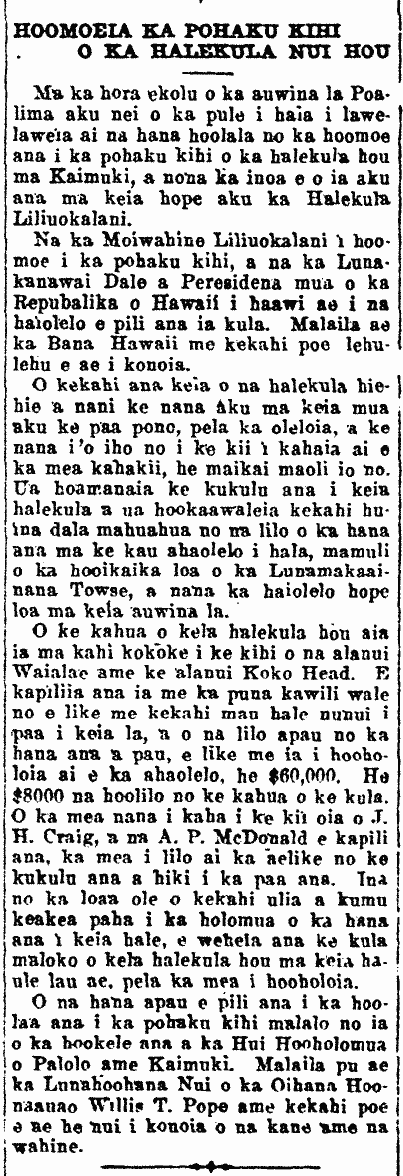
At three o’clock on the afternoon of last Friday (4/12/1912), a ceremony was conducted to lay the cornerstone of the new school house in Kaimuki, that will be called hereafter, Liliuokalani School.

Queen Liliuokalani laid the cornerstone, and Legislator Dole, and former President of the Republic of Hawaii gave a speech about the school. The Hawaiian Band was there along with many invited guests.

When it is completed, this will be one of the most distinguished and beautiful schools, according to what is being said. And when you look at the artist’s rendering, it is indeed splendid. Authorization for building and funds were set aside in the previous session of the Legislature, through the efforts of Legislator Towse, and it was he that gave the final speech that afternoon.

The grounds of this school is near the corner of Waialae and Koko Head. It is being constructed of cement, like many of the great buildings being built these days. And the entire costs will be, as decided by the legislature, $60,000. $8000 was spent to purchase the land. The artist who drew the rendering was J. H. Craig. A. P. McDonald is the one doing the constructing; he received the contract to build the school to completion. Should there be no accidents or hinderances to the progress, the school will be unveiled this coming fall, as per what was decided.

Everything concerning the dedication of the cornerstone fell under the Improvement Club of Palolo and Kaimuki. Present also the head of the DOE, Willis T. Pope, as well as many men and women invited to attend.

[Although sadly this school has been closed, I hear there will be a 100th year celebration of the laying of the cornerstone to be held on the Queen Liliuokalani School grounds, on the 12th of April, with gates opening at 3:00 p. m.

See also from Chronicling America these related articles in English:

Evening Bulletin, 4/13/1912, p. 11,

Hawaiian Gazette, 4/16/1912, p. 7.

And about the actual opening of the school:

Hawaiian Gazette, 10/15/1912, p. 7.]

(Kuokoa, 4/19/1912, p. 6)

HOOMOEIA KA POHAKU KIHI O KA HALEKULA NUI HOU.

Ka Nupepa Kuokoa, Buke XLVIII, Helu 16, Aoao 6. Aperila 19, 1912.

Ad from the first issue of Kuokoa, 1861.

NALO MELI [Bee]

SHOP

of

HALEWAI.

JOHN THOMAS WATERHOUSE’S

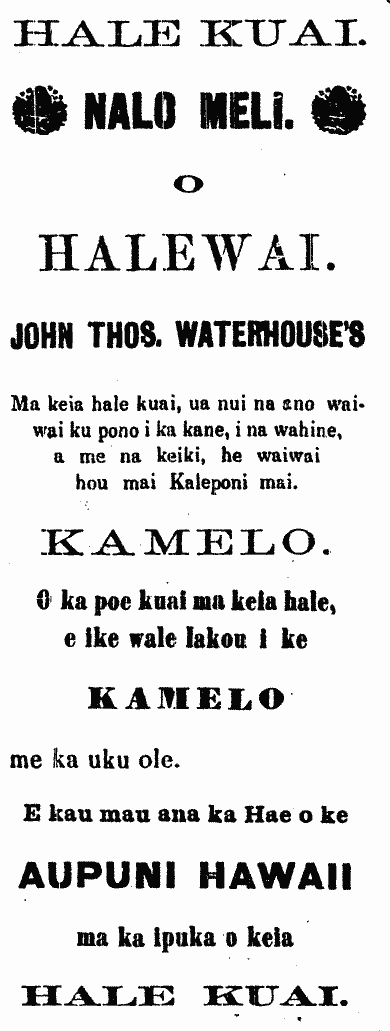
At this store, there are many items for men, women, and children; new goods from California.

CAMEL

Those who make purchases from this store will see the

CAMEL

at no cost.

Always flying is the Flag of the

HAWAIIAN NATION

at the entrace of this

STORE.

[Notice how “Halewai” [lit., water house] is what they called John Thomas Waterhouse. Later for Waterhouse you will also see Walakahausi and Walakahauki.

The images to the left and right of “Nalo Meli” are of a bee hive with bees flying above it.

OH, and yes, it seems there was a camel…]

(Kuokoa, 10/1861, p. 3)

HALE KUAI.

Ka Nupepa Kuokoa, Buke I, Helu 1, Aoao 3. Okatoba, 1861.

Entrance exams for Kamehameha Schools, 1941.

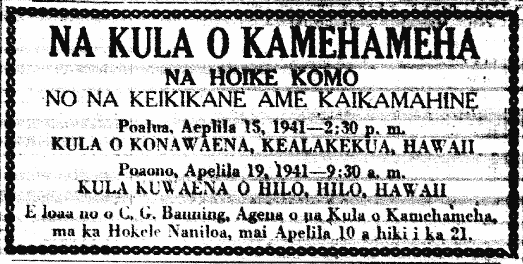
KAMEHAMEHA SCHOOLS

ENTRANCE EXAMS

FOR BOYS AND GIRLS

Tuesday, April 15, 1941—2:30 p. m.

KONAWAENA SCHOOL, KEALAKEKUA, HAWAII.

Saturday, April 19, 1941—9:30 a. m.

HILO INTERMEDIATE SCHOOL, HILO, HAWAII

C. G. Banning, Agent for the Kamehameha Schools will be available at the Naniloa Hotel from April 10 until the 21st.

(Hoku o Hawaii, 4/9/1941, p. 2)

NA KULA O KAMEHAMEHA

Ka Hoku o Hawaii, Buke XXXV, Helu 50, Aoao 2. Aperila 9, 1941.

More “Alika”! 1893.

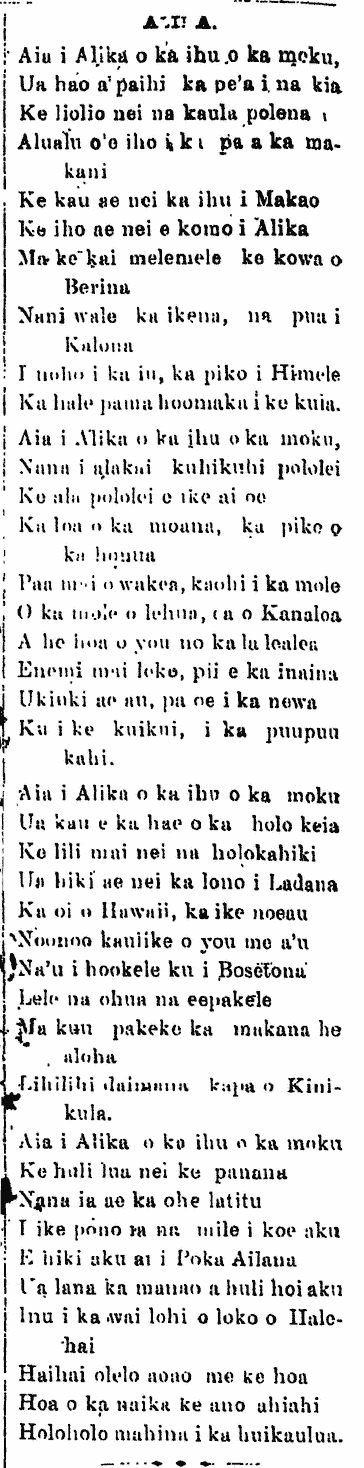
ALIKA.

Aia i Alika o ka ihu o ka moku,

Ua hao a paihi ka pe’a i na kia

Ke liolio nei na kaula polena

Alualu ole iho i ka pa a ka makani

Ke kau ae nei ka ihu i Makao

Ke iho ae nei e komo i Alika

Ma ke kai melemele ke kowa o Berina

Nani wale ka ikena, na pua i Kalona

I noho i ka iu, ka piko i Himele

Ka hale pama hoomaka i ke kuia.

Aia i Alika o ka ihu o ka moku,

Nana i alakai kuhikuhi pololei

Ke ala pololei e ike ai oe

Ka loa o ka moana, ka piko o ka honua

Paa mai [?] o wakea, kaohi i ka mole

O ka mole o lehua, oa [?] o Kanaloa

A he hoa o you no ka la lealea

Enemi mai loko, pii e ka inaina

Ukiuki ae au, pa oe i ka newa

Ku i ke kuikui, i ka puupuu kahi.

Aia i Alika o ka ihu o ka moku,

Ua kau e ka hae o ka holo keia

Ke lili mai nei na holokahiki

Ua hiki ae nei ka lono i Ladana

Ka oi o Hawaii, ka ike noeau

Noonoo kaulike o you me a’u

Na’u i hookele ku i Bosetona

Lele na ohua na eepakele [eepakeke]

Ma kuu pakeke ka makana he aloha

Lihilihi daimana kapa o Kinikula.

Aia i Alika o ka ihu o ka moku,

Ke huli lua nei ke panana

Nana ia ae ka ohe latitu

I ike pono ia na mile i koe aku

E hiki aku ai i Poka Ailana

Ua lana ka manao a huli hoi aku

Inu i ka wai lohi o loko o Halehai

Haihai olelo aoao me ke hoa

Hoa o ka naika ke ano ahiahi

Holoholo mahina i ka huikaulua.

[It is interesting how this might be divided into 4 stanzas of 10 lines, each beginning with “Aia i Alika o ka ihu o ka moku”. I wonder if it was sung differently than today. The Hawaiian-Language Newspapers are filled with mele: those we are familiar with today (often full of variations), as well at those that have been lost (temporarily) over time!]

(Lei Momi, 7/1/1893, p. 4)

ALIKA

Ka Lei Momi, Buke I, Helu 9, Aoao 4. Iulai 1, 1893.

More Hawaiians playing music afar, 1908.

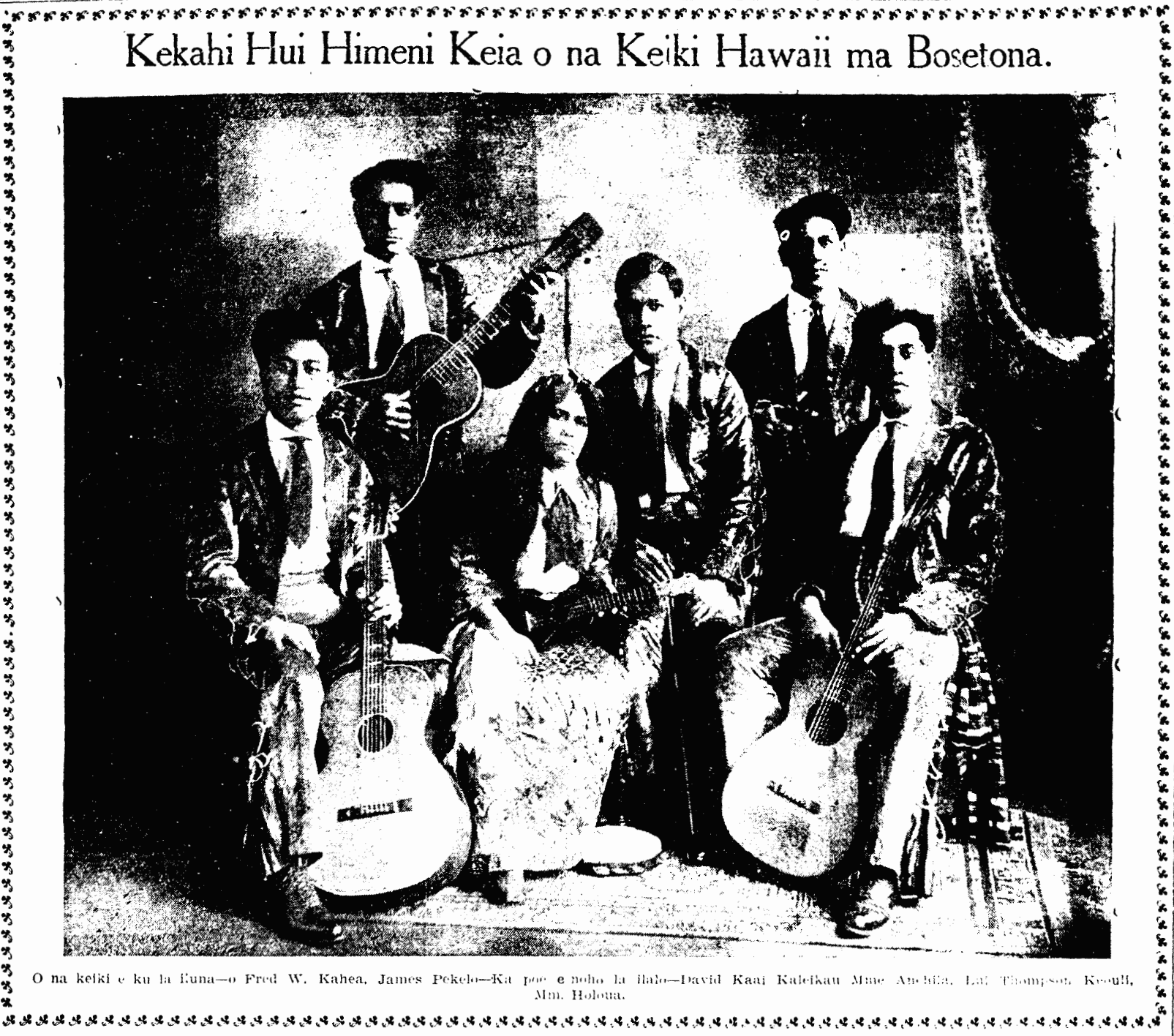
This is a Singing Group of Hawaiian Youths in Boston.

The ones standing–Fred W. Kahea, James Pekelo. Those sitting–David Kaai Kaleikau [Kaleikoa], Madame Anehila [Hobron], Lui Thompson Keouli, Monsieur [William] Holoua

[Plus check out this awesome brochure from the same time put up by the University of Iowa! The Honolulu Students from the Hawaiian Islands. Sometimes the internet is such a good thing!]

(Kuokoa 2/7/1908, p. 6)

Kekahi Hui Himeni Keia o na Keiki Hawaii ma Bosetona.

Ka Nupepa Kuokoa, Buke XLIII, Helu 6, Aoao 6. Feberuari 7, 1908.

More Ernest Kaai—meeting a Hawaiian living in Australia, 1925.

That Hawaiian Wants to Come Back Here

Ernest Kaai Finds L. G. Kaainoa in Australia, and He Tells of His Desire to See Once Again His Land

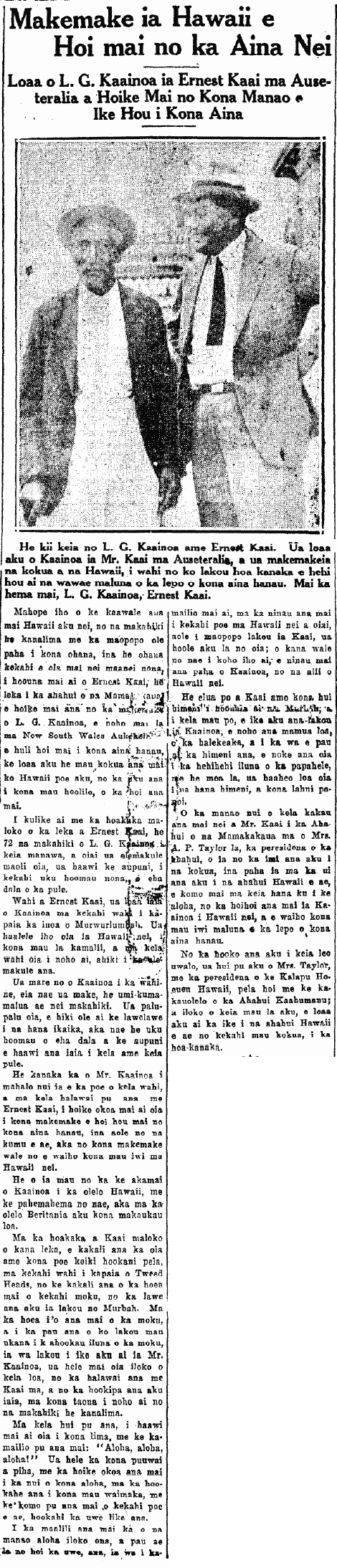
This is a picture of L. G. Kaainoa and Ernest Kaai. Mr. Kaai found Kaainoa in Australia, and he wants the help from Hawaiians to provide him a means for him to once again tread upon the land of his birth. From the left, L. G. Kaainoa, Ernest Kaai.

L. G. Kaainoa has been away from Hawaii for 50 years now without his family’s knowledge, or knowing even if he has ohana left alive here; Ernest Kaai sent a letter to the Ahahui Mamakakaua [Sons and Daughters of Hawaiian Warriors] telling them of the desire of Kaainoa (who now lives in New South Wales, Australia), to return to his homeland were he to receive assistance from Hawaii’s people to pay his expenses for the return.

According to the explanation in the letter of Ernest Kaai, L. G. Kaainoa is now 72 years old, and being that he is very old, the government provides him a pension of 4 dollars a week.

Ernest Kaai says he found Kaainoa at a place called Murwillumbah. He left Hawaii nei in his youth and it is there that he lived until his old age.

He married a woman, but she died 12 years earlier. He is infirm and cannot do hard labor. But he is given benefits by the government of 4 dollars every week.

Kaainoa is well liked by the people there, and when he met with Ernest Kaai, he made clear his hope to return to his homeland, if not for any other reason, but for his desire to leave his bones in Hawaii nei.

He is still very good at Hawaiian, yet is somewhat clumsy, but he is most fluent in English.

According to Kaai in his letter, he was staying along with his fellow musicians at a place called Tweed Heads, where they were waiting for the arrival of a ship to take them to Murbah. When the ship arrived, and after they loaded their belongings aboard, it was then they saw Mr. Kaainoa. He came all the way to meet with Kaai folk, and to welcome him to his town where he has lived for 50 years.

At their meeting, Kaainoa gave his hand, saying, “Aloha, aloha, aloha!” His heart was full while he expressed his great aloha as his tears flowed, while some others joined in with him.

After those feelings of aloha calmed within him, and his crying stopped, it was then that he began to speak, asking about some people in Hawaii nei. And as Kaai did not know them, he told him so. All he could think of that Kaainoa could ask of was the alii of Hawaii nei.

Kaai and his musical group spent two nights at Murbah, and on those two nights, they saw Kaainoa sitting way up front of the theater house. And when the singing was over, he continued to stomp on the floor as if he was so proud of this singing of his very own people.

The main reason Mr. Kaai wrote to the Ahahui Mamakakaua by way of Mrs. A. P. Taylor, the president of the Association, was to look for assistance; if she could ask the other Hawaiian associations to join in on this charitable endeavor to bring Kaainoa back to Hawaii nei for him to leave his bones in the soil of his homeland.

To follow through on this plea, Mrs. Taylor met with the president of the Hawaiian Civic Club [Kalapu Hoeueu Hawaii], and the secretary of the Kaahumanu Society; and in the upcoming days, the other Hawaiian organizations will learn about this assistance of their fellow Hawaiian.

(Kuokoa 3/5/1925, p. 1)

Makemake ia Hawaii e Hoi mai no ka Aina Nei

Ka Nupepa Kuokoa, Buke LXIV, Helu 10, Aoao 1. Maraki 5, 1925.