Writing on the wall, 1894.

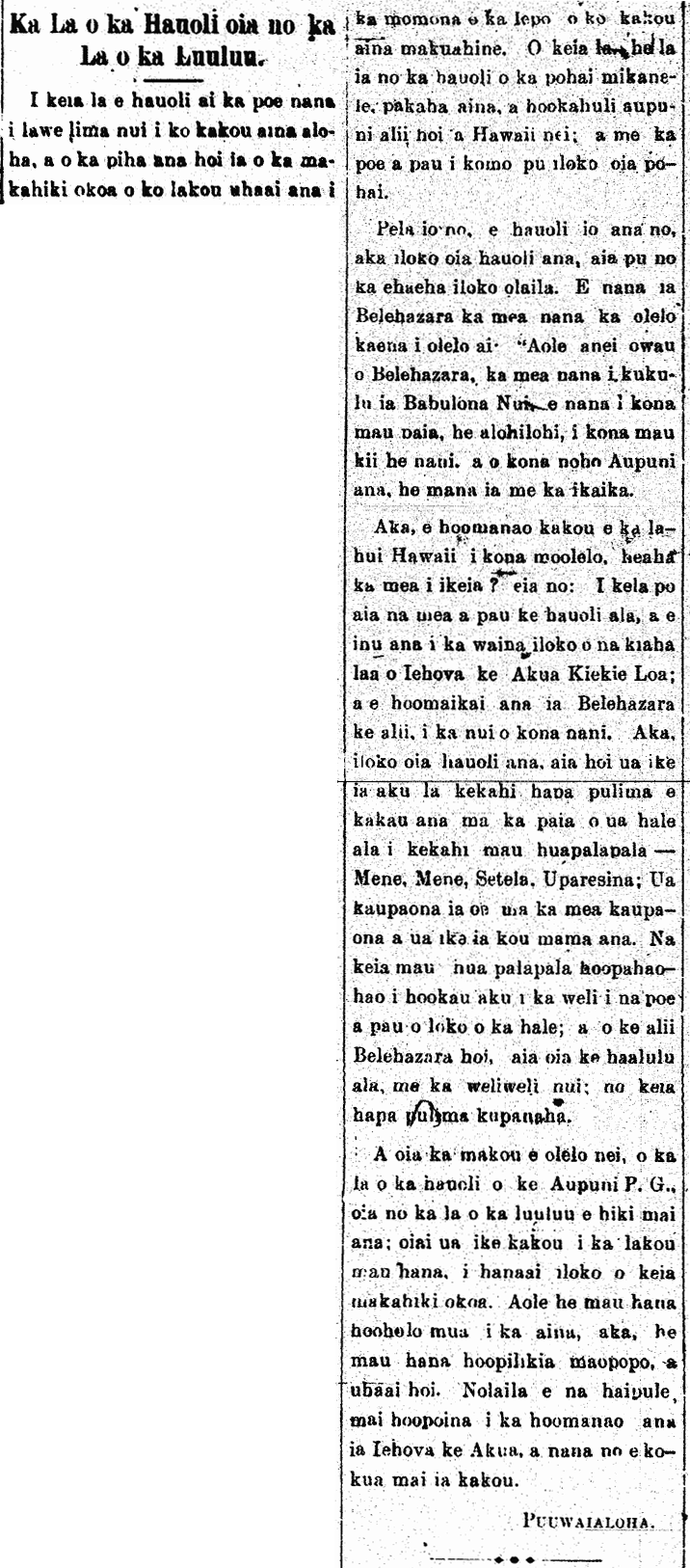
The Day of Happiness is a Day of Sadness.

On this day, those who took our beloved land by force rejoice, and it makes a full years since they’ve feasted wastefully of the fertile soil of our mother land. This day is one of happiness for the circle of missionaries, plunderers of land, and overthrowers of the Hawaiian Kingdom, as well as for those who enter join their circle.

It is true, they will indeed rejoice; however, along with this joy, there is hurt within. Look at Belshazzar [Belehazara] the one whose boast went, “Am I not Belshazzar, the builder of the Great Babylon? Look at its shiny walls, its beautiful images, and its Throne has authority and might.”

However, let us recall, O Hawaiian Lahui, his story; what is known? it is this: That night, everyone was joyous, and drinking wine from cups sacred to Jehovah, Almighty God; and they praised Belshazzar for his great beauty. However, while the rejoicing was going on, there was seen part of a hand writing some words on the wall of the house—Mene, Mene, Setela, Uparesina; You have been weighed on the scales and have been found wanting. It was these astonishing words which caused a fear to fall over everyone in the house; and as for the king Beshazzar, he was shaking with trepidation at this amazing portion of a hand.

And that is what we are saying: the day of joy of the Government of the P. G. [Provisional Government], is the day that sadness will come; for we have seen their actions done over the past year. They were not actions done to move this land forward, but actions that were clearly harmful as well as squandering. Therefore O Pious Ones, do not forget to remember Jehovah, God, and he shall help us.

Puuwaialoha [“Loving-heart”]

(Leo o ka Lahui, 1/17/1894, p. 2)

Ka La o ka Hauoli oia no ka La o ka Luuluu.

Ka Leo o ka Lahui, Buke II, Helu 856, Aoao 2. Ianuari 17, 1894.

Competing rallies, 1893.

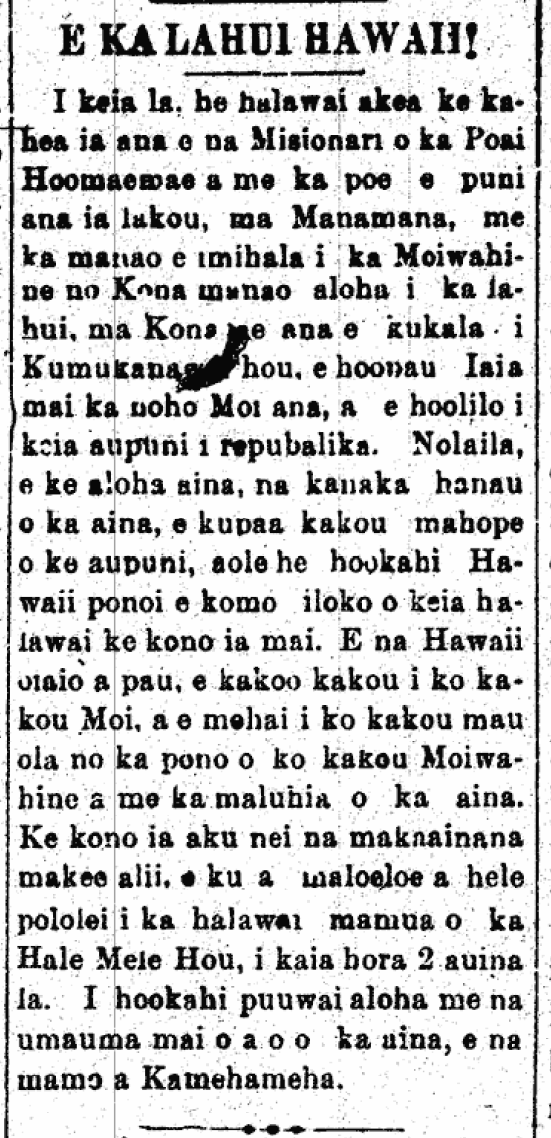
O HAWAIIAN LAHUI!

Today, there is a rally being called by the Missionaries of the Reformist Party [Poai Hoomaemae] and those who favor them, at Manamana, with the intent to bring harm to the Queen for Her aloha she has for the lahui, in Her proclaiming a new Constitution; by ending Her reign and making this nation a republic. Therefore, patriots, those born of this land, stand strong behind this nation; there shall not be a single true Hawaiian who will participate in this gathering, should they be invited. All of you true Hawaiians, let us stand behind our Sovereign and give our lives for the rights of our Queen and peace over the land. Those citizens who love their alii are called to join together to march straight to the rally fronting the Opera House [Hale Mele Hou] at 2 o’clock in the afternoon. With one heart of aloha and breasts side by side all across the land, you descendants of Kamehameha.

(Leo o ka Lahui, 1/16/1893, p. 2)

E KA LAHUI HAWAII!

Ka Leo o ka Lahui, Buke II, Helu 623, Aoao 2. Ianuari 16, 1893.

A haole kamaaina’s advice on teaching English instead of Hawaiian, 1872.

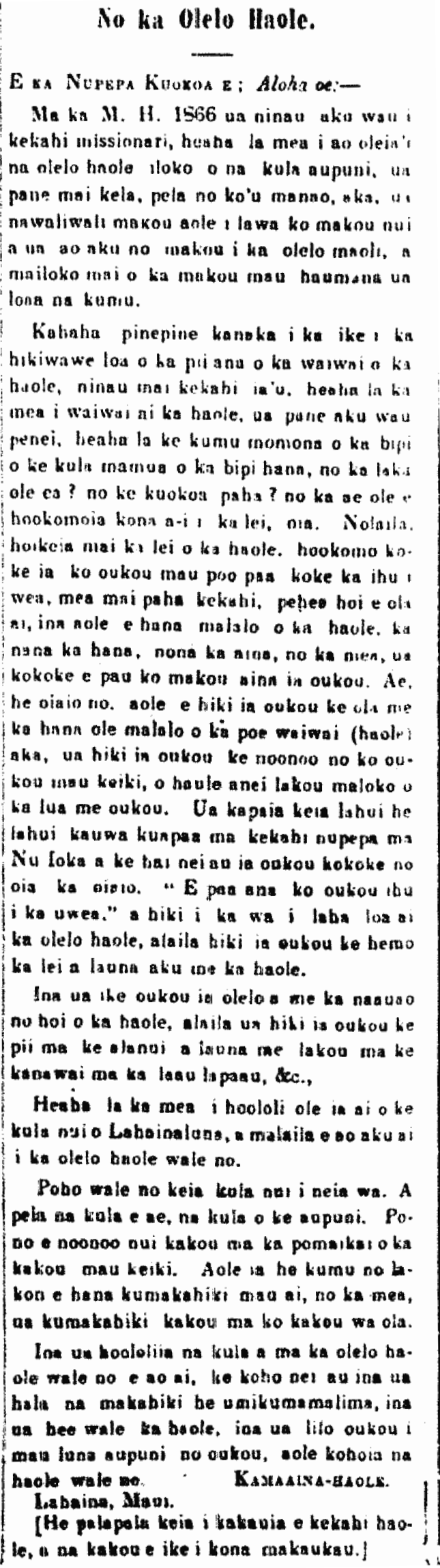
Pertaining to the English Language.

O Kuokoa Newspaper: Aloha oe:—

In the year 1866, I asked a missionary, “What is the reason English isn’t being taught in the government schools,” and he replied, “That is what I think as well, but we are weak, there are not enough of us, and we teach Hawaiian, and from amongst our students we find teachers.”

The Hawaiians are often astounded at seeing how quickly the haole gains wealth, and one asked me, “How does the haole get rich?” I answered this way, “Why is the cow in the fields fatter than the cow that works, isn’t it because it isn’t tamed? or because it is independent? or because it refuses to have it’s neck put in a yoke? That’s it. So when shown the yoke of the haole, your necks are put within it and your noses are soon wired; some may say, ‘How are we to live if we don’t work under the haole; they have the work, to them belongs the land, because soon our land will all be taken by you.’ It is true, you cannot survive without working for the rich (haole), but you can think about your children, lest they fall into the abyss with you. This race was called a race of slaves in a newspaper in New York, and I say to you that this will soon be true. ‘Your noses will be put through with a wire.’ until the day when the English language spreads amongst you, then you’ll will be able to remove your yokes and associate with the haole.

If you all understand the language and the knowledge of the haole, then you’d be able to climb the path and meet up with them in law, medicine, &c.

What is the reason that the college of Lahainaluna is not changed, having only English taught there?

This college is currently a waste. And so too the other schools, the government schools. We must all think carefully about the good of our children. That is no reason for them to forever more work under yearly contracts, for we’ve worked under yearly contracts during out lifetimes.

If the schools were changed so that just English was taught, I predict that after fifteen years, and if the haole leave, then you’d become your own leaders in the government, and not only haole would be appointed.

Kamaaina haole.

Lahaina, Maui.

{This is a letter written by a haole, and it is for us to determine his competence.}

[The argument over what language should be taught in schools is a heated topic that can be seen throughout the life of the Hawaiian-Language Newspapers. At first the argument is whether or not to teach English, and in later years when more and more schools are taught in English, the argument for teaching Hawaiian in schools will become prominent. Most everyone it seems were concerned with the future of the children (whether they were for English or Hawaiian-language education).]

(Kuokoa, 10/26/1872, p. 2)

No ka Olelo Haole.

Ka Nupepa Kuokoa, Buke XI, Helu 43, Aoao 2. Okatoba 26,1872.

Anonymous accusations against a Catholic priest in Kalawao, 1874.

The deeds of the Catholic teacher in Kalawao.

We are printing below the deeds of a certain Catholic priest amongst the leprosy patients in Kalawao:

1. Clothes—The clothes donated by the brethren of Honolulu for the needy leprosy patients of Kalawao, that is what the Catholic teacher is using to lure the people of the Evangelical faith [hoomana Euanelio] to join the Catholic religion. While he goes around doing his converting, and when they hear him they convert, but should they be steadfast, the teacher will say, “Should you join the Catholic faith, I will give you the clothing and things that you lack, should you desire.” By this action, some agree to join; there have been many converted over the clothes. This is the cunning way [kumu hinu ?] of the Catholic priest.

2. Wooden staff—The Catholic teacher constantly carries a staff in his hand, and it is with this that he converts people to his faith. This is what he does. For that person or persons who are resolute against being converted over clothes, they are struck by the cane of the Catholic teacher. This is what he does with the cane, and he converts them.

3. The church house—The church in Kalaupapa is of the Catholics.¹ He uses this church to convert some people to his religion. This is basically what he does. When the church was completed in Kalaupapa, the Catholic teacher when to the houses to convert people; the Catholic teacher said, “What is your faith.” “I’m a Calvinist [Kalawina],” that being a Protestant of the Evangelist faith, said the person in response. “That is a faith without any church,” said the Catholic teacher.”We are fine without a church; we hear that our kahu is coming and will hold services at the homes of brethren, and if we are in good health, we will attend the services,” he answered. “That’s no good, for here is our church, you all should come in, and then I’ll give you people clothes, and things you need, should you all desire,” replied the Catholic teacher. With this and everything else said in that conversation, some people converted, and some others remained steadfast behind the truth of the Gospel.

4. The cemetery.—The cemetery of the Catholics recently constructed here in Kalawao is one of the things used by that Catholic teacher and the Catholic disciples to convert people to their side. This Catholic teacher saw that the people were troubled with dead bodies left out, eaten up by pigs; and he was intent on converting the people to his belief, and therefore, he ordered Honolulu to send over several bundles of pine lumber; it arrived recently and is now standing here in Kalawao like a net to catch stupid fish who stray and are caught. So too is this graveyard; there are two faiths who come in, and they are left until the day they rise; who will they be for?

5. Extreme Unction [Ukione].—This act, Extreme Unction, is one of the most heinous acts which the Catholic teacher is doing here in Kalawo, and we all agree that this is akin to thievery. This is what he does. For those who don’t convert over clothes, or the rod, or the church, or the cemetery, he practices Extreme Unction on them. When the Catholic teacher sees or hears of a that a patient has grown weak, one that is from another faith, he goes to them constantly to urge them, and because the patient grows weary, he submits, whereupon the Catholic teacher performs the Extreme Unction; and when the patient recovers, he protests this improper deed of the Catholic teacher; this happens often; some people protest, and other mistakenly submit. From what we’ve seen, the Catholic teacher by these actions is like a yellow-eyed cat spying on its enemy, the mouse. And we believe that these actions of the Catholic teacher are not right in his sacred and faithful position.

Here is another new important thing we are witnessing. On the night of the 22nd of Dec. of the year 1873, at maybe 10 o’clock of that night, Kaiakoili (m) died, he was a brethren of the church of Kawaiahao, and he contracted leprosy and lived here in Kalawao, and was a member of the Siloama Church, and this was his faith until the day he died. However, on the night shown above, during his last hours, he was Baptized [Babetema ia] by Kulia (f), who is a disciple of the Catholic faith, but he was Baptized when he was dead.

Leprosy Patient.

¹St. Philomena Church

(Kuokoa, 1/17/1874, p. 1)

Na hana a ke kumu Pope ma Kalawao.

Ka Nupepa Kuokoa, Buke XIII, Helu 3, Aoao 1. Ianuari 17, 1874.

People suspected of having leprosy held in jail, 1872.

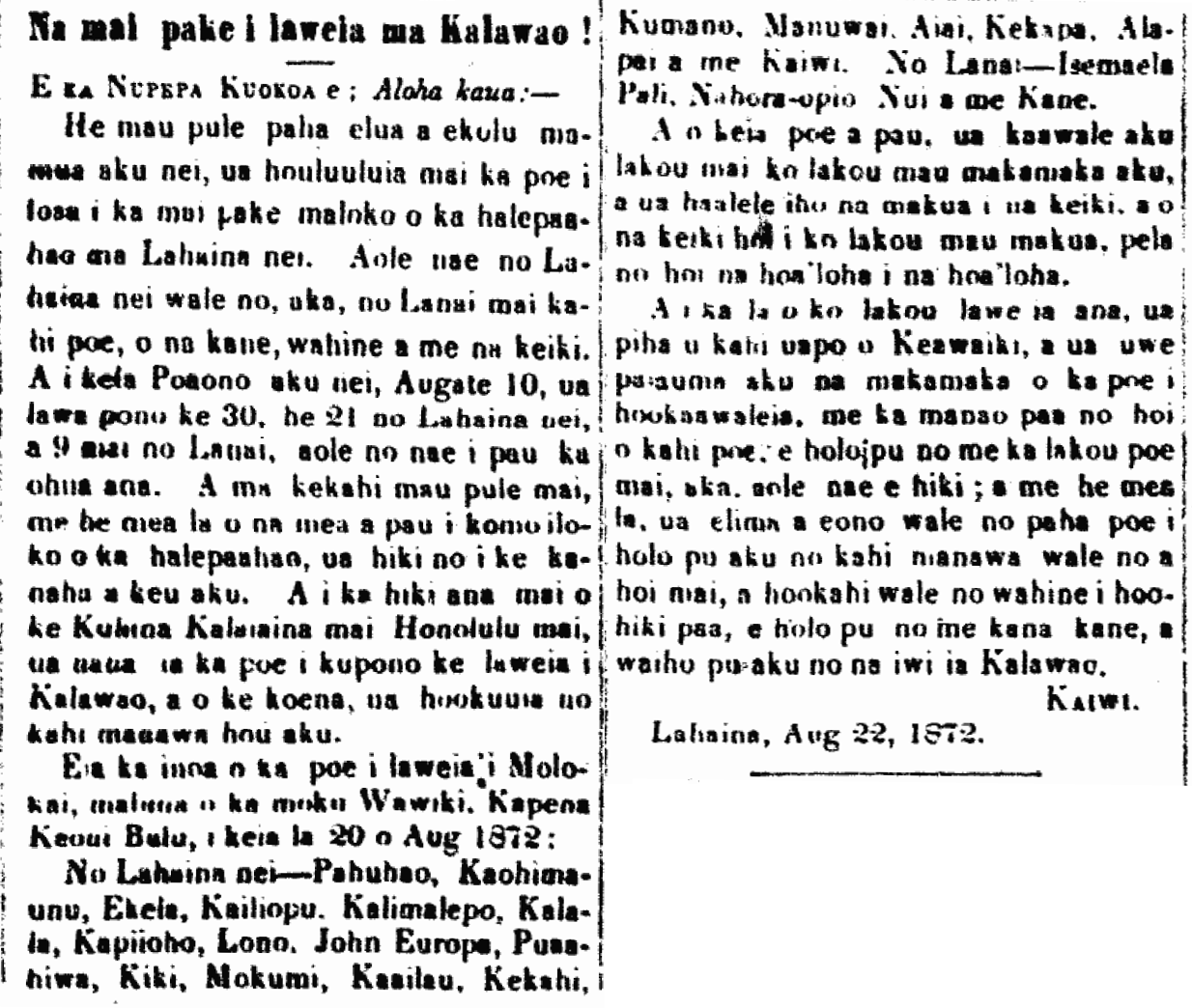
The leprosy patients taken to Kalawao!

O Kuokoa Newspaper: Aloha kaua:—

Perhaps some two or three weeks ago, those afflicted with the “Chinese disease” were assembled in the jail here in Lahaina. And it wasn’t just people from Lahaina, but some were also from Lanai: men, women, and children. And on this past Saturday, August 10, they totalled 30; 21 from Lahaina nei and 9 from Lanai; but the gathering is not over. And in the coming weeks, it seems as if the total of all those put in the jail will reach forty or more. And when the Minister of the Interior [Hutchison] arrives from Honolulu, they are examined for those who should go to Kalawao, and the rest are released for another time.

Here are the names of those taken to Molokai aboard the ship Warwick [Wawiki], Captain Keoni Bulu, today, the 20th of Aug. 1872:

From here in Lahaina—Pahuhao, Kaohimaunu, Ekela, Kailiopu, Kalimalepo, Kalala, Kapiioho, Lono, John Europa [? Europe], Puaahiwa, Kiki, Mokumi, Kaailau, Kekahi, Kumano, Manuwai, Aiai, Kekapa, Alapai, and Kaiwi. From Lanai—Isemaela Pali, Nahora opio, Nui, and Kane.

All of these people, they were separated from their companions, and parents left their children, children left their parents, and so too did friends leave friends.

On the day they were taken, the pier of Keawaiki was packed, and the friends of those who were being separated wailed in grief, while some of them were determined to go along with their sick, but that was not possible; and it seemed that there were but five or six who went along for just a while then returned; and there was only one woman who swore that she’d go with her husband and leave her bones in Kalawao.

Kaiwi.

Lahaina, Aug. 22, 1872.

(Kuokoa, 8/31/1872, p. 2)

Na mai pake i laweia ma Kalawao!

Ka Nupepa Kuokoa, Buke XI, Helu 35, Aoao 2. Augate 31, 1872.

E o, e Kaleleonalani! Queen Emma and Kamehameha Schools, 1887.

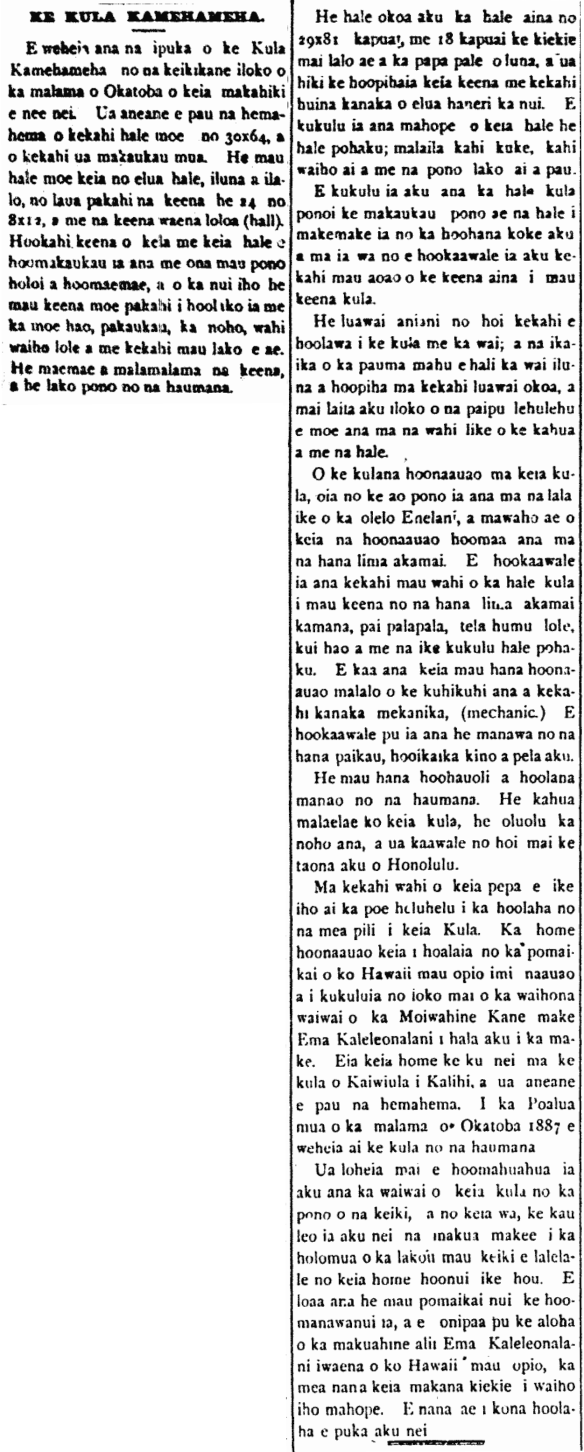
KAMEHAMEHA SCHOOL.

The gates of the Kamehameha School for boys will open in October of this current year. The imperfections of one of the dormitories of 30 x 64 [feet] are almost smoothed out, and another was complete before. These dormitories are two storied, bottom floor and top floor, and each of them have 24 rooms of 8 x 12, and a hallway [keena waena loloa]. One room of each house is furnished with facilities to wash up and clean, and the rest of the rooms are bedrooms, each being supplied with a iron bed, desk, chair, closet, and some other furnishings. The rooms are clean and lighted, and well-furnished for the student.

The dining hall of 29 x 81 feet is a separate building, and it is 18 feet from the bottom to the ceiling, and it will fit two-hundred people. A stone building will be built behind this, which will be the kitchen and and a place to store the food and all cookware and dinnerware.

A proper schoolhouse will be built after the buildings that are desired to be completed quickly are done, and in the meantime, parts of the dining hall will be set aside as school rooms.

A clear spring will supply the school with water and it is by steam pumps that the water will be brought up and filled into a separate water tank, and from there into many pipes laid all over the grounds and buildings.

The curriculum at this school teaches thoroughly the branches of the English language; and outside of that are the teaching of industrial arts. Some rooms of the school house will be set aside as rooms for carpentry, printing, tailoring, blacksmithing, and masonry. The instruction will take place under the direction of a mechanic [mekanika]. Some time will also be set aside for military drilling, physical development, and so forth.

There are fun and cheerful activities for the students. This school sits on a serene site, living there is pleasant, and it is separated from the town of Honolulu.

In a section of this paper, the reader will see the advertisement dealing with this School. This is the educating home established for the benefit of Hawaii’s children who seek education, and built by way of the estate of the late Dowager Queen Ema Kaleleonalani. This home stands in the plain of Kaiwiula in Kalihi, and it is near completion. On the first Tuesday of October 1887, this school will open to students.

It has been heard that the assets of the school will be increased for the good of the children, and for now, parents who want their children to progress forward are being urged to rush to this new home where knowledge is increased. Much benefits will be gained if patient and if the aloha of the royal parent Ema Kaleleonalani is held resolute as well by Hawaii’s children, the one who left this great gift behind. Look at its published notice.

[On this, the day after Queen Emma’s 177th birthday, i thought it would be a good thing  to look back at her role in the establishment of the Kamehameha Schools, a role which she is not recognized often for today.

Notice the difference between the article appearing in the May 24th edition of the Hawaiian Gazette, “The Kamehameha Schools.” (probably what the article is based upon) and this Hawaiian-Language article.]

(Kuokoa, 5/28/1887, p. 2)

KE KULA KAMEHAMEHA.

Ka Nupepa Kuokoa, Buke XXVI, Helu 22, Aoao 2. Mei 28, 1887.

And yet another newspaper closes its doors, 1912.

Last Words of Aloha from the Esteemed Newspaper, Kuokoa Home Rula

BEFORE ITS READERSHIP OF THIS TERRITORY

No More Will You See Its Delicate Body with Its Columns Festooned with Foreign and Domestic News; the Activities of the Coming Legislature will Not be Seen by You.

Today we publish the last issue of this Year, and after 11 years of appearing continuously before its readership, and this Newspaper fighting fearlessly and independently in all manner for the rights of this Lahui through Politics; its ideals led for justice and truth in all things, so that nothing done to harm our People would be hidden, nor corrupt actions seen steering the government; the Newspaper KUOKOA HOME RULA fought the lopsided and unfair laws being made by the lawmakers to the detriment of Hawaii, and you all know, O You Readers from its start, know of its fight, until this day; the Lahui did not in the least listen to its guidance, and therefore, we will not be able to stand again and lead you in the future because you, the Lahui, didn’t heed the advice of this Spokesman for you and for us all; and so we must stop the publication of this newspaper and this will be the last you’ll see of this, the Newspaper Kuokoa Home Rula appearing before you, the Reader, for all times. This is its last Issue, and with the close of this Newspaper with it never to rise again, you all will not see what happens in the upcoming year, this important year in which we believed you were to see and understand the bills of the incoming law makers on February 20, 1913, that being the work of the legislature.This newspaper was continuously published for 11 years, without missing a single Issue, so that the reader cannot criticize us for our ending its publication.

We regret greatly that the intent to end this paper by the Owner of this newspaper didn’t come at a good time for we have Thoughtful Advice for the good of our Lahui and our Political Party from here forth, as we assumed this paper would go forward to fight until the last man; however in the last moments without our previous knowledge, we received the order to inform the Public that the continued publication of this newspaper Kuokoa Home Rula for 1913 was ended. How sad for the Lahui who will have no spokesman. And we offer our Happy New Year to the readers of this newspaper which will be done for all time. Aloha once again to you all.

[Most of the issues from 1902–1907 of Kuokoa Home Rula are sadly not extant. Please look in closets and in boxes under the house, maybe there will be surviving pages!

Editor {Lunahooponopono}: Charles K. Notley, Managing Editor {Lunahooponopono Hoohana}: D. Kalauokalani, Sr., Business Manager {Luna Hoohana}: J. Kamainalulu, Publisher: Charles K. Notley, Owner {Ona}: Charles K. Notley]

(Kuokoa Home Rula, 12/26/1912, p. 1)

Ka Leo Aloha Hope loa o ka Hiwahiwa ka Nupepa Kuokoa Home Rula

Kuokoa Home Rula, Buke X, Helu 52, Aoao 1. Dekemaba 26, 1912.

Musicians travel to Japan and China, 1912.

Those Hawaiian Singers Leave for the East.

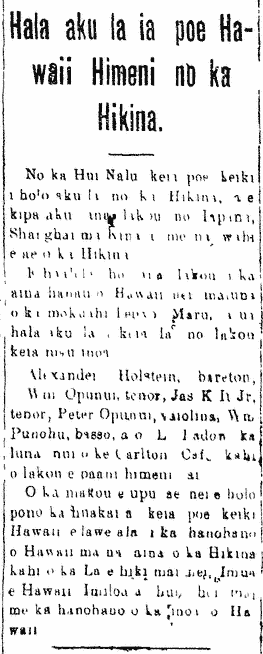
These youths are from the Hui Nalu [Singing Club] who left for the East; and they will visit Japan and Shanghai in China and other locations in the East.

They will leave the land of their birth aboard the steamship Tenyo Maru [?], and they left this day, their names being:

Alexander Holstein, baritone,

William Opunui, tenor, James K. Ii, Jr., tenor, Peter Opunui, violin, William Punohu, bass, and L. Ladon [Louis Ladow] the head of the Carlton Cafe, where they are to perform.

Our hope is that the journey of these Hawaii boys carrying with them the pride of Hawaii to East, to the land of the rising Sun, goes well. Go forward, go forward O Great-Travelling Hawaiians and return with glory in the name of Hawaii.

(Kuokoa Home Rula, 12/19/1912, p. 1)

Hala aku la ia poe Hawaii Himeni no ka Hikina

Kuokoa Home Rula, Buke X, Helu 51, Aoao 1. Dekemaba 19, 1912.

Early movie making in Honolulu, 1913.

FAKE MOVIE.

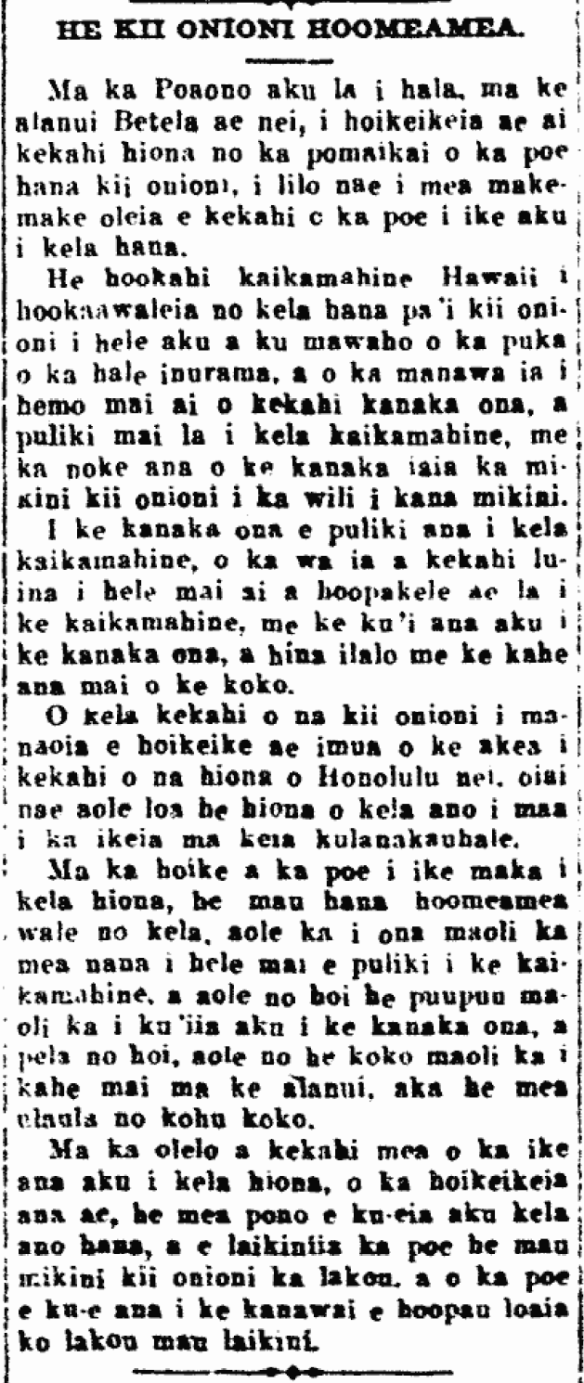
Last Saturday, on Bethel Street, a scene was put on for movie makers, which became something unappealing to some who witnessed it.

There was a Hawaiian girl set aside for the shooting that went and stood outside the entrance of a bar, and at this was when a drunk man exited and clutched the girl, while the one with the camera continued to film.

As the drunkard continued to grasp the girl, a sailor came and rescued the girl, and he punched the drunk man, who fell down as blood flowed.

This was a movie meant to show a Honolulu scene before the public, even if that type of scene is not something seen regularly in this town.

According to those who witnessed this, it was nothing but acting; the one who went and grabbed the girl was not really drunk, and he was not hit with a real punch, also, it was not real blood that flowed on the street, but it was something red that resembled blood.

One of those who saw this being staged said that this kind of thing should be prohibited, and those who own movie cameras should be licensed, and those who break the law should have their licenses revoked for good.

(Kuokoa, 1/10/1913, p. 4)

HE KII ONIONI HOOMEAMEA.

Ka Nupepa Kuokoa, Buke XLIX, Helu 2, Aoao 4. Ianuari 10, 1913.

More on the taxing of leprosy patients, 1876.

The Leprosy Patients are Taxed.

O Lahui Hawaii; Aloha oe:—

That is the title put up by Siloama (no such person), an ignorant one from Kawaapae [“the beached canoe”], a speaking companion and lover of Waawaa [Stupid] folks, that was released in Helu 50 of the “Kuokoa” of the 11th of December, page 4, of 1875. It is for the readership to see this incompetence. In the title is that the leprosy patients are being taxed. And in the second paragraph, line 1½, he states, “taxing of the animals, all but the body of man.” Look at what James said. “A double minded man is unstable in all his ways.” James 1:8.

Then it goes on to say: “it has almost been 10 years that these people have been living as prisoners in the penitentiary of the law, and this is the first time we’ve been taxed.” Here is what Jesus had to say to the laborers, “Is it not lawful for me to do what I will with mine own? Is thine eye evil, because I am good?” Matthew 20:15.

And further.—”This is astonishing that those dead to the Law are being taxed.” This is not right; it is the truth; all of the animals of the patients are being taxed, and that is the true intent of the Law.

And this too.—And even the tiniest of rights that we have are being taken away.” [The following two lines of this paragraph is not legible because of what appears to be a fold in the paper.] Yours,

LIHAU ANUENUE

Kalawao, Molokai, Dek. 28, 1875.

[This is a response to the article in the previous post.

The newspapers need to be reshot one page at a time, so that folds like these can be undone, and every possible word can be read as was intended. I am sure i am not the only one interested in what the last couple of lines said about their rights being taken away…]

(Lahui Hawaii, 1/13/1876, p. 1)

Ua Auhauia na mai Lepera.

Ka Lahui Hawaii, Buke II, Helu 3, Aoao 1. Ianuari 13, 1876.