Easter Sunday in Honokaa, 1942.

News of the Kohala Districts and Hamakua

HONOKAA:—Just like the news announced last week in the Hoku o Hawaii, the Easter events were carried out at the church of Honokaa by the Rev. Abraham Poepoe.

The church was decorated with Calla and Easter lily flowers by the meticulous hands of Ramona Poepoe and Bertha Herrman. At the hour of 10:30, the church bell rang. The church goers gathered in the church. It was filled with soldiers, haole from the sugarcane plantations, the children of the Sunday School, and some Japanese Christians as well as Hawaiians. The services held that day were beautiful. “Awe inspiring and filled with the spirit of God.”

Easter day was a very nice day here in the Hamakua district and the dawning of this Monday. This is a rainy day, and this is a humid day. However, praised always is God. He knows that it is good for there to be rain and fog these days of war.

(Hoku o Hawaii, 4/8/1942, p. 1)
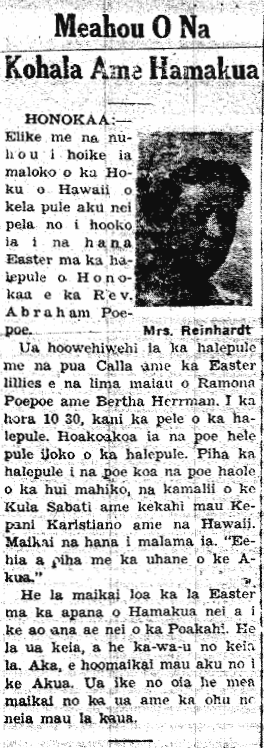
HokuoHawaii_4_8_1942_1

Ka Hoku o Hawaii, Volume XXXVI, Number 42, Aoao 1. Aperila 8, 1942.

Some of the battles of Kalaniopuu, 1866.

[Found under: “Ka Moolelo o Kamehameha I.”]

The battles between Kalaniopuu, the King of Hawaii, with Kahekili, the King of Maui.

The years 1775, 1776, 1777, 1778, and 1778. Kalaniopuu went to war at Kaupo on Maui, with his Alii, his war Officers, and his soldiers. Kalaniopuu first went to war at Kaupo, and he tortured the makaainana of Kaupo by clubbing their foreheads with his war club [newa]. This battle was called Kalaehohoa [“Clubbing-of-the-Forehead”] Continue reading

George Vancouver arrives once more on February 14, 1793.

[Found under: “He Moolelo Hawaii”]

Vancouver Returns

In the month of February, the 14 day, 1793, Vancouver [Vanekouwa] returned to Hawaii nei, from the northwest of America, and landed at Kawaihae.

The men pleaded for guns and powder from him. Vancouver refused and would not sell those sort things to them. There was great desire of Hawaiians for those things during those days, because it was a time of war, and Kamehameha was conquering the nation then; Oahu and Kauai remained.

And from there, Vancouver landed at Kealakekua, on the 22nd of that month and met with Kamehameha.

At that time, he gifted Kamehameha with two cattle, a bull and a cow. The cattle that Vancouver brought were from Monterey, a land in America.

These animals were greatly appreciated by Hawaiians because they were unusual, and they were called puaa pipi. It is from those pipi that the cattle which roam these days at Waimea and Maunakea and the other forests of Hawaii proliferated.

Kamehameha treated Vancouver kindly; Vancouver was facing hardship without water and took his water barrels into the uplands, and Kamehameha commanded his men to carry the barrels and to fill them with water. Continue reading

Aiu, the Kauai boy comes home from war, 1920.

KAUAI BOY SONG.

He mele he inoa no Aiu,
Kuu pua o Kina hapa Hawaii,
He opua hookahi a i kuu alo,
Kuu lei miulana poina ole;
Kau he hiki aku i ka moana,
Na ale nupanupa o ka Pakipika,
Ike oe i ke anu o Kaleponi,
I ohu halii paa ka moana.
Kau aku ka manao nou e Palani,
Ke kahua hoolulu a o na koa,
O ke kikowaena a o ke kaua,
Ua huliamahi na aupuni hui,
Ike pono i ka hana a Kelemania,
Lahui puuwai ole o ke ao nei,
Ilaila hu ae ke aloha a i ka  makua.
Haalele ana i ka puuwai,
Ua paa ko kino i ka aelike,
Me na ‘liikoa Amerika.
Hookahi makahiki i ka aina malihini,
Huli ho i ka home kulaiwi,
Hoomaikaiia ka Makua Lani,
E ole kuu kokua Mana Lani,
Hoi kino mai au me ka lanakila.
Haina ia mai ana ka puana,
Kuu pua o Kina hapa Hawaii.

Owau iho no,

MRS KILA KAILI.

[Might anyone know which Aiu this song is composed for by Mrs. Kila Kaili?]

(Kuokoa, 1/2/1920, p. 2)

Kuokoa_1_2_1920_2.png

Ka Nupepa Kuokoa, Buke LVIII, Helu 1, Aoao 2. Ianuari 2, 1920.

Sarai Hiwauli, 1856.

BIOGRAPHY OF S. HIWAULI II.

Sarai Hiwauli was born in Kahaluu, Koolaupoko, after the great plague here on Oahu during the time of Kamehameha I, and she was taken to Hilo, Hawaii to be raised, along with her parents and her kupuna; from Hopuola and Kalimahauna came Hiwauli, from Kahili and Napolo came Hopuola, from Kahiko and Kuanuuanu came Kahili, from Keaweikekino and Iliholo came Kahiko, from Hoou and Kamaiki came Keaweikekino, from Mahiopupelea and Kapaiki came Hoau, from Kanaloauoo and Kapulaiolaa came Kapaihi, from Kahoanokapuokuihewa and Kapahimaiakea came Kapuleiolaa, from Loheakauakeiki and Kalaniheliikauhilonohonua came Kahoanokapuokuihewa, from Kauhealuikawaokalani and LonowahineikahaleIkiopapa came Kalaniheliikauhilonohonua, from Kaholipioku and Moihala came LonowahineikahaleIkiopapa, from Lonoapii and Piilaniwahine came Moihala, and so on. Continue reading

Veterans’ Day in Hilo Town, 1943.

The 11th of November

Twenty-five years ago, on a Sunday, there was heard the ringing of the church bells here in Hilo. People asked one another, “What are these bells ringing?”

Calls to the telephone operator [kikowaena] rushed in, “Why are the bells sounding?”

The operator replied, “THE WAR IS OVER IN EUROPE. The opposing nations surrendered, and the Treaty was signed.”

That is when people began shouting, and those of the Chinese shops were woken up. Firecrackers were purchased and set off, and cars began going through the streets tooting their horns and dragging cans behind them. This did not cease until the hours of dawn came.

The following Monday became a great day in Hawaii nei and all of those victorious countries of the first world war. There were no bars in those days, because of the prohibition. Continue reading

A mele by the “Solomon” of Hawaii, William J. Sheldon, 1918.

A MELE FOR THE HAWAIIAN BOYS.

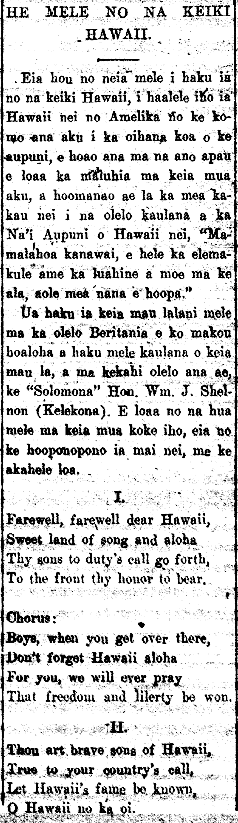
Here again is this mele which was composed for the Hawaiian boys who just left Hawaii for America to join the armed forces of the nation, to try all means to obtain peace in the future, and the composer recalls the famous words of the Conqueror of the Nation of Hawaii nei, “Law of the Splintered Paddle: let the old men and the old women go and lie by the roads, no one is to disturb them.”

These lines of mele were composed in English by our friend and famous composer of songs of these days, and in other words, the “Solomon,” Hon. William J. Sheldon (Kelekona). The music will be available soon as it is now being edited with great care.

I.

Farewell, farewell dear Hawaii,
Sweet land of song and aloha
Thy sons to duty’s call go forth,
To the front thy honor to bear.

Chorus:

Boys, when you get over there,
Don’t forget Hawaii aloha
For you, we will ever pray
That freedom and liberty be won.

II.

Thou are brave sons of Hawaii,
True to your country’s call,
Let Hawaii’s fame be known,
O Hawaii no ka oi.

(Aloha Aina, 6/21/1918, p. 2)

HE MELE NO NA KEIKI HAWAII.

Ke Aloha Aina, Buke XXIII, Helu 25, Aoao 2. Iune 21, 1918.

Peleioholani’s response to the Queen? 1902.

COMPANION OF A PRINCE

A Hawaiian Chief Who Fought in Africa.

HE TELLS A ROMANTIC TALE

Decapitated Morrocan of High Rank—Was Owner of Famous Feather Cloak.

WITHIN THREE months a stalwart Hawaiian will leave Honolulu and journey to London to attend the reunion of the survivors of one of England’s wars of conquest fought more than thirty years ago. Upon the Hawaiian’s body are the scars inflicted by sword, spear and bullets, received while he was fighting under the flag of St. George in the service of Queen Victoria upon the battlefields of Southern Africa. According to a romantic story which the Hawaiian tells, few amongst the veterans who will gather in the capital of the British nation will have more honorable records for bravery and conspicuous gallantry in the face of a dark-skinned enemy than he, and few will there be whose entire lives are so wrapped in a halo of romance. Linked with this Hawaiian’s life are those of Kings and Queens, Dukes and Admirals, Generals and Captains, and yet today he is an humble resident of the Hawaiian Islands. Continue reading

Atomic bomb destroys Hiroshima, 1945.

Hiroshima is Leveled

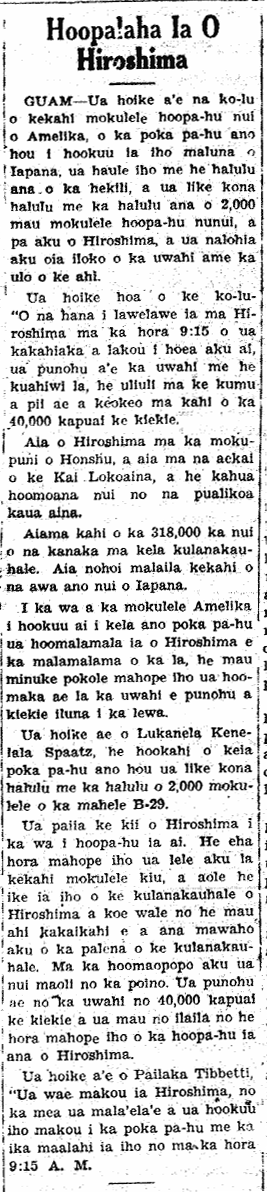
GUAM—The crew of a large American bomber reported of a new type of bomb released above Japan; it fell with the rumbling of thunder, and it was like the strength of 2,00 large bombers; and it hit Hiroshima which disappeared in smoke and the red of fire.

The crew also stated, “The action taken upon Hiroshima at 9:15 in the morning when they arrived, the smoke rose like a mountain, dark at the base and rose to white, reaching about 40,000 feet in height.

Hiroshima is on the island of Honshu, and is on the shore of the Inland Sea [Kai Lokoaina], and it is a large camp for the soldiers of the army.

The population of that city was 318,000. And also one of the major ports of Japan is located there.

When the American aircraft released the bomb, Hiroshima was lit up with the light of the sun, and a few minutes later, smoke began to billow high into the sky.

Lieutenant General Spaatz said the strength of one of those new bombs was equal to the strength of 2,000 B-29 planes.

A picture of Hiroshima was taken when it was bombed. Four hours later, a spy plane flew over, and the city of Hiroshima could not be seen except for a few fires burning outside of the city limits. The great destruction was clear. The smoke billowed up 40,000 feet high, and it remained for hours after the bombing of Hiroshima.

The Pilot Tibbett said, “Hiroshima was chosen because it was clear, and we released the bomb with clear vision at 9:15 A. M.

[70 years ago… Let’s learn from history.]

(Hoku o Hawaii, 8/15/1845, p. 1)

Hoopalaha Ia O Hiroshima

Ka Hoku o Hawaii, Volume XL, Number 16, Aoao 1. Augate 15, 1845.

Duke donating time to make warm clothing, 1918.

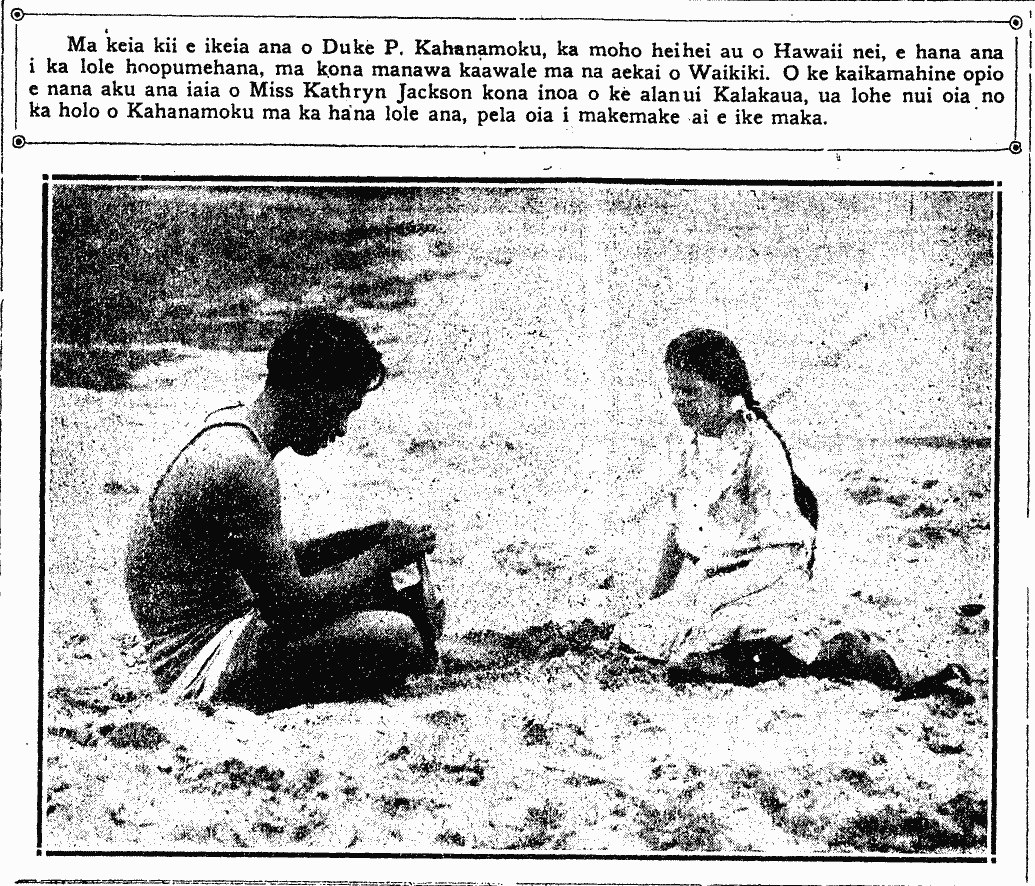
In this picture is seen Duke P. Kahanamoku, the swimming champion of Hawaii nei making warm clothing in his spare time on the shore of Waikiki. The young girl watching him is named Miss Kathryn Jackson of Kalakaua Avenue who heard much of Kahanamoku going to make clothes, and she thus wanted to see it for herself.

(Kuokoa, 4/5/1918, p.1)

Ma keia kii e ikeia ana o Duke P. Kahanamoku...

Ka Nupepa Kuokoa, Buke LVI, Helu 14, Aoao 1. Aperila 5, 1918.