Hawaiian medical kahuna and haole doctors, 1871.

Answer to W. P. Waha.

Mr. Editor; Aloha oe:

Perhaps it is well that I explain in your newspaper a thought responding to W. P. Waha of Honomaele Uka, Hana, Maui.

In the newspaper, Kuokoa, Buke 10, Helu 27, of the 8th of this past July, Waha published an opinion pertaining to the Practice of Hawaiian Medicine. From what I saw searching from beginning to end; this is what I mainly got out of it, that “he is jealous, malicious, and a slanderer, ” and so forth. You just chomp your mouth like a wild shark of the sea saying, “All of the Hawaiians are dying because of whom? Yes! They are dying because of you Heads of the Government!” If that is the intent of the questioner, then I ask of you, “Is that indeed true?” Let us all look at the thoughts of this malicious inciter, being that the Heads of our Nation are not looking to kill off the Hawaiian Lahui, and ways to kill them, but it is you, and it is you yourselves who offer yourselves off to die; and you enjoy grumbling to our Heads of Government. Take a short look at this, you fault finder; During the past session of the Legislature, in the year 1870, $4,000 was put to teach Hawaiian youths Medicine, and in the month of November of last year, the government chose the proper person in which they trust, as a teacher for the school, and it is being taught now. There is no other reason for this action except because of the aloha for you, O Hawaiian people.

Take another look; some Hawaiian medical kahuna are licensed, so that they can practice medicine in the country and areas where there are no doctors. The ignorant and uneducated practitioners are being sued. If you look at these actions by our Government Heads, it appears as if they are concerned that our Lahui will perish. Continue reading

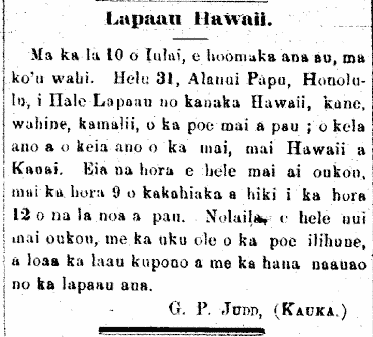
Kauka Judd opens a clinic for Hawaiians, 1871.

Treatment for Hawaiians.

On the 10th of July, I will commence at my place. Number 31, Fort Street, Honolulu, a Clinic for Hawaiian, men, women, children, everyone; with any illness, from Hawaii to Kauai. These are the hours for you all to come by, from 9 o’clock in the morning until 12 on weekdays [la noa]. Therefore, come all; there is no pay for the indigent, and you will get proper medicine with enlightened treatment.

G. P. Judd, (Kauka.)

[Although the title of this advertisement, “Lapaau Hawaii,” can be seen as “Treatment for Hawaiians,” I think the first idea that comes to mind would be “Hawaiian Medicine.” I wonder if that was done on purpose…]

(Au Okoa, 7/20/1871, p. 2)

Lapaau Hawaii.

Ke Au Okoa, Buke VII, Helu 14, Aoao 2. Iulai 20, 1871.

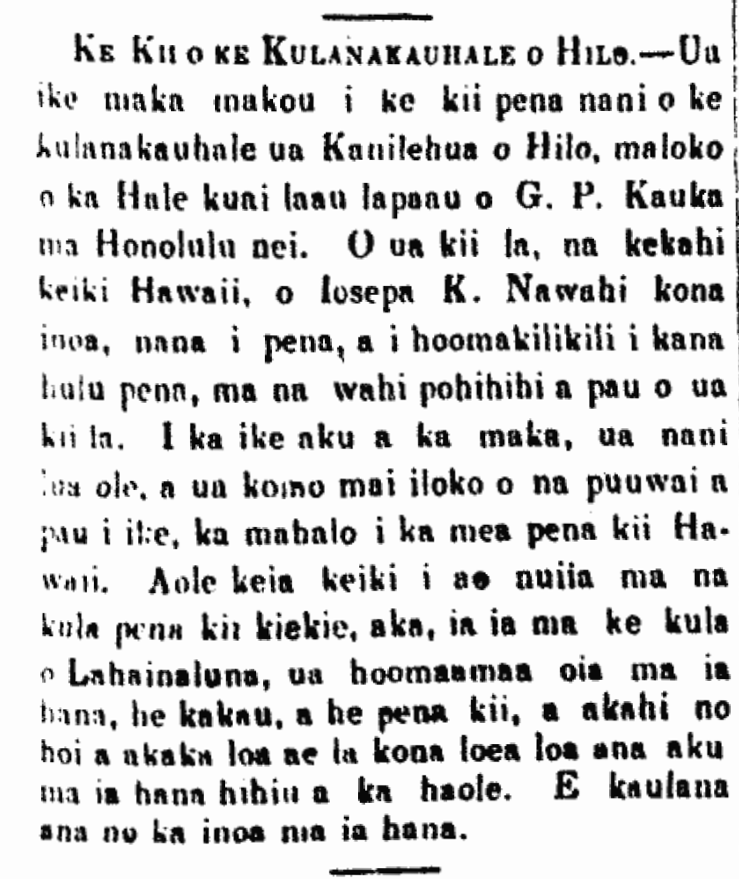
Nawahi paints Hilo Town, 1868.

[Found under: “NU HOU KULOKO.”—”Oahu.”]

Painting of the Hilo Town.—We saw the beautiful painting of the town of Hilo of the Kanilehua rain, in the drug store of G. P. Judd [G. P. Kauka] here in Honolulu. The painting was painted by a Hawaiian boy, named Joseph K. Nawahi [Iosepa K. Nawahi], and he used his brush with detail in all the intricacies the painting. When you see it, it is so beautiful, and admiration for that Hawaiian painter wells in the hearts of all who sees it. This youth was not intensely educated in great art schools, but while he attended Lahainaluna Seminary, he was trained in that skill, drawing and painting, and his expertise in that exceptional discipline of the haole is clear for the first time. His name will become famous through his paintings.

[We all have heard about the awesome story of the 1888 painting by Nawahi of Hilo Town which was featured on Antique Roadshow, now displayed up on the campus of Kamehameha Schools, but the painting described here seems to be the one in the care of the Mission Houses Museum!

Check out this story about two more Nawahi paintings. The whereabouts of these two painting are not known (at least publicly) today… I really want to see the one with the Hiiaka sisters!]

(Kuokoa, 10/31/1868, p. 3)

Ke Kii o ke Kulanakauhale o Hilo.

Ka Nupepa Kuokoa, Buke VII, Helu 44, Aoao 3. Okatoba 31, 1868.

Western medical school for Hawaiians, 1870.

Kahunas.

We understand that one of our physicians, who is thoroughly conversant with the native language, has been authorized to form a class of eight or ten Hawaiian young men, (graduates of the highest schools,) for instructions in the principles and practice of medicine.

There has never been made, that we are aware of, any systematic or earnest effort to instruct Hawaiian youth in the medical art. The knowledge that is necessary to be acquired to make a skillful and thoroughly competent practitioner is not to be obtained in this country, which as yet, does not possess medical schools and colleges, and the difficulties in the way of sending Hawaiian pupils abroad to obtain a medical education, are so various and insurmountable, as almost to preclude any hope of being overcome. Continue reading

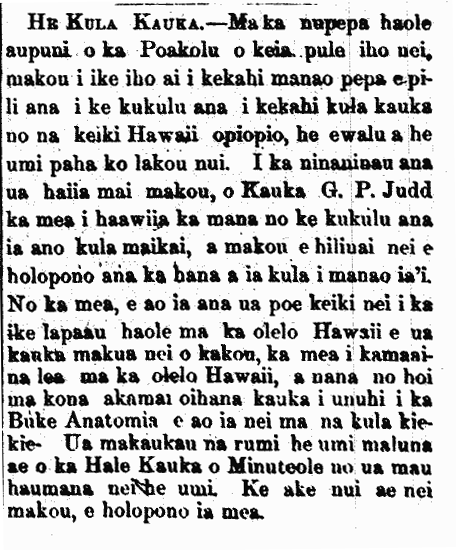
Dr. G. P. Judd starts a medical school for Hawaiians, 1870.

Medical School.—In the English government newspaper [Hawaiian Gazette], we saw an editorial [manao pepa] pertaining to the establishing of a medical school for Hawaiian youths, perhaps eight or ten in number. After asking about, we were told that it is Dr. G. P. Judd who suggested the idea of starting that type of fine school of which we have faith that this proposed school will go well. Because these youths will be taught the haole medicine in the Hawaiian language by that elder doctor of ours, the one that is fluent in Hawaiian, and it is he in his knowledge of medicine who translated the Anatomy Book which is being taught in the high schools. Ten room are set up above the Residence of Dr. Stangenwald [Minuteole] for those ten students. We dearly hope that it goes well.

(Manawa, 11/21/1870, p. 2)

He Kula Kauka.

Ka Manawa, Buke I, Helu 3, Aoao 2. Novemaba 21, 1870.

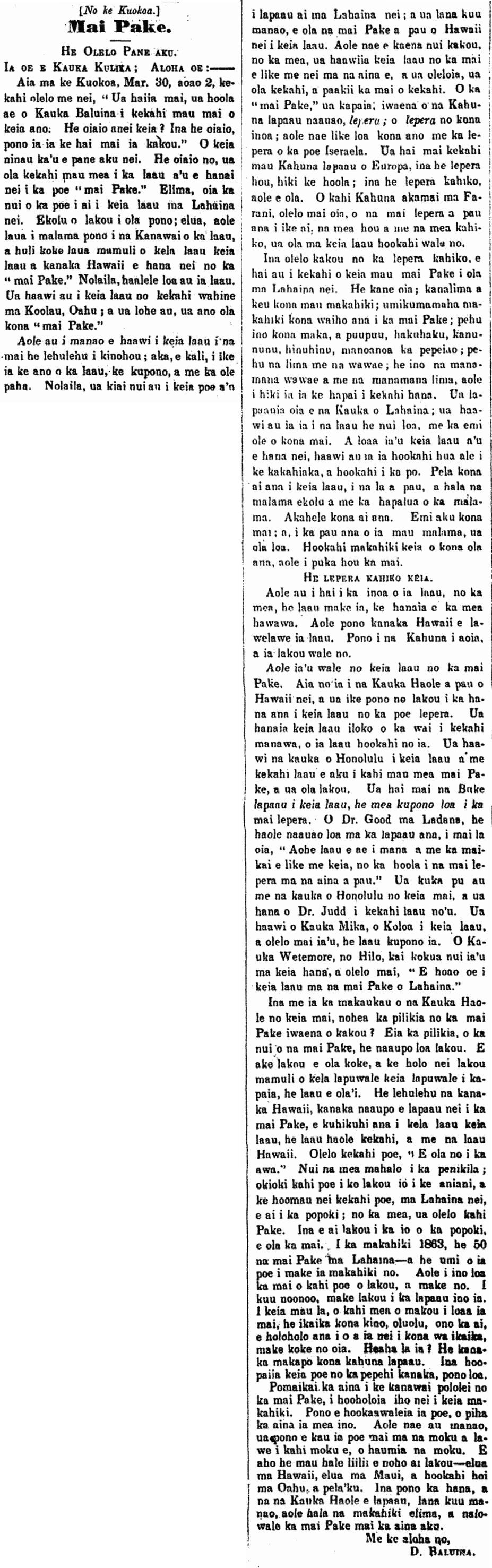
A cure for leprosy in Hawaii? 1865.

[For the Kuokoa]

Leprosy [“Chinese Disease”]

An Answer.

To you Doctor Gulick [Kauka Kulika]; Aloha oe:—

In the Mar. 30th issue of the Kuokoa, on page 2, there is a statement, “I have been told that Doctor Baldwin [Kauka Baluina] has cured some patients of this type. Is this true? If this is true, he should tell us.” It is to this question that I am responding to. It is indeed true, some people were cured with the medicine I am administering to those with the “Chinese disease.” Five are the number of those who ingested the medicine here in Lahaina. Three of them were totally cured; two, did not follow the instructions for the medicine and followed after this medicine and that medicine Hawaiians are taking for the “mai Pake.” Therefore, I’ve given up on that medicine [for those two]. I’ve given the medicine to a woman in Koolau, Oahu and I’ve heard that her “mai Pake” is somewhat better.

I did not consider prescribing this medicine to a great number of patients from the beginning; but instead to wait, and to see the affects of the medicine and if it was effective or not. Therefore, I watched carefully the people I cared after here in Lahaina; and I am hopeful that all the leprosy patients will be cured with this medicine. Let us not boast, for medicine like this has been given in other countries, and it is said that some have been cured while the illness of other has been persistent. The “Chinese disease” is referred to amongst enlightened Doctors [Kahuna lapaau] as leprosy [lepera]; leprosy is its name; however this is not the exact same thing as the leprosy of the Israelites. Some Doctors from Europe say that if this is a new leprosy, it is curable; if it is an ancient leprosy, it cannot be cured. A skilled Doctor from France, he says, all of the leprosy patients he has seen, both the new and ancient types, are curable only with this medicine.

If we are talking about ancient leprosy, I will mention one of these maii Pake cured in Lahaina. It is a man who is over fifty years of age; he was afflicted with mai Pake for fourteen years; his eyes were swollen, and his ears were knobby, lumpy, swollen, shiny, and thick; his feet and fingers were swollen, and he could do no work. He was treated by the Doctors of Lahaina; I gave him a lot of medicine, without his illness lessening. And I came upon this medicine I am working with, and gave him a pill in the morning and one at night. That is how he took this medicine every day, and three months and a half went by. He was careful in what he ate. His illness lessened; and after those months were over, his disease was entirely cured. This is now a year that he’s been cured, and the disease has not reappeared.

This is ancient leprosy.

I will not say what the name of this medicine is, for it is a poison if an unskilled one uses it. It would not be good if a Hawaiian prescribed this medicine. It is only for educated Doctors and just for them.

I am not the only one with this medicine for leprosy. All of the Haole Doctors in Hawaii have it, and they know well how to prescribe it for leprosy patients. This medicine is made into a liquid sometimes; it is the same medicine. The doctors of Honolulu have prescribed this medicine and other medicines to some leprosy patients, and they were cured. The medicine Book speaks of this medicine as good for leprosy. Dr. Good of London, a haole that is brilliant in doctoring says, “There is no other medicine that is as powerful and good for curing leprosy in all lands.” I spoke with the doctors of Honolulu about this illness, and Dr. Judd made some medicine for me. Doctor Smith [Mika] of Koloa prescribed this drug, and told me that it is a good medicine. Doctor Wetmore [Wetemore] of Hilo assisted me greatly in this effort, and said, “Try this medicine for the leprosy patients in Lahaina.”

If this is how prepared the Haole Doctors are for this disease, where does the problem lie with leprosy amongst us? Here is the problem; most of the leprosy patients are terribly simpleminded. They want to get cured quickly and follow after this or that foolishness called a medicine that works. There are many Hawaiians, uneducated people, who are treating leprosy, prescribing this medicine and that, haole medicine as well as Hawaiian medicine. One person says, “You will be cured with awa.” There are many who are fond of pain killers [penikila]; some cut their flesh with a piece of glass; and some here in Lahaina persist in eating cat, because some Chinese said, if they eat cat meat, they will be cured. In the year 1863, there were 50 leprosy patients in Lahaina—ten of them died that year. The illness of some of them was not that severe, but they died. In my opinion, they died because of bad medical treatment. These days, some of us who have this disease, they are strong and fine; they have an appetite, and go around here and there, but while they are strong, they die all of a sudden. What is tha about? His doctor is blind. It would be good to punish them for murder.

This land will be blessed by the good law for the leprosy patients that was passed this year. Those people must be segregated, or the land will be full of that horrible thing. I do not believe that it is right to put the patients on a ship and send them to another island, or the islands will become infested. It would be better that there be some small buildings where they are to live—two on Hawaii, two on Maui, and one on Oahu, and so forth. If it is done correctly, and if it is the Haole Doctor that does the treating, I am hopeful that in less than five years’ time, leprosy will be gone from the land.

With aloha,

D. Baldwin.

[Read this article, and then read the following post…]

(Kuokoa, 4/13/1865, p. 1)

Mai Pake.

Ka Nupepa Kuokoa, Buke IV, Helu 15, Aoao 1. Aperila 13, 1865.

More on Hawaiian Independence Day and Aloha Aina, 1843.

THE ANT [KA NONANONA].

“Go to the ant, thou sluggard; consider her ways, and be wise.” Proverbs [Solomona]

Book 2. HONOLULU, OAHU, JANUARY 17, 1843. Paper 17.

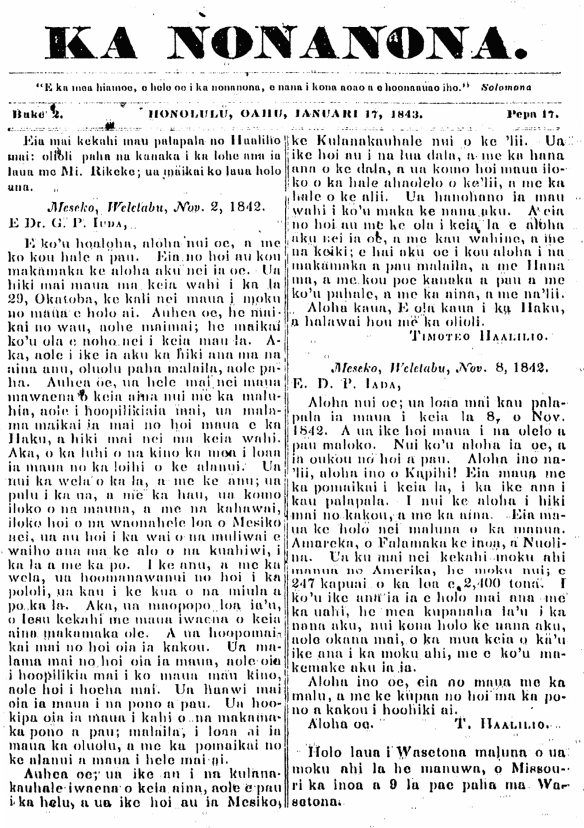
Here are some letters from Haalilio; people will surely be happy to hear from him and Mr. Richards that their travels are going well.

Weletabu [Vera Cruz ?], Mexico, Nov. 2, 1842.

Dr. G. P. Judd,

My dear friend, much aloha to you and your entire household. Here am I, your friend, with feeling aloha for you. The two of us [Haalilio and Richards] arrived here on the 29th of October, and we are awaiting a ship to ride. Hear me, I am doing fine, I have no illness; my health is fine now. However, I do not know how it will be when we get to the cold lands; perhaps it will be alright, and perhaps not. Hear me, we have travelled about this expansive land with peacefully, we were not troubled, we were cared for well by the Lord, until arriving here. But our bodies are spent after the long road. The days were extremely hot and extremely cold; we got drenched by the rain and snow, we passed through mountains, and rivers, and the wilds here in Mexico; we swam the water of rivers running by the face of the mountains, during the day and the night. In the cold and the heat, we endured hunger, riding on the backs of mules all day long. But I was certain that Jesus was with us in this friendless land. And that he blesses us. He takes care of the two of us, and our bodies are not troubled or hurt. He supplies us with all of our needs. He has welcomed us always amongst good friends; and there, we were given comfort and help on our path.

Listen to this, I’ve seen the towns of these lands; they are countless, and I have seen Mexico the great Town of the president [alii]. I’ve also seen the silver mines, and how they work silver; we’ve been to the legislature of the alii and his residence. Those places are grand to see. And today I am with health, giving my aloha to you and your wife and the children; give your [my?] aloha to all the friends there, and to Hana folks and to your people and to my household, and to the land and to the chiefs.

Aloha between us, Let us live through the Lord; until we meet in joy once more.

Timoteo Haalilio.

Mexico, Weletabu [Vera Cruz ?], Nov. 8, 1842.

O D. [G.] P. Judd,

Much Aloha to you; we received your letter on this day, the 8th of Nov., 1842. And we’ve understand all that was within. I have much aloha for you, and for all of you. How sad for all the alii, and how sad for Kapihi! We have been blessed this day in seeing your letter. There is much aloha for us all and our homeland. We are travelling aboard the American warships, Falmouth [Falamaka], to New Orleans [Nuolina]. A steam-powered American warship arrived, a huge vessel, 247 feet long and 2,400 tons. As I watch her sail by steam, it is a fantastic sight; she is so swift, with no comparison; this is the first time I’ve seen a steamer, and I am totally captivated by it.

Much aloha for you; here we are safe, steadfast in our duties we swore to.

Aloha to you.  T. Haalilio.

The two of them are headed to Washington aboard the steamer, a warship named Missouri, and perhaps they will land in Washington in 9 days.

[Does anyone know if Weletabu in Mexico is Vera Cruz, or if it is somewhere else?

Also, who is the Hana and the Kapihi mentioned here?]

(Nonanona, 1/17/1843, p. 81)

Eia mai kekahi mau palapala no Haalilio mai...

Ka Nonanona, Buke 2, Pepa 17, Aoao 81. Ianuari 17, 1843.

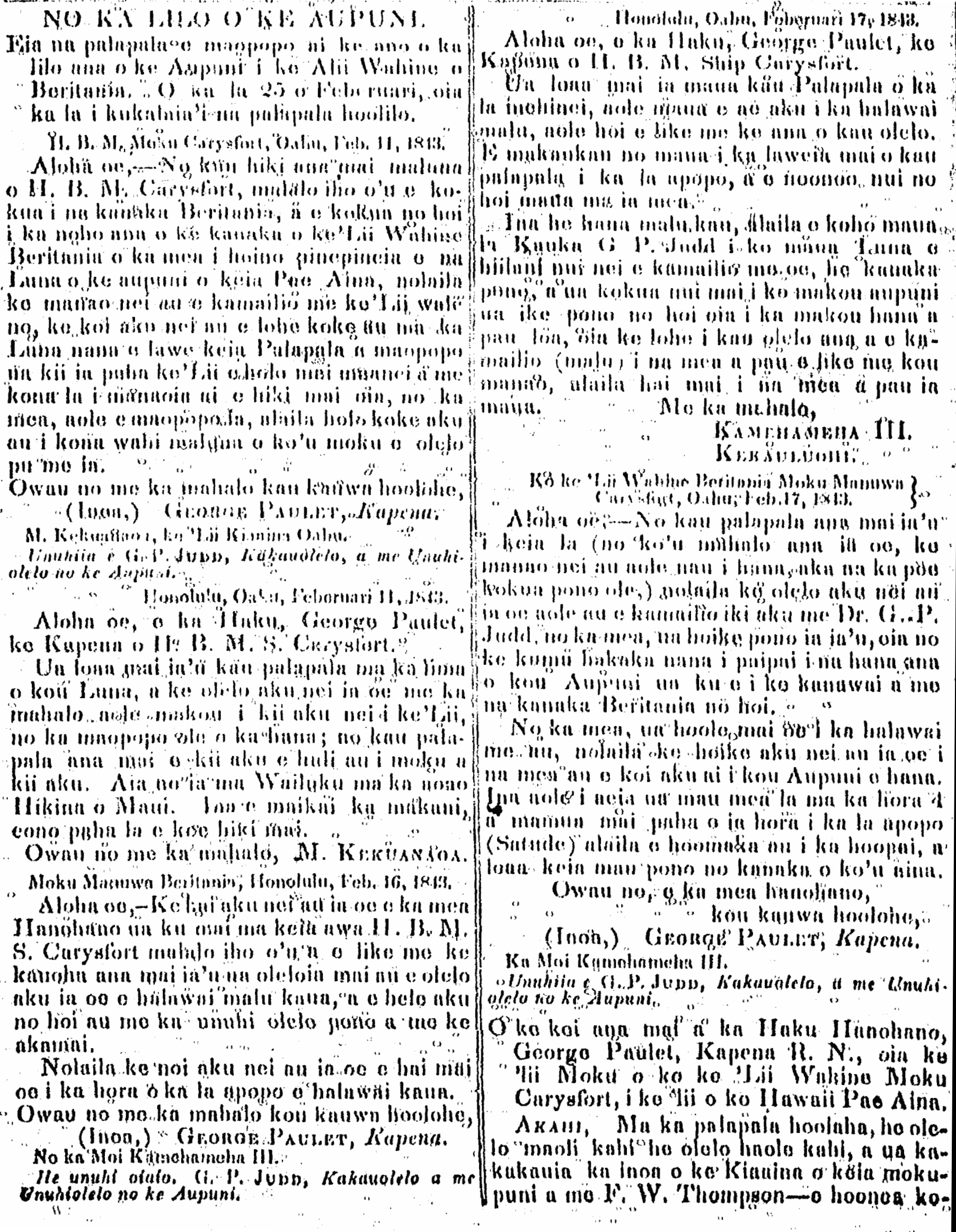
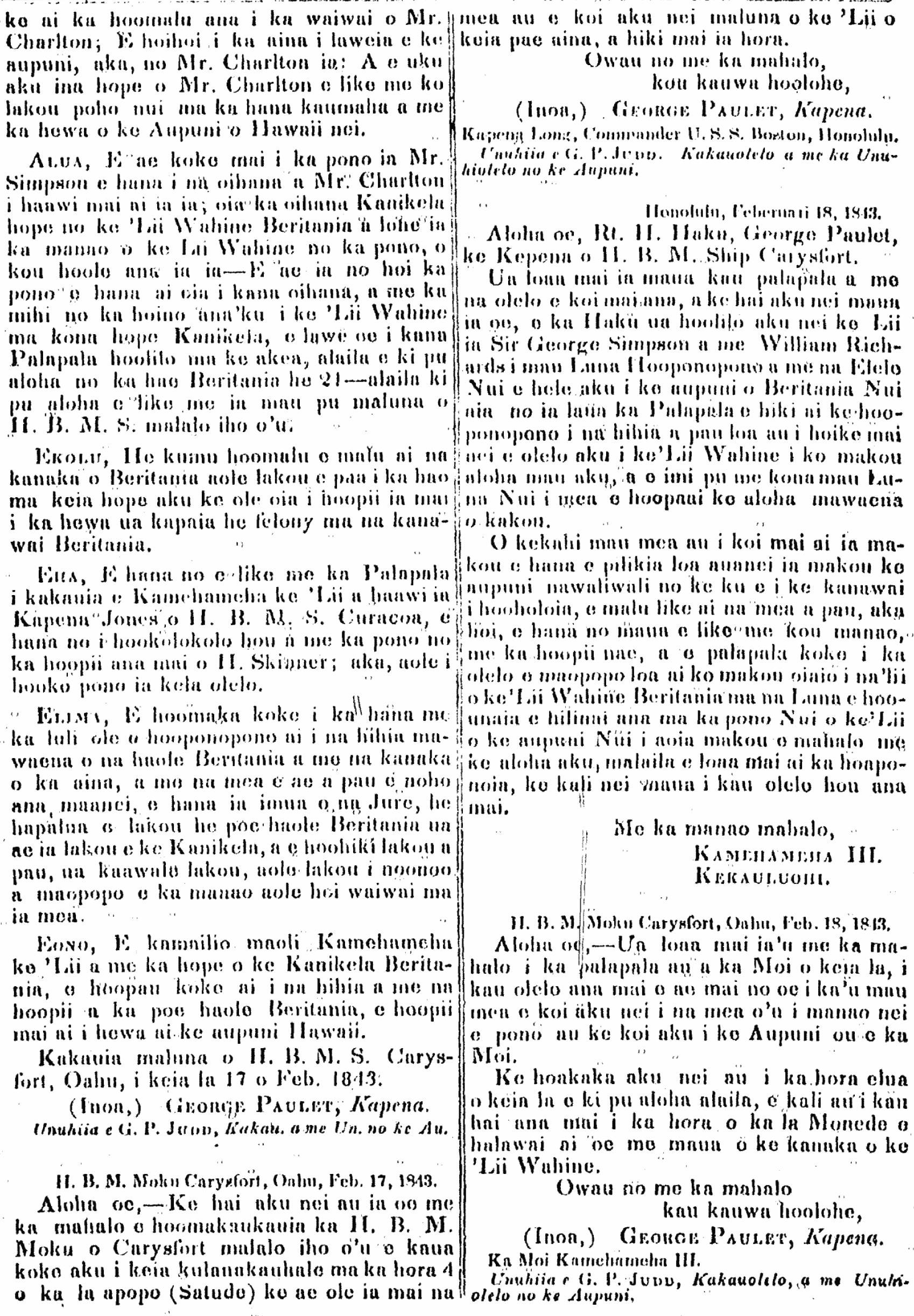
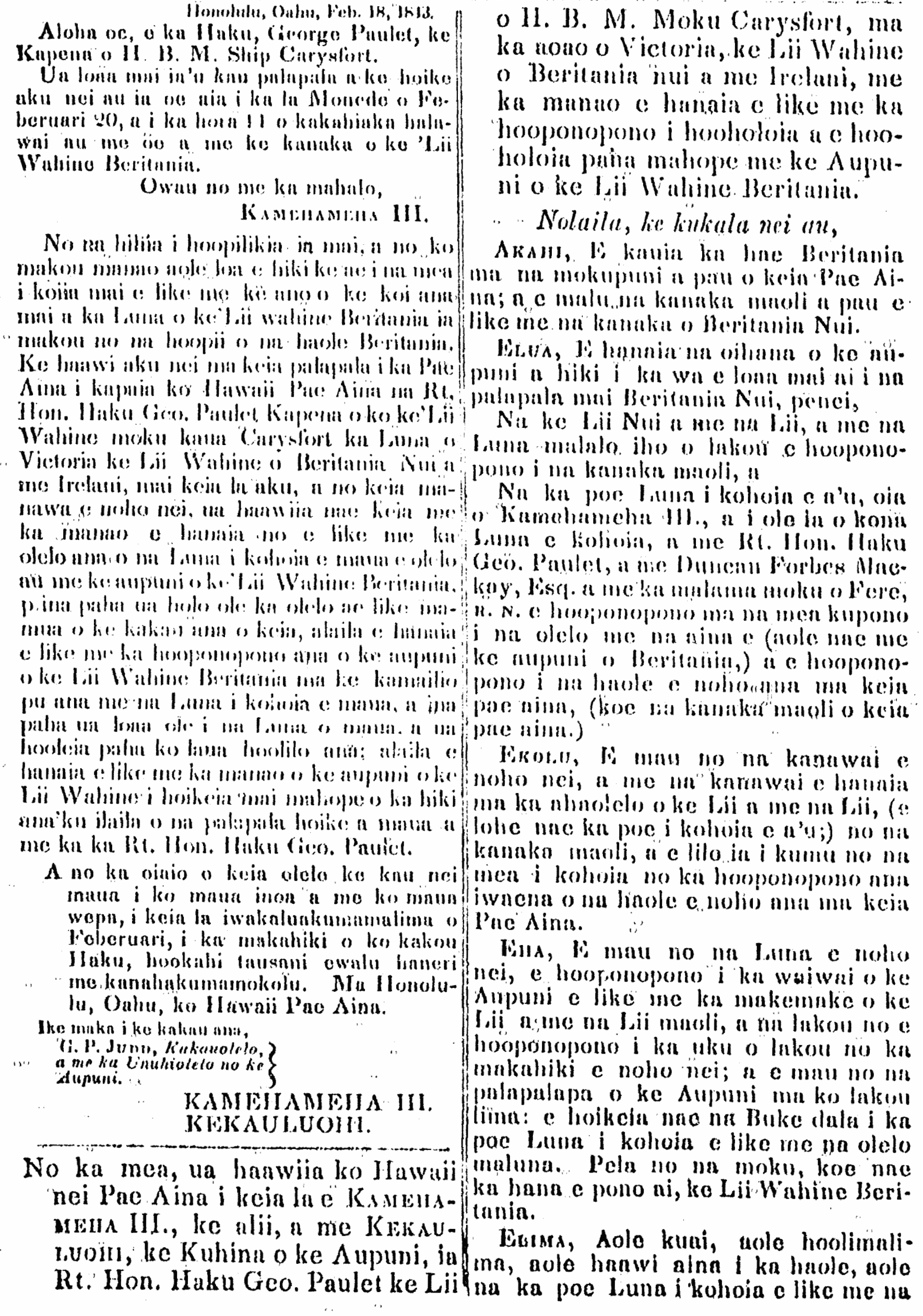
Correspondences between Paulet and the Hawaiian Government. 1843.

ON THE LOSS OF THE KINGDOM.

Here are the documents illuminating how the Kingdom was lost to the Queen of Britain. The 25th of February was the day the cession was proclaimed.

[See on Google Books: British and Foreign State Papers, starting on page 1023. These correspondences were translated from English into Hawaiian, and from Hawaiian into English by Gerrit Parmele Judd (Kauka), the Secretary and Translator of the Kingdom.]

(Nonanona, 3/7/1843, pp. 97–100.)

NO KA LILO O KE AUPUNI.

Ka Nonanona, Buke 2, Pepa 20, Aoao 97. Maraki 7, 1843.

ke ai ka hoomalu ana...

Ka Nonanona, Buke 2, Pepa 20, Aoao 98. Maraki 7, 1843.

Honolulu, Oahu, Feb. 18, 1843.

Ka Nonanona, Buke 2, Pepa 20, Aoao 99. Maraki 7, 1843.

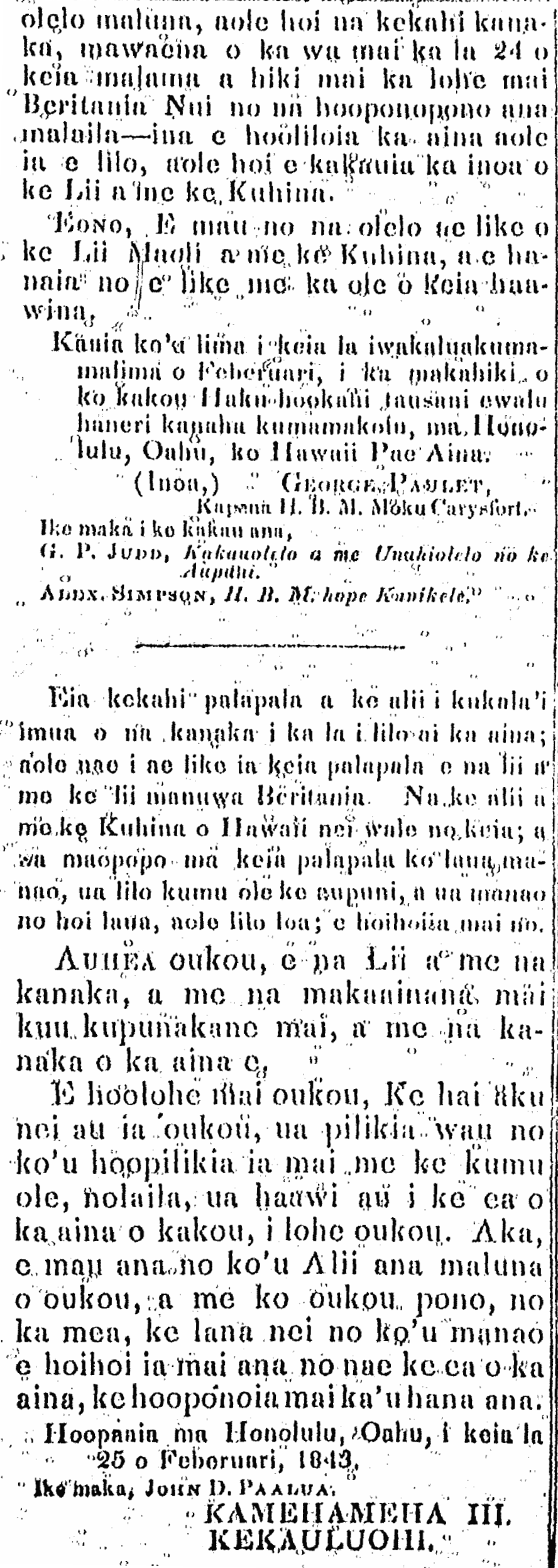
olelo maluna, aole hoi na kekahi kanaka...

Ka Nonanona, Buke 2, Pepa 20, Aoao 100. Maraki 7, 1843.

A small window into Koolauloa and Koolaupoko—150 years ago, 1862.

Rice and Gold.

Some days ago, we had reason to travel about Koolaupoko and Koolauloa, and because of the many wonderful and beneficial things for the people we witnessed in our travels, we are publishing what we saw before us.

PERTAINING TO KEKELE.

We saw some Loi perfect for growing rice; however, we are sad to state that they were fallow and it was not weeded, they were just left wild. Fine is the road from the pali of Nuuanu until

KANEOHE

In this land, it is green from one side to the other, which attests to the non-lazy lifestyle of the people there; the land has ample water, but one thing which saddened us a bit was the seeing of some loi that were left fallow next to the river there on the Heeia side, which caused us to ponder, “Why are these loi not farmed, and planted with rice? They are fine loi supplied and full of water, very good for rice growing. Does our lack of faith and our desire to while away our time still persist? We must discard those feelings, and heed the land, and it will supply us with items that will make this life pleasant. We left that place feeling sad, and travelled on to

HEEIA.

There is not much we saw there, and we went on quickly to

KAHALUU.

There, our eyes were shown things that eased our hearts because of our great joy, when we saw that the kamaaina there did work, and that they did much farming. The one who is leasing the land has started to plant rice; there are perhaps six or more acres. But the somewhat sad thing is the majority of the land suitable for rice cultivation in that Ahupuaa, are just left there without being all farmed; when will it be that if the time is right, we will quickly make up our minds to grasp opportunities to make ourselves rich? Time keeps going quickly. And what of us? Here is what we say, to wake up and to plant your unused loi with rice.

KAALAEA

A haole there is planting rice, and we hear that it is going well; because he resides there, the work is progressing, and our hopes go with him and those others that are working at this valuable endeavor for us Hawaiians and the nation of our beloved Alii.

WAIAHOLE TO KAAAWA.

Waiahole is the first place, in our knowledge, that planted rice; when we began to walk upon the soil of that ahupuaa, our hearts were filled with joy at the sights of that place, and reaching Waikane, all the loi were being farmed, as if it was just one huge farm; we thought to ask who was it that was farming the area, and we were told Messrs. Judd and Wilder (Kale of Kauka and Waila) [Kale of Kauka must be Charles Hastings Judd, the son of Kauka (Gerrit Parmele Judd); so many loi were finely built, and it seemed like almost thirty or more acres; they had thirty-five workers. We see the immediate benefits of growing rice, being that these men were hired, and got paid for their labor, and all this is because of rice; many subjects of the King were provided with jobs, and as a result, perhaps some of those people were prevented from acts which would have caused them to suffer difficulties and problems, because their minds are taken up by work. There are many Loi farmed in Waikane, by J. Fuller (J. Pula), and they are being reworked. The road from Waiahole to Waikane is horrible; it is swampy, and we hear that a horse sunk on this street and its throat was cut. The lower part is boggy, but it is dry on the surface of the earth. There is a fine wooden house standing in Kualoa belonging to Charles Hastings Judd, along with a horse shed, and a carriage house; that place is beginning to become a town.

KAAWA.

This land has a fine appearance, but we did not see a single person who started to grow rice; that is where Mr. Wilder (Waila) resides with a nice wooden house there, with other connected buildings, and life there is luxurious. The road from Kualoa until this land is not good, and in our travels, it was terribly slippery because rain had fallen upon it. After leaving that land and the adjoining lands, we arrived at

KAHANA.

We saw nothing new there, but they did have some rice fields which were located in the uplands; we did not go to see it for ourselves, we just heard of them from the kamaaina; J. M. Kapena and Asing Apakana are the ones doing the farming.

PUNALUU.

This is the rice growing lands of Dr. [Seth] Ford (Kauka Poka) them; they built a wooden house for themselves and a halau for the workers who number 35, and they work without any complaints. Dr. Ford them slaughter two cows as meat for their men for a week. The area that was plowed up is between thirty and forty acres and it is ready to be planted with rice. The work there progresses due to the good treatment by the bosses to their workers; they are anxious to work for Dr. Ford. We all know that if we treat others well, we will be treated well and with aloha.

HAUULA.

We saw some well-farmed land to the southwest of the Church, and the land all about is green. This shows the benefits of the recent showers.

“HOWLAND’SVILLE,” LAIE.

We arrived there at 4 in the evening, and met pleasantly with the Konohiki of that land, and rested our limbs at his house. Captain H. S. Howland (Haulani), the Konohiki of that land is starting to build a wooden house there. Here however is the problem, that being the long wait for the lumber and the other house building materials, because of the delay and the inattentiveness of the captains of the ships that travel there; we believe that if there was a ship that went regularly to Koolaupoko and landed at the harbor of Koolauloa, the materials needed for the Owners [of land] would always be there. After making a start at the home of the landowner, we went to the houses of those living on the land, and we were urged on by an astonishing idea, to question the people of that area about their life under their new landlord. And we are happy to report to our friends, their answer was that their life was very pleasant, without any admonishments or reproach; and because of their great aloha and appreciation for Capt. Howland, they went and gave him many gifts—taro, pig, chicken, and many other things, without pay; it was as if he was a native-born alii; also, they all went quickly to assist him, with things that Capt. Howland needed, on their own accord, without being coerced by him. One kamaaina of that area did not touch work in the least when the land was under the previous Konohiki, but with Capt. Howland, he came to work industriously without complaint, but enthusiastically, without being forced to. The new Land owner of Laie lives together with the people of his land, like brothers of the same family. How pleasant is the life of people like that!

The reason for their love is because their landlord gives them many things, and does not just burden them, or put a restriction on plants or things from the sea. The one who owns the land just wants to live together in peace, and to search for together things that will benefit them all. How could there be no appreciation and love if we treat others well? It is good to remember this, to remind us to treat others with aloha, so that we are loved, when the day comes where we will be blessed to become land owners.

GOLD IN KAHALUU.

There was so much commotion amongst the Hawaiians and haole at the news that there was Gold in Kahaluu; there were many people who came from Honolulu to the place where Gold was thought to be. Many Hawaiians from Koolaupoko came with Oo, Pickaxes, Shovels and other things, preparing them to dig.

When it was heard that there was real Gold on that land, the news flew from house to house like firebrand. Those who first spotted it went immediately, making ready with dynamite powder. However, before those people who first witnessed the Gold reached Kahaluu, the news reached the people of that land, and they were roused. Therefore, about 60 kanaka maoli and 2 haole got together with weapons to expel all those who came to that area thought to have Gold. So when the haole came that wanted to ascertain the truth or falsehood of the Gold of that place, they were sent away.

Following that time, a hole was bored into a rock to place dynamite and explode to see if there was Gold within it or not. People stood together there waiting in anticipation for the rock to break.

In the evening of the 18th, the hole dug in the rock was finally deep enough, and it was blasted, and the rock was shattered, the tiny pieces flew. There was however no Gold found. Many pieces were taken to Honolulu, and were looked at by experts, but there was no Gold found.

[Under all the disparaging comments and the obvious push for rice cultivation, you can glean some historical information of what the windward side of Oahu looked like a 150 years ago. There are followup articles in the papers speaking of how the true gold of Hawaii is found through farming the land…

For more information on the history of rice in Hawaii, see: RICE IN HAWAII: A GUIDE TO HISTORICAL RESOURCES, compiled and annotated by Karol Haraguchi.]

(Kuokoa, 2/22/1862, p. 2)
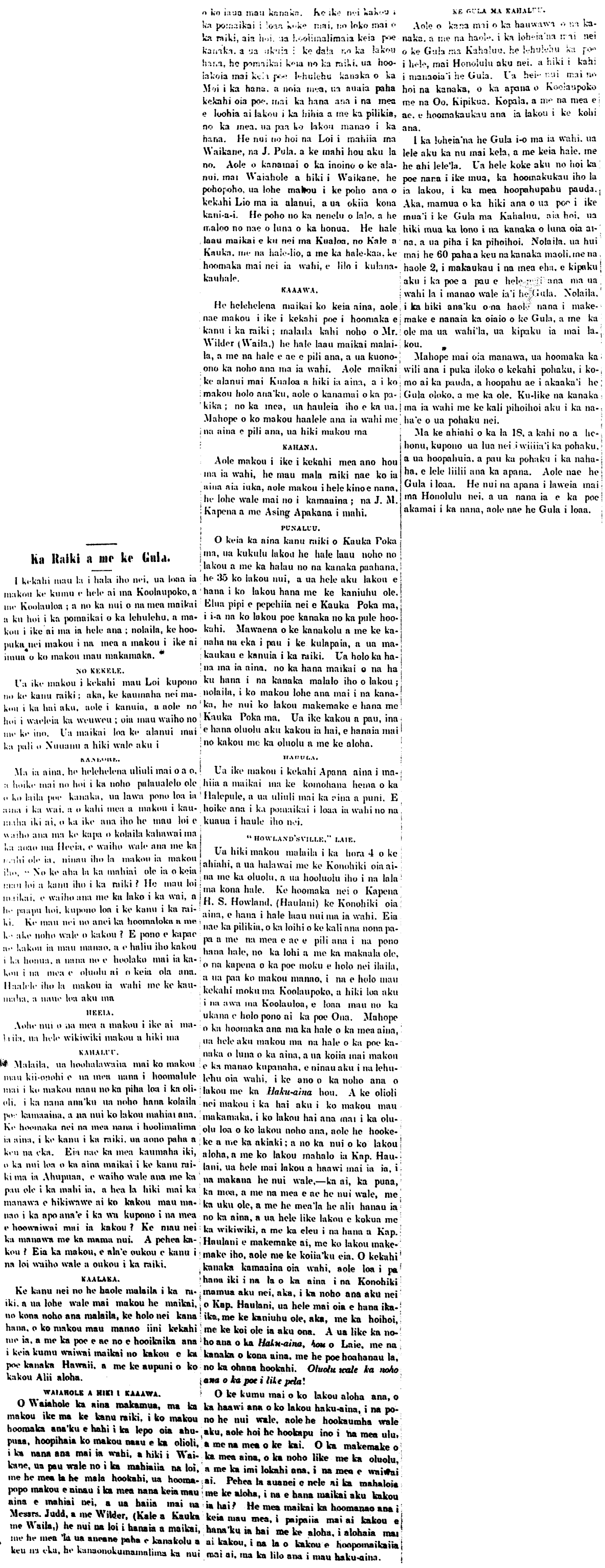
Ka Raiki a me ke Gula.

Ka Nupepa Kuokoa, Buke I, Helu 13, Aoao 2. Feberuari 22, 1862.

Smallpox brought by the Meifoo, 1881.

Smallpox in Honolulu nei.

O Hawaiian Nation, the steamship “Meifoo” from China, entered into Honolulu Harbor, and within its passengers, there are six Chinese who are suffering from that frightful annihilating disease of 1853–4, that illness that took ten-thousand of our beloved people. There are two of them with the disease that are very bad, and four will perhaps live.

We understand the the Board of Health has decided to quarantine the sick at the hospital at Kahakaaulana, and for those that are not sick, to quarantine them at Kakaako, while detaining the agents of the ship to pay all expenses should the disease spread here after.

We call out to our beloved nation, let us watch out for ourselves, and let us not associate much with these foreigners, for the time for concern has come upon our nation, because this disease was brought here and it is at our own door. Should we be saved, it is only through the love of the Almighty.

Do recall, O Leaders of our Nation, as well as the members of the Board of Health, that the cabinet of Gerrit P. Judd [Kauka] was ended because of this, and we fear that maybe there will be one that follows the first one in the very near future. Only time will tell.

As we were returning to print the paper for today, it was heard that Smallpox appeared in the body of a haole boy of this town. Here is a query, a question: what of this?

(Ko Hawaii Pae Aina, 2/5/1881, p. 2)

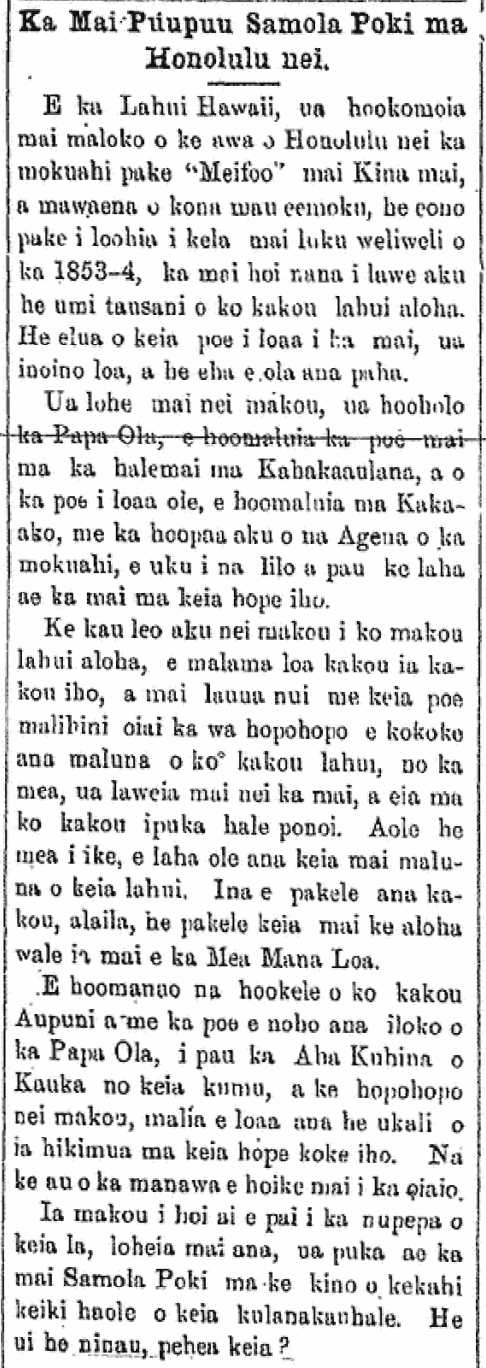
Ka Mai Puupuu Samola Poki ma Honolulu nei.

Ko Hawaii Pae Aina, Buke IV, Helu 6, Aoao 2. Feberuari 5, 1881.