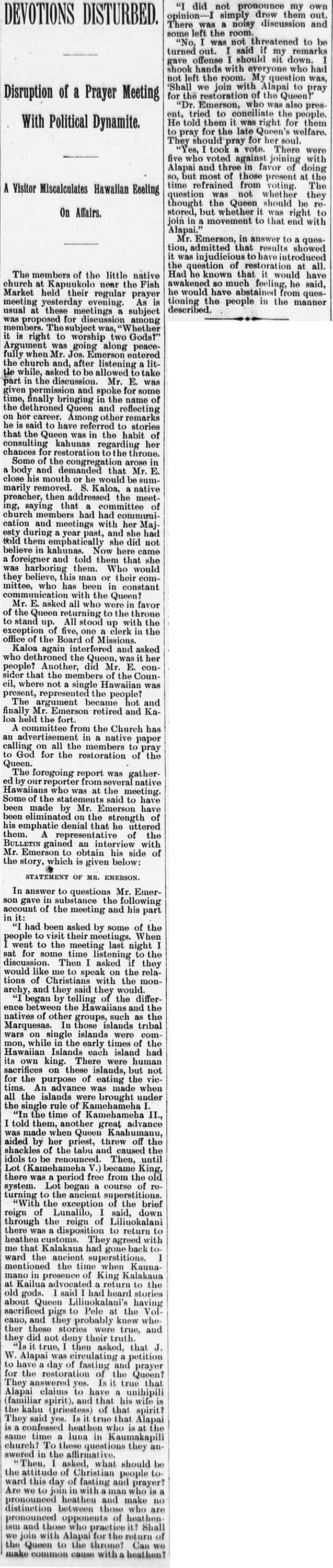
Joseph Emerson interrupts meeting at the Kapuukolo Church, 1893.

DEVOTIONS DISTURBED.

Disruption of a Prayer Meeting With Political Dynamite.

A Visitor Miscalculates Hawaiian Feeling On Affairs.

The members of the little native church at Kapuukolo near the Fish Market held their regular prayer meeting yesterday evening. As is usual at these meetings a subject was proposed for discussion among members. The subject was, “Whether it is right to worship two Gods?” Argument was going along peacefully when Mr. Jos. Emerson entered the church and, after listening a little while, asked to be allowed to take part in the discussion. Mr. E. was given permission and spoke for some time, finally bringing in the name of the dethroned Queen and reflecting on her career. Among other remarks he is said to have referred to stories that the Queen was in the habit of consulting kahunas regarding her chances for restoration to the throne.

 Some of the congregation arose in a body and demanded that Mr. E. close his mouth or he would be summarily removed. S. Kaloa, a native preacher, then addressed the meeting, saying that a committee of church members had had communication and meetings with her Majesty during a year past, and she had told them emphatically she did not believe in kahunas. Now here came a foreigner and told them that she was harboring them. Who would they believe, this man or their committee, who has been in constant communication with the Queen?

Mr. E. asked all who were in favor of the Queen returning to the throne to stand up. All stood up with the exception of five, one a clerk in the office of the Board of Missions.

Kaloa again interfered and asked who dethroned the Queen, was it her people? Another, did Mr. E. consider that the members of the Council, where not a single Hawaiian was present, represented the people?

The argument became hot and finally Mr. Emerson retired and Kaloa held the fort.

A committee from the Church has an advertisement in a native paper calling on all the members to pray to God for the restoration of the Queen.

The foregoing report was gathered by our reporter from several native Hawaiians who was at the meeting. Some of the statements said to have been made by Mr. Emerson have been eliminated on the strength of his emphatic denial that he uttered them. A representative of the Bulletin gained an interview with Mr. Emerson to obtain his side of the story, which is given below:

STATEMENT OF MR. EMERSON.

In answer to questions Mr. Emerson gave in substance the following account of the meeting and his part in it:

 “I had been asked by some of the people to visit their meetings. When I went to the meeting last night I sat for some time listening to the discussion. Then I asked if they would like me to speak on the relations of Christianity with the monarchy, and they said they would.

“I began by telling of the difference between the Hawaiians and the natives of other groups, such as the Marquesas. In those islands tribal wars on single islands were common, while in the early times of the Hawaiian Islands each island had its own king. There were human sacrifices on these islands, but not for the purpose of eating the victims. An advance was made when all the islands were brought under the single rule of Kamehameha I.

“In the time of Kamehameha II., I told them, another great advance was made when Queen Kaahumanu, aided by her priest, threw off the shackles of the tabu and caused the idols to be renounced. Then, until Lot (Kamehameha V.) became King, there was a period free from the old system. Lot began a course of returning to the ancient superstitions.

“With the exception of the brief reign of Lunalilo, I said, down through the reign of Liliuokalani there was a disposition to return to heathen customs. They agreed with me that Kalakaua had gone back toward the ancient superstitions. I mentioned the time when Kaunamano in the presence of King Kalakaua at Kailua advocated a return to the old gods. I said I had heard stories about Queen Liliuokalani’s having sacrificed pigs to Pele at the Volcano, and they probably knew whether these stories were true, and they did not deny their truth.

“Is it true, I then asked, that J. W. Alapai was circulating a petition to have a day of fasting and prayer for the restoration of the Queen? They answered yes. Is it true that Alapai claims to have a unihipili (familiar spirit), and that his wife is the kahu (priestess) of that spirit? They said yes. Is it tre that Alapai is a confessed heathen who is at the same time a luna in Kaumakapili church? To these questions they answered in the affirmative.

“Then, I asked, what should be the attitude of Christian people toward this day of fasting and prayer? Are we to join in with a man who is a pronounced heathen and make no distinction between those who are pronounced opponents of heathenism and those who practice it? Shall we join with Alapai for the return of the Queen to the throne? Can we make common cause with a heathen?

“I did not pronounce my own opinion—I simply drew them out. There was a noisy discussion and some left the room.

“No, I was not threatened to be turned out. I said if my remarks gave offense I should sit down. I shook hands with everyone who had not left the room. My question was, ‘Shall we join with Alapai to pray for the restoration of the Queen?’

“Dr. Emerson, who was also present, tried to conciliate the people. He told them it was right for them to pray for the late Queen’s welfare. They should pray for her soul.

“Yes, I took a vote. There were five who voted against joining with Alapai and three in favor of doing so, but most of those present at the time refrained from voting. The question was not whether they thought the Queen should be restored, but whether it was right to join in a movement to that end with Alapai.”

Mr. Emerson, in answer to a question, admitted that results showed it was injudicious to have introduced the question of restoration at all. Had he known that it would have awakened so much feeling, he said, he would have abstained from questioning the people in the manner described.

[This article was translated in Leo o ka Lahui, 2/9/1893, p. 2. It is interesting that there is a note appended to the end of the translated article that they did not have time to translate Emerson’s response.]

(Daily Bulletin, 2/7/1893, p. 3)
DEVOTIONS DISTURBED.

The Daily Bulletin, Volume V, Number 644, Page 3. February 7, 1893.
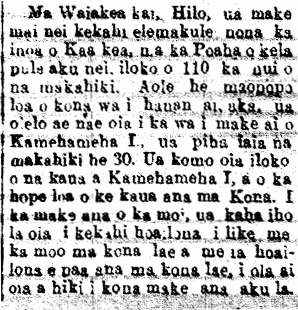
Kaa kea of Waiakea dies at 110 years old, 1898.

[Found under: “Nuhou Kuloko.”]

At Waiakea Kai, Hilo, an old man just died whose name was Kaa kea, on Thursday last, at 110 years old. It is not exactly known when he was born, however, he stated that he was 30 years old when Kamehameha I died. He joined in the battles of Kamehameha I, and at the last battle in Kona. At the death of the king, he slashed a mark like a moo on his forehead, and he lived with this mark until his death.

(Aloha Aina, 2/14/1898, p. 7)

Ma Waiakea kai, Hilo...

Ke Aloha Aina, Buke IV, Helu 7, Aoao 7. Feberuari 12, 1898.

History and the kahu hanai of Kamehameha, 1911.

RESPONSE OF O-U KA MAKA O KA WAUKE OI OPIOPIO.

O Mr. Editor of the Kuokoa. With appreciation: Please allow my clarification pertaining to the person who raised Kamehameha I. which was shown in the newspaper Kuokoa Home Rula of the past 10th of February, 1911, which said that it was Naeole who raised him. Forgive me for my late response, but I just received the issue of the aforementioned newspaper from a friend last week, and so that the true person who raised Kamehameha I. is known, who is not Naeole, that is the reason I am disseminating this information without the intent to show my relation to royal genealogy, being that it is shameful to speak haughtily; there are many now living who are related to alii and who prize the alii genealogist who are written in the books about the relatives of the parents of Kamehameha I., and here they are:

Keaweikekahialiiokamoku (m) dwelt with Kalanikauleleiaiwi (f), born was Keeaumoku (m).

Keeaumoku (m) dwelt with Kamakaimoku (f), born was Keoua (m), the father of Kamehameha I.

Here is the mother’s side; Kalanikauleleiaiwi (f) dwelt with another kane, Kauauanuiamahi (m), born was Haae (m).

Haae (m) dwelt with Kekelaokalani (f), born was Kekuiapoiwa (f), the birth mother of Kamehameha I.

Kamehameha I was born of Kekuiapoiwa (f) at Ainakea, Kohala, Hawaii. They were living there at the time, and that is where King Kalakaua searched for and built the statue of Kamehameha I, and that is the truth; that is what I heard from my kupuna; he was not born on a canoe and not in Halawa or Kokoiki as it is being fabricated. Here is the story of his birth: Continue reading

Death of Mary Ann Kaaumokulani Kinoole Pitman Ailau, 1905.

DIED.

AILAU—In Hilo, Hawaii. February 11, 1905. Mrs. Mary Ann Kaaumokulani Kinoole Pitman Ailau, daughter of the High Chiefess Kinoole and the late Benjamin Pitman, and widow of John Keakaokalani Ailau, aged 67 years.

Mrs. Ailau was known from one end of the group to the other, and in Boston and many of the Atlantic watering places.

She was born at Hilo 67 years ago, and with the exception of a number of years spent in Boston and New England completing her education, she always resided in the islands. She was a daughter of Benjamin Pitman a capitalist, who resided both in Hilo and Honolulu. The Pitman home was at the corner of Alakea and Beretania streets, on the site now occupied by the C. Q. Yee Hop building.

The Pitmans came here from Boston, where they were well connected. Mrs. Ailau’s father-in-law also resided here for a number of years. Her father married the High Chiefess Kinoole, daughter of the High Chief Hoolulu. Continue reading

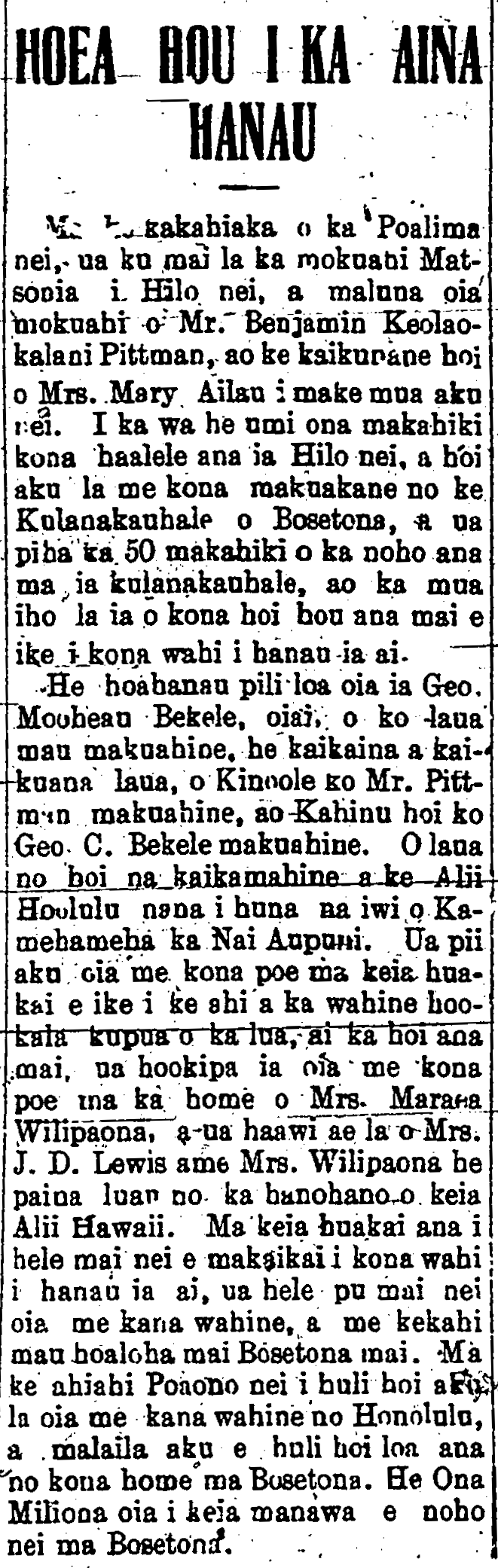
Hawaiian returns home to Hilo after living in Boston for 50 years, 1917.

RETURNED ONCE AGAIN TO THE LAND OF HIS BIRTH

In the morning of last Friday, the steamship Matsonia docked in Hilo nei, and aboard the ship was Mr. Benjamin Keolaokalani Pitman [Pittman], the brother of the recently deceased Mrs. Mary Ailau. He left left Hilo when he was 10 years old, and went back with his father to the city of Boston, and he has lived there for a full 50 years, and this is the first time he has returned to see the place where he was born.

He is a direct cousin to George Mooheau Beckley, as their mothers were sisters; Kinoole is Mr. Pitman’s mother, and Kahinu is George C. Beckley’s. The two of them were daughters of the Alii Hoolulu who hid the bones of Kamehameha Ka Na’i Aupuni. He [Pittman] went with his people on a tour to see the fire of the enchanting woman of the pit, and on their return, they were entertained at the home of Mrs. Maraea Wilipaona [? Mrs. Maria Wilfong], and Mrs. J. D. Lewis and Mrs. Wilfong put on a luau to honor this Hawaiian Alii. On this trip of his to his homeland, accompanying him were his wife and some friends from Boston. On Saturday evening, he and his wife left for Honolulu, and from their they will return to his home in Boston. He is now a Millionaire living in Boston.

[Unfortunately, the digital images of the Hoku o Hawaii newspaper are only available online from 5/31/1917, and so the issue in which this story appears is not available yet (along with the ten years of newspapers that come before it).]

(Hoku o Hawaii, 2/8/1917, p. 2)

HOEA HOU I KA AINA HANAU.

Ka Hoku o Hawaii, Buke 11, Helu 37, Aoao 2.

Peleioholani’s home is destroyed by fire, 1901.

ANCIENT RELICS

WERE DESTROYED

Valuable Feather Cloak In Peleioholani’s Fire Claim.

BELONGED TO KEEAUMOKU

THE CLAIMANT’S ANCESTOR

While Husband and Wife Were Shut Out By Quarantine the Flames Swept Away Their Home.

Claims of native Hawaiians were resumed before the Fire Claims Commission yesterday morning. Two of these were called this morning, one of which is of more than ordinary interest.

S. L. Peleioholani presents a claim for $2000 and it appears to be a perfectly straight one. The claimant is a lineal descendant of high chiefs and among his household possessions were heirlooms of great value. Indeed, it is scarcely practicable to measure their value in money, the articles having both historical and ethnological—it might be added without joking, ornithological—interest.

Of the last-named class was a feather cloak, the only one existing of its class except the famous garment of Kamehameha treasured in the British Museum. This cloak descended to Peleioholani from his great-great-grandfather, Keeaumoku, a high chief whose name is given to one of the streets of Honolulu. Evidence was presented before the Commission showing that the claimant refused $500 from Mrs. Marry Ailau, the well-known dealer and connoisseur in Hawaiian relics, several years ago. Yes, and when she sent a relative to further sound the owner on his selling figure an offer of $700 for the cloak was declined by him.

Peleioholani had also a few calabashes of high value, besides other ancient objects of native art.

Why did not Mr. Peleoholani or his wife rescue all this archaeological wealth from the advancing flames? It is an easy question and its answer is not mysterious. The husband was working at his trade of a carpenter on the Castle house, while his wife was away from home on some errand, when the rigid quarantine came down suddenly as a Pali cloud. In consequence the couple could not gain access to their home and the tempest of flame came and swept it away.

Peleioholani lost sundry articles of latter day manufacture and utility, which went to make up his claim. An item was sixty fathoms of inch and a half rope at $47, this being the price he paid for it at an auction sale. He explained that he used the hawser in connection with building and house-moving operations. Scion of a noble house as he is, Peleioholani gave the Commissioners the impression of an honorable man.

[See what was said in an article from one of the Hawaiian-Language Newspapers here.]

(Evening Bulletin, 10/15/1901, p. 1)

ANCIENT RELICS WERE DESTROYED

Evening Bulletin, Volume XI, Number 1968, Page 1. October 15, 1901.

The name of Kaumualii’s mahiole, 1906.

[Excerpt from: “He Moolelo no Kamehameha I. Ka Na’i Aupuni Hawaii.” by Hooulumahiehie.]

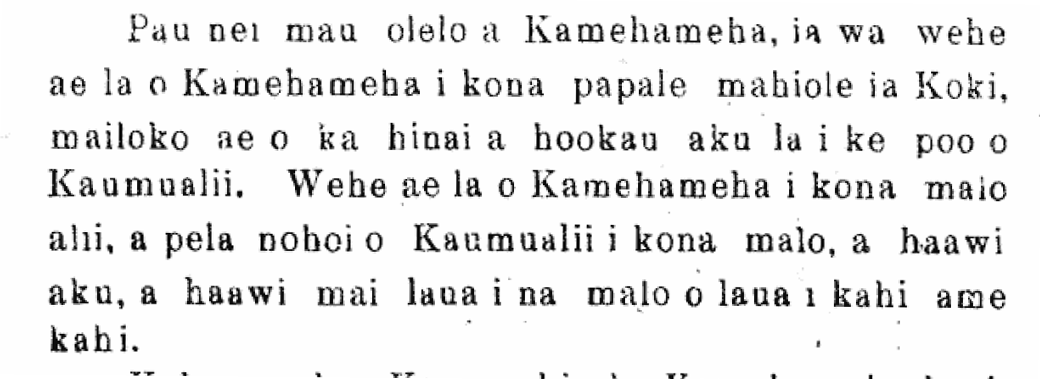
After these words of Kamehameha’s were over, he then took his mahiole, Koki, from a basket and placed it upon the head of Kaumualii. Kamehameha removed his royal malo and so too did Kaumualii remove his malo, and they exchanged them with each other.

[This account is from the meeting of Kamehameha and Kaumualii. It is just a tiny excerpt of the kind of awesome information available in the story of Kamehameha I translated by Kamaoli Kuwada, Emalani Case, and Beau Bassett, slated to come out from Kamehameha Publishing. I can’t wait.

I was informed that this priceless feathered object from the past is indeed being cared for amongst the many other antiquities at the Bernice Pauahi Bishop Museum.]

(Na’i Aupuni, 9/14/1906, p. 1)

HE MOOLELO NO KAMEHAMEHA I.

Ka Na’i Aupuni, Buke II, Helu 88, Aoao 1. Sepatemaba 14, 1906.

Z. P. K. Kawaikaumaiikamakaokaopua’s treatise on canoe building, 1922.

CANOE BUILDING AND ITS CHARACTERISTICS.

(Written by Z. P. K. Kawaikaumaiikamakaokaopua.)

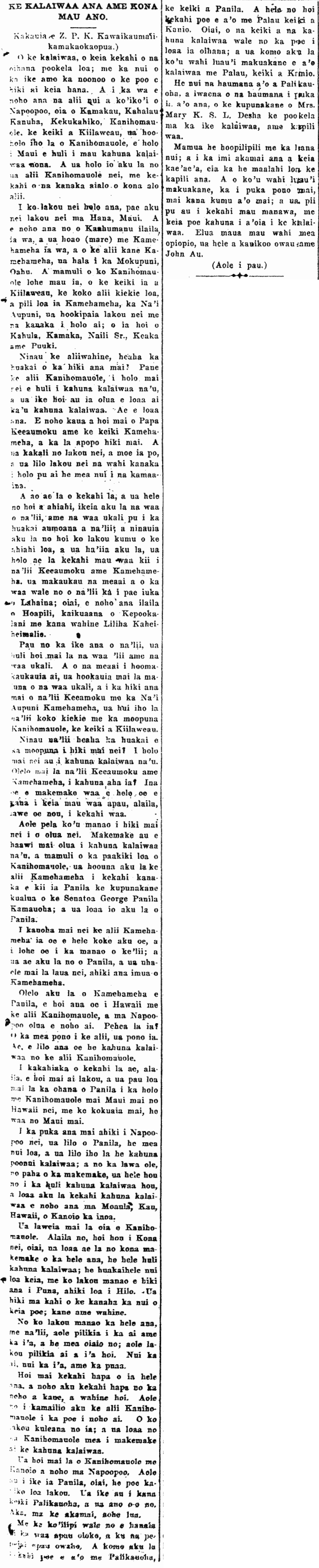
Canoe building is one of the greatest trades; it is with great knowledge and thought that this is done. And when the important high chiefs of Napoopoo were living, they being Kamakau; Kahalau; Kanuha; Kekukahiko; and Kanihomauole, the son of Kiilaweau; Kanihomauole decided to go to Maui in search of a number of canoe building kahuna for himself. And that alii Kanihomauole did indeed go with some attendants from his royal court.

When they went, they landed at Hana, Maui. Kaahumanu was there living at the time, and was married (hoao) with Kamehameha, who was away on Oahu. And because it was heard often that Kanihomauole was the child of Kiilaweau, the alii of highest blood, and that he was kin to Kamehameha, the Conqueror of the Nation, they were welcomed along with those who came, they being Kahula, Kamaka, Naili Sr., Keaka and Puuki.

The queen asked, “why have you come?” The alii Kanihomauole replied, “I have come in search of a kahuna kalaiwaa for myself, and I have come to see the two of you to get my kahuna kalaiwaa.” “Yes, you will have one. Let us remain until Papa Keeaumoku and the boy Kamehameha returns; they will be back tomorrow.” And they waited, and spent the night, and those that came were treated well by the kamaaina of the place.

[This is how the piece on canoes by Kalokuokamaile begins on 10/26/1922, and it continues on in the Kuokoa until 2/15/1923. This is one of the many priceless translations appearing in the Bernice Pauahi Bishop Museum’s Hawaiian Ethnographic Notes (HEN) Collection.  HEN: Newspapers, October 26, 1922.

Kalokuokamaile was very prolific. This series is then followed by yet another, this time on net making!]

(Kuokoa, 10/26/1922, p. 7)

KE KALAIWAA ANA AME KONA MAU ANO.

Ka Nupepa Kuokoa, Buke LXI, Helu 43, Aoao 7. Okatoba 26, 1922.

Paaiea Pond, part 4 and final, from the pen of J. W. H. Isaac Kihe, 1914.

SOME STORIED LANDS OF KONA

Written for the Hoku o Hawaii by ka Ohu Haaheo i na Kuahiwi Ekolu¹

PAAIEA POND

Meeting with Kolomu’o and Pahinahina.

When the flames subsided, the fire disappeared, and this is why it was assumed it was the fire of the Uau Bird Catchers in the Mountains.

In the middle of that night, the lava emerged and flowed like water below a crater on the side of a peak called Kileo, and it is black, shiny pahoehoe that remains there to this day. And from there the lava dove down and resurfaced makai side and several deep fissures cracked open and remain near the village that Mr. Maguire lives at.

The lava dropped down again and on the makai side of the old road there opened up a small furrow six (6) feet wide, and from here the lava began to flow and overran everything before it.

Villages were destroyed and some people died as victims to the wrath of the Goddess of the crater, because of the denial of Pele by that Konohiki [Kepaalani] which the Alii [Kamehameha I] stationed to oversee all of his wealth. And when the Konohiki saw the lava burning everything and turning into pahoehoe and gorging away, he finally realized that the old lady was Pele that appeared before him asking for fish, palu, and then shrimp, and he regretted this filled with dread and great fear. Continue reading

Paaiea Pond, part 3, from the pen of J. W. H. Isaac Kihe, 1914.

SOME STORIED LANDS OF KONA

Written for the Hoku o Hawaii by ka Ohu Haaheo i na Kuahiwi Ekolu¹

PAAIEA POND

Meeting with Kolomu’o and Pahinahina.

When the woman left that place at the seaside of Kaelehuluhulu, she arrived in the uplands of Keoneeli, a place that is renown to this day called Kepuhiapele [‘the scorching of Pele’], a heap of aa lava that is almost 200 Feet high, downside of the place where J. A. MaGuire [known also as Keoni Kaimana] is living.

When the woman arrived there, there were two girls named Kolomu’o and Pahinahina broiling breadfruit, while the parents were away farming. This was a huge town during those days, with many people living there. When the woman met up with the girls broiling ulu. The woman said, “The ulu that you are cooking is done.” One of the girls responded, “We are cooking ulu, but it is not totally done.”

The woman went on, “When you ulu is cooked, who will partake of it first?” “La’i, my god, will eat first.” “So La’i is a powerful akua?” “Yes, La’i is powerful.” The name of this girl was Kolomu’o, and the area beneath that scorching of Pele is famous to this day and called Kolomu’o, and famous too is the Opelu fishing shrine [Ko’a] at the beach of Kaupulehu.

Then the woman asked the other girl, Pahinahina, “And when your ulu is done, who is it for?” “It is for Pele Honuamea, my god.” “Then it is our ulu; your ulu is cooked, let the two of us partake in it.” Pahinahina agreed, and the ulu was peeled [makikoe²] and eaten up. Continue reading