Desecration of heiau, 1917.

A Terribly Mischievous Act.

The great heiau, Hikiau, which is near the sands of Kealakekua, is being cleaned up, and while this cleaning was being done, the people working found some burial caves and in them were neatly placed human bones. They were arranged nicely and the mouths of the caves were closed over with rocks; the shocking thing is that the rocks were later removed and the caves were entered perhaps to be searched for antiquities, or perhaps to desecrate the bones in the caves, and the rocks were piled up inside by some unknown person. The perpetrator of such mischief is not known, however if the culprit is found, there is a stiff punishment established here for those who desecrate the bones of the dead. The grounds of this heiau were cleaned up because the history of this heiau includes the landing of Captain Cook here, and it will become an attraction for those visiting Hawaii nei. Also cleaned up was the pathway to the small heiau where Henry Opukahaia was taught the old ways of the kahuna of Hawaii nei, and this place will become a place visited by world travellers who come to Hawaii nei.

[The early years of Hoku o Hawaii (including the issue which includes this article) have yet to be put up online.]

(Hoku o Hawaii, 2/1/1917, p. 1)
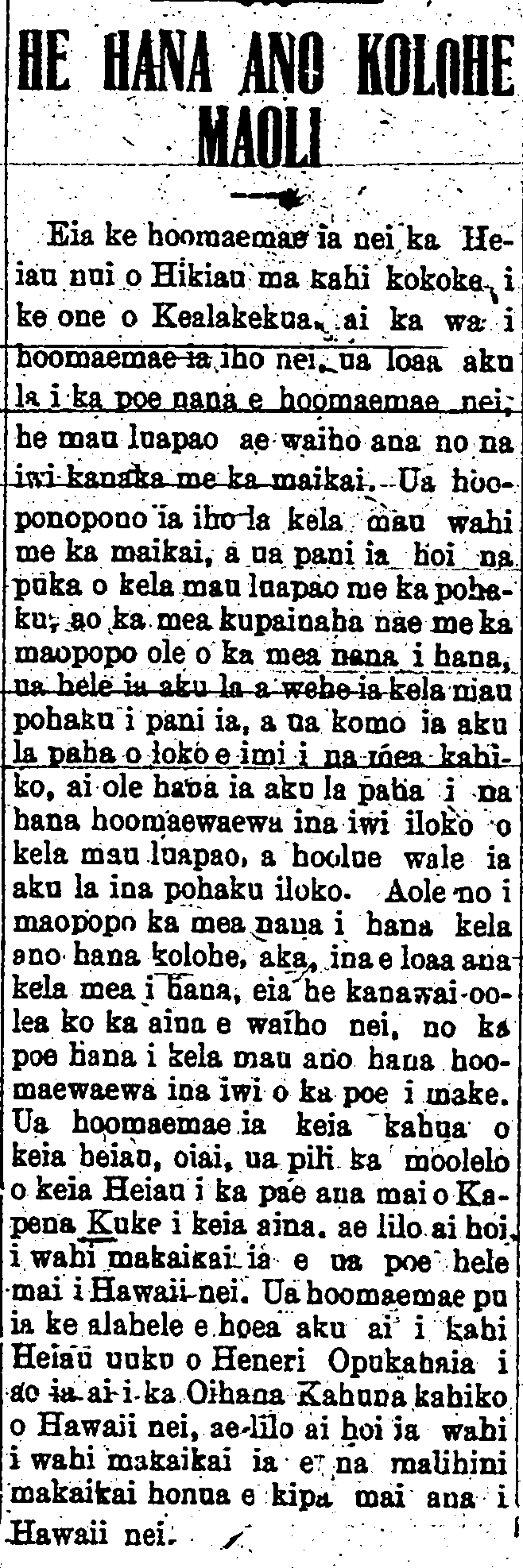
HE HANA ANO KOLOHE MAOLI

Ka Hoku o Hawaii, Buke 11, Helu 36, Aoao 1. Feberuari 1, 1917.
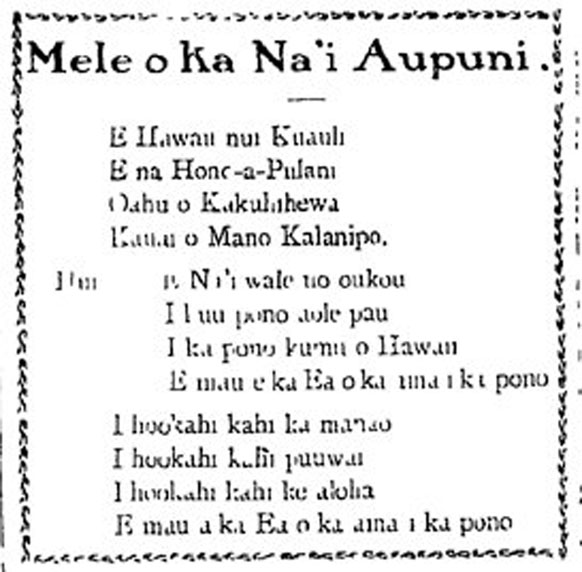
Song for Ka Na’i Aupuni, Kamehameha Paiea, 1909.

Mele o Ka Na’i Aupuni.

E Hawaii nui Kuauli
E na Hono-a-Piilani
Oahu o Kakuhihewa
Kauai o Mano Kalanipo.

Hui:  E Na’i wale no oukou
I kuu pono aole pau
I ka pono kumu o Hawaii
E mau e ka Ea o ka aina i ka pono.

I hookahi kahi ka manao
I hookahi kahi puuwai
I hookahi kahi ke aloha
E mau a ka Ea o ka aina i ka pono

[This was printed for Kamehameha Day 105 years ago! See also an earlier publication of a variant of this mele from Aloha Aina, 8/21/1897.]

(Kuokoa Home Rula, 6/11/1909, p. 1)

Mele o Ka Na'i Aupuni.

Kuokoa Home Rula, Buke VII, Helu 24, Aoao 1. Iune 11, 1909.


Fancy typesetting, 1874.

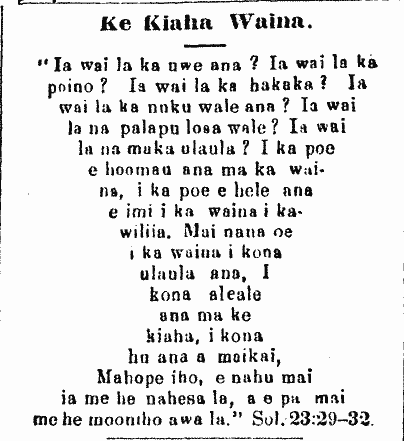
The Wine Glass.

“Who hath woe? who hath sorrow? who hath contentions? who hath babbling? who hath wounds without cause? who hath redness of eyes?  They that tarry long at the wine; they that go to seek mixed wine. Look not thou upon the wine when it is red, when it giveth his colour in the cup, when it moveth itself aright.At the last it biteth like a serpent, and stingeth like an adder.” Proverbs 23:29–32.

(Kuokoa, 8/8/1874, p. 4)

Ke Kiaha Waina.

Ka Nupepa Kuokoa, Buke XIII, Helu 32, Aoao 4. Augate 8, 1874.

More on George Glendon and Samoa, 1890.

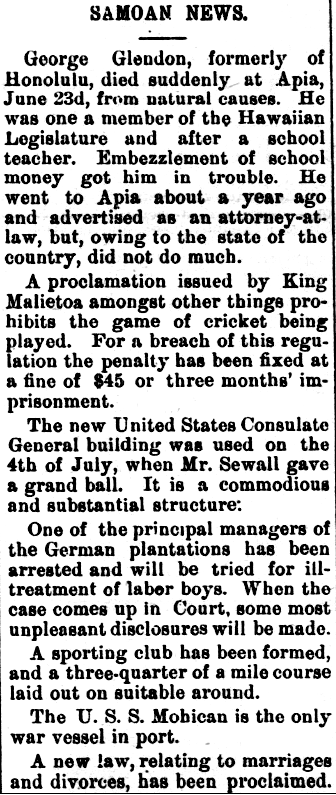
SAMOAN NEWS.

George Glendon, formerly of Honolulu, died suddenly at Apia, June 23d, from natural causes. He was one a member of the Hawaiian Legislature and after a school teacher. Embezzlement of school money got him in trouble. He went to Apia about a year ago and advertised as an attorney-at-law, but, owing to the state of the country, did not do much.

A proclamation issued by King Malietoa amongst other things prohibits the game of cricket being played. For a breach of this regulation the penalty has been fixed at a fine of $45 of three months’ imprisonment.

The new United States Consulate General building was used on the 4th of July, when Mr. Sewall gave a grand ball. It is a commodious and substantial structure.

One of the principal managers of the German plantation has been arrested and will be tried for ill-treatment of labor boys. When the case comes up in Court, some most unpleasant disclosures will be made.

A sporting club has been formed, and a three-quarter of a mile course laid out on suitable around.

The U. S. S. Mohican is the only war vessel in port.

A new law, relating to marriages and divorces, has been proclaimed.

(Pacific Commercial Advertiser, 7/28/1890, p. 2)

SAMOAN NEWS.

Pacific Commercial Advertiser, Volume XII, Number 23, Page 2. July 28, 1890.


Letters from Samoa, 1889.

Malietoa Arrives in Samoa!

Three-thousand Go to Meet Him with Gifts!
Important Correspondences!

Apia, Upolu, Samoa.

July 23, 1889.

John S. Kukahiko,

Much aloha between us.

I arrived on the 18th of June and am doing well.

Before I left Honolulu on the 7th of June, I went to your place often, thinking that perhaps we would meet one final time, but you weren’t at your place.

I’ve seen what’s new here and I have gone with Hairama Kaumialii to see the battlegrounds here in Samoa. All of their actions are admirable; they are a fearless people and true warriors. They are a loving and kind people. These are the most comely people I’ve seen throughout the world.

Each morning the King Mataafa attends Catholic Mass nearby where I live. And when he attends mass, he is accompanied by his fearless warriors very prepared, carrying weapons and firearms. They are very cautious [?? lili] in their protection of him; there is no enemy who is able to abduct him, lest he be abused.

The German and British warships are here in the port of Apia, but the Germans cannot try once again wage war and take him captive. Mataafa has fine features, and when he goes to pray, he and his guards are a magnificent sight to see. He is well regarded by the haole and his own people.

On the 22nd of this month, the American Consul and Admiral Kimberly bestowed upon him gifts from the President of the United States for them helping the Americans in Apia in the recent terrible storm. The Counsul and Admiral Kimberly gave speeches, and Mataafa gave a short reply which was printed in the newspaper, “Samoan Times.”

I’ve met fequently with Hairam Kaumialii, but where he lives is twelve miles away from here, in Malie. Continue reading

Hawaiians deported from Samoa, 1891.

Hawaiians From Samoa

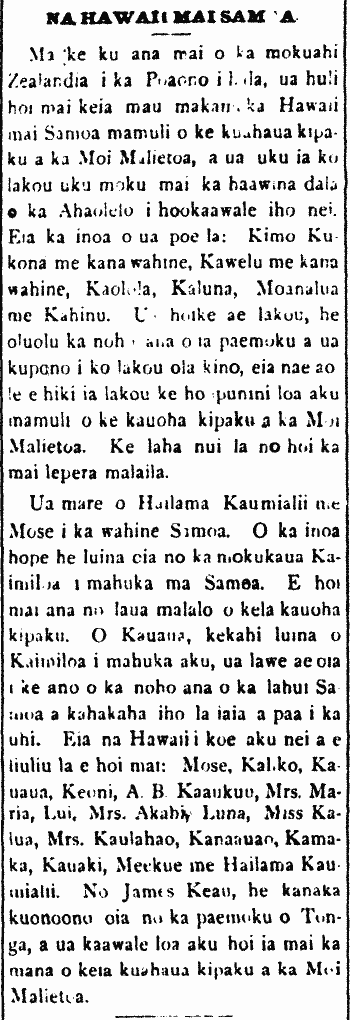
Aboard the steamship Zealandia which landed this past Saturday, these Hawaiian friends came back from Samoa due to the deportation proclamation by King Malietoa, and their passage was paid for by funds from the Legislature which was set aside. Here are their names: Kimo Kukona and wife, Kawelu and wife, Kaolola, Kaluna, Moanalua, and Kahinu. They said that life in those islands was comfortable, and suitable for the health, but they could not stay long because of King Malietoa’s deportation order. There is much leprosy spreading there.

Hairama Kaumialii and Mose wed Samoan wives. The latter named is a sailor on the Kaimiloa who abandoned ship at Samoa. They both will return under the deportation law. Kauaua, a sailor from the Kaimiloa who fled, assimilated to the Samoan way of life, and is covered in a tattoo. These are the Hawaiians who remained and are preparing to return: Mose, Kaliko, Kauaua, Keoni, A. B. Kaaukuu, Mrs. Maria, Lui, Mrs. Akahi, Luna, Miss Kalua, Mrs. Kaulahao, Kanaauao, Kamaka, Kauaki, Meekue, and Hailama Kaumialii. As for James Keau, he is well off, living in the islands of Tonga, and is far from the authority of this expulsion order by King Malietoa.

[If some of my posts look familiar to some of you, they are being reposted from my old Hoolaupai Facebook page. They cannot be easily found on that page, and that was one of the major reasons for starting this one. Here at least i can do tags and categories, and hopefully that makes them easier to find. Google also does a pretty good job of making them searchable!]

(Kuokoa, 1/17/1891, p. 2)

NA HAWAII MAI SAMOA

Ka Nupepa Kuokoa, Buke XXX, Helu 3, Aoao 2. Ianuari 17, 1891.

Kamehameha boys graduate, 1917.

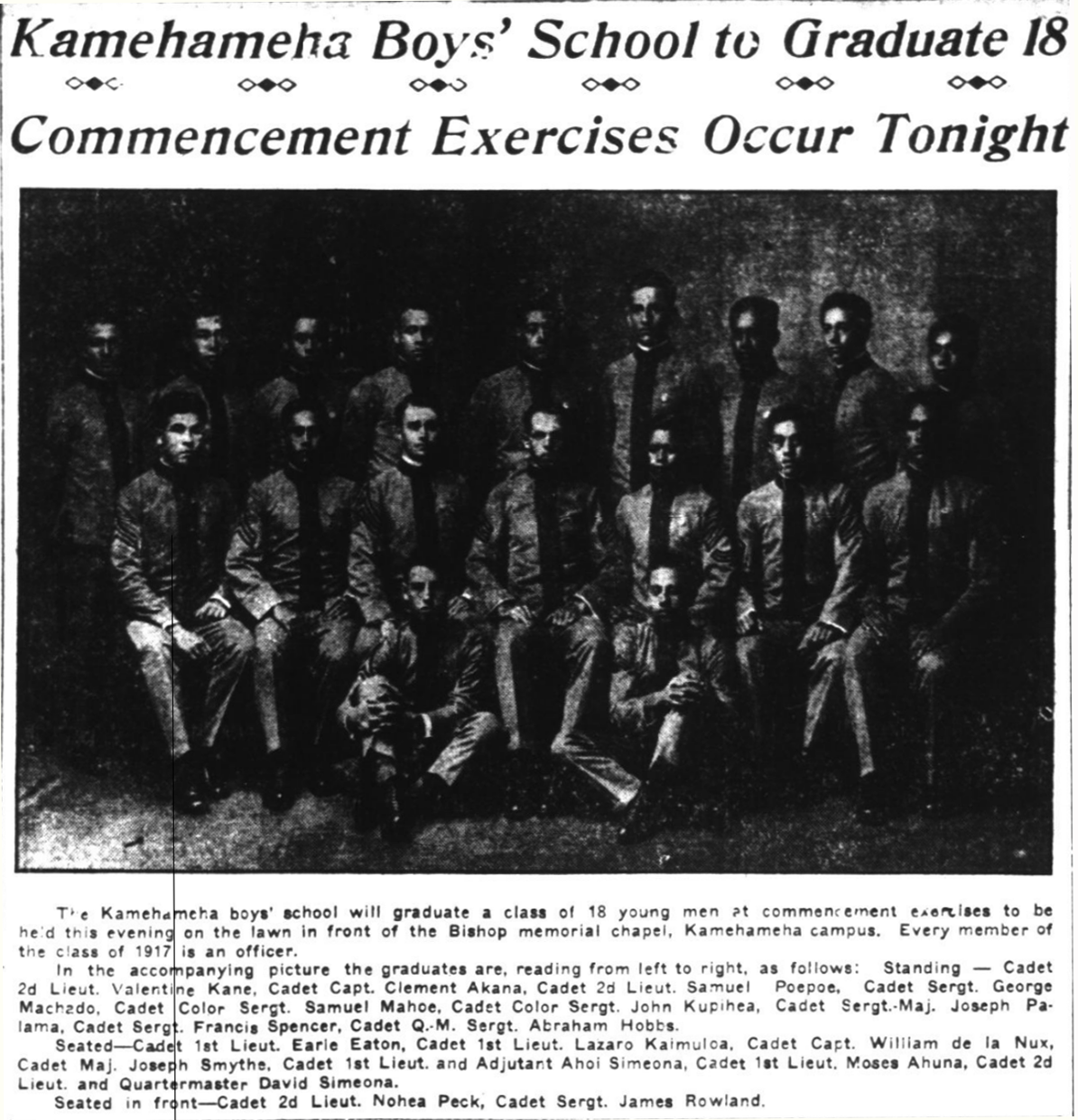
Kamehameha Boys’ School to Graduate 18 Commencement Exercises Occur Tonight

The Kamehameha boys’ school will graduate a class of 18 young men at commencement exercises to be held this evening on the lawn in front of the Bishop memorial chapel, Kamehameha campus. Every member of the class of 1917 is an officer.

In the accompanying picture the graduates are, reading from left to right, as follows: Standing—Cadet 2d Lieut. Valentine Kane, Cadet Capt. Clement Akana, Cadet 2d Lieut. Samuel Poepoe, Cadet Sergt. George Machado, Cadet Color Sergt. Samuel Mahoe, Cadet Color Sergt. John Kupihea, Cadet Sergt.-Maj. Joseph Palama, Cadet Sergt. Francis Spencer, Cadet Q. M. Sergt. Abraham Hobbs.

Seated—Cadet 1st Lieut. Earle Eaton, Cadet 1st Lieut. Lazaro Kaimuloa, Cadet Capt. William de la Nux, Cadet Maj. Joseph Smythe, Cadet 1st Lieut. and Adjutant Ahoi Simeona, Cadet 1st Lieut. Moses Ahuna, Cadet 2d Lieut. and Quartermaster David Simeona.

Seated in front—Cadet 2d Lieut. Nohea Peck, Cadet Sergt. James Rowland.

(Honolulu Star-Bulletin, 6/7/1917, p. 5)

Kamehameha Boys' School to Graduate 18...

Honolulu Star-Bulletin, Volume XXIV, Number 7847, Page 5. June 7, 1917.

First Kamehameha class reunites, 1916.

TWENTY-FIFTH ANNIVERSARY CELEBRATION

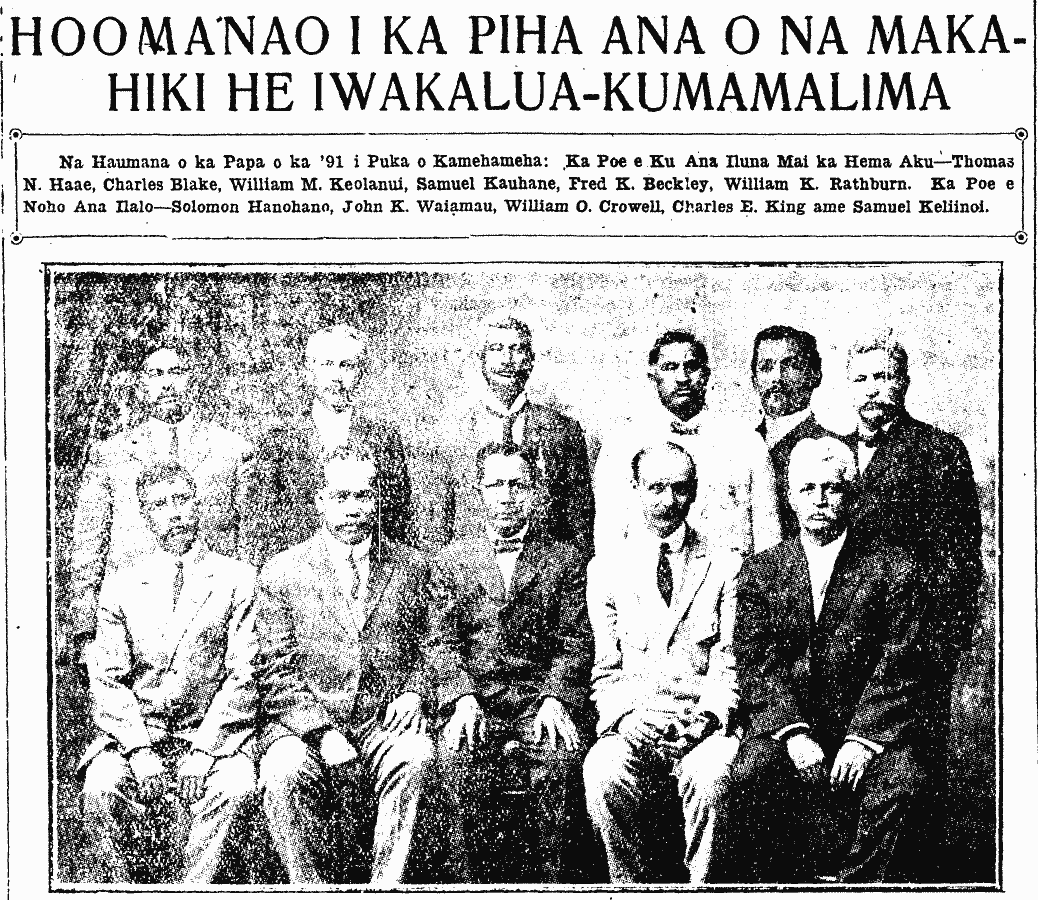
Students of the ’91 Graduate Class of Kamehameha: Those standing from the Left—Thomas N. Haae, Charles Blake, William M. Keolanui, Samuel Kauhane, Fred K. Beckley, William K. Rathburn. Those seated—Solomon Hanohano, John K. Waiamau, William O. Crowell, Charles E. King, and Samuel Keliinoi.

[There are many priceless articles on this reunion; this includes the one that accompanies the picture which can be found here from pages 1 & 3.

It is pretty awesome that we can compare the graduation portrait of the class of 1891 which is on the Kamehameha Schools Archives page with this picture from 25 years later!]

(Kuokoa, 6/16/1916, p. 3)

HOOMANAO I KA PIHA ANA O NA MAKAHIKI HE IWAKALUA-KUMAMALIMA

Ka Nupepa Kuokoa, Buke LIV, Helu 24, Aoao 3. Iune 16, 1916.


The first Kamehameha class celebrates reunion, 1916.

The Alumni Remember

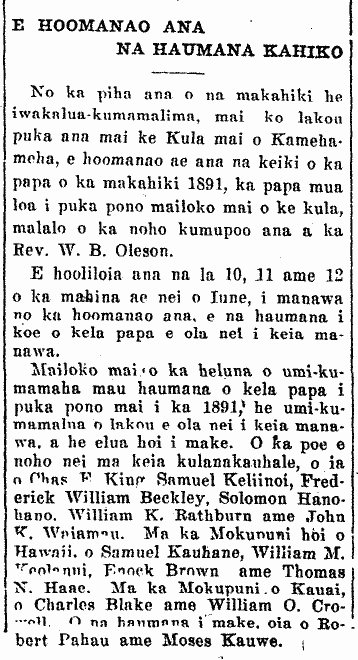
For the 25th anniversary of their graduation from Kamehameha School, the boys of the class of 1891 are looking back; it is the first class that graduated from that school, under the principal Rev. W. B. Oleson.

The 10th, 11th, and 12th of upcoming June will be set aside as time to reflect by the students still alive today.

From within the class of 14 that graduated in 1891, there are 12 of them still living, and two that passed away. Those residing in this town are: Charles E. King, Samuel Keliinoi, Frederick William Beckley, Solomon Hanohano, William K. Rathburn, and John K. Waiamau. On Hawaii island are Samuel Kauhane, William M. Keolanui, Enock Brown [Enoch Brown], and Thomas N. Haae. On Kauai is Charles Blake and William O. Crowell. The students who passed away are Robert Pahau and Moses Kauwe.

(Kuokoa, 5/12/1916, p. 1)

E HOOMANAO ANA NA HAUMANA KAHIKO

Ka Nupepa Kuokoa, Buke LIV, Helu 19, Aoao 1. Mei 12, 1916.

Kamehameha Schools new year, 1947.

Students at Kamehameha

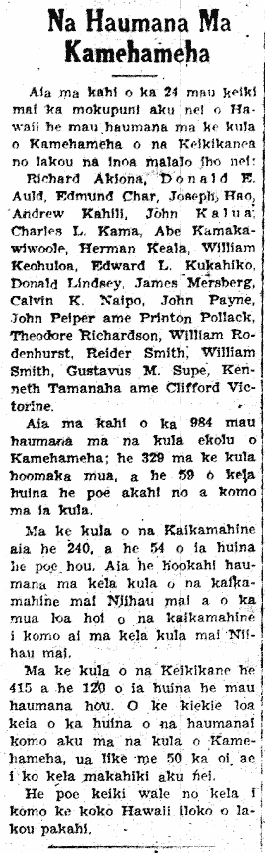
There are 24 children from Hawaii Island who are students at the Boys School, and their names are below:

Richard Akiona, Donald E. Auld, Edmund Char, Joseph Hao, Andrew Kahili, John Kalua, Charles L. Kama, Abe Kamakawiwoole, Herman Keala, William Keohuloa, Edward L. Kukahiko, Donald Lindsey, James Mersberg, Calvin K. Naipo, John Payne, John Peiper and Printon Pollack, Theodore Richardson, William Rondenhurst, Reider Smith, William Smith, Gustavus M. Supe, Kenneth Tamanaha and Clifford Victorine.

There are about 984 students in the three schools of Kamehameha; 329 at the primary school, and 59 of them have entered that school for the first time.

In the Girls’ School, there are 240, and 54 of them are new students. There is one student at the girls’ school from Niihau, and she is the first of the girls to enter that school from Niihau.

In the Boys’ School, there are 415 and 120 are new students. This is the greatest number of students in the schools of Kamehameha; it is 50 more students than the year past.

These are only children who are each of Hawaiian blood.

(Hoku o Hawaii, 10/1/1947, p. 1)

Na Haumana Ma Kamehameha

Ka Hoku o Hawaii, Volume XLI, Number 12, Aoao 1. Okatoba 1, 1947.