C. C. Moreno on missionaries, 1893.

A Misunderstood People.

MORENO ON THE MISSIONARIES.

Editor Post: For several years your public-spirited paper has published correspondence and statements submitted by me about Hawaii in which was foreshadowed the present state of affairs. The revolution which has just taken place is the inevitable result of missionary rule; the long-standing and deep-rooted cause of the unrest.

The missionaries in Hawaii, as in China, Japan, and elsewhere, consider that country as their open hunting grounds, regardless of the rights, customs, wishes, and priviliges of the natives and of stipulations.

I positively know that the self-appointed four chiefs of the Provisional Government in the Hawaiian Islands and the five commissioners coming to Washington to negotiate a treaty of annexation are, without a single exception, missionariesʻ confederates. Not a single native Hawaiian is with them, therefore, they cannot be considered as the representatives of the Hawaiian nation, of which they are aliens and enemies, but only as the emissaries of one side (or of a higher), which is not the right side.

The truth about Hawaiian affairs has never reached the State Department and that is the reason why, in the department, the knife has always been taken by the blade instead of by the handle in dealing with the Hawaiian question.

The United States always sent third rate politicians as ministers and consult to Honolulu, hence the erroneous information about Hawaii. I have on the spot studied Hawaii and the Hawaiians, their troubles with the missionaries of all creeds, and when distant from the islands I have kept an uninterrupted correspondence with the leaders of the Hawaiian nation, such as the Hons. Wilcox, Bush, Testa, Kaai, Kapena, Kaunamano, Kimo Pelekane [James I. Dowsett], and others.

My views on the Hawaiian question I explained at length to President Hayes and Secretary of State Evarts, to President Cleveland and to Assistant Secretary of State Porter: later, to Senator Morgan and to Congressman McCreary, and these are the statesmen that ought to dispose of the Hawaiian question and render justice to the weak, ill-treated, honest, and generous Hawaiian people that have been continually misrepresented, misjudged, and grossly wronged.

In accordance with the good order of things the coming self-appointed and self-styled Hawaiian commissioners, with more appearance than substance, should not be received by the United States authorities, because their self-attributed mission to Washington is based only upon selfish and malignant motives.

This will be a good opportunity for the great people of the United States to show their sentiment for fair play and generosity toward the unfortunate, harmless, friendly, and oppressed Hawaiian people, worthy of sympathy and of help in this their hour of national distress.

Celco Cæsar Moreno.

(Liberal, 2/25/1893, p. 2)

A Misunderstood People.

The Liberal, Volume I, Number 48, Page 2. February 25, 1893.

As it was then it is now. 1893 / 2013.

HE LEI NO KA POE ALOHA AINA.

Kaulana na pua a Hawaii
Kupaa mahope o ka Aina
Hiki mai ka Elele a ka lokoino
Palapala anunu me ka pakaha
Pane mai Hawaii Nui a Keawe
Kokua na Hono a Piilani
Kakoo mai Kauai o Mao
Pau pu me ke one o Kakuhihewa
Aole e kau kuu pulima
Maluna o ka pepa a ka Enemi
Aole makou e minamina
I ka puu kala a ke Aupuni
Ua ola makou i ka pohaku
I ka ai kamahao a ka Aina
Hoohui Aina kuai hewa
I ka pono Kiwila a o ke kanaka
Mahope makou o Liliulani
A kau hou ia i ke Kalaunu
Haina ia mai ana ka puana
No ka poe i Aloha i ka Aina.

A LEI FOR THE PATRIOTS.

Famous are the blossoms of Hawaii
Who stand steadfast behind the Land
When the evil-hearted Messengers arrives
With their documents of greed and plunder
Great Hawaii of the Chief Kakuhihewa answers
The Bays of the Chief Piilani assists
Kauai of the Chief Manokalanipo gives support
Along with the sands of the Chief Kakuhihewa
I will not affix my signature
Upon the paper of the Enemy¹
We will not feel longing
For the sums of money from the Government
We live on the rocks
On the amazing food of the Land
[Annexing and selling wrongfully
The Civil rights of the people]
We stand behind Liliulani
Her Crown shall be placed back upon her
Let the refrain be told
Of the people who Love the Land.

Miss Kekoaohiwaikalani,
Puahaulani Hale,
Honolulu, Feb. 10, 1893.

As a result of the many requests we received to reprint the mele of the Patriots, we are fulfilling your desire; and this is a totally accurate copy of this Mele gotten from the Lady who composed this mele.

[This mele was indeed printed many times in the Hawaiian-Language Newspapers, attesting to its importance. It is just as important today, 120 years since, if not more so!]

¹It appears that the bracketed lines were misplaced and should follow here. …or perhaps not, as it appears in basically this same form three years later: Aloha Aina, Buke III, Helu 24, Aoao 4. Iune 13, 1896. “E Nana Mai i ke Mele.”

(Leo o ka Lahui, 5/16/1893, p. 3)

HE LEI NO KA POE ALOHA AINA.

Ka Leo o ka Lahui, Buke II, Helu 706, Aoao 3. Mei 16, 1893.

More on the landing of the Boston, 1893.

OPPOSED.

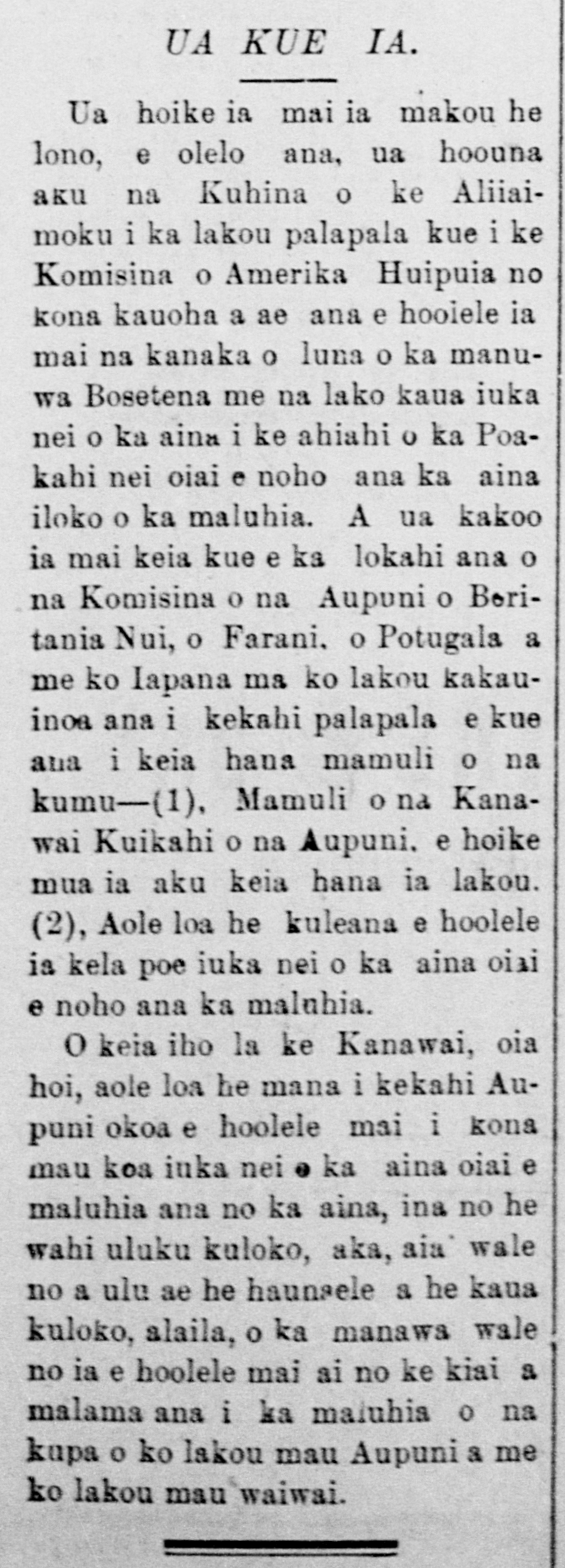
We have received news that the Ministers of the Queen sent their written protest to the Minister of the United States for his ordering the landing of the armed men from the man-of-war Boston on the evening of this Monday notwithstanding that there was peace on land. And this objection was jointly supported by the Commissioners of the Nations of Great Britain, France, Portugal, and Japan, by them signing a document opposing this action over these reasons—(1), Because of the agreement under law between the Nations to give prior notice. (2),  There was no cause to land the troops being that there was peace.

This is the Law, that being there is no other Nation that has any right to land its troops while there is peace; were there internal problems, but only if there was an uprising or a civil war, only then could there be troops landed to watch over and protect the safety of their citizens as well as their property.

(Hawaii Holomua, 1/18/1893, p. 3)

UA KUE IA.

Hawaii Holomua, Buke III, Helu 141, Aoao 3. Ianuari 18, 1893.

More on the Boston, 1893.

[Excerpt from the article: “OVERTHROW IN HAWAII NEI: The Queen Attempts to Push a New Constitution”]

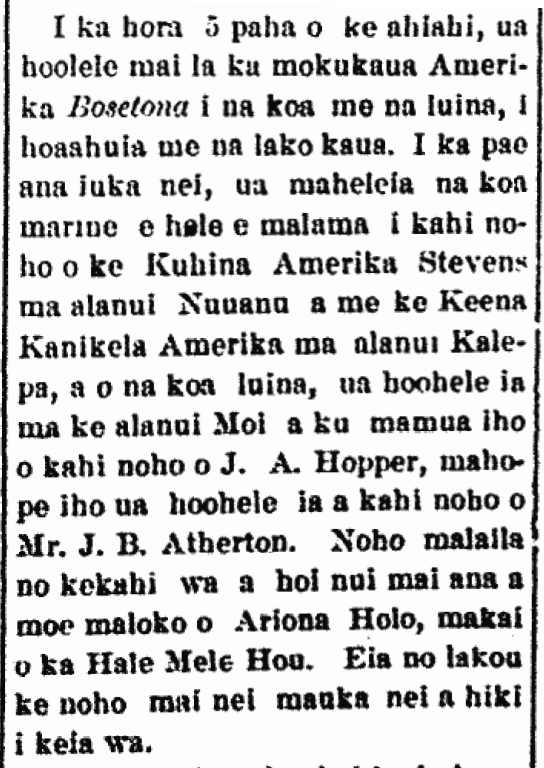
At perhaps 5 oʻclock in the afternoon, the American warship Boston [Bosetona] landed its officers and sailors who were armed. When they came ashore, the marines were split up to go and guard the residence of the American Minister Stevens on Nuuanu Avenue, and the American Consulate on Merchant Street, and the sailors were sent to King Street and stood before the residence of J. A. Hopper, and later they were sent to the residence of Mr. J. B. Atherton. They stayed there for some time, and then all came back and slept in Arion Hall [Ariona Holo] makai of the Opera House. They are still on shore to the present.

(Kuokoa, 1/21/1893, p. 2)

I ka hora 5 paha o ke ahiahi...

Ka Nupepa Kuokoa, Buke XXXII, Helu 3, Aoao 2. Ianuari 21, 1893.

Coverage of the landing of the USS Boston, 1893.

The American Troops Come Ashore.

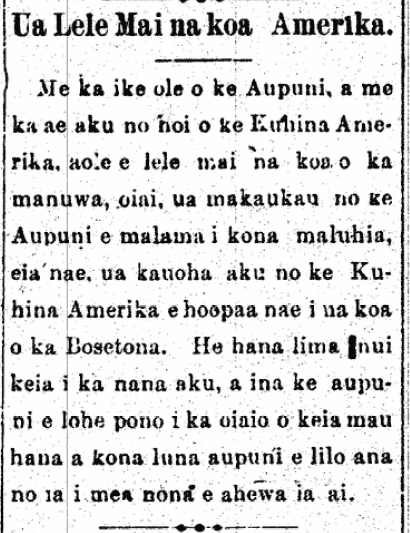
Without knowledge of the Government, and regardless of the agreement of the American Minister that the soldiers from the warship would not come ashore, being that the Government was prepared to uphold the peace; the American Minister ordered the soldiers of the Boston to to take control. This is an apparent act of aggression, and if that nation learns of the truth of this act by its official, it will be grounds for him to be condemned.

[This article and the following are coverage of the landing of the U. S. S. Boston 120 years ago today by different newspapers. Just as we see today, back then there was different coverage depending on what you read.]

(Leo o ka Lahui, 1/17/1893, p. 2)

Ua Lele Mai na koa Amerika.

Ka Leo o ka Lahui, Buke II, Helu 624, Aoao 2. Ianuari 17, 1893.

Display of power by the American battleship, 1893.

THE PARADING

OF THE
American Battleship Soldiers.

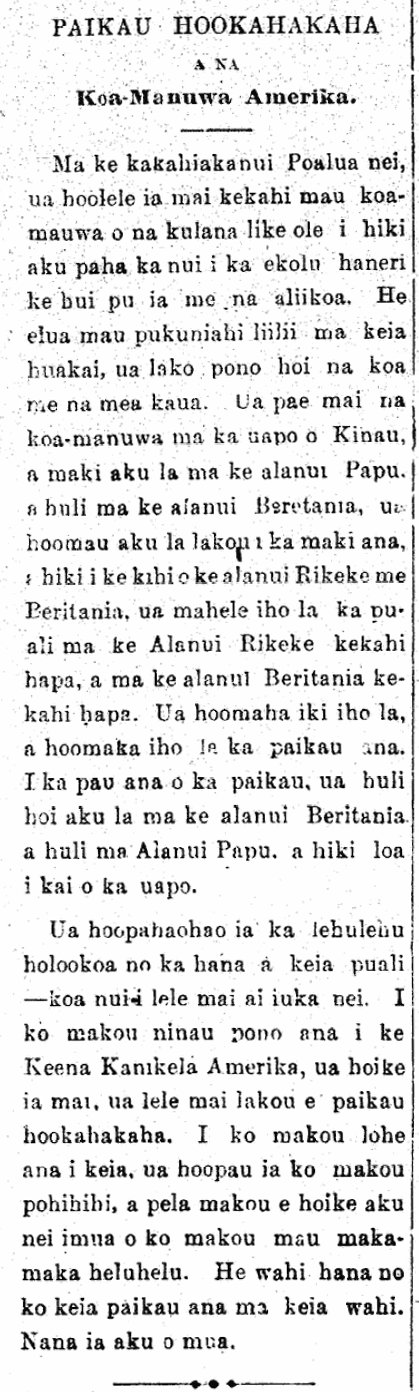
In the early morning of this Tuesday, some of the soldiers of all ranks from the warship were sent ashore, perhaps numbering three hundred when combined with the officers. There were two small cannons in this parade, and the soldiers were armed with weapons. The soldiers from the battleship landed at Kinau Wharf [uapo o Kinau], and marched on Fort Street and turned on Beritania where they continued marching until Richards and Beritania; the troops divided: some travelled on Richards Street and some on Beritania Street. They rested for a while, and then proceeded to drill. After drilling, they went back on Beritania Street and turned on Fort, until reaching the wharf.

Everyone was left puzzled by this action of the great number of the troops who came to shore. When we asked the Office of the American Consul directly, we were told that they landed to parade. When we heard this, our confusion was cleared, and so we report to our reader friends. The drilling here is part of their job. Let’s see what happens in the future.

(Leo o ka Lahui, 10/25/1893, p. 3)

PAIKAU HOOKAHAKAHA

Ka Leo o ka Lahui, Buke II, Helu 798, Aoao 3. Okatoba 25, 1893.

Workings of the Provisional Government, 1893.

INDEPENDENCE DAY OF THE PORTUGUESE.

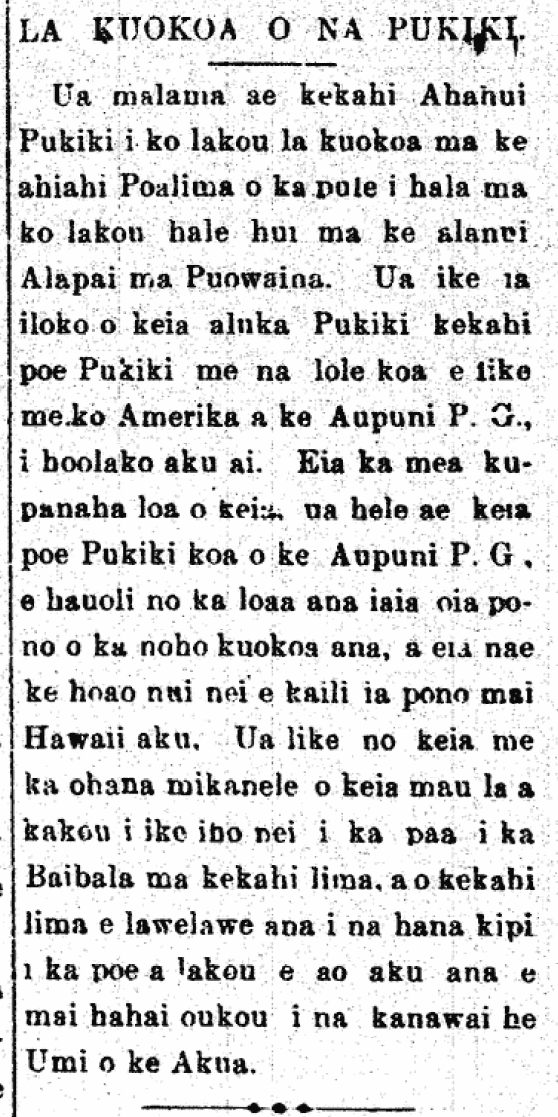
An Association of the Portuguese honored their independence day on the evening of Friday last week, in their club house on the streets of Alapai and Punchbowl [Puowaina]. Amongst this group of Portuguese were seen some with soldier uniforms like that of the Americans that were supplied by the P. G. This is the astonishing thing about this: these Portuguese soldiers of the Government of the P. G. went to celebrate their independence, and yet they are insistently trying to wrench that right from Hawaii. This is like the missionary family of these days who we’ve seen holding the Bible in one hand while with the other hand, carrying out treachery to the people to whom they taught not to break the Ten laws of God.

(Leo o ka Lahui, 12/4/1893, p. 2)

LA KUOKOA O NA PUKIKI.

Ka Leo o ka Lahui, Buke II, Helu 826, Aoao 2. Dekemaba 4, 1893.

Always important to look at sources. 1893 / 2012.

HAWAII ESCAPES FROM JAPAN.

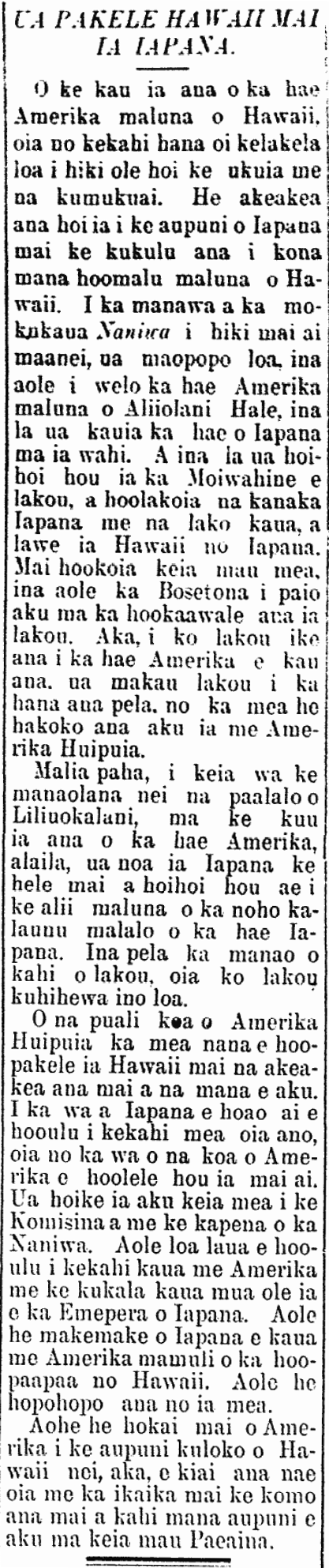
The raising of the American flag over Hawaii is one of the greatest things done that cannot be repaid. It blocks the nation of Japan from establishing its rule over Hawaii. When the warship Naniwa arrived here, it was clear that if the American flag was not waving over Aliiolani Hale, then the Japanese flag would have been put in its place. And then they would have returned the Queen and the Japanese would have been supplied with weapons and took Hawaii for Japan. It all would have happened if the Boston did not hold them off. But when they saw the American flag raised, they were afraid to do this, for it would be fighting with the United States of America.

Perhaps now Liliuokalani’s attendants are hoping that by the taking down of the American flag, the Japanese will be free to come and return the alii to the throne under the Japanese flag. Should that be the thought of some of them, they are gravely mistaken.

The American troops will save Hawaii from the interference by the other powers. When Japan tries to foment something of that sort, that will be when the soldiers of America will be deployed again. This has been announced to the Commissioner and the captain of the Naniwa. They will not start a war with America without it being proclaimed in advance by the Emperor of Japan. Japan has no desire to war against America because of the dispute over Hawaii. There is nothing to fear.

America will not interfere in the local government of Hawaii nei, however it will guard Hawaii with force against the entering of other national powers into this Archipelago.

[It is always important to look at what newspaper an article comes from. Also, long-running newspapers (and people for that matter) don’t necessarily keep their same ideologies throughout their entire life…]

(Kuokoa, 4/8/1893, p. 2)

UA PAKELE HAWAII MAI IA IAPANA.

Ka Nupepa Kuokoa, Buke XXXII, Helu 14, Aoao 2. Aperila 8, 1893.

One year since the Republic transferred power to the United States, 1899.

THE 12th OF AUGUST.

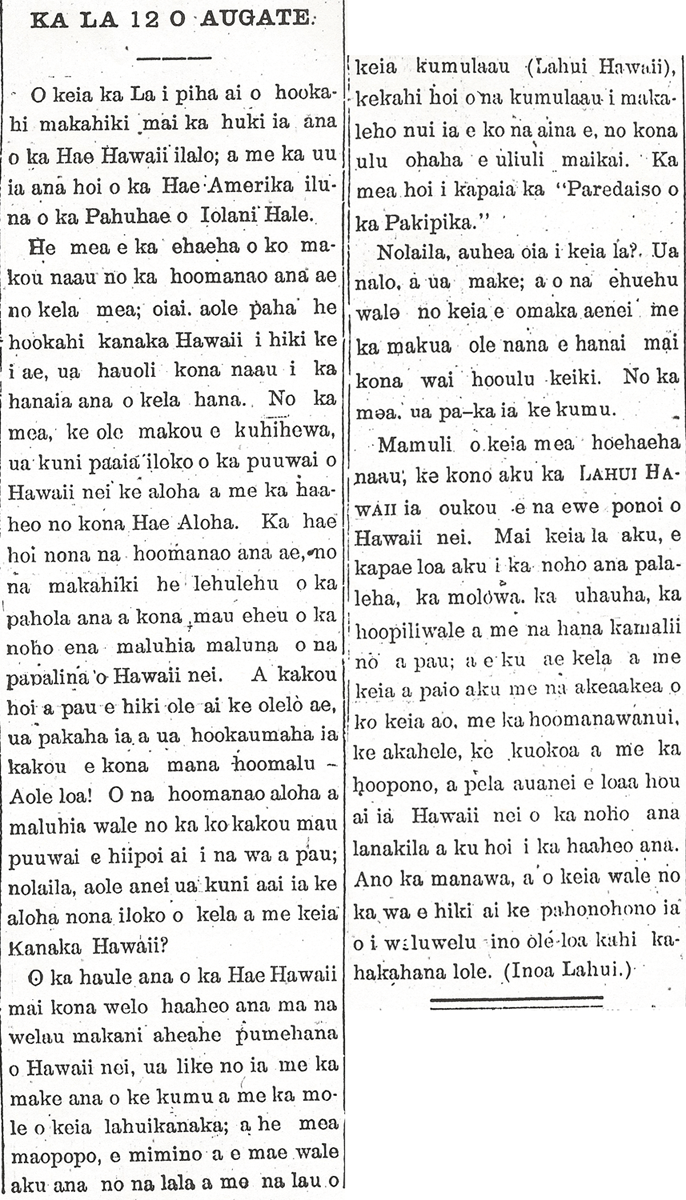
This is the Day that made a year since the day that the Hawaiian Flag was taken down and the American Flag was raised on the flag pole of Iolani Palace.

The hurt down in our guts [naau] is unimaginable when remembering this; for there is no Hawaiian that can say that his naau is happy with what was done. Because if we are not mistaken, branded withing the hearts of Hawaiians is the love and pride for his Beloved Flag. The flag which holds memories of many years spreading its wings in peace over the cheeks of Hawaii nei. And for which none of us can say that we were robbed and saddened under its protection. Not at all! Our hearts will only cherish for all times, the loving memories and peace; and as such, are not each and every Kanaka Hawaii burning with aloha for it?

The falling of the Hawaiian Flag from where it proudly fluttered on the tips of the warm breezes of Hawaii nei, is like the death of origin and foundation of this people [lahuikanaka]; and it is clear that the branches and leaves of this tree (The Hawaiian Nation) will wither and fade, a tree that was greatly admired by other nations for its lush and verdant growth. What was called the “Paradise of the Pacific [Paredaiso o ka Pakipika].”

Therefore, where is it today? It has gone, and died; and it is but the wisps that are budding, without a parent to feed its nourishing waters. For the trunk has been chopped.

Because of this heart-wrenching thing, the Lahui Hawaii invites all of you, native Hawaiians. From this day forward, to discard your living indifferently, lazily, wastefully, off others, and all of your childish ways; and for each and everyone of you to stand and fight against the obstructions in this world with patience, caution, independence, and righteousness; and it is through this that Hawaii nei will once again regain its success and pride. Now is the time, and it is only now that we can do the mending while this striped cloth has not become too ragged. (Inoa Lahui.)

(Lahui Hawaii, 8/12/1899, p. 4)

KA LA 12 O AUGATE.

Ka Lahui Hawaii, Buke 1, Helu 29, Aoao 4. Augate 12, 1899.

Denial of intent to annex Hawaii, 1891.

Annexation.

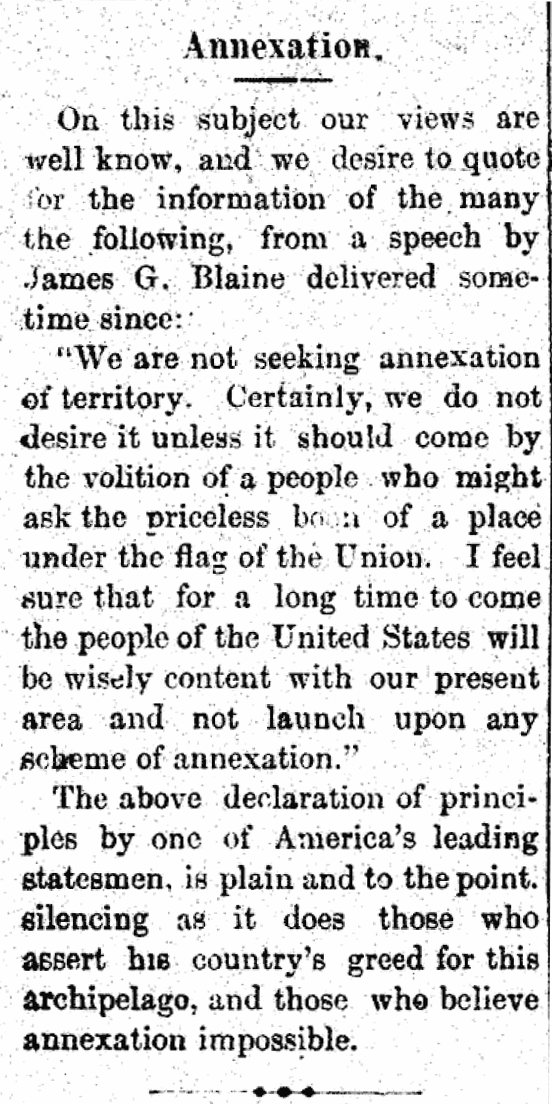
On this subject our views are well known, and we desire to quote for the information of the many the following, from a speech by James G. Blaine delivered sometime since:

“We are not seeking annexation of territory. Certainly, we do not desire it unless it should come by the volition of a people who might ask the priceless boon of a place under the flag of the Union. I feel sure that for a long time to come the people of the United States will be wisely content with our present area and not launch upon any scheme of annexation.”

The above declaration of principles by one of America’s leading statesman is plain and to the point, silencing as it does those who assert his country’s greed for this archipelago, and those who believe annexation impossible.

(Leo o ka Lahui, 9/11/1891, p. 4)

Annexation.

Ka Leo o ka Lahui, Buke II, Helu 278, Aoao 4. Sepatemaba 11, 1891.