Hawaiian Language banned at Lahainaluna and Hawaii to become a state of the United States? 1868.

Hawaiian Banned at

LAHAINALUNA.

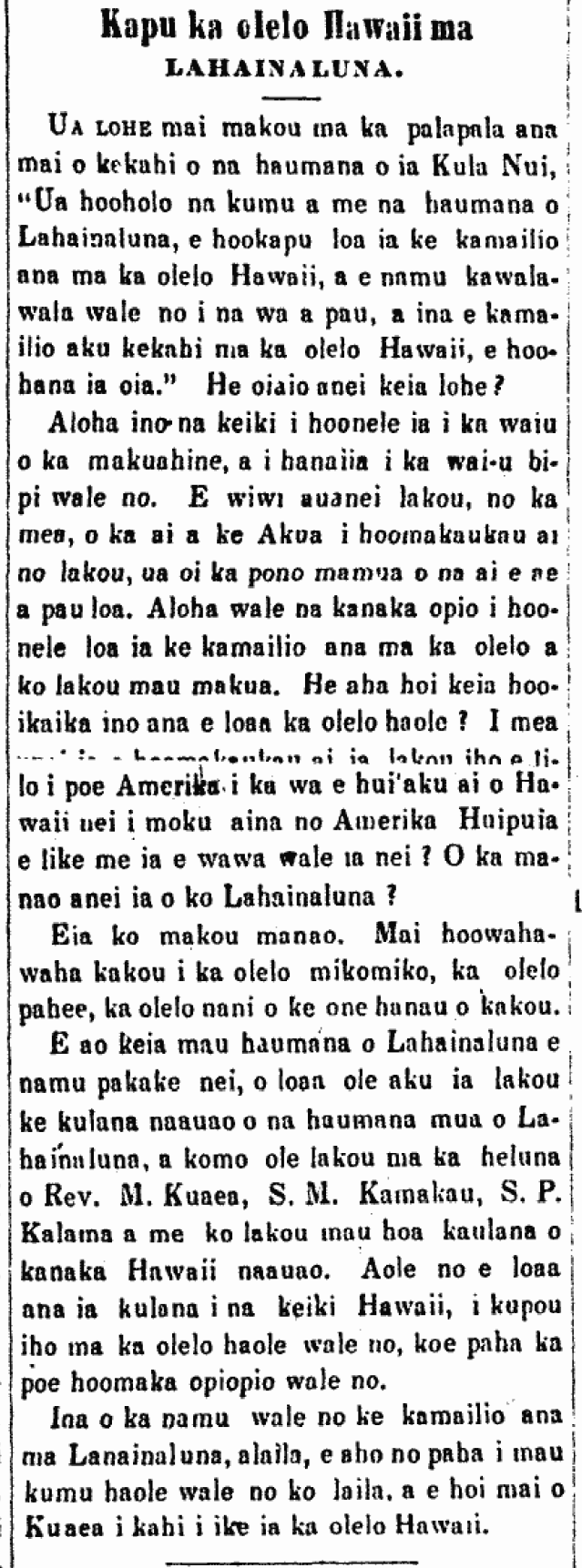
We have heard through a letter from one of the students at the College, “The teachers and students have decided to ban the speaking of Hawaiian, and instead to speak English [namu kawalawala] all the time; and should anyone speak in Hawaiian, he will be made to work.” Is what we hear correct?

How sad for children to be denied their mother’s milk, and fed only cow’s milk. They will end up malnourished, for the nourishment God prepared for them is better than all other foods. How tragic is it for the youth to be denied speaking the language of their parents. What is this big push to acquire the English language [olelo haole]? Is it to prepare them to become Americans when Hawaii joins as a state of the United States as is being rumored about? Is that the idea at Lahainaluna?

This is what we think. Let us not treat with contempt this eloquent language, this graceful language, this beautiful language of our homeland.

These students of Lahainaluna who speak English [namu pakake] will not attain the high education of the early students of Lahainaluna, and they will not join the ranks of Rev. M. Kuaea, S. M. Kamakau, S. P. Kalama, and their fellow famed educated Hawaiians. This level will not be reached by the Hawaiian youth who attempt to speak only English, except perhaps for those who start young.

If only English is spoken at Lahainaluna, then it would be better were there only haole teachers there, and Kuaea should be sent somewhere that Hawaiian Language is recognized.

[Does anyone know if this ban ever took place in the late 1860s?

And what does “S. P.” stand for in “S. P. Kalama”?]

(Kuokoa, 3/7/1868, p. 2)

Kapu ka olelo Hawaii ma LAHAINALUNA.

Ka Nupepa Kuokoa, Buke VII, Helu 10, Aoao 2. Maraki 7, 1868.

Different view of the seal of the republic, 1896.

Great Seal of the Republic of Hawaii.

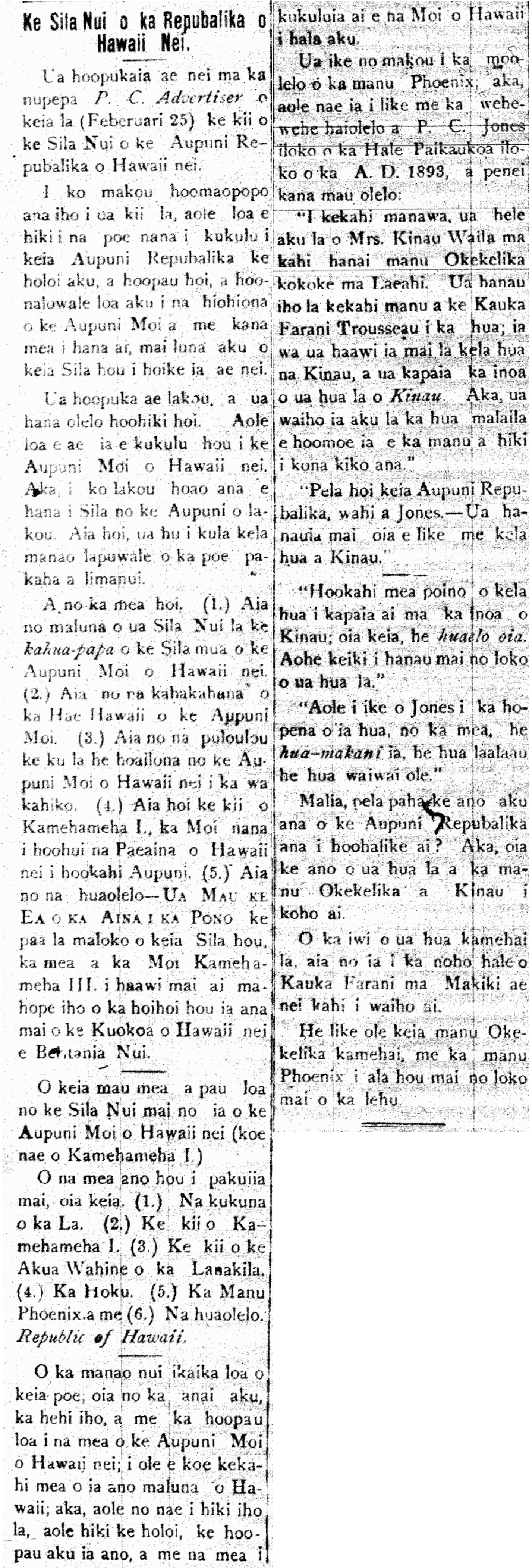
In today’s P. C. Advertiser (February 25), a picture of the Great Seal of the Republic of Hawaii was printed.

By our understanding of that image, there is no way that those who established this Republic can erase or end or eradicate visages of the Monarchy and its accomplishments, from the seal mentioned above.

They stated and vowed that there will be no way that the reestablishment of the Kingdom of Hawaii nei will be allowed. However, when they set out to create a Seal for their Government. And now, that foolish idea of the plunderers and thugs has gone awry.

Being that, (1.) On that Great Seal, is the foundation of the first Seal of the Monarchy of Hawaii nei. (2.) There is the stripes of the Hawaiian Flag of the Monarchy. (3.) There stand puloulou, a symbol of the Hawaiian Monarchy of old. (4.) There is an image of Kamehameha I., the King who unified the Hawaiian Archipelago into one Nation. (5.) There are the words—”Ua Mau ke Ea o ka Aina i ka Pono” affixed onto this new Seal, the words given by King Kamehameha III after the restoration of the Independence of Hawaii nei by Great Britain.

All these things were from the Great Seal of the Monarchy of Hawaii nei (except Kamehameha I.)

The new things added are these. (1.) Rays of the Sun. (2.) The image of Kamehameha I. (3.) The image of the Goddess of Victory. (4.) The Star. (5.) The Phoenix Bird, and (6.) The words, Republic of Hawaii.

Their intense desire is to rub out, to stomp out, and to end for all time, things of the Monarchy of Hawaii nei, lest vestiges of that sort remain in Hawaii; but that is not possible: there is no erasing, nor putting end to deeds done by the past Monarchs of Hawaii.

We know the story of the Phoenix, but it is not the same as the explanatory speech by P. C. Jones at the Armory [Hale Paikaukoa] in the year 1893, and these are his words:

“Once, Mrs. Kinau Wilder [Waila] went to where Ostrich were raised near Diamond Head [Laeahi]. One of the birds of the French Doctor Trousseau laid an egg, and it was on that occasion given to Kinau, and the egg was called Kinau. However, it was left there to be sat on by a bird until it hatched.

“This is similar to this Republic,” according to Jones. “It was born like that egg, Kinau.”

There is one unfortunate thing about that egg called by the name of Kinau, that being, it was a rotten egg [huaelo]. There was no chick born from that egg.

Jones didn’t know of the outcome of that egg, for it was but a yolk-less egg [hua makani], a hua laalaau?, a worthless egg.

Perhaps this will be the outcome of the Republic to which he compares it to? But at any rate, that is the kind of Ostrich egg that Kinau chose.

The shell of that astonishing egg is kept at the residence of Trousseau [Kauka Farani] in Makiki.

This astonishing Ostrich is not the same as a Phoenix which rises from the ashes.

(Aloha Aina, 2/29/1896, p. 4)

Ke Sila Nui o ka Repubalika o Hawaii Nei.

Ke Aloha Hawaii, Buke II, Helu 9, Aoao 4. Feberuari 29, 1896.

Use of tradition for propaganda, 1896.

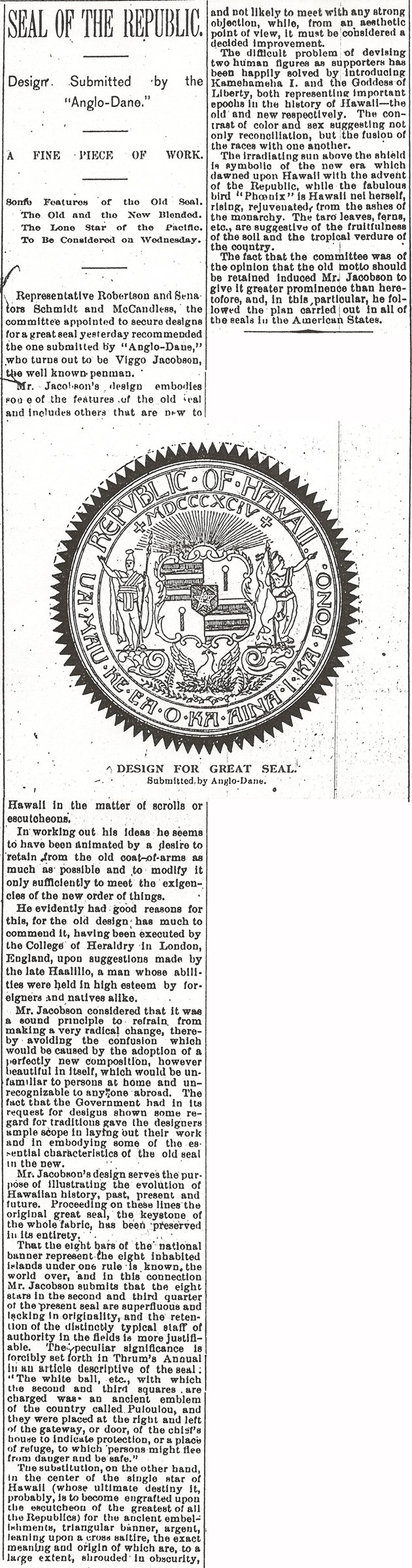
SEAL OF THE REPUBLIC.

Design Submitted by the “Anglo-Dane.”

A FINE PIECE OF WORK.

Some Features of the Old Seal. The Old and the New Blended. The Lone Star of the Pacific. To be Considered on Wednesday.

Representative Robertson and Senators Schmidt and McCandless, the committee appointed to secure designs for a great seal yesterday recommended the one submitted by “Anglo-Dane,” who turns out to be Viggo Jacobson, the well known penman.

Mr. Jacobson’s design embodies some of the features of the old seal and includes others that are new to Hawaii in the matter of scrolls or escutcheons.

In working out his ideas he seems to have been animated by a desire to retain from the old coat-of-arms as much as possible and to modify it only sufficiently to meet the exigencies of the new order of things.

He evidently had good reasons for this, for the old design has much to commend it, having been executed by the College of Heraldry in London, England, upon suggestions made by the late Haalilio, a man whose abilities were held in high esteem by foreigners and natives alike.

Mr. Jacobson considered that it was a sound principle to refrain from making a very radical change, thereby avoiding the confusion which would be caused by the adoption of a perfectly new composition, however beautiful in itself, which would be unfamiliar to persons at home and unrecognizable to anyone abroad. The fact that the Government had in its request for designs shown some regard for traditions gave the designers ample scope in laying out their work and in embodying some of the essential characteristics of the old seal in the new.

Mr. Jacobson’s design serves the purpose of illustrating the evolution of Hawaiian history, past, present and future. Proceeding on these lines the original great seal, the keystone of the whole fabric, has been preserved in its entirety.

That the eight bars of the national banner represent the eight inhabited islands under one rule is known, the world over, and in this connection Mr. Jacobson submits that the eight stars in the second and third quarter of the present seal are superfluous and lacking in originality, and the retention of the distinctly typical staff of authority in the fields is more justifiable. The peculiar significance is forcibly set forth in Thrum’s Annual in an article descriptive of the seal: “The white ball, etc., with which the second and third squares are charged was an ancient emblem of the country called Puloulou, and they were placed at the right and left of the gateway, or door, of the chief’s house to indicate protection, or a place of refuge, to which persons might flee from danger and be safe.”

The substitution, on the other hand, in the center of the single star of Hawaii (whose ultimate destiny it, probably, is to become engrafted upon the escutcheon of the greatest of all the Republics) for the ancient embellishments, triangular banner, argent, leaning upon a cross saltire, the exact meaning and origin of which are, to a large extent, shrouded in obscurity, and not likely to meet with any strong objection, while, from an aesthetic point of view, it must be considered a decided improvement.

The difficult problem of devising two human figures as supporters has been happily solved by introducing Kamehameha I. and the Goddess of Liberty, both representing important epochs in the history of Hawaii—the old and new respectively. The contrast of color and sex suggesting not only reconciliation, but the fusion of the races with one another.

The irradiating sun above the shield is symbolic of the new era which dawned upon Hawaii with the advent of the Republic, while the fabulous bird “Phœnix” is Hawaii nei herself, rising, rejuvenated, from the ashes of the monarchy. The taro leaves, ferns, etc., are suggestive of the fruitfulness of the soil and the tropical verdure of the country.

The fact that the committee was of the opinion that the old motto should be retained induced Mr. Jacobson to give it greater prominence than theretofore, and, in this particular, he followed the plan carried out in all of the seals in the American States.

(Pacific Commercial Advertiser, 2/25/1896, p. 1)

SEAL OF THE REPUBLIC.

The Pacific Commercial Advertiser, Volume XXIII, Number 4234, Page 1. February 25, 1896.

This is some list of names. July 18, 1898.

DAY OF PARDON FOR THE PEOPLE.

Monday, July 18, 1898.

THE PRISONERS ARE FORGIVEN.

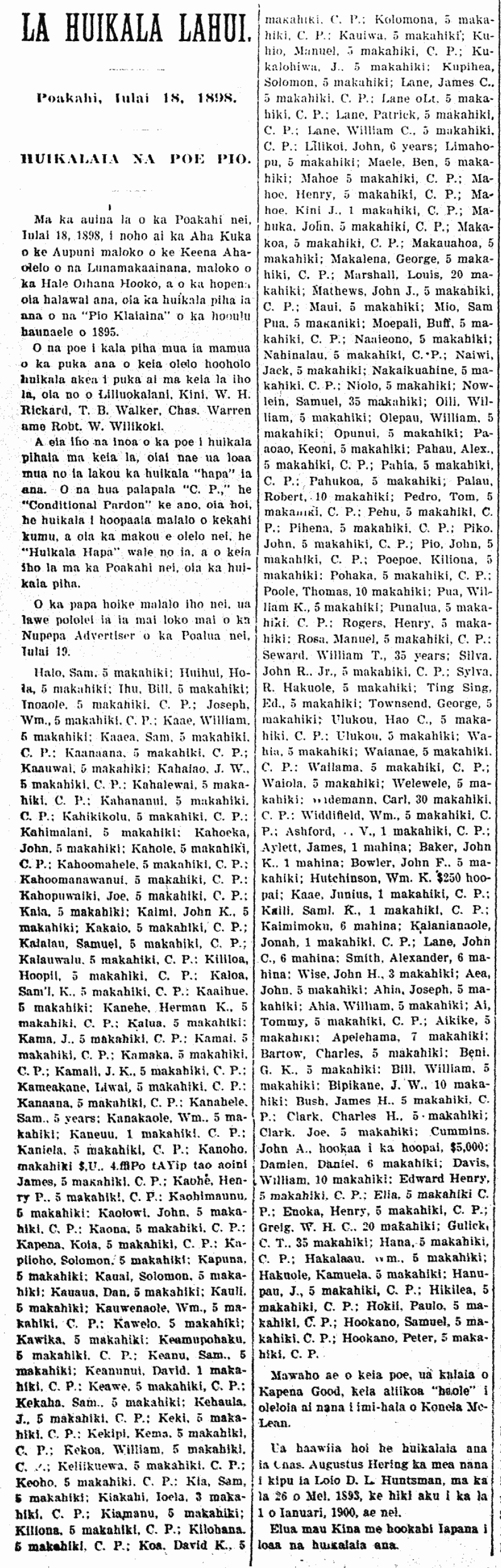
On the afternoon of this Monday, July 18, 1898, the Council of State held session in the Office of the House of Representatives in the Executive Office, and as a result of this meeting, the “Political Prisoners” of the 1895 rebellion [haunaele] were fully pardoned.

Those fully pardoned before the proclamation of this general pardon of the other day, was Liliuokalani, Kini, W. H. Rickard, T. B. Walker, Charles Warren, and Robert W. Wilcox.

Here is the list of those fully pardoned on this day, although they received a partial pardon earlier. The letters “C. P.,” stands for “Conditional Pardon,” meaning that it is a pardon under certain terms, and that is what we are calling just a “Partial Pardon,” but this on the past Monday was a full pardon.

The list below it taken directly from the Advertiser of Tuesday, July 19.

Halo, Sam, 5 years; Huihui, Hola, 5 years; Ihu, Bill, 5 years; Inoaole, 5 years; C. P.; Joseph, William, 5 years, C. P.; Kaae, William, 5 years; Kaaea, Sam, 5 years, C. P.; Kaanaana, 5 years, C. P.; Kaauwai, 5 years; Kahaiao, J. W., 5 years, C. P.; Kahalewai, 5 years, C. P.; Kahananui, 5 years, C. P.; Kahikikolu, 5 years, C. P.; Kahimalani, 5 years; Kahoeka, John, 5 years; Kahole, 5 years, C. P.; Kahoomahele, 5 years, C. P.; Kahoomanawanui, 5 years, C. P.; Kahopuwaiki, Joe, 5 years, C. P.; Kaia, 5 years; Kaimi, John K., 5 years; Kakaio, 5 years, C. P.; Kalalau, Samuel, 5 years, C. P.; Kalauwalu, 5 years, C. P.; Kililoa, Hoopii, 5 years, C. P.; Kaloa, Samuel, K., 5 years, C. P.; Kaaihue, 5 makahiki; Kanehe, Herman K., 5 years, C. P.; Kalua, 5 makahiki; Kama, J., 5 years, C. P.; Kamai, 5 years, C. P.; Kamaka, 5 years, C. P.; Kamali, J. K., 5 years, C. P.; Kameakane, Liwai, 5 years, C. P.; Kanaana, 5 years, C. P.; Kanahele, Samuel, 5 years; Kanakaole, William, 5 years; Kaneuu, 1 year, C. P.; Kaniela, 5 years, C. P.; Kanoho, James, 5 years, C. P.; Kaohe, Henry P., 5 years, C. P.; Kaohimaunu, 5 years; Kaolowi, John, 5 years, C. P.; Kaona, 5 years, C. P.; Kapena, Koia, 5 years, C. P.; Kapiioho, Solomon, 5 years; Kapuna, 5 years; Kauai, Solomon, 5 years; Kauaua, Dan, 5 years; Kauli, 5 years; Kauwenaole, William, 5 years, C. P.; Kawelo, 5 years; Kawika, 5 years; Keamupohaku, 5 years, C. P.; Keanu, Samuel, 5 years; Keanunui, David, 1 year, C. P.; Keawe, 5 years, C. P.; Kekaha, Samuel, 5 years; Kehaula, J., 5 years, C. P.; Keki, 5 years, C. P.; Kekipi, Kema, 5 years, C. P.; Kekoa, William, 5 years, C. P.; Keliikuewa, 5 years, C. P.; Keoho, 5 years, C. P.; Kia, Sam, 5 years; Kiakahi, Ioela, 3 years, C. P.; Kiamanu, 5 years; Kiliona, 5 years, C. P.; Kilohana, 5 years, C. P.; Koa, David K., 5 years, C. P.; Kolomona, 5 years, C. P.; Kauiwa, 5 years; Kuhio, Manuel, 5 years, C. P.; Kukalohiwa, J., 5 years; Kupihea, Solomon, 5 years; Lane, James C., 5 years, C. P.; Lane, Lot, 5 years, C. P.; Lane, Patrick, 5 years, C. P.; Lane, William C., 5 years, C. P.; Lilikoi, John, 6 years; Limahopu, 5 years; Maele, Ben, 5 years; Mahoe, 5 years, C. P.; Mahoe, Henry, 5 years, C. P.; Mahoe, Kini J., 1 year, C. P.; Mahuka, John, 5 years, C. P.; Makakoa, 5 years, C. P.; Makauahoa, 5 years; Makalena, George, 5 years, C. P.; Marshall, Louis, 20 years; Mathews, John J., 5 years, C. P.; Maui, 5 years; Mio, Sam Pua, 5 years; Moepali, Buff, 5 years, C. P.; Naaieono, 5 years; Nahinalau, 5 years, C. P.; Naiwi, Jack, 5 years; Nakaikuahine, 5 years, C. P.; Niolo, 5 years; Nowlein, Samuel, 35 years; Oili, William, 5 years; Olepau, William, 5 years; Opunui, 5 years; Paaoao, Keoni, 5 years; Pahau, Alex., 5 years, C. P.; Pahia, 5 years, C. P.; Pahukoa, 5 years; Palau, Robert, 10 years; Pedro, Tom, 5 years, C. P.; Pehu, 5 years, C. P.; Pihena, 5 years, C. P.; Piko, John, 5 years, C. P.; Pio, John, 5 years, C. P.; Poepoe, Kiliona, 5 years; Pohaka, 5 years, C. P.; Poole, Thomas, 10 years; Pua, William, K., 5 years; Punalua, 5 years, C. P.; Rogers, Henry, 5 years; Rosa, Manuel, 5 years, C. P.; Seward, William T., 35 years; Silva, John R., Jr., 5 years, C. P.; Sylva, R. Hakuole, 5 years; Ting Sing, Ed., 5 years; Townsend, George, 5 years; Ulukou, Hao C., 5 years, C. P.; Ulukou, 5 years; Wahia, 5 years; Waianae, 5 years, C. P.; Wailama, 5 years, C. P.; Waiola, 5 years; Welewele, 5 years; Widemann, Carl, 30 years, C. P.; Widdifield, William, 5 years, C. P.; Ashford, V. V., 1 year, C. P.; Aylett, james, 1 month; Baker, John K., 1 month; Bowler, John F., 5 years; Hutchinson, William K., $250 fine; Kaae, Junius, 1 year, C. P.; Kaili, Samuel K., 1 year, C. P.; Kaimimoku, 6 months; Kalanianaole, Jonah, 1 year, C. P.; Lane, John C., 6 months; Smith, Alexander, 6 months; Wise, John H., 3 years; Aea, John, 5 years; Ahia, Joseph, 5 years; Ahia, William, 5 years; Ai, Tommy, 5 years, C. P.; Aikike, 5 years; Apelehama,  7 years; Bartow, Charles, 5 years; Beni, G. K., 5 years; [Bertleman, H. F., 35 years;] Bill, William, 5 years; Bipikane, J. W., 10 years; Bush, James H., 5 years, C. P.; Clark, Charles H., 5 years; Clark, Joe, 5 years; Cummins, John A., fine payed, $5,000; Damien, Daniel, 6 years; Davis, William, 10 years; Edward, Henry, 5 years, C. P.; Elia, 5 years, C. P.; Enoka, Henry, 5 years, C. P.; Greig, W. H. C., 20 years; Gulick, C. T., 35 years; Hana, 5 years, C. P.; Hakalaau, William, 5 years; Hakuole, Kamuela, 5 years; Hanupau, J., 5 years, C. P.; Hikilea, 5 years, C. P.; Hokii, Paulo, 5 years, C. P.; Hookano, Samuel, 5 years, C. P.; Hookano, Peter, 5 years, C. P.;

Outside of these people, Captain Good, that “haole” officer who is said to have sought to discredit Colonel McLean, was pardoned.

Also pardon was granted to Charles Augustus Hering, the one who shot Lawyer D. L. Huntsman, on the 26th of May, 1893, when the 1st of January, 1900 arrives.

Two Chinese and one Japanese were pardoned [Akoi Akanu, Lum Sing, and Yakoyama? Yokoyama?].

(Kuokoa, 7/22/1898, p. 8)

LA HUIKALA LAHUI.

Ka Nupepa Kuokoa, Buke XXXVII, Helu 29, Aoao 8. Iulai 22, 1898.

Crown Lands and Government Lands, 1896.

GOVERNMENT LANDS.

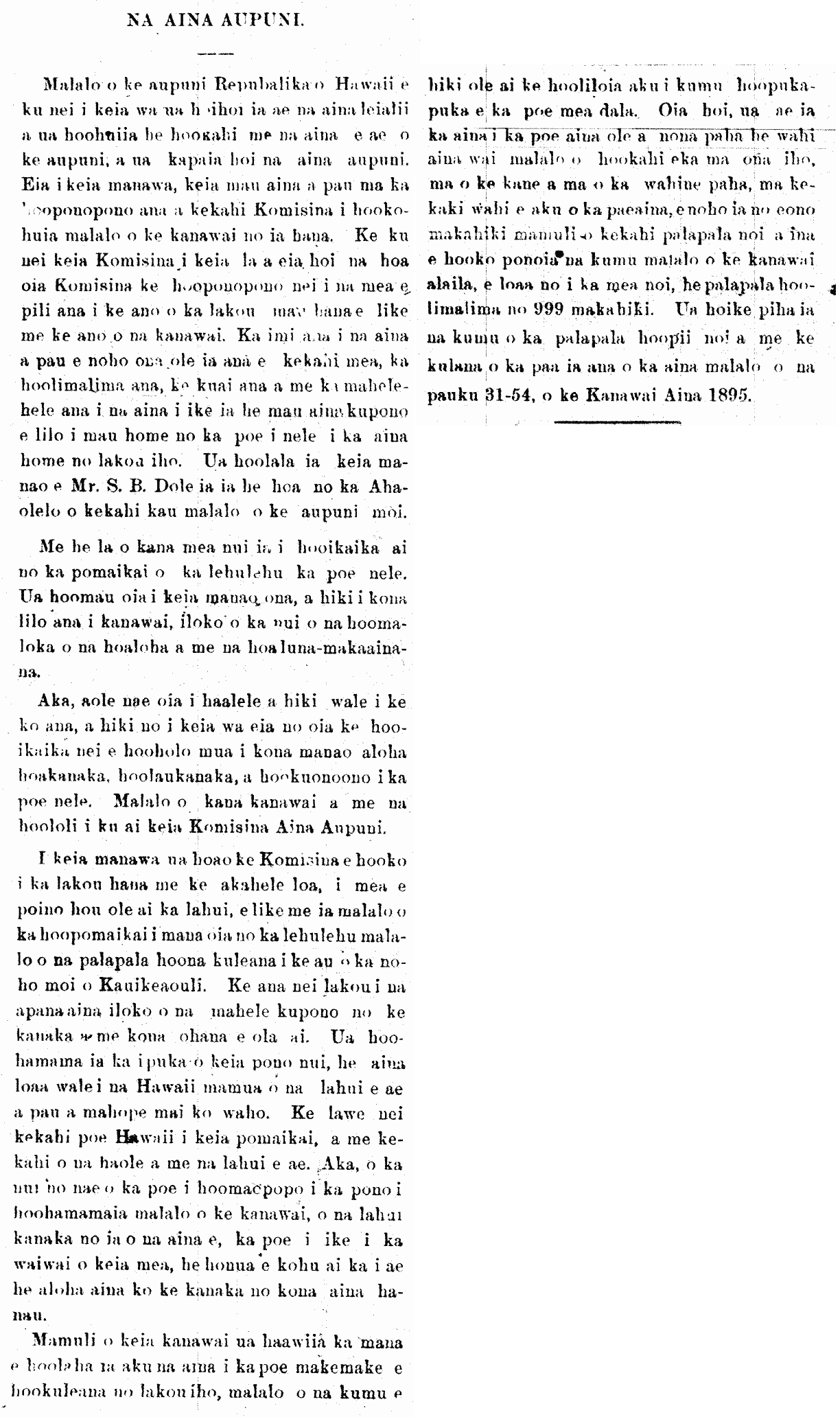
Under the Republic of Hawaii that stands now, the crown lands have been returned and added with the other lands of the government, and are referred to as government lands. Currently, the entirety of these lands are under the authority of a Commission appointed for that purpose under the law. The Commission is active today and its members are putting into order matters that pertain to their duties as per the laws. The finding of all lands that are not to be owned by someone, as well as the leasing, selling, and dividing of lands that are recognized as lands fitting to be homes for people without homesteads for themselves. This idea was devised by Mr. S. B. Dole while he was a member of the Legislature for a session under the monarchy.

It seems that this was what he focused on, for the good of those without. He kept at this idea until it became law, amidst much skepticism by friends and fellow representatives.

But he did not relent until he succeeded, and now he is working to move forward his loving idea for his fellow man, to increase, and to make prosperous, the poor people. Under his law and its revisions, this Government Lands Commission was created.

At this time, the Commission is trying to carefully carry out their duties so that the lahui will not once again be hurt like under the benefits intended for the masses with the quiet land titles in the time of Kauikeaouli’s rule. They are surveying parcels from areas suited for a man and his family to live. The doors to this great right is opened and Hawaiians will receive land before all other ethnicities and then thereafter those from the outside. There are some Hawaiians taking advantage of this opportunity, along with some haole and other ethnicities. But the majority of those that know of the good offered up by this law are the people of foreign lands, the ones who know the value of land for which one is able to say that he is patriotic to the land of his birth.

By this law, power is give to advertise land to those who claim land for themselves, under the condition that they cannot use it for profit. The land is available to those without land or those with wetlands of less than an acre under his name, or under the husband or wife in some other area of the archipelago; they will live on the land for six years after the request for land and should they meet the qualifications under the law, the applicant will receive a lease or 999 years. The requirements for the application and stipulations of the lease are shown in full in sections 31–54 of the Land Act of 1895.

[Just as it is today, it was back then. Different newspapers and sources had different stances. It is perhaps not best thing to base your opinions on a single article or the words of a single person. It is important to try and see all that was written and handed down in other ways (for ink and paper is not necessarily the best way that information is passed down), and then decide what you think on the subject…

Oh, and see here for the Land Act of 1895.]

(Oiaio Puka La, 4/3/1896, p. 2)

NA AINA AUPUNI.

Ka Oiaio Puka La, Buke I, Helu 67, Aoao 2. Aperila 3, 1896.

True Hawaiian? 1893.

True Hawaiian.

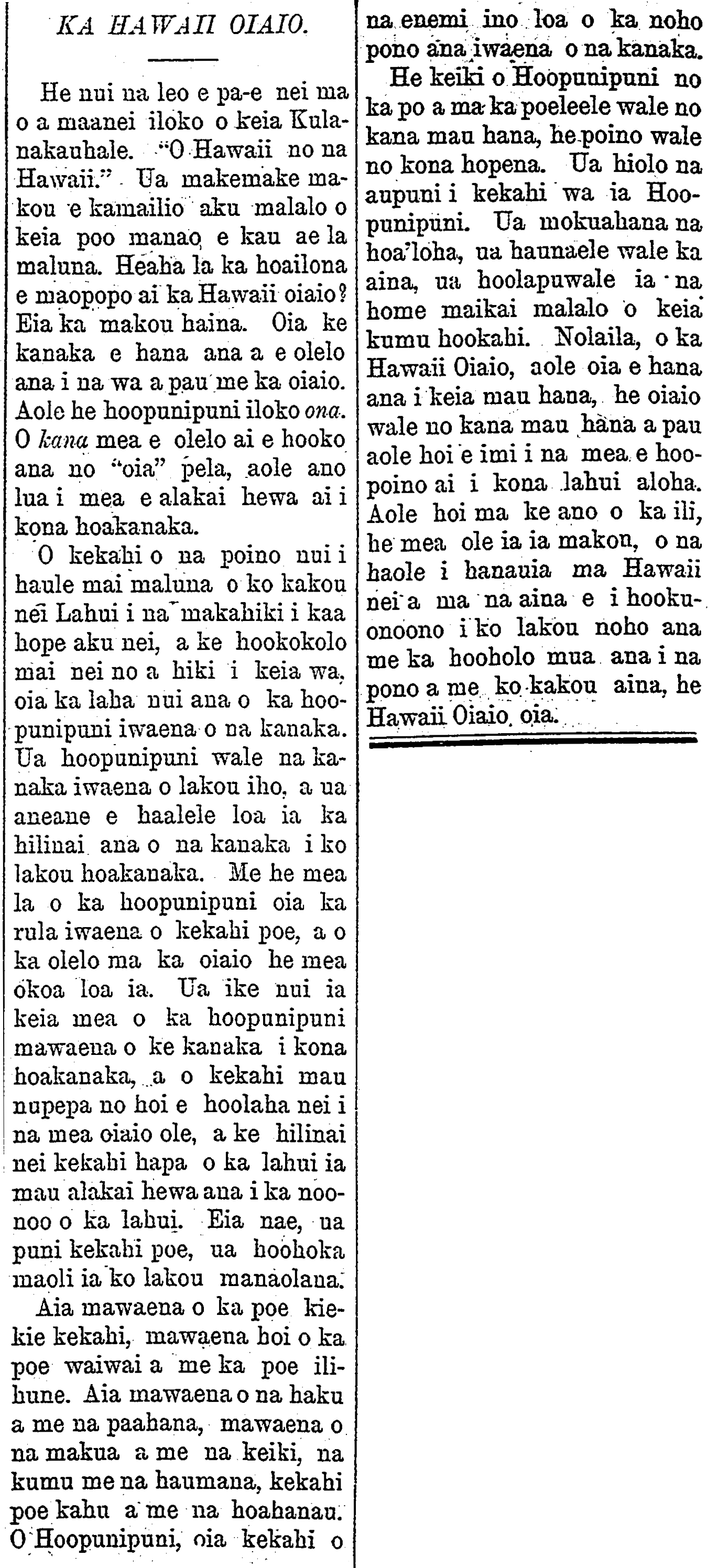
There are many voices ringing out here and there in this Town. “Hawaii for Hawaiians.” We wish to discuss the topic above. What in the world are the signs that distinguish a true Hawaiian? This is our answer. It is a person who acts and speaks at all times in truth. He has no falsehood within him. What he says, he follows through on, and does not speak to mislead his fellow man.

One of the great misfortune which fell upon our Lahui these past years, and creeps on to the present, is the rampant promulgation of lies amongst the people. People tell falsehoods amongst themselves, and it is almost to the point where people have lost faith their fellow man. It is as if lying is the norm with some people, and telling the truth is something terribly odd. This telling of falsehoods is often seen among people to his fellow man, and some newspapers are spreading things that are not true; and a part of the lahui believes this misleading of the minds of the lahui. And still some people were taken by it, and their hopes dashed.

Amongst the prominent people, amongst the rich and the poor. Amongst the bosses and the laborers, amongst the parents and the children, the instructors and students, some pastors and church members. Falsehood is the most vile enemy of righteous living amongst people.

Falsehood is the spawn of night, and it only works in darkness, and misfortune is its outcome. During some ages, nations have fallen to Falsehood. Friends have been torn apart, the land grew tumultuous, and good homes became retched, all because of this one reason. Therefore, the True Hawaiian does not act in such a manner, he only acts truthfully, and he does not seek to cause harm his own beloved lahui. It is not skin color, that means nothing to us; those haole born in Hawaii nei  and elsewhere who prosper while moving well-being and our land forward, he is a True Hawaiian.

[Notice that this editorial came out soon after the overthrow, and was in response to the many articles anticipating the return of the crown.

There were many types of Hawaiian-Language Newspaper owners and editors as well, and it is important to understand the slant of a paper when reading its articles. It is important also to remember that a newspaper might not always have the same goals and objectives throughout its existence, especially if its leadership changes. J. U. Kawainui was editor and J. K. Iosepa was assistant editor of the Daily Kuokoa when this article appeared.

This is one of those papers that are not available online yet (images or text). Also, they are not available at the usual places on microfilm. Hopefully they will be made available soon!]

(Nupepa Puka La Kuokoa me Ko Hawaii Paeaina i Huiia, 3/9/1893, p. 2)

KA HAWAII OIAIO.

Nupepa Puka La Kuokoa me Ko Hawaii Paeaina i Huiia, Buke I, Helu 28, Aoao 2. Maraki 9, 1893.

More donations for the anti-annexation petitions committee, 1898.

LIST OF DONORS

Honolulu, Feb. 26, 1898.

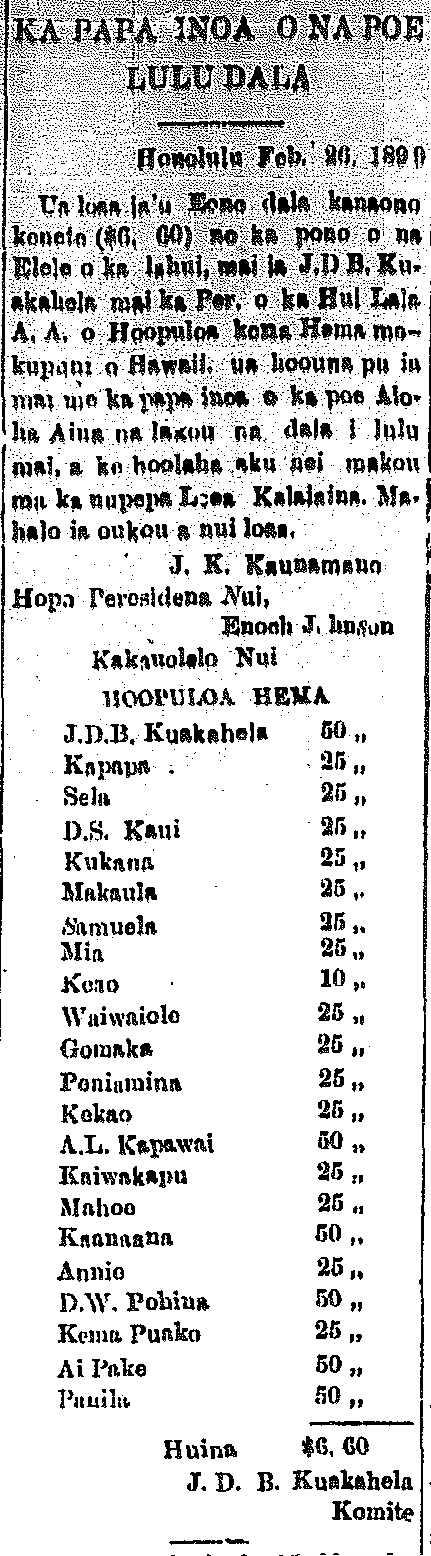
I have Six dollars and sixty cents ($6.60) for the well-being of the Representatives of the nation, from J. D. B. Kuakahela from the Pres. of the Members of the Patriotic League of Hoopuloa, South Kona, Island of Hawaii; it was sent along with a list of names of the Patriots who donated the money, and we are publishing it in the newspaper Loea Kalaiaina. Thank you very much to you all.

J. K. Kaunamano

Vice President,

Enoch Johnson

Head Secretary.

SOUTH HOOPULOA

J. D. B. Kuakahela, 50 ”

Kapapa, 25 ”

Sela, 25 ”

D. S. Kaui, 25 ”

Kukana, 25 ”

Makaula, 25 ”

Samuela, 25 ”

Mia, 25 ”

Keao, 10 ”

Waiwaiole, 25 ”

Gomaka, 25 ”

Peniamina, 25 ”

Kekao, 25 ”

A. L. Kapawai, 50 ”

Kaiwakapu, 25 ”

Mahoe, 25 ”

Kaanaana, 50 ”

Annie, 25 ”

D. W. Pohina, 50 ”

Kema Puako, 25 ”

Ai Pake, 50 ”

Pauila, 50 ”

Total, $6.60

J. D. B. Kuakahela

Committee.

(Loea Kalaiaina, 3/21/1898, p. 3)

KA PAPA INOA O NA POE LULU DALA

Ka Loea Kalaiaina, Buke II, Helu 12, Aoao 3. Maraki 21, 1898.

Donations for the commission carrying the anti-annexation petitions to America, 1898.

OLIVE LEAVES OF ALOHA

FOR THE REPRESENTATIVES

FROM BALDWIN HOME

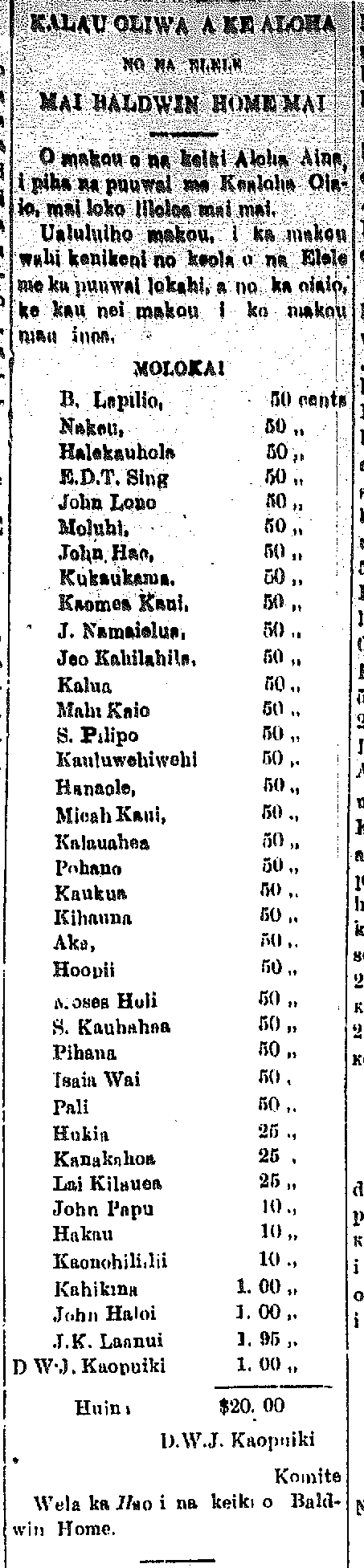
We are the Aloha Aina boys whose hearts are full of true aloha from deep within.

We are donating our few cents for the well-being of the Representatives with unified hearts and to attest to this, we affix our names.

MOLOKAI.

B. Lapilio, 50 cents

Nakeu, 50 ”

Halekauhola, 50 ”

E. D. T. Sing, 50 ”

John Lono, 50 ”

Moluhi, 50 ”

John Hao, 50 ”

Kukaukama, 50 ”

Kaomea Kaui, 50 ”

J. Namaielua, 50 ”

Jeo Kahilahila, 50 ”

Kalua, 50 ”

Mahi Kaio, 50 ”

S. Pilipo, 50 ”

Kauluwehiwehi, 50 ”

Hanaole, 50 ”

Micah Kaui, 50 ”

Kalauahea, 50 ”

Pohano, 50 ”

Kaukua, 50 ”

Kihauna, 50 ”

Ake, 50 ”

Hoopii, 50 ”

Moses Holi, 50 ”

S. Kauhahaa, 50 ”

Pihana, 50 ”

Isaia Wai, 50 ”

Pali, 50 ”

Hukia, 25 ”

Kanakahoa, 25 ”

Lai Kilauea, 25 ”

John Papu, 10 ”

Hakau, 10 ”

Kaonohiliilii, 10 ”

Kahikina, 1.00 ”

John Haloi, 1.00 ”

J. K. Laanui, 1.95 ”

D. W. J. Kaopuiki, 1.00 ”

Total: $20.00

D. W. J. Kaopuiki

Committee.

The boys of Baldwin Home are speedy.

[The newspaper Ka Loea Kalaiaina (and many other Hawaiian-Language Newspapers) are for some reason still not available online in searchable text form or even in image form. This is unfortunate, for although most people are familiar with the anti-annexation petitions (“Kū‘ē Petitions”), many have not seen the many lists of donations collected from all over the islands for the expenses of the commission carrying the petition to Washington D. C.

This particular list of donors and donations are from Kalawao! These patients were forced to live isolated from mainstream society, and yet they remained staunch patriots!!

This image is difficult to read, and I hope that clear images of these pages will be made, so if they are typed out to be word-searchable online, people will be able to find their kupuna—it will be near impossible to find a name if there is an “@” somewhere within it…]

(Loea Kalaiaina, 3/14/1898, p. 3)

KALAU OLIWA A KE ALOHA

Ka Loea Kalaiaina, Buke II, Helu 11, Aoao 3. Maraki 14, 1898.

Commission carrying the anti-annexation petitions, 1897.

THE APPEARANCES OF THE REPRESENTATIVES ARE FINE.

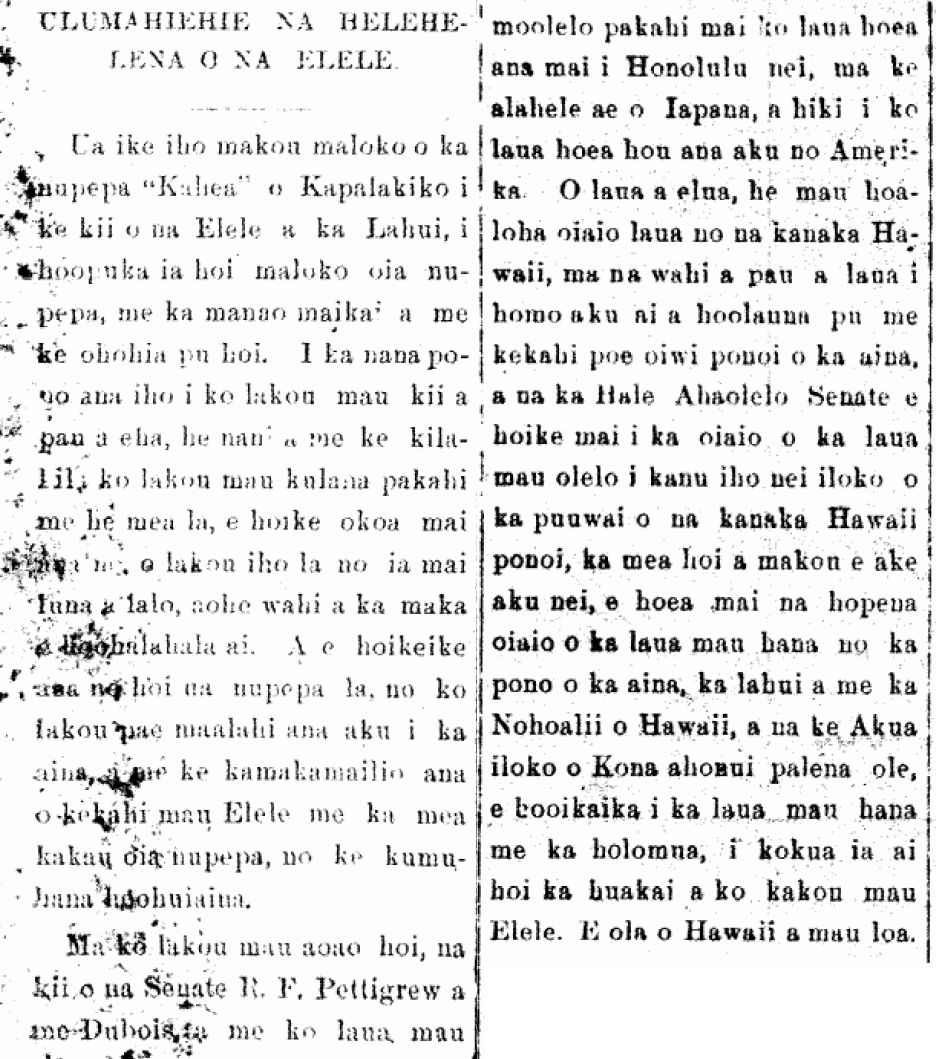
We have just seen in the newspaper the “Call” of San Francisco, portraits of the Representatives of the Lahui which were published in that newspaper, with appreciation and delight. Looking closely at all four of their portraits, they each appear fine and dignified, as if those are truly them from top to bottom; there is nothing for the eye to criticize. Also, that newspaper reports of their safe arrival, as well as a conversation of some of the Representatives with a reporter of the newspaper about annexation.

On their sides are portraits of Senators R. F. Pettigrew and Dubois, and both of their stories, from their arrival in Honolulu on the way to Japan, all the way to their return to America. Both of them are true friends to the Hawaiian, wherever they went and came in contact with our native people, but it will be the Senate that will confirm the truth of the words they planted in the hearts of the true Hawaiian people; we hope that the true outcome of their efforts for the good of the land, the people, and the Monarchy arises, and may God in His endless patience bolster their endeavors and progress, so that the journey of our Representatives is helped along. Let Hawaii live forever.

[See the issue of the San Francisco Call (11/28/1897, pp. 1 & 2) referred to in this article here.]

(Aloha Aina, 12/11/1897, p. 2)

ULUMAHIEHIE NA HELEHELENA O NA ELELE.

Ke Aloha Aina, Buke III, Helu 50, Aoao 2. Dekemaba 11, 1897.

Anti-Annexation Petitions, 1897.

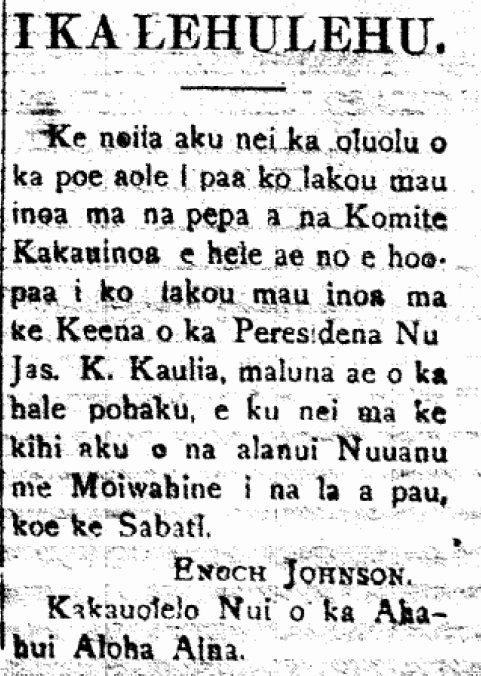
TO THE PEOPLE.

The people who have yet to sign their names on the documents of the Signature Committee are requested to please go and sign their names at the Office of the President, James K. Kaulia, atop the stone building at the corner of Nuuanu and Queen Streets, everyday except Sundays.

Enoch Johnson,

Secretary of the Hawaiian Patriotic League.

(Aloha Aina, 11/6/1897, p. 5)

I KA LEHULEHU.

Ke Aloha Aina, Buke III, Helu 45, Aoao 5. Novemaba 6, 1897.