Different type of vital statistics, 1888.

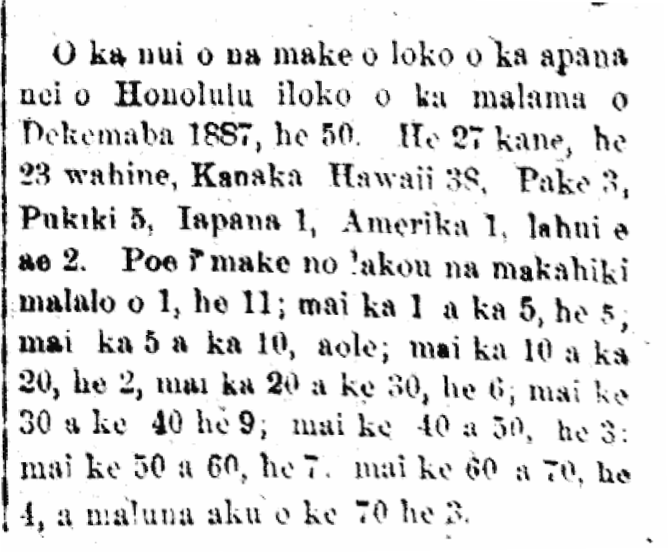
The number of deaths in the area of Honolulu, in the month of December 1887, is 50. There were 27 males and 23 females; 38 were Hawaiians, 3 Chinese, 5 Portuguese, 1 Japanese, 1 American, other ethnicities 2. Those who died under the age of 1 were 11, from 1 to 5 were 5, from 5 to 10 were none, from 10 to 20 were 2, from 20 to 30 were 6, from 30 to 40 were 9, from 40 to 50 were 3, from 50 to 60 were 7, from 60 to 70 were 4, and over 70 were 3.

(Alakai o Hawaii, 1/7/1888, p. 2)

O ka nui o ka make...

Ke Alakai o Hawaii, Buke 1, Helu 1, Aoao 2. Ianuari 7,1888.

On the perpetuation of the Hawaiian Language, 1911.

THE HAWAIIAN LANGUAGE

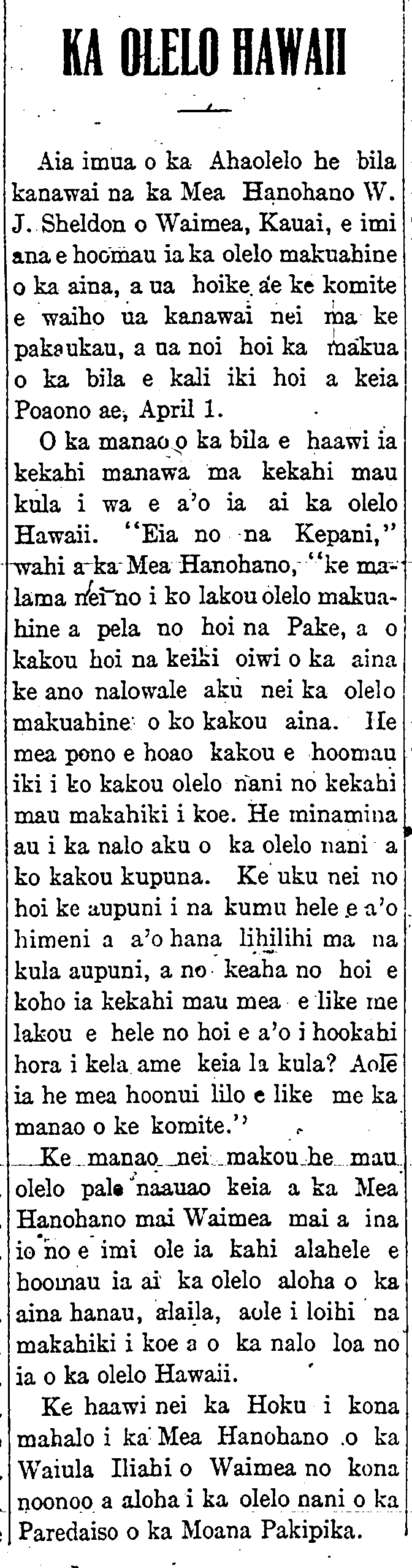
Before the Legislature is a bill put forth by the Honorable W. J. Sheldon of Waimea, Kauai, which seeks to perpetuate the mother tongue of this land; but the committee announced that the bill will be tabled; to which the father of the bill asked that they wait for a bit until the following Saturday, April 1.

The intent of the bill is to allow for time in some schools to teach the Hawaiian language. “Here are the Japanese,” said the Honorable One, “they are caring for their mother tongue, and so too of the Chinese; but we, the native children of this land, our native language is disappearing from our own land. It is imperative that we try to perpetuate our beautiful language even just a little longer. I feel remorse in letting the beautiful language of our ancestors go. The government pays for travelling instructors to teach singing and lace making [hana lihilihi ?] in public schools, so why not choose people like that to go and teach for one hour every school day? It will not be a great expense like what is imagined by the committee.”

We believe that these are very wise responses by the Honorable One of Waimea, and if indeed means are not sought to perpetuate the beloved language of our birth land, then it will not be long before the Hawaiian language will disappear completely.

The Hoku gives its mahalo to the Honorable One of the Waiula Iliahi¹ of Waimea for his consideration and aloha for the beautiful language of the Paradise of the Pacific Ocean.

¹Waiula Iliahi is one of the two branches of the Waimea River, and the other being Waikea, and they merge at Kikiaola.

(Hoku o Hawaii, 3/30/1911, p. 2)

KA OLELO HAWAII

Ka Hoku o Hawaii, Buke 5, Helu 47, Aoao 2. Maraki 30, 1911.

Bernice Pauahi Bishop Museum rules for patrons, 1903.

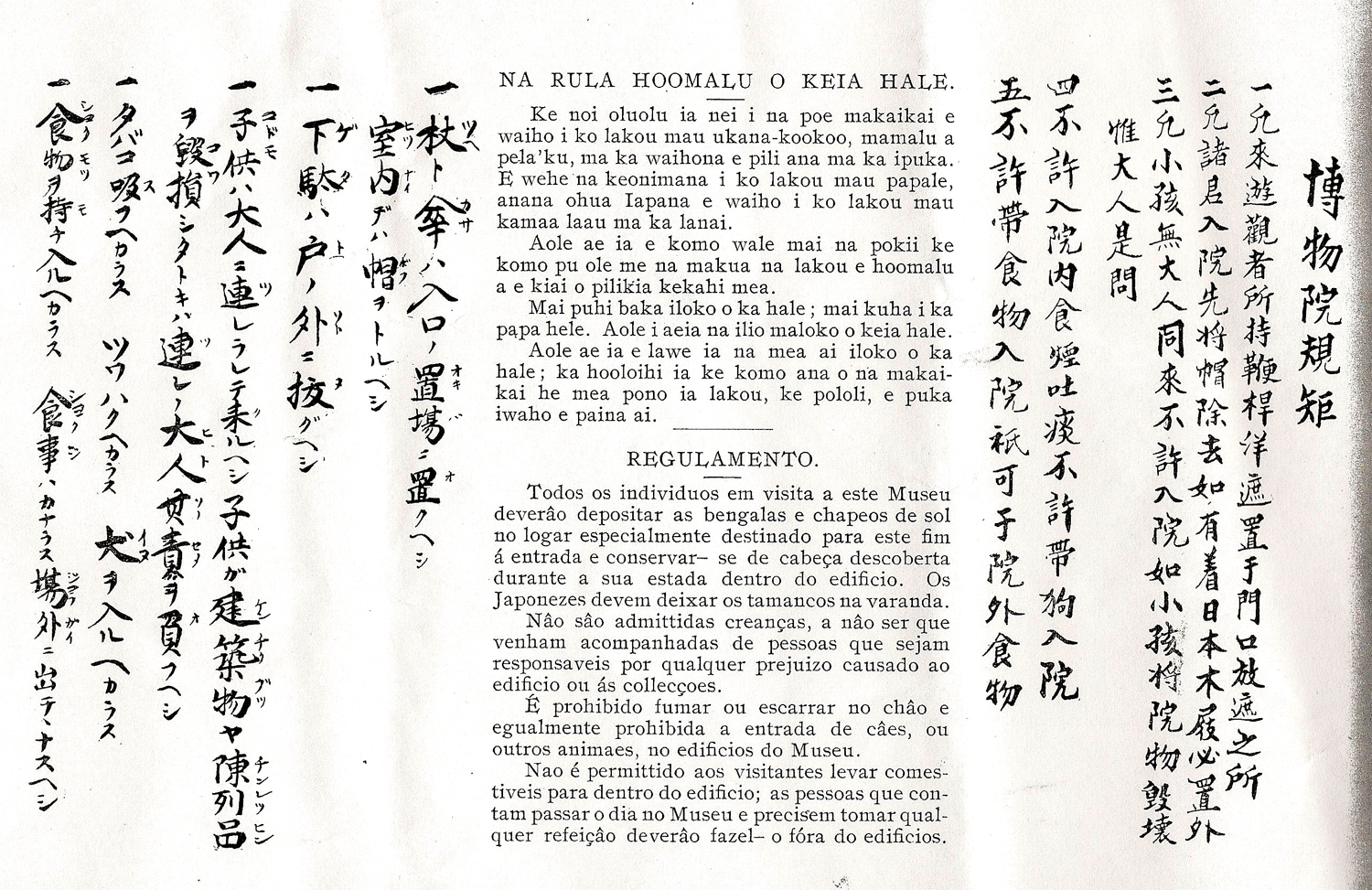
THE RULES OF ORDER OF THIS ESTABLISHMENT.

We kindly request of the visitors to leave their bags, canes, umbrellas, and so forth at the place to leave them by the entrance. Gentlemen are to remove their hats, and the Japanese guests are to leave their “wooden shoes” on the lanai.

Children are not allowed to enter unsupervised by adults who are to keep them in control and to watch them lest something gets damaged.

Do not smoke withing the building; do not spit on the floors. Dogs are not permitted in the building.

The bringing in of food into the building is not allowed; if here for an extended period, they must, if hungry, go outside to eat.

[This came from “A Handbook for Visitors to the Bernice Pauahi Bishop Museum of Polynesian Ethnography and Natural History” Honolulu 1903. I just came across this today and thought it was interesting.

In Japanese, the only big difference seems to be that it says if a child damages the building or one of the exhibits, then the accompanying adult must take responsibility. And those “wooden shoes” must have been troublesome, because it appears to be talked about in all four other languages as well!]

(“A Handbook for Visitors to the Bernice Pauahi Bishop Museum of Polynesian Ethnography and Natural History” Honolulu 1903.)

"A Handbook for Visitors to the Bernice Pauahi Bishop Museum of Polynesian Ethnography and Natural History" Honolulu 1903. Prepared by William T. Brigham, Director of the Museum.

“A Handbook for Visitors to the Bernice Pauahi Bishop Museum of Polynesian Ethnography and Natural History” Honolulu 1903. Prepared by William T. Brigham, Director of the Museum.

Food Exports, 1890.

[Found under: “HAWAII NEWS”]

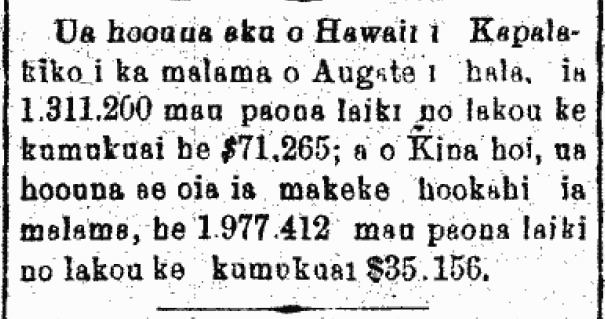
Hawaii exported to San Francisco in the month of this past August, 1,311,200 pounds of rice at the price of $71,265; and China exported to the same market in that month, 1,977,412 pounds of rice at the price of $35,156.

[What a different world we live in where we import most of our food…]

(Ko Hawaii Pae Aina, 10/18/1890, p. 2)

Ua hoouna aku o Hawaii i Kapalakiko...

Ko Hawaii Pae Aina, Buke XIII, Helu 42, Aoao 2. Okatoba 18, 1890.

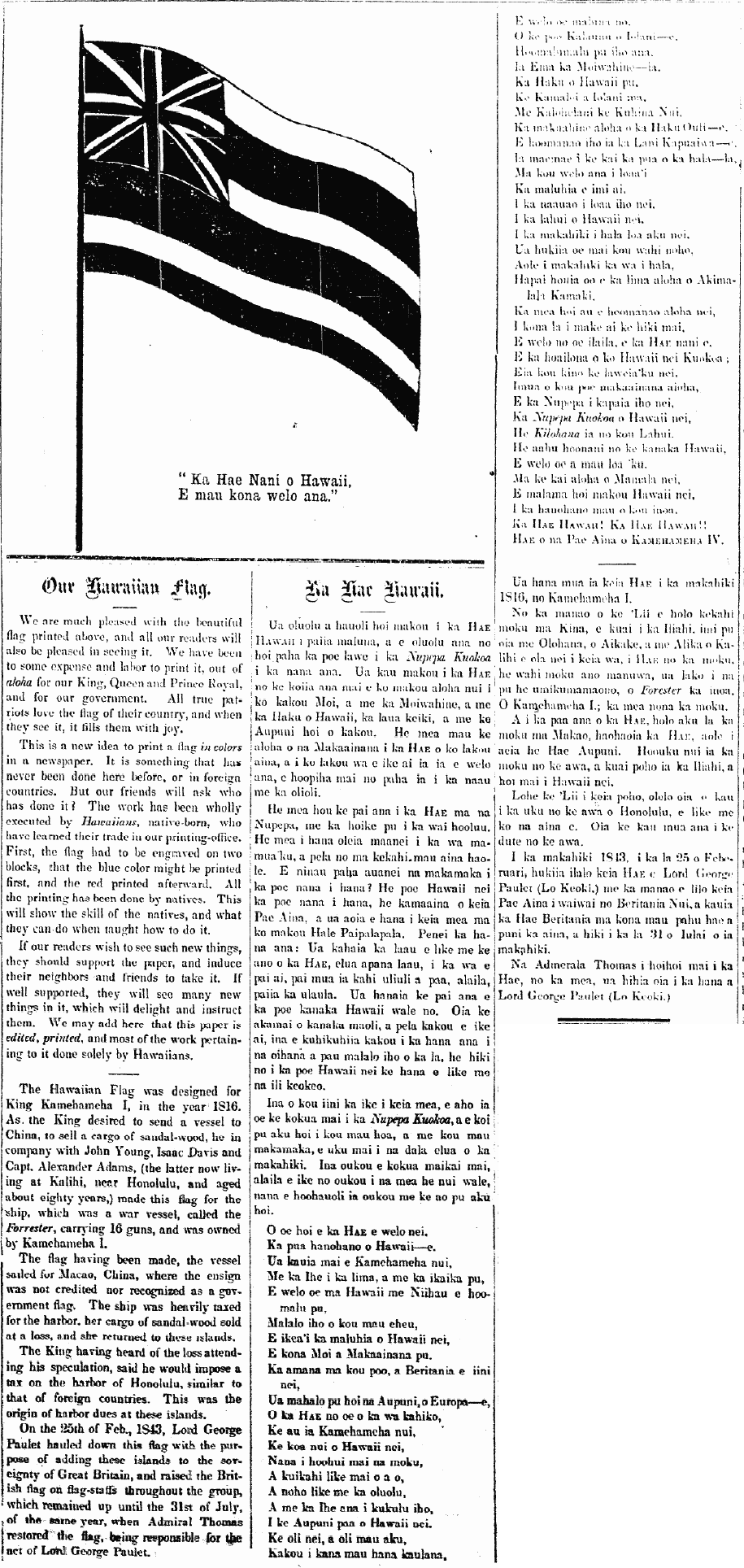
History of the Hawaiian Flag. 1862.

“The Beautiful Flag of Hawaii,
Let it forever wave.”

The Hawaiian Flag

We are pleased and happy about the Hawaiian Flag printed above, and the people subscribing to Ka Nupepa Kuokoa will be delighted to see it. We display the Flag, urged to do so by our great aloha for our King, Queen, and Ka Haku o Hawaii, their son, as well as for our Nation. The love by the people for their flag of their country is customary, and when they see her fluttering, it fills their hearts with joy.

The printing of the Flag in a Newspaper is something new, along with the displaying of its colors*. This is something not done previously here, as well as in some foreign countries. Perhaps our friends will inquire as to who did this work. Some Hawaiians did the work, people from this Archipelago, and they were taught to do this in our Printing Office. Here is how it was done: Woodblocks were carved in the fashion of the flag using two blocks. When it was printed, first the blue was printed, allowed to set, then the red was printed. This printing was done solely by Hawaiians. Such is the intelligence of the kanaka maoli, and that is how we recognize it. If we are instructed to do any task under the sun, Hawaiians can do the same as the white-skinned people.

If you should want to see this, you should support Ka Nupepa Kuokoa, and urge your acquaintances and friends to pay the two dollars a year. If you would kindly help, you will see many things that will gladden and instruct you.

You, O fluttering Flag,
The proud blossom of Hawaii.
Established by Kamehameha the great,
With Spear in hand, with strength,
Flutter over Hawaii and Niihau, and give protection.
Beneath your wings,
So that the peace of Hawaii be known,
By her King and the people as well.
The cross on your crest that Britain holds dear,
The Nations of Europe also give acclaim,
You are the Flag of old,
The time of Kamehameha the great,
The bravest warrior of Hawaii,
He who joined the islands,
With unity from end to end,
Living as one in contentment,
Along with the Spear upon which he erected,
The steadfast Nation of Hawaii.
We rejoice, and rejoice for all time,
His famed accomplishments,
You wave there above,
The crown of Iolani, the king
While giving shelter,
To Emma, the Queen.
Along with Ka Haku o Hawaii.
The Royal child of Iolani and Emma,
And Kalohelani, the Regent, Victoria Kamamalu.
The loving aunt of the young lord, Prince Albert,
Do remember his His Highness, Lot Kapuaiwa,
Cleansing the fruit of the pandanus in the sea,
Your fluttering has garnered
The peace that allowed us to seek,
The knowledge that has come,
To the Hawaiian populace.
That year long ago.
You were taken from your proper place.
Not a year passed,
You were raised by the loving hands of Admiral Thomas.
The one you fondly recall,
On the day of his death when it approaches,
You will wave there, O beautiful Flag.
O symbol of Hawaii’s Independence ;
Here is your body, being brought.
Before your beloved people,
By the Newspaper called,
Ka Nupepa Kuokoa of Hawaii,
The Excellence of your Nation.
A garment that adorns the Hawaiian People,
Wave forever.
Over the beloved sea of Mamala,
We, Hawaii, will cherish always,
The eternal glory of thy name.
The Hawaiian Flag! The Hawaiian Flag!!
The Flag of the Islands of Kamehameha IV.

This Flag was first designed in the year 1816 for Kamehameha I.

The King, wanting a ship to sail to China to sell Sandalwood, searched along with John Young, Isaac Davis, and Captain Alexander Adams of Kalihi, who is still living, for a Flag for the ship. It was a man-o-war, called the Forrester, carrying sixteen guns. Kamehameha I owned the ship.

When the Flag was completed, the ship sailed to Macao. The Flag was puzzled over, and was not accepted as a National Flag. The ship was charged exorbitantly for harbor fees, the Sandalwood was sold for a loss, and the ship returned to Hawaii.

The King learned of this loss, and he said that a tax should be placed on the harbor of Honolulu like those of foreign lands. That is when duty was first charged for the harbor.

In 1843, the 25th of February, this Flag was taken down by Lord George Paulet [Lo Keoki], with the intent that this Archipelago be taken as a possession of Great Britain. The British flag was raised on flag poles all around the land, until the 31st of July of that year.

It was Admiral Thomas who restored the Flag, for he disputed the actions of Lord George Paulet.

[Notice the English column to the left, which gives a translation of the Hawaiian. It seems this issue of the Kuokoa was sent to home by many a missionary, to show the progress they were making…

*A word of clarification: This is not the first time color appears in a newspaper. For more on this topic, see Hana Hou Magazine, August/September 2011: “Read All About It!” by Ron Williams.

For more flag articles, just click here!]

(Kuokoa, 1/1/1862, p. 1)
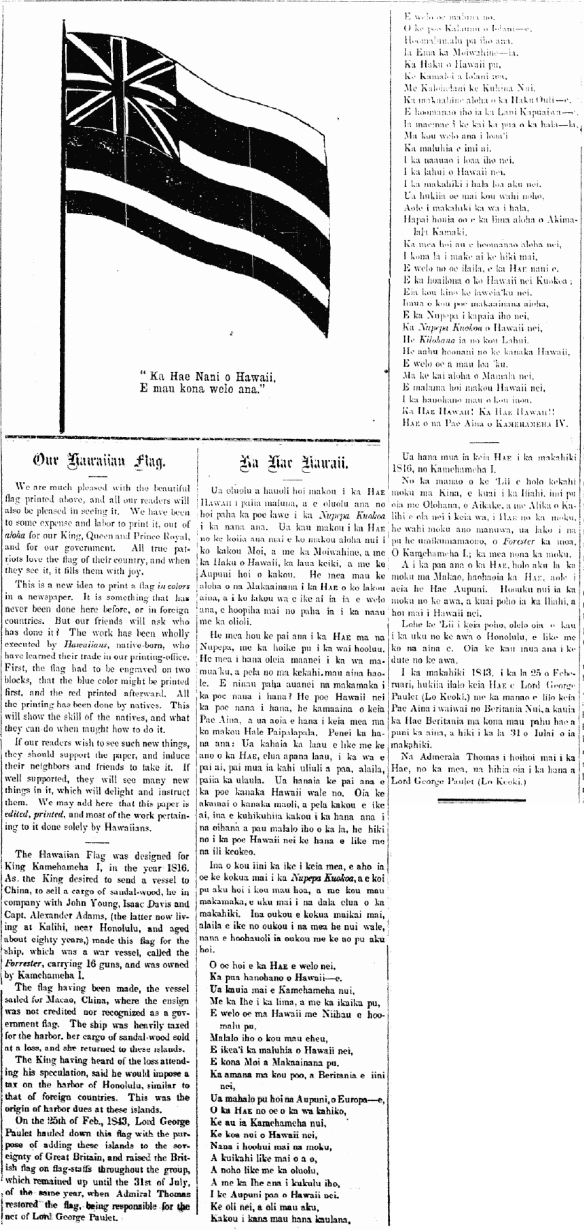
"Ka Hae Nani o Hawaii...

Ka Nupepa Kuokoa, Buke I, Helu 6, Aoao 1. Ianuari 1, 1862.
History of the Hawaiian Flag. 1880.

In Thrum’s Hawaiian Almanac and Annual for 1880, pp. 24–26, appears this article:

THE HAWAIIAN FLAG.

We exceedingly regret to report an unsuccessful search for the History of the present Flag of these Islands, the time of its adoption and the parties interested in its formation; but after diligent inquiries and research through volumes of voyages, histories, periodicals and manuscript journals during the past three years, we have to acknowledge the main fact lost in oblivion, while references thereto in various voyages and histories are confusing and contradictory.

There is a general idea and belief among many of our old residents that the present Hawaiian Flag was made by the late Capt. Alexander Adams before his voyage to China in the brig “Kaahumana, [Kaahumanu]” in 1817, and was by him first flown, not only in the Chinese waters, but on the coast of California. Others again have the impression that a flag was brought from China by him; but we can gather no information corroborative as to who was authorized in Chinese waters to design a flag for this, even small kingdom, though the description given viz: a St. George and St. Andrew’s cross in the corner filled in with blue, with field consisting of red and white stripes, shows almost virtually the East India Flag. Refering to Capt. Adams’ Journal we find the following mention only, that touches upon the points in question: ” April, 1816, The King of these Islands having a strong passion to purchase the brig, (‘Forrester,’ of London) and expressing the same, myself and Capt. Ebbetts was accordingly deputed to treat with him, but he would not purchase her without I would enter his service as her commander. I resultingly acquiesced, the brig being given up to him at Kealakekua, and called by him Kaahumanu * * *. I was accordingly honored on taking command with the Flag of his Majesty and a salute of 11 guns.”

This certainly refutes the general belief that the flag was made by Capt. Adams, as his own narrative shows a flag to have been here before him ; but
whether the present one or some other we cannot gather, for it is evident that there have been more than one. In another portion of his journal is an allusion to a flag—but also without description—that has no doubt given rise to the idea of his making the flag; where at Waimea, Kauai, at which port he had touched from Honolulu for supplies, en route for China, he notes: “Mch. 12, 1817, * * * Gave the King our ensign to hoist in lieu of the Russian, who said it was on account of his having no other.”

It is to be borne in mind that the allusion here is to the king of Kauai, and not Kamehameha, as Kauai was under its own King till 1821, and his possession of a Russian flag while the principal town was occupied by a Russian colony was not strange.

Finding these theories of Capt. Adams’ authorship exploded by his own writings, search was made in other directions with the following result. Vancouver, in his last visit, (1793) when he assured Kamehameha of England’s friendship and protection, gave him an English flag, which we find by Archibald Campbell, in his “Voyage round the World, 1806-1812,” arriving at these Islands Dec. 1808, that the English colors were used, for he says: “The King’s residence, built close upon the shore, and surrounded by a palisade upon the land side, was distinguished by the British colors.”

Jarvis [Jarves] states, (pp. 96) describing the period of about 1816, speaks of the flag, as somewhat similiar to the present, viz: “English Union, with seven alternated red, white and blue stripes.” This however is not coroborated by Lord Byron, in his “Voyage of the Blonde,” in 1825, in which he describes the flag as follows: “On all days of ceremony the Sandwich flag is hoisted on the forts; it has seven white and red stripes with a Union Jack in the corner.” (P. 121.)

This is almost the East India flag before described, and confuses the searcher after truth as to when the several changes took place. If Jarvis is correct in the flag he describes, and he certainly was in a position to know whereof he wrote, it is a grave error in the recorder of the “Voyage of the Blonde” to give so different a one nine years later. The present flag has eight stripes representing the Islands of the group-white, red and blue, with Union Jack in the corner. Capt. Hunt, who was here in the Baselisk [Basilisk] in 1845, is said to have changed the relative position of the colors of the stripes by placing the white on top instead of at the bottom, though there is a possibility of this being the time of adding the eighth stripe, Jarvis and Byron mentioning only seven. Capt. Hunt is also accredited with designing the Royal Standard now in use.

We leave the above subject as here recorded, trusting it will meet the eye of some one whose knowledge and memory will be freshened thereby to account the true history of the Hawaiian Flag, its origin, and parties interested in its formation.

[The original of this article is downloadable here at the University of Hawaii at Manoa’s EVOLS page! This publication is very useful for many random facts about Hawaii at the time. If you have not seen it before, you should go check it out!!]

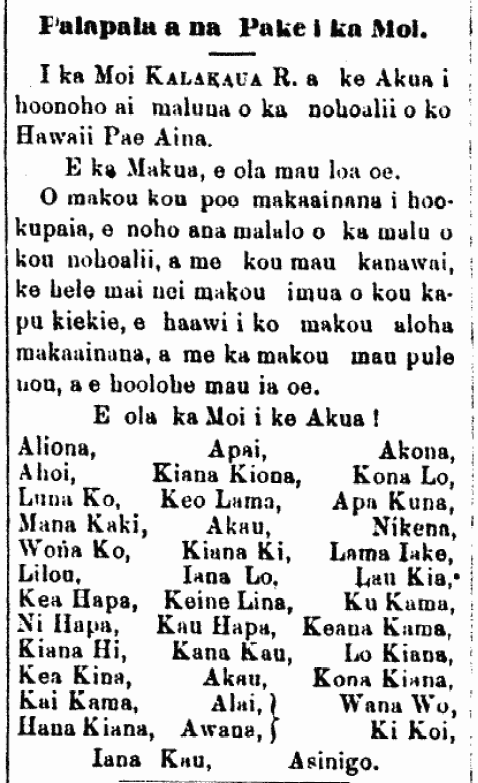
One of many congratulatory messages to the newly elected king, Kalakaua, 1874.

Letter from the Chinese to the King.

To King Kalakaua Rex, whom God has placed on the throne of the Hawaiian Archipelago.

Oh Father, long may you live.

We are your citizens who have been naturalized, living in under the protection of your rule and your laws; we come before your high kapu, to offer you our aloha from your citizens, as well as our prayers for you, and we shall always heed you.

Let the King live Through God!

Aliona, Apai, Akona, Ahoi, Kiana Kiona, Kona Lo, Luna Ko, Keo Lama, Apa Kuna, Mana kaki, Akau, Nikena, Wona Ko, Kiana Ki, Lama iake, Lilou, Iana Lo, Lau Kia, Kea Hapa, Keine Lina, Ku Kama, Ni Hapa, Kau Hapa, Keana Kama, Kiana Hi, Kana Kau, Lo Kiana, Ke Kina, Akau, Kona Kiana, Kai Kama, Alai, Wana Wo, Hana Kiana, Awana, Ki Koi, Iana Kau, Asinigo.

(Kuokoa, 3/21/1874, p. 1)

Palapala a na Pake i ka Moi.

Ka Nupepa Kuokoa, Buke XIII, Helu 12, Aoao 1.

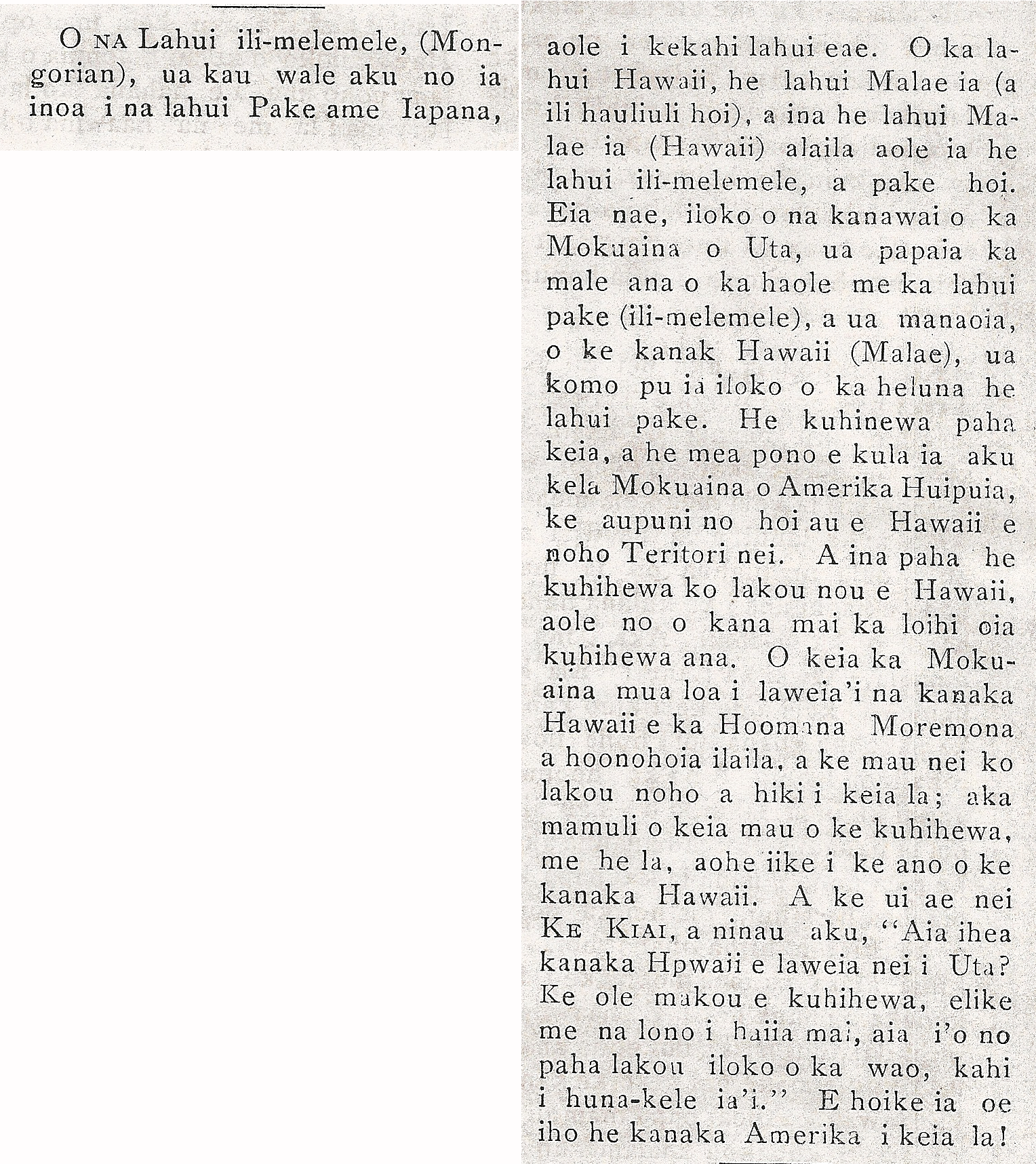
How sad it must be to be denied marriage to someone you love, 1902/2012.

THE yellow-skinned races (Mongolian), include the Chinese and Japanese, and not other lahui. The Hawaiian Race is of the Malae race (the brown-skinned), and if the Hawaiians are Malae, then they are not yellow-skinned, or Chinese. And yet, under the law of the state o Utah, haole are not allowed to marry Chinese (yellow-skins), and it is believed that Hawaiians (Malae) are included amongst the Chinese. This is perhaps a mistake, and that state of the United States needs to be educated of the nation in which you live as a Territory. And if they are mistaken about you, O Hawaii, this error is incredibly long standing. This is the first state to which Hawaiians were brought by the Mormon Faith to live, and they are still there to this day; but because of this continued misunderstanding, it is as if they do not know the nature of Hawaiians. The Kiai questions and asks, “Where in Utah are Hawaiians being taken? If we are not mistaken, and according to what is reported, they are perhaps in the desert, where they are hidden away.” Reveal yourself to be an American today!

(Kiai, 9/11/1902, p. 1)

O NA Lahui ili-melemele...

Ke Kiai, Buke 1, Helu 3, Aoao 1. Sepatemaba 11, 1902.

Chinese New Year. Sunday, February 18, 1912.

NEW YEAR¹ OF THE KEIKI OF THE LAND OF FLOWERS²

The people of China were finely adorned as they celebrated their New Year; the Chinese were seen from Friday, going to the shops of their own countrymen to purchase new year’s items, from the day until evening, and purchasing all sorts of flowers, like crown flower, koniako [?]³, chrysanthemum, and some other blossoms to decorated their tables.

When the hands of the clock reached the point where the year staggered away and the New Year was born, the popping sounds of the firecrackers reverberated along with their huge pu ie [some kind of shooting firework?]⁴ on Nuuanu Avenue between the streets of King and Hotel. Amidst that popping along with the deafening huge pu ie that were lined up straight in a row; as the Chinese of the shops in the area were lighting those huge pu ie, one of the pu ie went off and flew straight through the entrance of the hat shop of Uyeda on the Ewa side, and broke the glass without this misfortune being noticed while the activities were going on, and it was with the coming of day that this damage was discovered by someone, and seen also was the ie of that pu ie lying on the floor. The one good thing was that the ie that went inside was not on fire, if not there would have been a “side dish” to the new year of the Chinese, a house fire.

¹”Konohi” is the Hawaiian word for Chinese New Year, coming from “kong-hee” [恭喜]…
²Aina Pua [Land of Flowers] is a poetic name for China.
³I don’t know what kind of flower a “koniako” is.
⁴I have yet to find out exactly what type of firework a “pu ie” is.

(Kuokoa Home Rula, 1/23/1912, p. 1)

KE KONOHI O NA KEIKI O KA AINA PUA

Kuokoa Home Rula, Buke X, Helu 8, Aoao 1. Feberuari 23, 1912.

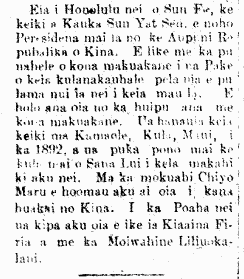
This is pretty awesome. A hundred years ago, Sun Yat-sen’s son, Sun Fo is leaving for China, 1912.

[Found under: “Local News”]

Here in Honolulu is Sun Fo, the child of Dr. Sun Yat-sen who is serving as President of the Republic of China. Just as his father was a favorite of the Chinese of this town, so too is he being treated with great affection these days. He is on his way to meet up with his father. This boy was born at Kamaole, Kula, Maui, in 1892, and he graduated from Saint Louis School the past year. He will continue his travels to China aboard the Chiyomaru. This Thursday, he visited with Governor Frear and Queen Liliuokalani.

[It seems many other sources like this one say Sun Fo was not born here in Hawaii… “Sun Yat-sen in Hawai’i: Activities and Supporters”]

(Aloha Aina, 1/6/1912, p. 4)

Eia i Honolulu nei o Sun Fo...

Ke Aloha Aina, Buke XVI, Helu 1, Aoao 4. Ianuari 6, 1912.