More on Hawaiian Independence Day and Aloha Aina, 1843.

THE ANT [KA NONANONA].

“Go to the ant, thou sluggard; consider her ways, and be wise.” Proverbs [Solomona]

Book 2. HONOLULU, OAHU, JANUARY 17, 1843. Paper 17.

Here are some letters from Haalilio; people will surely be happy to hear from him and Mr. Richards that their travels are going well.

Weletabu [Vera Cruz ?], Mexico, Nov. 2, 1842.

Dr. G. P. Judd,

My dear friend, much aloha to you and your entire household. Here am I, your friend, with feeling aloha for you. The two of us [Haalilio and Richards] arrived here on the 29th of October, and we are awaiting a ship to ride. Hear me, I am doing fine, I have no illness; my health is fine now. However, I do not know how it will be when we get to the cold lands; perhaps it will be alright, and perhaps not. Hear me, we have travelled about this expansive land with peacefully, we were not troubled, we were cared for well by the Lord, until arriving here. But our bodies are spent after the long road. The days were extremely hot and extremely cold; we got drenched by the rain and snow, we passed through mountains, and rivers, and the wilds here in Mexico; we swam the water of rivers running by the face of the mountains, during the day and the night. In the cold and the heat, we endured hunger, riding on the backs of mules all day long. But I was certain that Jesus was with us in this friendless land. And that he blesses us. He takes care of the two of us, and our bodies are not troubled or hurt. He supplies us with all of our needs. He has welcomed us always amongst good friends; and there, we were given comfort and help on our path.

Listen to this, I’ve seen the towns of these lands; they are countless, and I have seen Mexico the great Town of the president [alii]. I’ve also seen the silver mines, and how they work silver; we’ve been to the legislature of the alii and his residence. Those places are grand to see. And today I am with health, giving my aloha to you and your wife and the children; give your [my?] aloha to all the friends there, and to Hana folks and to your people and to my household, and to the land and to the chiefs.

Aloha between us, Let us live through the Lord; until we meet in joy once more.

Timoteo Haalilio.

Mexico, Weletabu [Vera Cruz ?], Nov. 8, 1842.

O D. [G.] P. Judd,

Much Aloha to you; we received your letter on this day, the 8th of Nov., 1842. And we’ve understand all that was within. I have much aloha for you, and for all of you. How sad for all the alii, and how sad for Kapihi! We have been blessed this day in seeing your letter. There is much aloha for us all and our homeland. We are travelling aboard the American warships, Falmouth [Falamaka], to New Orleans [Nuolina]. A steam-powered American warship arrived, a huge vessel, 247 feet long and 2,400 tons. As I watch her sail by steam, it is a fantastic sight; she is so swift, with no comparison; this is the first time I’ve seen a steamer, and I am totally captivated by it.

Much aloha for you; here we are safe, steadfast in our duties we swore to.

Aloha to you.  T. Haalilio.

The two of them are headed to Washington aboard the steamer, a warship named Missouri, and perhaps they will land in Washington in 9 days.

[Does anyone know if Weletabu in Mexico is Vera Cruz, or if it is somewhere else?

Also, who is the Hana and the Kapihi mentioned here?]

(Nonanona, 1/17/1843, p. 81)
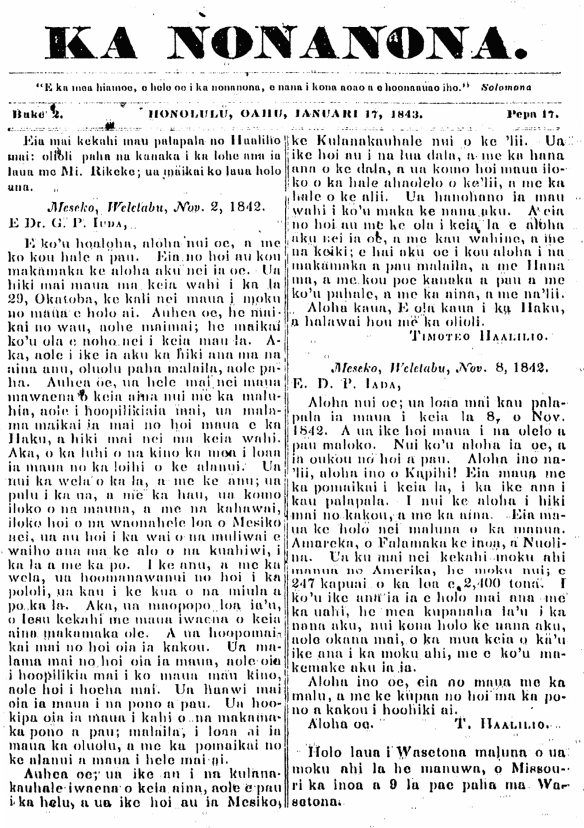
Eia mai kekahi mau palapala no Haalilio mai...

Ka Nonanona, Buke 2, Pepa 17, Aoao 81. Ianuari 17, 1843.

More reaction to Bayonet Constitution, 1887.

CURIOUS HAPPENING OF LAST NIGHT

Here Once More are the Deeds of the Rascals!

Who is Responsible? Who is this Rogue?

A little before 9 last night, there were handwritten bills posted at various places around town. The first found was in front of the residence of Dr. Rodgers [Kauka Lokeke], and other bills were found in other places like the Government Building and the Palace Grounds. The following was found by police lieutenant Kahumoku and officer S. Ku, at the corner of the estate of Haalelea, at the corner of Richards and the Palace, like this:

“Dec. 16th 1886” [1887 ?]

“To you rebel Ministers [Kuhina], it is best for you to return your appointments. We have measured you evil deeds. If these actions continue, then be vigilant every minute of your life lest a coffin be your end.”

(Picture of a Coffin.)

Written atop the coffin is the word, “Minister.”

When the officers in the Armory [Halekoa] got word, some of the soldiers were sent out to search, and this was found posted on the mauka gate of the Palace Grounds:

“To you, O treasonous Ministers, it is best for you to return your appointments. We have had enough of your evil deeds. If this should continue, you all watch out every minute, or you will have a coffin as your eternal home.”

(Picture of a Coffin.)

Written atop the image of the coffin were the words, “In Memory of the Ministers.”

Similar ones were found on the pillars on the grounds of Aliiolani Hale. Perhaps some were posted elsewhere, but it is not known.

[Unfortunately, only two issues have been found of this important newspaper which ran from 1887 to 1888.]

(Makaainana, 12/17/1887, p. 3)

HE PAHAOHAO NO KA PONEI

Ka Makaainana, Buke I, Helu 41, Aoao 3. Dekemaba 17, 1887.

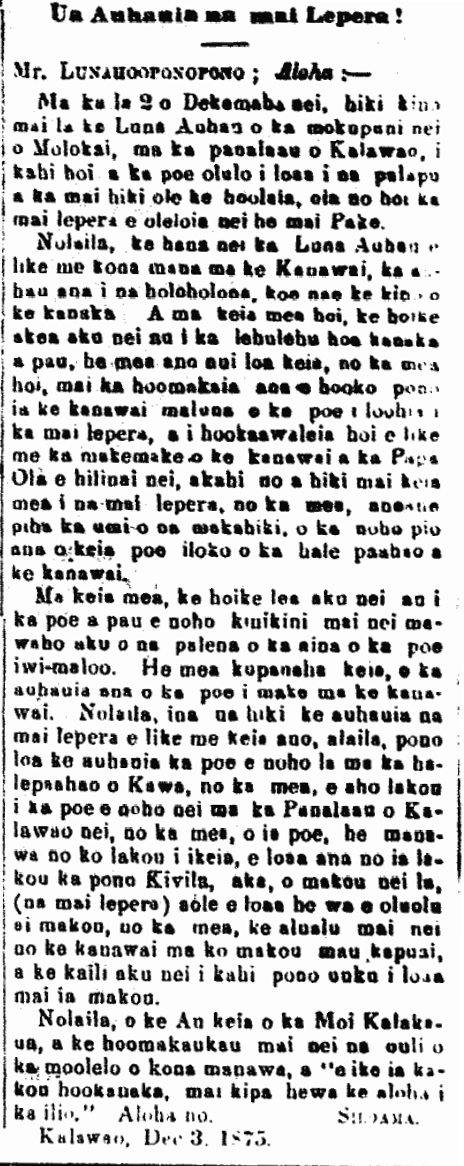
On taxation and leprosy patients, 1875.

The Leprosy Patients are Taxed!

Mr. Editor; Aloha:—

On the 2nd of this December, the Tax Assessor [Luna Auhau] of this island of Molokai came in person to the colony of Kalawao, the place of the castaways who are afflicted with wounds of an incurable sickness, that being leprosy [mai lepera], which is called he Chinese sickness [mai Pake].

Therefore, the Tax Assessor is acting as per his power under the Law; the taxing of animals, all except the body of man. And as such, I am announcing before all of our fellow people, that this is a major thing, because from the beginning of the enforcement of this law upon people afflicted with leprosy and who are set apart as based on the intent of the edict of the Board of Health; this is the first time this sort of thing has come before the patience, as it has almost been ten years that these people have been living as prisoners in the penitentiary of the law.

Through this, I am announcing clearly to all the people living all over outside of the boundaries of the land of the skeletons. This is astonishing that those dead to the law are being taxed. So if leprosy patients are taxable in this way, then those imprisoned in Kawa [the government prison] should be taxed, for they are better off than those living here in the Colony of Kalawao; those people, there is a given time when they will once again receive their Civil rights, but we here (the leprosy patience), we will not have a time when we are relieved, because the law follows after our steps, and takes from us even the tiniest of rights that we have.

This is the Era of King Kalakaua, and the character of the history of his reign is being prepared; so “Recognize your fellow man, and don’t waste your aloha on dogs.” Aloha no. SILOAMA.¹

Kalawao, Dec. 3, 1875

¹Siloama is probably a pen name; it is the Protestant church in Kalawao.

(Kuokoa, 12/11/1875, p. 4)

Ua Auhauia na mai Lepera!

Ka Nupepa Kuokoa, Buke XIV, Helu 50, Aoao 4. Dekemaba 11, 1875.

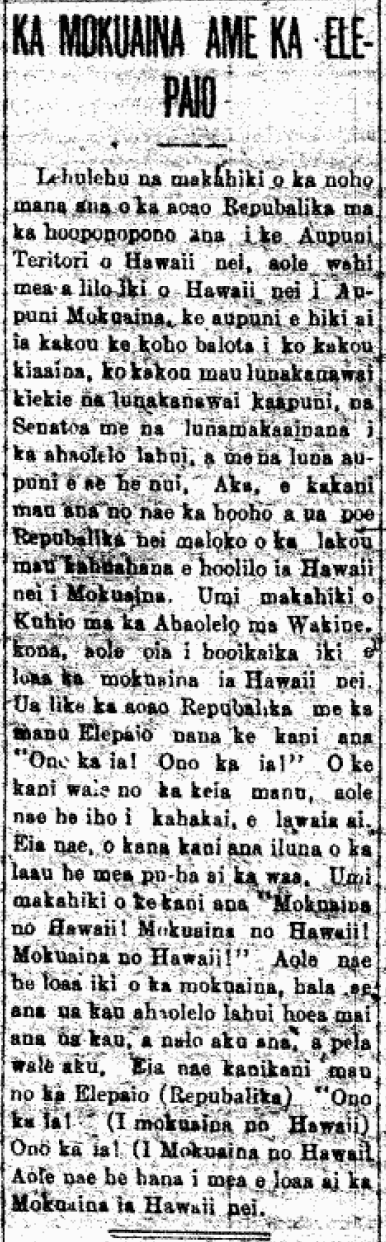
On Statehood, Republicans, Elepaio, and Voting Rights,1912.

STATEHOOD AND THE ELEPAIO

It has been many years during which the Republican party has held power in the governing of the Territory of Hawaii, and Hawaii has not at all been made into a state, where we’d be able to vote for our own governor, our chief justices, circuit court judges, Senators, and representatives in our legislature, and other many heads of government. However, the cry of those Republicans in their workplace to make Hawaii a State, does not cease.  It is ten years that Kuhio has been in the Legislature in Washington, and he has not put a bit of effort into making Hawaii a state. The Republicans are like the Elepaio bird who crying goes, “Ono ka ia! Ono ka ia! [I crave fish! I crave fish!]” This bird just cries out, but does not venture to the sea to catch fish. But its cry atop logs is what makes canoes bug ridden [pu-ha]. Ten years of crying “Mokuaina no Hawaii! Mokuaina no Hawaii! Mokuaina no Hawaii! [Statehood for Hawaii! Statehood for Hawaii! Statehood for Hawaii!]” But there has been no statehood at all; one session of the legislature passes by and the next comes, and then passes by, and so forth. But the Elepaio (Republican) continues to cry, “Ono ka ia! (I Mokuaina no Hawaii.) Ono ka ia! (I Mokuaina no Hawaii.) Yet they do nothing so that Hawaii would attain statehood.

(Aloha Aina, 10/26/1912, p. 2)

KA MOKUAINA AME KA ELEPAIO

Ke Aloha Aina, Buke XVII, Helu 43, Aoao 2. Okatoba 26, 1912.

Hugo Kawelo, sent to Glasgow to study, returns, 1886.

HAWAIIAN YOUTH RETURNS.

On the ship that brought the Portuguese laborers, Mr. Hugo Kawelo, one of the youths sent to Scotland [Sekotia] to seek education by working [unclear word] in an iron works factory. Because of sickness, he returned, but when he arrived back, he was the epitome of a robust and vigorous man. It was as if the air of the open ocean brought him back to health. He wishes to return to complete his education in the iron [unclear word] industry, should his health be good.

[Hugo Kawelo is one of the select Hawaiians sent abroad by Kalakaua to study and to bring back this knowledge to move Hawaii forward. For more on this program, see for instance: Agnes Quigg’s “Kalakaua’s Hawaiian Studies Abroad Program” from the Hawaiian Journal of History.

Here is one another example of a badly imaged newspaper. I guessed the meaning of some of the passage.

One of our readers, Lynda Fitzgerald, asked who can be contacted to get the original Hawaiian-Language Newspapers reshot clearly. I don’t have a specific name, but the more people that know how important this is, the more likely it will be done. So talk to your friends and coworkers and heads of boards and kumu hula and civic club officers and the aunty down the street. Why do you think seeing all of this information clearly is important…]

(Nupepa Elele, 3/6/1886, p. 2)

HAWAII OPIO UA HOI MAI.

Ka Nupepa Elele, Buke VII, Helu 36, Aoao 2. Maraki 6, 1886.

Princess Kaiulani born, 1875.

The Hon. A. S. Cleghorn was blessed with being gifted with a beautiful baby girl by his wife, the Alii Likelike Cleghorn. This is a new Royal Offspring in the era of King Kalakaua. That the Heavens watch over and bless Hawaii is our humble plea.

(Lahui Hawaii, 10/23/1875, p. 3)

Ua hoopomaikai ia ka Hon. A. S. Cleghorn...

Ka Lahui Hawaii, Buke I, helu 43, Aoao 3. Okatoba 23, 1875.

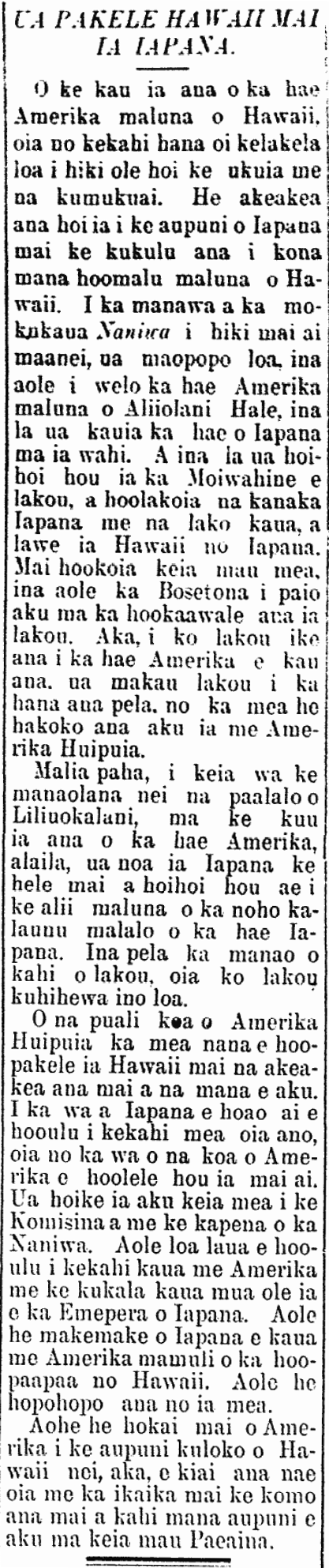
Always important to look at sources. 1893 / 2012.

HAWAII ESCAPES FROM JAPAN.

The raising of the American flag over Hawaii is one of the greatest things done that cannot be repaid. It blocks the nation of Japan from establishing its rule over Hawaii. When the warship Naniwa arrived here, it was clear that if the American flag was not waving over Aliiolani Hale, then the Japanese flag would have been put in its place. And then they would have returned the Queen and the Japanese would have been supplied with weapons and took Hawaii for Japan. It all would have happened if the Boston did not hold them off. But when they saw the American flag raised, they were afraid to do this, for it would be fighting with the United States of America.

Perhaps now Liliuokalani’s attendants are hoping that by the taking down of the American flag, the Japanese will be free to come and return the alii to the throne under the Japanese flag. Should that be the thought of some of them, they are gravely mistaken.

The American troops will save Hawaii from the interference by the other powers. When Japan tries to foment something of that sort, that will be when the soldiers of America will be deployed again. This has been announced to the Commissioner and the captain of the Naniwa. They will not start a war with America without it being proclaimed in advance by the Emperor of Japan. Japan has no desire to war against America because of the dispute over Hawaii. There is nothing to fear.

America will not interfere in the local government of Hawaii nei, however it will guard Hawaii with force against the entering of other national powers into this Archipelago.

[It is always important to look at what newspaper an article comes from. Also, long-running newspapers (and people for that matter) don’t necessarily keep their same ideologies throughout their entire life…]

(Kuokoa, 4/8/1893, p. 2)

UA PAKELE HAWAII MAI IA IAPANA.

Ka Nupepa Kuokoa, Buke XXXII, Helu 14, Aoao 2. Aperila 8, 1893.

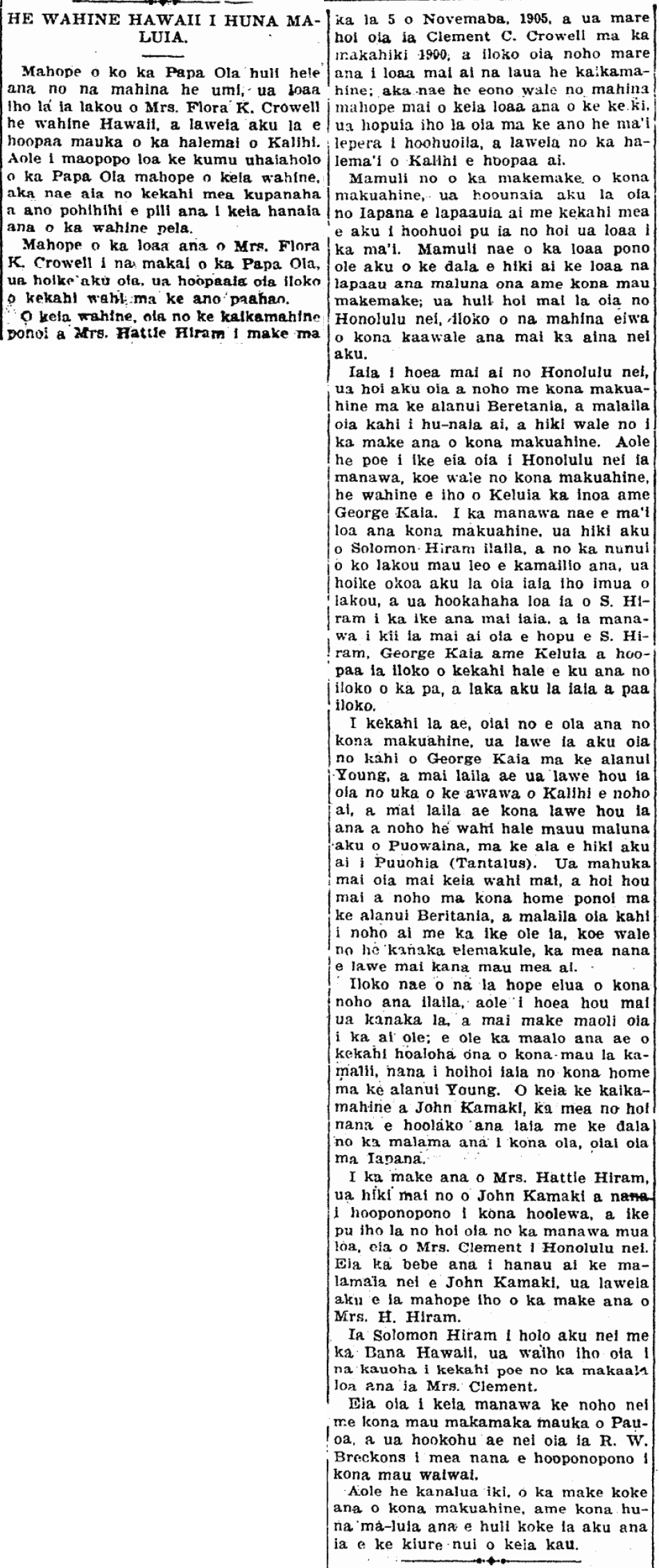
Board of Health and leprosy, 1906.

A HAWAIIAN WOMAN HIDDEN AWAY.

After the Board of Health [Papa Ola] searched for ten months, they found Mrs. Flora K. Crowell, a Hawaiian woman, and she was taken and detained mauka of the Kalihi Hospital. It is not clear why the Board of Health chased after that woman, but there is something astonishing and unclear about what was done to this woman.

After Mrs. Flora K. Crowell was found by the officers of the Board of Health, she said she was locked away like a prisoner.

This wahine is the birth daughter of Mrs. Hattie Hiram who died on the 5th of November 1905, and she married Clement C. Crowell in the year 1900, and by this marriage the two of them had a daughter; but just six months after they had the girl, she [Flora Crowell] was suspected of having leprosy and taken away to be held at the Kalihi Hospital.

According to the wishes of her mother [Hattie Hiram], she was sent to Japan to be treated along with others who were suspected of having the illness. Being that she did not have the funds to be treated and per her wishes, she came back to Honolulu nei after nine months of being away from here.

When she arrived in Honolulu, she went to live with her mother on Beritania Street, and she was hidden there until the death of her mother. There was no one who knew she was here in Honolulu at the time, except her mother along with another woman named Keluia and George Kaia. However, when her mother was extremely ill, Solomon Hiram came, and because they were speaking so loudly, he showed himself before them; S. Hiram was shocked at seeing her; and it was then that she was subdued by S. Hiram along with George Kaia and Keluia and detained in a building on the grounds, and she was locked inside.

A few days later, while her mother was still alive, she [Flora Crowell] was taken to the place of George Kaia on Young Street, and from there she was then taken to the uplands of Kalihi Valley to live, and from there she was taken to a grass house atop Puowaina, on the road that goes up to Puuohia (Tantalus). She escaped from this place and returned to live at her own home on Beritania Street, and it was there she lived unbeknownst to others, all except an old man who brought her food.

But during her last two days there, that man did not come back, and she almost starved for lack of food; it was only because of the passing by of one of her friends from her youth, that she was brought to that friend’s home on Young Street. This was the daughter of John Kamaki, the one who gave Flora Crowell money to care for herself while in Japan.

At the death of Mrs. Hattie Hiram, John Kamaki came and took care of her funeral, and saw for the first time that here was Mrs. Clement in Honolulu nei. Her baby was being cared for by John Kamaki, who took her after the death of Mrs. H. Hiram.

When Solomon Hiram just left with the Royal Hawaiian Band [Bana Hawaii], he left instructions for some people to keep good watch over Mrs. Clement.

She is now living with her friends mauka of Pauoa, and she has chosen R. W. Breckons as the executor of her estate.

There is no doubt, the quick death of her mother and her being hidden away, will be investigated immediately by the grand jury of this session.

(Kuokoa, 11/2/1906, p. 8)

HE WAHINE HAWAII I HUNA MA-LUIA.

Ka Nupepa Kuokoa, Buke XLV, Helu 44, Aoao 8. Novemaba 2, 1906.

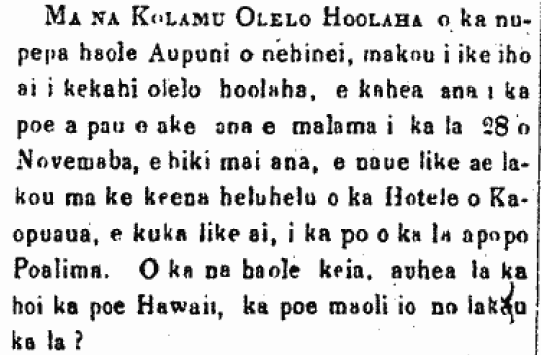
Independence Day, 1867.

In the Announcements Column of the Government’s English newspaper [Hawaiian Gazette] of yesterday, we saw an announcement calling all those who want to celebrate the coming 28th of November, to all come down to the reading room of the Hotel of Kaopuaua to discuss it tomorrow night, Friday. This is what the haole are doing; where are the Hawaiians for whom this day is truly for?

(Au Okoa, 9/26/1867, p. 2)

Ma na Kolamu Olelo Hoolaha...

Ke Au Okoa, Buke III, Helu 23, Aoao 2. Sepatemaba 26, 1867.

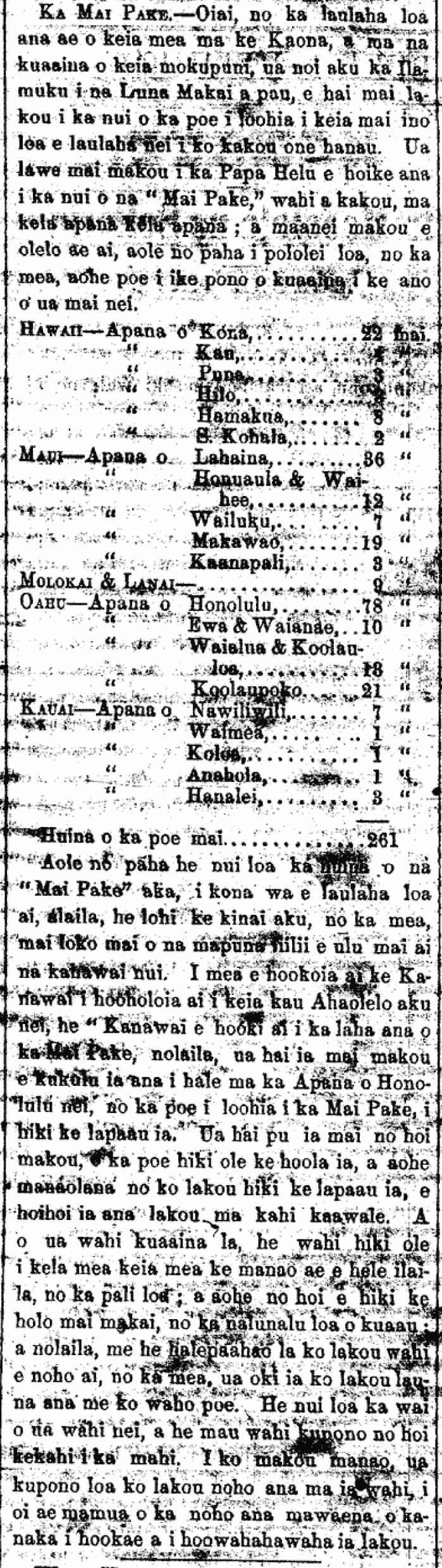
The “Chinese Disease,” 1865.

Leprosy [Mai Pake]—As this is greatly spreading about Town and in the country of this island, the Sheriff [Ilamuku ?] has requested that all of the District Sheriffs [Luna Makai ?] to report the number of people inflicted with this horrible sickness that is spreading in our homeland. We have taken the List showing the number of “Chinese Disease,” as we call it, in each district; and we say here that this is probably not accurate, because there is no one in the country who knows for certain what the symptoms are.

Hawaii—District of Kona, . . . 22 sick.
” of Kau, . . . 4 ”
” of Puna, . . . 3 ”
” of Hilo, . . . 3 ”
” of Hamakua, . . . 8 ”
” of S. Kohala, . . . 2 ”
Maui—District of Lahaina, . . . 36 ”
” of Honuaula & Waihee, . . . 12 ”
” of Wailuku, . . . 7 ”
” of Makawao, . . . 19 ”
” of Kaanapali, . . . 3 ”
Molokai & Lanai— . . . 9 ”
Oahu—District of Honolulu, . . . 78 ”
” of Ewa & Waianae, . . . 10 ”
” of Waialua & Koolauloa, . . . 18 ”
” of Koolaupoko, . . . 21 ”
Kauai—District of Nawiliwili, . . . 7 ”
” of Waimea, . . . 1 ”
” of Koloa, . . . 1 ”
” of Anahola, . . . 1 ”
” of Hanalei, . . . 3 ”
Total of sick . . . 261
Maybe the total of the number of “Mai Pake” is not so great, but when it truly spreads, then it will be too late to extinguish, for it is from tiny springs which great rivers grow forth. In order to comply with the law which was passed this last session of the legislature, “An Act to Prevent the Spread of Leprosy,” we are told that structures will be built here in Honolulu for those inflicted with leprosy so that they may be treated. We are also told that for those who are incurable, and for those for whom there is no hope in treating, they will be sent to a place set apart. And that country side will be a place that no one will think about going to, because of great cliffs; and it cannot be accessed by sea because of the rough conditions of the lagoon. So where they live will be like a prison, for their association with those on the outside will be cut off. There is much water there, and it is also a place suitable for farming. In our opinion, it is better for them to live there than for them to live amongst people who hate and scorn them.
(Au Okoa, 6/26/1865, p. 2)
Ka Mai Pake

Ke Au Okoa, Buke I, helu 10, Aoao 2. Iune 26, 1865.