On Liliuokalani’s composition of “Mele Lahui Hawaii,” 1898.

“In the early years of the reign of Kamehameha V, he brought to my notice the fact that the Hawaiian people had no national air. Each nation, he said, but ours had its expression of patriotism and love of country in its own music; but we were using for the purpose on state occasions the time-honored British anthem, “God save the Queen.” This he desired me to supplant by one of my own composition. In one week’s time I notified the king that I had completed my task. The Princess Victoria had been the leader of the choir of the Kawaiahao church; but upon her death, May 29, 1866, I assumed the leadership. It was in this building and by that choir that I first introduced the “Hawaiian National Anthem.” The king was present for the purpose of criticising my new composition of both words and music, and was liberal in his commendations to me on my success. He admired not only the beauty of the music, but spoke enthusiastically of the appropriate words, so well adapted to the air and to the purpose of which they were written.”

(from Hawaii’s Story by Hawaii’s Queen, pp. 31–32.)

“Ina makahiki kinohi o ka noho moi ana o Kamehameha V., ua hoike mai oia ia’u i ka mea oiaio, aohe himeni lahui o na kanaka Hawaii. O na lahuikanaka, wahi ana, aka, koe kakou, ua hoopuka ae lakou i ko lakou makee a me ke aloha i ka aina ma kona mele ponoi, aka, ia wa e mele ia ana ka himeni o Beritania, “E ola ka Moiwahine i ke Akua,” no na manawa nui. O keia kana i makemake ai e kulai, ma o kekahi mele a’u e haku ponoi ai. Maloko o ka manawa o hookahi pule, ua hoike aku la au i ka moi, ua pau ka’u hana i ka hana ia. O ke Kama’liiwahine Vitoria, ke alakai o ka papa himeni o ka luakini o Kawaiahao, aka, i kona make ana ma ka la 29 o Mei, 1866, ua lilo ae la ia’u ke alakai ana. A maloko o keia hale, a na ia papa himeni i hoopuka mua mai i ke “Mele Lahui o Hawaii.” Ua hoea ae ka moi no ka manao ana e hooponopono i ka’u mele i haku ai, i na huaolelo a me ka leo, a ua haawi mai hoi oia i kona mau hoapono no ka holopono o ka’u mea i hana ai. Aole wale o ka leo kana i mahalo ai, aka, ua hoopuka ae oia i na huaolelo walohia nui o ka hoomaikai no ka pili pono o na huaolelo i ka leo mele.”

(Aloha Aina, 5/14/1898, p. 7)
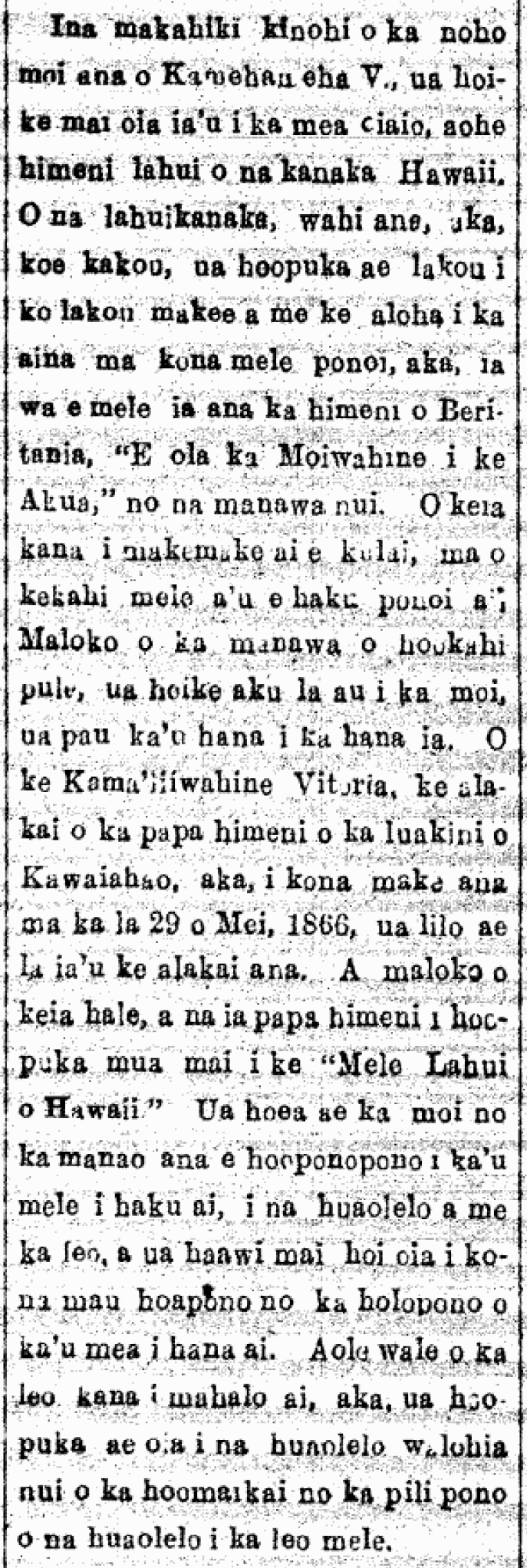
KA BUKE MOOLELO HAWAII I HAKUIA E KA Moiwahine Liliuokalani...

Ke Aloha Aina, Buke IV, Helu 20, Aoao 7. Mei 14, 1898.
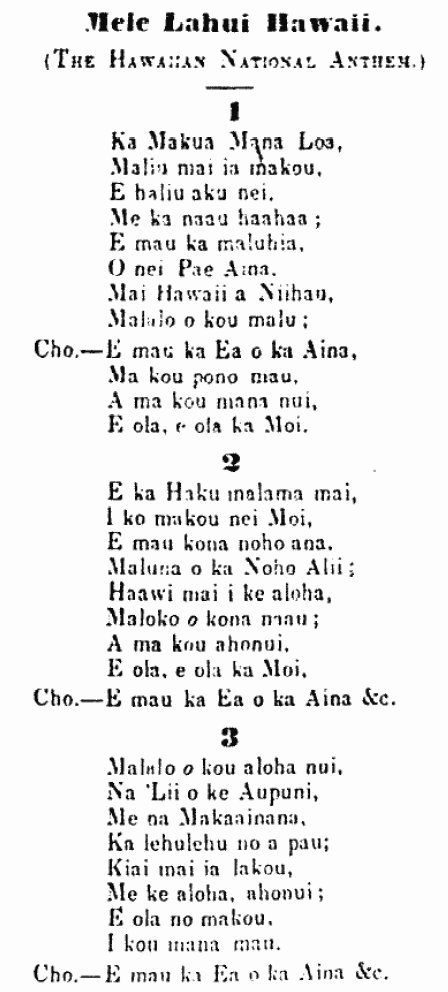
Hawaiian National Anthem, 1866.

Mele Lahui Hawaii.
(The Hawaiian National Anthem.)

1

Ka Makua Mana Loa,
Maliu mai ia makou,
E haliu aku nei,
Me ka naau haahaa;
E mau ka maluhia,
O nei Pae Aina,
Mai Hawaii a Niihau,
Malalo o kou malu.

Cho.—E mau ka Ea o ka Aina,
Ma kou pono mau,
A ma kou mana nui,
E ola, e ola ka Moi.

2

E ka Haku malama mai,
I ko makou nei Moi,
E mau kona noho ana,
Maluna o ka Noho Alii;
Haawi mai i ke aloha,
Maloko o kona naau;
A ma kou ahonui,
E ola, e ola ka Moi.

Cho.—E mau ka Ea o ka Aina, &c.

3

Malalo o kou aloha nui,
Na ‘Lii o ke Aupuni,
Me na Makaainana,
Ka lehulehu no a pau;
Kiai mai ia lakou,
Me ke aloha, ahonui;
E ola no makou,
I kou mana mau.

Cho.—E mau ka Ea o ka Aina, &c.

The Hawaiian National Anthem.

1

Almighty Father,
Heed us,
Who turn to you,
With humble hearts;
Let there forever be peace,
In these Islands,
From Hawaii to Niihau,
Under your protection;

Cho.—Let the Sovereignty of this Land be for always,
By your never ending righteousness,
And by your great power,
Long live, long live the King.

2

O Lord, protect,
Our King,
Let his rule continue,
Upon the Throne;
Bestow him aloha,
Within his heart;
And by your grace
Long live, long live the King.

Cho.—Let the Sovereignty of this Land be for always, &c.

3

Under your great love,
Are the Alii of the Nation,
And the Makaainana,
All the people;
Do watch over them,
With aloha and magnanimity,
Let us live,
By your eternal power.

Cho.—Let the Sovereignty of this Land be for always, &c.

(Kuokoa, 11/24/1866, p. 2)

Mele Lahui Hawaii.

Ka Nupepa Kuokoa, Buke V, Helu 47, Aoao 2. Novemaba 24, 1866.

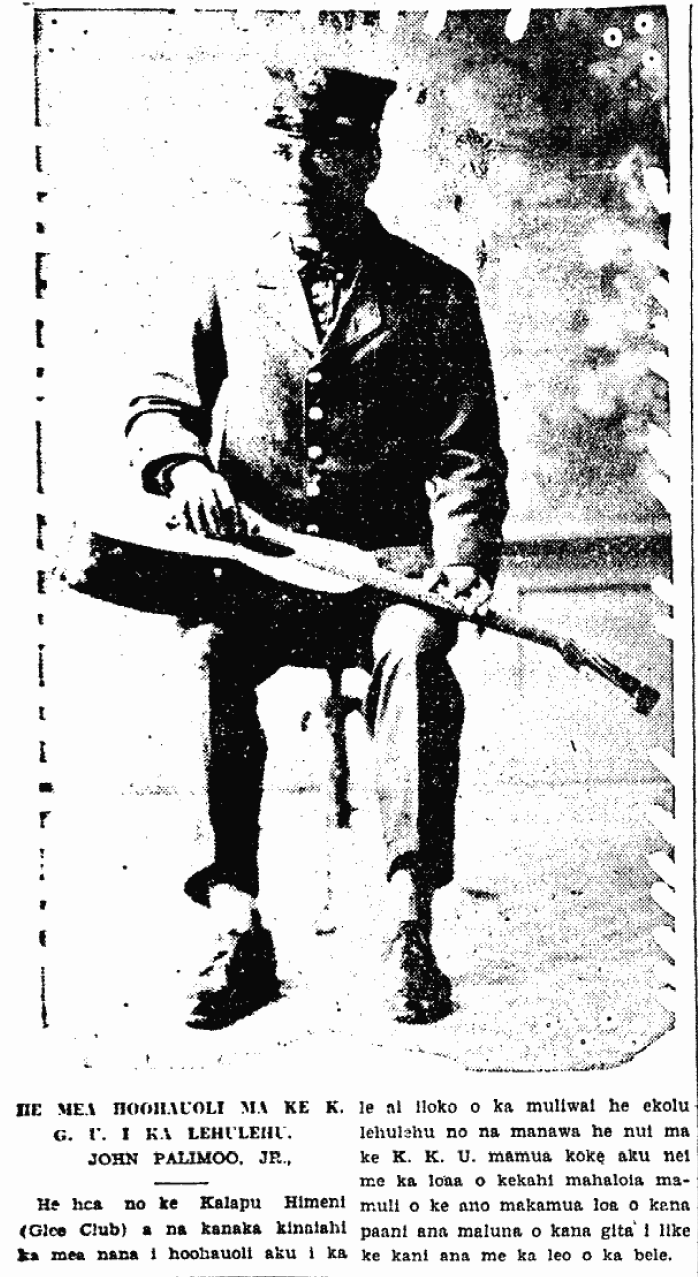
John Palimoo, Jr., steel guitarist on the radio, 1927.

ENTERTAINING THE MULTITUDES ON K. G. U., JOHN PALIMOO, JR.

He is a member of the Firemen’s Glee Club [Kalapu Himeni], the one who entertained the pubic many a time on K. K. U. [K. G. U.] recently, receiving acclaim because of his new way of playing on his guitar, making it sound like bells.

[Notice the first line on the right column. On occasion, there will be a misplaced line or section, especially in the later years of the newspapers, and the line that reads “le ai iloko o ka muliwai he ekolu” seems to be out of place.

Does anyone have any information on this steel guitar player, John Palimoo, Jr.?]

(Kuokoa, 9/8/1927, p.2)

HE MEA HOOHAUOLI MA KE K. G. U. I KA LEHULEHU, JOHN PALIMOO, JR.

Ka Nupepa Kuokoa, Buke LXVI, Helu 35, Aoao 2. Sepatemaba 8, 1927.

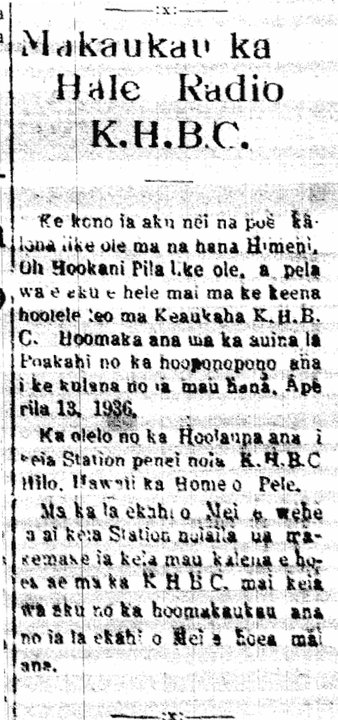
Beginning of KHBC, the famed radio station of Keaukaha, 1936.

The Radio Station, K.H.B.C. is Ready

Everyone talented in everything from Singing, Oli, Playing Instruments any type, and so forth, are invited to come to the radio broadcast station office in Keaukaha, K. H. B. C. The preparations for this begins on the afternoon of Monday, April 13, 1936.

The Station introduction goes, “K.H.B.C., Hilo, Hawaii, the Home of Pele.”

This Station will open on the first of May, therefore, we want these talented people to come to K. H. B. C. from now forth to prepare for the approaching first day of May.

[Vickie Ii Rodrigues’ famous composition, still heard today, begins: “Aia i ka la’i, ulalaeho; O Keaukaha la, ulalaeho; K. H. B. C., ulalaeho; Ka home a’o Pele, ulalaeho!” (There in the calm, ulalaeho; Of Keaukaha, ulalaeho; Is K. H. B. C., ulalaeho; The home of Pele, ulalaeho!)

I still recall my mom, who was born and raised in Ninole, saying that she used to listen to that station…]

(Hoku o Hawaii, 4/15/1936, p. 2)

Makaukau ka Hale Radio K. H. B. C.

Ka Hoku o Hawaii, Volume XXVII, Number 39, Page 2. April 15, 1936.

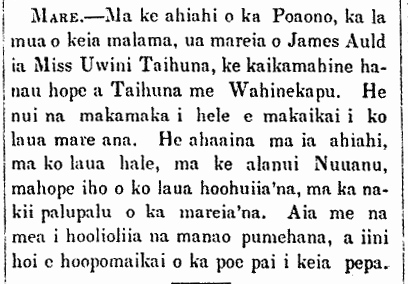
James Auld gets married. 1862.

[Found under: “NEWS OF HAWAII NEI.”]

MARRIED.—On Saturday evening, the first day of this month, James Auld was married to Miss Uwini Taihuna, the youngest daughter of Taihuna and Wahinekapu. There were many friends who went to see the wedding. There was a party at their house that evening, on Nuuanu Avenue, after they were joined by the gentle tie of marriage. With those who were filled with joy are the warm thoughts and hopes that they will be blessed from the people who print this paper.

[See Kuokoa 9/3/1864, p. 4, for mele inoa composed for Harry W. Auld (Uwilakulani), the first child of Kimo (James) and Uwinihepa! The mele inoa are composed by Apela and Kaniwahie of Kawela, Molokai.—This was found searching the Bishop Museum’s Archives online search!!

Wow… Also found online: “Taihuna” is also known as “Wong Tai-hoon” or “Tyhune”. See: Three Chinese Stores in Early Honolulu, Wai-Jane Char (Hawaiian Journal of History, Volume 08, 1974.]

(Kuokoa, 3/8/1862, p. 2)

MARE.

Ka Nupepa Kuokoa, Buke I, Helu 15, Aoao 2. Maraki 8, 1862.

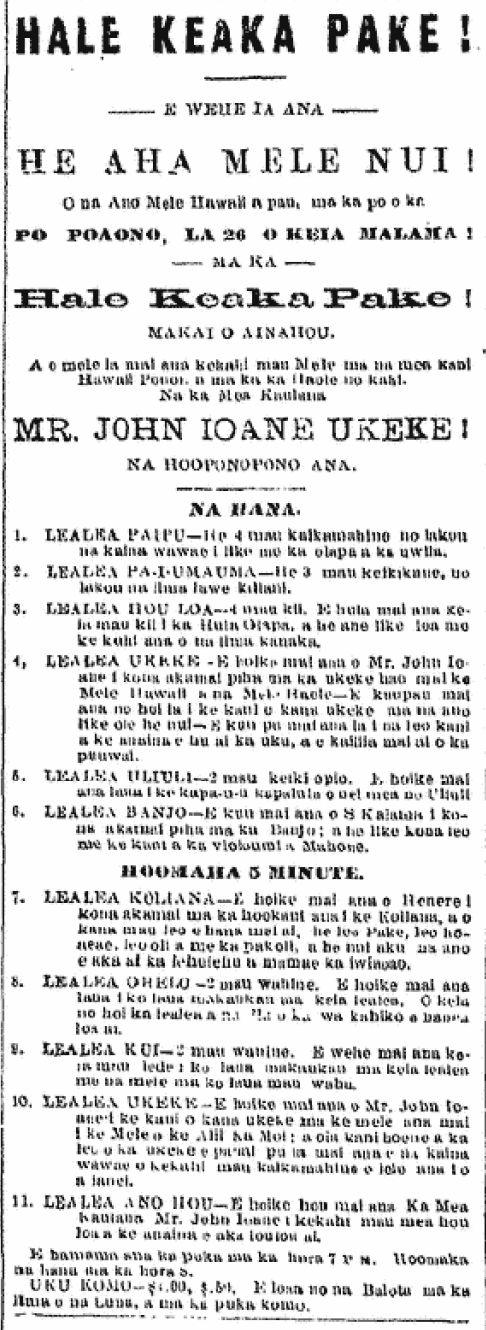
John Ioane Ukeke, in his earlier days! 1880

CHINESE THEATER!

OPENING

A GRAND CONCERT!

Of all types of Hawaiian Music, on the night of the

SATURDAY NIGHT, THE 26TH OF THIS MONTH!

AT THE

Chinese Theater!

SEASIDE OF AINAHOU.

There will be some Mele performed with Native Hawaiian instruments, and some with Haole instrments.

By the Famed One

MR. JOHN IOANE UKEKE!

IS THE ORCHESTRATING.

THE PERFORMANCE.

1. IPU PERFORMANCE [LEALEA PAIPU]—4 girls whose steps are like flashes of lightning.

2. CHEST SLAPPING PERFORMANCE [LEALEA PA-I-UMAUMA]—3 boys with swift hand motions.

3. MODERN PERFORMANCE [LEALEA HOU LOA]—4 dolls. The dolls will do a Hula Olapa, and their hand motions will be like those of a human.

4. UKEKE PERFORMANCE [LEALEA UKEKE]—Mr. John Ioane will show his total skill with the metal ukeke (Jew’s harp) with Hawaiian songs and Haole songs—He will exert himself with his ukeke playing in all fashions—[It doesn’t help that the image is not clear, but cannot make out the next line and a half. Anyone?] and your hearts will be captured.

5. ULIULI PERFORMANCE [LEALEA ULIULI]—2young children. They will show the fluttering and rattling of this thing, the Uliuli.

6. BANJO PERFORMANCE [LEALEA BANJO]—S. Kalama will exhibit his full skill at the Banjo; and its sound is like the ten-stringed lyre of Mahone [this is probably a reference to a story running in the Kuokoa: “KA MOOLELO O BERIANA KA WIWO OLE A ME MAHONE KE KOA” (4/26/1879–11/20/1880)]

FIVE MINUTE BREAK.

7. ACCORDIAN PERFORMANCE [LEALEA KOLIANA]—Henere [Henry] will show his skill at playing the Accordian, and the sounds he makes: Chinese, hoaeae, oli and the musical scale [pakoli]; it will make the crowd laugh and your sides will hurt.

8. OHELO PERFORMANCE [LEALEA OHELO]—2 women. They will show their abilities at this amusement. This is the amusement of the alii of the olden days that they greatly enjoyed.

9. KUI PERFORMANCE [LEALEA KUI]—2 women. These two ladies will display their readiness at this amusement while from their mouths come mele.

10. UKEKE PERFORMANCE [LEALEA UKEKE]—Mr. John Ioane will show his playing of the ukeke with Mele of the King; and this sweet voice of the ukeke will be accompanied by the steps of some girls doing lele this way and that.

11. MODERN PERFORMANCE [LEALEA ANO HOU]—The Famous Mr. Ioane will show once again some new things that will have the audience in stitches.

The doors will open at 7 P. M. Performances begin at 8.

ENTRANCE FEE: $1.00, $ .50. Tickets [Balota ?] available from hand of those in charge as well as at the entrance.

(Ko Hawaii Pae Aina, 6/26/1880, p. 2)

HALE KEAKA PAKE!

Ko Hawaii Pae Aina, Buke III, Helu 26, Aoao 2. Iune 26, 1880.

One more on the passing of Ioane Ukeke, 1903.

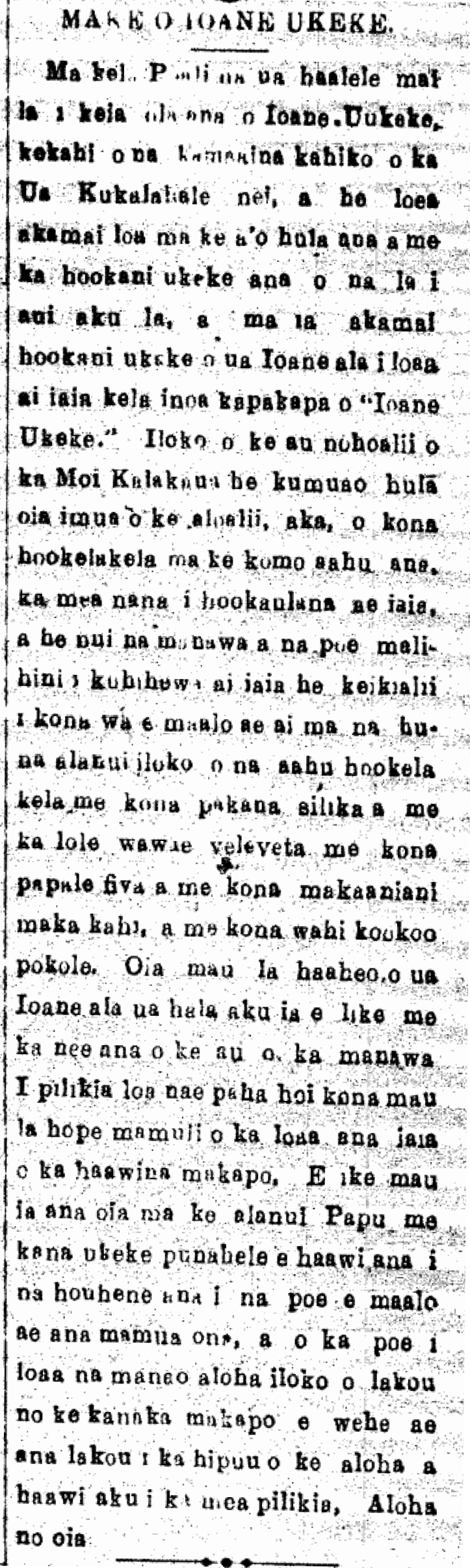
IOANE UKEKE HAS DIED.

Last Friday, Ioane Ukeke left this life, he was one of the old-time kamaaina of the Kukalahale Rain [famous rain of Honolulu], and he was a skilled expert at teaching hula and playing the ukeke in the days gone by, and it is because of Ioane’s skill at playing the ukeke that he received the nickname “Ioane Ukeke.” During the reign of King Kalakaua, he was a hula teacher [kumuao hula] in the royal court, but what made him famous was his showing off in costume, and there was many a time when foreigners mistook him for a prince when he passed by the street corner [huna alanui? huina alanui?] in his stylish attire and his silk waist [pakana ?] and velvet slacks with his beaver hat and monocle, with his short cane. Those proud days of Ioane have gone with the flow of time. He faced difficulties in his latter days, because of blindness. He was always seen on Fort Street with his favorite ukeke serenading those passing by before him, and those who felt aloha for this blind man would undo the tie of aloha and gave a helping hand to the impaired one. Aloha for him.

(Aloha Aina, 5/9/1903, p. 6)

MAKE O IOANE UKEKE.

Ke Aloha Aina, Buke IX, Helu 19, Aoao 6. Mei 9, 1903.

Because February shouldn’t be the only Hawaiian Language month… 1948.

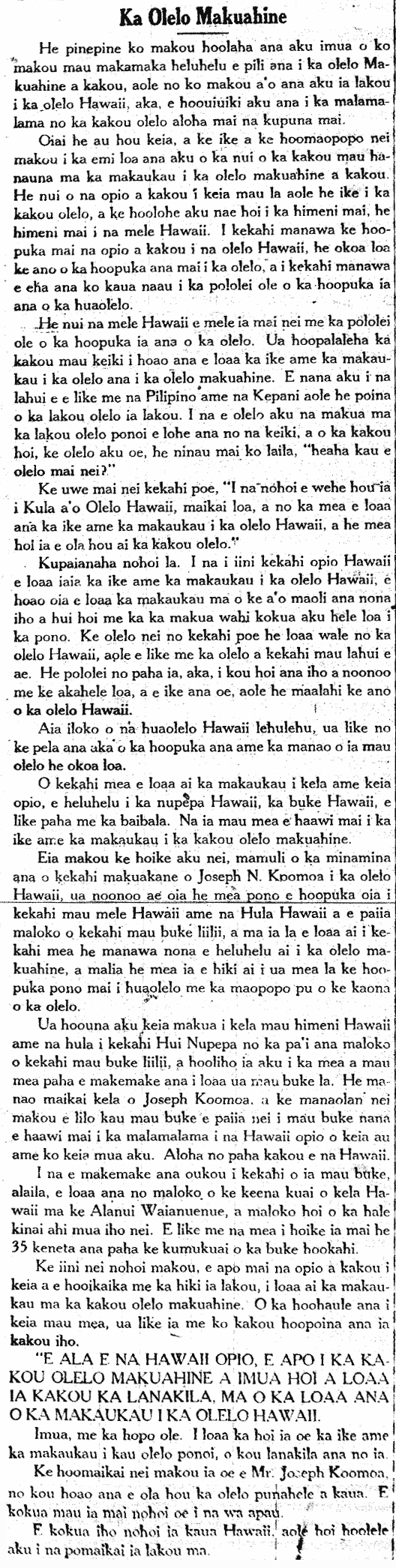
THE MOTHER TONGUE

We frequently speak to our dear readers about our Mother tongue, not about our teaching them the Hawaiian language, but that the light of our beloved language from our forefathers is being extinguished.

Being that this is a new era, and we see and realize that there is a drastic reduction in the number of our generations capable in our mother tongue. There are many of our youths these days who have no knowledge of our language, but when you listen to them singing, they sing Hawaiian songs. Sometimes when our children speak Hawaiian, their production of the language is so strange, and sometimes our naau [gut, heart] aches at their mispronunciation of words.

There are many Hawaiian songs sung with incorrect pronunciation. Our children are neglecting trying to acquire knowledge and proficiency in speaking the mother tongue. Look at the other ethnicities like the Filipinos and the Japanese, they haven’t forgotten their language. If parents spoke in their own language then the children would hear; and when we talk to them, they’ll ask, “he aha kau e olelo mai nei? [what are you saying?]”

Some people bewail, “If only Hawaiian-Language Schools were reopened, that would be a good thing because we’d get knowledge and proficiency in the Hawaiian language and it would revive our language.”

That is astonishing. Should a young Hawaiian have the desire to acquire knowledge and competency in the Hawaiian language, he should try to get this competency by studying diligently by himself and to get together with an adult for help and there would be great progress. Some say that Hawaiian can be gotten just like that, not like the languages of other people. Perhaps it is true, but if you go back and think with great seriousness, you will see that the Hawaiian language is not easy.

Within the many Hawaiian words, spellings might be the same, but the pronunciation and meanings of those words are different.

One thing that will give every youth proficiency is the reading of Hawaiian newspapers and Hawaiian books like perhaps the bible. Those things will give knowledge and competence in our native language.

We point out that because of the great love of a certain father, Joseph N. [Nihiaumoe] Koomoa, for the Hawaiian language, he thought it would be important to publish some Hawaiian songs and Hawaiian Hula and print some booklets, and through that someone could make time to read the Hawaiian language and perhaps that way the person could pronounce the words while understanding the kaona [underlying meanings].

This man sent those Hawaiian songs and hula to a Newspaper company to be printed in booklets, and it will be sold to the person or persons who want those books. This is a good idea of Joseph Koomoa’s, and we hope that your books that are being printed will become books that give knowledge to the Hawaiian youths of this age and of the future. Aloha to us, O Hawaiians.

Should you want one of those books, they will be available at the shop of that Hawaiian on Waianuenue Avenue, and also the former fire station [?] According to what was announced, the books will probably cost 35 cents each.

We want our youngsters to get a hold of this and and improve themselves to the best of their ability so that they can get proficiency in our mother tongue. Letting these go would be like forgetting our own selves.

“RISE YOUNG HAWAIIANS, GRASP OUR MOTHER TONGUE AND GO FORTH AND LET US BE TRIUMPHANT BY BEING PROFICIENT IN THE HAWAIIAN LANGUAGE.

Forge forward with no fear. So that you can get knowledge and proficiency in your own language—that will be your triumph.

We give our congratulations to you, Mr. Joseph Koomoa, for you attempt to revive the prized language of ours. You will be helping for all times [E kokua mau ia mai nohoi oe i na wa apau. ?]

Help ourselves Hawaiians, and don’t let the benefits go to those others [E kokua iho nohoi ia kaua Hawaii, aole hoi hoolele aku i na pomaikai ia lakou ma. ?]

[Anyone know of any copies of these music booklets by Joseph N. Koomoa still in existence???]

(Hoku o Hawaii, 2/11/1948, p. 2)

Ka Olelo Makuahine.

Ka Hoku o Hawaii, Volume XLI, Number 19, Aoao 2. Pepeluali 11, 1948.

Kawaihau Orchestra and Glee Club in SF. 1905.

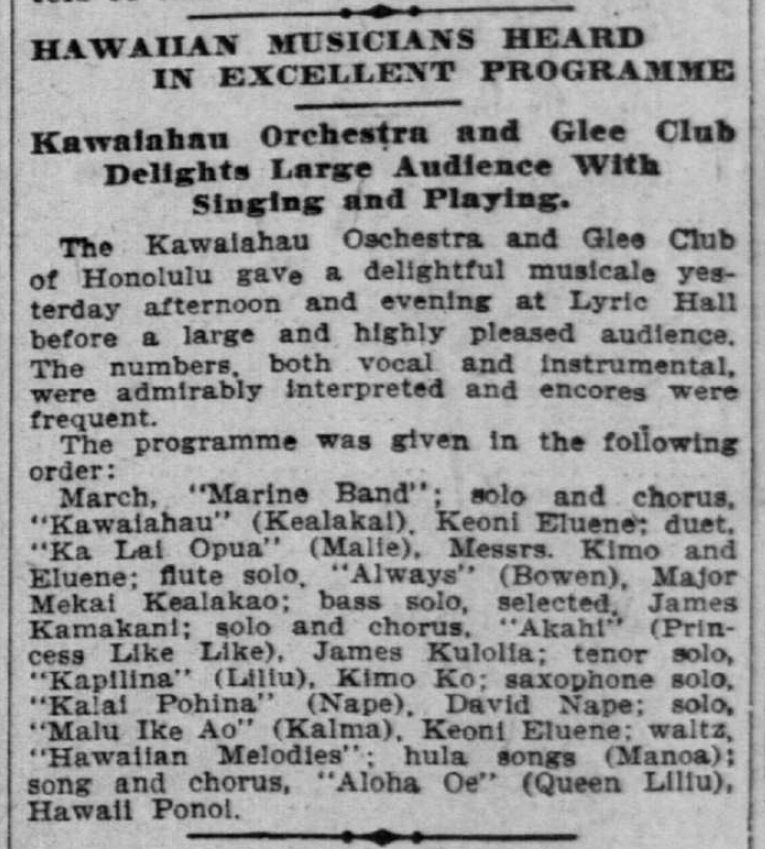
HAWAIIAN MUSICIANS HEARD IN EXCELLENT PROGRAMME

Kawaiahau Orchestra and Glee Club Delights Large Audience With Singing and Playing.

The Kawaiahau Orchestra and Glee Club of Honolulu gave a delightful musicale yesterday afternoon and eveing at Lyric Hall before a large and highly pleased audience. The numbers, both vocal and instrumental, were admirably interpreted and encores were frequent.

The programme was given in the following order:

March, “Marine Band”; solo and chorus, “Kawaiahau” (Kealakai), Keoni Eluene; duet, “Ka Lai Opua” (Malie), Messrs. Kimo and Eluene; flute and solo, “Always” (Bowen), Major Mekia Kealakao [Kealakai]; bass solo, selected, James Kamakani; solo and chorus, “Akahi” (Princess Like Like [Likelike]), James Kulolia; tenor solo, “Kapilina” (Liliu), Kimo Ko; saxophone solo, “Kalai Pohina” (Nape), David Nape; solo, “Malu Ike Ao” (Kalima), Keoni Eluene; waltz, “Hawaiian Melodies” ; hula songs (Manoa); song and chorus, “Aloha Oe” (Queen Liliu), Hawaii Ponoi.

[Because of its location, The San Francisco Call had much Hawaii coverage.]

(San Francisco Call, 10/7/1905, p. 16)

HAWAIIAN MUSICIANS HEARD IN EXCELLENT PROGRAMME

The San Francisco Call, Volume XCVIII, Number 129, Page 16. October 7, 1905.