Tarzan in the Hawaiian-Language Newspapers, 1917–1931.

Just as the previous “Tarzan of the Apes” advertisement said, Kuokoa was running a Tarzan story while the movie was playing! Tarzan stories were apparently very popular as they were translated in the papers for many, many years.

Kuokoa

“He Moolelo no Tazana, a i ole, Ka Hiena o na Ululaau Anoano o na Kapakai o Aferika” 11/30/1917–5/10/1918 (Tarzan of the Apes),

5/10/1918–11/8/1918 (Return of Tarzan)

11/8/1918–3/7/1919 (The Beasts of Tarzan)

“He Moolelo no Keaka Tazana: Ka Weli o na Ululaau Mehameha o Aferika a o ka Hoaloha o na Holoholona Ahiu” 11/7/1919–5/21/1920 (The Son of Tarzan)

“He Moolelo no Tazana a i ole, Ka Hiena o na Ululaau Anoano o na Kapakai o Aferika. Mahele II” 5/21/1920–10/8/1920 (Tarzan and the Jewels of Opar)

Hoku o Hawaii

“He Moolelo no Tarzan me ka Liona Gula” 3/22/1923–9/11/1924 (Tarzan and the Golden Lion)

“He Moolelo no Tarzan: Ke Alii o na Mabu ao ka Mea Laka Ole” 9/18/1924–3/1/1927 (Tarzan the Untamed)

3/8/1927–6/18/1929 (Tarzan the Terrible)

6/25/1929–12/22/1931 (Return of Tarzan) [Retranslated]

Ola o Hawaii

[Unfortunately, this publication is not online. I need to check for dates and title.]

Be good to your parents while you can! 1911.

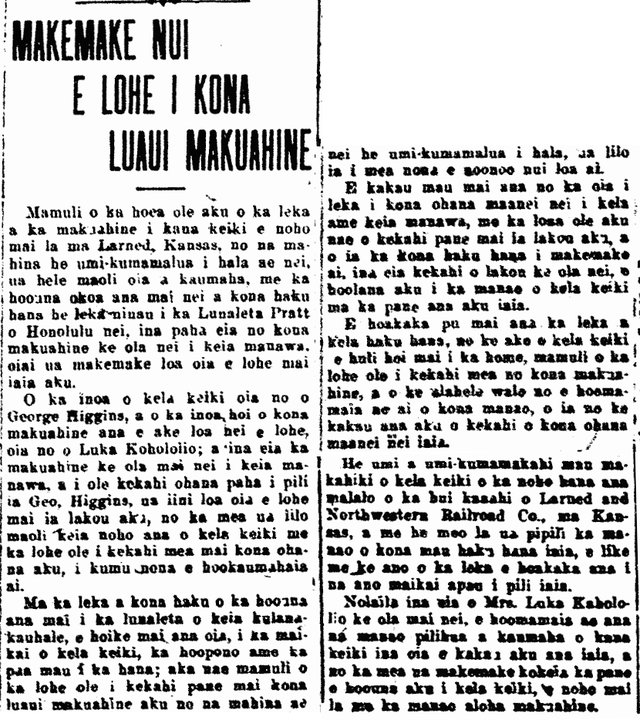
DESPERATELY WANTING TO HEAR FROM HIS BIRTH MOTHER

Because there arrived no letter from a mother to her child living in Larned, Kansas, over the past 12 months, this man has become very dejected. And his boss personally just sent a letter to Post Master Pratt of Honolulu nei, asking if perhaps his mother is living, because the man really wants to hear from her.

The name of this youth is George Higgins, and the name of his mother, from whom he desperately wants to hear from is Luka Kohololio [Kahololio]; and if the mother is still living, or any other relatives of Geo. Higgins, he would like terribly to hear from them, for living without word from his family has put him in depression.

In the letter sent by his boss to the the post master of this town, he speaks of the upright nature of the youth, and his good work ethic; however, because he has heard nothing from his birth mother for the past 12 months, it is something that he is constantly concerned about.

He keeps writing letter to his family here, without any response; therefore, his boss hopes that if there is any of them here still living, that they would brighten his disposition by responding.

The letter by his boss goes on to describe that the boy wants to go back home because of the lack of news from his mother. And the only means to take this load off of him is for one of his family here to write.

This boy was working for the Larned and Northwestern Railroad Co. in Kansas for some 10 or 11 years. And it seems that his boss is quite taken with him, as was shown in the letter expounding on all of his good traits.

Therefore, should Mrs. Luka Kahololio be alive, it would lessen the grief and sadness of her child should she write to him, and it is hoped that a speedy reply be sent to this boy living with thoughts of aloha for his mother.

(Kuokoa, 6/30/1911, pp. 1 & 4)

MAKEMAKE NUI E LOHE I KONA LUAUI MAKUAHINE

Ka Nupepa Kuokoa, Buke XLVII, Helu 26, Aoao 1 & 4. Iune 30, 1911.

Letter from Iosepa, Utah, 1913.

A VOICE FROM UTAH.

Iosepa, Toole County. Dec. 19, 1912.

Solomon Hanohano, Editor of the Kuokoa, Aloha oe:—Because I want to know the news of the land of our birth, the desire to get a subscription to the Kuokoa grew. Being the the new year is coming, it would be a means for me to see the news of our home and the progress of the political scene or its regression, as well as the victories or discouragements of our fellow makaainana.

Not because Iosepa lacks newspaper subscribers, but for me to get a personal one.

This is one of the important years regarding the nation, being that the leadership of the power of the nation went to the Democrats; the big question is just this: Will the poor makaainana really benefit, or will they be left unstable once again like during the presidency of Cleveland, but it is only time that will tell.

If those elected could follow through on what their lips pledge to the masses, then we indeed will be blessed, however if it is like what Isaiah said, thusly: “These people come near to me with their mouth, but their hearts are far from me.” [Isaiah 29:13] Then comes those famous words of that old timer of Lahaina: “Saying, when indeed will that happen.” [“I mai hoi, ahea la ka hoi.”] The big-eyed images know that the small-eyed images are not watched. [Ikeia aku la no na kii maka nunui, nana oleia iho la na wahi kii maka liilii ??]

My aloha to the few Hawaiian makaainana left who are squeezed and assimilated [i ka opaia aku ua pili pu ?] until they are totally gone from the beloved face of Hawaii, along with the increase of the other races upon the land. And so too with the various diseases of the different races whose devastation spread to our people who lack immunity. Aloha to our people.

As for our living in this unfamiliar land, this land that true Mormons know as the chosen land, and a land to foster the believers in that one faith, all of the Hawaiians are in good health as well as the Samoans, from the old to the young.

I have faith that Iosepa will become a place where Hawaiians will multiply once again, and that these valleys will become full of true Hawaiians and Samoans, when the children are born, and grow up, and marry and give birth.

Some proof of this belief is the great desire of the president of the Mormons for the youths to marry of their own race so that this land is full of Hawaiians. For according to him, it is here that the people of the islands of the ocean will spread.

The town of Iosepa is growing. The church is building homes for the people without homes, lest they live in disarray as the Hawaiians before, with two or three families in a single dwelling.

The workers are paid a dollar every Saturday. The children are taught in the school here in Iosepa. Two children graduated from the local school of Iosepa, and are attending high school, they are Joseph H. Bird and William Pukahi, both are true Hawaiians.

I have been just chosen as judge, and George K. Hubbell as sheriff of the district. We are both Republicans, which also are the majority of the Hawaiians here.

Perhaps this will do.

Charles J. Broad.

Iosepa, Toole County, Utah.

(Kuokoa, 1/10/1913, p. 6)

HE LEO MAI UTAH MAI.

Ka Nupepa Kuokoa, Buke XLIX, Helu 2, Aoao 6. Ianuari 10, 1913.

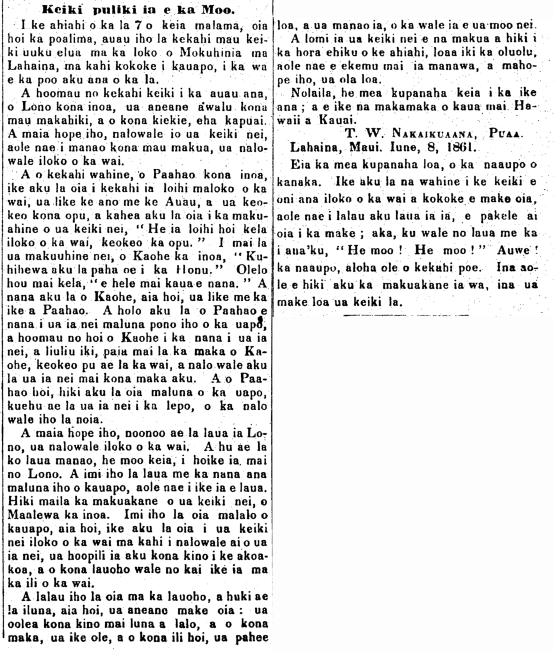
Moo at Mokuhinia, Lahaina, 1861.

Child Grabbed by Moo.

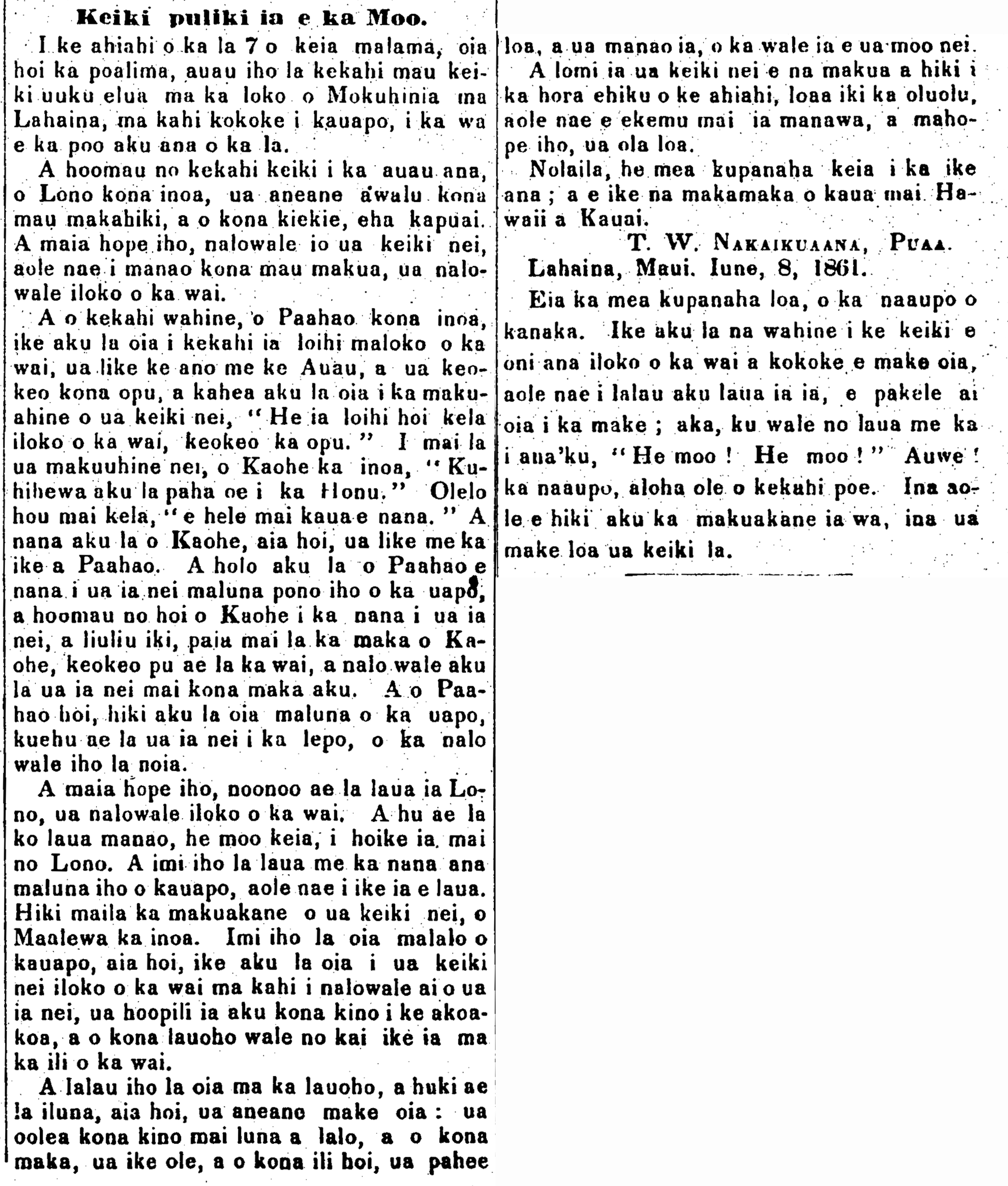
On the evening of the 7th of this month, that being a Friday, a couple of small children were bathing in Mokuhinia Pond in Lahaina, close to the bridge [uapo], when the sun was going down.

One of them continued to bathe, his name was Lono; he was almost eight years old, and his height was four feet. Right then after, this boy plain disappeared, but his parents did not think that he disappeared in the water.

A woman named Paahao saw a long fish in the water like an Swordfish [Auau], and its belly was white; she called out to the mother of the boy, “There is a long fish in the water with a white belly.” The mother named Kaohe said, “You must be confusing it with a Turtle.” The other responded, “Let’s go and see.” Kaohe went, and lo and behold, it was as Paahao had seen. Paahao went to go see the fish from atop the bridge while Kaohe continued to watch the fish; after a little time, Kaohe’s eyes were struck [temporarily blinded? “paia mai la ka maka”] and the water turned white, and the fish disappeared from her sight. As for Paahao, she arrived atop the bridge and the fish sprayed up dust, and it disappeared.

Then after, the two thought of Lono, and that he disappeared in the water. And they concluded that this was a moo that had revealed itself for Lono. They searched and went to look on the bridge, but it was not seen.

The father of the boy arrived, named Maalewa. He looked under the bridge, and come to find out, he saw the boy in the water where he was hidden by the moo; his body was attached to the coral and his hair was all that could be seen on the surface of the water.

The father grabbed him by the hair, and pulled him up, and he was almost dead; his body was stiff from top to bottom, and his eyes could not see, and his skin was slimy, which was believed to be the slime of the moo.

He was massaged by his parents until seven in the evening, whereupon he got slightly better but did not say a word, but later he revived.

Therefore, this was something miraculous to see; let it be known to all our friends from Hawaii to Kauai.

T. W. NAKAIKUAANA, PUAA.

Lahaina, Maui. June 8, 1861.

This is the remarkable thing; the foolishness of man. The women saw the child shaking in the water, close to dying, and they did not grab him and save him; but they just stood there saying, “A moo! A moo!” Auwe! the foolishness and heartlessness of some people. If the father had not arrived then, the child would be dead.

[I posted this article a long time ago on the Hoolaupai Facebook page, but because it has such bad search capabilities, i can’t find it. That is one of the reasons i started this blog. Searching for names or places or subjects, etc., is so much easier to do!

I am not sure what the commentary at the bottom is referring to, about the women seeing the boy shaking in the water…

For more on Mokuhinia and the work being done to restore this historic place, see: Friends of Mokuula.]

(Hae Hawaii, 6/12/1861, p. 41)
Keiki puliki ia e ka Moo.

Ka Hae Hawaii, Buke 6, Ano Hou.—Helu 11, Aoao 41. Iune 12, 1861.

More on the opening of KHBC, 1936.

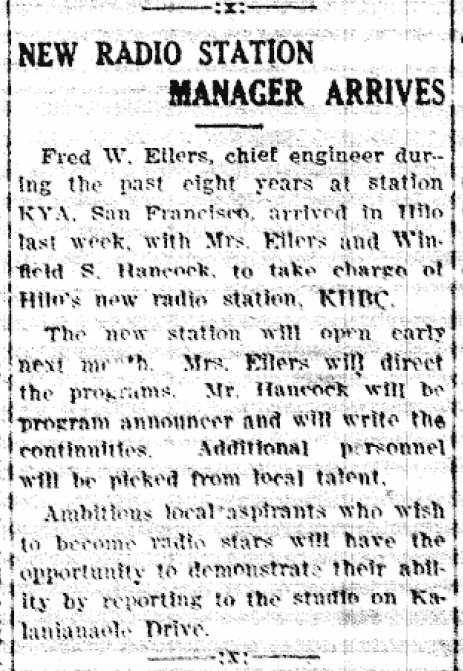
NEW RADIO STATION MANAGER ARRIVES

Fred W. Eilers, chief engineer during the past eight years at station KYA, San Francisco, arrived in Hilo last week, with Mrs. Eilers and Winfield S. Hancock, to take charge of Hilo’s new radio station, KHBC.

The new station will open early next month. Mrs. Eilers will direct the programs. Mr. Hancock will be program announcer and will write the continuities. Additional personnel will be picked from local talent.

Ambitious local aspirants who wish to become radio stars will have the opportunity to demonstrate their ability by reporting to the studio on Kalanianaole Drive.

[Starting on February 4, 1936, the front page of Hoku o Hawaii (published in Hilo), was printed in English, and the following three pages were in Hawaiian.]

(Hoku o Hawaii, 4/15/1936, p. 1)

NEW RADIO STATION MANAGER ARRIVES

Ka Hoku o Hawaii, Volume XXVII, Number 39, Page 1. April 15, 1936.

Beginning of KHBC, the famed radio station of Keaukaha, 1936.

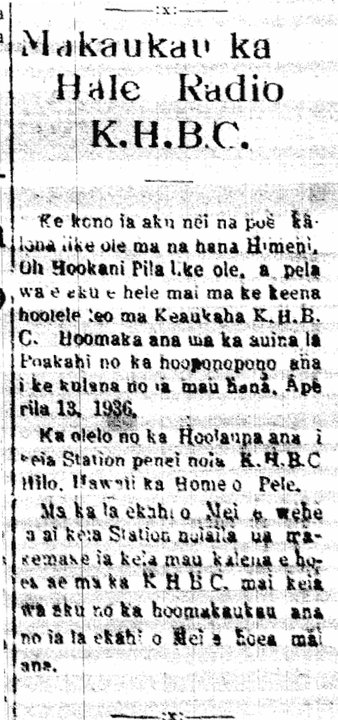
The Radio Station, K.H.B.C. is Ready

Everyone talented in everything from Singing, Oli, Playing Instruments any type, and so forth, are invited to come to the radio broadcast station office in Keaukaha, K. H. B. C. The preparations for this begins on the afternoon of Monday, April 13, 1936.

The Station introduction goes, “K.H.B.C., Hilo, Hawaii, the Home of Pele.”

This Station will open on the first of May, therefore, we want these talented people to come to K. H. B. C. from now forth to prepare for the approaching first day of May.

[Vickie Ii Rodrigues’ famous composition, still heard today, begins: “Aia i ka la’i, ulalaeho; O Keaukaha la, ulalaeho; K. H. B. C., ulalaeho; Ka home a’o Pele, ulalaeho!” (There in the calm, ulalaeho; Of Keaukaha, ulalaeho; Is K. H. B. C., ulalaeho; The home of Pele, ulalaeho!)

I still recall my mom, who was born and raised in Ninole, saying that she used to listen to that station…]

(Hoku o Hawaii, 4/15/1936, p. 2)

Makaukau ka Hale Radio K. H. B. C.

Ka Hoku o Hawaii, Volume XXVII, Number 39, Page 2. April 15, 1936.

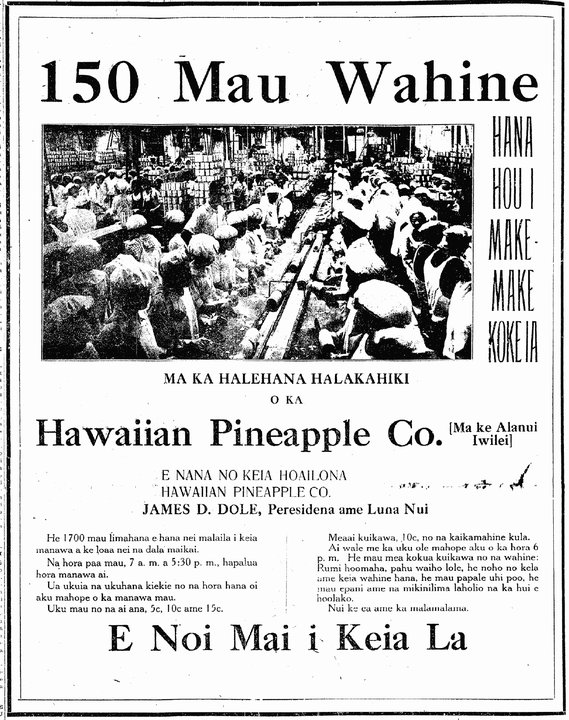
Hawaiian Pine Advertisement, 1919.

150 Women

NEW POSITIONS WANTED FILLED SOON

AT THE PINEAPPLE PLANT

OF

Hawaiian Pineapple Co. [On Iwilei Street]

LOOK FOR THIS SIGN

HAWAIIAN PINEAPPLE CO.

JAMES D. DOLE, President and Foreman

1700 workers are working there currently and are receiving good pay.

The set hours are 7 a. m. to 5:30 p. m. with half an hour food break.

High overtime pay is paid for work done over the regular hours.

Regular costs for food, 5¢, 10¢ and 15¢.

Snacks, 10¢ for school girls.

Food for free after 6 p. m. Special amenities for the women: Break room, lockers, seats for each working woman, head coverings, apron and rubber gloves supplied by the company.

There is much air and light.

Inquire Today

(Kuokoa, 7/18/1919, p. 2)

150 Mau Wahine

Ka Nupepa Kuokoa, Buke LVII, Helu 29, Aoao 2. Iulai 18, 1919.

Another Wooden Kii found, 1868.

Akua Kii of Kalia.

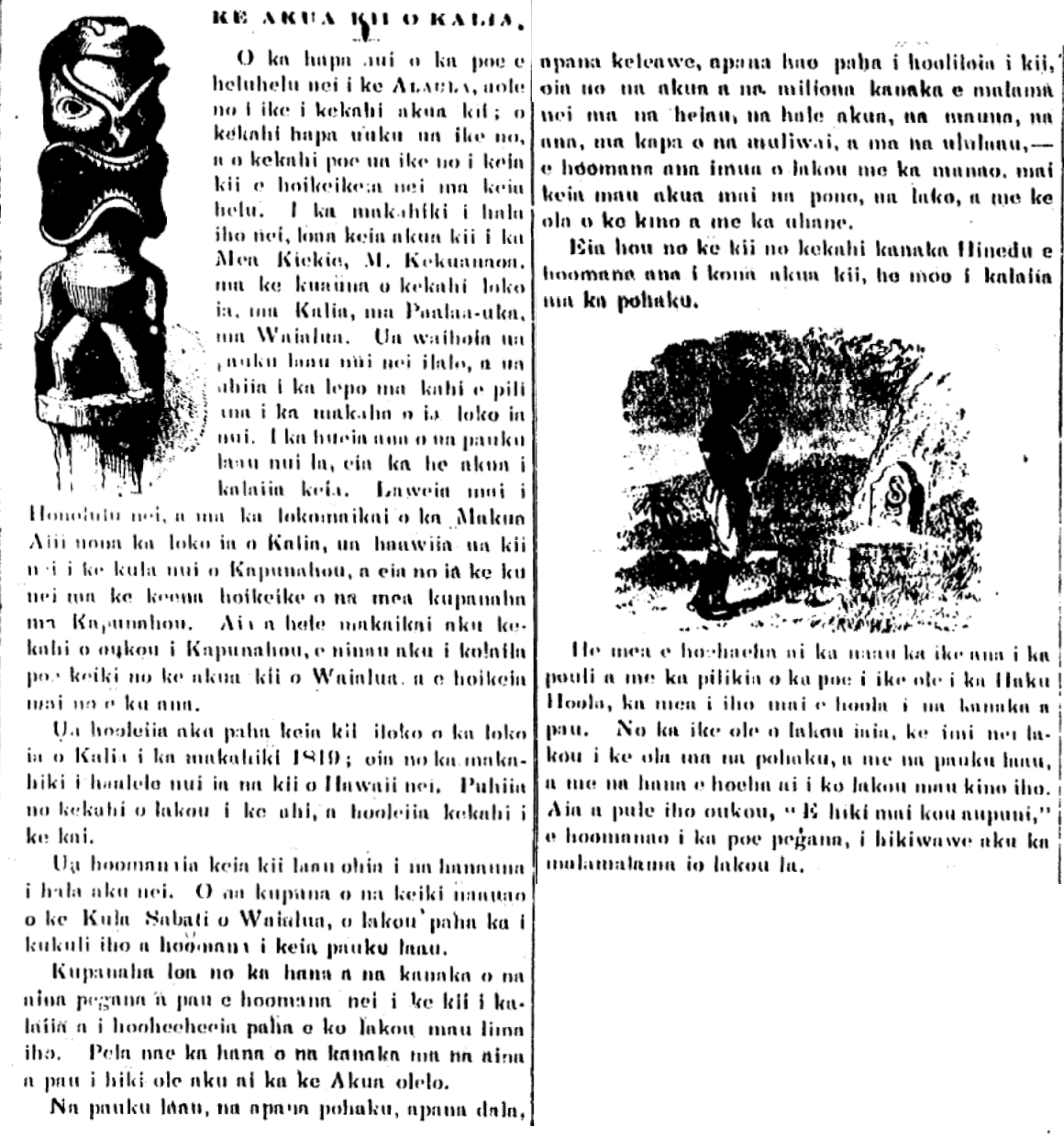
Most of the people reading Ke Alaula have not seen an akua kii, but a small fraction have seen one, and some of you saw this image that is shown here in this issue. Last year, this god idol was found by the Honorable M. Kekuanaoa on the banks of a fish pond at Kalia in Paalaa Uka in Waialua. That large piece of wood was set down and covered with soil near the sluice gate of that large fish pond. When that big piece of wood was unearthed, lo and behold, it was a carved god. It was brought to Honolulu nei, and through the goodwill of the Alii Elder who owns Kalia fishpond, that kii was given to the college of Kapunahou [Punahou], and there it stands in the exhibition room of curiosities at Kapunahou. When some of you go to visit Kapunahou, ask the children there about the kii from Waialua, and it will be shown to you where it stands.

This kii was probably thrown into the pond of Kalia in the year 1819; that is the year when there was the kii of Hawaii nei were greatly abandoned. Some of them were burnt in fire and some were thrown into the sea.

These ohia wood images were worshiped by previous generations. The kupuna of the educated children of Waialua Sunday School were probably those that knelt down and worshiped this piece of wood.

How astonishing are the actions of the people of all of the pagan lands, who worship idols that are carved or molded by their own hands. That is how all lands are where the word of God has not reached.

Pieces of wood, fragments of rock, chunks of silver, chunks of metal, or perhaps chunks of iron turned into images—those are the gods cared for by millions of people, in heiau, houses of god, mountains, caves, banks of rivers, and in forests; they worship before them thinking that from these gods come well being, wealth, and life in body and spirit.

Here also is a picture of a Hindu man worshiping his godly image; it is a snake carved into a rock.

This is something that pains the heart to see the darkness and trouble of those that don’t know of the God the Savior, the one who came down to save all man. Because they don’t know him, they seek salvation from rocks and pieces of wood and from actions that hurt their very own bodies. When you pray, “Thy kingdom come,” remember the pagans so that the light reaches them quickly.

[Could this Akua Kii be the one now at the Bishop Museum which was found in Waialua and presented to Punahou?]

(Alaula, 1/1868, p. 39)

KE AKUA KII O KALIA.

Ke Alaula, Buke II, Helu 10, Aoao 39. Ianuari, 1868.

Titanic survivor comes through Hawaii. 1912

[Found under: “Local News”]

One of the passengers who escaped from the steamship Titanic, Hosono, a Japanese, arrived here in Honolulu aboard the Shinyo Maru [Shun’yō Maru] and left for Japan.

[Monday (4/16/2012) marks the 100th year since the tragedy heard all over the world. Who knew the only Japanese aboard the Titanic, Masabumi Hosono, spent some time in Hawaii nei.]

(Kuokoa, 5/31/1912, p. 8)

O kekahi o na ohua...

Ka Nupepa Kuokoa, Buke XLVIII, Helu 22, Aoao 8. Mei 31, 1912.