Hawaiian boys casualties of WWI, 1917.

FIVE HAWAIIAN BOYS DIED.

Washington, April 3—There are five Hawaiian boys thought to have been killed along with 16 Americans when the American steamer the Aztec was sunk. This ship was sunk outside of the seas of France by the German submarine without being given prior time for the captain and his sailors to prepare themselves on the previous Sabbath. Amongst the Americans  who are thought to have died are some sailors of the navy which the government placed aboard the ship when it left Newtown of Brest, the place of the shipwrecks of past [?? New York for Brest]. These are the first sailors of the navy to become victims of the Prussians as they attacked without giving time for them to distance themselves from the calamity of the sea placed upon them, and it is believed that Germany is at fault for breaking the pact with America by Germany starting its massacre with its submarines. This is the Brests where some of the shipwrecked of some of the skiffs landed [??] here below are the names of the Hawaiian boys:

Julian R. Masomber [Julian R. Macomber], Honolulu.

Charles Pinapolo, Honolulu.

Ekila Kaohi [Ekila Kaoki], Hawaii.

Tota Davisfi [Tato Davis], Hawaii.

H. K. Price, Hawaii. Continue reading

“American Queen”? 1917.

QUEEN LILIUOKALANI.

Clarifications by a Newspaper Writer about Her.

(Translated)

To “Ke Ola o Hawaii,”

Appearing in the British newspaper, The Outlook, of the other week, there were a number of awe-inspiring lines about our Queen, Liliuokalani, titled: “An American Queen.” This is how it went:

Americans sometimes forget that within one of the Territories of the United States there lives a real ex-Queen who owes the loss of her crown to the activities of American missionaries.

This Queen is, of course, Liliuokalani, of Hawaii, dethroned in the revolution of 1893. She is now a frail old lady of nearly seventy-nine years, and few but her immediate household and closest friends ever have the opportunity of meeting and talking with her.

It is interesting to record that because of one of the tragedies of the present war this aged Queen has permitted for the first time an American flag to fly over her home. The news of this incident comes to us in a letter from a correspondent in Hawaii. This correspondent writes:

It was my privilege a few days ago to attend what will possibly be the last public reception she will ever give to members of the Hawaiian Senate—some of her own race, and some sons of the missionaries who were mainly responsible for her overthrow. Although they belonged to a body absolutely democratic in form and elected by vote of the people as citizens of the United States, it was most interesting and somewhat touching to note the loyalty and love shown the aged ex-Queen: almost, one could imagine, as if she were still their reigning sovereign. Continue reading

Decoration Day, 1909.

“DAY TO STREW FLOWERS”

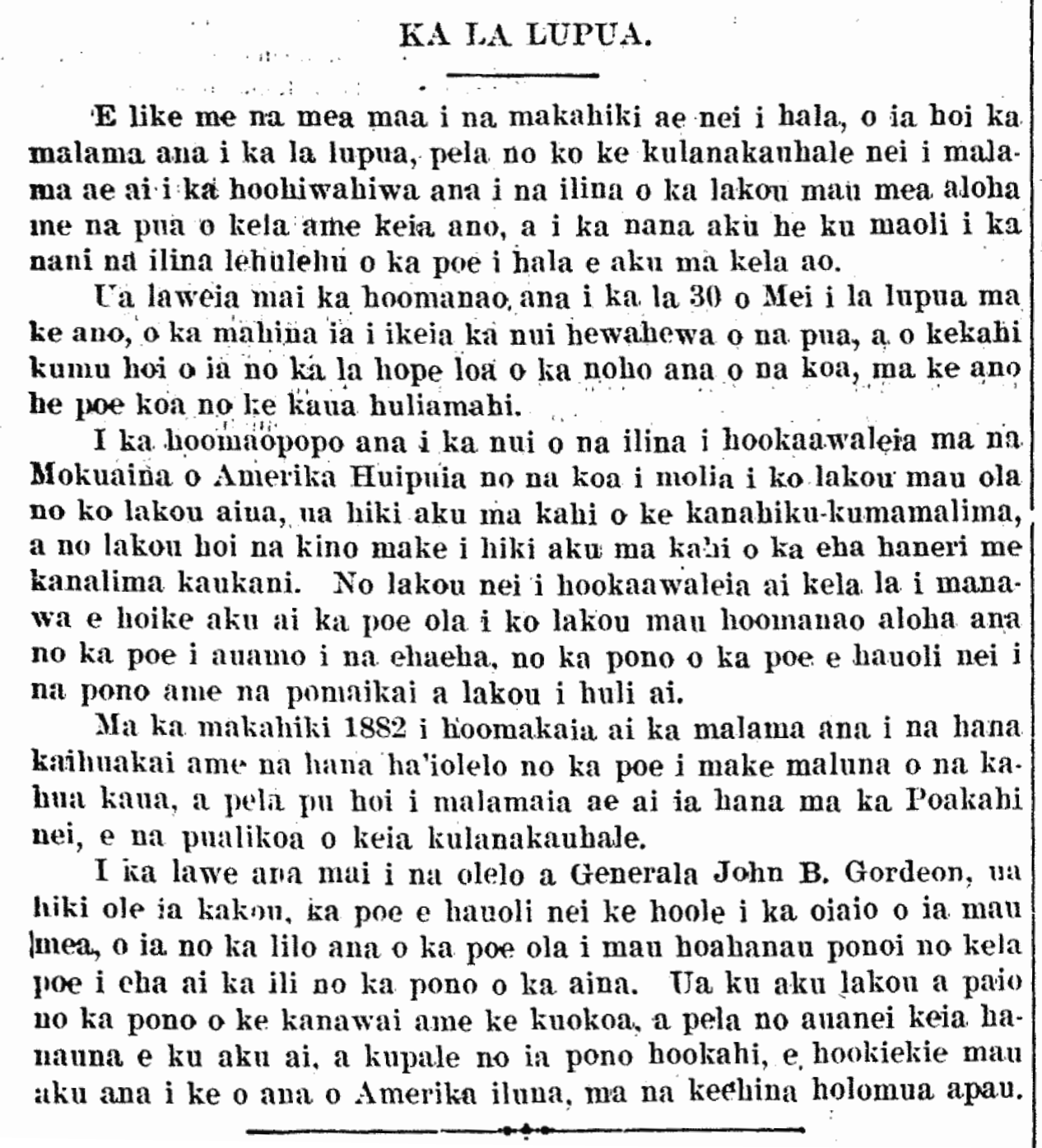
As has been the custom in previous years, that is the observation of memorial day [la lupua], the town is similarly decorating the graves of their loved ones with flowers of every type, and the cemeteries of the many who have passed are truly beautiful to see.

The 30th of May has been taken as a day to “strew flowers,” being that it is the month in which many flowers are seen, and also it is the final day the soldiers served as soldiers in the great war [kaua huliamahi].

The number of the [national] cemeteries in the different States of the United States, for the soldiers who sacrificed their lives for their land, is about seventy-seven, and within them they hold about four-hundred fifty thousand bodies. It is for them that the day is set aside; it is a time for the living to show their loving remembrances for those who bore suffering for the welfare of the people who enjoy the rights and blessings for which they sought after.

In the year 1882, the parades and speeches for those who died on the battlefields were initiated, and that is what happened this past Monday by the soldiers of this town.

Taking the words of General John B. Gordon, “It is impossible for us who are today joyful, to deny the truth of these things, that being, those who are living should be as true brothers of those people who suffered injuries for the blessings of this land. They stood and fought for the righteousness of the law and for independence, and that is how this generation then should remain and defend the very same right, continually pushing America on higher in all areas of progress.”

(Kuokoa, 6/9/1909, p. 4)

KA LA LUPUA.

Ka Nupepa Kuokoa, Buke XLVI, Helu 23, Aoao 4. Iune 9, 1909.

Kamehameha boys off to war, 1917.

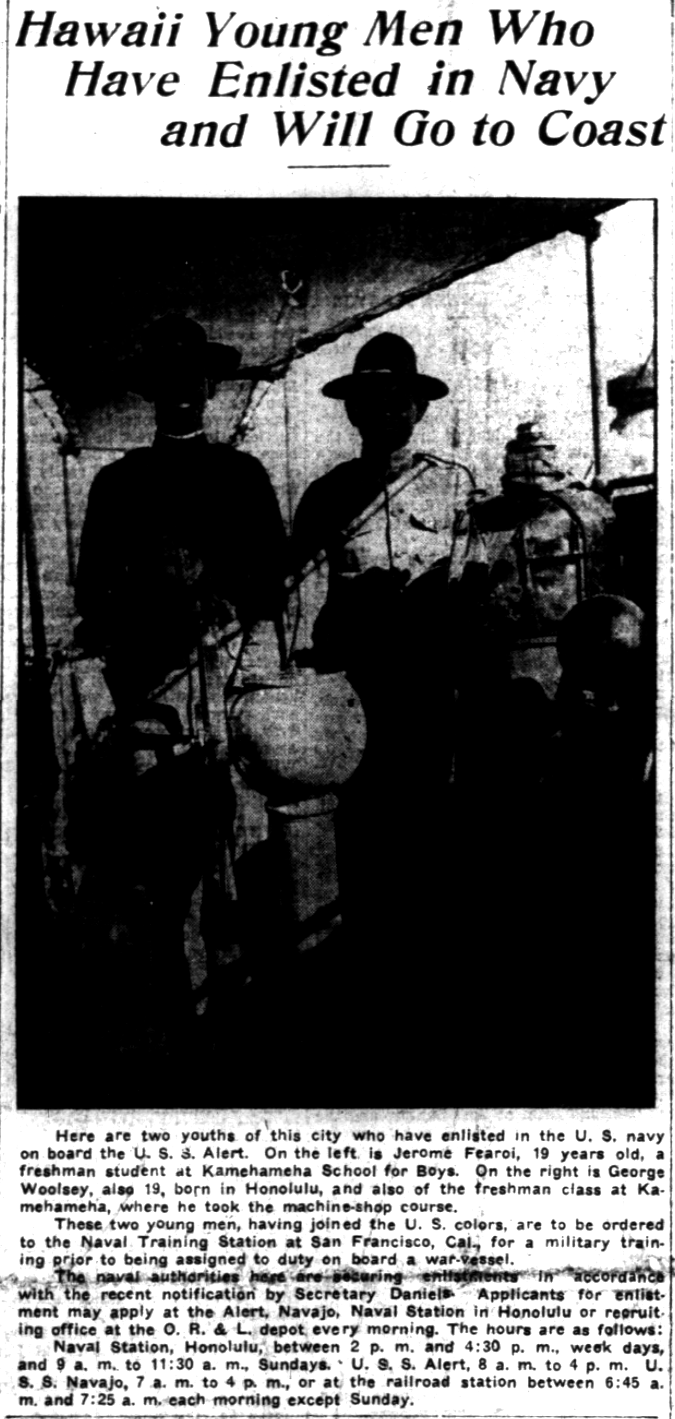
Hawaii Young Men Who Have Enlisted in Navy and Will Go to Coast

Here are two youths of this city who have enlisted in the U. S. navy on board the U. S. S. Alert. On the left is Jerome Fearoi, 19 years old, a freshman student at Kamehameha School for Boys. On the right is George Woolsey, also 19, born in Honolulu, and also of the freshman class at Kamehameha, where he took the machine-shop course.

These two young men, having joined the U. S. colors, are to be ordered to the Naval Training Station at San Francisco, Cal., for a military training prior to being assigned to duty on board a war vessel.

The naval authorities here are securing enlistments in accordance with the recent notification by Secretary Daniels. Applicants for enlistment may apply at the Alert, Navajo, Naval Station in Honolulu or recruiting office at the O. R. & L. depot every morning. The hours are as follows:

Naval Station, Honolulu, between 2 p. m. and 4:30 p. m., week days, and 9 a. m. to 11:30 a. m., Sundays. U. S. S. Alert, 8 a. m. to 4 p. m. U. S. S. Navajo, 7 a. m. to 4 p. m., or at the railroad station between 6:45 a. m. and 7:25 a. m. each morning except Sunday.

(Honolulu Star-Bulletin, 4/17/1917, p. 9)

Hawaii Young Men Who Have Enlisted in Navy and Will Go to Coast

Honolulu Star-Bulletin, Volume XXIV, Number 7803, p. 9. April 17, 1917.


A day to remember, 1924.

THE “DAY TO PLACE FLOWERS” WAS OBSERVED HERE IN HONOLULU

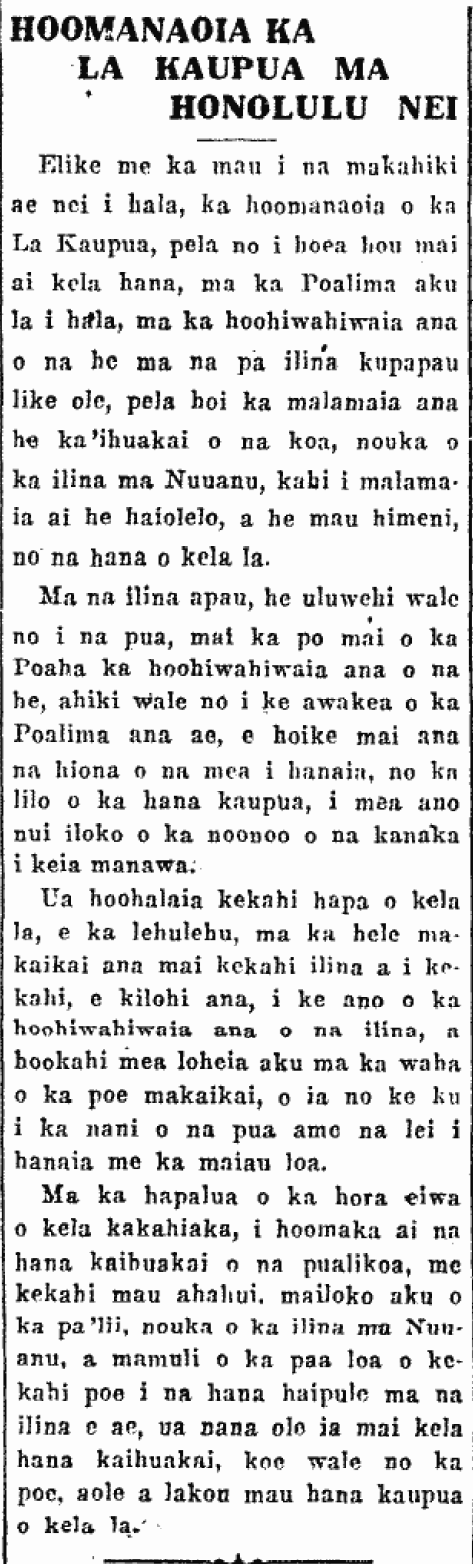
Just as in years past where Decoration Day [La Kaupua] was observed, so too has it come again on this past Friday, as the graves in the different cemeteries were decorated, and also a parade of soldiers was held upland of the cemetery of Nuuanu, where speeches were given as well as songs, for the observances on that day.

All of the cemeteries were decorated with flowers; from Thursday night the graves were being decorated until noon of the following Friday, showing that the observation of Decoration Day is given much thought to by the people these days.

A majority of the day was spent by the people going around from graveyard to graveyard looking at the adornments of the graves, and one thing heard amongst the people making their rounds was that the flowers and lei done with great care were beautiful.

At nine thirty in the morning, the parade of the soldiers and some organizations began from within the palace grounds up to the cemetery in Nuuanu, and being that some people were occupied with prayers at other cemeteries, this parade was not given any thought to, except by those who were not participating in decorating flowers on that day.

[Memorial Day (Decoration Day), which was held on the 30th of May and is now held on the last Monday of May, can be found in the Hawaiian-Language Newspapers as La Kaupua (“day to place flowers”) or La Lupua (“day to strew flowers”).]

(Kuokoa, 6/5/1924, p. 1)

HOOMANAOIA KA LA KAUPUA MA HONOLULU NEI

Ka Nupepa Kuokoa, Buke LXIII, Helu 23, Aoao 1. Iune 5, 1924.

Paaiea Pond, from the pen of J. W. H. Isaac Kihe, 1914.

SOME STORIED LANDS OF KONA

Written for the Hoku o Hawaii by ka Ohu Haaheo i na Kuahiwi Ekolu¹

PAAIEA POND

Paaiea was a great pond almost like the ponds of Wainanalii and Kiholo. In the olden days, when the great ruling chiefs were living, and when these fish ponds were full of the riches of Awa, Anae, and Ahole, along with all sorts of fish which swam within.

During that time, Konohiki were stationed, and he was the guard of the pond that watched over the pond and all things, as here we are talking about Paaiea Pond which was destroyed by lava and became pahoehoe lava which remains today, which is what the writer is introducing to the readers of the Hoku o Hawaii.

In the correct and trues story of this pond, its boundaries began from Kaelehuluhulu on the north and on the south was at the place called Wawaloli, and the distance from one end to the other was 3 miles or more, and that was the length of this pond; and today within these boundaries, there are a number of pools [lua wai loko] remaining during this time that the writer is speaking before the readers of the Hoku.

The great Overseer [Konohiki] who cared for this pond was Kepaalani, and everything fell under him: the storehouses [hale papaa] where poi and fish were stored, the halau for the fishing canoes, the nets and all thing, and from him the fishermen and the retainers of the court would obtain their sustenance.

And at this time when the pond was destroyed by lava, Kamehameha was residing in Hilo for the purpose of waging war, and this war was called Kaipalaoa; during this war, Namakehaikalani died and was offered atop the Heiau of Piihonua in Hilo; and this was Kamehameha’s final war, and his enemies lived quietly without uprising once again. This was the time between 1798 until 1801, and it is said that this is when lava destroyed this pond that was full of riches, and turned it into a land of pahoehoe lava which remains to this day. Continue reading

Let the old men go forth and lie upon the roads… 1895.

“LAW OF THE PADDLE BLOW.”
[“MAMALAHOE KANAWAI.”]

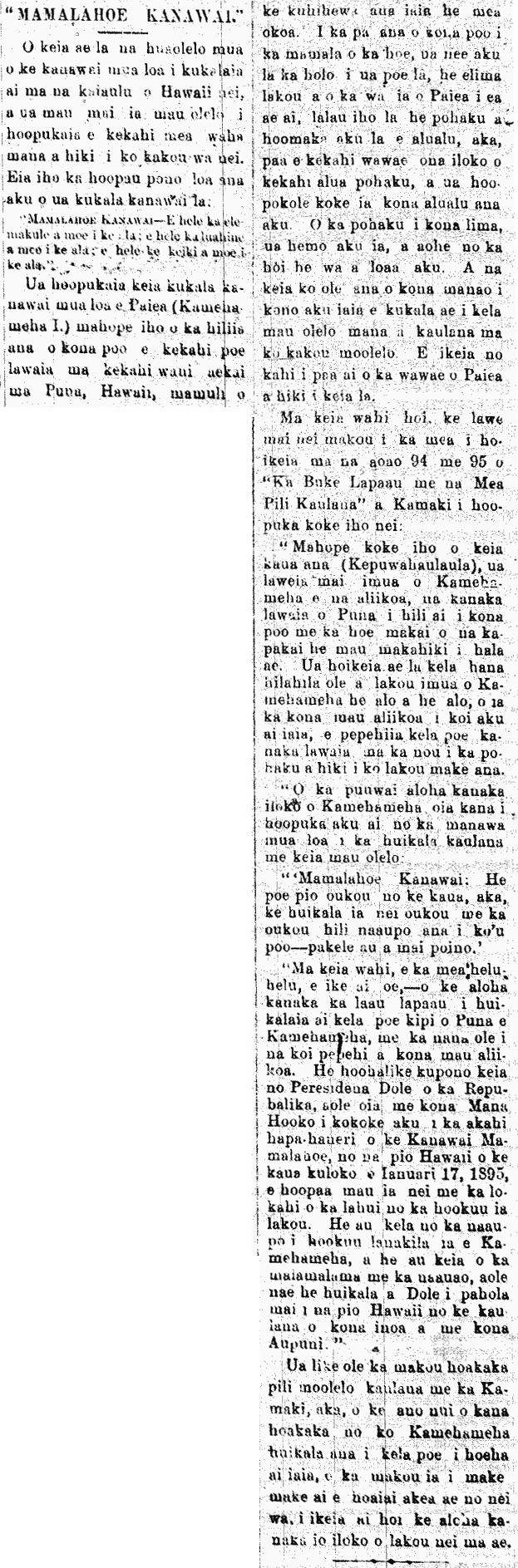
This above are the initial words of the very first law promulgated in the communities of Hawaii, and those words spoken by one in authority still remain. Here below is the the law in its entirety:

“MAMALAHOE KANAWAI—Let the old men go forth and lie upon the roads; let the old women go forth and lie upon the roads; let the children go forth and lie upon the roads.”

This first law was proclaimed by Paiea (Kamehameha I) after his head was struck by some fishermen at the seashore in Puna, Hawaii, because they mistakenly thought he was someone else. When his head was struck with the blow from a canoe paddle, the men fled, there being five of them; that was when Paiea rose, picked up a rock, and made to chase after them, however, his foot was caught in a rock crevice, and his chase was cut short. The rock in his hand fell, and there was no getting it back. And it was this disappointment which caused him to proclaim these famous and powerful words in our history. The place where Paiea’s foot was caught can be seen to this day.

Here, we take what is shown on pages 94 and 95 of “Ka Buke Lapaau me na Mea Pili Kaulana” which was published by Kamaki [Thomas P. Spencer]:¹

“Soon after this battle (Kepuwahaulaula), the fishermen who years earlier struck the head of Kamehameha with a paddle near the sea were brought before him by his officers. This shameful act of theirs was made known to Kamehameha face to face, for which his officers demanded that they be killed by stoning them to death.

“The aloha Kamehameha had for his fellow man was expressed for the first time in his famous pardon by announcing:

“‘Mamalahoe Kanawai: you are prisoners of war, but you are forgiven for unwittingly striking my head–I escaped, but nearly was in trouble.’

“Here, O Reader, do recognize–love for his fellow man was the cure² for which allowed for the release of these rebels of Puna by Kamehameha, and him not giving regard to the calls by his officers to put them to death. This is a fine comparison to President Dole of the Republic; he with his Executive Powers does not come close to a hundredth of the Kanawai Mamalahoe, in his treatment of the Hawaiian prisoners of the revolution of January 17, 1895 who continue to be imprisoned albeit the lahui are united in wanting them released. That was an uncivilized time when [the men] were triumphantly released by Kamehameha, and this is a knowledge and civilization, and yet Dole has not given clemency to the Hawaiian prisoners for the fame of his name and that of his Nation.”

Our elucidation of this famous story is not like that of Spencer’s, but the basis of his explanation of Kamehameha’s forgiving those who injured him, that is what we want to make clear at this time, so that true love of one’s fellow man is seen by them.

¹This book was republished in 2003 by Bishop Museum Press as: Buke ‘Oihana Lapa’au me na ‘Apu la’au Hawai’i (Book of Medical Practices and Hawaiian Prescriptions). See here for further description.

²”Laau lapaau” [medicinal cure] is the word chosen here because this story appears in a book of traditional medicinal practices.

(Makaainana, 11/25/1895, p. 4)

"MAMALAHOE KANAWAI."

Ka Makaainana, Buke IV—-Ano Hou. Helu 22, Aoao 4. Novemaba 25, 1895.

Veterans Day, the early years, 1938.

THE ENDING OF THE WAR
NOVEMBER 11

November 11, 1938. The battles of Marne, Ypres, Loos, Arras, Somme, Chateau Thierry, Verdun, Argonne, Belleau Wood—these famous blood-shedding battles, their stories and the men who fought in them, both living and dead, remain as memorials for the conscience. The great number of soldiers constantly sent away here and there for their home, to fight and for peace. We honor those men who fought for a purpose, and at the same time, put to use those frightful years as a means to attain the peace of which we are blessed.

Drive-In Market                                  E. Yanagihara Store

V. A. Carvalho                                      Quong Sing Market

Beamer’s Hardware Store              B. F. Shoen, Ltd.

S. Ikeda Soyo Factory                       Hawaii Motor Supply

J. S. Rickard                                           The Men’s Shop

Union Meat Co.                                  G. Miyamoto Cash & Carry

Diamond Bar                                        Kilauea Radio Shop

Simeon Armor The Sign Artist       Akadama

De Silva Vogue Shop                         Lacai Bros. [?]

June Shipman Beauty Shoppe      Mamalahoa Chapter No. 2 Order of Kamehameha

Isemoto Contracting Co. Ltd.

(Hoku o Hawaii, 11/9/1938, p. 3)

LA PAU O KE KAUA

Ka Hoku o Hawaii, Volume XXXIII, Number 28, Aoao 3. Novemaba 9, 1938.

Kuakini, and Hawaiian tradition, 1845.

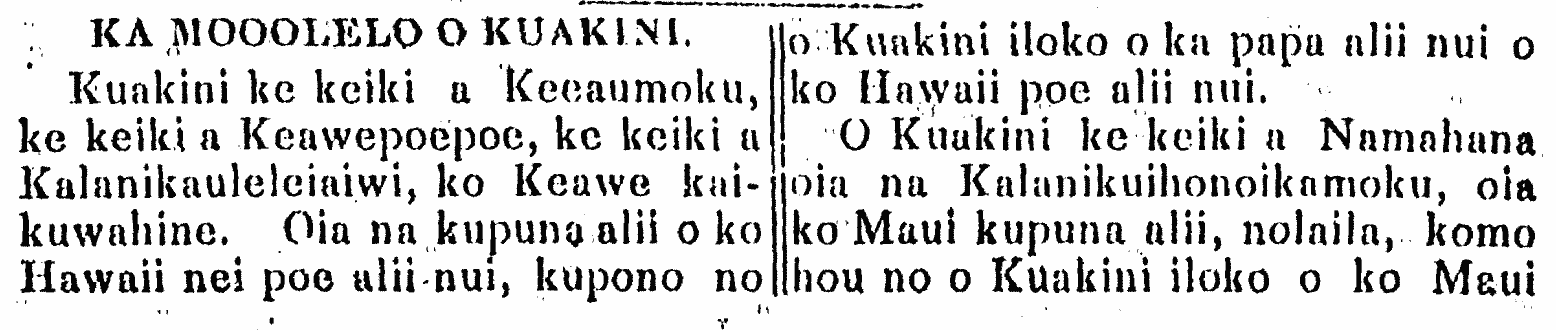
BIOGRAPHY OF KUAKINI.

Kuakini was the son of Keeaumoku, the son of Kalanikauleleiaiwi, the sister of Keawe. They are the royal ancestors of Hawaii Island’s high chiefs, Kuakini was befitting the class of high chiefs amongst Hawaii’s alii nui.

Kuakini was the son of Namahana who was born from Kalanikuihonoikamoku, and they are Maui’s royal ancestors, and therefore, Kuakini is amongst Maui’s…

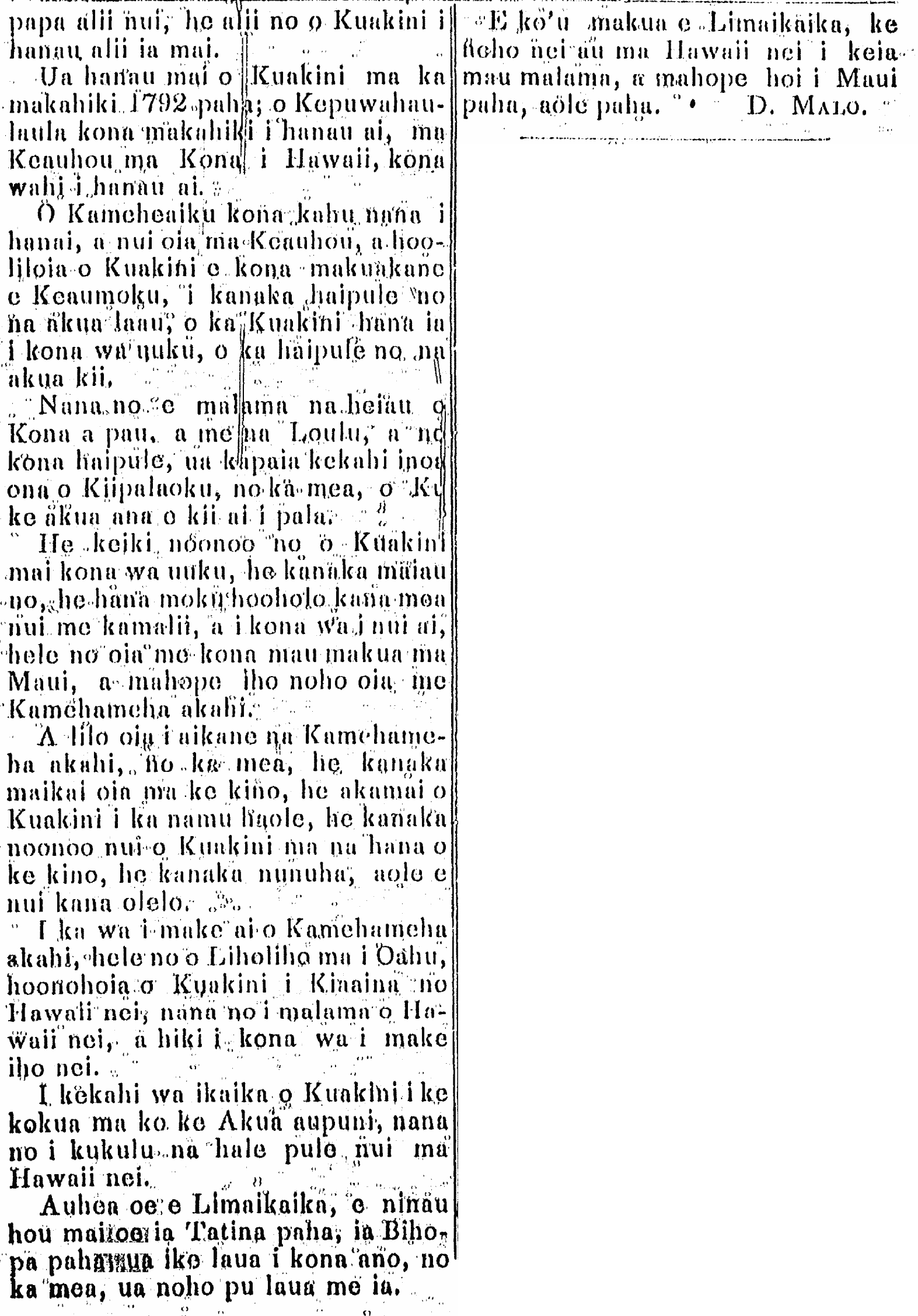
…class of high chiefs; Kuakini was born as an alii.

Kuakini was born in the year 1792 perhaps; he was born in the year of [battle of] Kepuwahaulaula; at Keauhou in Kona in Hawaii was where he was born.

His caretaker [kahu hanai] was Kameheaiku, and Kuakini grew up at Keauhou, and he was made by his father, Keeaumoku, to pray to the wooden gods; this was Kuakini’s duties in his youth, the worship of the wooden gods.

He was the one who cared for all the temples in Kona, along with the Loulu temples, and in regard to his worshiping, one of the names Kuakini was called was Kiipalaoku, for Ku was the god for whom he would fetch pala fern.

Kuakini was a thinker from when he was small; he was meticulous; he often would sail boats with the other children in his youth, and when he grew up, he went with his parents to Maui, and thereafter he lived with Kamehameha I.

He became an aikane of Kamehameha I, because Kuakini possessed a fine body, he was skilled in English, he thought much about the way a body functions, he was sullen, and was a man of few words.

When Kamehameha I died, Liholiho them went to Oahu, and Kuakini was appointed Governor of Hawaii, and it was he that was to care for Hawaii until his recent death.

When Kuakini was assisting intently with the kingdom of God, it was he who built the great churches here on Hawaii Island.

O Armstrong [Limaikaika], please ask of Thurston [Tatina] or Bishop [Bihopa], for they know what he was like for both of them lived with him.

O Father Armstrong, I am living here on Hawaii these months, and will then return to Maui, or perhaps not. D. MALO.

(Nonanona, 1/7/1845, pp. 89–90)

KA MOOOLELO O KUAKINI.

Ka Nonanona, Buke 4, Pepa 19, Aoao 89. Ianuari 7, 1845.

papa alii nui, he alii no o Kuakini...

Ka Nonanona, Buke 4, Pepa 19, Aoao 90. Ianuari 7, 1845

May Day in Hilo town, 1942.

Our Lei Day

According to what we understand and hear pertaining to the celebration of Lei Day, that being this Friday, the show put on will be great.

There will be two hula groups that will hula on that day, that being the hula troupe [Hui Lokelani] of Mrs. Rose Kuamoo and the Hui Huapala led by Albert Nahale-a. Other than these groups will be the Police Glee Club led by William K. Kahimoku (Kualii), and also the children of Mr. and Mrs. Joseph Kalima, and also perhaps some duets and some solos.

Last year, this show was held in the evening, beginning at 6:00, but this year, it can’t be put on in the late evening, but instead will be held at 3:00  p. m. This is times of blackout in this land, and we are not to turn on lights outside.

This show and hula will be held at Kalakaua Square, and we are lucky to have the military band join in and commemorate this day. There is nothing to be said about our County Band, for they have not dropped out of the activities of the day.

The activities of the day will begin with a concert put on by the military band at port here in Hilo, at 2:30 p. m. until 3:00 p. m., and the County band until 3:30 p. m. and followed by the other parts.

Here below is the program of events of that afternoon

MAY DAY IS LEI DAY
IN HAWAII
Directed by the Hawaiian Civic Club of Hilo
Friday, May 1, 1942,
at the Hour of 3:30 P. M.
KALAKAUA PARK

Part I, Old Hawaiian Hula

1. “Ka La o Mei He La Lei Ia Ma Hawaii” [May Day is Lei Day in Hawaii] Police Glee Club, Lokelani, and Huapala.

2. “Oli” by Mary Ahiena

3. Old Hawaiian Hula, by the Hui Lokelani.

a. Olapa — Niihau, Pua Hau o Maleka

b. Puili — Malualua

c. Iliili — Kona Hema

d. Uliuli — Moku Kia Kahi, Alekoki

4. Combined Old Hawaiian Hula, by the Hui Huapala

a. Puili & Uliuli — Nani Wale Na Hala

5. “Pua Mohala” by the Hilo Police Glee Club

Part II, Hawaiian Hula of Modern Times

1. “Kuikahi” by Huapala

2. A Hula for President Roosevelt, Lokelani

3. “Ua Hoomaka lakou i Kekahi Mea,” Frank Kahili

4. Holoholo Kaa, Huapala

5. “Loke Honesakala,” Ernest Hanaike and his Guitar

6. Nani Hilo, Lokelani

7. “Mele Maka Lalau” by Baby Kaieie

9. “Wiliwili Wai,” William Kualii

8. Aloha Ia No O Maui, Lokelani

10. Kona Hema, Huapala

11. My Sweet Sweetie, Three Children of Kalaima

12. Oahu, Lokelani

13. Ke Kali Nei Au, duet by Miss Kuaana Nathaniel and Joseph Kalima

14. Maikai Wale No Kauai, Lokelani

15. “TAHUAHUAI,” Abraham Laeha

16. Sasa & Somemore o Samoa, Huapala

17. THE CONCLUSION

a. Hilo March — Lokelani

b. “I Lei Nou” — Police Glee Club

c. Leahi, Hanohano Hanalei — Huapala

18. ALOHA OE

19. STARS SPANGLED BANNER

(Hoku o Hawaii, 4/29/1942, p. 2)

Ka La Lei O Kakou

Ka Hoku o Hawaii, Volume 37, Number 1, Page 2. Apelila 29, 1942.