C. C. Moreno on missionaries, 1893.

A Misunderstood People.

MORENO ON THE MISSIONARIES.

Editor Post: For several years your public-spirited paper has published correspondence and statements submitted by me about Hawaii in which was foreshadowed the present state of affairs. The revolution which has just taken place is the inevitable result of missionary rule; the long-standing and deep-rooted cause of the unrest.

The missionaries in Hawaii, as in China, Japan, and elsewhere, consider that country as their open hunting grounds, regardless of the rights, customs, wishes, and priviliges of the natives and of stipulations.

I positively know that the self-appointed four chiefs of the Provisional Government in the Hawaiian Islands and the five commissioners coming to Washington to negotiate a treaty of annexation are, without a single exception, missionariesʻ confederates. Not a single native Hawaiian is with them, therefore, they cannot be considered as the representatives of the Hawaiian nation, of which they are aliens and enemies, but only as the emissaries of one side (or of a higher), which is not the right side.

The truth about Hawaiian affairs has never reached the State Department and that is the reason why, in the department, the knife has always been taken by the blade instead of by the handle in dealing with the Hawaiian question.

The United States always sent third rate politicians as ministers and consult to Honolulu, hence the erroneous information about Hawaii. I have on the spot studied Hawaii and the Hawaiians, their troubles with the missionaries of all creeds, and when distant from the islands I have kept an uninterrupted correspondence with the leaders of the Hawaiian nation, such as the Hons. Wilcox, Bush, Testa, Kaai, Kapena, Kaunamano, Kimo Pelekane [James I. Dowsett], and others.

My views on the Hawaiian question I explained at length to President Hayes and Secretary of State Evarts, to President Cleveland and to Assistant Secretary of State Porter: later, to Senator Morgan and to Congressman McCreary, and these are the statesmen that ought to dispose of the Hawaiian question and render justice to the weak, ill-treated, honest, and generous Hawaiian people that have been continually misrepresented, misjudged, and grossly wronged.

In accordance with the good order of things the coming self-appointed and self-styled Hawaiian commissioners, with more appearance than substance, should not be received by the United States authorities, because their self-attributed mission to Washington is based only upon selfish and malignant motives.

This will be a good opportunity for the great people of the United States to show their sentiment for fair play and generosity toward the unfortunate, harmless, friendly, and oppressed Hawaiian people, worthy of sympathy and of help in this their hour of national distress.

Celco Cæsar Moreno.

(Liberal, 2/25/1893, p. 2)

A Misunderstood People.

The Liberal, Volume I, Number 48, Page 2. February 25, 1893.
Royal huakai, 1865.

[Found under: “BITS OF NEWS OF HAWAII NEI.”]

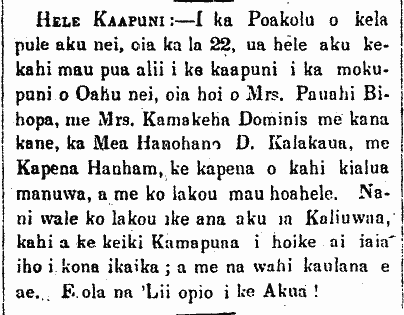
Circuit:—On Wednesday of the week last, that being the 22nd, some of the royal descendants made a circuit of Oahu nei, that being Mrs. Pauahi Bishop, Mrs. Kamakeha Dominis [Kamakaeha Dominis] and her husband, the Honorable D. Kalakaua, and Captain Hanham, the captain of a single-masted warship, along with their travelling companions. Splendid was their view of Kaliuwaa, where the youth Kamapuaa revealed himself and his strength; along with the other famous sites. Long live the young Alii in God!

(Kuokoa, 3/30/1865, p. 2)

Hele Kaapuni...

Ka Nupepa Kuokoa, Buke IV, Helu 13, Aoao 2. Maraki 30, 1865.

More on the Honorable Lilia Kamakaeha Paki’s marriage, 1862.

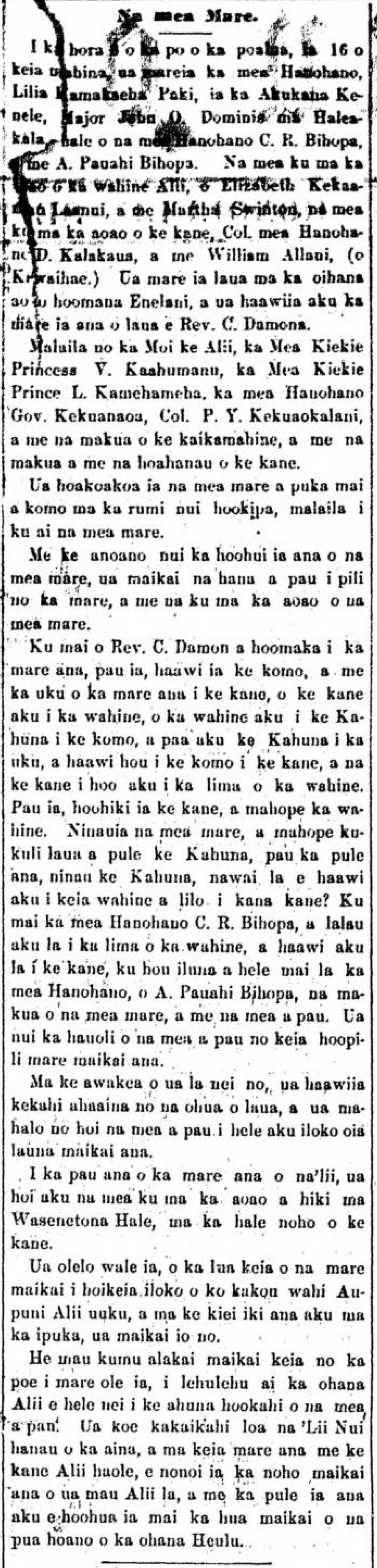
The Ones Who Were Married.

At 8 o’clock at night, on the 16th of this month, the Honorable Lilia Kamakaeha Paki was married to Adjutant General, Major John O. Dominis at Haleakala, the house of the Honorable C. R. Bishop and A. Pauahi Bishop. The ones who attended the royal bride were Elizabeth Kekaaniau Laanui and Martha Swinton; those attending the groom were the Honorable Colonel D. Kalakaua and William Allen [? William Allani] (of Kawaihae).

Present were the Chief, the King; her Highness Princess V. Kaahumanu, his Highness L. Kamehameha; the Honorable Governor Kekuanaoa; Colonel P. Y. Kekuaokalani; and the parents of the bride, and the parent and cousins of the groom.

The ones to be wed were gathered and they went out and entered the great parlor and it was there that the couple stood.

The uniting of the pair was done with much reverence, and all the proceedings of the wedding were fine, as well as with the attendants.

The Rev. C. Damon stood and began the marriage ceremony; then the ring and the marriage fee [? ka uku o ka mare ana] was given to the groom, from the groom to the bride, and from the bride to the Priest; the Priest took the fee and gave the ring once more to the groom, who put it on the brideʻs finger. When this was done, the groom was made to give his vow and then the bride. The couple were questioned, and then the two knelt down and Priest gave a prayer, and after the prayer, the Priest asked, “Who will give this woman to this man?” The Honorable C. R. Bishop stood and took the hand of the bride and gave it to the groom; the Honorable A. Pauahi Bishop, the parents of the couple and everyone else stood once more and approached. Everyone was full of joy for this beautiful wedding.

In midday of that very day, a party was given for their cortege, and all who found themselves amongst that fine gathering felt admiration.

After the marriage of the alii, the attendants returned to their sides until they reached Washington Place [Wasenetona Hale], the place of residence of the groom.

It is said that this is the second of the righteous marriages known in our tiny Kingdom, and by glancing through the gate, it is indeed righteous.

These are fine examples for those who are not married, so that the Royal family that associates with the multitudes will become numerous. There are but a few High Chiefs born of the land left, and with this marriage to a haole Royal one, it is hoped that the Royal couple live righteously along with the prayer that they bear good fruit of the sacred descent of the line of Heulu.

[Does anyone know if Pauahi had a name that started with an “A.”? For some reason she is here twice referred to as A. Pauahi Bihopa.]

(Hoku o ka Pakipika, 9/18/1862, p. 2)

Na mea Mare.

Ka Hoku o ka Pakipika Buke I, Helu 52, Aoao 2. Sepatemaba 18, 1862.

More on Liliu’s marriage, 1862.

I was engaged to Mr. Dominis for about two years and it was our intention to be married on the second day of September, 1862. But by reason of the fact that the court was in affliction and mourning, our wedding was delayed at the request of the king, Kamehameha IV., to the sixteenth of that month; Rev. Dr. Damon, father of Mr. S. M. Damon, at present the leading banker of the Islands, being the officiating clergyman. It was celebrated at the residence of Mr. and Mrs. Bishop, in the house which had been erected by my father, Paki, and which, known as the Arlington Hotel [Haleakala], is still one of the most beautiful and central of the mansions in Honolulu. To it came all the high chiefs then living there, also the foreign residents; in fact, all the best society of the city.

[This is what Queen Liliuokalani had to say about her marriage in Hawaii’s Story by Hawaii’s Queen, first published in 1898. Mahalo to Heather Wilkinson Rojo for her response on the previous post, saying she posted an image of their marriage certificate on her blog. This is one of the many priceless treasures cared for by the Bernice Pauahi Bishop Museum!]

(Hawaii’s Story by Hawaii’s Queen, 1988. p. 22.)

Marriage of Liliuokalani and John Owen Dominis, 1862.

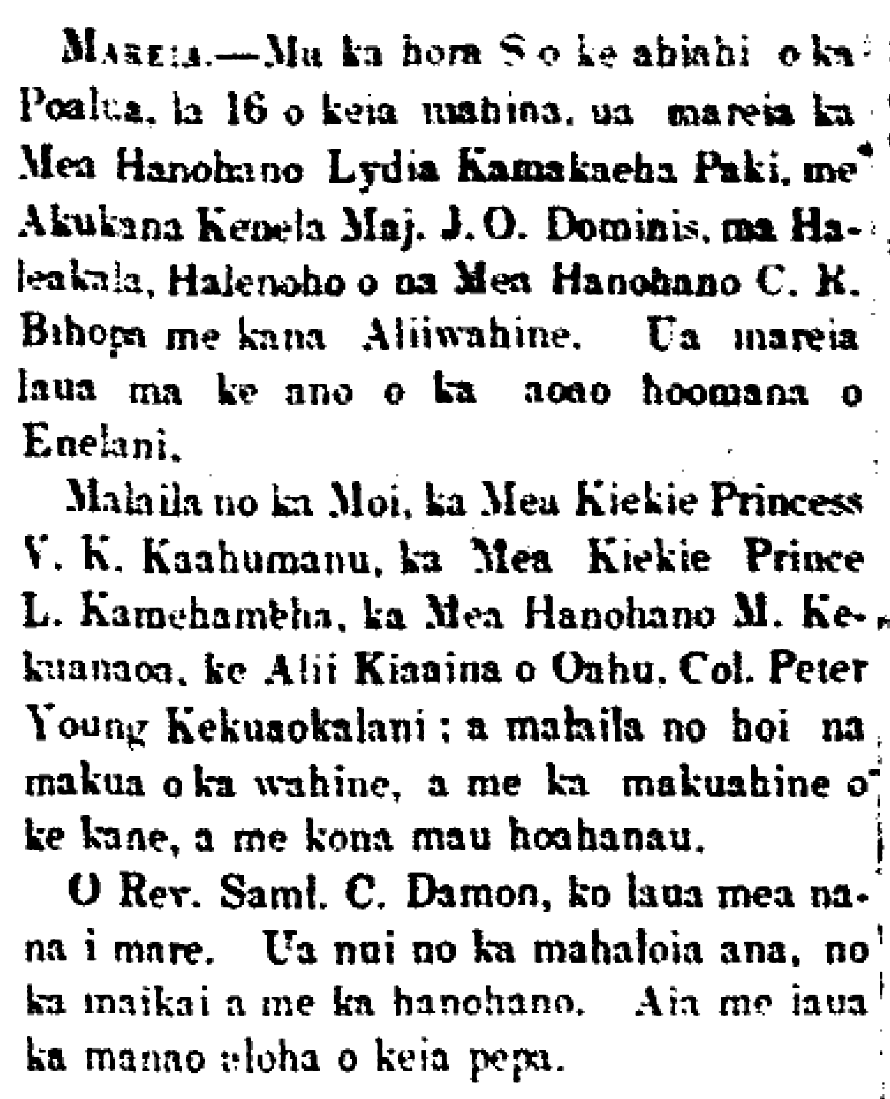
Marriage.—At 8 in the evening of Tuesday, the 16th of this month, the Honorable Lydia Kamakaeha Paki and Adjutant General Major J. O. Dominis were wed at the Residence of the Honorable C. R. Bishop and his Queen. The two were married in the Anglican faith.

Present were the King; her Highness Princess V. K. Kaahumanu; his Highness Prince L. Kamehameha; the Honorable M. Kekuanaoa, the Royal Governor of Oahu; Colonel Peter Young Kekuaokalani; also there were the parents of the bride, and the mother of the groom, and his cousins.

Rev. Samuel C. Damon was who performed the ceremony. It was appreciated for its righteousness and honor. With the two of them are the thoughts of aloha of this paper.

(Kuokoa, 9/20/1862, p. 3)

Mareia.

Ka Nupepa Kuokoa, Buke I, Helu 43, Aoao 3. Sepatemaba 20, 1862.

Sweet Emalia and “Moku o Keawe” redux, 1907.

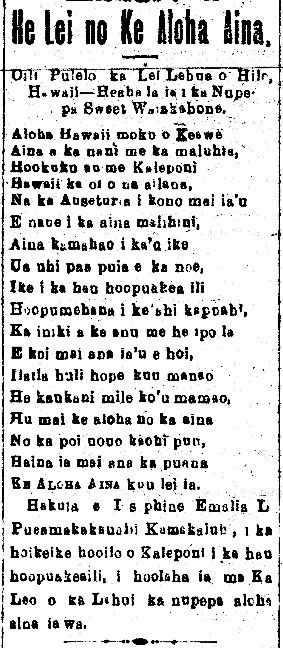
A Lei of Patriotism.

The Lehua Garland of Hilo, Hawaii Rises in Triumph—What is that in the Newspaper, Sweet Waiakahone.

Aloha Hawaii moku o Keawe
Aina a ka nani me ka maluhia,
Hookuku au me Kaleponi
Hawaii ka oi o na ailana,
Na ka Auseturia i kono mai ia’u
E naue i ka aina malihini,
Aina kamahao i ka’u ike
Ua uhi paa puia e ka noe,
Ike i ka hau hoopuakea ili
Hoopumehana i ke ahi kapuahi,
Ka iniki a ke anu me he ipo la
E koi mai ana ia’u e hoi,
Ilaila huli hope kuu manao
He kaukani mile ko’u mamao,
Hu mai ke aloha no ka aina
No ka poi uouo kaohi puu,
Haina ia mai ana ka puana
Ke Aloha Aina kuu lei ia.

Composed by Iosephine Emalia L. Pueamakakaualii Kamakaluhi, at the California winter exhibition in the skin-whitening snow, published in Ka Leo o ka Lahui, the patriotic newspaper of the time.

[Sweet Emalia and her song of aloha aina which is still so famous today!]

(Aloha Aina, 10/26/1907, p. 8)

He Lei no Ke Aloha Aina.

Ke Aloha AIna, Buke XII, Helu 43, Aoao 8. Okatoba 26, 1907.

Queen Liliuokalani birthday celebration, 1911.

Birthday of Liliu.

On this past Saturday, September 2, it was the birthday of Queen Liliuokalani, and a royal audience was held midday of that day between 11 a. m. and 1 p. m. in the afternoon.

At 8 a. m. in the morning of this Saturday, the Royal Hawaiian Band [Bana Hawaii] appeared at Washington Place [Wakinekona Home] and played Hawaiian songs which were composed by the alii during the Monarchy of Hawaii nei, and some of these songs were composed by Queen Liliuokalani. The Royal Hawaiian Band played for an hour in the morning to commemorate the birthday of Liliu at Washington Place, and they played once again from 11 midday to 1 in the afternoon.

At 11, the public was allowed to come and see the alii. The Kalama Society, Kaahumanu Society, and Kauikeaouli Society arrived to see the Queen.

The interior of Washington Place was decorated with kahili, just as during the era when the alii ruled—it was beautiful and awe inspiring to see that morning. The Queen sat upon her cotton chair [noho pulu], with two boys behind her chair, holding long kahili, with ahuula upon their shoulders. The Princess Kawananakoa was on the Queen’s right, and Colonel Iaukea was on her left, and he was the one who introduced the Queen to the malihini and to the townspeople. There also, were the heads of the Territory, County, and Federal government. There were many distinguished people of this town who went to see the alii, and by the looks of it, almost one thousand people came during this royal audience.

What shocked this reporter on that morning, was that two-thirds of the people who went to give their congratulations on the birthday of the Queen were malihini and haole. As for the true Hawaiians, only but a few went to see the alii. Reflecting back in time, and seeing Liliu in her finery, i am lulled into recalling the days when Hawaiians were proud upon the soil of their native land.

(Kuokoa Home Rula, 9/8/1911, p. 4)

ka La Hanau o Liliu.

Kuokoa Home Rula, Buke IX, Helu 36, Aoao 4. Sepatemaba 8, 1911.

More on the Wahiawa “healing stones,” 1927.

THE SUPERNATURAL ROCKS WILL BE LEFT IN THEIR PLACE.

At the meeting of the Daughters of Hawaii last week Wednesday in the Home of Queen Emma Kaleleonalani in Nuuanu, the association decided not to move the “Healing Stones” from where the two stand in Wahiawa; they made no decision to perhaps not move them for a time between three and six months and after that time, to take up again the question of those rocks.

When ayes and nays were asked for per the request explained earlier by Mrs. Julie Judd Swanzy and added to with small changes made by Mrs. F. A. Potter, there were three members who were opposed to the changes.

The decision by the association agreed upon that day, was in accordance with the decision by the President of the Board of Health, F. E. Trotter, that there would be no action upon on the matter of the rocks and that they’d be left where they stand now without being moved. With this decision by the Daughters of Hawaii, the ones who have responsibility over the rocks, dashed was the hope and request of 400 citizens of Wahiawa made to this association in a petition to remove the rocks from Wahiawa.

Another subject considered and decided upon by the association was this: there shall be no monuments built upon heiau. At that meeting, announced were pledges of $588, and cash donations of $1712, and funds of $341.72 for the restoration of that palace in Kailua, Kona, Hawaii [Hulihee].

Because of the rumor that the enthusiasm over the healing powers of the rocks are dwindling, which was known because less people go to worship the stones and because of less donations, this is the reason for the postponement by the association on action to be taken in regard to the rocks, with their belief that perhaps in a short few months the craze of the people over worshiping them will decrease drastically.

At that meeting of the association, there were many letters read by the President, Mrs. Swanzy, in front of the members gathered there, from different people dealing with the stones.

One of these letters was a petition by 400 people of Wahiawa asking to remove these rocks from there; three of the people who signed their names to the document asked that their names not be publicized and to take out their names from the list; there was a letter against the moving of the rocks to the Bishop Museum, where the stones would just be a “Collection” there; in another letter, it was asked to move the rocks to an area near the new road in Koko Head.

Mrs. Charles Clark asked to return these stones to the grounds of Kukaniloko; her idea was opposed by the majority of the members for the reason that the ancient history of these stones have nothing to do with the history dealing with the alii born at Kukaniloko, and therefore, it is not right to move them there. The rocks were moved to Kukaniloko at the order of Galbraith, because he thought they might be broken up where they stood beneath the stream.  The association does not want to return the stones there; they have been something much cared for by the Filipinos and others, and other stones of Kukaniloko have been cracked because of candles placed upon them, and the grounds are full of rotting fruits and flowers; and seeing those things which marred the beauty of the area was why they were moved to where they stand now. Those stones will not be considered again for return to Kukaniloko.

As for the $3000 in the bank, it is from donations made by people who went to worship the stones, but the association has not agreed to take a cent of the money, but it will instead be appropriated for use for works benefiting the people of Wahiawa.

(Kuokoa, 11/24/1927, p. 4)

E WAIHOIA ANA NO NA POHAKU KUPUA MA KO LAUA WAHI.

Ka Nupepa Kuokoa, Buke LXVI, Helu 52, Aoao 4. Novemaba 24, 1927.

Healing Stone (?) of Wahiawa, 1927.

Supernatural Rock of Wahiawa

Honolulu, Oct. 26—This rock being visited by people to worship these days is becoming something that truly is stirring the thoughts of some people here in Honolulu, and some who are living near Wahiawa are appealing to the Government and to the power of the Board of Health to move that rock from where it first stood, because in their opinion, this action by the people will cause an epidemic to grow here where all ethnicities are going and touching themselves against the bodies of others, and this will perhaps cause sicknesses to spread from one to another.

The Board of Health refused to step in and block this action by people who believe their ailments will be healed by touching the sick area to that rock of Wahiawa, and the birthing stones of the High Chiefs of this land in ancient times.

Some people have said that their weakness due to rheumatism by them going there and touching their areas of pain to that rock. Some say that their weak areas were not cured by touching the rock.

If the Naha Stone was not moved to the mauka side of the Hilo Library here, and it was left where it was from olden times, then the healing powers of these Birthing Stones of the sacred Alii of Hawaii and the Stone that Kamehameha the Great flipped over and which became a symbol of his victory over this entire Archipelago, and for which Kamehameha spoke these words:

“He Naha oe, a he Naha hoi kou mea e neeu ai. He Niau-pio hoi wau, ao ka Niau-pio hoi o ka Wao.”¹

With these words did Kamehameha put his shoulders up to the Naha Stone [Naha Pohaku], and flipped it over, being this was a stone that could not be moved by five men. Perhaps some sick with rheumatism will rub up their ailing places against the Naha Stone in the future.

[I was reminded of this by a picture of two stones with the caption “Sacred Stones at Wahiawa” from the Lani Nedbalek Collection displayed at the Pineapple Festival today.]

¹”You are a Naha, and it will be a Naha who will move you. I am a Niaupio, the Niaupio of the Forest.”

(Hoku o Hawaii, 11/1/1927, p. 3)

Ka Pohaku Kupua o Wahiawa

Ka Hoku o Hawaii, Buke XXI, Helu 23, Aoao 3. Novemaba 1, 1927.