Paaiea Pond, from the pen of J. W. H. Isaac Kihe, 1914.

SOME STORIED LANDS OF KONA

Written for the Hoku o Hawaii by ka Ohu Haaheo i na Kuahiwi Ekolu¹

PAAIEA POND

Paaiea was a great pond almost like the ponds of Wainanalii and Kiholo. In the olden days, when the great ruling chiefs were living, and when these fish ponds were full of the riches of Awa, Anae, and Ahole, along with all sorts of fish which swam within.

During that time, Konohiki were stationed, and he was the guard of the pond that watched over the pond and all things, as here we are talking about Paaiea Pond which was destroyed by lava and became pahoehoe lava which remains today, which is what the writer is introducing to the readers of the Hoku o Hawaii.

In the correct and trues story of this pond, its boundaries began from Kaelehuluhulu on the north and on the south was at the place called Wawaloli, and the distance from one end to the other was 3 miles or more, and that was the length of this pond; and today within these boundaries, there are a number of pools [lua wai loko] remaining during this time that the writer is speaking before the readers of the Hoku.

The great Overseer [Konohiki] who cared for this pond was Kepaalani, and everything fell under him: the storehouses [hale papaa] where poi and fish were stored, the halau for the fishing canoes, the nets and all thing, and from him the fishermen and the retainers of the court would obtain their sustenance.

And at this time when the pond was destroyed by lava, Kamehameha was residing in Hilo for the purpose of waging war, and this war was called Kaipalaoa; during this war, Namakehaikalani died and was offered atop the Heiau of Piihonua in Hilo; and this was Kamehameha’s final war, and his enemies lived quietly without uprising once again. This was the time between 1798 until 1801, and it is said that this is when lava destroyed this pond that was full of riches, and turned it into a land of pahoehoe lava which remains to this day. Continue reading

Monument to Kauikeaouli on his 100th birthday, 1914.

UNVEILING OF THE DONATED TABLET

The Populace Gathers in Kawaiahao on the Evening of this Past Tuesday.

It was a scene from the sacred times when the Islands were ruled under monarchs, that was before a great crowd of people which arrived at Kawaiahao Church in the afternoon of this past Tuesday, when a memorial service for the hundredth birthday of King Kauikeaouli, Kamehameha III was held, and unveiled was the stone tablet dedicated to him that will be stood at the place of his birth at Keauhou, North Kona, Hawaii.

Before the hour set aside for that remembrance, at four o’clock in the afternoon, the crowd entered the church: from the members of the organizations of this town, the students of the Kamehameha Schools, the heads of the government, to the general public, filled up the church, with some people standing.

Outside of the church grounds was the Royal Hawaiian Band entertaining the people, with a majority of the people there, because they could not get a seat in the church.

Before the pulpit stood a painting of King Kauikeaouli, Kamehameha III, and right below the painting was the tablet with clear lettering that said: “Kauikeaouli, Kamehameha III, ke keiki a Kamehameha III ame Keopuolani. Hanauia i Maraki 17,1814. Ka Moi lokomaikai.”

Continue reading

One more on the passing of Jane Loeau, 1873.

The Death of Jane Loeau.

On Wednesday, July 30, Mrs. Jane Loeau Kaelemakule died, at Puunui, in this town. She died quickly; she had a pain in her chest after bathing in water; this is the ailment she died of, while still strong in body. She was born in Waimea, Kauai, in the year 1828, therefore she was 45 years old when she died. Her rank and ancestry is very famous in the history of succession of alii of Hawaii nei. Her father was Kalaniulumoku, and Liliha was her mother. On her mother’s side, it can be said that she was a great-granddaughter [moopuna kualua] of Kamehameha I. Here is clarification: Kamehameha lived with Kualii (f) and bore Loeau (the first) (f). Koakanu lived with Loeau (the first) and bore Liliha, the mother of Jane Loeau. During her childhood, she was educated under the teaching of Mr. and Mrs. Cooke, and she was a schoolmate of the past two Monarchs who passed away as well as our present King, and also the royal descendants living today. Her passing may not be something that will greatly mourned by the people, as that blossom was plucked from the generation of alii; however, it is the moolelo of her ancestry that will show us these features [? na ka moolelo o kona hanauna e hoike mai ia kakou i na hiohiona i like pela]. Being that:

“Ua hala ka pili ka owa o Hakalau,
Hala ke kaha, ke ohi kumano ia mano,
I Kaumakaamano i ke kapu ka ai,
I ka ouli maka o Hanaimalama,
Ke ohi la i ka liko lau o ke Pahili,
I Hili mo—e, i Hili pawa, o Hele—i—pa—wa,
Mea e ka hele a hoi mai e,
E waiho ia hoi ka hele a kipakuia—a.

(Ko Hawaii Ponoi, 8/6/1873, p. 2)

Ka make ana o Jane Loeau.

Ko Hawaii Ponoi, Buke I, Helu 8, Aoao 2. Augate 6, 1873.

More on Jane Loeau’s passing, 1873.

Death of a Chiefess.—Jane Loeau, a descendant in the female line of the ancient chiefs of Kauai, and a reputed granddaughter of Kamehameha I., died suddenly in this city on Wednesday last. She was 45 years of age, and was in childhood an inmate of the Chief’s school under the charge of Mr. and Mrs. Cooke, at the same time with Kamehameha IVth and Vth and His present Majesty.

(Pacific Commercial Advertiser, 8/2/1873, p. 3)

Death of a Chiefess.

The Pacific Commercial Advertiser, Volume XVIII, Number 5, Page 3. August 2, 1873.

One of the early students at the Chiefs’ Children’s School, Jane Loeau, dies, 1873.

Passed On.—On the morning of the 30th of July, Jane Loeau left this life, and her spirit returned to He who made it. Loeau reached the age of 45; she is of an alii family of Kauai, and it is said that she was a grandchild of Kamehameha I.

(Ka Lau Oliva, 8/1/1873, p. 2)

Ua Hala.

Ka Lau Oliva, Buke III, Helu 8, Aoao 2. Augate 1, 1873.

Let the old men go forth and lie upon the roads… 1895.

“LAW OF THE PADDLE BLOW.”
[“MAMALAHOE KANAWAI.”]

This above are the initial words of the very first law promulgated in the communities of Hawaii, and those words spoken by one in authority still remain. Here below is the the law in its entirety:

“MAMALAHOE KANAWAI—Let the old men go forth and lie upon the roads; let the old women go forth and lie upon the roads; let the children go forth and lie upon the roads.”

This first law was proclaimed by Paiea (Kamehameha I) after his head was struck by some fishermen at the seashore in Puna, Hawaii, because they mistakenly thought he was someone else. When his head was struck with the blow from a canoe paddle, the men fled, there being five of them; that was when Paiea rose, picked up a rock, and made to chase after them, however, his foot was caught in a rock crevice, and his chase was cut short. The rock in his hand fell, and there was no getting it back. And it was this disappointment which caused him to proclaim these famous and powerful words in our history. The place where Paiea’s foot was caught can be seen to this day.

Here, we take what is shown on pages 94 and 95 of “Ka Buke Lapaau me na Mea Pili Kaulana” which was published by Kamaki [Thomas P. Spencer]:¹

“Soon after this battle (Kepuwahaulaula), the fishermen who years earlier struck the head of Kamehameha with a paddle near the sea were brought before him by his officers. This shameful act of theirs was made known to Kamehameha face to face, for which his officers demanded that they be killed by stoning them to death.

“The aloha Kamehameha had for his fellow man was expressed for the first time in his famous pardon by announcing:

“‘Mamalahoe Kanawai: you are prisoners of war, but you are forgiven for unwittingly striking my head–I escaped, but nearly was in trouble.’

“Here, O Reader, do recognize–love for his fellow man was the cure² for which allowed for the release of these rebels of Puna by Kamehameha, and him not giving regard to the calls by his officers to put them to death. This is a fine comparison to President Dole of the Republic; he with his Executive Powers does not come close to a hundredth of the Kanawai Mamalahoe, in his treatment of the Hawaiian prisoners of the revolution of January 17, 1895 who continue to be imprisoned albeit the lahui are united in wanting them released. That was an uncivilized time when [the men] were triumphantly released by Kamehameha, and this is a knowledge and civilization, and yet Dole has not given clemency to the Hawaiian prisoners for the fame of his name and that of his Nation.”

Our elucidation of this famous story is not like that of Spencer’s, but the basis of his explanation of Kamehameha’s forgiving those who injured him, that is what we want to make clear at this time, so that true love of one’s fellow man is seen by them.

¹This book was republished in 2003 by Bishop Museum Press as: Buke ‘Oihana Lapa’au me na ‘Apu la’au Hawai’i (Book of Medical Practices and Hawaiian Prescriptions). See here for further description.

²”Laau lapaau” [medicinal cure] is the word chosen here because this story appears in a book of traditional medicinal practices.

(Makaainana, 11/25/1895, p. 4)

"MAMALAHOE KANAWAI."

Ka Makaainana, Buke IV—-Ano Hou. Helu 22, Aoao 4. Novemaba 25, 1895.

Kuakini, and Hawaiian tradition, 1845.

BIOGRAPHY OF KUAKINI.

Kuakini was the son of Keeaumoku, the son of Kalanikauleleiaiwi, the sister of Keawe. They are the royal ancestors of Hawaii Island’s high chiefs, Kuakini was befitting the class of high chiefs amongst Hawaii’s alii nui.

Kuakini was the son of Namahana who was born from Kalanikuihonoikamoku, and they are Maui’s royal ancestors, and therefore, Kuakini is amongst Maui’s…

…class of high chiefs; Kuakini was born as an alii.

Kuakini was born in the year 1792 perhaps; he was born in the year of [battle of] Kepuwahaulaula; at Keauhou in Kona in Hawaii was where he was born.

His caretaker [kahu hanai] was Kameheaiku, and Kuakini grew up at Keauhou, and he was made by his father, Keeaumoku, to pray to the wooden gods; this was Kuakini’s duties in his youth, the worship of the wooden gods.

He was the one who cared for all the temples in Kona, along with the Loulu temples, and in regard to his worshiping, one of the names Kuakini was called was Kiipalaoku, for Ku was the god for whom he would fetch pala fern.

Kuakini was a thinker from when he was small; he was meticulous; he often would sail boats with the other children in his youth, and when he grew up, he went with his parents to Maui, and thereafter he lived with Kamehameha I.

He became an aikane of Kamehameha I, because Kuakini possessed a fine body, he was skilled in English, he thought much about the way a body functions, he was sullen, and was a man of few words.

When Kamehameha I died, Liholiho them went to Oahu, and Kuakini was appointed Governor of Hawaii, and it was he that was to care for Hawaii until his recent death.

When Kuakini was assisting intently with the kingdom of God, it was he who built the great churches here on Hawaii Island.

O Armstrong [Limaikaika], please ask of Thurston [Tatina] or Bishop [Bihopa], for they know what he was like for both of them lived with him.

O Father Armstrong, I am living here on Hawaii these months, and will then return to Maui, or perhaps not. D. MALO.

(Nonanona, 1/7/1845, pp. 89–90)

KA MOOOLELO O KUAKINI.

Ka Nonanona, Buke 4, Pepa 19, Aoao 89. Ianuari 7, 1845.

papa alii nui, he alii no o Kuakini...

Ka Nonanona, Buke 4, Pepa 19, Aoao 90. Ianuari 7, 1845

Speaking of Hewahewa, the great kahuna o Kamehameha…, 1837.

[Found under: “DEATHS.”]

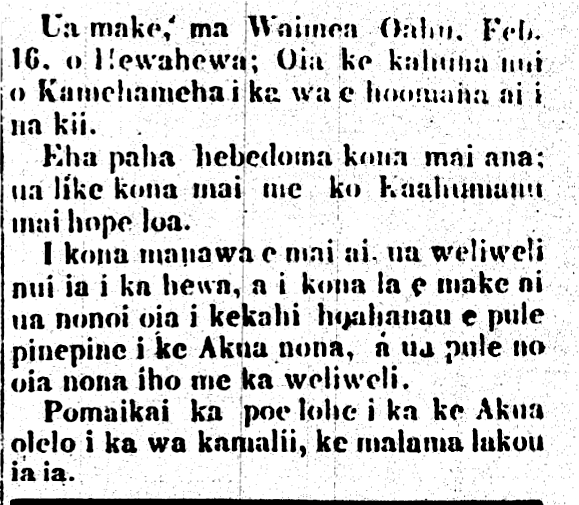
Hewahewa died at Waimea, Oahu, Feb. 16; he was the great kahuna of Kamehameha during the time when the idols were worshiped.

He was ill for perhaps four months; his illness was like that of Kaahumanu’s final illness.

While he was sick, he was terrified of sins, and on the day that he died, he asked one of the brethren to pray often to God for him, and he prayed for himself in fear.

Blessed are those who hear Godʻs teachings while they are young, should they heed them.

(Kumu Hawaii, 4/26/1837, p. 96)

Ua make ma Waimea, Oahu...

Ke Kumu Hawaii, Buke 2, Pepa 24, Aoao 96. Aperila 26, 1937.

More on Opukahaia, 1865.

The Story of Opukahaia.

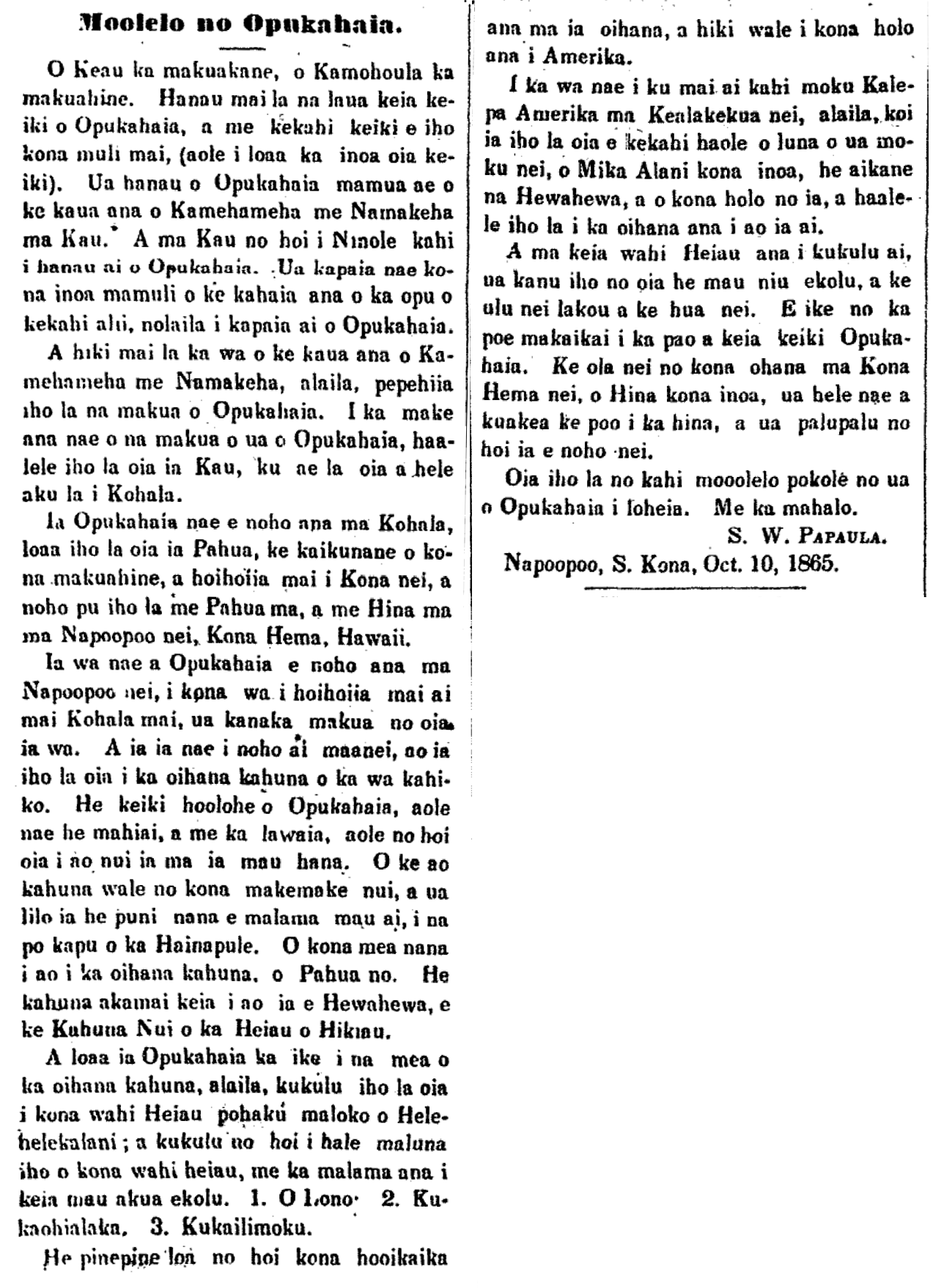
Keau was the father, Kamohoula was the mother. From the two was born this child, Opukahaia, along with another younger child (the name of that child is not known). Opukahaia was born soon before the battle between Kamehameha and Namakeha at Kau. And at Kau in Ninole, is where Opukahaia was born. He was named for the slitting of the stomach of a certain alii, and that is why he was called Opukahaia [“the cutting of the stomach”].

When the time of warfare between Kamehameha and Namakeha arrived, the parents of Opukahaia were killed. When his parents were killed, Opukahaia fled Kau, and went to Kohala.

While he lived in Kohala, Opukahaia was found by Pahua, the brother of his mother, and he was returned here to Kona, and lived with Puhua them and Hina them here in Napoopoo, South Kona, Hawaii.

The time when Opukahaia was living here in Napoopoo, when he was brought back from Kohala, he was an adult at the time. While he lived here, to him belonged the occupation of the kahuna of the olden days. Opukahaia was obedient; he was however not a farmer nor a fisherman, for he was not taught much about those things. He really just wanted to be taught kahuna things, and this was something that he was very interested in doing constantly, on sacred nights of Prayer [? Hainapule]. The one who taught him the ways of the kahuna was Pahua. He was a skilled kahuna taught by Hewahewa, the Great Kahuna of the Heiau of Hikiau.

After Opukahaia received the knowledge of the occupation of the kahuna, he constructed his stone Heiau within Helehelekalani, and he built a house atop his heiau, while he worshiped three gods. 1. Lono, 2. Kukaohiakala, 3. Kukailimoku.

He was constantly honing his skills, until he left for America.

When the American trading ship appeared here at Kealakekua, he was prodded by a haole aboard the ship, named Mika Alani, who was an aikane of Hewahewa; and so he went and left the work that he was trained in.

And at this Heiau which he built, he planted three coconuts, and they are growing and fruiting. The cave [? pao] of this boy, Opukahaia, can be seen by those who visit here. His relative still lives here in South Kona, her name is Hina; she is gray-haired and is frail now.

This is a short story of what is heard of Opukahaia. With mahalo.

S. W. Papaula.

Napoopoo, S. Kona, Oct. 10, 1865.

[This seems to be written in response to the translation being published in Kuokoa at the same period. Papaula is adding to the information given in the translation. This ability to quickly add to or correct information published in the newspapers was one of the many advantages newspapers had over books.]

(Kuokoa, 11/4/1865, p. 4)

Moolelo no Opukahaia.

Ka Nupepa Kuokoa, Buke IV, Helu 44, Aoao 4. Novemaba 4, 1865.

Healing Stone (?) of Wahiawa, 1927.

Supernatural Rock of Wahiawa

Honolulu, Oct. 26—This rock being visited by people to worship these days is becoming something that truly is stirring the thoughts of some people here in Honolulu, and some who are living near Wahiawa are appealing to the Government and to the power of the Board of Health to move that rock from where it first stood, because in their opinion, this action by the people will cause an epidemic to grow here where all ethnicities are going and touching themselves against the bodies of others, and this will perhaps cause sicknesses to spread from one to another.

The Board of Health refused to step in and block this action by people who believe their ailments will be healed by touching the sick area to that rock of Wahiawa, and the birthing stones of the High Chiefs of this land in ancient times.

Some people have said that their weakness due to rheumatism by them going there and touching their areas of pain to that rock. Some say that their weak areas were not cured by touching the rock.

If the Naha Stone was not moved to the mauka side of the Hilo Library here, and it was left where it was from olden times, then the healing powers of these Birthing Stones of the sacred Alii of Hawaii and the Stone that Kamehameha the Great flipped over and which became a symbol of his victory over this entire Archipelago, and for which Kamehameha spoke these words:

“He Naha oe, a he Naha hoi kou mea e neeu ai. He Niau-pio hoi wau, ao ka Niau-pio hoi o ka Wao.”¹

With these words did Kamehameha put his shoulders up to the Naha Stone [Naha Pohaku], and flipped it over, being this was a stone that could not be moved by five men. Perhaps some sick with rheumatism will rub up their ailing places against the Naha Stone in the future.

[I was reminded of this by a picture of two stones with the caption “Sacred Stones at Wahiawa” from the Lani Nedbalek Collection displayed at the Pineapple Festival today.]

¹”You are a Naha, and it will be a Naha who will move you. I am a Niaupio, the Niaupio of the Forest.”

(Hoku o Hawaii, 11/1/1927, p. 3)

Ka Pohaku Kupua o Wahiawa

Ka Hoku o Hawaii, Buke XXI, Helu 23, Aoao 3. Novemaba 1, 1927.