English Song for the Restoration of the Kingdom, 1893.

[The Hawaiian Historical Society, on their Facebook page, posted this awesome image of the English lyrics of the “Restoration Anthem,” which it seems was sung at the luau given by Kamehameha III at Luakaha!]

Restoration Anthem.

Tune. God save the King

Hail! to our rightful king!
We joyful honor bring,
This day to thee!
Long live your Majesty!
Long reign thou dynasty!
And for posterity,
The sceptre be

Hail! to the worthy name!
Worthy his country’s fame!
Thomas, the brave!
Long shall they virtues be,
Shrined in our memory
Who came to set us free
Quick oe’r the wave!

Hail! to our Heavenly King!
To thee our thanks we bring,
Worthy of all.
Loud, we thine honors raise!
Loud, is our song of praise!
Smile on our future days,
Sovereign of all.

July 31, 1843

Sung at the great cold water luau given by H.H.M. Kamehameha III, in Nuuanu to several thousands of natives and all the Foreigners including the officers of 4 ships of war. For which Admiral Thomas thanked the ladies and gent who did him the honor.

[unclear phrase]  August 20, 1843

Song for the Restoration of the Kingdom, 1843.

MELE HOI HOU ANA.

(Leo, ‘E Ola ke Alii i ke Akua.’)

1.  E ko makou alii!
Mahalo ‘ka moi,
I keia la!
E mau kou ola nei!
E mau kou aupuni!
No na hanauna hoi,
I oni paa.

2.  Nani! ka inoa maikai!
Me kona aina nae!
Toma ke koa!
Mahalo ‘kou maikai,
Kou wikiwiki mai!
Maluna o ke kai,
E kuu ‘na pau!

3.  Hiilani i ke Lii!
Iehova ka Moi,
E hapai no;
Nui ke kupinai!
Nui ke mele nae!
I mau ka pomaikai
Ia oe no.

Honolulu, Oahu, Iulai 31, 1843.

(Nonanona, 9/5/1843, p. 44)

MELE HOI HOU ANA.

Ka Nonanona, Buke 3, Pepa 8, Aoao 44. Sepatemaba 5, 1843.

La Hoihoi Ea, 1843.

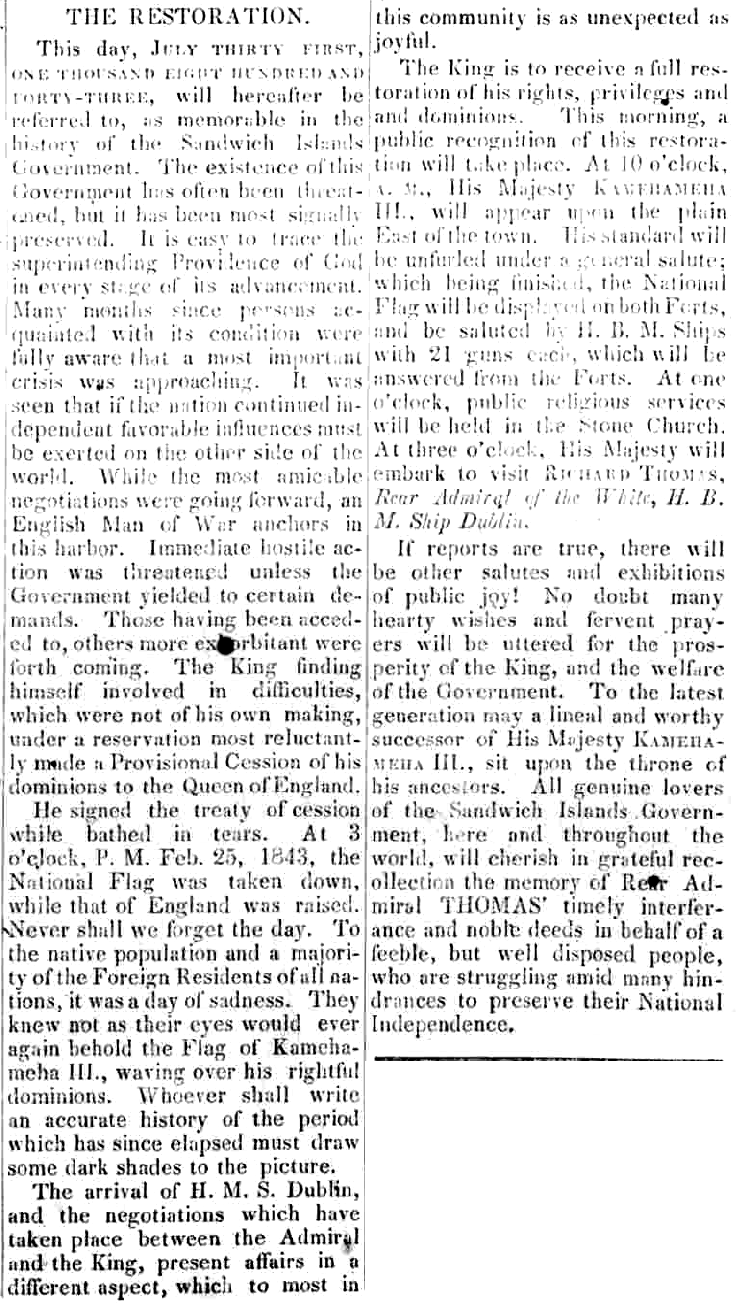
THE RESTORATION.

This day, July thirty first, one thousand eight hundred and forty-three, will hereafter be referred to, as memorable in the history of the Sandwich Islands Government. The existence of the Government has often been threatened, but it has been most signally preserved. It is easy to trace the superintending Providence of God in every stage of its advancement. Many months since persons acquainted with its condition were fully aware that a most important crisis was approaching. It was seen that if the nation continued independent favorable influences must be exerted on the other side of the world. While the most amicable negotiations were going forward, an English Man of War anchors in this harbor. Immediate hostile action was threatened unless the Government yielded to certain demands. Those having been acceded to, others more exhorbitant were forth coming. The King finding himself involved in difficulties, which were not of his own making, under a reservation most reluctantly made a Provisional Cession of his dominions to the Queen of England.

He signed the treaty of cession while bathed in tears. At 3 oʻclock, P. M. Feb. 25, 1843, the National Flag was taken down, while that of England was raised. Never shall we forget the day. To the native population and a majority of the Foreign Residents of all nations, it was a day of sadness. They knew not as their eyes would ever again behold the Flag of Kamehameha III., waving over his rightful dominions. Whoever shall write an accurate history of the period which has since elpased must draw some dark shades to the picture.

The arrival of H. M. S. Dublin, and the negotiations which have taken place between the Admiral and the King, present affairs in a different aspect, which to most in this community is as unexpected as joyful.

The King is to receive a full restoration of his rights, privileges and and dominions. This morning, a public recognition of this restoration will take place. At 10 oʻclock, A. M., His Majesty Kamehameha III., will appear upon the plain East of the town. His standard will be unfurled under a general salute; which being finished, the National Flag will be displayed on both Forts, and be saluted by H. B. M. Ships with 21 guns each, which will be answered from the Forts. At one oʻclock, public religious services will be held in the Stone Church. At three oʻclock, His Majesty will embark to visit Richard Thomas, Rear Admiral of the White, H. B. M. Ship Dublin.

If reports are true, there will be other salutes and exhibitions of public joy! No doubt many hearty wishes and fervent prayers will be uttered for the prosperity of the King, and the welfare of the Government. To the latest generation may a lineal and worthy successor of His Majesty Kamehameha III., sit upon the throne of his ancestors. All genuine lovers of the Sandwich Islands Government, here and throughout the world, will cherish in grateful recollection the memory of Rear Admiral THOMASʻ timely interferance and noble deeds in behalf of a feeble, but well disposed people, who are struggling amid many hindrances to preserve their National Independence.

[This is from a special edition of the Advocate and Friend published on the very day of the restoration. The rest of the coverage can be seen here on the Mission Houses Museum page! Mahalo to Dwight Baldwin (descendant of the Temperance Advocate, and Seamenʻs Friend editor Samuel C. Damon) via Nathan Napoka for reminding me that there are indeed Hawaii newspapers other than Hawaiian-Language Newspapers.]

(Advocate and Friend, 7/31/1843, p. 38)

THE RESTORATION.

Advocate and Friend. (Extra). July 31, 1843, p. 38.

The first Kamehameha Day out in the country, continued, 1872.

At Wailuku.

The children of the Hawaiian nation celebrated this day to commemorate the day believed to be the incorrect [? kupaewa] day of birth of the old chief who passed on, the one who joined Hawaii nei together to become one.

Here below are the activities done in celebration on that day. A crowd gathered at the protestant church in Wailuku; people were separated into those who were born during the time of Kamehameha I, who had a separate seating section, and so too of the people of Kamehameha IIʻs time, and all the way until those of Kamehameha Vʻs time; when looking about, a majority of the audience was born in the time of Kamehameha III.

The program was opened with the singing of a hymn to Almighty God; Hymn 33 and Mr. Napue gave a prayer; there was a second Hymn 196, and that came to an close. J. A. Napela [J. H. Napela] served as the Chairman, and spoke about things of Kamehameha Iʻs time and his deeds, his strength, and so forth. This was the first speech, and it was given for the commemoration, appropriately done by one who is well-immersed in the ways of those times.

Speech number two. C. P. Kealakai, teacher of Halehaku; his speech was about the one being commemorated; his main topic which he expounded upon was aloha for God.

Speech number three. D. H. Hakuole, teacher of Kauaula; his speech was about Opukahaia, and not about the remembrance of Kamehameha I.

Speech number four. Kamoku, a student of the theological seminary; this speech was on the mark [pilipono ka la i papaenaena] and did not go astray; it was the first delightful speech for the audience.

Speech number five. A. Keohokalole, audience member from the island of Maui; this was a speech suited for the learned; the items were woven skillfully together, and was fitting to the program.

Speech number six. I donʻt have the name; it was a speech that was not pertinent to the topic; he was made to sit down by the Chairman.

Speech number seven. Mr. Kaleohano; the speech was about electricity, but it was related to the topic. He spoke about these famous words before the audience, because the haole sugar farmers don’t recall the words of the alii, Kamehameha V, who said: “If I had a million dollars in my pocket, I would be able to demolish these sugar mills for their contempt of the royal proclamation.

Speech number eight. P. Kaluna, teacher of Papohaku, it was electric; it was apparent that his speech showed his great thought for the celebration of the day.

Speech number nine. Kawelau, teacher of the district of that famous rain, the Ukiukiu [of Makawao]; I will not say that he wasn’t electric, but it was somewhat like speech number four.

Speech number ten. Nahunahupu; this was a speech not appropriate for the person who was being commemorated that day.

Speech number eleven. D. Mamaki, teacher of Lahaina; this was a fine speech.

After this speech was over, that concluded the activities of the day. Everyone proceeded down to the place of N. Kepoikai, Esq. There, they were supplied with every type of Hawaiian food, along with haole food, all except liquor. This feast was appreciated for its peaceful nature and great pride, well-suited for gentlemen. The majority of those who partook in the food were government school teachers of the from all around Maui.

[This is a continuation of “Day Commemorating Kamehameha I.” There is one more section describing the celebration held at Kailua, Kona, with quite a display of whale ivory! I will try to get that up sometime in the future.]

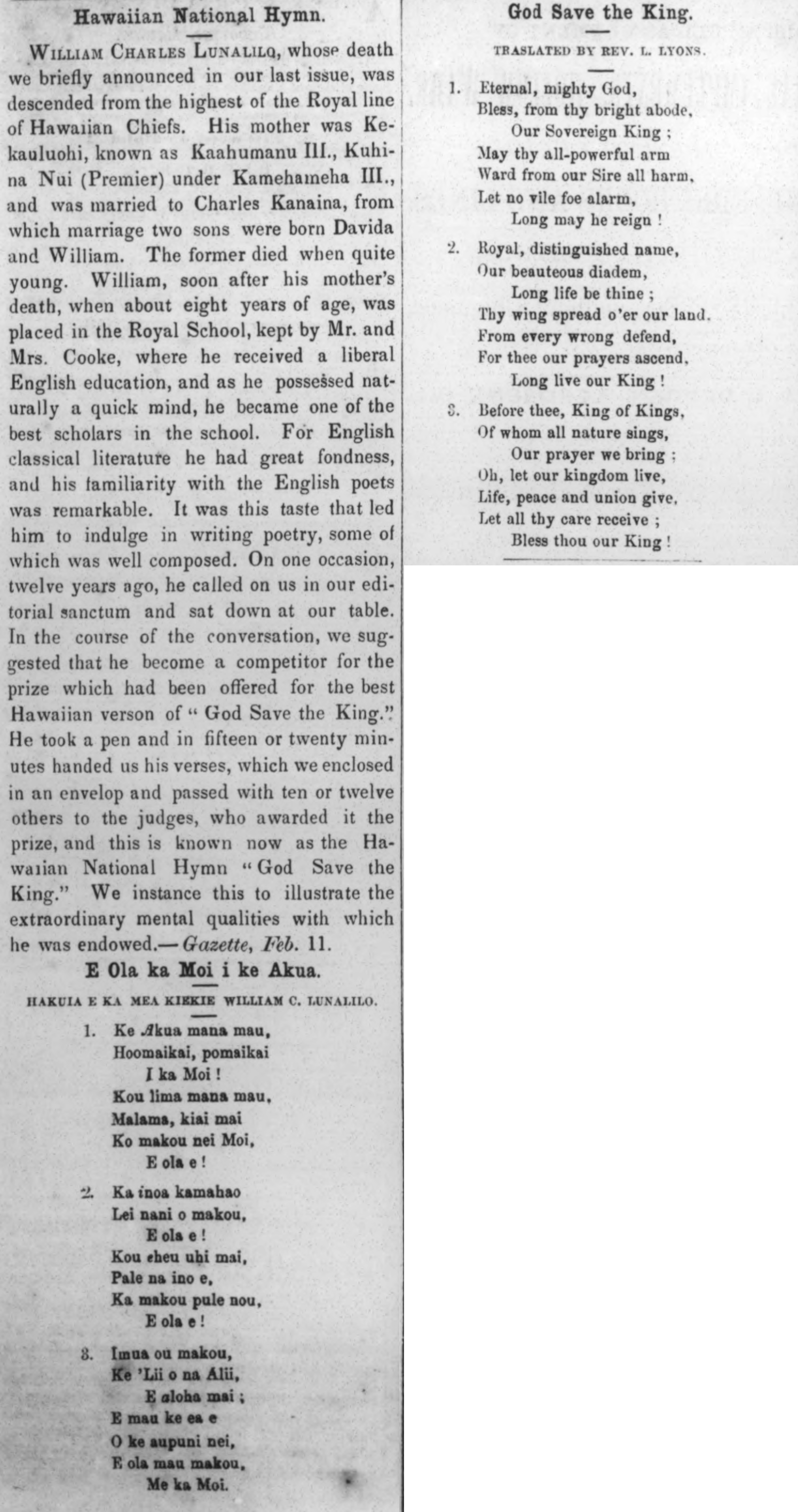
More on the Hawaiian National Hymn, 1874.

Hawaiian National Hymn.

William Charles Lunalilo, whose death we briefly announced in our last issue, was descended from the highest of the Royal line of Hawaiian Chiefs. His mother was Kekauluohi, known as Kaahumanu III., Kuhina Nui (Premier) under Kamehameha III., and was married to Charles Kanaina, from which marriage two sons were born Davida and William. The former died when quite young. William, soon after his mother’s death, when about eight years of age, was placed in the Royal School, kept by Mr. and Mrs. Cooke, where he received a liberal English education, and as he possessed naturally, a quick mind, he became one of the best scholars in the school. For English classical literature he had great fondness, and his familiarity with the English poets was remarkable. It was this taste that led him to indulge in writing poetry, some of which was well composed. On one occasion, twelve years ago, he called on us in our editorial sanctum and sat down at our table. In the course of the conversation, we suggested that he become a competitor for the best prize which had been offered for the best Hawaiian version of “God Save the King.” He took a pen and in fifteen or twenty minutes handed us his verses, which we enclosed in an envelope and passed with ten or twelve others to the judges, who awarded it the prize, and this is known now as the Hawaiian National Hymn “God Save the King.” We instance this to illustrate the extraordinary mental qualities with which he was endowed.—Gazette, Feb. 11.

E Ola ka Moi i ke Akua.

HAKUIA E KA MEA KIEKIE WILLIAM C. LUNALILO.

1. Ke Akua mana mau,
Hoomaikai, pomaikai
I ka Moi!
Kou lima mana mau,
Malama, kiai mai
Ko makou nei Moi,
E ola e!

2. Ka inoa kamahao
Lei nani o makou,
E ola e!
Kou eheu uhi mai,
Pale na ino e,
Ka makou pule nou,
E ola e!

3. Imua ou makou,
Ke ‘Lii o na Alii,
E aloha mai;
E mau ke ea e
O ke aupuni nei,
E ola mau makou,
Me ka Moi.

God Save the King.

TRANSLATED BY REV. L. LYONS.

1. Eternal, mighty God,
Bless, from thy bright abode,
Our Sovereign King;
May thy all-powerful arm
Ward from our Sire all harm,
Let no vile foe alarm,
Long may he reign!

2. Royal, distinguished name,
Our beauteous diadem,
Long life be thine;
Thy wing spread o’er our land.
From every wrong defend,
For thee our prayers ascend,
Long live our King!

3. Before thee, King of Kings,
Of whom all nature sings,
Our prayer we bring;
Oh, let our kingdom live,
Life, peace and union give,
Let all thy care receive;
Bless thou our King!

(Friend, 3/2/1874, p. 24)

Hawaiian National Hymn.

The Friend, New Series, Volume 23, Number 3, Page 24. March 2, 1874.

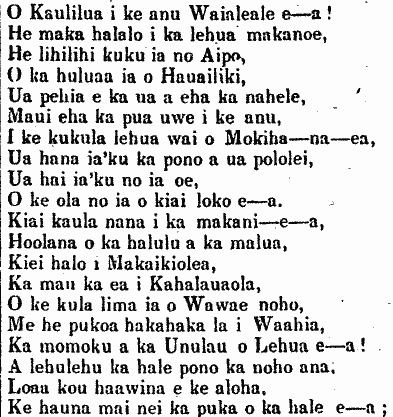
Kaulilua… Mele inoa for Kamehameha IV, 1864.

[Excerpt found under: “A DIRGE FOR KING Alexander Kalanikualiholiho, Maka o Iouli, Kunuiakea o Kukailimoku, KAMEHAMEHA IV!”]

O Kaulilua i ke anu Waialeale e—a!
He maka halalo i ka lehua makanoe,
He lihilihi kuku ia no Aipo,
O ka huluaa ia o Hauailiki,
Ua pehia e ka ua a eha ka nahele,
Maui eha ka pua uwe i ke anu,
I ke kukula lehua wai o Mokiha—na—ea,
Ua hana ia’ku ka pono a ua pololei,
Ua hai ia’ku no ia oe,
O ke ola no ia o kiai loko e—a.
Kiai kaula nana i ka makani—e—a,
Hoolana o ka halulu a ka malua,
Kiei halo i Makaikiolea,
Ka mau ka ea i Kahalauaola,
O ke kula lima ia o Wawae noho,
Me he pukoa hakahaka la i Waahia,
Ka momoku a ka Unulau o Lehua e—a!
A lehulehu ka hale pono ka noho ana,
Loaa kou haawina e ke aloha,
Ke hauna mai nei ka puka o ka hale e—a;

[So many interesting things about this. The first and foremost perhaps is that this appears as part of an unusual kanikau for Alexander Liholiho Kamehameha IV in the form of a conversation between Kamehameha III (K III.) and himself (K IV.). Another is that if you hula, you probably learned this as a mele inoa for Kalakaua and not as one for Kamehameha IV. Does anyone know who it is that is labeled as (M.) in the conversation? Click here for a PDF of the issue with the rest of the piece on page 4.]

(Kuokoa, 1/23/1864, p. 4)

O Kaulilua i ke anu Waialeale e—a!

Ka Nupepa Kuokoa, Buke III, Helu 4, Aoao 4. Ianuari 23, 1864.

The Kings of Hawaii, 1876.

This is from an issue of “The Friend,” which includes a short biography in English of the ruling monarchs of Hawaii nei, written by S. C. Damon. As for this page of illustrations, they say:

The illustrations accompanying this number of the Friend we could wish were better executed. The plate was made in New York, from the best photographs we could procure in Honolulu. The original of Kamehameha 1st was executed in 1817 by a Russian artist, who accompanied Kotzebue in his voyage, and may be seen by referring to the third volume of his voyage. The original of Kamehameha 2d was executed in England in 1824, in the style of the dress of George 4th’s reign. We think those of Kamehameha 3d, 4th and 5th are very good, but not quite so good those of Lunalilo or His Majesty Kalakaua.

[For the biographies, find them here: The Friend, February 1, 1876.

Although it is clunky to maneuver, most of this series of news letters is available from the Mission Houses Museum here: The Friend.]

(Friend, 2/1/1876, pp. 9–13)

[Monarchs]

The Friend, New Series, Volume 25, Number 2, Page unnumbered. February 1, 1876.

Mele Inoa for Kauikeaouli, Kamehameha III. 1862.

HE INOA NO KAUIKEAOULI.

Auhea wale ana oe, kapua hau o Maleka,
Ke au nei ka manao, Pehea o Niagala,
Kela wai kamahao, wai halulu o ka moano,
Nene i na moku, lohe aku nei Lukini,
Ua ana ia Kuleke, aohe i hopo Ladana,
I ka nui o Asia, hue a ke kaona nui,
Laki ka moana Iniana, ehuehu Enelani,
Ke kowa o Sekotia, aita oe e palau,
No’u o Ainahau, a ka wai o Nolewai,
Pau mai ko’u palena, ilaila a’u la oki,
Lawe u’a linohau, a ai ka manu iluna,
I kilohi iho kuu hana, he nani o Hudesona,
Kaikuono Papine, mea ua ae ia,
Me oe a ke aloha iwini o ke aumoa,
Auhea wale ana oe, e ka uneune puuwai,
E ke kaukini ma-lo, nana i ue laholio,
Hoomaloe i kuu kino, hooueue i ka moe,
Lana koi kahi manao, halanalana i ka leo,
O ua mea ino nei, he hoouluulu ia,
Keehi pono i ko haka, i luhi lai ko kahu,
A ao luau ai, pau ko aumakua pi kai a kaua,
I ka lihi kai o lalo, eia la he manao,
Kai hiki mai ia nei, e kali iki iho oe,
A hala ae Welehu, ka malama ino ke kau,
Hiki ae la ia Nana, pe oi kahi manao,
Olu ka noho na o ka lani me oe a ke aloha,
Iwini o ke aumoe, i mai nei o Piuta,
Ua hala kou palena, aohe koina oonei,
O kou la luu loli, a lae hao au lohe,
Ilaila ka wahine Ia, nana i nai ka moana,
He ukali aina ahi, i ka lae o Kepohoni,
Aia iho o Palema, ke noho la i ka hema,
Nana e kuhikuhi mai, ka lonitu akau,
Ike ia na degere, na kuea o ka honua,
Alo mai Kapena Kuke, ka noe i Nouaiki,
Ikiiki wale hoi au, i ka lohe pepeiao,
E ake ko’u manao, ka ike ia Panama,
I pau kuu kuhihewa, i ke kai o Inia,
Nopia o Iapana, ke hui me Ualana,
Me oe a ke aloha, iwini o ke aumoe.

Ii.

Honolulu, Aperila 14, 1862.

[This is a mele known as a mele inoa for Kamamalu, but here it is submitted by Ioane Ii as a mele inoa for Kauikeaouli.]

(Hoku o ka Pakipika, 5/8/1862, p. 4)

HE INOA NO KAUIKEAOULI.

Ka Hoku o ka Pakipika, Buke I, Helu 33, Aoao 4. Mei 8, 1862.

More mele from Mary Jane Montano, 1927.

SOME OLD MELE OF HAWAII NEI.

Mr. Solomon Hanohano, Editor of the Kuokoa Newspaper:—Please publish the following mele from times past, when the land was filled with alii.

This is a name song [mele inoa] for the royal one Ahumanu [Kaahumanu], which was inherited by Kaumakaokane II, the mother of Kuakini (John Adams Cummins) during the youth of Kaumaka, and that royal woman [Kaahumanu] then called Kaumakaokane, by the name Papaleaiaina.

This name is the name that Kalaniahumanu [Kaahumanu] called the Royal One, Paiea Kamehameha I, and it is answered to today by the granddaughter of the Hon. J. A. Cummins, that being Matilda Papaleaiaina Walker Constable.

It would be best that these jewels of Hawaii nei be shown, for some of us will live on as teachers for the impertinent questions, as like the one who questioned in the Advertiser newspaper, about my dear brother, the Hon. J. A. Cummins, the “backbone” [iwikuamoo] of the chiefly ones who have passed into the next realm.

Kaumakaokane he inoa,
Hanau a koa he kupuna,
Eia ua aliiwahine nei,
Ke holo mai nei o ka moku,
Me ka hae o kau weloweloula,
Ku’ilua ka pu,
He aloha ia,
Aole i ike ka haole,
Wahi a Kalanikauleleiaiwi,
Iwi ka maka,
Holoholo ka onohi,
Lele ka puuwai i ka makemake,
I ka wai olu o Lanipo-e,
Nau ke ku’i haukeke ka auwae,
I hemahema i ka wa kamalii,
O ko’u wa naaupo no ia,
E laua la e,
Papaleaiaina kuu aloha e—
O kau ka haili aloha i o’u nei,
O ka welelau o kuu lima ka i pa aku,
Pa i ka lihi o Kilauea.

And here is the genealogy of the lei to adorn the neck of Ahia (Mrs. Capt. George Beckley), that being John Adams Cummins.

Liloa is the father who dwelt with Akahiakuleana, born was Umi. Umi, dwelt with Piikea, born was Aihakoko, Kumulaenuiaumi. Kumulaenui, dwelt with Kumunuipawalau, born was Kekapuhelemai; Kekapuhelemai dwelt with Piilani, born was Lonoikauakini.

Lonokauakini, dwelt with Kapukaheiau, born was Lonoikahaupo; Lonoikahaupo, dwelt with Ninauaiwi, born was Kekapalakea. Kekapalakea dwelt with Kelahuna, born was Kowali; Kolwali dwelt with Kaumaokaokane, born was Keaweaua. Keaweaua dwelt with Kaahaiku, born was Keauiaole; Keauiaole dwelt with Liloa, born was Kaumakaokane, Kameeiamoku.

Kaumakaokane (f) dwelt with Thomas Cummins, born was John Adams Cummins.

Kelahuna (f) is a descendant of Kelahunapaikua (m) and Ahia (f) and Kelahunapaikua (m) is a child of Kakuhihewa and Kolimoalani, that being Koaekea (f), the grandchild of Akahinuikameenoa (f), the woman that I placed a kapu upon.

Kelahuna (f) is the younger sister of Kamehaiku, these being female alii of Kau, Hawaii, and Kamehaiku is the woman of Keeaumoku, the father of Kaahumanu who slept with Kalanianoano and begot Kanehoa, the grandfather of Kaleianoano, Hoapili, and so forth, as well as Jesse Hakainai [Makainai ?], and so forth.

Sincerely, this is I

Ako-kuia ka hale lehua o ka manu,
Kauwewe i ka liko o ka ohia,
He uanoe he uaawa no ka mauna,
Uli ka nahele o Ookuauli,
Uli ka nahu hoomau a ka makani,
A makani a lei a lea,
Lea i na kauna ami a ka ua,
Alohi Maukele anapa i ka la e,
Okioki a hoe,
O ke aho no ia a ka ua Polohinalo,
A pikipiki ka lei,
Me he nu’a kapa la,
Popo ka lei a waiho malie,
Nana aku o kuu apana hala iuka o Panaewa,
Mamina ino no kuu kula lehua,
A’u i kawili mua ai,
Ua maka-pa ua eena ka manu,
He ena kai olohia ia no ke kanaka e—

The is the origin of my name from the heavenly one, Kauikeaouli; Kekulani is the name appended to Keoni Ana Opio [John Young, Jr.] when Kauikeaouli died and returned.

E o mai oe i kou inoa e Kekulani,
O ka lani no ka i ku,
I ka papa holu i ka makani,
A o oe no ke o mai e,

MARYJANE AHIA AHUENA KEKULANI MONTANO.

(Kuokoa, 3/31/1927, p. 1)

KEKAHI MELE KAHIKO O HAWAII NEI.

Ka Nupepa Kuokoa, Buke LXVI, Helu 13, Aoao 1. Maraki 31, 1927.

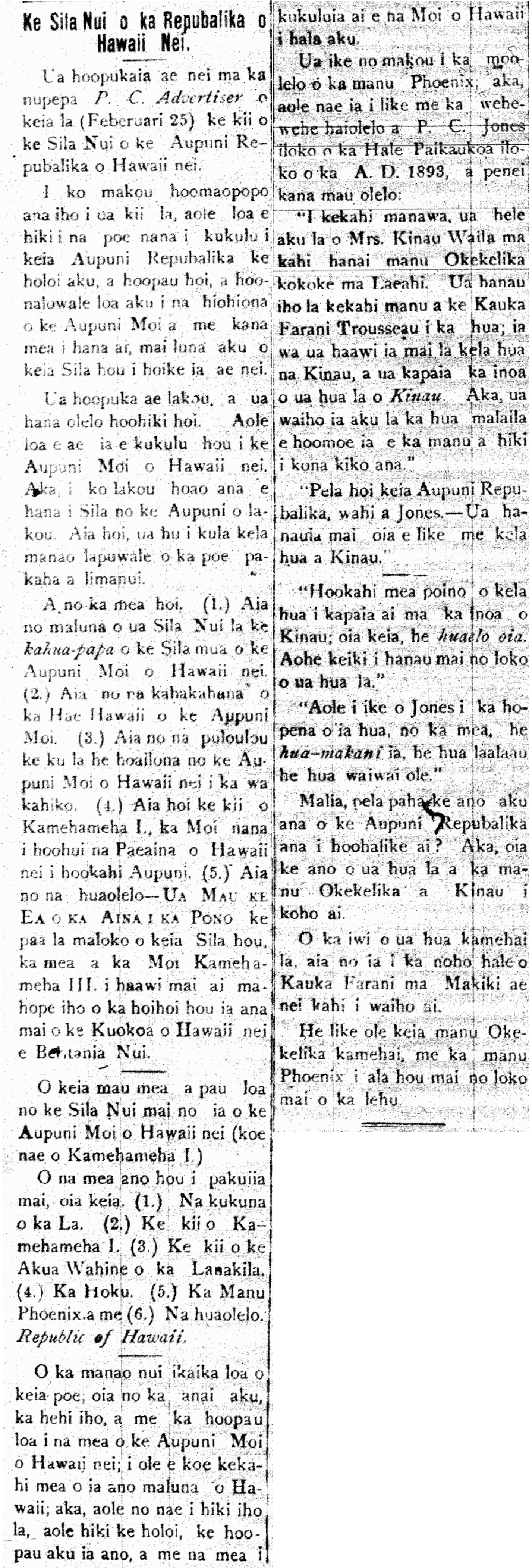
Different view of the seal of the republic, 1896.

Great Seal of the Republic of Hawaii.

In today’s P. C. Advertiser (February 25), a picture of the Great Seal of the Republic of Hawaii was printed.

By our understanding of that image, there is no way that those who established this Republic can erase or end or eradicate visages of the Monarchy and its accomplishments, from the seal mentioned above.

They stated and vowed that there will be no way that the reestablishment of the Kingdom of Hawaii nei will be allowed. However, when they set out to create a Seal for their Government. And now, that foolish idea of the plunderers and thugs has gone awry.

Being that, (1.) On that Great Seal, is the foundation of the first Seal of the Monarchy of Hawaii nei. (2.) There is the stripes of the Hawaiian Flag of the Monarchy. (3.) There stand puloulou, a symbol of the Hawaiian Monarchy of old. (4.) There is an image of Kamehameha I., the King who unified the Hawaiian Archipelago into one Nation. (5.) There are the words—”Ua Mau ke Ea o ka Aina i ka Pono” affixed onto this new Seal, the words given by King Kamehameha III after the restoration of the Independence of Hawaii nei by Great Britain.

All these things were from the Great Seal of the Monarchy of Hawaii nei (except Kamehameha I.)

The new things added are these. (1.) Rays of the Sun. (2.) The image of Kamehameha I. (3.) The image of the Goddess of Victory. (4.) The Star. (5.) The Phoenix Bird, and (6.) The words, Republic of Hawaii.

Their intense desire is to rub out, to stomp out, and to end for all time, things of the Monarchy of Hawaii nei, lest vestiges of that sort remain in Hawaii; but that is not possible: there is no erasing, nor putting end to deeds done by the past Monarchs of Hawaii.

We know the story of the Phoenix, but it is not the same as the explanatory speech by P. C. Jones at the Armory [Hale Paikaukoa] in the year 1893, and these are his words:

“Once, Mrs. Kinau Wilder [Waila] went to where Ostrich were raised near Diamond Head [Laeahi]. One of the birds of the French Doctor Trousseau laid an egg, and it was on that occasion given to Kinau, and the egg was called Kinau. However, it was left there to be sat on by a bird until it hatched.

“This is similar to this Republic,” according to Jones. “It was born like that egg, Kinau.”

There is one unfortunate thing about that egg called by the name of Kinau, that being, it was a rotten egg [huaelo]. There was no chick born from that egg.

Jones didn’t know of the outcome of that egg, for it was but a yolk-less egg [hua makani], a hua laalaau?, a worthless egg.

Perhaps this will be the outcome of the Republic to which he compares it to? But at any rate, that is the kind of Ostrich egg that Kinau chose.

The shell of that astonishing egg is kept at the residence of Trousseau [Kauka Farani] in Makiki.

This astonishing Ostrich is not the same as a Phoenix which rises from the ashes.

(Aloha Aina, 2/29/1896, p. 4)

Ke Sila Nui o ka Repubalika o Hawaii Nei.

Ke Aloha Hawaii, Buke II, Helu 9, Aoao 4. Feberuari 29, 1896.