Marriage of Liliuokalani and John Owen Dominis, 1862.

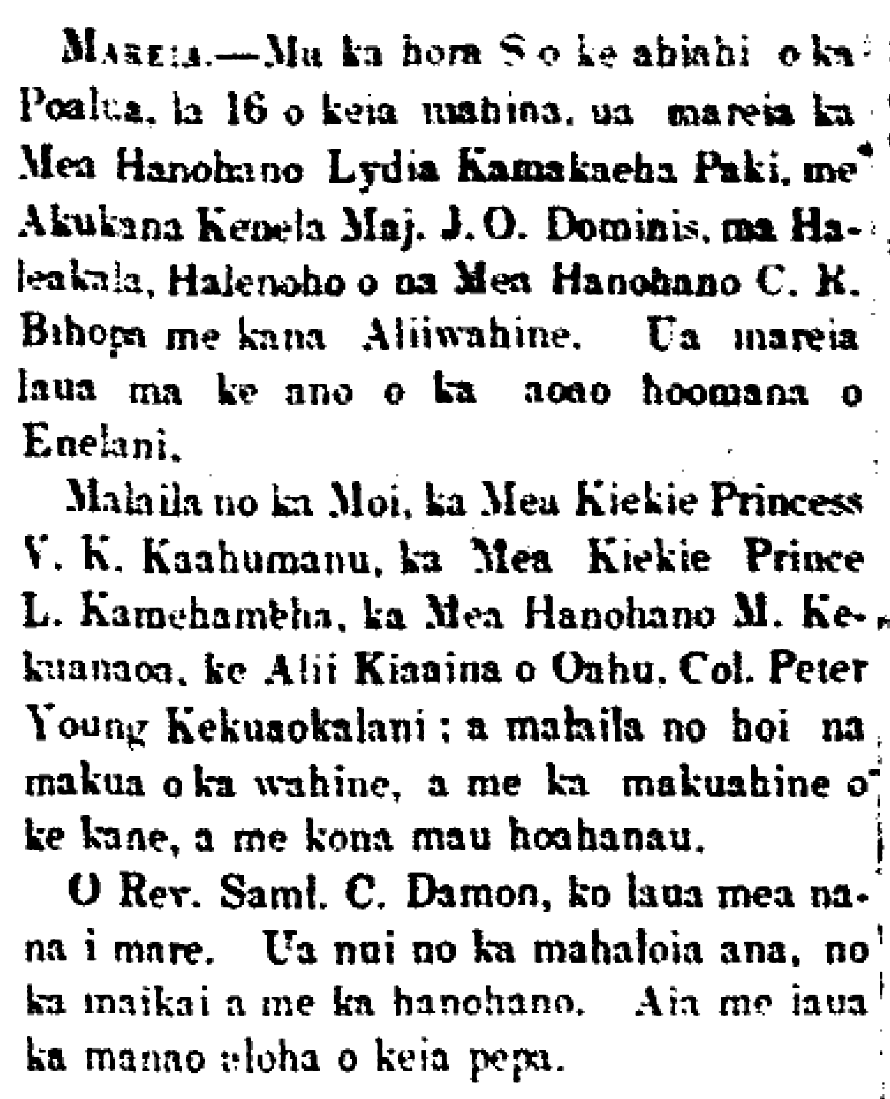
Marriage.—At 8 in the evening of Tuesday, the 16th of this month, the Honorable Lydia Kamakaeha Paki and Adjutant General Major J. O. Dominis were wed at the Residence of the Honorable C. R. Bishop and his Queen. The two were married in the Anglican faith.

Present were the King; her Highness Princess V. K. Kaahumanu; his Highness Prince L. Kamehameha; the Honorable M. Kekuanaoa, the Royal Governor of Oahu; Colonel Peter Young Kekuaokalani; also there were the parents of the bride, and the mother of the groom, and his cousins.

Rev. Samuel C. Damon was who performed the ceremony. It was appreciated for its righteousness and honor. With the two of them are the thoughts of aloha of this paper.

(Kuokoa, 9/20/1862, p. 3)

Mareia.

Ka Nupepa Kuokoa, Buke I, Helu 43, Aoao 3. Sepatemaba 20, 1862.

Admiral Richard Thomas honored once again, 1857.

BY AUTHORITY.

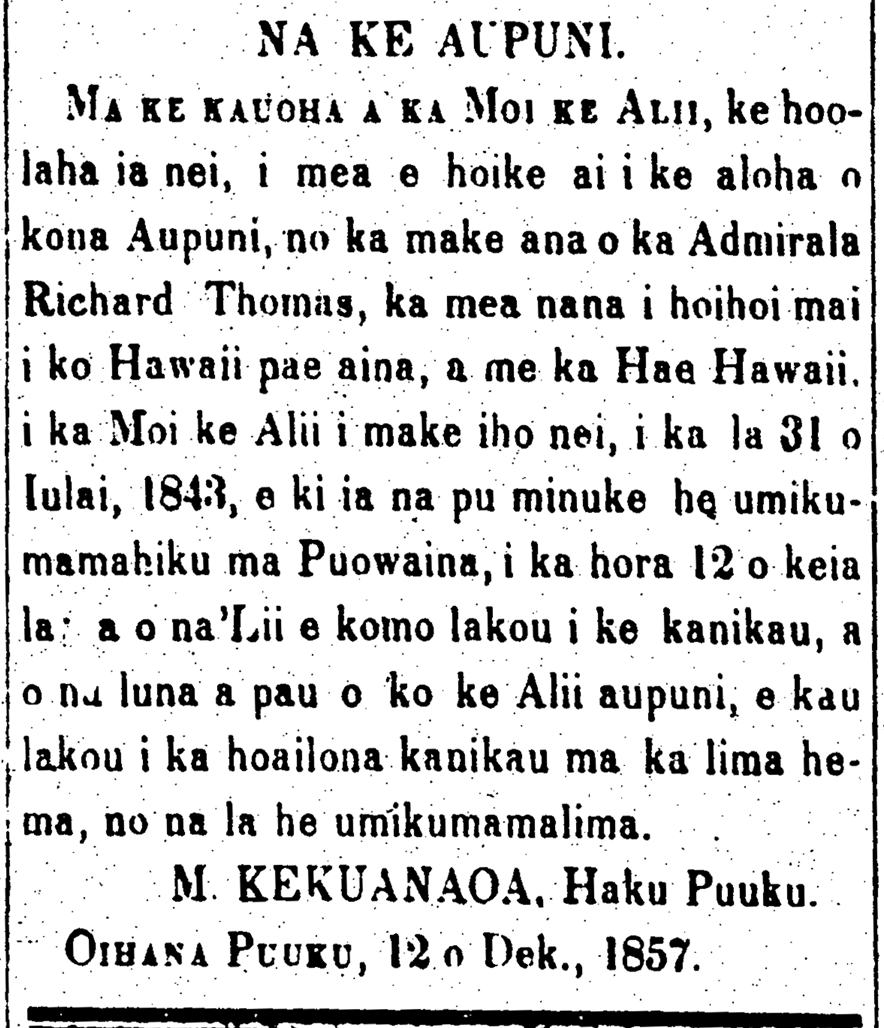
By order of the King, the Chief [Kamehameha IV], it is hereby proclaimed that in order to show the aloha of his Nation at the passing of Admiral Richard Thomas, the one who returned the islands of Hawaii and the Hawaiian Flag on the 31st of July, 1843 to the King recently deceased, seventeen minute guns [pu minuke] will be fired from Puowaina [the fort at Punchbowl] at 12 o’clock on this day, and the Alii will go into mourning and all of the officers of the King’s government shall wear black crepe [hoailona kanikau] on their left arm for fifteen days.

M. KEKUANAOA, Chief Chamberlain [Haku Puuku],

Office of the Chamberlain [Oihana Puuku], 12th of Dec., 1857.

(Hae Hawaii, 12/16/1857, p. 150.)

NA KE AUPUNI.

Ka Hae Hawaii, Buke 2, Ano Hou.—Helu 38, Aoao 150. Dekemaba 16, 1857.

Restoration Celebration at Luakaha, in Nuuanu, 1843.

FEAST OF THE KING.

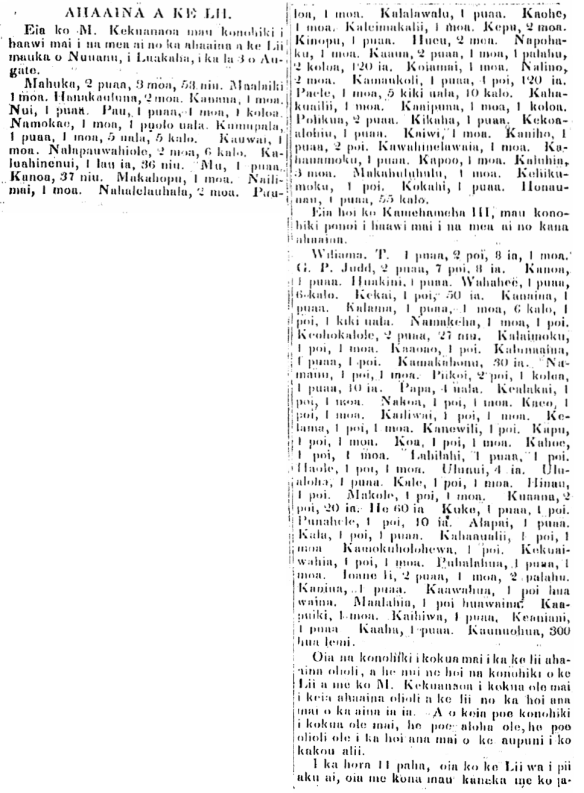
Here is the food that M. Kekuanaoaʻs overseers [konohiki] contributed for the feast of the King upland of Nuuanu at Luakaha on the 3rd of August.

Mahuka, 2 pigs, 3 chickens, 53 coconuts. Maalaiki, 1 chicken. Hanakauluna, 2 chicken. Kanana, 1 chicken. Nui, 1 pig, 1 basket of sweet potato. Kumupala, 1 pig, 1 chicken, 5 sweet potato, 5 taro. Kauwai, 1 chicken. Nalapauwahiole, 2 chicken, 6 taro. Kaluahinenui, 1 lau [400] fish, 36 coconuts. Mu, 1 pig. Kanoa, 37 coconuts. Makahopu, 1 chicken. Nailimai, 1 chicken. Nahalelauhala, 2 chicken. Puuloa, 1 chicken. Kalalawalu, 1 pig. Kaohe, 1 chicken. Kaleimakalii, 1 chicken. Kepu, 2 chicken. Kinopu, 1 pig. Hueu, 2 chicken. Napohaku, 1 chicken. Kaaua, 2 pigs, 1 chicken, 1 turkey, 2 ducks, 120 fish. Koiamai, 1 chicken. Nalino, 2 chicken. Kamaukoli, 1 pig, 4 poi, 120 fish. Paele, 1 chicken, 5 baskets of sweet potato [kiki uala], 10 taro. Kahakuailii, 1 chicken. Kaaipuna, 1 chicken, 1 duck. Polikua, 2 pigs. Kikaha, 1 pig. Kekoaalohiu, 1 pig. Kaiwi, 1 chicken. Kaniho, 1 pig, 2 poi. Kawahinelawaia, 1 chicken. Kahanamoku, 1 pig. Kapoo, 1 chicken. Kaluhia, 3 chicken. Makahuluhulu, 1 chicken. Keliikumoku, 1 poi. Kokahi, 1 pig. Honaunau, 1 pig, 55 taro.

Here is the food that Kamehameha’s very own konohiki contributed for his feast.

Wiliama, T. 1 pig, 2 poi, 8 fish, 1 chicken. G. P. Judd, 2 pig, 7 poi, 8 fish. Kanoa, 1 pig. Huakini, 1 pig. Wahahee, 1 pig, 6 taro. Kekai, 1 poi, 50 fish. Kanaina, 1 pig. Kalama, 1 pig, 1 chicken, 6 taro, 1 poi, 1 basket of sweet potato. Namakeha, 1 chicken, 1 poi. Keohokalole, 2 pig, 27 coconuts. Kalaimoku, 1 poi, 1 chicken. Kaaoao, 1 poi. Kalunaaina, 1 pig, 1 poi. Kamakahonu, 30 fish. Namauu, 1 poi, 1 chicken. Piikoi, 2 poi, 1 duck, 1 pig, 10 fish. Papa, 4 sweet potato. Kealakai, 1 poi, 1 chicken. Nakoa, 1 poi, 1 chicken. Kaeo, 1 poi, 1 chicken. Kailiwai, 1 poi, 1 chicken. Kelama, 1 poi, 1 chicken. Kanewili, 1 poi. Kapu, 1 poi, 1 chicken. Koa, 1 poi, 1 chicken. Kahoe, 1 poi, 1 chicken. Lahilahi, 1 pig, 1 poi. Haole, 1 poi, 1 chicken. Ulunui, 4 fish. Ulualoha, 1 pig. Kale, 1 poi, 1 chicken. Hinau, 1 poi. Makole, 1 poi, 1 chicken. Kuaana, 2 poi, 20 fish. He 60 fish. Kuke, 1 pig, 1 poi. Punahele, 1 poi, 10 fish. Alapai, 1 pig. Kala, 1 poi, 1 pig. Kahaaualii, 1 poi, 1 chicken. Kamokuholohewa, 1 poi. Kekuaiwahia, 1 poi, 1 chicken. Puhalahua, 1 pig, 1 chicken. Ioane Ii, 2 pig, 1 chicken, 2 turkey. Kanina, 1 pig. Kaawahua, 1 poi, grapes. Maalahia, 1 poi, grapes. Kaapuiki, 1 chicken. Kaihiwa, 1 pig. Keaniani, 1 pig. Kaaha, 1 pig. Kaunuohua, 300 lemons.

Those were the konohiki who contributed to the king’s celebratory feast, and there were many konohiki of the King and M. Kekuanaoa who did not contribute to this celebratory feast of the king for the return of the land to him. And these konohiki who did not contribute, are without aloha, and without joy for the return of the nation to our king.

At perhaps 11 o’clock was when the King went up with his men in their …

(Nonanona, 8/5/1843, p. 28)
AHAAINA A KE LII.

Ka Nonanona, Buke 3, Pepa 6, Aoao 28. Augate 8, 1843.

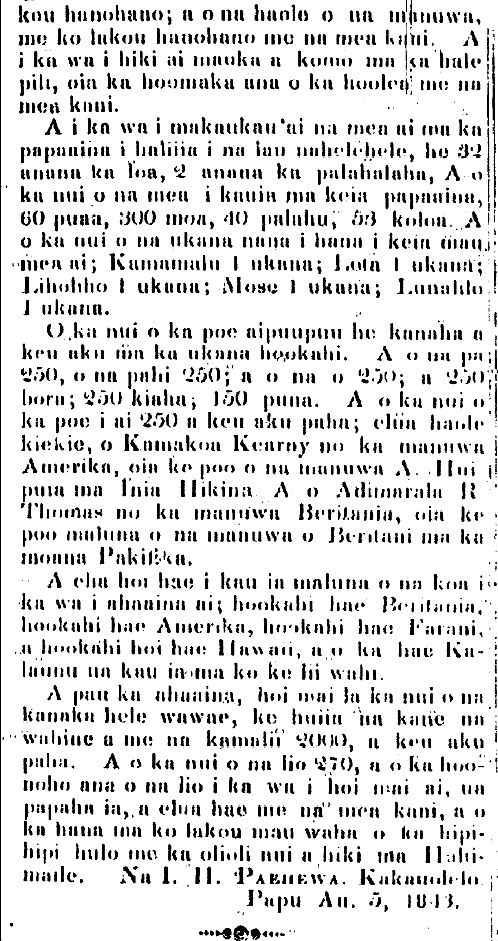
glory; and the haole of the warships, in their best; and the musicians. And when they reached the uplands and entered into the grass house [hale pili], that was when the celebration began with music.

When the food was ready on the table spread over with greenery, it was 32 feet long and 2 feet wide. And the amount of food placed on this table was: 60 pigs, 300 chicken, 40 turkeys, 58 ducks. With all the supplies necessary to prepare this food; Kamamalu 1 set of supplies [? ukana], Lota 1 ukana; Liholiho 1 ukana; Mose 1 ukana; Lunalilo 1 ukana.

The number of servants was over forty per ukana. There were 250 plates, 250 knives, 250 forks, 250 bowls, 250 cups, 150 spoons. And the number of those who ate were probably over 250; there were two prominent haole: Commodore Kearny from the American man-of-war, and the head of the United States warships in East India. Ana Admiral R. Thomas of the British warship, the head of the British warships in the Pacific.

There were four flags raised above the troops while the feast went on: one British flag, one American flag, one French flag, and one Hawaiian flag; and the king’s standard stood near to where the king was.

When the  feast was over, most on foot went back; all together the men, women, and children totaled 2000 or perhaps more. The number of horses were 270, and the riding on the horses on the return was by fours, with two flags and the musicians, while from their mouths came hip hip hurrah [hipi hipi hulo] with great joy all the way until Haliimaile. Written by I. H. Paehewa, Secretary

The Fort. August 5, 1843.

[Anyone know how “ukana” is being used here? Calabash?]

(Nonanona, 8/8/1843, p. 29)
"...kou hanohano..."

Ka Nonanona, Buke 3, Pepa 6, Aoao 29. Augate 5, 1843.
Honorable Lydia Kamakaeha Paki weds Adjutant General Major J. O. Dominis, 1862.

MARRIED—At the hour of 8 in the evening of Tuesday, the 16th of this month, the Honorable Lydia Kamakaeha Paki married Adjutant General Major J. O. Dominis, at Haleakala, the Residence of the Honorable C. R. Bishop and his Chiefess. The two were married in the Anglican faith.

Present were the King; Her Highness Princess V. K. Kaahumanu; His Highness Prince L. Kamehameha; the Honorable M. Kekuanaoa, the Chiefly Governor of Oahu; Colonel Peter Young Kekuaokalani; there also were the parents of the woman, and the mother of the man, and his cousins.

Rev. Samuel C. Damon was who married them. There was much appreciation for how fine and honorable it was. With the two of them is the aloha of this paper.

[It seems Queen Emma was not present at this wedding. Ka Haku o Hawaii had only passed away a few weeks earlier…]

(Kuokoa, 9/20/1862, p. 3)

MAREIA...

Ka Nupepa Kuokoa, Buke I, Helu 43, Aoao 3. Sepatemaba 20, 1862.

Even more from Ka Nonanona, August 8, 1843.

TRAITORS.

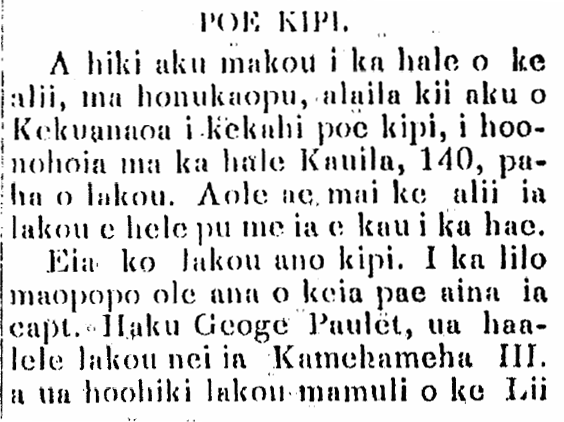
When we reached the residence of the king, at Honukaopu [Honokaupu ?], Kekuanaoa fetched some traitors who were kept at Hale Kauila; perhaps there were 140 of them. The king did not allow them to accompany him to raise the flag.

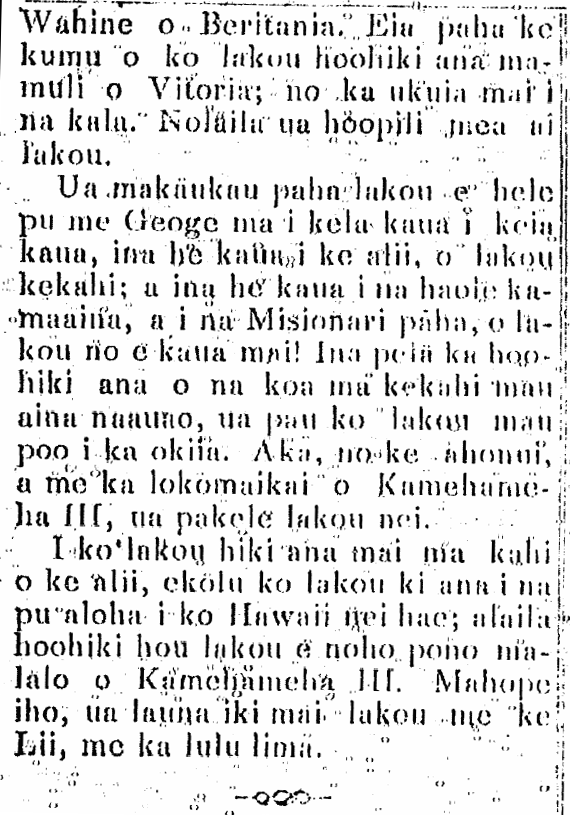
This is the nature of their treason. When this archipelago was not clearly under Capt. Lord George Paulet, they left Kamehameha III, and they swore allegiance to the Queen of Britain. This is probably the reason they swore allegiance to Victoria; because they were paid money. They therefore curried his favor [hoopilimeaai].

They were probably prepared to go with George to this war and that; if he warred against the king, so too would they; and if he went to war against the local haole or the Missionaries, they would fight as well! If soldiers of enlightened lands took an oath in this fashion, their heads would fall. But because of the patience and goodness of Kamehameha III, they were saved.

When they came in the presence of the king, they gave a three gun salute to Hawaii’s flag; and they swore once again to live obediently beneath Kamehameha III. After that, they spent time with the King, and shook hands.

(Nonanona, 8/8/1843, pp. 25 & 26.)

POE KIPI.

Ka Nonanona, Buke 3, Pepa 6, Aoao 25. Augate 8, 1843.

Wahine o Beritania...

Ka Nonanona, Buke 3, Pepa 6, Aoao 26. Augate 8, 1843.

Harper’s New Monthly Magazine and Kekuanaoa, 1871.

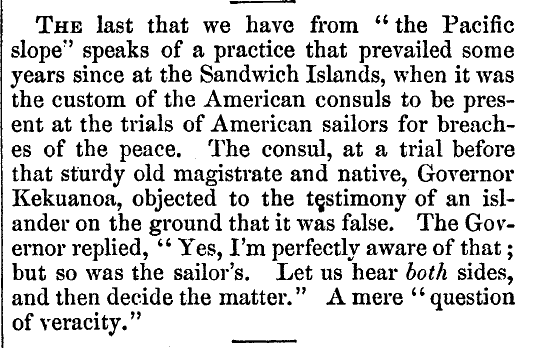
Here is the short piece described in the last post:

The last that we have from “the Pacific slope” speaks of a practice that prevailed some years since at the Sandwich Islands, when it was the custom of the American consuls to be present at the trials of American sailors for breaches of the peace. The consul, at a trial before the sturdy old magistrate and native Governor Kekuanoa [Kekuanaoa], objected to the testimony of an islander on the grounds that it was false. The Governor replied, “Yes, I’m perfectly aware of that; but so was the sailor’s. Let us hear both sides, and then decide the matter.” A mere “question of veracity.”

(Harper’s New Monthly, 4/1871, p. 797)

The last that we have from...

Harper’s New Monthly Magazine, Volume 42, Issue 251, Page 797. April 1871.

In praise of Mataio Kekuanaoa, 1871.

The different Father of Chiefs.

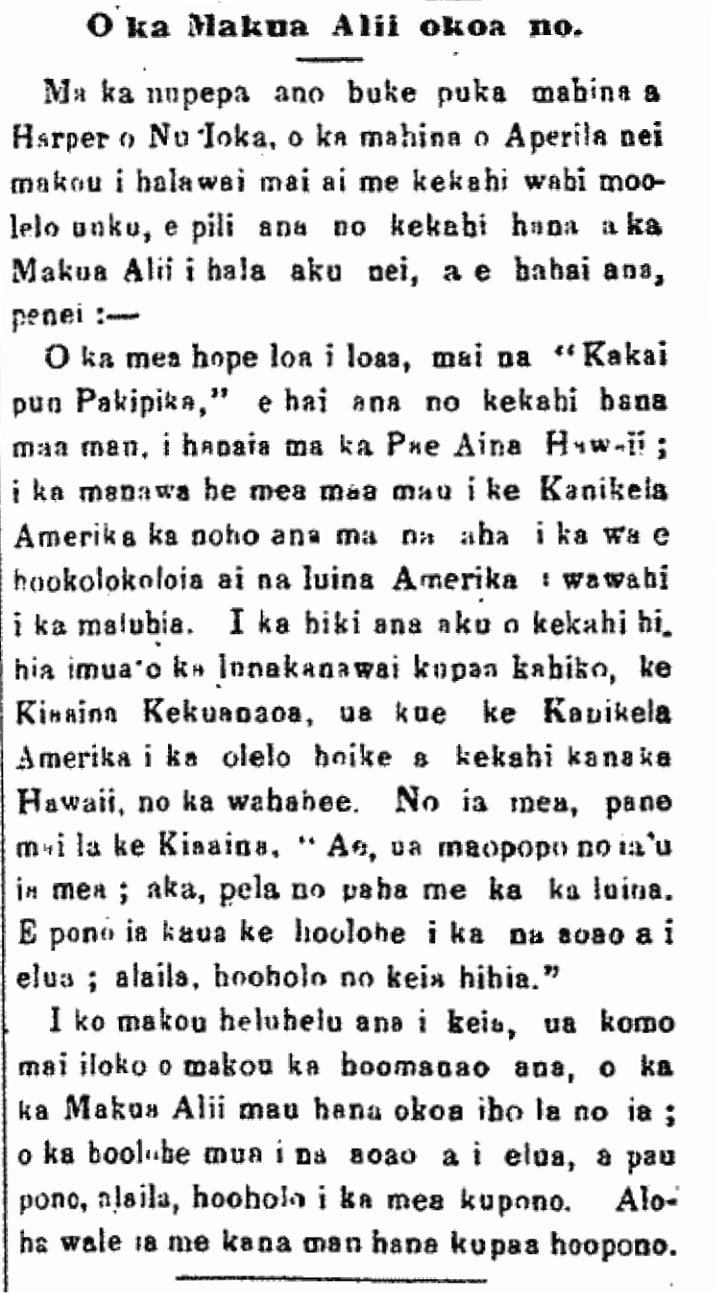
In the monthly magazine, Harper’s of New York, we came across in the April edition, a short story about something done by the Alii Father [Makua Alii] who has passed, and it reports:—

The latest received from the “Pacific String of Hills” speaks of a regular practice carried out in the Hawaiian Islands; during the times when it was a regular thing for the American Consul to sit at court when an American sailor was on trial for disturbing the peace. When a case came before the traditional judge, the Governor Kekuanaoa, the American Consul objected to the testimony of a Hawaiian on the grounds of perjury. At which the Governor replied, “Yes, I am aware of this; but the same may be true of the sailor. The two of us must hear both sides and then rule on this matter.”

When we read this, we recalled that is the different way the Father of Chiefs did things; he listened to both sides first, and when that was finished, he would decide what was proper. Aloha to him and his deeds of steadfast righteousness.

(Au Okoa, 4/13/1871, p. 1)

O ka Makua Alii okoa no.

Ke Au Okoa, Buke VI, Helu 52, Aoao 1. Aperila 13, 1871.

Beginnings of the Anglican Church in Hawaii, 1862.

Pertaining to the 28th of November¹

This day known to everyone, the day of the return of independence to the Islands and the day chosen by the Monarchs as a day for the two of them to join the new faith which has recently arrived.

On the morning of that day, at the hour of 10½, the Alii arrived at the Church and the National troops [koa o ke Aupuni], the Honolulu Rifles [koa Rifles?], the Hawaii Kiai [?], and the Cavalry [Puali Kaua Lio] were all lined up.

When the Alii arrived and passed through the entrance, the Bishop came and layed his hand and blessed them. They then entered within and sat down; following them was a procession, and they entered while chanting one of the psalms. After this was done, the laying on of hands began, and they were confirmed as brethren of the new church.

The beauty that is imbued in all creatures of the earth is what left all of their subjects who went there awe-stricken. Some wept, some fled [hoonaholoholopoo?], some were downcast, and some shuddered in awe, appearing as if the spirit from the heavens was accepted in the Monarchs joining into the circle of eternal life.

Present was Her Highness Princess V. K. Kaahumanu, the Honorable M. Kekuanaoa, the Honorable R. C. Wyllie, the Honorable Chief Justice E. H. Allen, the Honorable C. R. Bishop and his wife, the Honorable C. Kapaakea, the Honorable Colonel D. Kalakaua, Colonel McKibbin Jr., Colonel W. C. Lunalilo, Major Hasslocher, Kekaaniau, the Dowager Queen K. Hakaleleponi, Mrs. Haalelea, the wives of the Supreme Court Judges, and the Honorable Ii. There also was W. W. F. Synge and his wife, along with the Consuls of Foreign Nations.

The building was filled with those wanting to witness the joining of the Monarchs as brethren, and everyone felt much appreciation for the beauty of the Royals, the Alii, and the ceremony performed. God save the King.

¹La Kuokoa [Hawaiian Independence Day]

(Hoku o ka Pakipika, 12/4/1862, p. 2)

No ka la 28 o Novemaba.

Ka Hoku o ka Pakipika, Buke 2, Helu 8, Aoao 2. Dekemaba 4, 1862.

Another Wooden Kii found, 1868.

Akua Kii of Kalia.

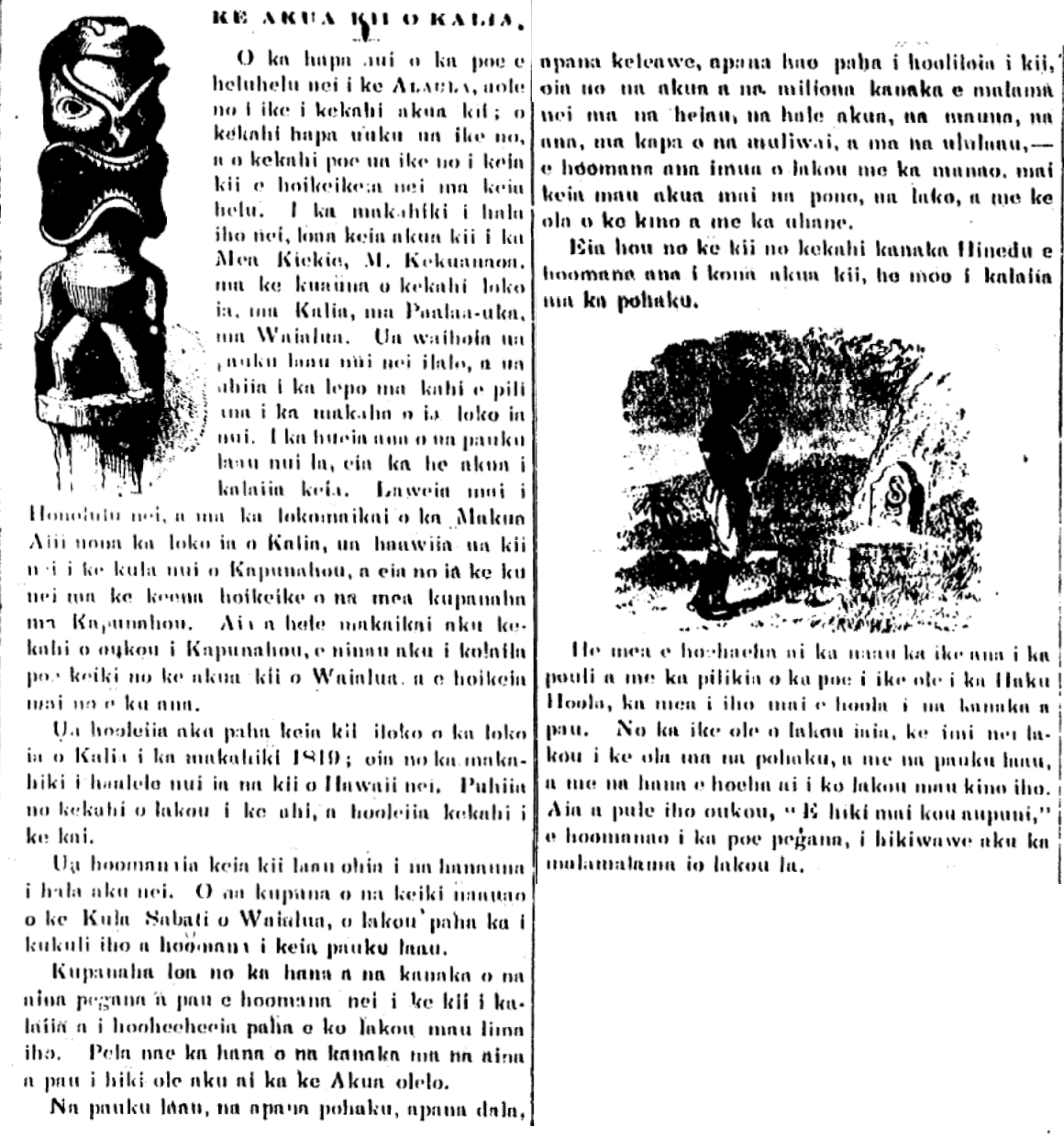
Most of the people reading Ke Alaula have not seen an akua kii, but a small fraction have seen one, and some of you saw this image that is shown here in this issue. Last year, this god idol was found by the Honorable M. Kekuanaoa on the banks of a fish pond at Kalia in Paalaa Uka in Waialua. That large piece of wood was set down and covered with soil near the sluice gate of that large fish pond. When that big piece of wood was unearthed, lo and behold, it was a carved god. It was brought to Honolulu nei, and through the goodwill of the Alii Elder who owns Kalia fishpond, that kii was given to the college of Kapunahou [Punahou], and there it stands in the exhibition room of curiosities at Kapunahou. When some of you go to visit Kapunahou, ask the children there about the kii from Waialua, and it will be shown to you where it stands.

This kii was probably thrown into the pond of Kalia in the year 1819; that is the year when there was the kii of Hawaii nei were greatly abandoned. Some of them were burnt in fire and some were thrown into the sea.

These ohia wood images were worshiped by previous generations. The kupuna of the educated children of Waialua Sunday School were probably those that knelt down and worshiped this piece of wood.

How astonishing are the actions of the people of all of the pagan lands, who worship idols that are carved or molded by their own hands. That is how all lands are where the word of God has not reached.

Pieces of wood, fragments of rock, chunks of silver, chunks of metal, or perhaps chunks of iron turned into images—those are the gods cared for by millions of people, in heiau, houses of god, mountains, caves, banks of rivers, and in forests; they worship before them thinking that from these gods come well being, wealth, and life in body and spirit.

Here also is a picture of a Hindu man worshiping his godly image; it is a snake carved into a rock.

This is something that pains the heart to see the darkness and trouble of those that don’t know of the God the Savior, the one who came down to save all man. Because they don’t know him, they seek salvation from rocks and pieces of wood and from actions that hurt their very own bodies. When you pray, “Thy kingdom come,” remember the pagans so that the light reaches them quickly.

[Could this Akua Kii be the one now at the Bishop Museum which was found in Waialua and presented to Punahou?]

(Alaula, 1/1868, p. 39)

KE AKUA KII O KALIA.

Ke Alaula, Buke II, Helu 10, Aoao 39. Ianuari, 1868.