“American Queen”? 1917.

QUEEN LILIUOKALANI.

Clarifications by a Newspaper Writer about Her.

(Translated)

To “Ke Ola o Hawaii,”

Appearing in the British newspaper, The Outlook, of the other week, there were a number of awe-inspiring lines about our Queen, Liliuokalani, titled: “An American Queen.” This is how it went:

Americans sometimes forget that within one of the Territories of the United States there lives a real ex-Queen who owes the loss of her crown to the activities of American missionaries.

This Queen is, of course, Liliuokalani, of Hawaii, dethroned in the revolution of 1893. She is now a frail old lady of nearly seventy-nine years, and few but her immediate household and closest friends ever have the opportunity of meeting and talking with her.

It is interesting to record that because of one of the tragedies of the present war this aged Queen has permitted for the first time an American flag to fly over her home. The news of this incident comes to us in a letter from a correspondent in Hawaii. This correspondent writes:

It was my privilege a few days ago to attend what will possibly be the last public reception she will ever give to members of the Hawaiian Senate—some of her own race, and some sons of the missionaries who were mainly responsible for her overthrow. Although they belonged to a body absolutely democratic in form and elected by vote of the people as citizens of the United States, it was most interesting and somewhat touching to note the loyalty and love shown the aged ex-Queen: almost, one could imagine, as if she were still their reigning sovereign. Continue reading
On Kaumualii and Kaahumanu, 1880.

[From: “Ka Moolelo o Kaahumanu”]

Kaahumanu was one of them who made a circuit of Maui, Oahu, and Kauai with Liholiho. When Kaahumanu arrived on Kauai, she took Kaumualii, the alii of Kauai, as a kane [husband] for herself. When Liholiho returned to Oahu, it was with Haakulou, the woman of Kaumualii; because Liholiho took Haakulou as a wahine [wife] for himself, along with his other wahine.

Kaahumanu lived on Kauai along with Kaumualii in the year 1822. Perhaps in the month of August.

Kaahumanu wanted to seek out Nihoa. It was the very first time that Nihoa was found, that tiny island to the North-West of Niihau. Continue reading

I hookahi, kahi ka manao, 1897.

LET US BE OF ONE SHOULDER,¹ LET US BE OF UNIFIED THOUGHT.

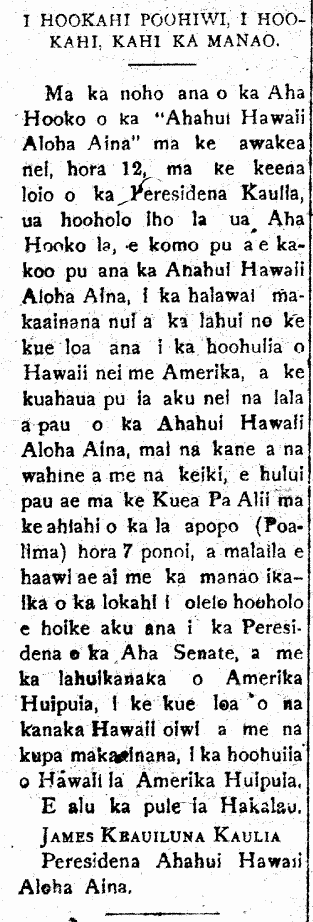
At the meeting of the Executive Committee of the “Ahahui Hawaii Aloha Aina” [Hawaiian Patriotic League] at noon, 12 o’clock, at the attorney’s office of President Kaulia, the said Executive Committee decided that the Patriotic League will join and support the great rally of the makaainana of the lahui to absolutely protest the annexation of Hawaii to America, and it is announced to all of the members of the Hawaiian Patriotic League, from the men, to the women, to the children, to assemble at the Palace Square [Kuea Pa Alii] tomorrow evening (Friday) at exactly 7 o’clock, and there will be presented with insistence and unity, the resolution informing the President of the Senate and the people of the United States, that the native Hawaiians and the long-time makaainana protest the annexation of Hawaii to the United States of America.

Let us combine our prayers to overcome Hakalau. [E alu ka pule ia Hakalau.]²

James Keauiluna Kaulia

President of the Ahahui Hawaii Aloha Aina.

¹Hearkening to the idea of “I hookahi umauma, i hookahi poohiwi, a i hookahi puuwai.” [Let us be of one chest, one shoulder, and of one heart.] Also from earlier that year, see by Samuel K. Kamakaia, “Nai Wale no Oukou A’oe Pau.”

²According to Mary Kawena Pukui’s Olelo Noeau (115): “A sorcerer at Hakalau once created havoc in his own and other neighborhoods. Many attempts to counter-pray him failed until a visiting kahuna suggested that all of the others band together to concentrate on the common enemy. This time they succeeded.”

(Aloha Aina, 10/9/1897, p. 3)

I HOOKAHI POOHIWI, I HOOKAHI, KAHI KA MANAO.

Ke Aloha Aina, Buke III, Helu 41, Aoao 3. Okatoba 9, 1897.

Restoration Anthem, 1843.

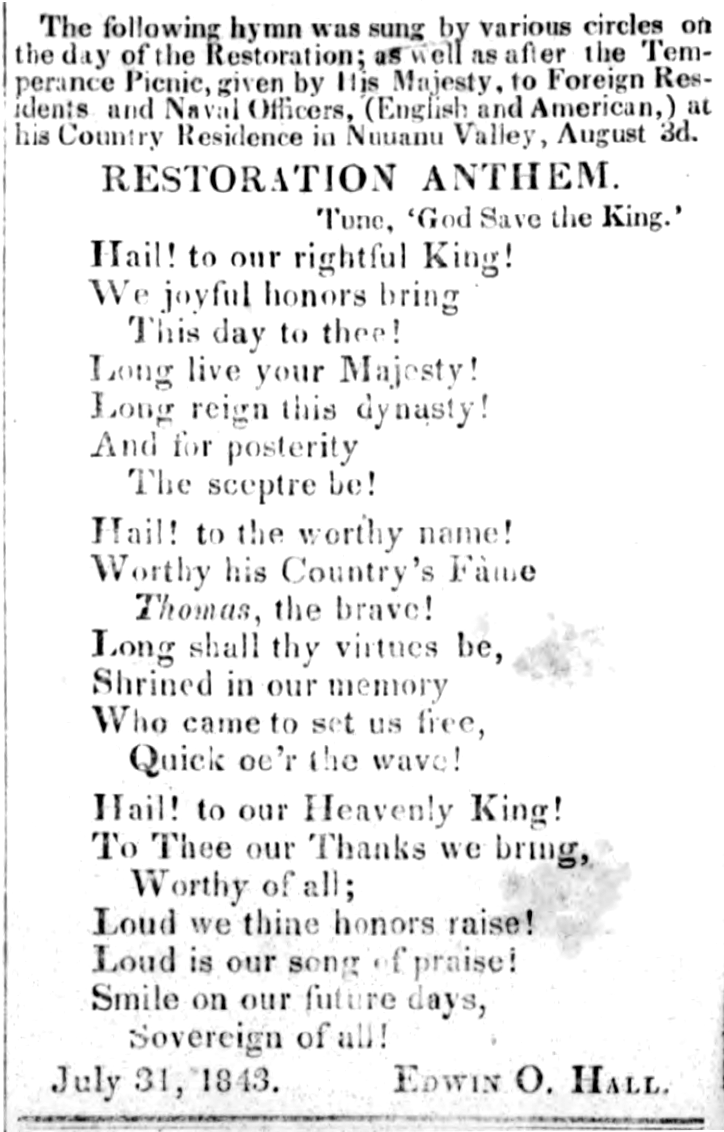
The following hymn was sung by various circles on the day of the Restoration; as well as after the Temperance Picnic, given by His Majesty, to Foreign Residents and Naval Officers, (English and American,) at his Country Residence in Nuuanu Valley, August 3d.

RESTORATION ANTHEM.

Tune, ‘God Save the King.’

Hail! to our rightful King!
We joyful honors bring
This day to thee!
Long live your Majesty!
Long reign this dynasty!
And for posterity
The sceptre be!

Hail! to the worthy name!
Worthy his Country’s Fame
Thomas, the brave!
Long shall they virtues be,
Shrined in our memory
Who came to set us free,
Quick oe’r the wave!

Hail! to our Heavenly King!
To Thee our Thanks we bring,
Worthy of all;
Loud we thine honors raise!
Loud is our song of praise!
Smile on our future days,
Sovereign of all!

July 31, 1843.  Edwin O. Hall.

[This post may be just a little early this year, but it is good to not just remember momentous events like Ka La Hoihoi Ea just one day of the year. Last year, the Hawaiian Historical Society put up handwritten lyrics of this mele on their Facebook page on the 27th of July. Here we find it in print, just a few days following its being penned by Edwin O. Hall!]

(Temperance Advocate and Seamen’s Friend, 8/11/1843, p. 42)

RESTORATION ANTHEM.

Temperance Advocate and Seamen’s Friend, Volume I, Number VIII, Page 42. August 11, 1843.

Newspapers, translation, and a mele for the Merrie Monarch, 1913 / Timeless.

You can find various translations for the beautiful song, “Kaipoleimanu” in the archives of the Bernice Pauahi Bishop Museum, online, and on liner notes. None however seems to acknowledge that Kaipoleimanu itself was a wahi pana, along with its neighboring hau of Maihi, ulu of Weli [also seen as Wehi], and hala of Mapuana.

There is a priceless church meeting report/travelogue appearing in the Kuokoa from 12/5/1913 to 2/6/1914: Ka Ike Hou ana o ke Kamahele i ka Mokupuni o Kauai [The Traveler Sees Once More the Island of Kauai], signed, Kamahele. Amongst all the fascinating information found in this report is a description of the places hearkened to in the mele Kaipoleimanu, to which the traveller is taken by his guide, the Deputy Sheriff of Hanalei, William Werner. He says: Continue reading

The Queen visits Hilo, 1914.

QUEEN LILIUOKALANI

Queen Liliuokalani arrived here in Hilo in the afternoon of this past Sunday, and she is an honored guest of Mrs. Aima Nawahi these days. The Royal one of Hawaii is in good health. She will return to Honolulu the following Friday.

This Thursday, at 10 a. m. until 12 noon, our Queen graciously has granted loving audience with all those who go to see her at the home of Mrs. Aima Nawahi. The members of all the Hawaiian Associations of Hilo nei also want to see their beloved Queen. This audience is open to all the people here in Hilo. Continue reading

And more on the passing of John G. M. Sheldon, 1914.

JOHN KAHIKINA KELEKONA HAS PASSED.

At nine o’clock in the morning of this past Friday, the life breath of John Kahikina Kelekona left forever at his home; he was a very famous historian, and an old newspaperman in this town in years past, and his famous works will become an unforgettable monument to him.

He left behind many children, six daughters and two sons. The girls are: Mrs. I. Cockett; Mrs. J. R. Francis; Mrs. Ernest Kaai; Mrs. Joseph Namea; Mrs. M. Dutro, of Wailuku, Maui; Miss Emma Sheldon; and the boys are: D. K. Sheldon and Henry Sheldon, who work as clerks on inter-island steamships.

He left also two brothers [hoahanau]: William J. Sheldon, one of the esteemed members of the legislature some sessions ago, and Lawrence K. Sheldon who is with the law enforcement office in Honolulu. Continue reading

Kahikina Kelekona, John G. M. Sheldon, editor of the Hawaii Holomua, arrested for speaking, 1893.

LIBERTY OF THE SUBJECT.

Has Anybody Any Rights Under the Provisional Government?

Argument of the Question in the Circuit Court.

John G. M. Sheldon, editor of the Holomua, who is deprived of his liberty under a warrant issued by the President of the Provisional Government, was produced in the First Circuit Court before Judge Frear, at 11 o’clock this forenoon, under a writ of habeas corpus. Attorney-General Smith and F. M. Hatch appeared for the Government, and C. W. Ashford, C. Creighton, A. Rosa and J. L. Kaulukou for the prisoner.

Mr. C. W. Ashford argued for the discharge of the prisoner, speaking to the following effect: There was no authority vested in the Executive and Advisory Councils to issue warrants of arrest. President Dole had no right in the Proclamation of the Provisional Government to issue a warrant of arrest. The Government could not go behind that proclamation, he presumed. “We the People of the Hawaiian Islands” gave him no such power. If “We the People of the Hawaiian Islands” had intended to exercise that power they would have given it to him. The Proclamation stated that the President’s duties were to preside over the meetings of the Executive Council. Mr. Dole now holds no judicial position in these islands. He did hold such position before, but resigned it to become President of the Provisional Government. If that warrant, of President Dole was valid, then there was no security of liberty for any man, woman or child under these tropic skies. There was then nothing to prevent any resident of this country being consigned to a dungeon or bound in irons. It should be known whether the Provisional Government had such tremendous powers. He was not making a covert attack on the late revolution. He believed in the sacred right of revolution, and he considered the late revolution was a good thing. But it might not be good if the Provisional Government introduced anarchy and despotism. Some persons were led by their philosophy to believe that a beneficent despotism was the best form of government, and he believed that members of this school of philosophy had seats in the Advisory Council. Continue reading

On Aloha Aina, 1893.

“Breathes there a man with soul so dead,
Who never to himself hath said,
This is my own my native land.”
(Scott.)

Many of those who support honestly the present state of affairs, have done so in the full hope and belief, that thereby the flag of their country—the Stars and Stripes—will float over the land in perpetuity. Not a single Hawaiian, however, even those few whose signatures to annexation petitions (not 200 in number and mostly convicts.) have been bought or forced by necessity from them, desires to see any foreign flag replace his own. Continue reading

Liliuokalani’s horse riding association, 1892.

[Found under: “NU HOU KULOKO.”]

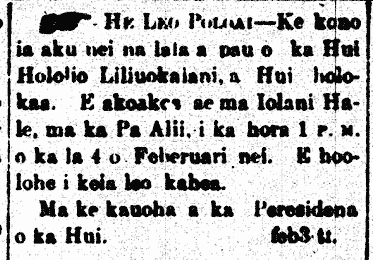
A Summons—All the members of the Liliuokalani Horse Riding Association and Carriage Riding Association are invited. To gather at Iolani Palace, on the Palace Grounds, at 1 p. m. on the 4th of February. Heed this call.

By the orders of the President of the Association.

(Leo o ka Lahui, 2/3/1892, p. 3)

He Leo Poloai

Ka Leo o ka Lahui, Buke II, Helu 382, Aoao 3. Feberuari 3, 1892.