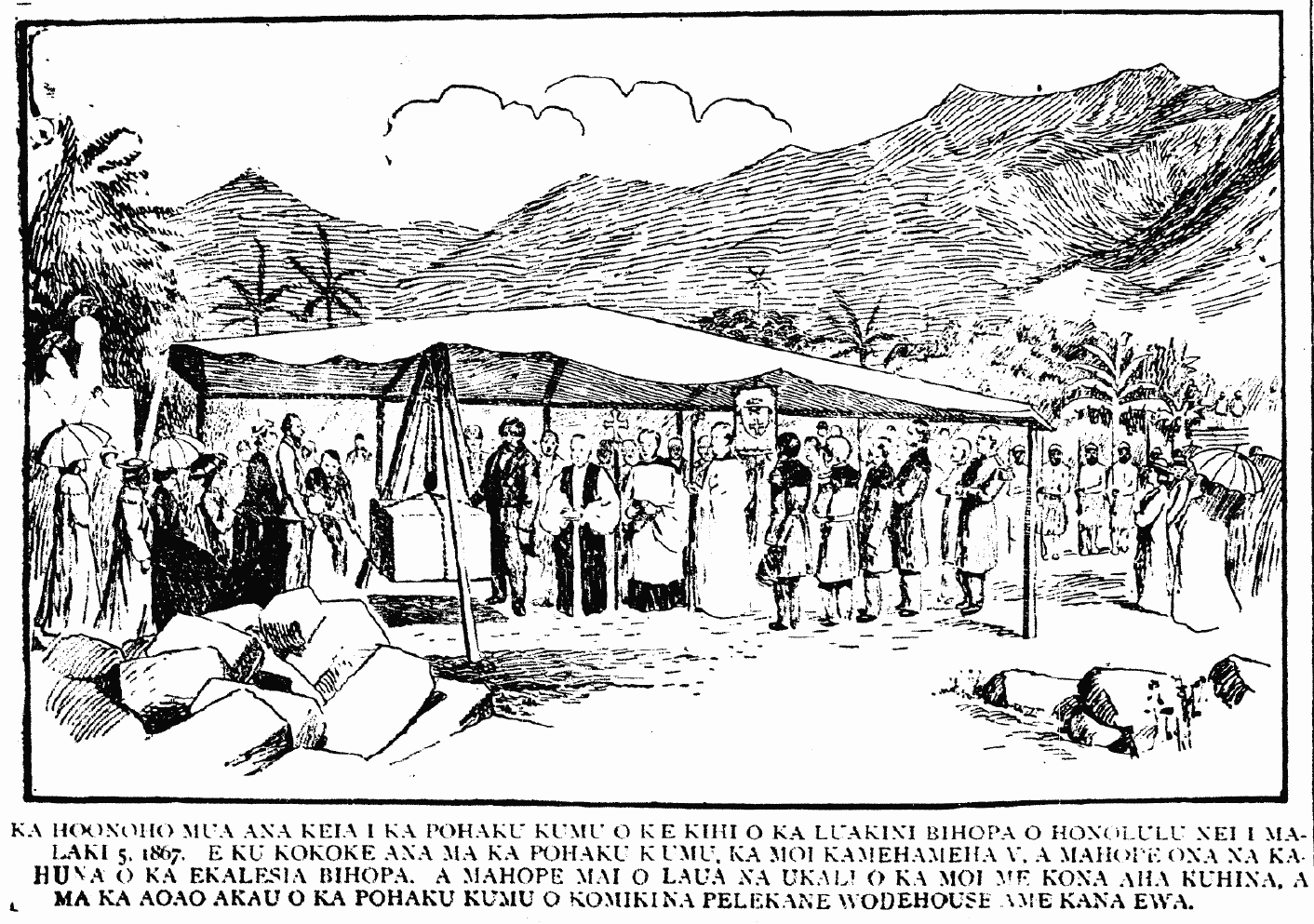
Look back at the 1867 laying of the cornerstone of St. Andrew’s Cathedral, 1906.

This is the first laying of the cornerstone of the Anglican Church of Honolulu, on March 5, 1867. Standing near the cornerstone is King Kamehameha V, and behind him are the priests of the Anglican Church. And behind those two are the attendants of the King and his Cabinet of Ministers, and to the right side of the cornerstone is the British Consul Wodehouse and his wife.

(Kuokoa, 11/30/1906, p. 2)

KA HOONOHO MUA ANA KEIA I KA POHAKU KUMU...

Ka Nupepa Kuokoa, Buke XLV, Helu 48, Aoao 2. Novemaba 30, 1906.

Another Wooden Kii found, 1868.

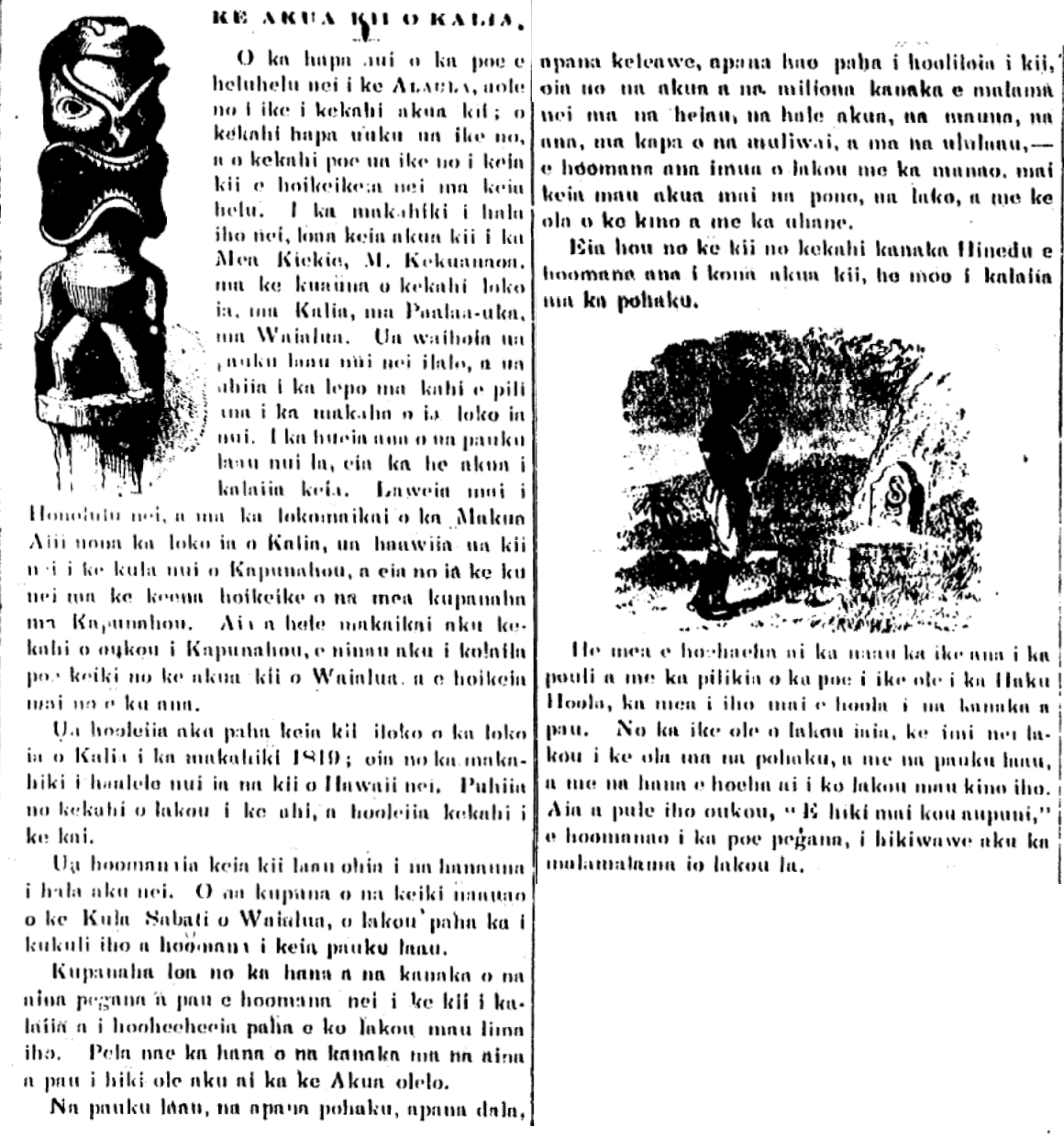
Akua Kii of Kalia.

Most of the people reading Ke Alaula have not seen an akua kii, but a small fraction have seen one, and some of you saw this image that is shown here in this issue. Last year, this god idol was found by the Honorable M. Kekuanaoa on the banks of a fish pond at Kalia in Paalaa Uka in Waialua. That large piece of wood was set down and covered with soil near the sluice gate of that large fish pond. When that big piece of wood was unearthed, lo and behold, it was a carved god. It was brought to Honolulu nei, and through the goodwill of the Alii Elder who owns Kalia fishpond, that kii was given to the college of Kapunahou [Punahou], and there it stands in the exhibition room of curiosities at Kapunahou. When some of you go to visit Kapunahou, ask the children there about the kii from Waialua, and it will be shown to you where it stands.

This kii was probably thrown into the pond of Kalia in the year 1819; that is the year when there was the kii of Hawaii nei were greatly abandoned. Some of them were burnt in fire and some were thrown into the sea.

These ohia wood images were worshiped by previous generations. The kupuna of the educated children of Waialua Sunday School were probably those that knelt down and worshiped this piece of wood.

How astonishing are the actions of the people of all of the pagan lands, who worship idols that are carved or molded by their own hands. That is how all lands are where the word of God has not reached.

Pieces of wood, fragments of rock, chunks of silver, chunks of metal, or perhaps chunks of iron turned into images—those are the gods cared for by millions of people, in heiau, houses of god, mountains, caves, banks of rivers, and in forests; they worship before them thinking that from these gods come well being, wealth, and life in body and spirit.

Here also is a picture of a Hindu man worshiping his godly image; it is a snake carved into a rock.

This is something that pains the heart to see the darkness and trouble of those that don’t know of the God the Savior, the one who came down to save all man. Because they don’t know him, they seek salvation from rocks and pieces of wood and from actions that hurt their very own bodies. When you pray, “Thy kingdom come,” remember the pagans so that the light reaches them quickly.

[Could this Akua Kii be the one now at the Bishop Museum which was found in Waialua and presented to Punahou?]

(Alaula, 1/1868, p. 39)

KE AKUA KII O KALIA.

Ke Alaula, Buke II, Helu 10, Aoao 39. Ianuari, 1868.

More on Liliuokalani and her support of education. 1895.

HYPOCRITICAL REMEMBRANCE.

The celebrating and remembering of the birthday of someone is not a bad thing, or something to criticize. And this applies when the person whose birthday that is being remembered has died, it is a good thing, should that person have done a famous deed or left an important legacy for her trustees to carry out, like the Alii, Pauahi-a-Paki.

We are not opposing the remembrance of her trustees and the heads of the Kamehameha Schools, like what was done this past Thursday, on the birthday of this Alii of this land, who showed her true aloha for her lahui by leaving her great estate for the good and welfare of the new generations of her own people, so that the their thoughts and actions are bettered. We do however oppose and criticize the attempt to deify, and it is almost to the point where the missionaries and teachers of those places of learning are making her, the deceased Alii, into a god [akua? ahua?] to be worshiped. In the presentations on that day mentioned, the girls performed before a huge audience of all sorts of people who attended, where they all knelt before an image of the Alii, and thereafter placed lei and flowers upon that picture. This is not a good lesson for the children.

Pauahi has died, she has gone, she is no more in body, but she still lives through her glorious deeds, perhaps the greatest amongst the Hawaiian Chiefs who left on the “Dark Path of Kane”. It is for her trustees and her representatives that were empowered in her will, which the Supreme Court will fill should there be a vacancy amongst those people, they are they ones carrying out these remembrances without her knowledge of what is being done, and that is why we call it—a hypocritical remembrance.

For here is the Queen, still living, and she is not honored by those missionaries for her good works that are exemplary for the benefit of her people, before and since her ascending the throne. She took up the Liliuokalani Educational Society, with its two divisions, and greatly assisted its funds from her own earnings and property. There were many girls who received an education because of this society, and the girls’ school of Kawaiahao, that grounds of learning of the missionaries, saw benefits, and this cannot be denied in the least.

She is sill living and has followed through on her good works which were established under her very own leadership, not by other like with the late Pauahi. And yet these haughty missionaries of her days don’t at all remember her great deeds which show her true aloha for her lahui while she is alive and not after her death. Aye, she is still living, and we see the fruits of her good labors, and perhaps she mistakenly put her faith in her weak fellow lahui for whom she felt much aloha, and she fell from her position on high; and now she sees clearly those who are steadfastly loyal to her and those who are traitorous, abusive, and speak badly about her.

The missionaries themselves are the true witnesses to her good deeds. They have no words for Pauahi, hers were seen before. They go to her [Liliuokalani] and ask for money from her, and they are not given just a trifle, but they are given great amounts. And yet, those people do not think a bit of her, or thank her, not at all; they instead abuse and fling and besmear her with filth, in return for the good that was done, and given to, and received by them. This is a time to tell tales, to rouse, ask for rudely, to beg, to abuse, to curse, to insult, and that list goes on and on, just filled with indolence.

[How sad that even today, her namesake, Queen Lydia Liliuokalani Elementary School has been shut down. Today there was a celebration of the 100th anniversary of the laying of the cornerstone of the school on the grounds of Liliuokalani Elementary School! Let us remember her always along with her great love for her people!]

(Makaainana, 12/23/1895, pp. 4 & 5.)

HOOMANAO HOOKAMAEMAE.

Ka Makaainana, Buke IV----Ano Hou., Helu 26, Aoao 4 & 5. Dekemaba 23, 1895.

Criticism of treatment at Baldwin Home, 1896.

Improper Acts.

Editor:

Your news-sniffing detective reports before all, the improper actions of the Brothers [Hoahanau] overseeing the Baldwin Home [Home Balauwina] in Kalawao. On Wednesday morning, the 9th of September, there was a uprising between the boys and the Brothers because the pig feed bucket was brought filled with tea to drink that morning. So the boys were incensed at that mistreatment. These Brothers must have thought that those boys inflicted with leprosy at that Home were pigs, and that is why they did that kind of thing.

Here is another thing: one of the boys who died at the Home some months ago was taken to the mortuary. That night, his clothes he was wearing were fetched. Here are the items taken from the body of the dead boy: One brand new suit, and a pair of shoes. These things are being worn now by another boy of the Home.

One more thing, if a boy of the Home dies, he is wrapped up in a blanket and put in a box and taken to Koloa [?].

The cart used to transport beef is another thing; that is the cart used to transport the patients with rotting sores. Is this something proper that the Brothers are doing to these boys of the lahui who are afflicted with this suffering from leprosy living in the Home?

Your detective believes that it is not right. It is killing the body and the soul of their neighbor. The Board of Health [Papa Ola] should remove these Brothers from the Home and return the Sisters [Viregine] of Aloha to this Home. Their care of the patients was much better than that of these people who waste the Government’s money.

With appreciation,

News-Sniffing Detective

Kalawao, Molokai.

(Makaainana, 11/9/1896, p. 3)

He Mau Hana Maikai Ole.

Ka Makaainana, Buke VI----Ano Hou, Helu 19, Aoao 3. Novemaba 9, 1896.

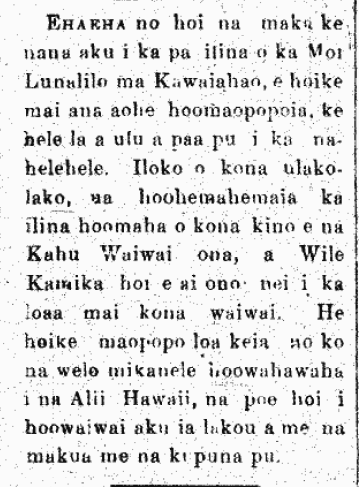
Lunalilo’s Crypt overgrown by weeds? 1894.

It is painful to see the cemetery of King Lunalilo at Kawaiahao, showing that it is not remembered, for it is overgrown by weeds. In its wealth, the crypt where his body is laid to rest was left to waste by his Trustees, along with Wile Kamika [William Owen Smith] who feasts off of his pay from the trust. This is proof of the missionary descendents’ [welo mikanele] contempt for the Alii of Hawaii, the people who made them wealthy and also their parents and grandparents.

(Makaainana, 3/19/1894, p. 4)

Ehaeha no hoi na maka...

Ka Makaainana, Buke I----Ano Hou, Helu 12, Aoao 4. Maraki 19, 1894.

More on Orramel Gulick, 1874.

[Found under: “Local News”]

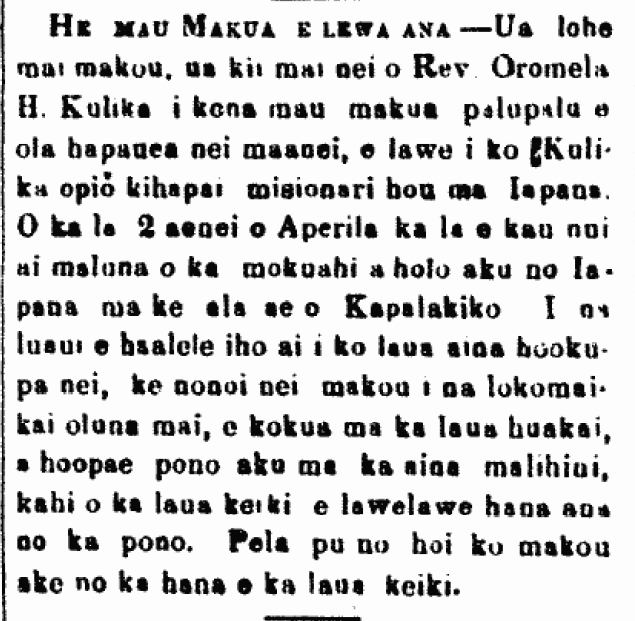
Parents will be voyaging—We hear that Rev. Orramel H. Gulick came to get his weak parents [Peter Johnson Gulick and Fanny Hinckley Thomas Gulick] living here in a feeble state to take them to the young Gulick’s [Luther Halsey Gulick] new missionary parish in Japan.It is on the coming 2nd of April that they will all board the steamship to make their journey to Japan by way of San Francisco. To his parents who are leaving this land which they grew accustomed, we hope for blessings from above, to help them on their journey, and to give them safe landing at this foreign land, where their child works for righteousness. So too is our hopes for the endeavors of their child.

[For more on Orramel Hinckley Gulick, see also: The Pilgrims of Hawaii, by Rev. and Mrs. Orramel Hinckley Gulick (1918).]

(Kuokoa, 3/14/1874, p. 2)

He mau Makua e lewa ana...

Ka Nupepa Kuokoa, Buke XIII, Helu 11, Aoao 2. Maraki 14, 1874.

Hawaiianized missionary name list, 1848.

NAMES OF THE MISSIONARIES.

Hawaiians are bad at pronouncing haole words, so they call the haole by names that they can pronounce. However, these names are not familiar to the newcomers; therefore, letters often fall to the side and do not arrive because the person to whom it is addressed is not known. In this manner, sometime earlier, a letter was addressed to Rev. R. Tinker, and this is what was written on the outside. Ia Tineka Amerikahuipuia [To Tineka, United States of America]. What Postmaster in America understands these words? So too of many who deliver letters here in Hawaii; those malihini form foreign lands who don’t know the missionaries’ Hawaiian names. Therefore, this document makes clear the real names of the missionaries living in this Archipelago.

Laimana, Rev. D. B. Lyman.

Koana, Rev. Titus Coan.

Parika, Rev. J. D. Paris.

Kine, Rev. H. Kinney.

Aiwa, Rev. Mar. Ives.

Pokue, Rev. J. F. Pogue.

Tatina, Rev. Asa Thurston.

Kauka Aneru, S. L. Andrews, M. D.

Laiana, Rev. Lorenzo Lyons.

Bona, Rev. E. Bond.

Kaahele, Rev. E. Whittlesey.

Gerina, Rev. J. S. Green.

Bele, Mr. E. Bailey.

Konede, Rev. D. T. Conde.

Okana, Miss M. Ogden.

Alekanedero, Rev. W. P. Alexander.

Aneru, Rev. C. B. Andrews.

Baluwina, Rev. D. Baldwin, M. D.

Hikikoke, Rev. H. R. Hitchcock.

Duaita, Rev. S. G. Dwight.

Berauna, Miss L. Brown.

Kalaka, Rev. E. W. Clark.

Kemita, Rev. Lowell Smith.

Limaikaika, Rev. R. Armstrong.

Kamalani, Mr. Levi Chamberlain.

Kasela, Mr. S. N. Castle.

Holo, Mr. E. O. Hall.

Laukeke, Mr. E. H. Rogers.

Kaimana, Mr. H. Dimond.

Kuke, Mr. A. S. Cooke.

Rikeke Wahine, Mrs. C. L. Richards.

Dole, Rev. D. Dole.

Rike, Mr. W. H. Rice.

Kemika, Miss M. M. Smith.

Aneru, Lunakanawai Rev. L. Andrews.

Hana, Rev. T. D. Hunt.

Demana, Rev. S. Damon.

Bihopa, Rev. A. Bishop.

Emekona, Rev. J. S. Emerson.

Kulika, Rev. P. J. Gulick.

Pareka, Rev. B. W. Parker.

Kauka Kemika, J. W. Smith, M. D.

Ioane, Rev. E. Johnson.

Wilikoke, Mr. A. Wilcox.

Rowela, Rev. G. B. Rowell.

Wini Wahine, Mrs. M. P. Whitney.

[This is definitely not a complete listing. One famous person not included for example is Gerrit P. Judd, who was called Dauta Iada and Kauka Iada, but mostly just Kauka. Also once again, there are often a variety of given names for a single person. Baldwin was not only called Baluwina, but Balawina, Ogden is not only Okana, but Ogana, etc.

This hopefully will help you when searching for missionaries, especially because they are often referred to only by their Hawaiian names in the newspapers (like Laiana in the earlier post about snow on Hualalai in 1862)!

There needs to be a more comprehensive listing (not only of missionary names but of all name variants) done and put somewhere online so that it is easily accessed!!

Also found: Ioane, Edward Johnson]

(Elele Hawaii, 10/9/1848, p. 36)
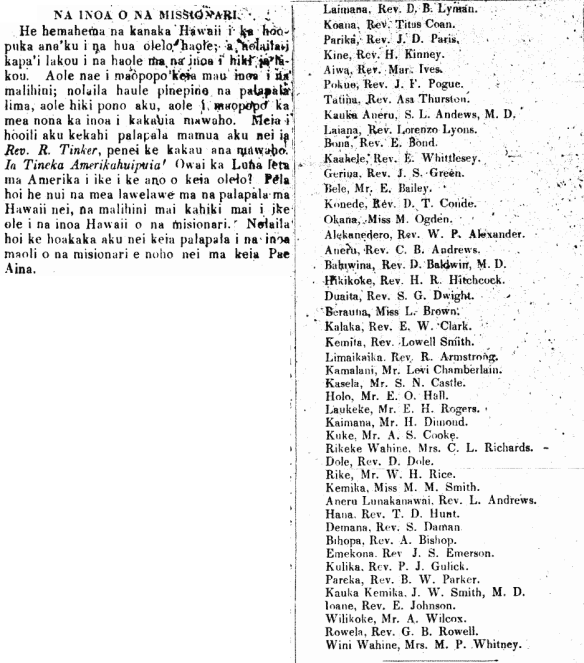
NA INOA O NA MISIONARI.

Ka Elele Hawaii, Buke 4, Pepa 9, Aoao 36. Okatoba 9, 1848.

Snow on Hualalai 150 years ago. 1862.

Much Snow, and cold.

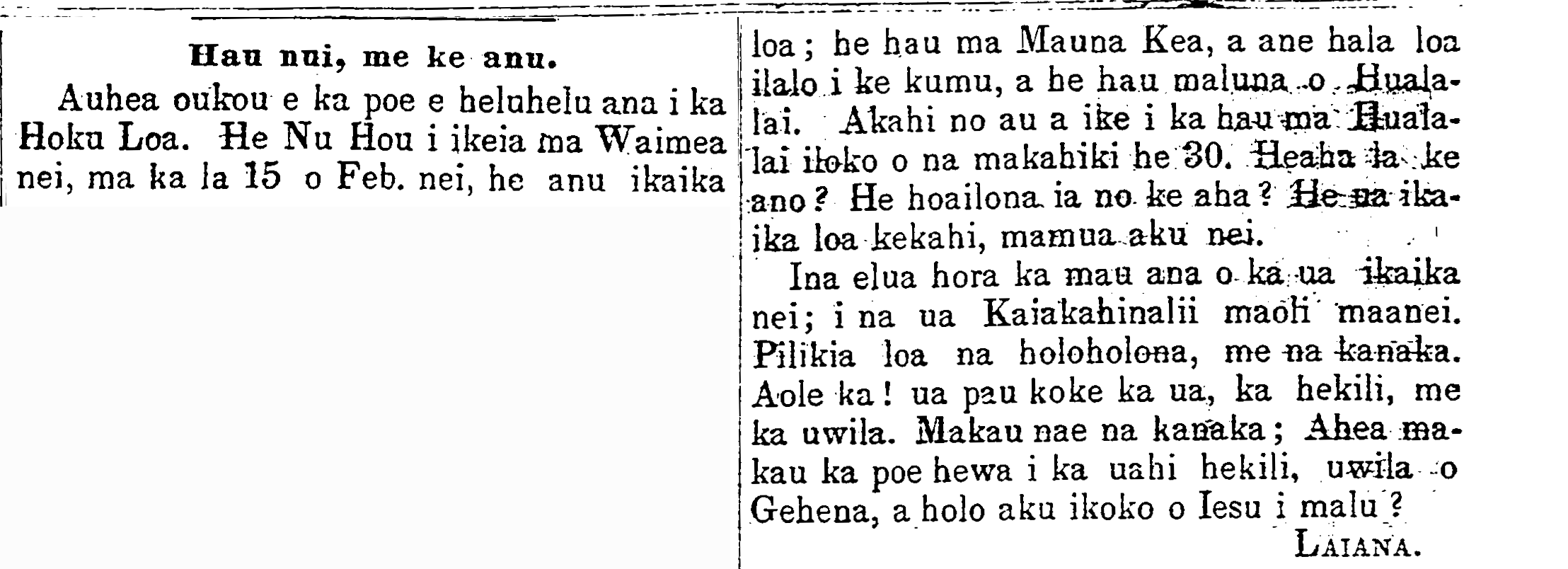
O People reading the Hoku Loa. There is News seen here in Waimea; on the 15th of February, there was extreme cold; there was snow on Mauna Kea, and it almost reached its base, and there was snow atop Hualalai. It was the first time I saw snow on Hualalai in 30 years. What is this? What is it a sign of? There was also heavy rains earlier.

If the heavy rains lasted for a couple of hours, it would have had a massive flood [Kaiakahinalii] here. The livestock and people would have been in trouble. But no! the rain, thunder, and lightning soon stopped. The people were still afraid; When will the people be afraid of the smoke, thunder, and lightning of Gehenna, and go to the protection of Jesus?

LYONS.

(Hoku Loa, 3/1862, p. 34.)

Hau nui, me ke anu.

Ka Hoku Loa, Buke III, Helu 9, Aoao 34. Maraki, 1862.

More Gulick in Japan, 1871.

LETTER FROM JAPAN.—Part 3.

Kobe, Japan, July 18, 1871.

The “Alaula:” Aloha oe;

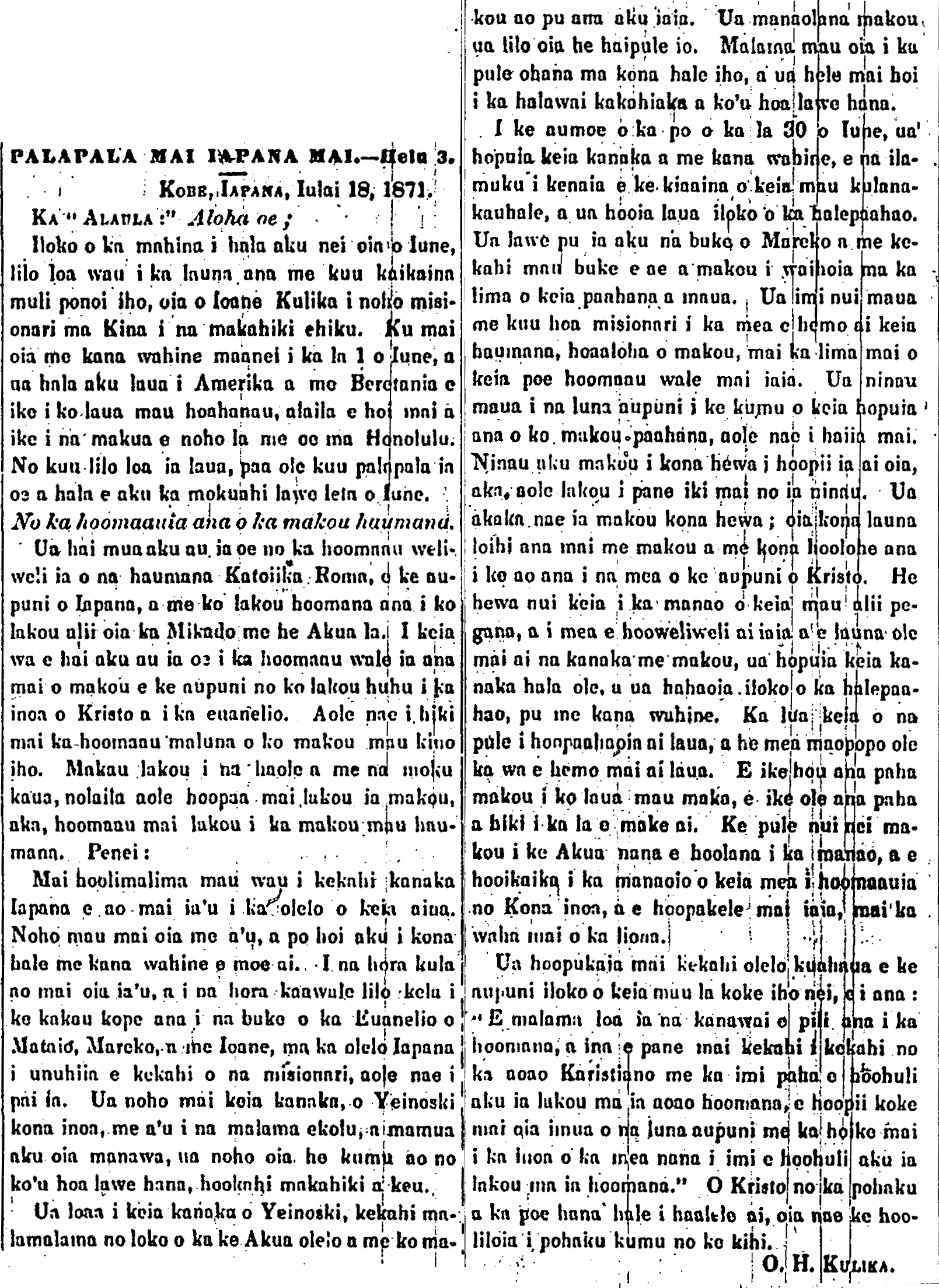
During this past month, that being June, I was caught up meeting with my youngest brother, John Gulick who lived as a missionary in China for seven years. He and his wife arrived on the 1st of June, and left for America and Britain to meet with their cousins, then they will go back to meet with the parents who are with you in Honolulu. Because of all the time I spent with them, my letter to you was not completed until the postal ship for June had already left.

On the persecution of our students.

I spoke to you earlier about the terrifying persecution of the Roman Catholic followers, by the government of Japan, and how the Japanese worship their ruler, the Mikado, as if he were a God. Now I will speak to you about our persecution by the government because of their anger at the name of Christ and the gospel. But this persecution has not fell upon us directly. They fear the haole and the warships, therefore they do not detain us, but persecute our followers. In this fashion:

I was about to hire a certain Japanese to teach me the language of this land on a regular basis. He stayed with me always, and returned home to his wife at nights to sleep. During school hours, he taught me, and when we were apart, he copied the books of the Gospel of Matthew, Mark, and John, which was translated into Japanese by one of the missionaries, but it was not published. This man named Einosuke lived with me for three months, and before this, he was a teacher for a fellow missionary, for one year or more.

This Einosuke had some learning from the word of God and from our teaching. We had hoped that he had become a devout believer. He always held family prayer at his home, and he came to the morning services of my fellow missionary.

In the evening of the 30th of June, this man and his wife were taken by the sheriff who was ordered by the governor of this city, and they were thrown into jail. Taken were the books of Mark and some other books which we left in the hands of this worker of ours. The other missionary and I sought hard for a means to get this follower and friend of freed from these people who were persecuting him. We asked government officials of the reason for our worker being jailed, but we were not told. We asked of the charges against him, but they did not answer in the least. It is clear to us what is his offense, that being his long association with us and his listening to the teachings of the kingdom of Christ. This is a major offense in the minds of the pagan officials, and to scare him and so that the people do not associate with us, this innocent man was taken and thrown in jail with his wife. This is the second week that they have been imprisoned, and it is not known when they will be released. Perhaps we will see their faces again; perhaps we will not see them again until they die. We pray fervently to God to give hope and to strengthen the faith of this man who is persecuted in His name, and to save him from the mouth of the lion.

There was an announcement by the government recently, saying: “Obey dearly the laws pertaining to religion; and if someone speaks to another about Christianity with perhaps the intent to convert them to that religion, they should bring charges immediately before the government officials and make known the name of the person who tried to convert them.” Christ is the stone left behind by the house builders, but he is who shall be made the cornerstone.

O. H. Gulick.

(Alaula, 11/1871, p. 30)

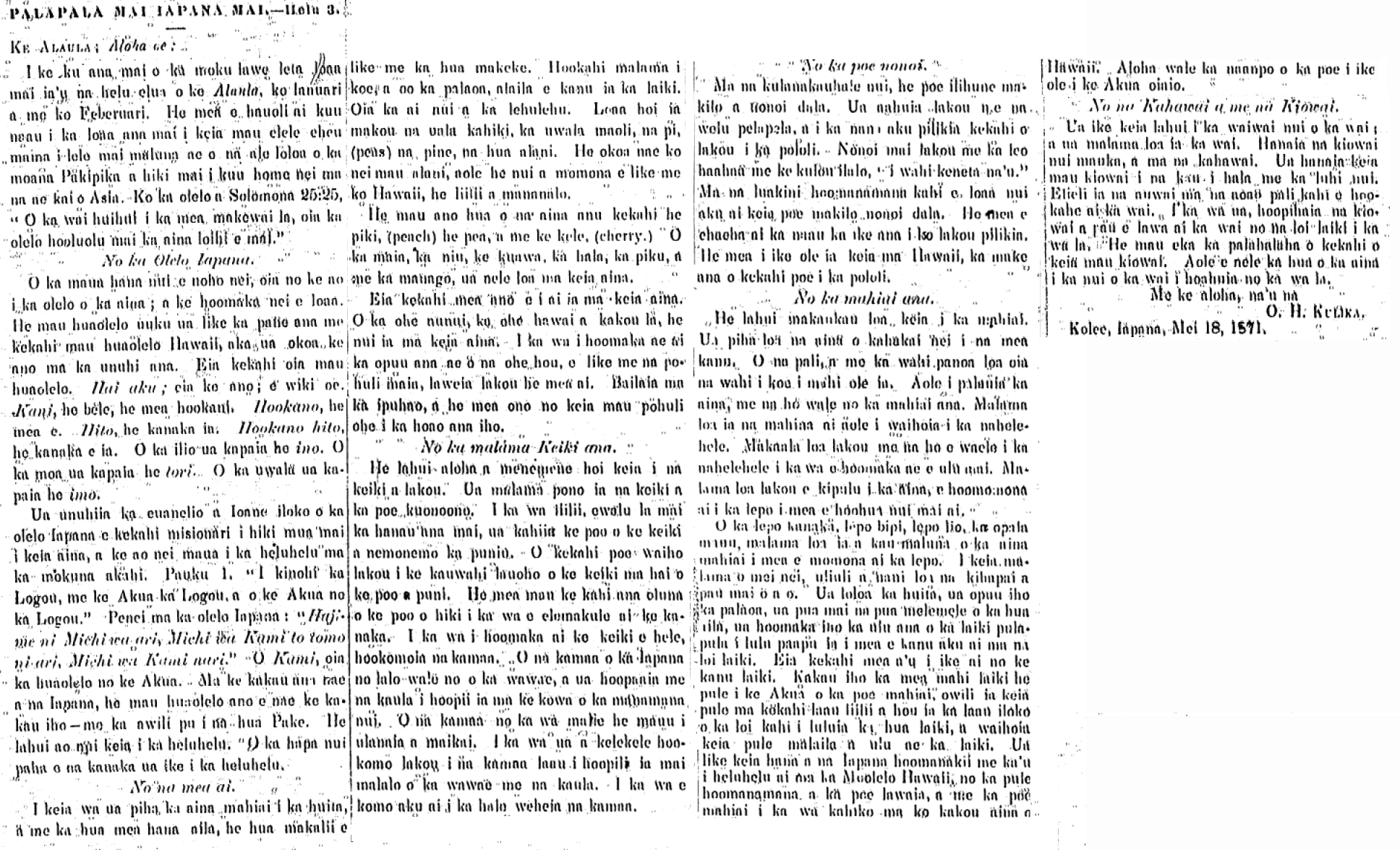
PALAPALA MAI IAPANA MAI.

Ke Alaula, Buke VI, Helu 8, Aoao 30. Novemaba, 1871.

More from Orramel Gulick, 1871.

LETTER FROM JAPAN.—Number [2].

Ke Alaula: Aloha oe:

When the postal ship arrived, I received two issues of Ke Alaula, January’s and February’s. It made my heart happy, receiving these quick-winged messengers who flew above the great waves of the Pacific Ocean and reaching my home here on the shores of Asia. According to the words of Proverbs 25:25, “Like cold water to a weary soul is good news from a distant land.”

About the Japanese Language.

Our great task at hand is learning the language of this land; and we have begun. Some of the short words, the pronunciation is the same as in Hawaiian, but the translation is different. Here are some of those words. Hai aku [Hayaku]; this is the meaning; hurry up. Kani [Kane], a bell, something that sounds. Hookano [Hoka no], a different thing. Hito, a person. Hookano hito, a different person. Dogs are called ino [inu]. Chickens are called tori. Sweet potato is called imo.

The Gospel of John was translated into Japanese by a missionary who came to this land before, and we are learning to read from the first chapter. Chapter 1. “In the beginning was the Word, and the Word was with God, and the Word was God.” Here it is in Japanese: “Hajime ni Michi wa ari, Michi wa Kami to tomo ni ari, Michi wa Kami nari.” When they write it however, they write in strange letters mixed with Chinese characters. The people study reading intensely. Perhaps more than half of the people can read.

About the food.

At this time, the fields are filled with wheat and oil producing fruit, which is a tiny fruit like that of the black mustard. In a month, the wheat will be mature, then rice will be planted. That is the main staple of the people. We have potatoes, sweet potatoes, peas, beans [pine?], and oranges. Their oranges are different, they are not large and sweet like those of Hawaii, they are small and bland.

They also have fruit of cold lands: peaches, pears, and cherries. Bananas, coconuts, guavas, pandanus, figs, and mangoes are not to be found here.

Here is something strange eaten here. Large bamboo, what we call ohe hawai, is found in abundance here. When the new shoots begin to sprout, like a banana sprout, they harvest it to eat. It is boiled in a pot, and this bamboo shoot is good if it is tried.

On Child rearing.

These are a people who love and are compassionate towards their children. The children of the wealthy are well taken care of. When they are little, eight days after birth, the head of the child is shaved smooth. Some leave some hair circling the edge of the child’s head. It is customary to shave the top of the head until they are elderly. When the child begins to walk, they are fitted with sandals. The sandals of the Japanese are just under the feet and are fastened with with straps going up from between the space between the big toes. The sandals used for nice days are made of finely-woven grass. On rainy and muddy days, they wear wooden sandals fastened below the feet with straps. When they enter the house, the sandals are removed.

On beggars.

In large cities, there are poor who beg for money. They are clothed in rags, and when looking at them some of them seem to be suffering from starvation. They beg with soft voices and heads bowed down, “Please may I have a few cents.” These beggars are found in large numbers at places of worship. Seeing their suffering breaks one’s heart. This is something not seen in Hawaii, someone dying of starvation.

On farming.

This is a nation very skilled at farming. The lowlands are full of plants. The places left unfarmed are the cliffs and very dry areas. The land is not plowed, but is only worked with a hoe. Farms are well cared for, and are not left to go wild. They watch vigilantly and clear weeds with their hoe, when they begin to grow. They pay much attention to fertilizing the land to fortify the soil so that much fruit is produced.

Night soil, cow feces, horse feces, and waste vegetation are kept and placed on the farmland to fertilize the soil. In this month of May, the farms as far as the eye can see are green and beautiful. The wheat is long, and the ears of wheat are forming, the yellow flowers are blossomed, the rice sprouts are beginning to be grown, sprinkled out all crowded, to be planted in the rice paddies. Here is something else I’ve seen of rice cultivation. The rice farmer writes a prayer to the God of farmers, this prayer is rolled about a small stick, and the stick is then stuck into the paddy where the rice seeds are spread, and this prayer is left there until the rice grows. This custom by the idol-worshiping Japanese is like what I read in Hawaiian History about the prayers of the fishermen and farmers of the ancient times in our land of Hawaii. How pitiful is the ignorance of those who don’t know of the true God.

On Rivers and Reservoirs.

This nation knows the great value of water, and water is well cared for. Large reservoirs are made in the uplands, and by rivers. These reservoirs were made in times past with much labor. Canals are dug on sides of cliffs where water flows. In rainy periods, the reservoirs are filled to supply water to the rice paddies on dry periods. Some of these reservoirs are acres wide. The land will not lack fruit because of the great water reserved for dry periods.

With aloha, me,

O. H. Gulick.

Kobe, Japan, May 18, 1871.

(Alaula, 7/1871, p. 16)

PALAPALA MAI IAPANA MAI.

Ke Alaula, Buke VI, Helu 4, Aoao 16. Iulai, 1871.