Let the old men go forth and lie upon the roads… 1895.

“LAW OF THE PADDLE BLOW.”
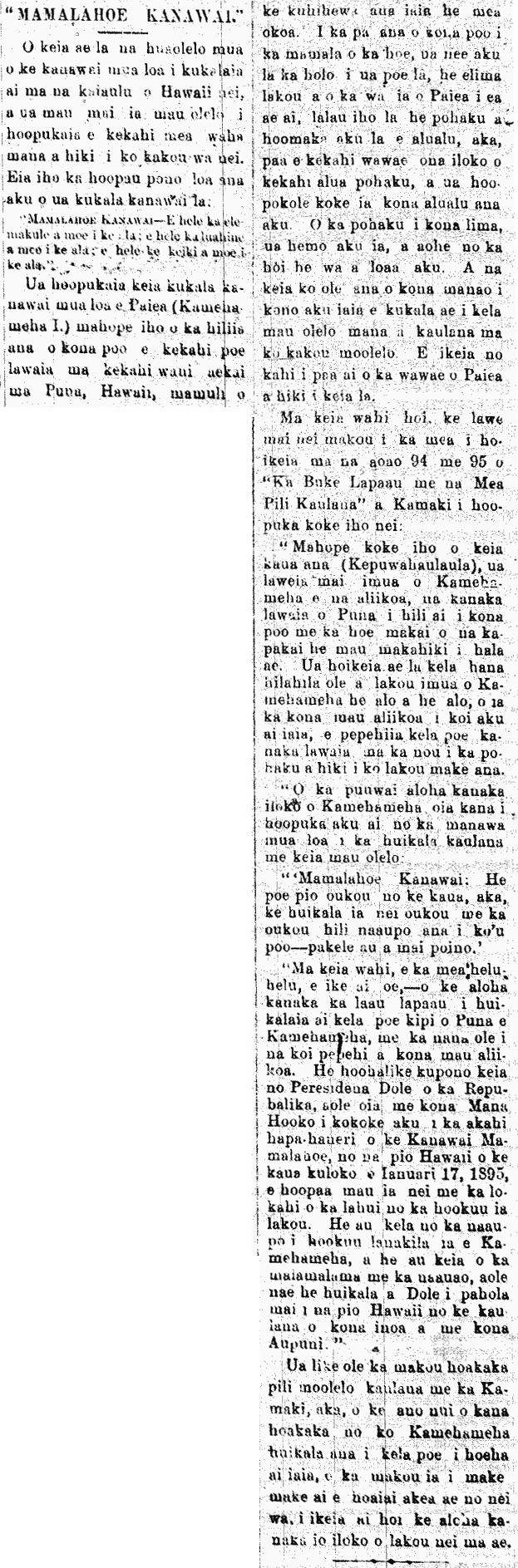
[“MAMALAHOE KANAWAI.”]

This above are the initial words of the very first law promulgated in the communities of Hawaii, and those words spoken by one in authority still remain. Here below is the the law in its entirety:

“MAMALAHOE KANAWAI—Let the old men go forth and lie upon the roads; let the old women go forth and lie upon the roads; let the children go forth and lie upon the roads.”

This first law was proclaimed by Paiea (Kamehameha I) after his head was struck by some fishermen at the seashore in Puna, Hawaii, because they mistakenly thought he was someone else. When his head was struck with the blow from a canoe paddle, the men fled, there being five of them; that was when Paiea rose, picked up a rock, and made to chase after them, however, his foot was caught in a rock crevice, and his chase was cut short. The rock in his hand fell, and there was no getting it back. And it was this disappointment which caused him to proclaim these famous and powerful words in our history. The place where Paiea’s foot was caught can be seen to this day.

Here, we take what is shown on pages 94 and 95 of “Ka Buke Lapaau me na Mea Pili Kaulana” which was published by Kamaki [Thomas P. Spencer]:¹

“Soon after this battle (Kepuwahaulaula), the fishermen who years earlier struck the head of Kamehameha with a paddle near the sea were brought before him by his officers. This shameful act of theirs was made known to Kamehameha face to face, for which his officers demanded that they be killed by stoning them to death.

“The aloha Kamehameha had for his fellow man was expressed for the first time in his famous pardon by announcing:

“‘Mamalahoe Kanawai: you are prisoners of war, but you are forgiven for unwittingly striking my head–I escaped, but nearly was in trouble.’

“Here, O Reader, do recognize–love for his fellow man was the cure² for which allowed for the release of these rebels of Puna by Kamehameha, and him not giving regard to the calls by his officers to put them to death. This is a fine comparison to President Dole of the Republic; he with his Executive Powers does not come close to a hundredth of the Kanawai Mamalahoe, in his treatment of the Hawaiian prisoners of the revolution of January 17, 1895 who continue to be imprisoned albeit the lahui are united in wanting them released. That was an uncivilized time when [the men] were triumphantly released by Kamehameha, and this is a knowledge and civilization, and yet Dole has not given clemency to the Hawaiian prisoners for the fame of his name and that of his Nation.”

Our elucidation of this famous story is not like that of Spencer’s, but the basis of his explanation of Kamehameha’s forgiving those who injured him, that is what we want to make clear at this time, so that true love of one’s fellow man is seen by them.

¹This book was republished in 2003 by Bishop Museum Press as: Buke ‘Oihana Lapa’au me na ‘Apu la’au Hawai’i (Book of Medical Practices and Hawaiian Prescriptions). See here for further description.

²”Laau lapaau” [medicinal cure] is the word chosen here because this story appears in a book of traditional medicinal practices.

(Makaainana, 11/25/1895, p. 4)
"MAMALAHOE KANAWAI."

Ka Makaainana, Buke IV—-Ano Hou. Helu 22, Aoao 4. Novemaba 25, 1895.
Important words from today about yesterday, today, and tomorrow, 2013.

[Appropriate for this Lei Day, i found a lei woven with great thought and care within the pages of the current Ka Wai Ola, out today. This is a two-stranded lei—two insightful articles (both on a like topic, but one not a translation of the other) by Bryan Kamaoli Kuwada, student, translator, teacher, editor, and researcher living in Palolo i ka ua Lililehua e kilihune nei. Do read it and do pass it on.

For the entire issue, click here: Ka Wai Ola, Mei 2013.]

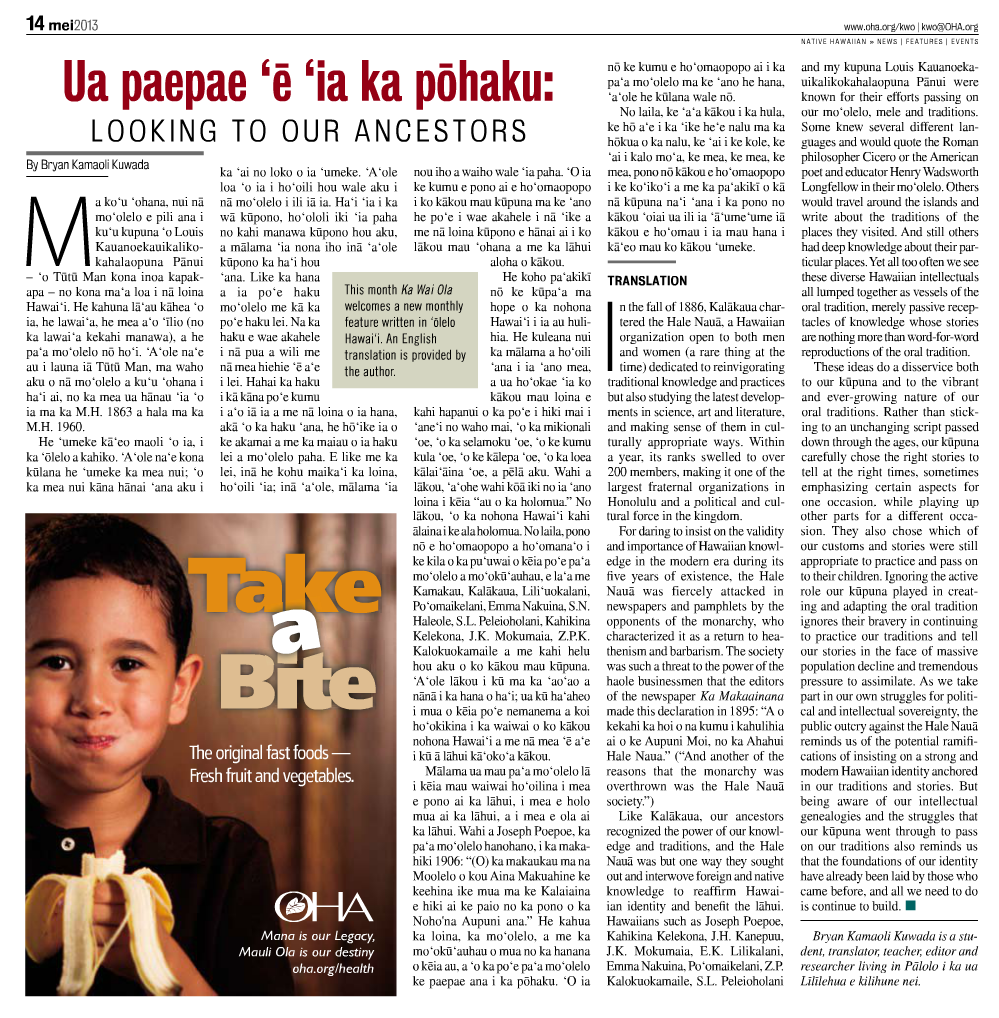
“Ua paepae ʻē ʻia ka pōhaku: Looking to Our Ancestors.”

Ua paepae e ia ka pohaku: Looking to our Ancestors

Ka Wai Ola, Volume 30, Number 5, Page 14. Mei 2013.

The children are your future! 1909 / timeless.

DON’T DECREASE THE PAY OF THE TEACHERS.

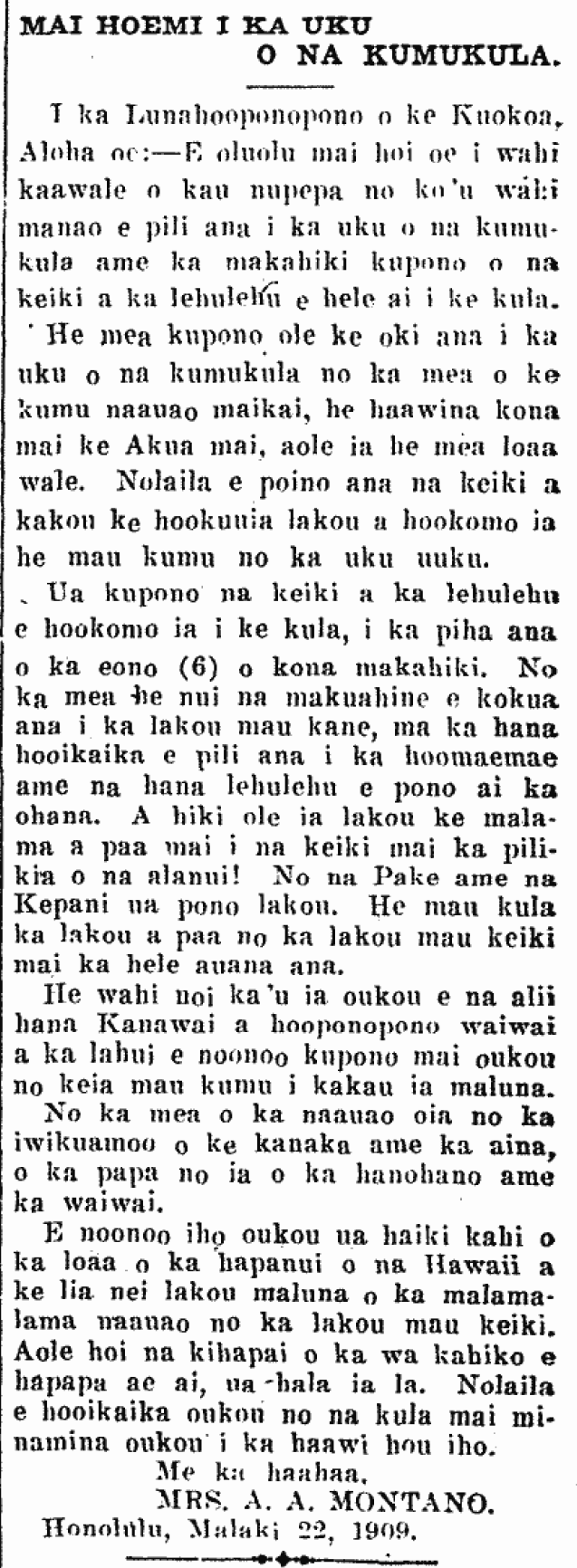
To the Editor of the Kuokoa, Aloha oe:—Please allow me some space in your newspaper for my humble thoughts dealing with the salary of teachers and the age at which children of the public should attend school.

It is wrong to cut the teachers’ pay because a well-educated teacher has a gift from God; it is not something readily gotten. And our children will be hurt should we let those teachers go and employ teachers for little pay.

The children of the people should be enrolled in school when they turn six (6) years of age. For there are many women who assist their husbands by endeavoring to take care of the many duties for the good of the family. And they are not able to care for and keep their children from the harm of the streets! As for the Chinese and the Japanese, they are fine. They have schools and their children are kept from wandering about.

I beseech all of you leaders who make Laws and who regulate public funds, do think carefully about these thoughts written above.

For knowledge is the backbone of man and his nation; it is the basis for fame and wealth.

Consider that the income of the majority of the Hawaiians is limited, and they are counting on the light of education for their children. The plantations of the old days are not to be reached out for, for those days are past. So all of you, please put effort into the schools, and don’t feel hesitant in investing more.

Sincerely,

MRS. A. A. MONTANO.

Honolulu, Malaki 22, 1909.

[Times have changed. Hopefully we learn from the past…

This letter is written by famed composer, Mary Jane Kekulani Montano.]

(Kuokoa, 3/26/1909, p. 4)

MAI HOEMI I KA UKU O NA KUMUKULA.

Ka Nupepa Kuokoa, Buke XLVI, Helu 13, Aoao 4. Maraki 26, 1909.

Beginning of line-by-line commentary of “Aia i Honolulu kuu pohaku,” 1929.

EXPLANATION OF THE FIRST LINE.

1. Aia i Honolulu kuu pohaku

Kapanookalani’s thoughts:—This land Honolulu, it is close to Nanawale, Puna, by the sea. It is a ku, a small land in between large lands.

The stone [pohaku] is Lord [Haku] of the chiefess and in this word, the important idea is chiefess [‘lii wahine].

Kahapula’s thoughts:—Honolulu is on Oahu, where King Kamehameha V dwelt and those who opposed him is the Honolulu in this first line of the mele. It was here his enemies schemed and carried out all their defiant acts against him. While they knew the wish of the King to marry the chiefess Pauahi, her teacher, Amos Cooke secretly agreed to  Bishop for him to meet with Pauahi without the knowledge of her parents. That is how Pauahi became Bishop’s, and this is how Bishop and his relative Lee [? William Little Lee] became dignitaries of the land.

Kupihea’s thoughts:—Honolulu is a fish stone called a Kuula, and was brought here to this Honolulu [on Oahu] from the Honolulu of Puna [on Hawaii]. This Kuula was placed in the tiny land of Honolulu where an Alii called Honolulu lived, who was related to the chiefess Peleula, whose younger sister was the beautiful Waikiki. This place is mauka of the old Rawlin’s Estate. There is a bank of coral where Honolulu is; the fishing altar [Kuula] for the fish ponds [loko i’a] is on the Waikiki side of Liliha Street and between Vineyard and King Streets.

The stone is related to chiefs from times immemorial [mai ka po mai]. It is a manifestation made by God.

Iokepa’s thoughts:—Honolulu is a small land and a canoe landing makai of Nanawale, Puna, between two sand dunes, one on the Hilo side and one on the Puna side, called Puu Waawaa. From this Honolulu is called the Honolulu here [on Oahu] which used to be called Kou before, and after it was called Honolulu until this day.

This is the meaning for the word Honolulu:—The wind is very calm [lulu] an the sea is serene; it is very fine and peaceful. Bay [? Hono] of calm sea; Hono that is peaceful.

Kuluwaimaka’s thoughts:—The stone is related to Kamehameha V. Honolulu in Puna is a lowland next to the sea. Its width is perhaps half a mile long between Na Puu o Pele and Waiakahiula on the Hilo side. Honolulu is a place where you pick opihi [ku’i opihi] and pick limu [hana limu]. There is a fine spring [punawai] there and there is a foot path there.

[And to think that this is but the very beginning of Kelsey’s detailed account of the explanation of the six loea of the mele “Aia i Honolulu kuu pohaku.” This is just the first line! It continues in the following issues!!

One more (huge) reason that Hawaiian-Language Newspapers are priceless!!!]

(Alakai o Hawaii, 12/5/1929, p. 2)

NA MANAO WEHEWEHE MALUNA O KA LAINA EKAHI.

Ke Alakai o Hawaii, Buke 1, Helu 32, Aoao 2. Dekemapa 5, 1929.

Response to hula commentary, 1891.

THE HULA AND THE “P. C. ADVERTISER.”

Another example of the “P. C. Advertiser’s” moral attitude appears int the announcement, that a hula given by the Hon. J. A. Cummins at his resident at Waimanalo was a glorious affair.—We have no doubt, that the display was exceptionally fine, since the ex-Premier has a well earned reputation as a connoiseur in that line, and is said to use the collection of females, formerly of boat house fame, second to none in the country.—Still there is something about the hula, that has so far excluded it from the programs of church festivals and school exercises.—It has never been recommended to lure the mind to thoughts of higher and better things or to produce rigid uprightness of morals.

The hula is a graceful and rhythmic representation of certain actions of the human animal. There is no doubt, that from the earliest ages the physiology of reproduction has been the most intrinsically interesting known to man. After the question of food and personal safety, it is the most important consideration in the lives of man, savage and civilized. The Hindoos and Budhists covered their temples and public buildings with indecent pictures, which in some instances took the form of a cross. This was imported to Rome together with the worship of Isis. So every spire on a Christian Church represents a resurrection of the flesh. But civilized society has decided for good reason to cover Isis with a vail and put Osiris in a straight-jacket. It is only those, who believe in the infallibility and prerogatives derived from gold—as some of our friends—who may wish to go back to the first principles and have the hula taught as an accomplishment in our public schools, so that it might prove more attractive in catching a husband and certainly in domesticating him when caught, than the art of piano playing or embroidery. There are great posibilities in the hula! But at present it is prohibited by the law, and we are sorry to see the law violated by those who ought to know better.

(Leo o ka Lahui, 5/14/1891, p. 4)

THE HULA AND THE "P. C. ADVERTISER."

Ka Leo o ka Lahui, Buke II, Helu 193, Aoao 4. Mei 14, 1891.

Pilipo Kamai, Representative in the Legislature, takes a stand. 1890.

OBJECTIVES OF REPRESENTATIVE P. KAMAI.

On the 30th of March, between the hours of 1 and 6 in the afternoon, the representative Pilipo Kamai of here in Hana held a meeting of the makaainana in the old school house adjacent to his residence at Puuomaiai, Kaupo. There were fifty-four Hawaiians, one Portuguese, and one American that showed up. Rev. Mr. Kailioha of Huelo called for the light from the Heavens to shine down. The meeting began peacefully, and our representative revealed his path for the upcoming Legislative session, and the number of his objectives is twenty-three. And here they are, without my clarifications; the 3rd objective is the one he is passionate about.

And this is how he began, “When my feet are firmly planted amongst my fellow law makers, your humble servant will strive to fulfill these objectives:

1. To maintain our nation’s independence.

2. To pay off our nation’s debt.

3. To restore all power of the King.

4. To lessen the wages of all the nation’s officials, from the first to the last.

5. To have the government lands sold at low cost only to Hawaiians who have no land.

6. To block the entrance of the Chinese, Japanese, and Portuguese.

7. To continue the Treaty with the United States of America.

8. To repeal for good the desertion of marriage law passed during the last Legislative Session.

9. To make Arbor Day (La kanu laau) into a day that is recognized.

10. To have voting for the Monarch done by all.

11. To have the Cabinet of Ministers be made up of two Hawaiians and two haole.

12. To lessen taxes.

13. To pay only $25.00 to representatives who win and not to those who lose.

14. To have juries for Hawaiians be Hawaiian, and juries for haole be haole.

15. To bring an end to pensions [uku hoomau].

16. To have clergy teach School children about religion everyday, during school hours.

17. To have makaainana petition to their Representatives of their problems by way of Committee of thirteen selected members, it being signed by fifty names.

18. To get funding for the jail in Kipahulu.

19. To have children under 17 years not be taxed.

20. To get Hana two Judges.

21. To  get Hana two Representatives.

22. To have street taxes levied in each town remain with each respective town, and not be turned over to the Street Funds of the district.

23. These objectives above will be considered carefully before the representatives brings them to motion in the Legislature.

A Committee was selected, and here is who were chosen: Paele, Chairman; Kala, Secretary; Anakalea; Kamoau; Kanamu; Helio; Naehu; Karolo; Nehemia; Haleauki; Anton Paiko; and Kalima. The committee will meet this coming week, on April 12, to think on the problems here in Kaupo, and the entire district.

Before the meeting was adjourned, a letter was read from Ulupalakua asking our representative to go there for a grand party given to honor Mister Wilcox [Wilikoki]. The meeting was adjourned.

Kahupo.

Kaupo, March 31.

(Ko Hawaii Pae Aina, 4/19/1890, p. 1)

NA KUMUHANA A LUNAMAKAAINANA P. KAMAI.

Ko Hawaii Pae Aina, Buke XIII, Helu 16, Aoao 1. Aperila 19, 1890.

Leprosy patients on the run, 1893.

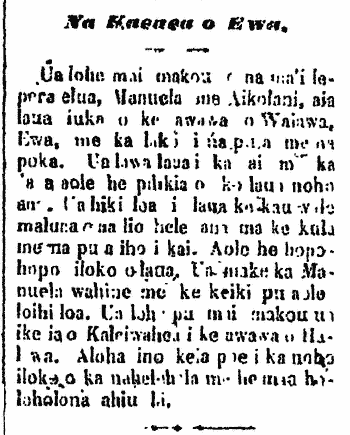
The Heroes of Ewa.

We have heard that the two leprosy patients, Manuela and Aikolani are in the uplands of Waiawa valley in Ewa, and that they are stocked with guns and bullets. The have enough fish and poi, and they have no difficulties with their living situation. They can just get on horses in the fields with their guns and go down to the sea. They have nothing to worry about. Manuel’s wife and child died long ago. We also hear that Kaleiwahea was seen in Halawa valley. How sad for these people living in the forests like wild animals.

[Here is yet another unclear digital image from a Hawaiian-Language Newspaper!]

(Lei Momi, 8/5/1893, p. 5)

Na Kaeaea o Ewa.

Ka Lei Momi (Oili Pule), Buke I, Helu 1, Aoao 5. Augate 5, 1893.

Writing on the wall, 1894.

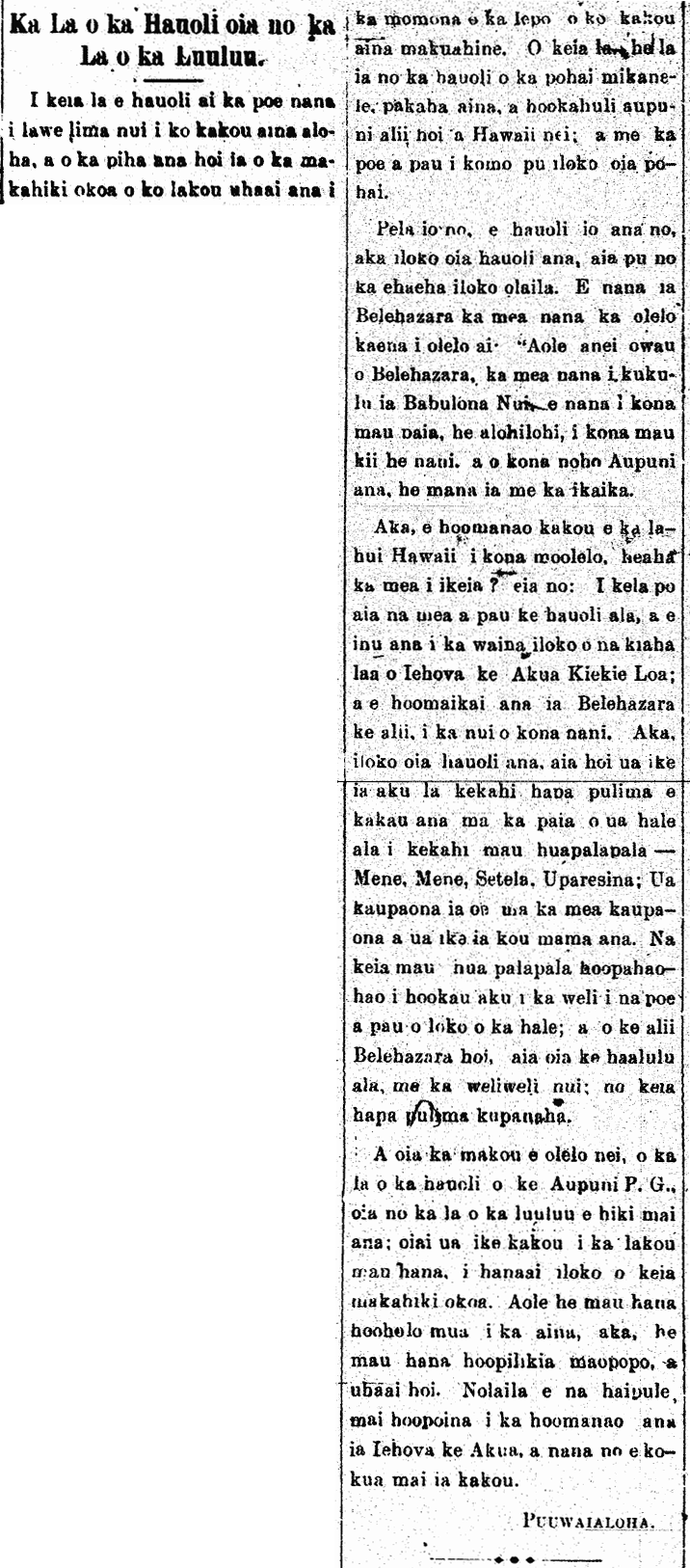
The Day of Happiness is a Day of Sadness.

On this day, those who took our beloved land by force rejoice, and it makes a full years since they’ve feasted wastefully of the fertile soil of our mother land. This day is one of happiness for the circle of missionaries, plunderers of land, and overthrowers of the Hawaiian Kingdom, as well as for those who enter join their circle.

It is true, they will indeed rejoice; however, along with this joy, there is hurt within. Look at Belshazzar [Belehazara] the one whose boast went, “Am I not Belshazzar, the builder of the Great Babylon? Look at its shiny walls, its beautiful images, and its Throne has authority and might.”

However, let us recall, O Hawaiian Lahui, his story; what is known? it is this: That night, everyone was joyous, and drinking wine from cups sacred to Jehovah, Almighty God; and they praised Belshazzar for his great beauty. However, while the rejoicing was going on, there was seen part of a hand writing some words on the wall of the house—Mene, Mene, Setela, Uparesina; You have been weighed on the scales and have been found wanting. It was these astonishing words which caused a fear to fall over everyone in the house; and as for the king Beshazzar, he was shaking with trepidation at this amazing portion of a hand.

And that is what we are saying: the day of joy of the Government of the P. G. [Provisional Government], is the day that sadness will come; for we have seen their actions done over the past year. They were not actions done to move this land forward, but actions that were clearly harmful as well as squandering. Therefore O Pious Ones, do not forget to remember Jehovah, God, and he shall help us.

Puuwaialoha [“Loving-heart”]

(Leo o ka Lahui, 1/17/1894, p. 2)

Ka La o ka Hauoli oia no ka La o ka Luuluu.

Ka Leo o ka Lahui, Buke II, Helu 856, Aoao 2. Ianuari 17, 1894.

More on the Boston, in English, 1893.

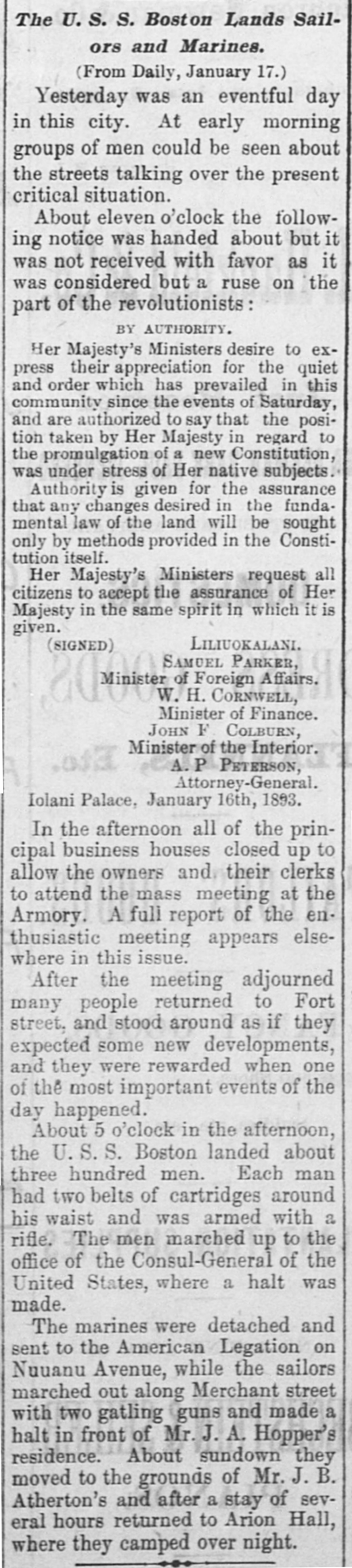
The U. S. S. Boston Lands Sailors and Marines.

(From Daily, January 17.)

Yesterday was an eventful day in this city. At early morning groups of men could be seen about the streets talking over the present critical situation.

About eleven o’clock the following notice was handed about but it was not received with favor as it was considered but a ruse on the part of the revolutionists:

BY AUTHORITY.

Her Majesty’s Ministers desire to express their appreciation for the quiet and order which has prevailed in this community since the events of Saturday, and are authorized to say that the position taken by Her Majesty in regard to the promulgation of a new Constitution, was under stress of Her native subjects.

Authority is given for the assurance that any changes desired in the fundamental law of the land will be sought only by methods provided in the Constitution itself.

Her Majesty’s Ministers request all citizens to accept the assurances of Her Majesty in the same spirit in which it is given.

(SIGNED) Liliuokalani.

Samuel Parker,
Minister of Foreign Affairs.

W. H. Cornwell,
Minister of Finance.

John F. Colburn,
Minister of the Interior.

A. P. Peterson,
Attorney-General.

Iolani Palace, January 16, 1893.

In the afternoon all of the principal business houses closed up to allow the owners and their clerks to attend the mass meeting at the Armory. A full report of the enthusiastic meeting appears elsewhere in this issue.

After the meeting adjourned many people returned to Fort street, and stood around as if they expected some new developments, and they were rewarded when one of the most important events of the day happened.

About 5 o’clock in the afternoon, the U. S. S. Boston landed about three hundred men. Each man had two belts of cartridges around his waist and was armed with a rifle. The men marched up to the office of the Consul-General of the United States, where a halt was made.

The marines were detached and sent to the American Legation on Nuuanu Avenue, while the sailors marched out along Merchant street with two gatling guns and made a halt in front of Mr. J. A. Hopper’s residence. About sundown they moved to the grounds of Mr. J. B. Atherton’s and after a stay of several hours returned to Arion Hall, where they camped over night.

[The “Daily” here mention at the top refers to the Daily Pacific Commercial Advertiser.]

(Hawaiian Gazette, 1/24/1893, p. 6)

The U. S. S. Boston Lands Sailors and Marines.

Hawaiian Gazette, Volume XXVIII, Number 4, Page 6. January 24, 1893.

More on the Boston, in English, 1893.

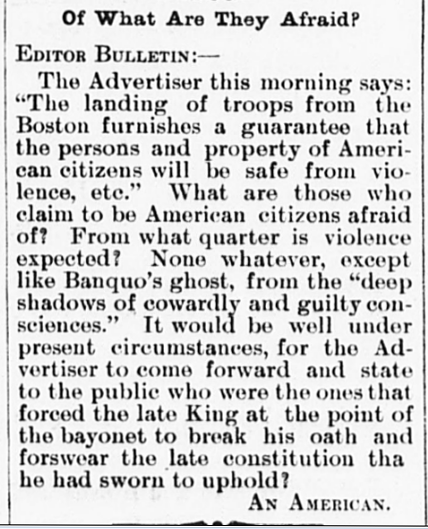
Of What Are They Afraid?

Editor Bulletin:—

The Advertiser this morning says: “The landing of troops from the Boston furnishes a guarantee that the persons and property of American citizens will be safe from violence, etc.” What are those who claim to be American citizens afraid of? From what quarter is violence expected? None whatever, except like Banquo’s ghost, from the “deep shadows of cowardly and guilty consciences.” It would be well under present circumstances, for the Advertiser to come forward and state to the public who were the ones that forced the late King at the point of the bayonet to break his oath and forswear the late constitution tha he had sworn to uphold?

An American.

(Daily Bulletin, 1/17/1893, p. 3)

Of What Are They Afraid?

The Daily Bulletin, Volume 5, Number 626, Page 3. January 17, 1893.