Ia oe e ka la e alohi nei… 1874.

The Birthday of the King.

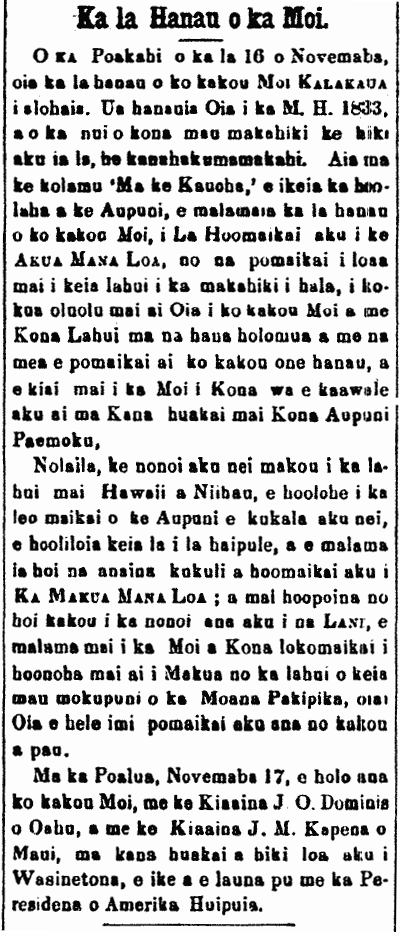
Monday, the 16th of November, is the birthday of our beloved King Kalakaua. He was born in the year 1833, and he will be making forty-three years old. In the column ‘Ma ke Kauoha’ [By Authority], seen is the Government notice that the birthday of our King will be held as a Day of Thanks to the Almighty God, for the blessings received by our lahui this past year; He has kindly assisted our King and His People in progressive endeavors and in things that will benefit our homeland, and may He watch over the King during His time away from his Kingdom of Islands on His travels.

Therefore, we ask the lahui from Hawaii to Niihau to heed the good announcement of the Government, that this day shall be a day of prayer, and that meetings will be held to kneel and give appreciation to the Almighty Father; and let us not forget to ask of the Heavens to watch over the King who He in his benevolence has placed as a Father to the lahui of these islands in the Pacific Ocean, while He will be travelling to seek blessings for us all.

On Tuesday, November 17th, our King and the Governor of Oahu, J. O. Dominis, along with the Governor of Maui, J. M. Kapena, will go on a trip to Washington to meet with the President of the United States of America.

(Kuokoa, 11/7/1874, p. 2)

Ka la Hanau o ka Moi.

Ka Nupepa Kuokoa, Buke XIII, Helu 5, Aoao 2. Novemaba 7, 1874.

Pirates? Honolulu? Iolani Palace looted? 1884.

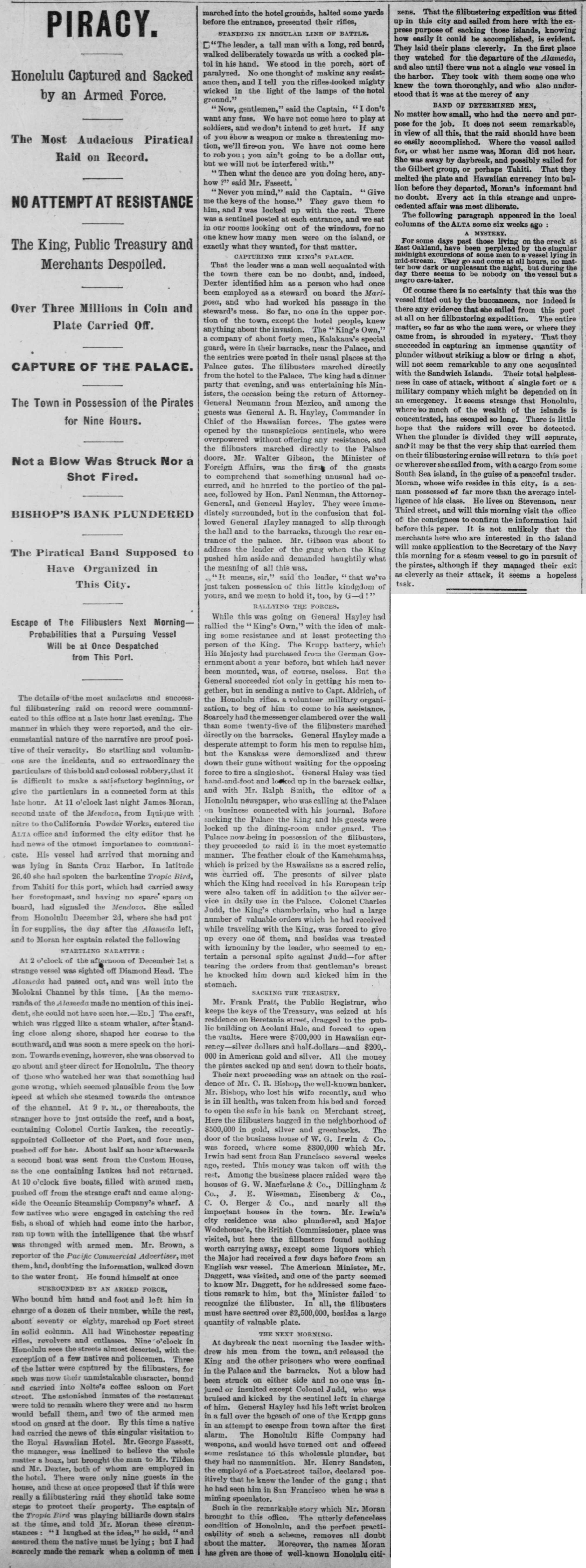
PIRACY.

Honolulu Captured and Sacked by an Armed Force.

The Host Audacious Piratical Raid on Record.

NO ATTEMPT AT RESISTANCE

The King, Public Treasury and Merchants Despoiled.

Over Three Millions in Coin and Plate Carried Off.

CAPTURE OF THE PALACE.

The Town in Possession of the Pirates for Nine Hours.

Not a Blow Was Struck Nor a Shot Fired.

BISHOP’S BANK PLUNDERED

The Piratical Band Supposed to Have Organized in This City.

Escape of The Filibusters Next Morning — Probabilities that a Pursuing Vessel Will be at Once Despatched from This Port.

The details of the most audacious and successful filibustering raid on record were communicated to this office at a late hoar last evening. The manner” in which they were reported, and the circumstantial nature of the narrative are proof positive of their veracity. So startling and voluminous are the incidents, and so extraordinary the particulars of this bold and colossal robbery, that it is difficult to make a satisfactory beginning, or give the particulars in a connected form at this late hour. At 11 o’clock last night James Moran, second mate of the Mendoza, from Iquique with nitre to the California Powder Works, entered the Alta office and informed the city editor that he had news of the utmost importance to communicate. Hie vessel had arrived that morning and was lying in Santa Cruz Harbor. In latitude 26, 40 she had spoken the barkentine Tropic Bird, from Tahiti for this port, which had carried away her foretopmast, and having no spare spars on board, had signaled the Mendoza. She sailed from Honolulu December 2d, where she had pat in for supplies, the day after the Alameda left, and to Moran her captain related the following

STARTLING NARATIVE :

At 2 o’clock of the afternoon of December 1st a strange vessel was sighted off Diamond Head. The Alameda had passed out, and was well into the Molokai Channel by this time. [As the memoranda of the Alameda made no mention of this incident, she could not have seen her. — Ed.] The craft, which was rigged like a steam whaler, after standing close along shore, shaped her course to the southward, and was soon a mere speck on the horizon. Towards evening, however, she was observed to co about and steer direct for Honolulu. The theory of those who watched her was that something had gone wrong, which seemed plausible from the low speed at which she steamed towards the entrance of the channel. At 9 p. m., or thereabouts, tho stranger hove to just outside the reef, and a boat, containing Colonel Curtis Iaukea, the recentlyappointed Collector of the Port, and four men, poshed off for her. About half an hour afterwards a second boat was sent from the Custom House, as the one containing Iaukea had not returned. At 10 o’clock five boats, filled with armed men, pushed off from the strange craft and came alongside the Oceanic Steamship Company’s wharf. A few natives who were engaged in catching the red fish, a fchoal of which had come into the harbor, ran up town with the intelligence that the wharf was thronged with armed men. Mr. Brown, a reporter of the Pacific Commercial Advertiser, met them, and, doubting the information, walked down to the water front. He found himself at once

SURROUNDED BY AN ARMED FORCE,

Who bound him hand and foot and left him in charge of a dozen o£ their number, while the rest, about’ seventy or eighty, marched up Fort street in solid column. All had Winchester repeating rifles, revolvers and cutlasses. Nine ‘o’clock in Honolulu sees the 6treets almost deserted, with the exception of a few natives and policemen. Three of the latter were captured by the filibusters, for Each was now their unmistakable character, bound and carried into Nolte’s coffee saloon on Fort street. The astonished inmates of the restaurant were told to remain where they were and no harm would befall them, and two of the armed men stood on guard at the door. By this time a native had carried the news of this singular visitation to the Royal Hawaiian Hotel. Mr. George Fassett, the manager, was inclined to believe the whole matter a hoax, but brought the man to Mr. Tilden and Mr. Dexter, both of whom are employed in the hotel. There were only nine guests in the house, and these at once proposed that if this were really a filibustering raid they 6honld take some 6teps to protect their property. The captain of the Tropic Bird was playing billiards down stairs at the time, and told Mr. Moran these circumstances : “I laughed at the idea,” he said, “and assured them the native must be lying ; but I had scarcely made the remark when a column of men marched into the hotel grounds, halted some yards before the entrance, presented their rifles,

STANDING IN REGULAR LINE OF BATTLE.

“The leader, a tall man with a long, red beard, walked deliberately towards as with a cocked pistol in his hand. We stood in the porch, sort of paralyzed. No one thonght of making any resistance then, and I tell yoa the rifles ‘looked mighty wicked in the light of the lamps of the hotel ground.”

” Now, gentlemen,” said the Captain, ” I don’t want any foes. We have not come here to play at soldiers, and we don’t intend to get hurt. If any of yon show a weapon or make a threatening motion, we’ll fire-on yon. We have not come here to rob you ; yon ain’t going to be a dollar out, but we will not be interfered with.”

“Then what the deuce are you doing here, anyhow?” said Mr. Fassett.

” Never you mind,” said the Captain. ” Give me the keys of the house.” They gave them to him, and I was locked up with the rest. There was a sentinel posted at each entrance, and we sat in our rooms looking out of the windows, for no one knew how many men were on the island, or exactly what they wanted, for that matter.

CAPTURING THE KING’S PALACE.

That the leader was a man well acquainted with the town there can be no doubt, and, indeed, Dexter identified him as a person who had once been employed as a steward on board the Mariposa, and who had worked his passage in the steward’s moss. So far, no one in the upper portion of the town, except the hotel people, knew anything about the invasion. The ” King’s Own,” a company of abont forty men, Kalakaua’s special guard, were in their barracks, near the Palace, and the sentries were posted in their usual places at the Palace gates. The filibusters marched directly from the hotel to the Palace. The king had a dinner party that evening, and was entertaining his Ministers, the occasion being the return of Attorney General Neumann from Mexico, and among the gne6ts was General A. B. Hayley, Commander in Chief of the Hawaiian forces. The gates were opened by the nnsnspicious sentinels, who were overpowered without offering any resistance, and the filibusters marched directly to the Palace doore. Mr, Walter Gibson, the Minister of Foreign Affairs, was the tir:-| of the guests to comprehend that something unusual had occurred, and he hurried to the portico of the palace, followed by Hon. Paul Neuman, the AttorneyGeneral, and General Hayley. They were immediately snrrounded, but in the confusion that followed General Hayley managed to slip through the hall and to the barracks, through tho rear entrance of the palace. Mr. Gibson was about to address the leader of the gang when the King pushed him aside and demanded haughtily what the meaning of all this was.

“It means, sir,” said tho leader, “that we’ve just taken possession of this little kindgdom of yours, and we mean to hold it, too, by G — d ! “

RALLYING THE FORCES.

While this was going on General Hayley had rallied the ” King’s Own,” with the idea of making some resistance and at least protecting tho person of the King. The Krupp battery, which His Majesty had purchased from the German Government about a year before, but which had never been mounted, was, of course, useless. But the General succeeded riot only in getting his men together, but in sending a native to Capt. Aldrich, of the Honolulu rifles, a volunteer military organization, to beg of him to come to his assistance. Scarcely had the messenger clambered over the wall than some twenty-five of the filibuster.* marched directly on the barracks. General Hayley made a desperate attempt to form his men to repalse him, bat the Kanakas were demoralized and threw down their guns without waiting for the opposing force to fire a single shot. General Haley was tied hand-and-foot and loeked up in the barrack cellar, and with Mr. Ralph Smith, the editor of a Honolulu newspaper, who was calling at the Palace on business connected with his journal. Before hacking the Palace the King and his guests were locked up the dining-room under guard. The Palace now being in possession of the filibusters, they proceeded to raid it in the most systematic manner. The feather cloak of the Kamehamahas, which is prized by the Hawaiians as a sacred relic, was carried off. The presents of silver plate which the King had received in his European trip were aleo taken off in addition to the silver service in daily use in the Palace. Colonel Charles Judd, the King’s chamberlain, who had a large number of valuable orders which he had received while traveling with the King, was forced to give up every one 6f them, and besides was treated with urnominy by the leader, who seemed to entertain a personal spite against Judd — for after tearing the orders from that gentleman’s breast he knocked him down and kicked him in the stomach.”

SACKING THE TREASURY.

Mr. Frank Pratt, the Public Registrar, who keeps the keys of the Treasury, was seized at his residence on Beretania street, dragged to the public building on Aeolani Hale, and forced to open the vaults. Here were $700,000 in Hawaiian currency—silver dollars and half-dollars— and $200,000 in American gold and silver. All the money the pirates sacked up and sent down to their boats. Their next proceeding was an attack on the residence of Mr. C. R. Bishop, the well-known banker. Mr. Bishop, who lost his wife recently, and who is in ill health, was taken from his bed and forced to open the safe in his bank on Merchant streej. Here the filibusters bagged in the neighborhood of §500,000 in gold, silver and greenbacks. Th9 door of the business house of W. G. Irwin & Co. was forced, where some $300,000 which Mr. Irwia had sent from San Francisco several weeks ago, rested. This money was taken off with the rest. Among the business places raided were the houses of G. W. Macfarlane & Co., Dillingham & Co., J. E. Wiseman, Eisenberg & Co., C. O. Berger & Co., and nearly all the important houses in the town. Mr. Irwin’s city residence was also plundered, and Major Wodehouse’e, the British Commissioner, place was visited, but here the filibusters found nothing worth carrying away, except some liquors which the Major had received a few days before from an English war vessel. The American Minister, Mr. Daggett, was visited, and one of the party seemed to know Mr. Daggett, for he addressed some facetious remark to him, but the Minister failed ‘ to recognize the filibuster. In all, the filibusters mast have secured over $2,500,000, besides a large quantity of valuable plate.

THE NEXT MORNING.

At daybreak the next morning the leader withdrew his men from the town, and released the King and the other prisoners who were .confined in the Palace and the barracks. Not a blow had been struck on either side and no one was injured or insulted except Colonel Judd, who was bruised and kicked by the sentinel left in charge of him. General Hayley had his left wrist broken in a fall over the breach of one of the Krupp guns in on attempt to escape from town after the first alarm. The Honolulu Rifle Company had weapons, and would have turned oat and offered some resistance to this wholesale plunder, but they had no ammunition. Mr. Henry Sandsten, the employs of a Fort-street tailor, declared positively that he knew the leader of the gang ; that he had seen him in San Francisco when he was a mining speculator.

Such is the remarkable story which Mr. Moran brought to this office. The utterly defenceless condition of Honolulu, and the perfect practicability of snch a scheme, removes all doubt about the matter. Moreover, the names Moran has given are those of well-known Honolulu citizens. That the filibustering expedition was fitted np in this city and sailed from here with the express purpose of sacking those islands, knowing how easily it could be accomplished, is evident. They laid their plans cleverly. In the first place they watched for the departure of the Alameda, and also until there was not a single war vessel in the harbor. They took with them some one who knew the town thoroughly, and who also understood that it was at the mercy of any .

BAND OF DETERMINED MEN.

No matter how small, who had the nerve and purpose for the job. It does not seem remarkable, in view of all this, that the raid should have been so easily accomplished. Where the vessel sailed for, or what her name was, Moran did not hear. She was away by daybreak, and possibly sailed for the Gilbert group, or perhaps Tahiti. That they melted plate and Hawaiian currency into bullion before they departed, Moran’s informant had no doubt. Every act in this strange and unprecedented affair was most dliberate.

The following paragraph appeared in the local columns of the Alta some six weeks ago :

A MYSTERY.

For some days past those living on the creek at East Oakland, have been perplexed by the singular midnight excursions of some men to a vessel lying In mid-stream. They go and come at all hours, no matter how dark or unpleasant the night, bat daring the day there seems to be nobody on the vessel but a negro care-taker.

Of course there is no certainty that this was the vessel fitted oat by the buccaneers, nor indeed is there any evidence that she sailed from this port at all on her filibustering expedition. The entire matter, so far as who the men were, or where they came from, is shrouded in mystery.- That they succeeded in capturing an immense quantity of plunder without striking a blow or firing a shot, will not seem remarkable to any one acquainted with the Sandwich Islands. Their total helplessness in case of attack, without a” single fort or a military company which might be depended on in an emergency. It seems strange that Honolulu, where so much of the wealth of the islands is concentrated, has escaped so long. There is little hope that the raiders will ever be detected. When the plunder is divided they will separate, and”it may be that the very ship that carried them on their filibustering cruise will return to this port or wherever she sailed from, with a cargo from some South Sea island, in the guise of a peaceful trader. Moran, whose wife resides in this city, is a seaman possessed ef far more than the average intelligence of his class. He lives on Stevenson, near Third Street, and will this morning visit the offices of the consignees to confirm the information laid before this paper. It is not unlikely that the merchants here who are interested in the island will make application to the Secretary of the Navy this morning for a steam vessel to go in pursuit of the pirates, although if they managed their exit as cleverly as their attack, it seems a hopeless task.

[This is one of the more exciting things i have seen lately! Anybody know anything about this??

This site, California Digital Newspaper Collection, seems to be separate from Chronicling America, and makes available many California newspapers! Here is a list of what is online and word-searchable!]

(Daily Alta California, 12/15/1884, p. 1)

PIRACY.

Daily Alta California, Volume XXXVII, Number 12664, Page 1. December 15, 1884.

More on Liliu’s 75th birthday, 1913.

THE BIRTHDAY OF QUEEN LILIUOKALANI

This past Tuesday, the 2nd of September, was the birthday of Queen Liliuokalani; she has been living in this world 75 years, and she is the only reigning queen of Hawaii that has almost reached extreme age.

There was a royal audience that day as was done regularly in the years past, at her home at Washington Place [Wakinekona Hale], before noon; there were many friends and Hawaiian citizens of the queen who went to see her on that day. Princess Kawananakoa assisted her in welcoming the friends and citizens, and Colonel C. P. Iaukea introduced the friends before her, and Mr. E. K. Lilikalani escorted the malihini into the house.

The Royal Hawaiian Band [Bana Hawaii] was there entertaining the audience while they all were visiting the queen; there were many old songs, songs which the queen took great delight in while she reigned and mele that were sung in the days of King Kalakaua.

(Kuokoa, 9/5/1913, p. 2)

KA LA HANAU O KA MOIWAHINE LILIUOKALANI

Ka Nupepa Kuokoa, Buke LI, Helu 35, Aoao 2. Sepatemaba 5, 1913.

Royal huakai, 1865.

[Found under: “BITS OF NEWS OF HAWAII NEI.”]

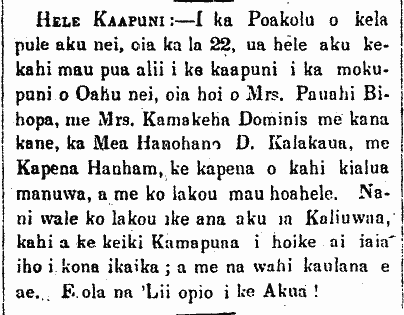
Circuit:—On Wednesday of the week last, that being the 22nd, some of the royal descendants made a circuit of Oahu nei, that being Mrs. Pauahi Bishop, Mrs. Kamakeha Dominis [Kamakaeha Dominis] and her husband, the Honorable D. Kalakaua, and Captain Hanham, the captain of a single-masted warship, along with their travelling companions. Splendid was their view of Kaliuwaa, where the youth Kamapuaa revealed himself and his strength; along with the other famous sites. Long live the young Alii in God!

(Kuokoa, 3/30/1865, p. 2)

Hele Kaapuni...

Ka Nupepa Kuokoa, Buke IV, Helu 13, Aoao 2. Maraki 30, 1865.

More on the Honorable Lilia Kamakaeha Paki’s marriage, 1862.

The Ones Who Were Married.

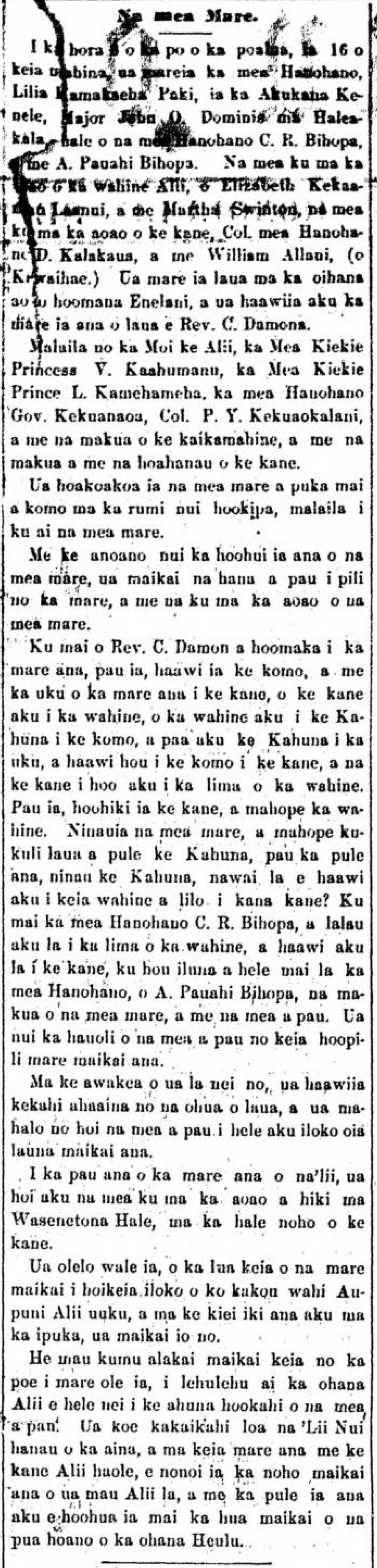
At 8 o’clock at night, on the 16th of this month, the Honorable Lilia Kamakaeha Paki was married to Adjutant General, Major John O. Dominis at Haleakala, the house of the Honorable C. R. Bishop and A. Pauahi Bishop. The ones who attended the royal bride were Elizabeth Kekaaniau Laanui and Martha Swinton; those attending the groom were the Honorable Colonel D. Kalakaua and William Allen [? William Allani] (of Kawaihae).

Present were the Chief, the King; her Highness Princess V. Kaahumanu, his Highness L. Kamehameha; the Honorable Governor Kekuanaoa; Colonel P. Y. Kekuaokalani; and the parents of the bride, and the parent and cousins of the groom.

The ones to be wed were gathered and they went out and entered the great parlor and it was there that the couple stood.

The uniting of the pair was done with much reverence, and all the proceedings of the wedding were fine, as well as with the attendants.

The Rev. C. Damon stood and began the marriage ceremony; then the ring and the marriage fee [? ka uku o ka mare ana] was given to the groom, from the groom to the bride, and from the bride to the Priest; the Priest took the fee and gave the ring once more to the groom, who put it on the brideʻs finger. When this was done, the groom was made to give his vow and then the bride. The couple were questioned, and then the two knelt down and Priest gave a prayer, and after the prayer, the Priest asked, “Who will give this woman to this man?” The Honorable C. R. Bishop stood and took the hand of the bride and gave it to the groom; the Honorable A. Pauahi Bishop, the parents of the couple and everyone else stood once more and approached. Everyone was full of joy for this beautiful wedding.

In midday of that very day, a party was given for their cortege, and all who found themselves amongst that fine gathering felt admiration.

After the marriage of the alii, the attendants returned to their sides until they reached Washington Place [Wasenetona Hale], the place of residence of the groom.

It is said that this is the second of the righteous marriages known in our tiny Kingdom, and by glancing through the gate, it is indeed righteous.

These are fine examples for those who are not married, so that the Royal family that associates with the multitudes will become numerous. There are but a few High Chiefs born of the land left, and with this marriage to a haole Royal one, it is hoped that the Royal couple live righteously along with the prayer that they bear good fruit of the sacred descent of the line of Heulu.

[Does anyone know if Pauahi had a name that started with an “A.”? For some reason she is here twice referred to as A. Pauahi Bihopa.]

(Hoku o ka Pakipika, 9/18/1862, p. 2)

Na mea Mare.

Ka Hoku o ka Pakipika Buke I, Helu 52, Aoao 2. Sepatemaba 18, 1862.

Ahuula and priceless treasures gone up in smoke, 1901.

THE AHUULA WAS DESTROYED BY FIRE

This Possession Belonged to Keaumoku.

S. L. Peleiholani claims $500 in damages
for this Feather Cloak.

Before the fire inspection Commissioner, seen was the relationship of S. L. Peleiholani to Kamehameha I, the conqueror of the nation [Ka Naʻi Aupuni], and also seen was the destruction of a very valuable ahuula in the bubonic fire. Peleiholani claimed $500 damages for this ahuula, and he said that he was urged to sell the ahuula for $1,000, which he absolutely refused to do. This is an ahuula that was cared for by his grandparents on down to him, and for this reason, he refused money which kept appearing before him until the cloak was consumed by fire.

Peleioholani added a claim of $2,140.05, and the majority of the assets were inherited from his kupuna. He is the child of Peleiholani and Pukeau. His grandfather was a child of Kalanuilumoku [Kalaniulumoku], a grandchild of Kamehameha I. His grandfather married Kahana, a daughter of Keaumoku, the one to whom belonged this ahuula. This Keaumoku was a high chief, and an minister [kuhina] of Kamehameha I, and he received may greatly valuable gifts from the conqueror of the nation. Peleiholani cared for this ahuula for a long time, and showed it to the many people who came before him to buy this cloak. The sum of money desired to offer him reached a thousand, and some ministers of Kalakaua came before him wanting the ahuula for the King. He refused all of these urging, and said to them that there was no way money could buy this ahuula while he was alive. Some men came from the alii Kalakaua bringing wine and money and put it at his side, intending to get him to drink until drunk when he would agree to giving this ahuula to the alii, however they left without.

There is but one other ahuula like it, and that is the ahuula cared for in the Kamehameha Museum [Bernice Pauahi Bishop Museum]. When people ask for the actual monetary value of that ahuula, they say Peleiholani’s claim is right, but the actual truth is that the true value of this ahuula reaches $2,000. Mrs. Mary Ailau was a witness called to testify as to the truth of the claim, and according to her testimony, it was correct; and she went before this man many a time and urged him to sell to her this ahuula for $500 and her request was refused. She felt that the true value of the ahuula reached all the way to two thousand dollars. When she was asked if the ahuula was auctioned off, how much would she offer, Mrs. Ailau answered that she would bid as much as one thousand dollars, and if she had a lot of money, she would bid up to two thousand dollars for this ahuula.

In this claim by Peleiholani, it is seen the great amount of valuable antiquities he was caring for and that was destroyed in the bubonic fires. If these treasures were not burned in the fire, and they were bought off of him, he would have gained a large amount of money. This is an example to we Hawaiians, showing the great value of some antiquities which we are just selling off or discarding. Take care of them and find out their value before throwing them away.

[I am guessing not only were there priceless objects in Peleioholani’s collection, but also manuscripts, as he is well known for his writings!]

(Kuokoa, 10/18/1901, p. 6)

PAU KA AHUULA I KE AHI

Ka Nupepa Kuokoa, Buke XXXIX, Helu 16, Aoao 6. Okatoba 18, 1901.

More on “Aia i Honolulu kuu pohaku”! 1929.

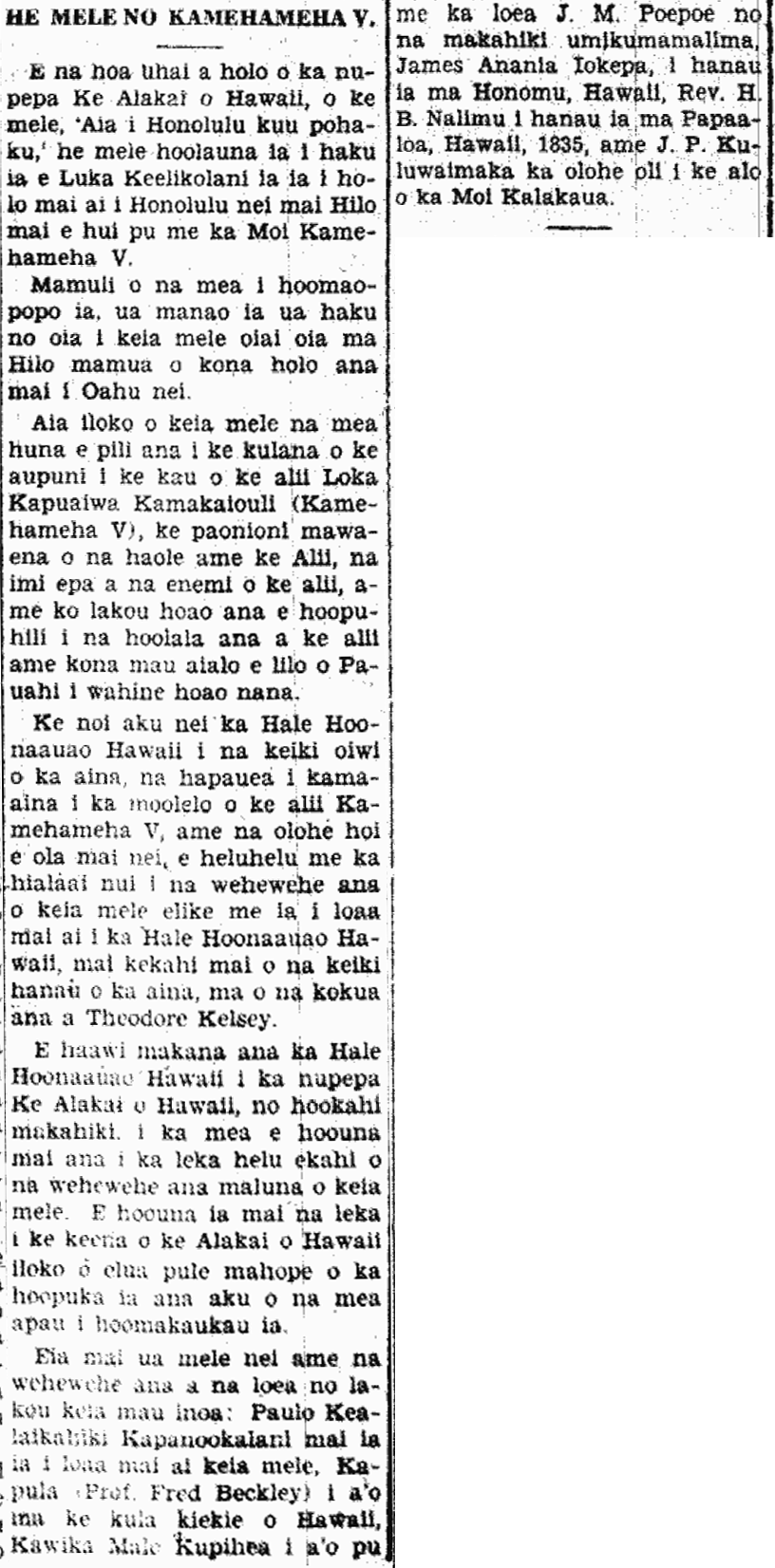
A MELE FOR KAMEHAMEHA V.

O Friends who chase after Ke Alakai o Hawaii, the mele, “Aia i Honolulu kuu pohaku,” is a mele of familiarity [mele hoolauna] composed by Luka Keelikolani when she was coming to here in Honolulu from Hilo to meet with King Kamehameha V.

From what is understood, it is believed that she composed this mele while she was in Hilo before her travelling to Oahu nei.

In this mele are hidden things dealing with the nation in the time of the alii Loka Kapuaiwa Kamakaiouli (Kamehameha V); the contention between the haole and the King, the deceit of the enemies of the King and their attempt to thwart the plans by the King and his court to make Pauahi his wife.

The Hale Hoonaauao Hawaii asks the native ones of the land, the old ones familiar with the history of King Kamehameha V, and the experts still living, to read with much pleasure the explanations of this mele as per what was obtained by the Hale Hoonaauao Hawaii from those native born of the land through the assistance of Theodore Kelsey.

The Hale Hoonaauao Hawaii will award a one-year subscription of the newspaper Ke Alakai o Hawaii to the one who sends the best letter with explanations on this mele. Send the letters to the office of Ke Alakai o Hawaii withing two weeks of the completion of the publishing of all that has been compiled.

Here is the mele and the explanations of the experts [loea] whose names are: Paulo Kealaikahiki Kapanookalani from whom we received this mele, Kahapula (Prof. Fred Beckley) who teaches at the University of Hawaii, Kawika Malo Kupihea who studied with the loea J. M. Poepoe for fifteen years. James Anania Iokepa who was born in Honomu, Hawaii, Rev. H. B. Nalimu who was born in Papaaloa, Hawaii in 1835, and J. P. Kuluwaimaka the skilled chanter [olohe oli] in the court of King Kalakaua.

[“Aia i Honolulu kuu pohaku” is perhaps the most widely studied mele i have seen, with line-by-line interpretations by experts of the day. It continues on for a number of issues of Alakai o Hawaii.

Does anyone have any details on the organization called Hale Hoonaauao Hawaii, or Hale Hoonaauao o Hawaii?]

(Alakai o Hawaii, 12/5/1929, p. 2)

HE MELE NO KAMEHAMEHA V.

Ke Alakai o Hawaii, Buke 1, Helu 32, Aoao 2. Dekemapa 5, 1929.

Kaulilua… Mele inoa for Kamehameha IV, 1864.

[Excerpt found under: “A DIRGE FOR KING Alexander Kalanikualiholiho, Maka o Iouli, Kunuiakea o Kukailimoku, KAMEHAMEHA IV!”]

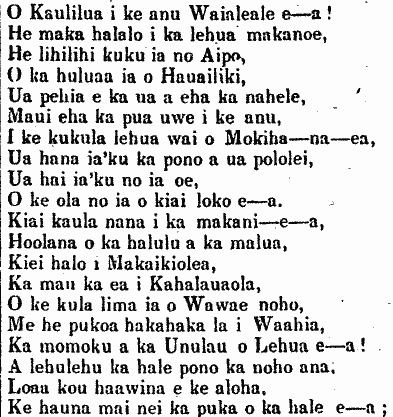
O Kaulilua i ke anu Waialeale e—a!
He maka halalo i ka lehua makanoe,
He lihilihi kuku ia no Aipo,
O ka huluaa ia o Hauailiki,
Ua pehia e ka ua a eha ka nahele,
Maui eha ka pua uwe i ke anu,
I ke kukula lehua wai o Mokiha—na—ea,
Ua hana ia’ku ka pono a ua pololei,
Ua hai ia’ku no ia oe,
O ke ola no ia o kiai loko e—a.
Kiai kaula nana i ka makani—e—a,
Hoolana o ka halulu a ka malua,
Kiei halo i Makaikiolea,
Ka mau ka ea i Kahalauaola,
O ke kula lima ia o Wawae noho,
Me he pukoa hakahaka la i Waahia,
Ka momoku a ka Unulau o Lehua e—a!
A lehulehu ka hale pono ka noho ana,
Loaa kou haawina e ke aloha,
Ke hauna mai nei ka puka o ka hale e—a;

[So many interesting things about this. The first and foremost perhaps is that this appears as part of an unusual kanikau for Alexander Liholiho Kamehameha IV in the form of a conversation between Kamehameha III (K III.) and himself (K IV.). Another is that if you hula, you probably learned this as a mele inoa for Kalakaua and not as one for Kamehameha IV. Does anyone know who it is that is labeled as (M.) in the conversation? Click here for a PDF of the issue with the rest of the piece on page 4.]

(Kuokoa, 1/23/1864, p. 4)

O Kaulilua i ke anu Waialeale e—a!

Ka Nupepa Kuokoa, Buke III, Helu 4, Aoao 4. Ianuari 23, 1864.

The Kings of Hawaii, 1876.

This is from an issue of “The Friend,” which includes a short biography in English of the ruling monarchs of Hawaii nei, written by S. C. Damon. As for this page of illustrations, they say:

The illustrations accompanying this number of the Friend we could wish were better executed. The plate was made in New York, from the best photographs we could procure in Honolulu. The original of Kamehameha 1st was executed in 1817 by a Russian artist, who accompanied Kotzebue in his voyage, and may be seen by referring to the third volume of his voyage. The original of Kamehameha 2d was executed in England in 1824, in the style of the dress of George 4th’s reign. We think those of Kamehameha 3d, 4th and 5th are very good, but not quite so good those of Lunalilo or His Majesty Kalakaua.

[For the biographies, find them here: The Friend, February 1, 1876.

Although it is clunky to maneuver, most of this series of news letters is available from the Mission Houses Museum here: The Friend.]

(Friend, 2/1/1876, pp. 9–13)

[Monarchs]

The Friend, New Series, Volume 25, Number 2, Page unnumbered. February 1, 1876.

Hula and King Kalakaua’s 50th Jubilee, 1886.

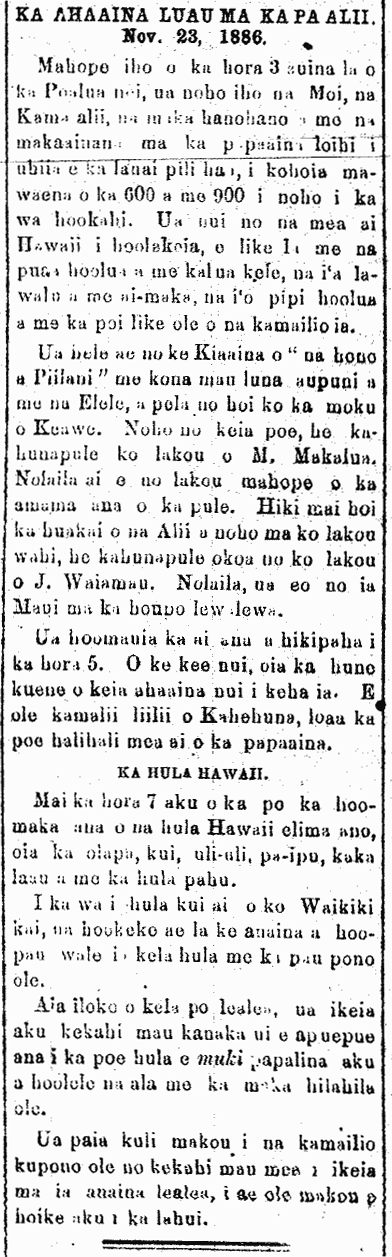
THE LUAU FEAST AT THE PALACE GROUNDS.

Nov. 23, 1886.

After 3 o’clock in the afternoon of this Tuesday, the King, the Princes and Princesses, the dignitaries, and the makaainana sat at a long table housed by a pavilion with corrugated iron roofing [lanai pili hao], which could sit an estimated 600 to 900 people at a time. There was much Hawaiian foods supplied, like laulau [puaa hoolua] and roasted pork [puaa kalua kele]; fish wrapped in ti leaves and baked [lawalu] and raw [ai-maka]; baked beef [i’o pipi hoolua] and all types of poi spoken of.

The Governor of the “bays of Piilani”¹ as well as his government officials and Delegates, along with those of the island of Keawe.² These people sat along with their pastor, M. Makalua. They began eating after the prayer was over. The entourage of the King and Queen arrived and sat in their area, and they had their own pastor, J. Waiamau. Therefore, Maui was victorious over their hunger [?? Nolaila, ua eo no ia Maui ma ka houpo lewalewa].

The eating continued perhaps until 5 o’clock. A big problem was the dearth of waiters for the grand feast that was boasted about. Thanks to the small children of Kahehuna [School], there were those to serve the food for the feast.

HAWAIIAN HULA.

From 7 o’clock in the night, Hawaiian hula of five types commenced, that being olapa, kui, uli-uli, pa-ipu, kaka laau, and hula pahu.

When those of Waikiki kai danced their hula kui, the audience complained, and that hula was put to an end without ending properly.

During that joyful night, some youths were seen attempting to get the dancers to kiss their cheeks, and to [?? hoolele na ala] without any sign of shame.

We were deafened by all the improper talk of some of the things seen in that partying crowd that we will not agree to tell the nation.

¹The governor of Maui was John Owen Dominis.

²The governor of Hawaii was Virginia Kapooloku Poomaikelani

(Ko Hawaii Pae Aina, 11/27/1886, p. 4)

KA AHAAINA LUAU MA KA PA ALII.

Ko Hawaii Pae Aina, Buke IX, Helu 48, Aoao 4. Novemaba 27, 1886.