Congratulations Waikiki Aquarium, 110 years old! 1904 / 2014.

HOME OF THE FISHES IS OPENED

A Place to Learn and Enjoy for the Visitors.

AN EFFORT BY HONOLULU’S WEALTHY FOR THE BENEFIT OF EVERYONE.

On the Saturday of this past week, the Aquarium of Hawaii, which stands in Waikiki, makai of Kapiolani Park opened for viewing. This opening was not an opening for the general public, but it was for just those who were invited to come see. This Sunday is when it will be open to the public.

Earlier, it was reported in the columns of the Kilohana¹ that a home will be built where Hawaii’s fishes will be kept, and in the end, the report has come true as the building was entered by the invited guests and will be entered by Honolulu’s people on Sunday.

Many years ago, there was a thought to build an aquarium in Honolulu nei, and Dr. Dorn was the one to come up with the idea; however, because the Government held back some of the resources, this idea by the doctor was dropped and it slept quietly until it was revived by the Rapid Transit Company [Hui Kaauwila]. This idea was considered seriously by this group, when Mr. James Castle [Kimo Kakela] and Mr. and Mrs. C. M. Cooke stepped in and encouraged the effort.

Mr. James Castle gave a portion of the land of Kapiolani Park, which he held in lease, as a place to build this home. When Mr. C. M. Cooke and his wife joined in this effort, that is when the Rapid Transit Company realized that their dream that they were dreaming would come true, and Mr. and Mrs. C. M. Cooke graciously gave the money for the construction. Therefore, the Rapid Transit Company was left to collect Hawaii’s fishes for the aquarium, and that is how the aquarium here on Oahu came to be.

This is seen in the great lands all over the world, and its importance is recognized. One of the benefits is that knowledge is gained by those studying the life of fish, and this is taught at universities. And some thousands of people graduate, being educated in where various ocean fishes live, like whales, sharks, the fishes of the ocean floor, and outside of those, the small fishes of the sea shore.

At the aquarium of Hawaii mentioned above are the many fishes of Hawaii; the ocean fishes are separated from the fresh-water fishes, and according to the visitors who went to see this new place and who have seen the displays of the Foreign Lands, …

¹From the subtitle of the Kuokoa Newspaper: “Ke Kilohana Pookela no ka Lahui Hawaii” [The Greatest Prize of the Hawaiian Nation]

[Go check out the Waikiki Aquarium today, Saturday, 3/22/2014! The 110th anniversary celebration continues with fun for the entire family! $1.10 admission to the Waikiki Aquarium all day! Activities include: the Great Marine Chalk Art Draw and Kids Doodle Zone, entertainment by the UH Rainbow Marching Band, Rainbow Dancers, and other guests groups, a special performance of the musical “Honu by the Sea,” free giveaways (while supplies last), LEGO build area, samples from Pepsi, educational and entertaining activities and much more!]

(Kuokoa, 3/25/1904, p. 1) Continue reading
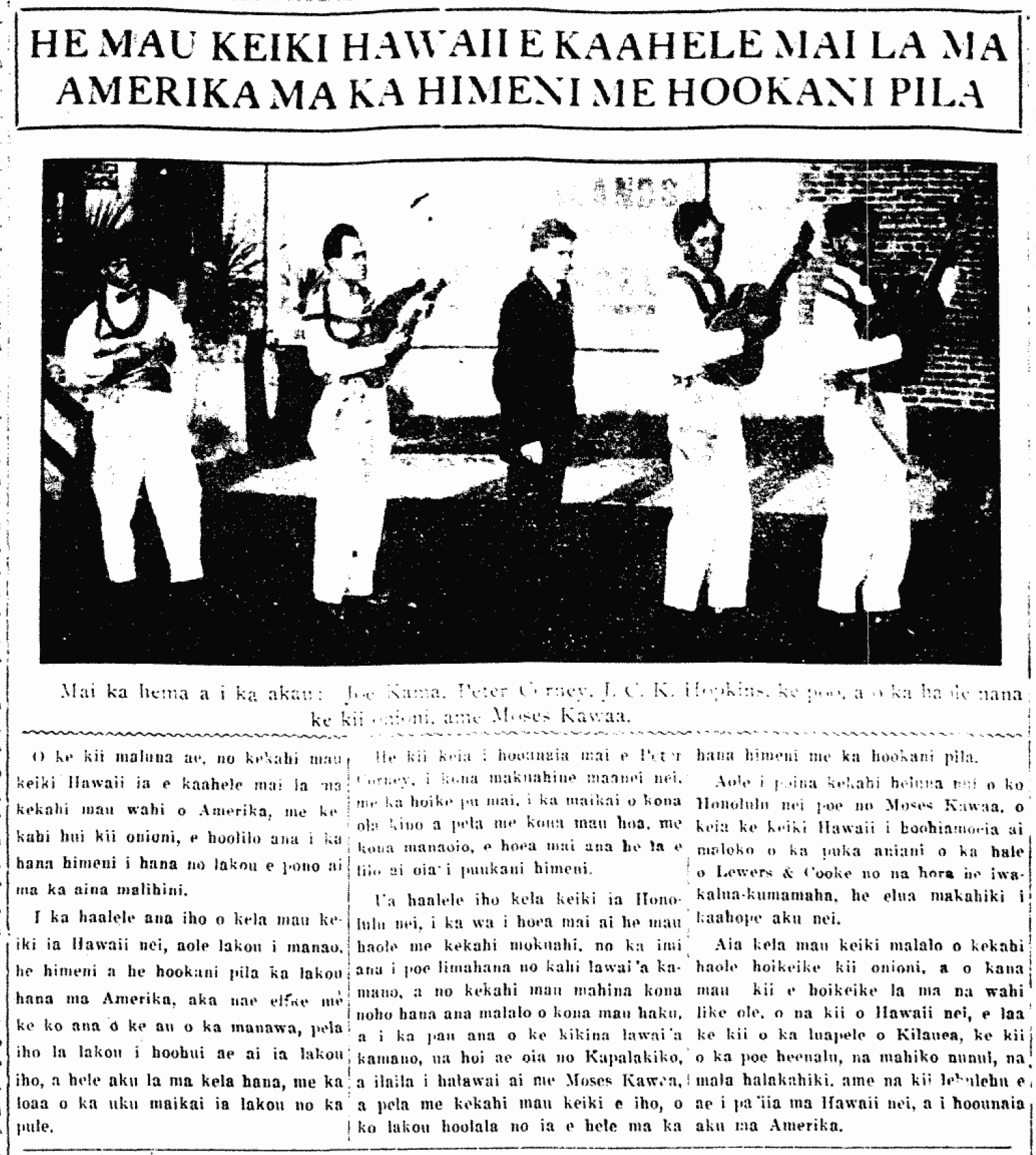
J. C. K. Hopkins and his band travelling around America, 1914.

SOME HAWAIIAN BOYS TRAVELLING AMERICA SINGING AND PLAYING MUSIC

From the left to right: Joe Kama; Peter Corney; J. C. K. Hopkins, the leader; the haole to whom belongs the movies; and Moses Kawaa.

The picture above is of some Hawaiian boys travelling around some places in America, along with a movie company, using music to make a living in the unfamiliar lands.

When the Hawaiian boys left Hawaii nei, they did not imagine that they would be singing and playing music in America, but with the passing of time, they found themselves getting together with each other and started this job, getting paid well by the week.

This picture was sent by Peter Corney to his mother here and he also stated that he was in very good health as well as his friends, and that he believes that the day will come when he will become a singer.

This boy left Honolulu nei when some haole came with a steamship in search of workers for a salmon fishing outfit and he spent several months working under his supervisors, and when the salmon fishing season was over, he returned to San Francisco and there he ran into Moses Kawaa and with some other boys, and they planned to go around singing and playing music.

Many here in Honolulu have not forgotten Moses Kawaa, the Hawaiian boy who was made to sleep in the window of the Lewers & Cooke building for twenty-four hours, two years ago.

These boys work under a haole who shows movies, and the movies that he shows all over the place are of scenes of Hawaii, like shots of the crater of Kilauea, shots of surfers, the expansive sugarcane plantations, pineapple fields, and many, many scenes taken in Hawaii nei and sent to America.

(Kuokoa, 3/13/1914, p. 5)

HE MAU KEIKI HAWAII E KAAHELE MAI LA MA AMERIKA MA KA HIMENI ME HOOKANI PILA

Ka Nupepa Kuokoa, Buke LII, Helu 11, Aoao 5. Maraki 13, 1914.

Strange fish in Honomalino, South Kona, 1865.

Fish that Washed Ashore.

On the 26th of December, a very strange fish washed ashore at Honomalino, South Kona, Hawaii, and was found by a little girl. The length of this fish was 18 inches, and the width was 9 inches. When cut square, it looked flat. Some people have said that the name of the fish is Hoana. Its mouth is like that of a humuhumu. Its eyes, and dorsal fin, and gill plate look like that of an Ahi or and Aku, and it was eaten up by Mahoe. Three more of the very same type of fish came up at another place in Hoopuloa. How wonderful is God’s work.

S. W. Papaula.

Napoopoo, Kona, Hawaii, Jan. 30, 1864.

(Kuokoa, 2/2/1865, p. 3)

I-a Pae.

Ka Nupepa Kuokoa, Buke IV, Helu 5, Aoao 3. Feberuari 2, 1865.

More fishes, more prices, 1918.

FISH PRICES SET ONCE AGAIN.

For the benefit of the public, printed below is the chart of the prices of the many fishes being sold, by the orders of the Food Administrator [Lunahooponopono o na Meaai], Child, whether it be at the market or somewhere else; each home is invited to keep this chart, so that they will not be fooled by the fish mongers.

With this establishing by the commission of this price chart of the fishes, it is acceptable to sell fish below the price, being that this is the top price when the fish is scarce; if there is an abundance, the prices will be decreased.

This chart of fish prices was decided through discussion of the Food Administration [komisina o na meaai] along with the people who sell fish and the fishermen; these prices will continue until the coming month of October.

Here below is the new chart of the price of fishes, compared with the old prices.

Old Price New Price
Aalaihi  $      0.12 lb.            0.11 c
Aawa  $           0.12  $            0.11
Aha  $           0.12  $            0.11
Ahi  $           0.14  $            0.14
Aholehole  $           0.15  $            0.14
Aku  $           0.08  $            0.06
Akule  $           0.18  $            0.18
Amaama  $           0.20  $            0.20
Alalauwa  $           0.05  $            0.05
Awa  $           0.17  $            0.16
Awakalamoho  $           0.15  $            0.15
Awaaua  $           0.20  $            0.20
Aweoweo  $           0.12  $            0.12
Hahalalu  $           0.18  $            0.18
Hapuupuu  $           0.16  $            0.15
Hauliuli  $           0.12  $            0.12
Hee  $           0.20  $            0.20
Hihimanu  $           0.14  $            0.08
Hilu  $           0.12  $            0.12
Hinalea  $           0.09  $            0.10
Honu  $           0.05  $            0.05
Humuhumu  $           0.07  $            0.07
Iheihe  $           0.16  $            0.16
Ina  $           0.10  $            0.10
Kahala  $           0.16  $            0.15
Kaku  $           0.17  $            0.17
Kala  $           0.10  $            0.10
Kalikali  $           0.16  $            0.17
Kawakawa  $           0.16  $            0.16
Kawelea  $           0.17  $            0.16
Kihikihi  $           0.05  $            0.05
Kole  $           0.16  $            0.15
Kumu  $           0.23  $            0.23
Kupoupou  $           0.17  $            0.16
Kupipi  $           0.16  $            0.15
Lauhau  $           0.05  $            0.05
Laenihi  $           0.10  $            0.16
Iai  $           0.17  $            0.16
Mahimahi  $           0.15  $            0.14
Maiii  $           0.16  $            0.14
Maiko  $           0.16  $            0.15
Maka-a  $           0.05  $            0.05
Malamalama  $           0.05  $            0.05
Malolo  $           0.16  $            0.15
Mamamo  $           0.16  $            0.15
Manini  $           0.15  $            0.15
Mano  $           0.03  $            0.03
Mikiawa  $           0.08  $            0.08
Moano  $           0.20  $            0.20
Moi  $           0.26  $            0.26
Mu  $           0.15  $            0.15
Naia  $           0.05  $            0.05
Naenae  $           0.05  $            0.05
Nenue  $           0.15  $            0.14
Nohu  $           0.05  $            0.05
Nunu  $           1.00  $            1.00
Oama  $           0.15  $            0.15
Oio  $           0.17  $            0.16
Olali  $           0.05  $            0.05
Omaka  $           0.15  $            0.14
Omilu  $           0.17  $            0.16
Ono  $           0.15  $            0.14
Oopu  $           0.20  $            0.18
Opakapaka  $           0.18  $            0.14
Opelu  $           0.17  $            0.14
Opule  $           0.17  $            0.14
Opelu Palahu  $           0.17  $            0.14
Pakaii  $           0.15  $            0.15
Papai  $           0.07  $            0.07
Palani  $           0.10  $            0.10
Panuhunuhu  $           0.17  $            0.16
Papiopio  $           0.10  $            0.10
Pauu  $           0.10  $            0.10
Poopaa  $           0.10  $            0.10
Pualu  $           0.10  $            0.05
Puhi  $           0.06  $            0.15
Puhikii  $           0.15  $            0.15
Uhu  $           0.17  $            0.16
Uku  $           0.16  $            0.15
Ulae  $           0.10  $            0.09
Ulaula  $           0.19  $            0.19
Ulua  $           0.17  $            0.16
Ula  $           0.20  $            0.20
Upapalu  $           0.16  $            0.18
Uu  $           0.23  $            0.23
Walu  $           0.25  $            0.20
Wana  $           0.10  $            0.10
Weke  $           0.10  $            0.10
Ehu  $           0.19  $            0.18
Lehi  $           0.18  $            0.17
Kamano  $           0.18  $            0.17
A-u  $           0.15  $            0.15

(Kuokoa, 5/3/1918, p. 2)

KAU HOU IA KE KUMUKUAI O NA I'A.

Ka Nupepa Kuokoa, Buke LVI, Helu 18, Aoao 2. Mei 3, 1918.

Fish prices, 1918.

NEW PRICES SET FOR FISH UNTIL APRIL 30

Here following is the new prices for fish set by the food commission upon the various fishes; and this will be the only prices announced on fishes big to small, until April 30th when it will end.

 Per Lb.
Aalaihi  $           0.12
Aawa  $           0.12
Aha  $           0.12
Ahi  $           0.14
Aholehole  $           0.15
Aku  $           0.08
Akule  $           0.15
Amaama  $           0.20
Alalauwa  $           0.05
Awa  $           0.17
Awakulamoho  $           0.15
Awaaua  $           0.20
Aweoweo  $           0.12
Hahalalu  $           0.20
Hapuupuu  $           0.16
Hauliuli  $           0.12
Hee (squid)  $           0.20
Hihimanu  $           0.14
Hilu  $           0.12
Hinalea  $           0.10
Honu (turtle)  $           0.05
Humuhumu  $           0.07
Iheihe  $           0.16
Kahala  $           0.16
Kaku ?  $           0.17
Kala  $           0.10
Kalikali [?]  $           0.16
Kawakawa  $           0.16
Kawelea  $           0.17
Kihiihi  $           0.05
Kole  $           0.16
Kumu  $           0.23
Kupoupou  $           0.17
Kupipi  $           0.16
Lauhau  $           0.05
Laenihi  $           0.10
Lai  $           0.17
Mahimahi  $           0.15
Maiii  $           0.16
Maiko  $           0.16
Maka-a  $           0.05
Malamalama  $           0.05
Malolo (flying fish)  $           0.16
Mamami  $           0.16
Manini  $           0.16
Mano (shark)  $           0.03
Mikiawa  $           0.10
Moano  $           0.25
Moi  $           0.26
Mu  $           0.15
Muhee  $           1.50
Naia  $           0.05
Naenae  $           0.05
Nenue  $           0.15
Nohu  $           0.05
Nunu  $           1.00
Oama  $           0.15
Oio  $           0.17
Olali  $           0.05
Omaka  $           0.15
Omilu  $           0.17
Ono  $           0.15
Oopu  $           0.20
Opakapaka  $           0.18
Opelu  $           0.17
Opule  $           0.17
Opelu Palahu  $           0.17
Pakii  $           0.15
Papai  $           0.07
Palani  $           0.10
Panuhunuhu  $           0.17
Papiopio  $           0.10
Pauu  $           0.10
Poopaa  $           0.10
Pualu  $           0.10
Puhi  $           0.15
Puhikii  $           0.15
Uhu  $           0.17
Uku  $           0.16
Ulae  $           0.10
Ulaula  $           0.19

[This list is very interesting for many reasons! Just seeing what fishes are listed is informative.]

(Aloha Aina, 3/1/1918, p. 1)

KAU IA KE KUMUKUAI HOU O KA I'A A HIKI I APERILA 30

Ke Aloha Aina, Buke XXIII, Helu 9, Aoao 1. Maraki 1, 1918.

Mild hula ku’i and California Midwinter International Exposition, 1894.

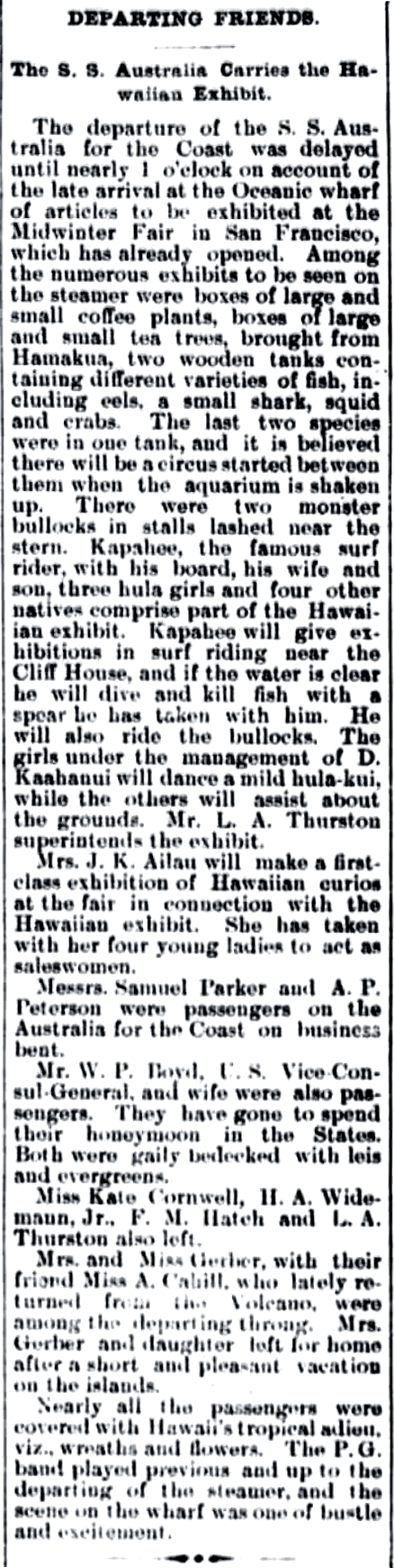
DEPARTING FRIENDS.

The S. S. Australia Carries the Hawaiian Exhibit.

The departure of the S. S. Australia for the Coast was delayed until nearly 1 o’clock on account of the late arrival at the Oceanic wharf of articles to be exhibited at the Midwinter Fair in San Francisco, which has already opened. Among the numerous exhibits to be seen on the steamer were boxes of large and small coffee plants, boxes of large and small tea trees, brought from Hamakua, two wooden tanks containing different varieties of fish, including eels, a small shark, squid and crabs. The last two species were in one tank, and it is believed there will be a circus started between them when the aquarium is shaken up. There were two monster bullocks in stalls lashed near the stern. Kapahee, the famous surf rider, with his board, his wife and son, three hula girls and four other natives comprise part of the Hawaiian exhibit. Kapahee will give exhibitions in surf riding near the Cliff House, and if the water is clear he will dive and kill fish with a spear he has taken with him. He will also ride the bullocks. The girls under the management of D. Kaahanui will dance a mild hula-kui, while the others will assist about the grounds. Mr. L. A. Thurston superintends the exhibit.

Mrs. J. K. Ailau will make a first-class exhibition of Hawaiian curios at the fair in connection with the Hawaiian exhibit. She has taken with her four young ladies to act as saleswomen.

Messrs. Samuel Parker and A. P. Peterson were passengers on the Australia for the Coast on business bent.

Mr. W. P. Boyd, U. S. Vice-Consul-General, and wife were also passengers. They have gone to spend their honeymoon in the States. Both were gaily bedecked with leis and evergreens.

Miss Kate Cornwell, H. A. Widemann, Jr., F. M. Hatch and L. A. Thurston also left.

Mrs. and Miss Gerber, with their friend Miss A. Cahill, who lately returned from the Volcano, were among the departing throng. Mrs. Gerber and daughter left for home after a short and pleasant vacation on the islands.

Nearly all the passengers were covered with Hawaii’s tropical adieu, viz., wreaths and flowers. The P. G. band played previous and up to the departing of the steamer, and the scene on the wharf was one of bustle and excitement.

(Daily Bulletin, 1/6/1894, p. 2)

DEPARTING FRIENDS.

The Daily Bulletin, Volume VII, Number 924, Page 2. January 6, 1894.

Pearls found in Heeia, 1918.

PEARLS FOUND IN OYSTERS.

According to the Japanese newspaper, Hawaii Shinpo, down in Heeia, Koolau, from six oysters [papaua] got by a Japanese who was diving in the ocean a few days ago, he found two pearls [pohaku momi].

From what was said, this is a Japanese used to diving in search of pearls, and the place he is accustomed to diving is the Seas of the South, where he spent a lot of his time searching for pearls in oysters.

When he dove at Heeia, it was not much work searching for papaua, and he found six easily; checking inside of them, two had pearls inside, and the other four did not.

In the South Seas, according to that Japanese, it is very rare to find an pearl in an oyster; from a hundred papaua, you will only find two pearls.

However he believes that the papaua here are different from the ones of the South Seas; and he is certain that if the diving for papaua continues here, a lot of pearls will be found, and this endeavor will benefit a number of people.

(Kuokoa, 2/8/1918, p. 8)

LOAA KA MOMI ILOKO O KA PAPAUA.

Ka Nupepa Kuokoa, Buke LVI, Helu 6, Aoao 8. Feberuari 8, 1918.

Beginning of line-by-line commentary of “Aia i Honolulu kuu pohaku,” 1929.

EXPLANATION OF THE FIRST LINE.

1. Aia i Honolulu kuu pohaku

Kapanookalani’s thoughts:—This land Honolulu, it is close to Nanawale, Puna, by the sea. It is a ku, a small land in between large lands.

The stone [pohaku] is Lord [Haku] of the chiefess and in this word, the important idea is chiefess [‘lii wahine].

Kahapula’s thoughts:—Honolulu is on Oahu, where King Kamehameha V dwelt and those who opposed him is the Honolulu in this first line of the mele. It was here his enemies schemed and carried out all their defiant acts against him. While they knew the wish of the King to marry the chiefess Pauahi, her teacher, Amos Cooke secretly agreed to  Bishop for him to meet with Pauahi without the knowledge of her parents. That is how Pauahi became Bishop’s, and this is how Bishop and his relative Lee [? William Little Lee] became dignitaries of the land.

Kupihea’s thoughts:—Honolulu is a fish stone called a Kuula, and was brought here to this Honolulu [on Oahu] from the Honolulu of Puna [on Hawaii]. This Kuula was placed in the tiny land of Honolulu where an Alii called Honolulu lived, who was related to the chiefess Peleula, whose younger sister was the beautiful Waikiki. This place is mauka of the old Rawlin’s Estate. There is a bank of coral where Honolulu is; the fishing altar [Kuula] for the fish ponds [loko i’a] is on the Waikiki side of Liliha Street and between Vineyard and King Streets.

The stone is related to chiefs from times immemorial [mai ka po mai]. It is a manifestation made by God.

Iokepa’s thoughts:—Honolulu is a small land and a canoe landing makai of Nanawale, Puna, between two sand dunes, one on the Hilo side and one on the Puna side, called Puu Waawaa. From this Honolulu is called the Honolulu here [on Oahu] which used to be called Kou before, and after it was called Honolulu until this day.

This is the meaning for the word Honolulu:—The wind is very calm [lulu] an the sea is serene; it is very fine and peaceful. Bay [? Hono] of calm sea; Hono that is peaceful.

Kuluwaimaka’s thoughts:—The stone is related to Kamehameha V. Honolulu in Puna is a lowland next to the sea. Its width is perhaps half a mile long between Na Puu o Pele and Waiakahiula on the Hilo side. Honolulu is a place where you pick opihi [ku’i opihi] and pick limu [hana limu]. There is a fine spring [punawai] there and there is a foot path there.

[And to think that this is but the very beginning of Kelsey’s detailed account of the explanation of the six loea of the mele “Aia i Honolulu kuu pohaku.” This is just the first line! It continues in the following issues!!

One more (huge) reason that Hawaiian-Language Newspapers are priceless!!!]

(Alakai o Hawaii, 12/5/1929, p. 2)

NA MANAO WEHEWEHE MALUNA O KA LAINA EKAHI.

Ke Alakai o Hawaii, Buke 1, Helu 32, Aoao 2. Dekemapa 5, 1929.

A “fishing” accident, 1913.

MAIMED FROM AN EXPLOSION OF GIANT POWDER

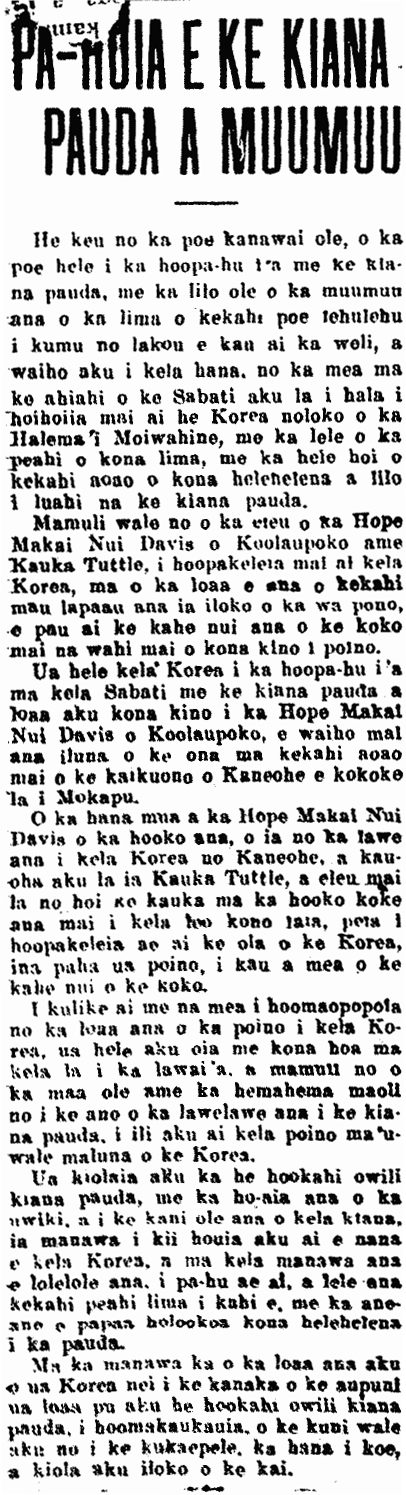
How reckless are the lawless, those who fish by setting off giant powder [kiana pauda] without fear resulting from the many people whose hands were maimed and without stopping this activity; because this past Sunday, a Korean was brought to the Queen’s Hospital with his hand blown off and a side of his face falling victim to the giant powder.

It was only because of the quick action taken by Deputy Sheriff [Hope Makai Nui] Davis of Koolaupoko and Dr. Tuttle that that Korean was saved by stopping the heavy bleeding from his injuries earlier in proper time.

That Korean went that Sunday to blast fish with giant power and his body was found by Deputy Sheriff Davis of Koolaupoko, he was lying on the sand on the side of Kaneohe Bay near Mokapu.

The first thing Deputy Sheriff Davis did was to bring that Korean to Kaneohe, and called for Dr. Tuttle; he hurried in answering to the call, and that is how the Korean’s life was spared; he was would have been in trouble because of the tremendous amount of bleeding.

According to what is understood about how that Korean received his injuries: he went with a friend that day to fish, and because he was not accustomed to and very inept at handling giant powder, that is how this senseless tragedy befell him.

A twist of giant powder was thrown after lighting the fuse, and because it did not go off, that Korean went to grab it and check it out, and while he was handling it, it exploded, and his had flew off, and almost his whole face was burnt by the powder.

When the government man found the Korean, found also was a twist of giant powder ready to ignite and throw into the ocean.

[Notice how the dash in the first word of the title, “pa-huia” signifies that the syllable after the dash is lengthened, and also how the passive “ia” is as usual, not set off—today therefore it would be written “pahū ʻia”

(Kuokoa, 3/21/1913, p. 1)

PA-HUIA E KE KIANA PAUDA A MUUMUU

Ka Nupepa Kuokoa, Buke VL, Helu 12, Aoao 1. Maraki 21, 1913.

The latest from Hana, Maui, 1877.

News from Hana.

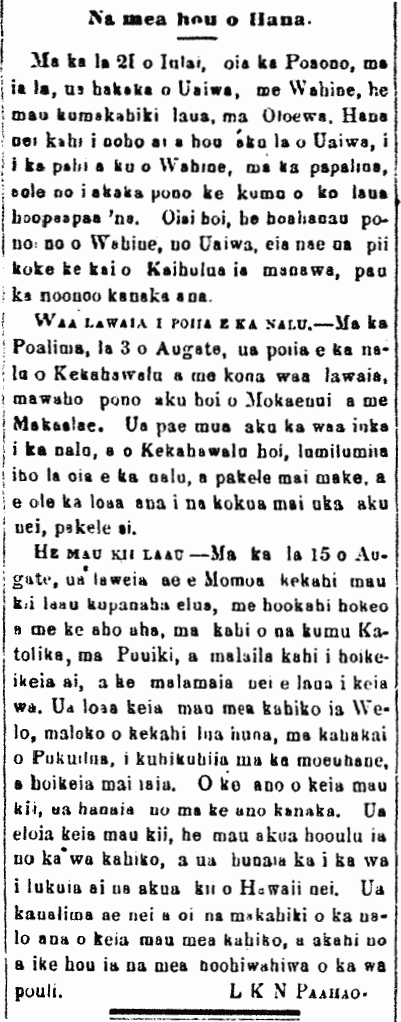
On the 21st of July, that being Saturday, on that day, Uaiwa fought with Wahine, both of them being contract laborers; they live at Oloewa, Hana, and Uaiwa stabbed Wahine with a knife in the cheek, and the reason for their quarrel is not known. Wahine is an actual cousin of Uaiwa, and here yet his temper soon flared up [pii koke ke kai o Kaihulua] and he lost his senses.

A fishing canoe pounded by a wave.—On Friday, the 3rd of August, Kekahawalu and his fishing canoe was hit by a wave right outside of Mokaenui and Makaalae. The canoe came ashore first carried by the waves, and as for Kekahawalu, he was pounded by the waves and escaped nearly dying; without receiving help from those on shore he would not have escaped.

Some wooden idols [kii laau].—On the 15th of August, brought by Momoa were a couple of amazing wooden images, along with one gourd calabash [hokeo] and some cordage [aho aha], to the Catholic teachers in Puuiki; there it was displayed, and the two of them are caring for them until this day. These old things were found by Welo in a hidden cave, seaside of Pukuilua, which was revealed to him in a dream, and was shown to him. The kii are made in the shape of people. It is said that these kii were procreative gods of the olden days, and were hidden away during the time that the god images of Hawaii nei were being destroyed. These old things have been hidden for fifty or more years, and it is the first time these revered things of the dark ages are being seen again.  L. K. N. Paahao.

(Kuokoa, 9/15/1877, p. 3)

Na mea hou o Hana.

Ka Nupepa Kuokoa, Buke XVI, Helu 37, Aoao 3. Sepatemaba 15, 1877.