Mahalo to Elinor Langer for her comment on trial of participants of the January 6, 1895 Counter Revolution. 1895.

Elinor Langer says:

And it was on January 17, 1895, the second anniversary, that the Republic opened the trials of the people arrested for “treason” in the revolt. Has anyone seen accounts in the Hawaiian papers about what happened on January 24, the day the Queen signed her forced abdication statement? According to “The Friend” (February 1, 1895) “On the 24th, while engaged in the trial of a company of natives, the Court was startled by the fall upon the table around which they sat of a massive bar of plaster from the lofty ceiling [of the Throne Room, where the trials were taking place.] The bar was nine feet long, forming part of a decorative panel. It fell upon the center of the table, precisely fitting the length of it. Col. Whiting had a narrow escape, his face being grazed, although protected by his military hat. The plaster had been loosened by a sharp shake of earthquake the night before.” The Queen signed the statement at 11 a.m. in the rooms directly above –perhaps even at the same time?

[See the original article, “The Story of the Insurrection” in The Friend, Volume 53, Number 2, Pages 9–11. February 1895.

Comment to Writing on the wall, 1894.]
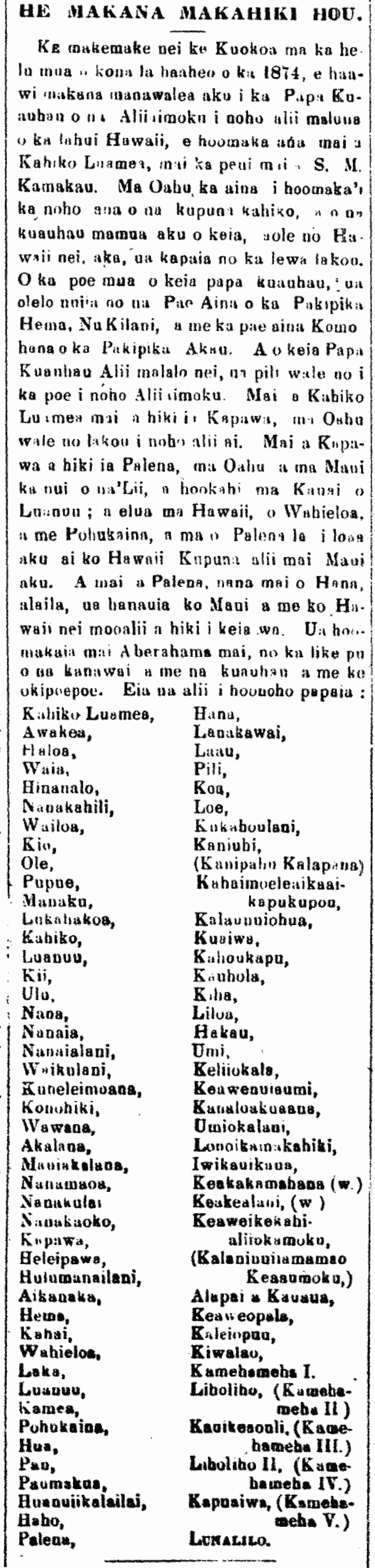
A New Year’s Gift: a Genealogy of Rulers, 1874.

A NEW YEAR’S GIFT.

The Kuokoa, on this first issue of its proud days of 1874, wants to gift this Genealogical List of the Rulers over the Hawaian people, starting from Kahiko Luamea, from the pen of S. M. Kamakau. It was upon Oahu that the ancient ones first lived, and the genealogy from before this is not from here in Hawaii, but it is said that they were from the sky [lewa]. The first people in this genealogy, it is widely stated that they are from the Islands of the South Pacific, New Zealand, and the islands to the Western North Pacific. And the listing of Alii Genealogy below just pertains to those who were Aliiaimoku. From Kahiko Luamea to Kapawa, they just ruled on Oahu. From Kapawa to Palena, most of the Alii were on Oahu and Maui; one was from Kauai, Luanuu; and two on Hawaii, Wahieloa and Pohukaina; and from Palena is where Hawaii’s royal Ancestry from Maui come from. And from Palena was born Hana, thereafter Maui’s and Hawaii’s chiefly line have been born until this time. It began from Abraham, being that the laws were the same, the genealogy was the same, and the circumcision was the same. Here are the alii listed out:

Kahiko Luamea,
Awakea [Wakea],
Haloa,
Waia,
Hinanalo,
Nanakahili,
Wailoa,
Kio,
Ole,
Pupue,
Manaku,
Lukahakoa,
Kahiko,
Luanuu,
Kii,
Ulu,
Nana,
Nanaia,
Nanaialani,
Waikulani,
Kuheleimoana,
Konohiki,
Wawana,
Akalana,
Mauiakalana,
Nanamaoa,
Nanakulai,
Nanakaoko,
Kapawa,
Heleipawa,
Hulumanailani,
Aikanaka,
Hema,
Kahai,
Wahieloa,
Laka,
Luanuu,
Kamea,
Pohukaina,
Hua,
Pau,
Paumakua,
Huanuiikalailai,
Haho,
Palena,
Hana,
Lanakawai,
Laau,
Pili,
Koa,
Loe,
Kukahoulani,
Kaniuhu,
(Kanipahu Kalapana)
Kahaimoeleaikaaikapukupou,
Kalaunuiohua,
Kuaiwa,
Kahoukapu,
Kauhola,
Kiha,
Liloa,
Hakau,
Umi,
Keliiokala,
Keawenuiaumi,
Kanaloakuaana,
Umiokalani,
Lonoikamakahiki,
Iwikauikaua,
Keakakamahana (w [wahine])
Keakealani (w),
Keaweikekahialiiokamoku,
(Kalaninuiiamamao Keeaumoku),
Alapai a Kauaua,
Keaweopala,
Kaleiopuu,
Kiwalao,
Kamehameha I.
Liholiho (Kamehameha II),
Kauikeaouli (Kamehameha III),
Liholiho II (Kamehameha IV),
Kapuaiwa (Kamehameha V),
Lunalilo.

[This seems to be a little different from what is seen in the appendix of Kamakau’s “Ruling Chiefs of Hawaii”.]

(Kuokoa, 1/3/1874, p. 2)

HE MAKANA MAKAHIKI HOU.

Ka Nupepa Kuokoa, Buke XIII, Helu 1, Aoao 2. Ianuari 3, 1874.

Writing on the wall, 1894.

The Day of Happiness is a Day of Sadness.

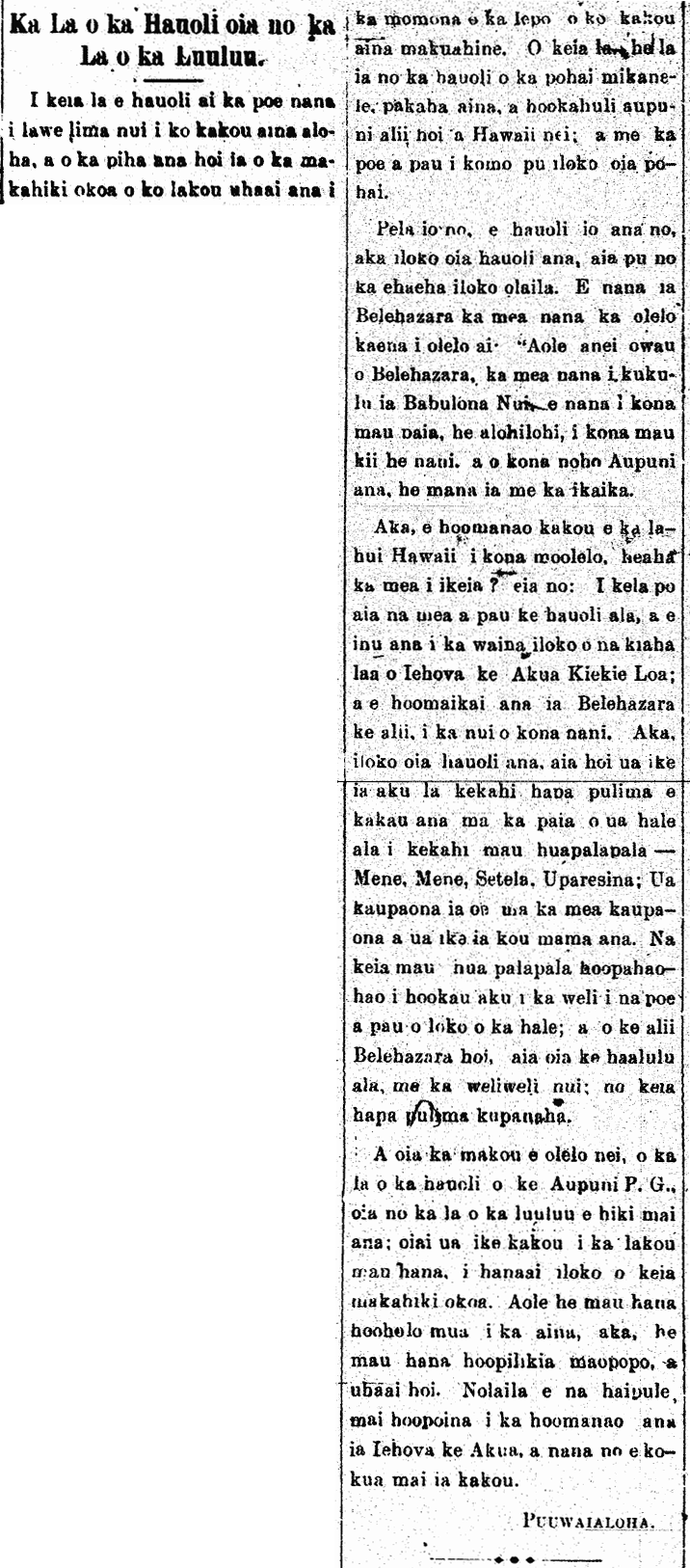
On this day, those who took our beloved land by force rejoice, and it makes a full years since they’ve feasted wastefully of the fertile soil of our mother land. This day is one of happiness for the circle of missionaries, plunderers of land, and overthrowers of the Hawaiian Kingdom, as well as for those who enter join their circle.

It is true, they will indeed rejoice; however, along with this joy, there is hurt within. Look at Belshazzar [Belehazara] the one whose boast went, “Am I not Belshazzar, the builder of the Great Babylon? Look at its shiny walls, its beautiful images, and its Throne has authority and might.”

However, let us recall, O Hawaiian Lahui, his story; what is known? it is this: That night, everyone was joyous, and drinking wine from cups sacred to Jehovah, Almighty God; and they praised Belshazzar for his great beauty. However, while the rejoicing was going on, there was seen part of a hand writing some words on the wall of the house—Mene, Mene, Setela, Uparesina; You have been weighed on the scales and have been found wanting. It was these astonishing words which caused a fear to fall over everyone in the house; and as for the king Beshazzar, he was shaking with trepidation at this amazing portion of a hand.

And that is what we are saying: the day of joy of the Government of the P. G. [Provisional Government], is the day that sadness will come; for we have seen their actions done over the past year. They were not actions done to move this land forward, but actions that were clearly harmful as well as squandering. Therefore O Pious Ones, do not forget to remember Jehovah, God, and he shall help us.

Puuwaialoha [“Loving-heart”]

(Leo o ka Lahui, 1/17/1894, p. 2)

Ka La o ka Hauoli oia no ka La o ka Luuluu.

Ka Leo o ka Lahui, Buke II, Helu 856, Aoao 2. Ianuari 17, 1894.

More on the Boston, in English, 1893.

The U. S. S. Boston Lands Sailors and Marines.

(From Daily, January 17.)

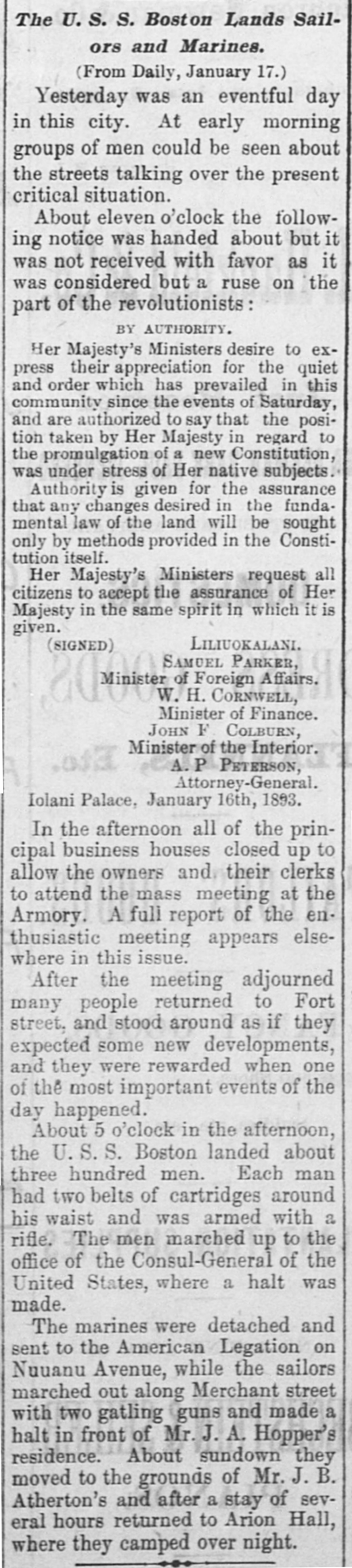
Yesterday was an eventful day in this city. At early morning groups of men could be seen about the streets talking over the present critical situation.

About eleven o’clock the following notice was handed about but it was not received with favor as it was considered but a ruse on the part of the revolutionists:

BY AUTHORITY.

Her Majesty’s Ministers desire to express their appreciation for the quiet and order which has prevailed in this community since the events of Saturday, and are authorized to say that the position taken by Her Majesty in regard to the promulgation of a new Constitution, was under stress of Her native subjects.

Authority is given for the assurance that any changes desired in the fundamental law of the land will be sought only by methods provided in the Constitution itself.

Her Majesty’s Ministers request all citizens to accept the assurances of Her Majesty in the same spirit in which it is given.

(SIGNED) Liliuokalani.

Samuel Parker,
Minister of Foreign Affairs.

W. H. Cornwell,
Minister of Finance.

John F. Colburn,
Minister of the Interior.

A. P. Peterson,
Attorney-General.

Iolani Palace, January 16, 1893.

In the afternoon all of the principal business houses closed up to allow the owners and their clerks to attend the mass meeting at the Armory. A full report of the enthusiastic meeting appears elsewhere in this issue.

After the meeting adjourned many people returned to Fort street, and stood around as if they expected some new developments, and they were rewarded when one of the most important events of the day happened.

About 5 o’clock in the afternoon, the U. S. S. Boston landed about three hundred men. Each man had two belts of cartridges around his waist and was armed with a rifle. The men marched up to the office of the Consul-General of the United States, where a halt was made.

The marines were detached and sent to the American Legation on Nuuanu Avenue, while the sailors marched out along Merchant street with two gatling guns and made a halt in front of Mr. J. A. Hopper’s residence. About sundown they moved to the grounds of Mr. J. B. Atherton’s and after a stay of several hours returned to Arion Hall, where they camped over night.

[The “Daily” here mention at the top refers to the Daily Pacific Commercial Advertiser.]

(Hawaiian Gazette, 1/24/1893, p. 6)

The U. S. S. Boston Lands Sailors and Marines.

Hawaiian Gazette, Volume XXVIII, Number 4, Page 6. January 24, 1893.

More on the Boston, in English, 1893.

Of What Are They Afraid?

Editor Bulletin:—

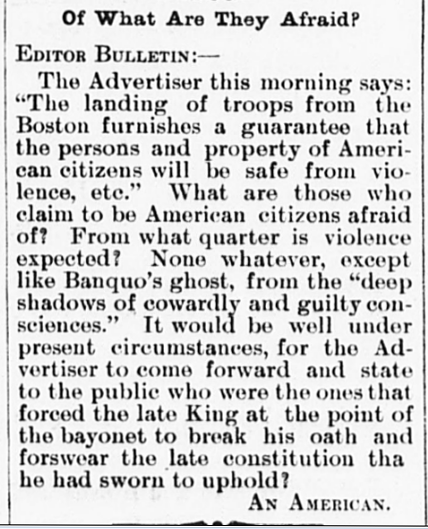
The Advertiser this morning says: “The landing of troops from the Boston furnishes a guarantee that the persons and property of American citizens will be safe from violence, etc.” What are those who claim to be American citizens afraid of? From what quarter is violence expected? None whatever, except like Banquo’s ghost, from the “deep shadows of cowardly and guilty consciences.” It would be well under present circumstances, for the Advertiser to come forward and state to the public who were the ones that forced the late King at the point of the bayonet to break his oath and forswear the late constitution tha he had sworn to uphold?

An American.

(Daily Bulletin, 1/17/1893, p. 3)

Of What Are They Afraid?

The Daily Bulletin, Volume 5, Number 626, Page 3. January 17, 1893.

More on the landing of the Boston, 1893.

OPPOSED.

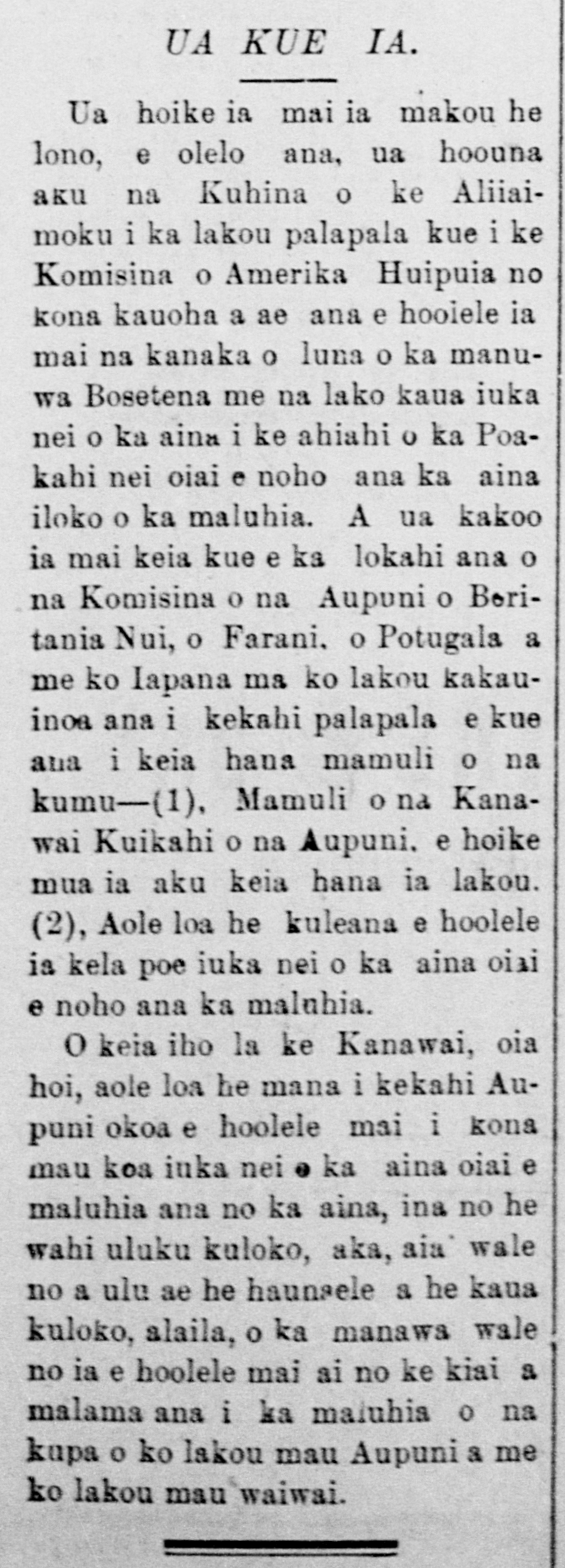
We have received news that the Ministers of the Queen sent their written protest to the Minister of the United States for his ordering the landing of the armed men from the man-of-war Boston on the evening of this Monday notwithstanding that there was peace on land. And this objection was jointly supported by the Commissioners of the Nations of Great Britain, France, Portugal, and Japan, by them signing a document opposing this action over these reasons—(1), Because of the agreement under law between the Nations to give prior notice. (2),  There was no cause to land the troops being that there was peace.

This is the Law, that being there is no other Nation that has any right to land its troops while there is peace; were there internal problems, but only if there was an uprising or a civil war, only then could there be troops landed to watch over and protect the safety of their citizens as well as their property.

(Hawaii Holomua, 1/18/1893, p. 3)

UA KUE IA.

Hawaii Holomua, Buke III, Helu 141, Aoao 3. Ianuari 18, 1893.

More on the Boston, 1893.

[Excerpt from the article: “OVERTHROW IN HAWAII NEI: The Queen Attempts to Push a New Constitution”]

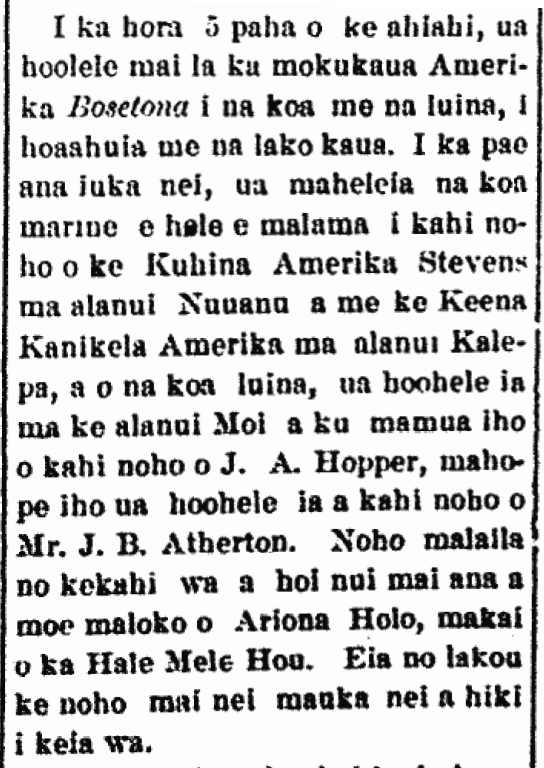
At perhaps 5 oʻclock in the afternoon, the American warship Boston [Bosetona] landed its officers and sailors who were armed. When they came ashore, the marines were split up to go and guard the residence of the American Minister Stevens on Nuuanu Avenue, and the American Consulate on Merchant Street, and the sailors were sent to King Street and stood before the residence of J. A. Hopper, and later they were sent to the residence of Mr. J. B. Atherton. They stayed there for some time, and then all came back and slept in Arion Hall [Ariona Holo] makai of the Opera House. They are still on shore to the present.

(Kuokoa, 1/21/1893, p. 2)

I ka hora 5 paha o ke ahiahi...

Ka Nupepa Kuokoa, Buke XXXII, Helu 3, Aoao 2. Ianuari 21, 1893.

Competing rallies, 1893.

O HAWAIIAN LAHUI!

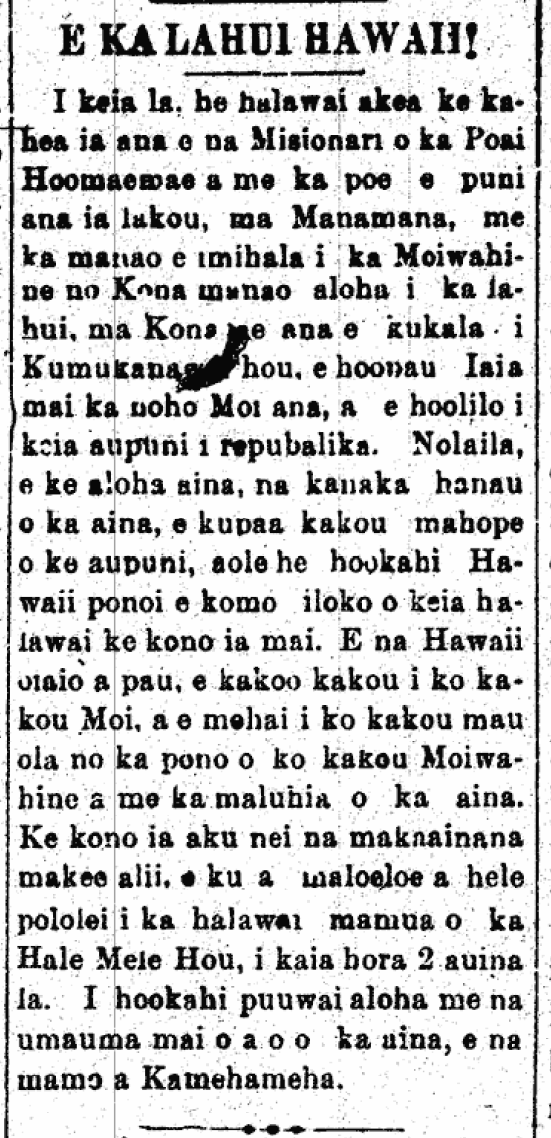
Today, there is a rally being called by the Missionaries of the Reformist Party [Poai Hoomaemae] and those who favor them, at Manamana, with the intent to bring harm to the Queen for Her aloha she has for the lahui, in Her proclaiming a new Constitution; by ending Her reign and making this nation a republic. Therefore, patriots, those born of this land, stand strong behind this nation; there shall not be a single true Hawaiian who will participate in this gathering, should they be invited. All of you true Hawaiians, let us stand behind our Sovereign and give our lives for the rights of our Queen and peace over the land. Those citizens who love their alii are called to join together to march straight to the rally fronting the Opera House [Hale Mele Hou] at 2 o’clock in the afternoon. With one heart of aloha and breasts side by side all across the land, you descendants of Kamehameha.

(Leo o ka Lahui, 1/16/1893, p. 2)

E KA LAHUI HAWAII!

Ka Leo o ka Lahui, Buke II, Helu 623, Aoao 2. Ianuari 16, 1893.

A haole kamaaina’s advice on teaching English instead of Hawaiian, 1872.

Pertaining to the English Language.

O Kuokoa Newspaper: Aloha oe:—

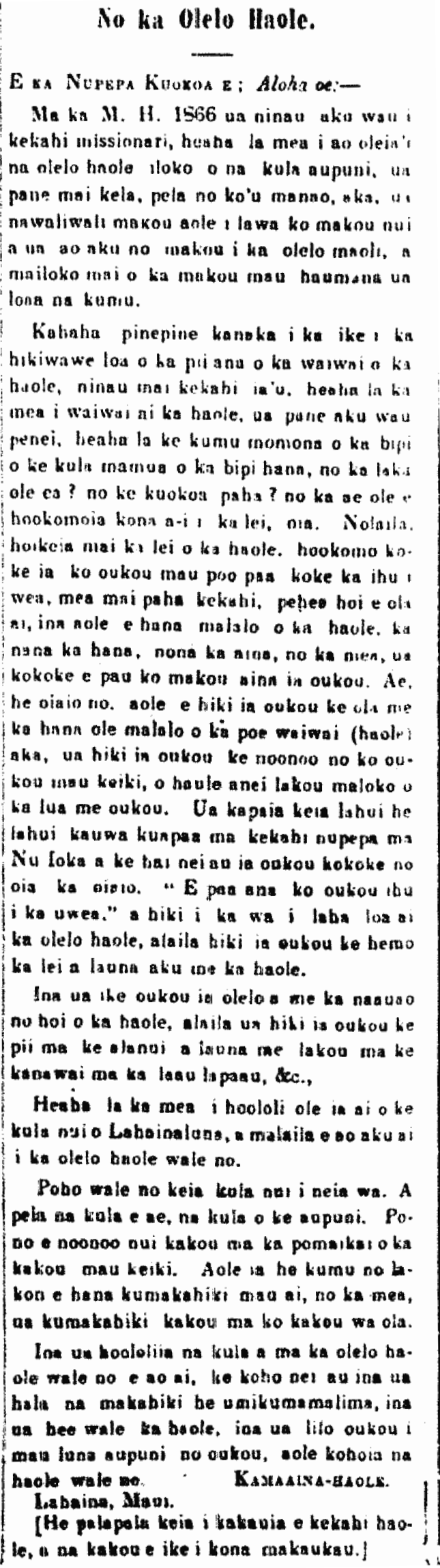
In the year 1866, I asked a missionary, “What is the reason English isn’t being taught in the government schools,” and he replied, “That is what I think as well, but we are weak, there are not enough of us, and we teach Hawaiian, and from amongst our students we find teachers.”

The Hawaiians are often astounded at seeing how quickly the haole gains wealth, and one asked me, “How does the haole get rich?” I answered this way, “Why is the cow in the fields fatter than the cow that works, isn’t it because it isn’t tamed? or because it is independent? or because it refuses to have it’s neck put in a yoke? That’s it. So when shown the yoke of the haole, your necks are put within it and your noses are soon wired; some may say, ‘How are we to live if we don’t work under the haole; they have the work, to them belongs the land, because soon our land will all be taken by you.’ It is true, you cannot survive without working for the rich (haole), but you can think about your children, lest they fall into the abyss with you. This race was called a race of slaves in a newspaper in New York, and I say to you that this will soon be true. ‘Your noses will be put through with a wire.’ until the day when the English language spreads amongst you, then you’ll will be able to remove your yokes and associate with the haole.

If you all understand the language and the knowledge of the haole, then you’d be able to climb the path and meet up with them in law, medicine, &c.

What is the reason that the college of Lahainaluna is not changed, having only English taught there?

This college is currently a waste. And so too the other schools, the government schools. We must all think carefully about the good of our children. That is no reason for them to forever more work under yearly contracts, for we’ve worked under yearly contracts during out lifetimes.

If the schools were changed so that just English was taught, I predict that after fifteen years, and if the haole leave, then you’d become your own leaders in the government, and not only haole would be appointed.

Kamaaina haole.

Lahaina, Maui.

{This is a letter written by a haole, and it is for us to determine his competence.}

[The argument over what language should be taught in schools is a heated topic that can be seen throughout the life of the Hawaiian-Language Newspapers. At first the argument is whether or not to teach English, and in later years when more and more schools are taught in English, the argument for teaching Hawaiian in schools will become prominent. Most everyone it seems were concerned with the future of the children (whether they were for English or Hawaiian-language education).]

(Kuokoa, 10/26/1872, p. 2)

No ka Olelo Haole.

Ka Nupepa Kuokoa, Buke XI, Helu 43, Aoao 2. Okatoba 26,1872.

People suspected of having leprosy held in jail, 1872.

The leprosy patients taken to Kalawao!

O Kuokoa Newspaper: Aloha kaua:—

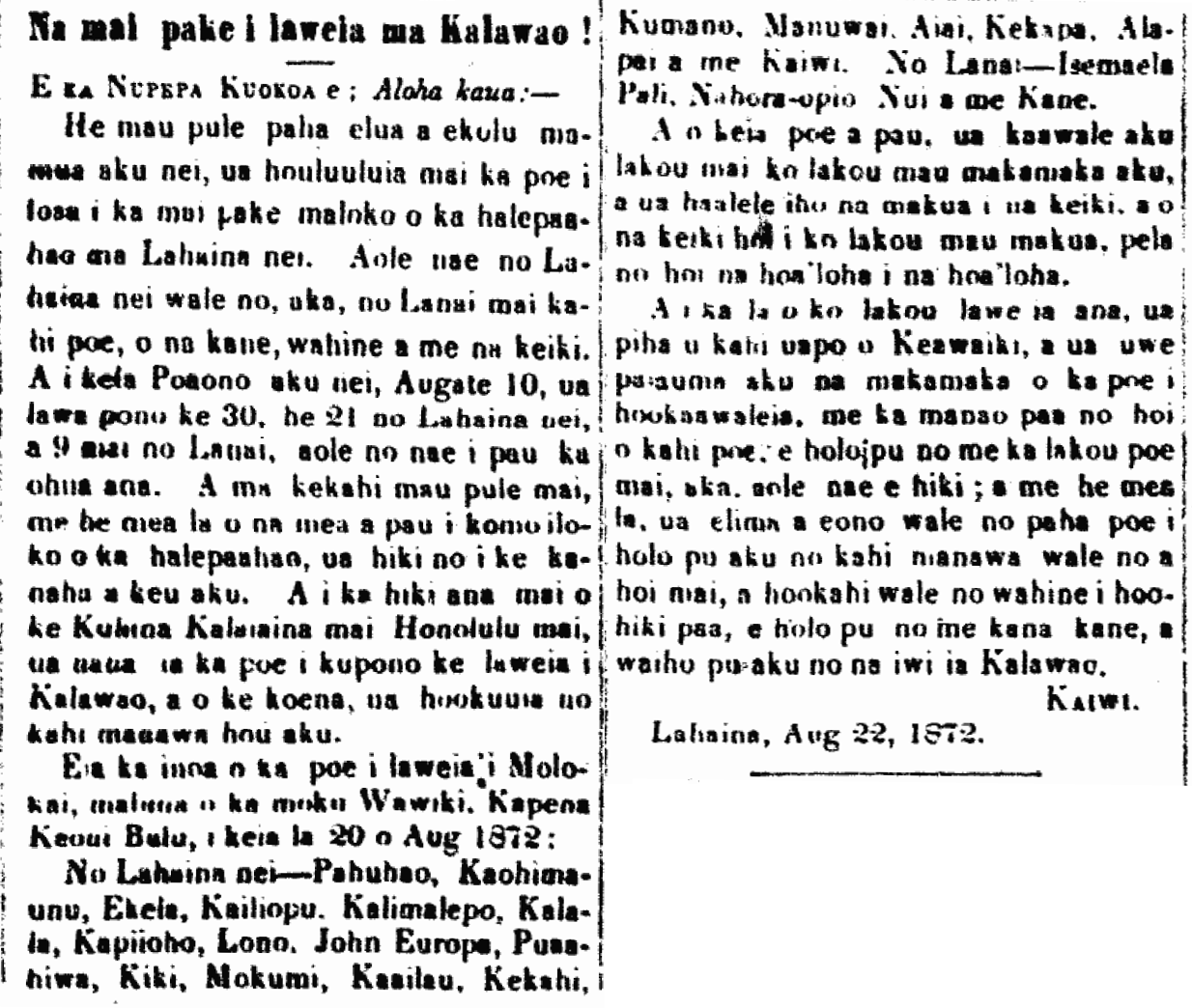
Perhaps some two or three weeks ago, those afflicted with the “Chinese disease” were assembled in the jail here in Lahaina. And it wasn’t just people from Lahaina, but some were also from Lanai: men, women, and children. And on this past Saturday, August 10, they totalled 30; 21 from Lahaina nei and 9 from Lanai; but the gathering is not over. And in the coming weeks, it seems as if the total of all those put in the jail will reach forty or more. And when the Minister of the Interior [Hutchison] arrives from Honolulu, they are examined for those who should go to Kalawao, and the rest are released for another time.

Here are the names of those taken to Molokai aboard the ship Warwick [Wawiki], Captain Keoni Bulu, today, the 20th of Aug. 1872:

From here in Lahaina—Pahuhao, Kaohimaunu, Ekela, Kailiopu, Kalimalepo, Kalala, Kapiioho, Lono, John Europa [? Europe], Puaahiwa, Kiki, Mokumi, Kaailau, Kekahi, Kumano, Manuwai, Aiai, Kekapa, Alapai, and Kaiwi. From Lanai—Isemaela Pali, Nahora opio, Nui, and Kane.

All of these people, they were separated from their companions, and parents left their children, children left their parents, and so too did friends leave friends.

On the day they were taken, the pier of Keawaiki was packed, and the friends of those who were being separated wailed in grief, while some of them were determined to go along with their sick, but that was not possible; and it seemed that there were but five or six who went along for just a while then returned; and there was only one woman who swore that she’d go with her husband and leave her bones in Kalawao.

Kaiwi.

Lahaina, Aug. 22, 1872.

(Kuokoa, 8/31/1872, p. 2)

Na mai pake i laweia ma Kalawao!

Ka Nupepa Kuokoa, Buke XI, Helu 35, Aoao 2. Augate 31, 1872.