More on Aberahama Kaikioewa Palekaluhi, 1912.

THAT HEAVENLY ONE PASSED BY, STAGGERED AWAY,

GONE ON THAT DARK PATH OF KANE

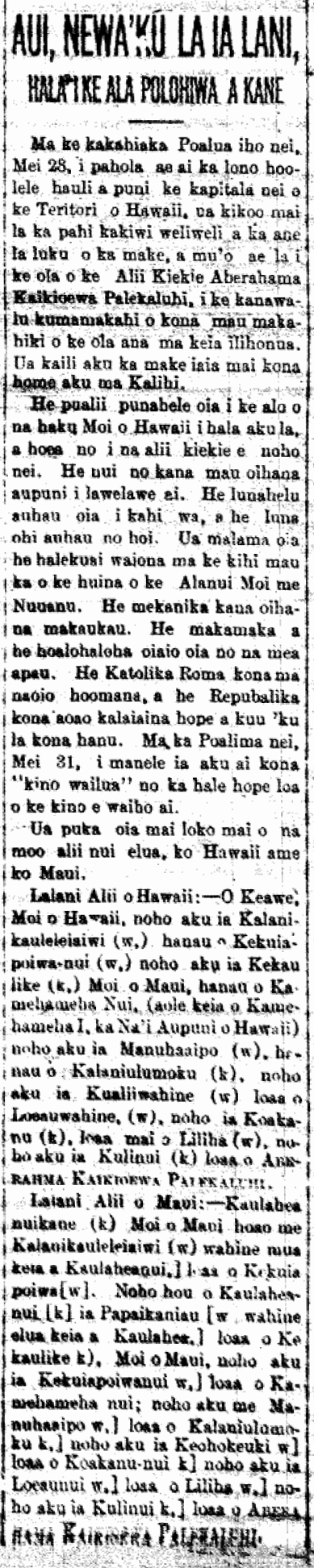
On the morning of this past Tuesday, May 28th, the shocking news spread all over the capital of the Territory of Hawaii, that the terrifying sickle of the angel of death was stretched out and cut short the life of the High Chief Abraham Kaikioewa Palekaluhi, at eighty-one years of living on this earth. Death took him from his home in Kalihi.

He was a favorite chiefly descendant in the court of the past Kings of Hawaii, all the way until the high chiefs living now. He had many positions in the government. He was a tax assessor at one point, and a tax collector as well. He managed a bar at the corner mauka of the corner of King Street and Nuuanu Avenue. He was a skilled mechanic. He was a friend and a ally of all. He was a true believer in the Roman Catholic faith, and he was in the Republican party until his last breath. This Friday, May 31st, his remains [kino wailua] was carried to the last abode where his body would be laid.

He descended from two royal lineages, from Hawaii and from Maui.

Hawaii Island Lineage:—Keawe, the King of Hawaii, “wed” [noho] with Kalanikauleleiaiwi (f) and Kekuiapoiwanui (f) was born, who wed Kekaulike (m), the King of Maui, and Kamehameha Nui was born (which was not Kamehameha I, Ka Na’i Aupuni of Hawaii), who wed with Manuhaaipo (f) and Kalaniulumoku (m) was born, who wed Kualiiwahine (f) and born was Loeauwahine (f), who wed Koakanu (m), and Liliha (f) was born, who wed Kulinui (m) and Aberahama Kaikioewa Palekaluhi was born.

Maui Island Lineage:—Kaulaheanuikane (m), King of Maui wed [hoao] with Kalanikauleleiaiwi (f), which was his first wife, and Kekuiapoiwa (f) was born. Kaulaheanui (m) married again to Papaikaniau (f), his second wife, and born was Kekaulike (m), the King of Maui, who wed Kekuiapoiwanui (f), and born was Kamehameha Nui, who wed Manuhaaipo (f), and born was Kalaniulumoku (m), who wed Keohokeuki (f) and born was Koakanu Nui (m), who wed Loeaunui (f), and born was Liliha (f), who wed Kulinui (m), and born was Aberahama Kaikioewa Palekaluhi.

(Aloha Aina, 6/1/1912, p. 1)

AUI, NEWA'KU LA IA LANI, HALA I KE ALA POLOHIWA A KANE

Ke Aloha Aina, Buke XVI, Helu 22, Aoao 1. Iune 1, 1912.

Iolani Palace, 1882.

THE NEW PALACE.

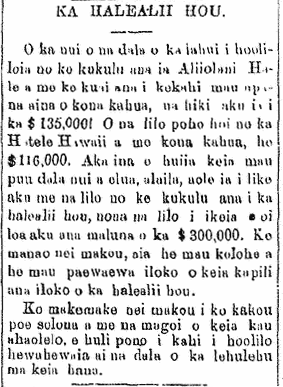
The sum of the people’s money that was spent to build Aliiolani Hale and for the purchase of the parcels of land for its grounds totaled $135,000! The losses for the Hawaiian Hotel [Hotele Hawaii] and its grounds were $116,000. However, if these two sums of money were added together, then it would not equal the costs to build the new palace, which is known to exceed costs of $300,000. We believe that there has been misconduct and impropriety in the construction of the new palace.

We wish that our many solon [solona] and the wise men of this legislative session will investigate thoroughly where the money of the people was spent rashly.

(Ko Hawaii Pae Aina, 5/6/1882, p. 2)

KA HALEALII HOU.

Ko Hawaii Pae Aina, Buke V, Helu 18, Aoao 2. Mei 6, 1882.

We still haven’t learned today what they knew a hundred years ago?

Remember the article on snakes we posted just a couple of weeks ago? Out today is a current related article…

How sad is it when Hawaii already had the answer a hundred years ago, that today, the State of Hawaii doesn’t think keeping alien pests out of Hawaii is important enough to fund! See this article out today by Audrey McAvoy: Alien pests risk fewer inspectors upon entry.

More from David Keaweamahi on Japanese contract laborers, 1890.

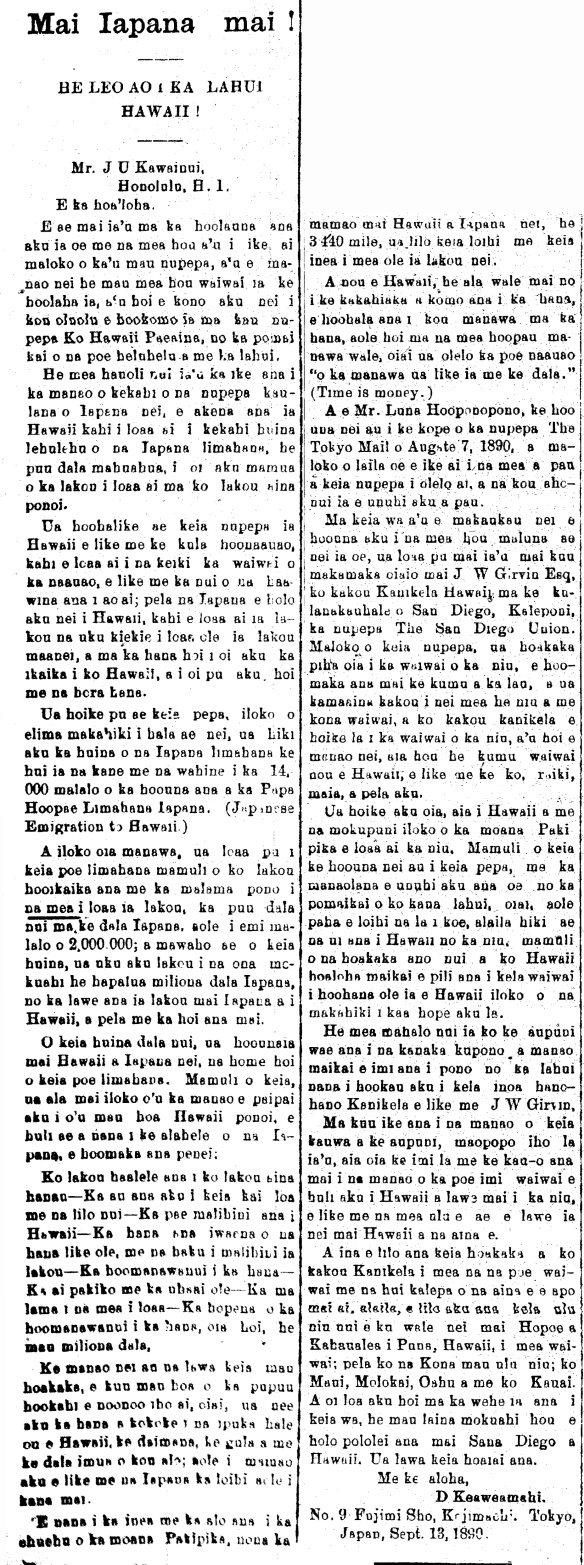
From Japan!

INFORMATION FOR THE HAWAIIAN PEOPLE!

Mr. J. U. Kawainui,

Honolulu, H. I.

O Friend,

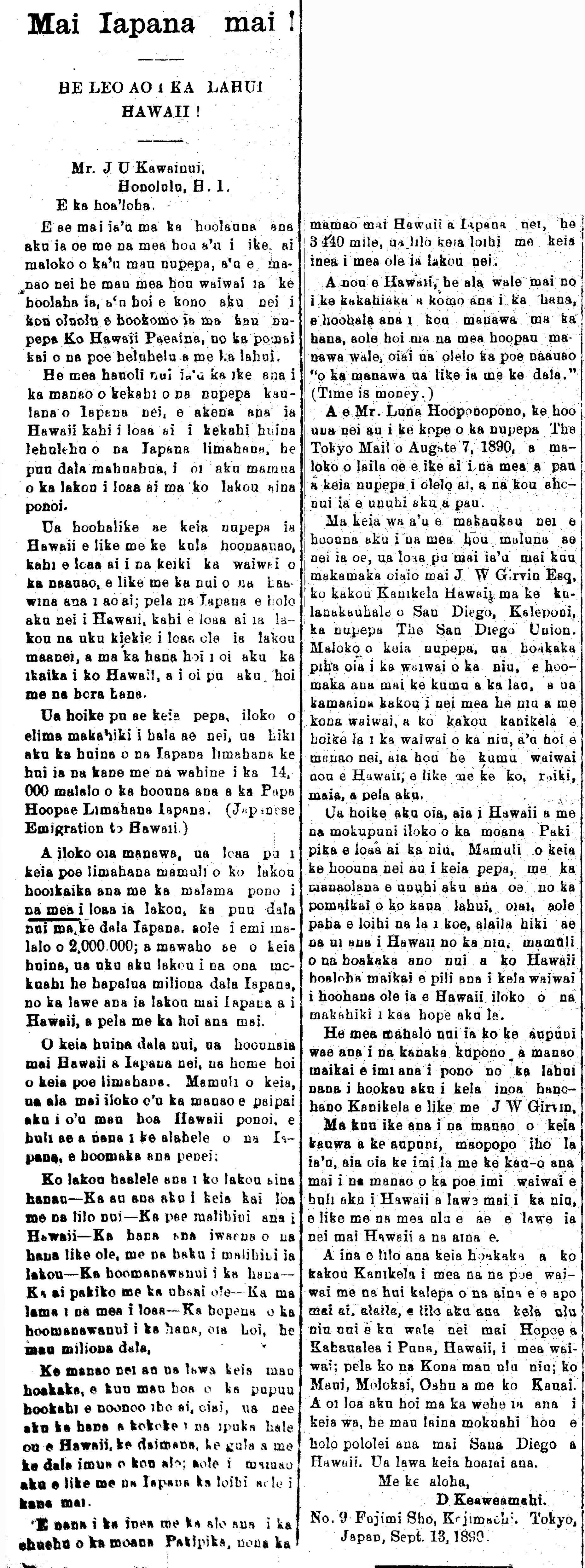
Please allow me to introduce you to the new things I have seen in my newspaper which I believe are new information important to spread; which I invite you to kindly insert into your newspaper, Ko Hawaii Pae Aina, for the benefit of the readers and the nation.

I was pleased to see the thoughts of a famous newspaper of Japan, praising Hawaii as the place where a great number of Japanese laborers obtained a big sum of money, more than they’d receive in their homeland.

This newspaper likened Hawaii to a school of education, where a child receives the wealth of knowledge, equal to the amount of lessons he studies; so too with the Japanese who are going to Hawaii, where they get high salaries that they’d not get here, and for more intense work than in Hawaii, along with more hours.

This paper also stated that within the past five years, the total number of Japanese laborers including men and women has reached 14,000, sent by the Board for Emigration of Japanese Laborers.

And within this period, these laborers, as a result of their effort and their saving of what they earned, made a great amount in Japanese money, not less than 2,000,000 yen; and not included with this, they paid the ship owners half a million yen to take them from Japan to Hawaii and return.

This great sum of money was sent from Hawaii to here in Japan, the home of these laborers. As a result, there rose within me the desire to encourage my own Hawaiian friends to take a look at the path taken by the Japanese, starting like this:

Their departure from the land of their birth—Their travelling across the great ocean at great expense—The landing as strangers in Hawaii—Working all sorts of jobs for a boss who is a stranger—Enduring the work—Eating only a little without wasting—Caring for what they have—The results of their putting up with the work, that being millions of dollars.

I believe that this is ample explanation, O Friends of the same womb, for you to think about; for the work has come to your door O Hawaiians—diamonds, gold, and money, right before your eyes; it is not far away like for the Japanese for whom it is far, far away.

Look at the hardships and the facing of the spray of the Pacific Ocean whose distance from Hawaii to Japan is 3,440 miles; this distance and hardships became nothing to them.

And you, O Hawaiians, you wake up in the morning and take up your work, and put in your time working, and not with things that waste your time, as goes the saying of the educated people: “Time is like money.”

And O Mr. Editor, I am sending a copy of the newspaper, “The Tokyo Mail” of August 7th, 1890, and within it you will see all of what this paper has said, and it is for you to patiently translate it all.

As I am preparing to send to you the news above, I have also received from my true friend, J. W. Girvin, Esq., our Hawaiian Consul in the city of San Diego, California, the newspaper “The San Diego Union”. Within this paper, he explained fully the value of coconuts, starting from the trunk to the leaves; we are familiar with coconuts and its value; and with our consul explaining the value of the coconut, I am thinking that there are also other sources of wealth for you, O Hawaiians, like sugarcane, rice, bananas, and so forth.

He explains that coconuts can be found in Hawaii and the islands of the Pacific Ocean. Therefore, I am sending this paper with hopes that you will translate it for the good of our people, being that it should not be long before Hawaii starts receiving inquiries for coconuts because of this important description of Hawaii’s good friend dealing with the asset not put to use by Hawaiians in the past years.

It is a very admirable thing that the government selects good people with good ideas to search after the well being of the people that conferred upon him that honorable title, Consul, like J. W. Girvin.

When I look at the ideas of this servant of the nation, I know that he is searching while pulling along the minds of entrepreneurs to look to Hawaii to export coconuts, like the other produce exported from Hawaii to other lands.

And should this description of our Consul become something that the wealthy people and trade companies of foreign lands latch on to, then those great fields of coconut from Hopoe until Kahaualea in Puna, Hawaii will become a source of wealth; so too the stands of coconut in the Kona districts, along with those of Maui, Molokai, Oahu and Kauai. And even more so, with the opening these days of new steamship lines which go directly from San Diego to Hawaii. This clarification should be sufficient.

With aloha,

D. Keaweamahi.

No. 9 Fujimi Sho [Fujimi-cho], Kojimachi, Tokyo, Japan, Sept. 13, 1890.

[As we celebrate Merrie Monarch week, Japanese contract laborers is one of Kalakaua’s many legacies…]

(Ko Hawaii Pae Aina, 9/27/1890, p. 2)
Mai Iapana mai!

Ko Hawaii Pae Aina, Buke XIII, Helu 39, Aoao 2. Sepatemaba 27, 1890.
Crown Lands and Government Lands, 1896.

GOVERNMENT LANDS.

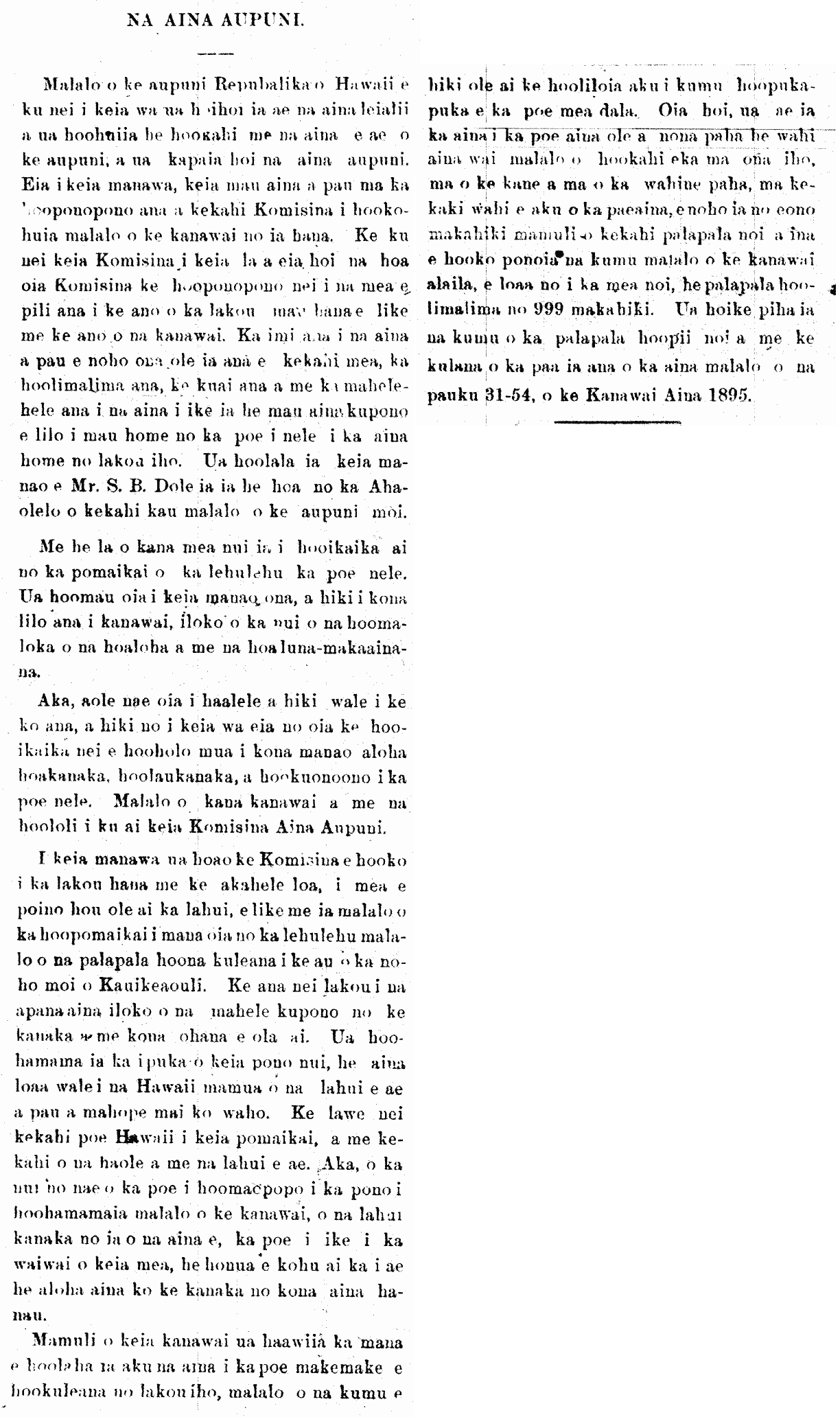
Under the Republic of Hawaii that stands now, the crown lands have been returned and added with the other lands of the government, and are referred to as government lands. Currently, the entirety of these lands are under the authority of a Commission appointed for that purpose under the law. The Commission is active today and its members are putting into order matters that pertain to their duties as per the laws. The finding of all lands that are not to be owned by someone, as well as the leasing, selling, and dividing of lands that are recognized as lands fitting to be homes for people without homesteads for themselves. This idea was devised by Mr. S. B. Dole while he was a member of the Legislature for a session under the monarchy.

It seems that this was what he focused on, for the good of those without. He kept at this idea until it became law, amidst much skepticism by friends and fellow representatives.

But he did not relent until he succeeded, and now he is working to move forward his loving idea for his fellow man, to increase, and to make prosperous, the poor people. Under his law and its revisions, this Government Lands Commission was created.

At this time, the Commission is trying to carefully carry out their duties so that the lahui will not once again be hurt like under the benefits intended for the masses with the quiet land titles in the time of Kauikeaouli’s rule. They are surveying parcels from areas suited for a man and his family to live. The doors to this great right is opened and Hawaiians will receive land before all other ethnicities and then thereafter those from the outside. There are some Hawaiians taking advantage of this opportunity, along with some haole and other ethnicities. But the majority of those that know of the good offered up by this law are the people of foreign lands, the ones who know the value of land for which one is able to say that he is patriotic to the land of his birth.

By this law, power is give to advertise land to those who claim land for themselves, under the condition that they cannot use it for profit. The land is available to those without land or those with wetlands of less than an acre under his name, or under the husband or wife in some other area of the archipelago; they will live on the land for six years after the request for land and should they meet the qualifications under the law, the applicant will receive a lease or 999 years. The requirements for the application and stipulations of the lease are shown in full in sections 31–54 of the Land Act of 1895.

[Just as it is today, it was back then. Different newspapers and sources had different stances. It is perhaps not best thing to base your opinions on a single article or the words of a single person. It is important to try and see all that was written and handed down in other ways (for ink and paper is not necessarily the best way that information is passed down), and then decide what you think on the subject…

Oh, and see here for the Land Act of 1895.]

(Oiaio Puka La, 4/3/1896, p. 2)

NA AINA AUPUNI.

Ka Oiaio Puka La, Buke I, Helu 67, Aoao 2. Aperila 3, 1896.

Royal Hawaiian Band gets new instruments, 1912.

EXPRESSION OF APPRECIATION.

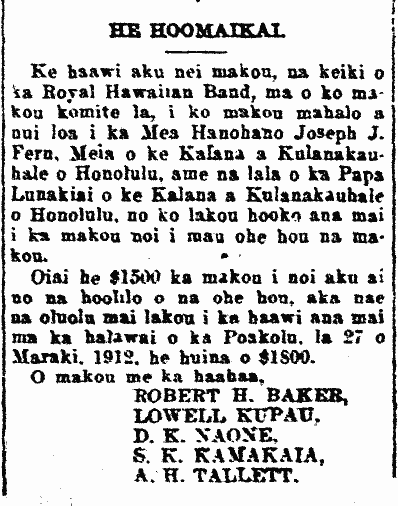
We, the boys of the Royal Hawaiian Band, by means of our committee, give our great appreciation to the Honorable, Joseph J. Fern, Mayor of the City and County of Honolulu, and the Board of Supervisors of the City and County of Honolulu, for their approving our request for new wind instruments.

Although we requested $1500 for the costs of the new instruments, they kindly granted us at the meeting of Wednesday, the 27th of March, 1912, the sum of $1800.

We, with sincerity,

Robert H. Baker,
Lowell Kupau,
D. K. Naone,
S. K. Kamakaia,
A. H. Tallett.

(Kuokoa, 4/5/1912, p. 6)

HE HOOMAIKAI.

Ka Nupepa Kuokoa, Buke XLVIII, Helu 14, Aoao 6. Aperila 5, 1912.

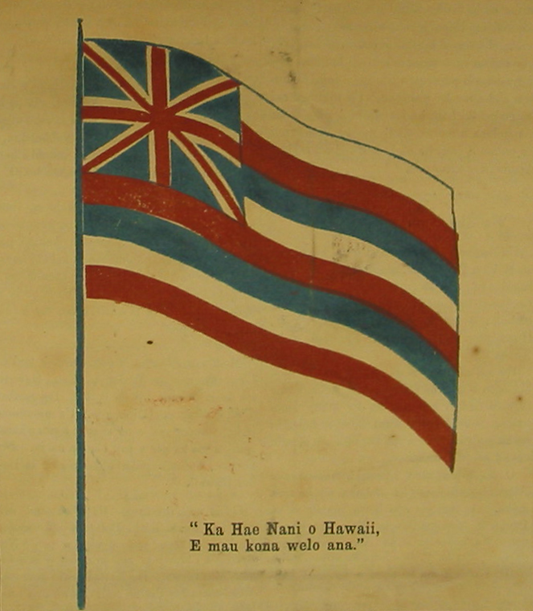
The Hawaiian Flag—a closeup. 1862.

“The Beautiful Flag of Hawaii,
Let it forever wave.”

[The image of the Hawaiian Flag as it appeared to the readers of the Kuokoa in 1862! (Courtesy of the library/archives at the Bishop Museum.)

The Library and Archives at the Museum holds so much priceless information! They need more funding to do important things!!]

"Ka Hae Nani o Hawaii...

Ka Nupepa Kuokoa, Buke I, Helu 6, Aoao 1. Ianuari 1, 1862.

History of the Hawaiian Flag. 1862.

“The Beautiful Flag of Hawaii,
Let it forever wave.”

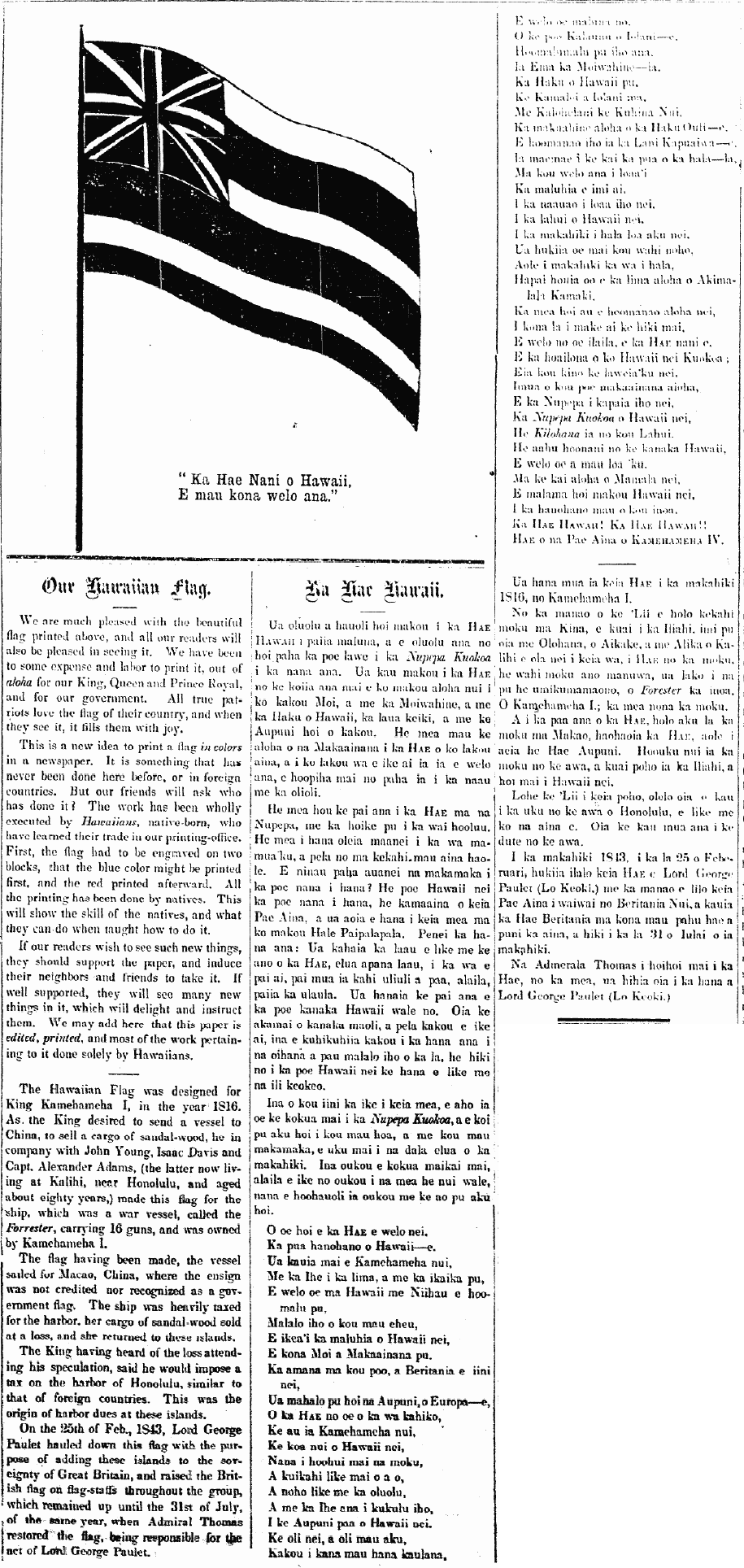
The Hawaiian Flag

We are pleased and happy about the Hawaiian Flag printed above, and the people subscribing to Ka Nupepa Kuokoa will be delighted to see it. We display the Flag, urged to do so by our great aloha for our King, Queen, and Ka Haku o Hawaii, their son, as well as for our Nation. The love by the people for their flag of their country is customary, and when they see her fluttering, it fills their hearts with joy.

The printing of the Flag in a Newspaper is something new, along with the displaying of its colors*. This is something not done previously here, as well as in some foreign countries. Perhaps our friends will inquire as to who did this work. Some Hawaiians did the work, people from this Archipelago, and they were taught to do this in our Printing Office. Here is how it was done: Woodblocks were carved in the fashion of the flag using two blocks. When it was printed, first the blue was printed, allowed to set, then the red was printed. This printing was done solely by Hawaiians. Such is the intelligence of the kanaka maoli, and that is how we recognize it. If we are instructed to do any task under the sun, Hawaiians can do the same as the white-skinned people.

If you should want to see this, you should support Ka Nupepa Kuokoa, and urge your acquaintances and friends to pay the two dollars a year. If you would kindly help, you will see many things that will gladden and instruct you.

You, O fluttering Flag,
The proud blossom of Hawaii.
Established by Kamehameha the great,
With Spear in hand, with strength,
Flutter over Hawaii and Niihau, and give protection.
Beneath your wings,
So that the peace of Hawaii be known,
By her King and the people as well.
The cross on your crest that Britain holds dear,
The Nations of Europe also give acclaim,
You are the Flag of old,
The time of Kamehameha the great,
The bravest warrior of Hawaii,
He who joined the islands,
With unity from end to end,
Living as one in contentment,
Along with the Spear upon which he erected,
The steadfast Nation of Hawaii.
We rejoice, and rejoice for all time,
His famed accomplishments,
You wave there above,
The crown of Iolani, the king
While giving shelter,
To Emma, the Queen.
Along with Ka Haku o Hawaii.
The Royal child of Iolani and Emma,
And Kalohelani, the Regent, Victoria Kamamalu.
The loving aunt of the young lord, Prince Albert,
Do remember his His Highness, Lot Kapuaiwa,
Cleansing the fruit of the pandanus in the sea,
Your fluttering has garnered
The peace that allowed us to seek,
The knowledge that has come,
To the Hawaiian populace.
That year long ago.
You were taken from your proper place.
Not a year passed,
You were raised by the loving hands of Admiral Thomas.
The one you fondly recall,
On the day of his death when it approaches,
You will wave there, O beautiful Flag.
O symbol of Hawaii’s Independence ;
Here is your body, being brought.
Before your beloved people,
By the Newspaper called,
Ka Nupepa Kuokoa of Hawaii,
The Excellence of your Nation.
A garment that adorns the Hawaiian People,
Wave forever.
Over the beloved sea of Mamala,
We, Hawaii, will cherish always,
The eternal glory of thy name.
The Hawaiian Flag! The Hawaiian Flag!!
The Flag of the Islands of Kamehameha IV.

This Flag was first designed in the year 1816 for Kamehameha I.

The King, wanting a ship to sail to China to sell Sandalwood, searched along with John Young, Isaac Davis, and Captain Alexander Adams of Kalihi, who is still living, for a Flag for the ship. It was a man-o-war, called the Forrester, carrying sixteen guns. Kamehameha I owned the ship.

When the Flag was completed, the ship sailed to Macao. The Flag was puzzled over, and was not accepted as a National Flag. The ship was charged exorbitantly for harbor fees, the Sandalwood was sold for a loss, and the ship returned to Hawaii.

The King learned of this loss, and he said that a tax should be placed on the harbor of Honolulu like those of foreign lands. That is when duty was first charged for the harbor.

In 1843, the 25th of February, this Flag was taken down by Lord George Paulet [Lo Keoki], with the intent that this Archipelago be taken as a possession of Great Britain. The British flag was raised on flag poles all around the land, until the 31st of July of that year.

It was Admiral Thomas who restored the Flag, for he disputed the actions of Lord George Paulet.

[Notice the English column to the left, which gives a translation of the Hawaiian. It seems this issue of the Kuokoa was sent to home by many a missionary, to show the progress they were making…

*A word of clarification: This is not the first time color appears in a newspaper. For more on this topic, see Hana Hou Magazine, August/September 2011: “Read All About It!” by Ron Williams.

For more flag articles, just click here!]

(Kuokoa, 1/1/1862, p. 1)

"Ka Hae Nani o Hawaii...

Ka Nupepa Kuokoa, Buke I, Helu 6, Aoao 1. Ianuari 1, 1862.

History of the Hawaiian Flag. 1880.

In Thrum’s Hawaiian Almanac and Annual for 1880, pp. 24–26, appears this article:

THE HAWAIIAN FLAG.

We exceedingly regret to report an unsuccessful search for the History of the present Flag of these Islands, the time of its adoption and the parties interested in its formation; but after diligent inquiries and research through volumes of voyages, histories, periodicals and manuscript journals during the past three years, we have to acknowledge the main fact lost in oblivion, while references thereto in various voyages and histories are confusing and contradictory.

There is a general idea and belief among many of our old residents that the present Hawaiian Flag was made by the late Capt. Alexander Adams before his voyage to China in the brig “Kaahumana, [Kaahumanu]” in 1817, and was by him first flown, not only in the Chinese waters, but on the coast of California. Others again have the impression that a flag was brought from China by him; but we can gather no information corroborative as to who was authorized in Chinese waters to design a flag for this, even small kingdom, though the description given viz: a St. George and St. Andrew’s cross in the corner filled in with blue, with field consisting of red and white stripes, shows almost virtually the East India Flag. Refering to Capt. Adams’ Journal we find the following mention only, that touches upon the points in question: ” April, 1816, The King of these Islands having a strong passion to purchase the brig, (‘Forrester,’ of London) and expressing the same, myself and Capt. Ebbetts was accordingly deputed to treat with him, but he would not purchase her without I would enter his service as her commander. I resultingly acquiesced, the brig being given up to him at Kealakekua, and called by him Kaahumanu * * *. I was accordingly honored on taking command with the Flag of his Majesty and a salute of 11 guns.”

This certainly refutes the general belief that the flag was made by Capt. Adams, as his own narrative shows a flag to have been here before him ; but
whether the present one or some other we cannot gather, for it is evident that there have been more than one. In another portion of his journal is an allusion to a flag—but also without description—that has no doubt given rise to the idea of his making the flag; where at Waimea, Kauai, at which port he had touched from Honolulu for supplies, en route for China, he notes: “Mch. 12, 1817, * * * Gave the King our ensign to hoist in lieu of the Russian, who said it was on account of his having no other.”

It is to be borne in mind that the allusion here is to the king of Kauai, and not Kamehameha, as Kauai was under its own King till 1821, and his possession of a Russian flag while the principal town was occupied by a Russian colony was not strange.

Finding these theories of Capt. Adams’ authorship exploded by his own writings, search was made in other directions with the following result. Vancouver, in his last visit, (1793) when he assured Kamehameha of England’s friendship and protection, gave him an English flag, which we find by Archibald Campbell, in his “Voyage round the World, 1806-1812,” arriving at these Islands Dec. 1808, that the English colors were used, for he says: “The King’s residence, built close upon the shore, and surrounded by a palisade upon the land side, was distinguished by the British colors.”

Jarvis [Jarves] states, (pp. 96) describing the period of about 1816, speaks of the flag, as somewhat similiar to the present, viz: “English Union, with seven alternated red, white and blue stripes.” This however is not coroborated by Lord Byron, in his “Voyage of the Blonde,” in 1825, in which he describes the flag as follows: “On all days of ceremony the Sandwich flag is hoisted on the forts; it has seven white and red stripes with a Union Jack in the corner.” (P. 121.)

This is almost the East India flag before described, and confuses the searcher after truth as to when the several changes took place. If Jarvis is correct in the flag he describes, and he certainly was in a position to know whereof he wrote, it is a grave error in the recorder of the “Voyage of the Blonde” to give so different a one nine years later. The present flag has eight stripes representing the Islands of the group-white, red and blue, with Union Jack in the corner. Capt. Hunt, who was here in the Baselisk [Basilisk] in 1845, is said to have changed the relative position of the colors of the stripes by placing the white on top instead of at the bottom, though there is a possibility of this being the time of adding the eighth stripe, Jarvis and Byron mentioning only seven. Capt. Hunt is also accredited with designing the Royal Standard now in use.

We leave the above subject as here recorded, trusting it will meet the eye of some one whose knowledge and memory will be freshened thereby to account the true history of the Hawaiian Flag, its origin, and parties interested in its formation.

[The original of this article is downloadable here at the University of Hawaii at Manoa’s EVOLS page! This publication is very useful for many random facts about Hawaii at the time. If you have not seen it before, you should go check it out!!]