Kokua being sent out of Kalaupapa, 1903.

Desire to Live in Kalaupapa

According to reports, most of the assistants [kokua] and the people who have been diagnosed not to have leprosy have requested of the Board of Health to remain in Kalaupapa.

Amongst these requests, four have staunchly opposed their being removed from the place of the sick. In accordance with the thought of the Board of Health, some requests were granted while others were denied.

The petitions of Mrs. Jessie Kaeana and Mrs. Lahela Amaka for their husbands to go to the colony as kokua were approved, and Superintendent McVeigh [Lunanui Maka-we] helped in this.

C. Kopena, a kokua that was ordered by the Board of Health to leave, asked that the decision be changed. The Board of Health gave the 31st of August as his last day to live in the colony. Kopena stated that he lived there for a long time and has not in the least gone against the Board of Health. When he left for the colony, he sold all of his assets, believing that he would spend the rest of his days there; and now, he is unable to return to the outside world unless he has supplies. If the Board is set upon his leaving, he needs to be given a home outside, and if not, he will become a vagabond of the earth.

According to Superintendent McVeigh, Kopena refuses to work, and has tried to join in with the rest of the kokua to defy the power of the Board of Health. For this reason, the request was denied.

McVeigh stated that when telling Kopena the Board of Health decided to remove him from the colony, Kopena said, “ko ke hele”¹, and that he would be staying.

That was not the case of Mr. and Mrs. Imihia. They asked the Board to allow the two of them to live there because they have no ohana left living, and they don’t have enough money to sustain them for two days.

Mr. McVeigh asked that they live in the colony and he said that Imihia works hard and is a farmer. The request was approved.

The request of Simms was denied for him to continue living in the colony, because he was suspected of having leprosy, but he will be released after he receives his clearance.

According to the explanation of McVeigh, Simms is one of the most lazy blacks that he has seen, and he should be sent out to work for himself.

The request of Sam Kaaiko and his wife was approved to go to the colony to visit their child.

Mrs. H. K. Aylett’s request was denied to take her young child to the colony.

¹Hawaiianization of the phrase, “go to hell.”

(Kuokoa, 8/7/1903, p. 3)

Ua Makemake e Noho i Kalaupapa

Ka Nupepa Kuokoa, Buke XLI, Helu 32, Aoao 3. Augate 7, 1903.
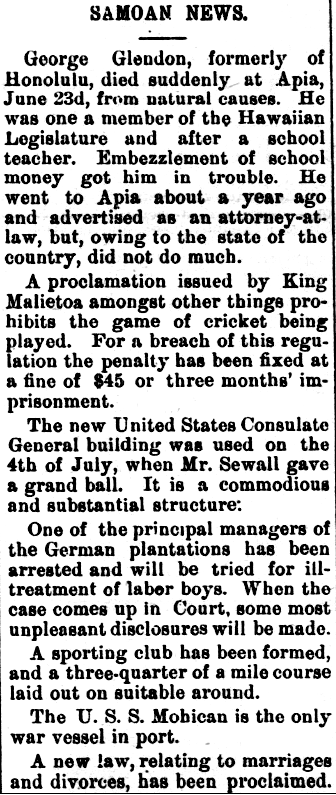
More on George Glendon and Samoa, 1890.

SAMOAN NEWS.

George Glendon, formerly of Honolulu, died suddenly at Apia, June 23d, from natural causes. He was one a member of the Hawaiian Legislature and after a school teacher. Embezzlement of school money got him in trouble. He went to Apia about a year ago and advertised as an attorney-at-law, but, owing to the state of the country, did not do much.

A proclamation issued by King Malietoa amongst other things prohibits the game of cricket being played. For a breach of this regulation the penalty has been fixed at a fine of $45 of three months’ imprisonment.

The new United States Consulate General building was used on the 4th of July, when Mr. Sewall gave a grand ball. It is a commodious and substantial structure.

One of the principal managers of the German plantation has been arrested and will be tried for ill-treatment of labor boys. When the case comes up in Court, some most unpleasant disclosures will be made.

A sporting club has been formed, and a three-quarter of a mile course laid out on suitable around.

The U. S. S. Mohican is the only war vessel in port.

A new law, relating to marriages and divorces, has been proclaimed.

(Pacific Commercial Advertiser, 7/28/1890, p. 2)

SAMOAN NEWS.

Pacific Commercial Advertiser, Volume XII, Number 23, Page 2. July 28, 1890.


Looking back at their time spent at Lahainaluna, 1904.

TEARS SHED FOR THE DAYS GONE BY.

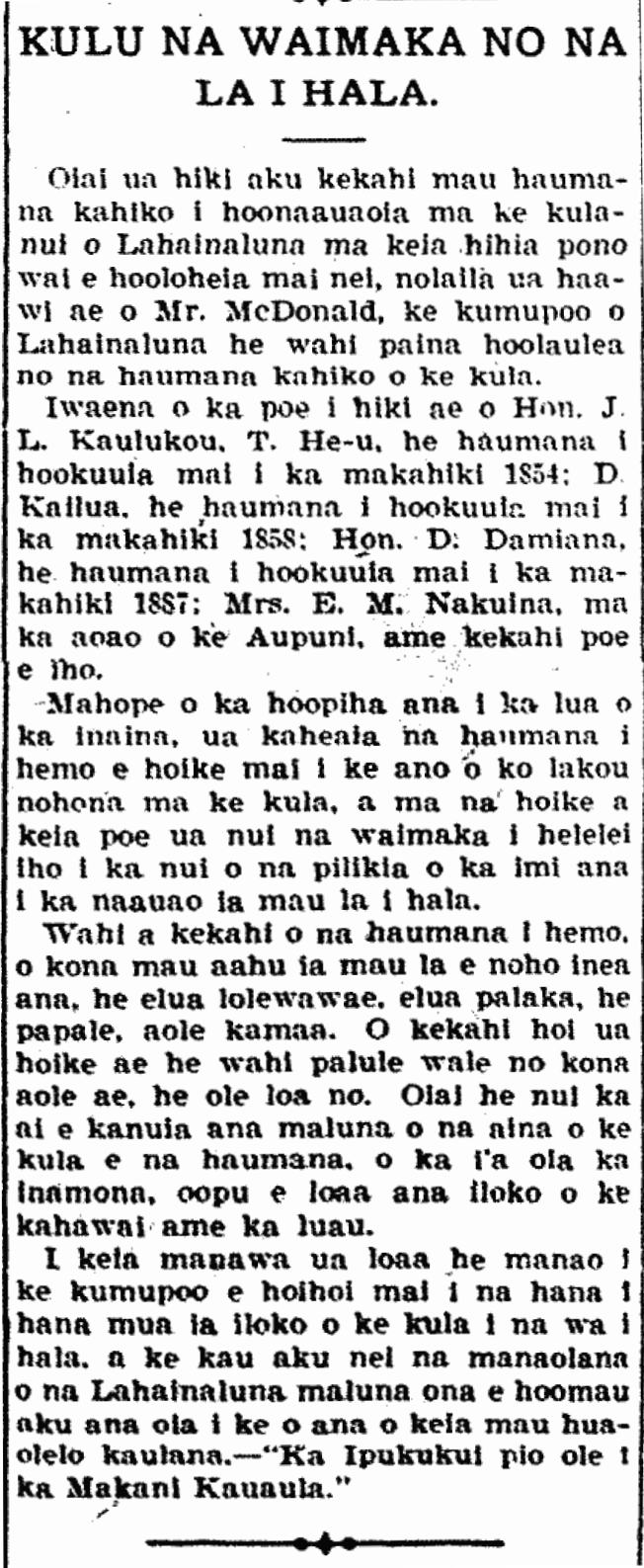
Being that some of the old students educated at Lahainaluna College are involved in this water rights case, Mr. McDonald, the principal of Lahainaluna, gave a small party for the old students of the school.

Amongst those who attended were the Hon. J. L. Kaulukou, T. He-u, students who graduated in 1854; D. Kailua, a student who gradutated in 1858; Hon. D. Damiana, a student who graduated in 1857; Mrs. E. M. Nakuina, from the side of the Government; and some other people.

After the stomachs were filled, the graduates were called up to talk about their life at the school, and as a result of the words of these people, much tears were shed because of the great troubles faced in search of education in those days gone by.

According to one of the graduates, his clothes in those days of hardship was just two pants, two palaka, a hat, and no shoes. Another said that he had just one shirt and no other, none at all. Being that there was much food planted on the school property by the students, fish was the relish, the oopu that were caught in the rivers, and the luau.

Currently, the principal is thinking about going back to the work done in the schools in days past, those of Lahainaluna have placed their hope upon him, that he will have this famous saying go on.—”Ka ipukukui pio ole i ka Makani Kauaula.”¹

¹The famous epithet for Lahainaluna School: “The light not extinguished by the Kauaula winds.”

(Kuokoa, 5/13/1904, p. 5)

KULU NA WAIMAKA NO NA LA I HALA.

Ka Nupepa Kuokoa, Buke XLII, Helu 20, Aoao 5. Mei 13, 1904.

Bilingual law announcements in English-language newspapers, 1902.

BY AUTHORITY.

REGULATIONS
FOR
HACK AND FOR PASSENGER VEHICLES
AND
RATES OF FARE.

By virtue of the authority in me vested and under the provisions of Section 794 of Chapter 55, of the Penal Laws of 1897, I, James H. Boyd, Superintendent of Public Works of the Territory of Hawaii, do make and declare the following Rules and Regulations to be observed by Licensed Carriers of Passenger Vehicles, in the District of Honolulu:

1st. Every licensed carriage, dray or vehicle must be numbered, and this number must be placed on a conspicuous part of the carriage, dray or vehicle.

2d. Every licensed carriage running at night must exhibit two lights, and the number of such carriage plainly shown on the glass of each lantern, in black figures, not less than one and one-half (1½) inches in height.

3d. Drivers of licensed vehicles must obey the orders of the Police.

4th. On all stands set apart for licensed carriages the horses must be headed parallel to the street, and close to the sidewalk.

5th. No horse harnessed to a licensed vehicle must be left on any stand unless properly secured by a hitching rope to an iron hitching weight.

6th. No licensed carriage will be allowed to be left on the street over night. Continue reading

G. W. Kahiolo / G. W. Poepoe, feminist of his day, 1864.

The Value of Girls

SEEKING KNOWLEDGE EARNESTLY.

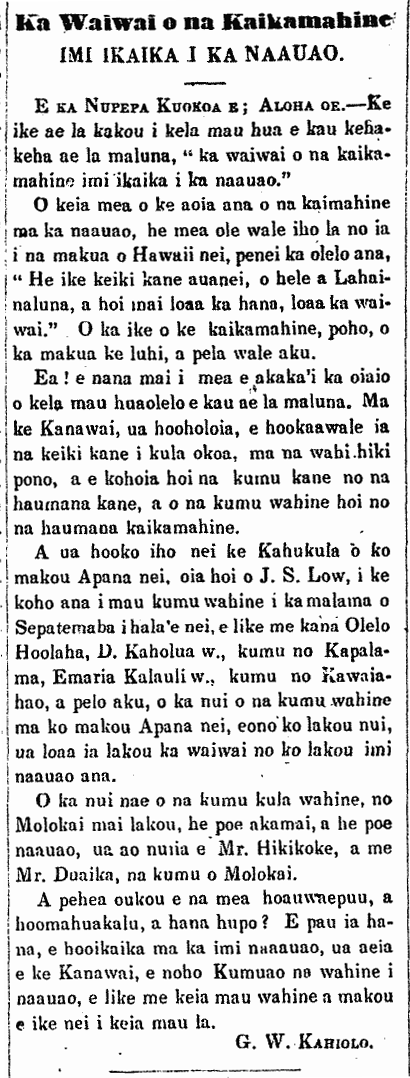
O Kuokoa Newspaper; Aloha oe.—We see the words placed proudly above, “the value of girls seeking knowledge earnestly.”

Teaching girls knowledge is something not important for Hawaiian parents, who say, “When boys are educated, they can go on to Lahainaluna, and return and find a job and get riches.” But educating girls is a waste of their parents efforts, and so forth.

Come now! look at this that makes clear the truth of the words above. The Law was passed that boys would be segregated in separate schools where possible, and men teachers would be selected for the boy students, and women teachers for the girl students.

And the Principal of our District, J. S. Low, has put this into practice, selecting women teachers in this past September, as per his Announcement: D. Kaholua (f), as teacher for Kapalama; Emaria Kalauli (f), teacher for Kawaiahao; and so forth; the number of female teachers in our District is six; they have reaped the wealth from their seeking education.

However, the majority of women teachers are from Molokai; they are intelligent and educated, they were taught well by Mr. Hitchcock [Hikikoke] and Mr. Dwight [Duaika], the teachers of Molokai.

What about you all, indifferent ones, skeptics, and the foolish? Stop this; put effort into education; the Law has allowed knowledgeable women to become Teachers, like these women that we see these days.

G. W. Kahiolo.

(Kuokoa, 1/16/1864, p. 3)

Ka Waiwai o na Kaikamahine

Ka Nupepa Kuokoa, Buke III, Helu 4, Aoao 3. Ianuari 16, 1864.

Kuhio’s “Four Horsemen,” a translation from the time! 1939.

The Four Horsemen

The above picture was taken at Honolulu a few years before the passage of the Rehabilitation Law. There were four of these Hawaiians, and a few days after the return of the Delegate Prince Kuhio from Washington, assembled at Pualeilani at Waikiki to discuss the subject “Rehabilitation of the Hawaiians and after that discussion, these men went to town and had their picture taken at the William’s Gallery on Fort Street, as it was the Prince’s wish, so that he can show to his fellow congressmen at Washington his backers that brought up this important matter for rehabilitating its people, known to be decreasing, during the session of the Hawaii legislature, if the measure is allowed by congress. They are sitting. Prince Kuhio, standing, from left to right, Rev. S. L. Desha, Sr., John C. Lane and H. L. Holstein.

Continue reading

Let the old men go forth and lie upon the roads… 1895.

“LAW OF THE PADDLE BLOW.”
[“MAMALAHOE KANAWAI.”]

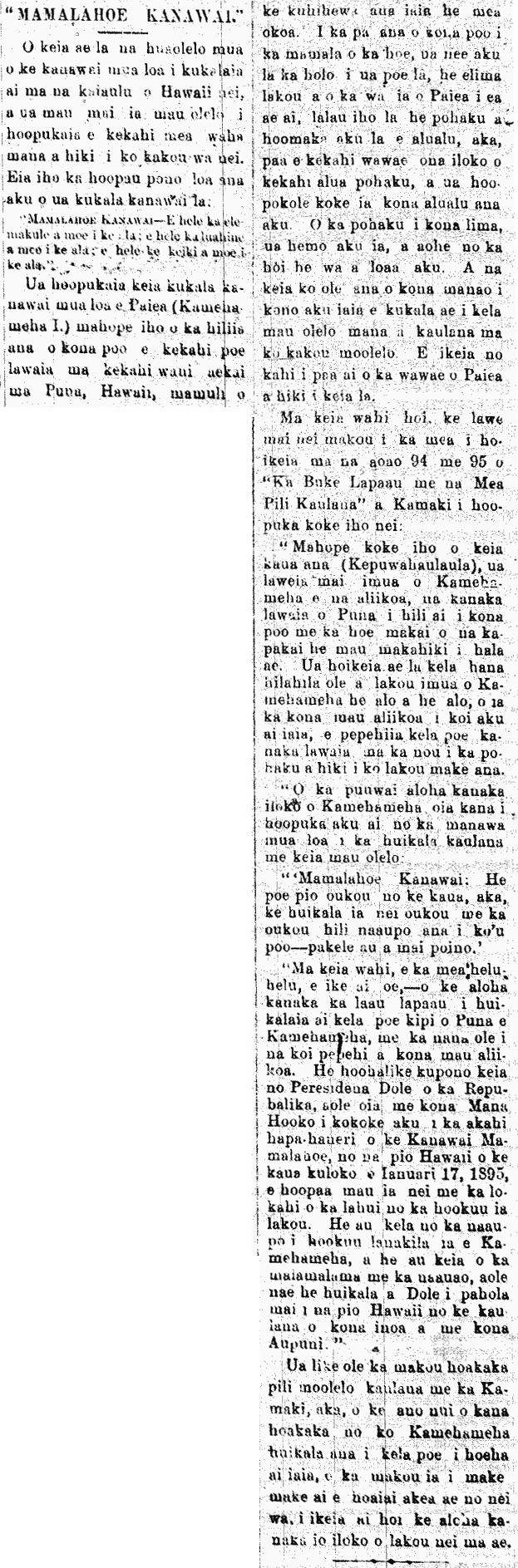
This above are the initial words of the very first law promulgated in the communities of Hawaii, and those words spoken by one in authority still remain. Here below is the the law in its entirety:

“MAMALAHOE KANAWAI—Let the old men go forth and lie upon the roads; let the old women go forth and lie upon the roads; let the children go forth and lie upon the roads.”

This first law was proclaimed by Paiea (Kamehameha I) after his head was struck by some fishermen at the seashore in Puna, Hawaii, because they mistakenly thought he was someone else. When his head was struck with the blow from a canoe paddle, the men fled, there being five of them; that was when Paiea rose, picked up a rock, and made to chase after them, however, his foot was caught in a rock crevice, and his chase was cut short. The rock in his hand fell, and there was no getting it back. And it was this disappointment which caused him to proclaim these famous and powerful words in our history. The place where Paiea’s foot was caught can be seen to this day.

Here, we take what is shown on pages 94 and 95 of “Ka Buke Lapaau me na Mea Pili Kaulana” which was published by Kamaki [Thomas P. Spencer]:¹

“Soon after this battle (Kepuwahaulaula), the fishermen who years earlier struck the head of Kamehameha with a paddle near the sea were brought before him by his officers. This shameful act of theirs was made known to Kamehameha face to face, for which his officers demanded that they be killed by stoning them to death.

“The aloha Kamehameha had for his fellow man was expressed for the first time in his famous pardon by announcing:

“‘Mamalahoe Kanawai: you are prisoners of war, but you are forgiven for unwittingly striking my head–I escaped, but nearly was in trouble.’

“Here, O Reader, do recognize–love for his fellow man was the cure² for which allowed for the release of these rebels of Puna by Kamehameha, and him not giving regard to the calls by his officers to put them to death. This is a fine comparison to President Dole of the Republic; he with his Executive Powers does not come close to a hundredth of the Kanawai Mamalahoe, in his treatment of the Hawaiian prisoners of the revolution of January 17, 1895 who continue to be imprisoned albeit the lahui are united in wanting them released. That was an uncivilized time when [the men] were triumphantly released by Kamehameha, and this is a knowledge and civilization, and yet Dole has not given clemency to the Hawaiian prisoners for the fame of his name and that of his Nation.”

Our elucidation of this famous story is not like that of Spencer’s, but the basis of his explanation of Kamehameha’s forgiving those who injured him, that is what we want to make clear at this time, so that true love of one’s fellow man is seen by them.

¹This book was republished in 2003 by Bishop Museum Press as: Buke ‘Oihana Lapa’au me na ‘Apu la’au Hawai’i (Book of Medical Practices and Hawaiian Prescriptions). See here for further description.

²”Laau lapaau” [medicinal cure] is the word chosen here because this story appears in a book of traditional medicinal practices.

(Makaainana, 11/25/1895, p. 4)

"MAMALAHOE KANAWAI."

Ka Makaainana, Buke IV—-Ano Hou. Helu 22, Aoao 4. Novemaba 25, 1895.

Missing newspapers leave holes in histories, 1881.

[Found under: “LOCAL NEWS”]

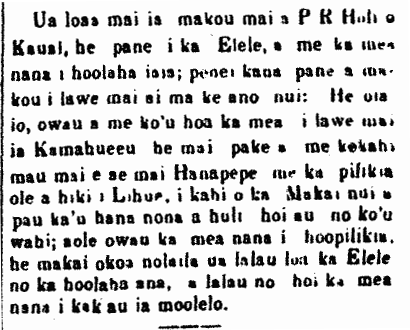
We have received from P. R. Holi of Kauai, a response to the Elele, and what it published about him; this is his response which we accepted with great import: It is true, it was my friend and I who brought Kamahueeu, a person inflicted with leprosy [mai pake], and some other sick ones from Hanapepe without any problem to Lihue to the Sheriff [Makai nui], and then after completing this duty for him, I returned home; it was not me who caused him harm, it was some other officer; therefore, the Elele was totally misdirected in its publishing this, and the one who wrote the story was mistaken.

[Hopefully the missing years of the newspaper “Ka Nupepa Elele” (1879–1885), which includes the year the article referred to here appears, will not be missing forever! Might anyone have any ideas where these might be found?

It also should be noted that responding to a news article appearing in one newspaper in another paper like the response above, was a very common practice.]

(Kuokoa, 11/26/1881, p. 3)

Ua loaa mai ia makou mai a P. R. Holi...

Ka Nupepa Kuokoa, Buke XX, Helu 48, Aoao 3. Novemaba 26, 1881.

Kauai court records saved …by prisoners? 1911.

RECORDS OF THE KAUAI DISTRICT COURT SAVED ONLY BECAUSE OF SOME PRISONERS.

In some news received from Kauai, it told of the saving of the records of the court of Kauai from being destroyed by fire on the night of the 14th, that being this past Friday, through the quick action of a prisoner sentenced for attempted murder.

At 11 o’clock that night, the desk of Judge C. S. Dole in the courthouse of Lihue was on fire; the cause of the fire is unknown. The courthouse and the court records within it were saved because of the quick action taken by some of the prisoners in the jail; if the jail was located far away, there would have just been a pile of ashes. The prisoner who noticed it and went to go save it was Jona Davis, a prisoner sentenced a day earlier for attempted murder; he was assisted by some other prisoners.

(Kuokoa, 7/21/1911, p. 6)

E OLE KEKAHI MAU PAAHAO PAKELE AI KA BUKE MOOLELO O KA AHA O KAUAI.

Ka Nupepa Kuokoa, Buke XLVII, Helu 29, Aoao 6. Iulai 21, 1911.

In the collections of the Bishop Museum, 1903.

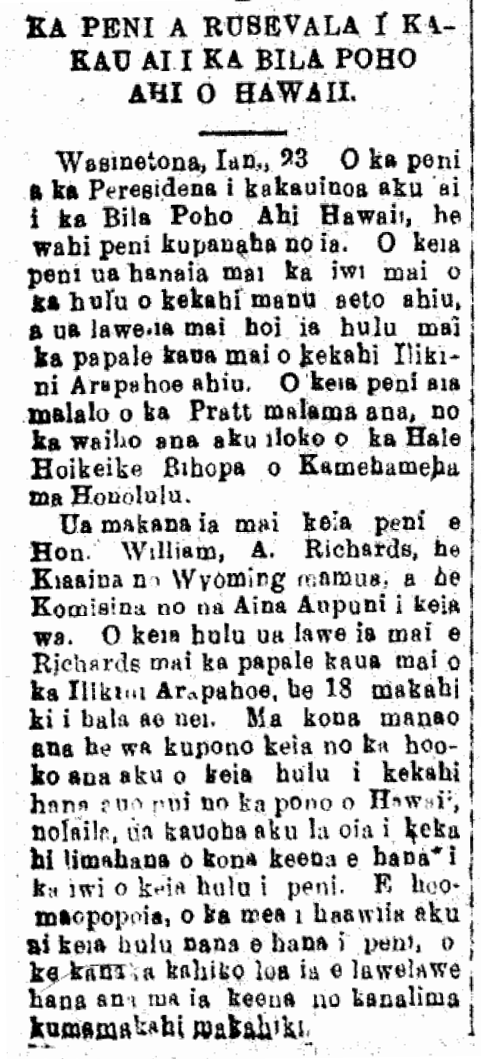
THE PEN WITH WHICH ROOSEVELT SIGNED THE FIRE CLAIMS BILL OF HAWAII.

Washington, Jan. 23. The pen with which the President signed the Hawaiian Fire Claims Bill [Bila Poho Ahi Hawaii] is a remarkable pen. This pen was made from the quill of a feather of a wild eagle, and that feather was taken from a war headdress of a wild Arapaho Indian. This pen is now in the care of Pratt to be placed in the Bishop Museum of Kamehameha in Honolulu.

This pen was gifted to the Hon. William A. Richards, a former Governor of Wyoming, and currently a Commissioner of Public Lands [Aina Aupuni]. This feather was taken by Richards from the headdress of an Arapaho Indian 18 years ago. He thought it was the right time for this feather to be put to some important use for Hawaii, therefore, he ordered one of the workers in his office to fashion the feather into a pen. Let it be remembered that this person who was given the feather to make a pen is a man of much seniority who was working in that office for fifty-one years.

(Aloha Aina, 2/7/1903, p. 1)

KA PENI A RUSEVALA I KAKAU AI I KA BILA POHO AHI O HAWAII.

Ke Aloha Aina, Buke IX, Helu 6, Aoao 1. Feberuari 7, 1903.