Follow up to Hawaiian National Hymn, 1862.

[Found under: “NEWS OF HAWAII NEI.”]

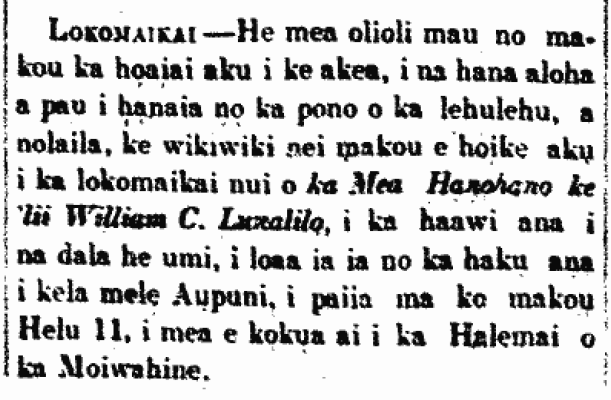
Good Will.—We are always delighted to release to the public all kind deeds done for the benefit of the people, and therefore, we are showing at once the great kindness of the Honorable, Chief William C. Lunalilo, in his donating the ten dollars he received for composing the National song that was published in our Issue 11, to aid the Queen’s Hospital.

(Kuokoa, 2/15/1862, p. 2)

Lokomaikai.

Ka Nupepa Kuokoa, Buke I, Helu 12, Aoao 2. Feberuari 15, 1862.

More on the Hawaiian National Hymn, 1874.

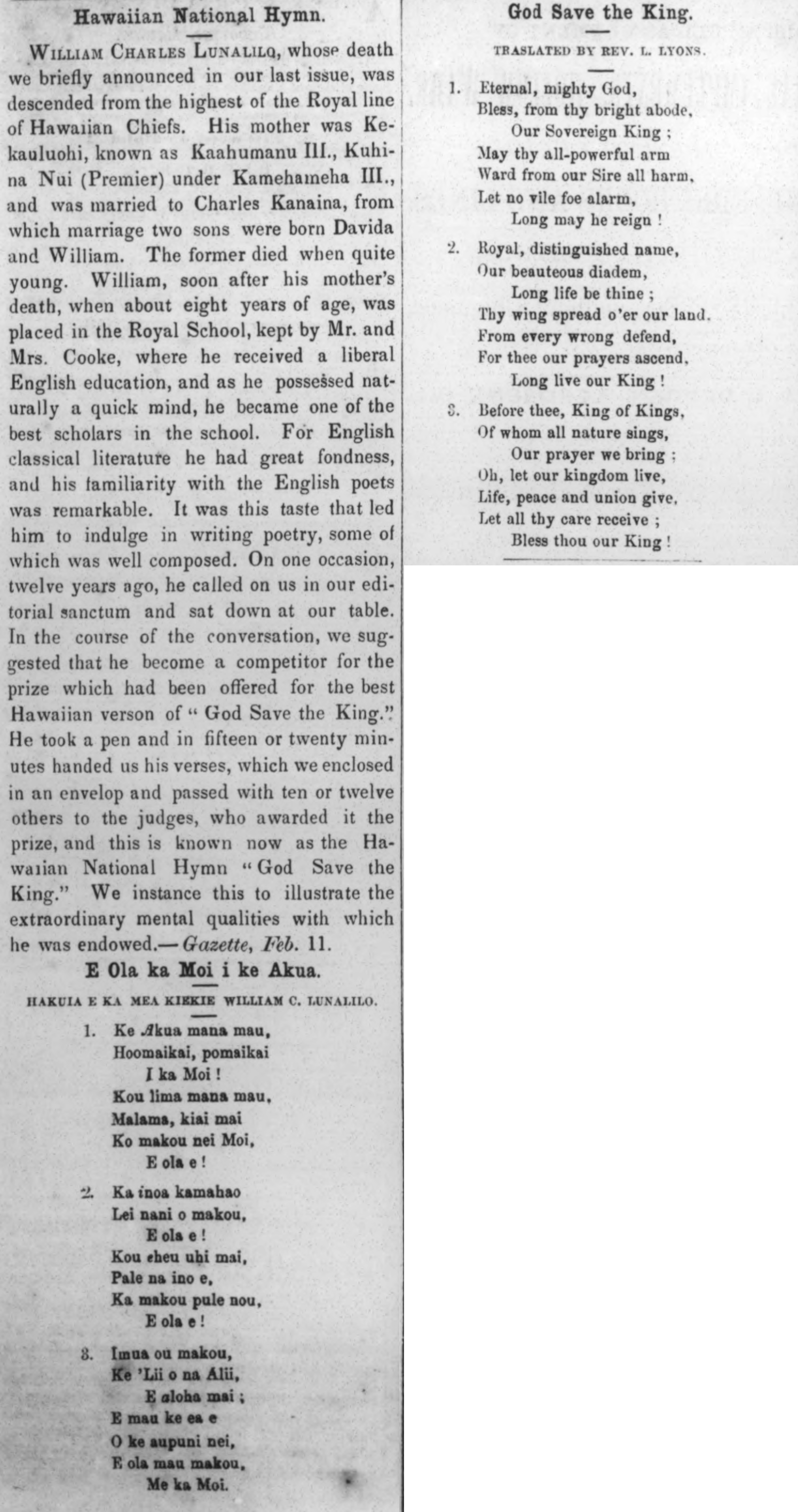
Hawaiian National Hymn.

William Charles Lunalilo, whose death we briefly announced in our last issue, was descended from the highest of the Royal line of Hawaiian Chiefs. His mother was Kekauluohi, known as Kaahumanu III., Kuhina Nui (Premier) under Kamehameha III., and was married to Charles Kanaina, from which marriage two sons were born Davida and William. The former died when quite young. William, soon after his mother’s death, when about eight years of age, was placed in the Royal School, kept by Mr. and Mrs. Cooke, where he received a liberal English education, and as he possessed naturally, a quick mind, he became one of the best scholars in the school. For English classical literature he had great fondness, and his familiarity with the English poets was remarkable. It was this taste that led him to indulge in writing poetry, some of which was well composed. On one occasion, twelve years ago, he called on us in our editorial sanctum and sat down at our table. In the course of the conversation, we suggested that he become a competitor for the best prize which had been offered for the best Hawaiian version of “God Save the King.” He took a pen and in fifteen or twenty minutes handed us his verses, which we enclosed in an envelope and passed with ten or twelve others to the judges, who awarded it the prize, and this is known now as the Hawaiian National Hymn “God Save the King.” We instance this to illustrate the extraordinary mental qualities with which he was endowed.—Gazette, Feb. 11.

E Ola ka Moi i ke Akua.

HAKUIA E KA MEA KIEKIE WILLIAM C. LUNALILO.

1. Ke Akua mana mau,
Hoomaikai, pomaikai
I ka Moi!
Kou lima mana mau,
Malama, kiai mai
Ko makou nei Moi,
E ola e!

2. Ka inoa kamahao
Lei nani o makou,
E ola e!
Kou eheu uhi mai,
Pale na ino e,
Ka makou pule nou,
E ola e!

3. Imua ou makou,
Ke ‘Lii o na Alii,
E aloha mai;
E mau ke ea e
O ke aupuni nei,
E ola mau makou,
Me ka Moi.

God Save the King.

TRANSLATED BY REV. L. LYONS.

1. Eternal, mighty God,
Bless, from thy bright abode,
Our Sovereign King;
May thy all-powerful arm
Ward from our Sire all harm,
Let no vile foe alarm,
Long may he reign!

2. Royal, distinguished name,
Our beauteous diadem,
Long life be thine;
Thy wing spread o’er our land.
From every wrong defend,
For thee our prayers ascend,
Long live our King!

3. Before thee, King of Kings,
Of whom all nature sings,
Our prayer we bring;
Oh, let our kingdom live,
Life, peace and union give,
Let all thy care receive;
Bless thou our King!

(Friend, 3/2/1874, p. 24)
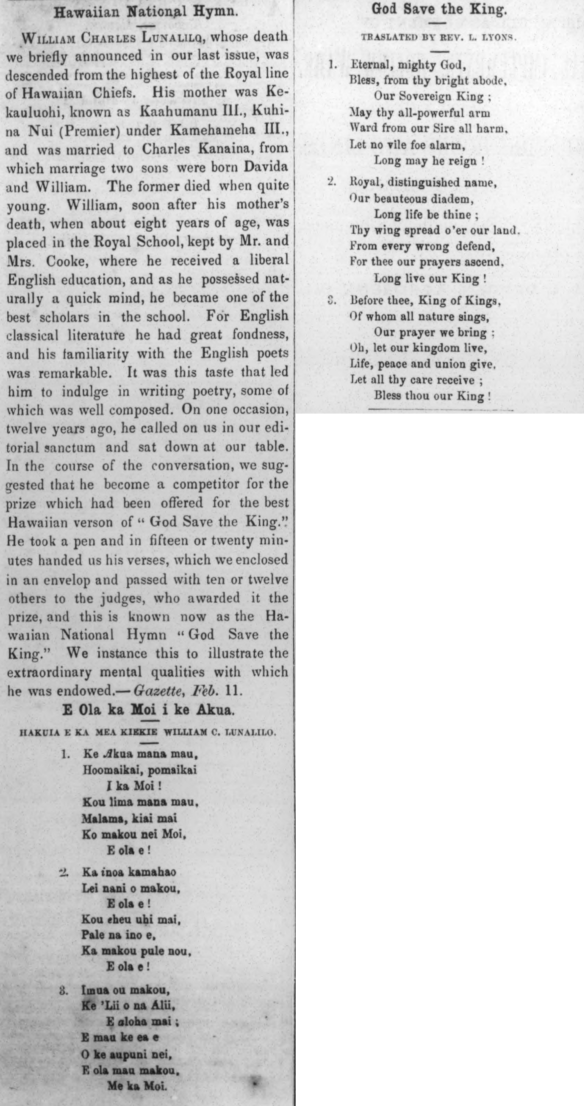
Hawaiian National Hymn.

The Friend, New Series, Volume 23, Number 3, Page 24. March 2, 1874.
Hawaiian National Hymn, 1862.

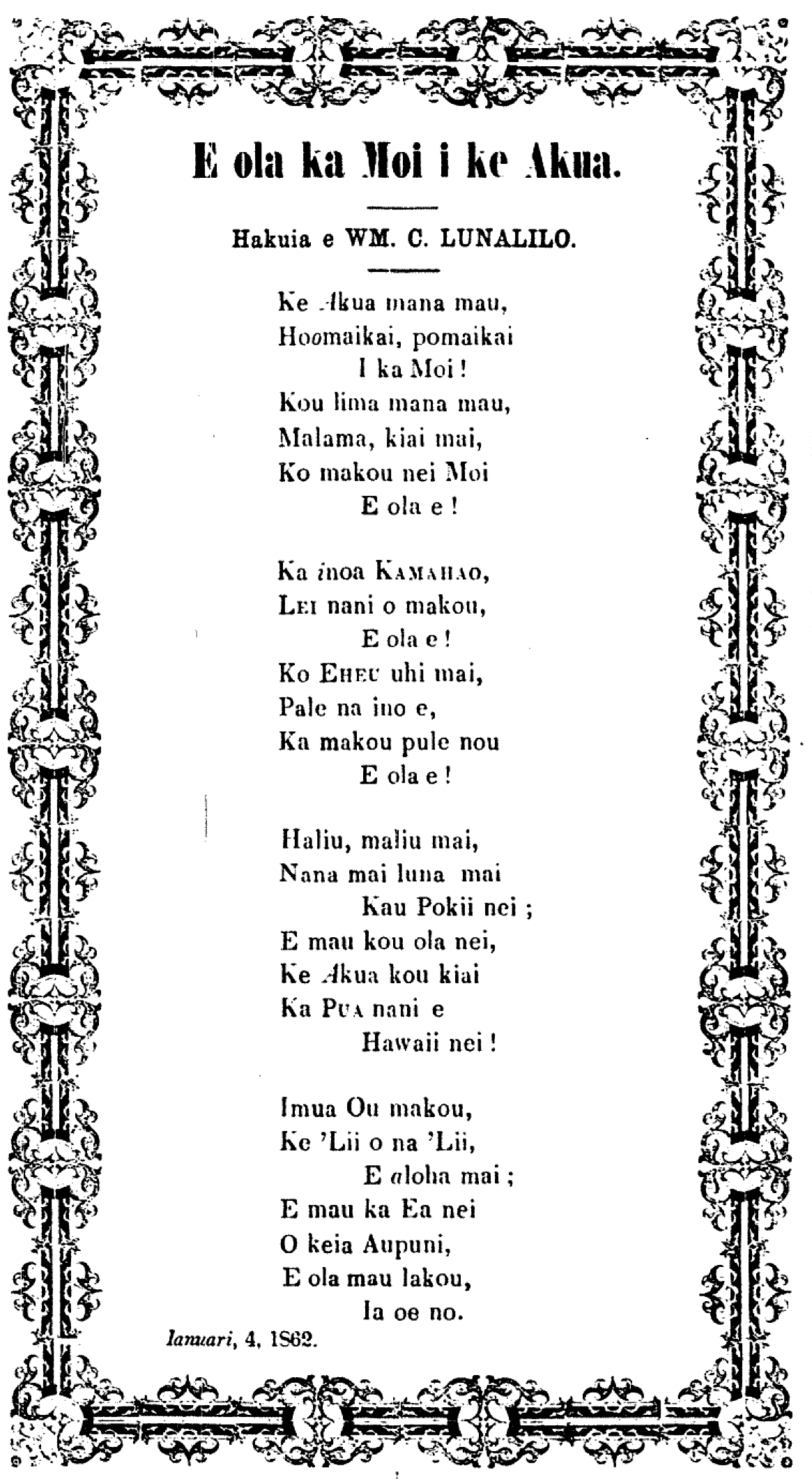
E ola ka Moi i ke Akua.

Composed by WILLIAM C. LUNALILO.

Ke Akua mana mau,
Hoomaikai, pomaikai
I ka Moi!
Kou lima mana mau,
Malama, kiai mai,
Ko makou nei Moi
E ola e!

Ka inoa Kamahao,
Lei nani o makou,
E ola e!
Ko Eheu uhi mai,
Pale na ino e,
Ka makou pule nou,
E ola e!

Haliu, maliu mai,
Nana mai luna mai
Kau Pokii nei;
E mau kou ola nei,
Ke Akua kou kiai
Ka Pua nani e
Hawaii nei!

Imua Ou makou,
Ke ‘Lii o na ‘Lii,
E aloha mai;
E mau ka Ea nei
O keia Aupuni,
E ola mau lakou,
Ia oe no.

January 4, 1862.

(Kuokoa, 2/8/1862, p. 1)

E ola ka Moi i ke Akua.

Ka Nupepa Kuokoa, Buke I, Helu 11, Aoao 1. Feberuari 8, 1862.

A composition for Hawaiians boys going away to war, 1918

Mele for the Hawaiian Boys

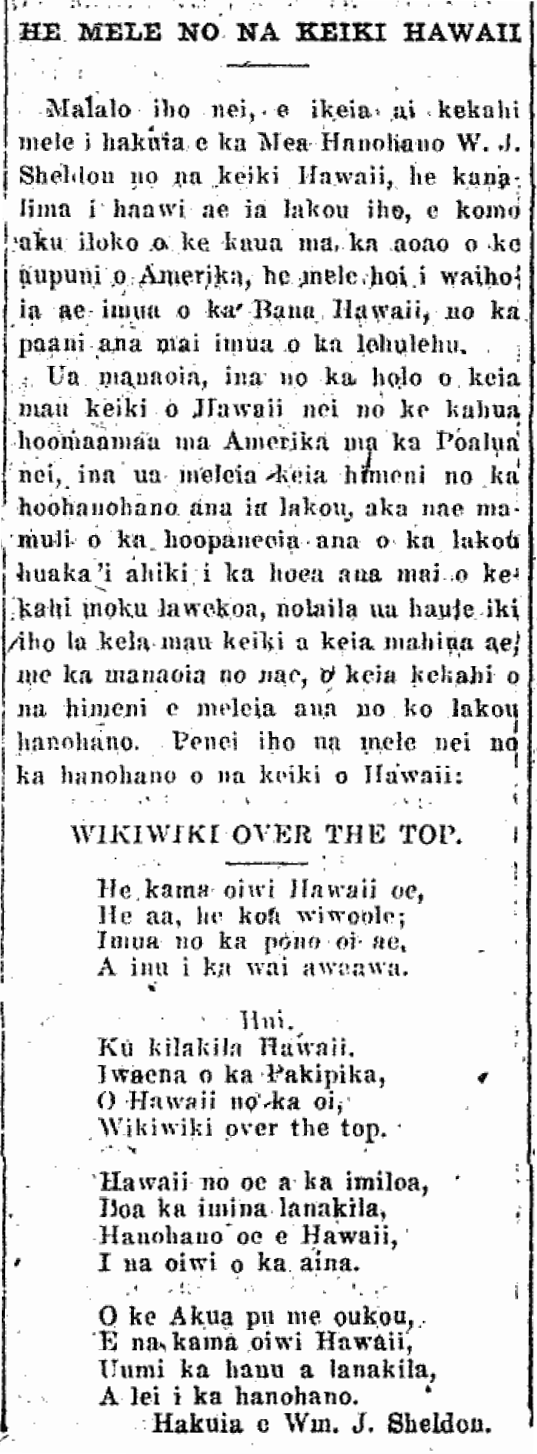
Seen below is a mele composed by the Honorable W. J. Sheldon for the fifty Hawaiian boys who gave themselves to join the war on the side of the nation of America. It is a song put before the Royal Hawaiian Band, to be played before the public.

It is believed that if these Hawaiian boys head out to the training camp in America on Tuesday, this song would have been sung for them in their honor. But as their trip is postponed until the arrival of a military ship, therefore the boys have been set back until next month. It is still believed that this will be one of the songs that will be sung to honor them. Here is this mele to glorify these Hawaiian youths:

WIKIWIKI OVER THE TOP

He kama oiwi Hawaii oe,
He aa,  he koa wiwoole;
Imua no ka pono oi ae,
A inu i ka wai awaawa.

Hui.

Ku kilakila Hawaii,
Iwaena o ka Pakipika,
O Hawaii no ka oi,
Wikiwiki over the top.

Hawaii no oe a ka imiloa,
Loa ka imina lanakila,
Hanohano oe e Hawaii,
I na oiwi o ka aina.

O ke Akua pu me oukou,
E na kama oiwi Hawaii,
Uumi ka hanu a lanakila,
A lei i ka hanohano.

Hakuia e Wm. J. Sheldon.

[Which went something like this:

QUICKLY OVER THE TOP.

You are a native son,
Daring, a fearless warrior;
Forward for the greater good,
And drink of the bitter waters.

Chorus.

Hawaii stands tall,
Amidst the Pacific,
Hawaii is the foremost,
Quickly, over the top.

You are Hawaii, of explorers,
Far reaching is your search for victory,
Proud is Hawaii,
For the oiwi of the land.

God be with you,
O Native sons of Hawaii,
Be patient until victorious,
And wear the honor like a lei.

Composed by William J. Sheldon.]

(Kuokoa, 5/17/1918, p. 3)

HE MELE NO NA KEIKI HAWAII

Ka Nupepa Kuokoa, Buke LVI, Helu 20, Aoao 3. Mei 17, 1918.

Another mele composed by Mary Jane Montano, 1919.

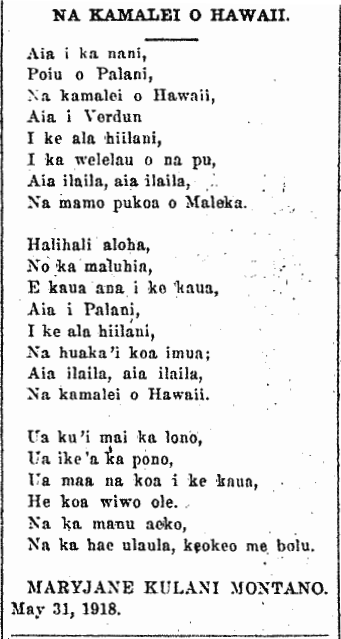
NA KAMALEI O HAWAII.

Aia i ka nani,
Poiu o Palani,
Na kamalei o Hawaii,
Aia i Verdun,
I ke ala hiilani,
I ka welelau o na pu,
Aia ilaila, aia ilaila,
Na mamo pukoa o Maleka.

Halihali aloha,
No ka maluhia,
E kaua ana i ke kaua,
Aia i Palani,
I ke ala hiilani,
Na huaka’i koa imua;
Aia ilaila, aia ilaila,
Na kamalei o Hawaii.

Ua ku’i mai ka lono,
Ua ike’a ka pono,
Ua maa na koa i ke kaua,
He koa wiwo ole.
Na ka manu aeko,
Na ka hae ulaula, keokeo me bolu.

MARYJANE KULANI MONTANO.

May 31, 1918.

[This is yet another composition by Mary Jane Montano, although not widely known today. This was composed in honor of the Hawaiian boys who were fighting in World War I, and alludes to the Battle of Verdun.

In the Hawaiian-Language Newspapers, you can find countless examples of Hawaiian boys going off to war outside of Hawaii nei, starting with America’s Civil War, and on down to the present.

The mele goes somewhat like:

THE BELOVED YOUTH OF HAWAII.

There in the beauty,
The glory of France,
Are the beloved youth of Hawaii,
There at Verdun,
On the exalted trail,
At the point of the artillery,
They are there, they are there,
The young fighters of America.

Carrying aloha,
For peace,
Fighting the fight,
There in France,
On the exalted trail,
The marching soldiers go forth,
They are there, they are there,
The beloved youth of Hawaii.

The news has spread,
The good has been seen,
The soldiers are seasoned,
Fearless warriors.
For the eagle,
For the red, white, and blue flag.

MARYJANE KULANI MONTANO.

May 31, 1918.]

(Kuokoa, 1/3/1919, p. 8)

NA KAMALEI O HAWAII

Ka Nupepa Kuokoa, Buke LVII, Helu 1, Aoao 8. Ianuari 3, 1919.

The children are your future! 1909 / timeless.

DON’T DECREASE THE PAY OF THE TEACHERS.

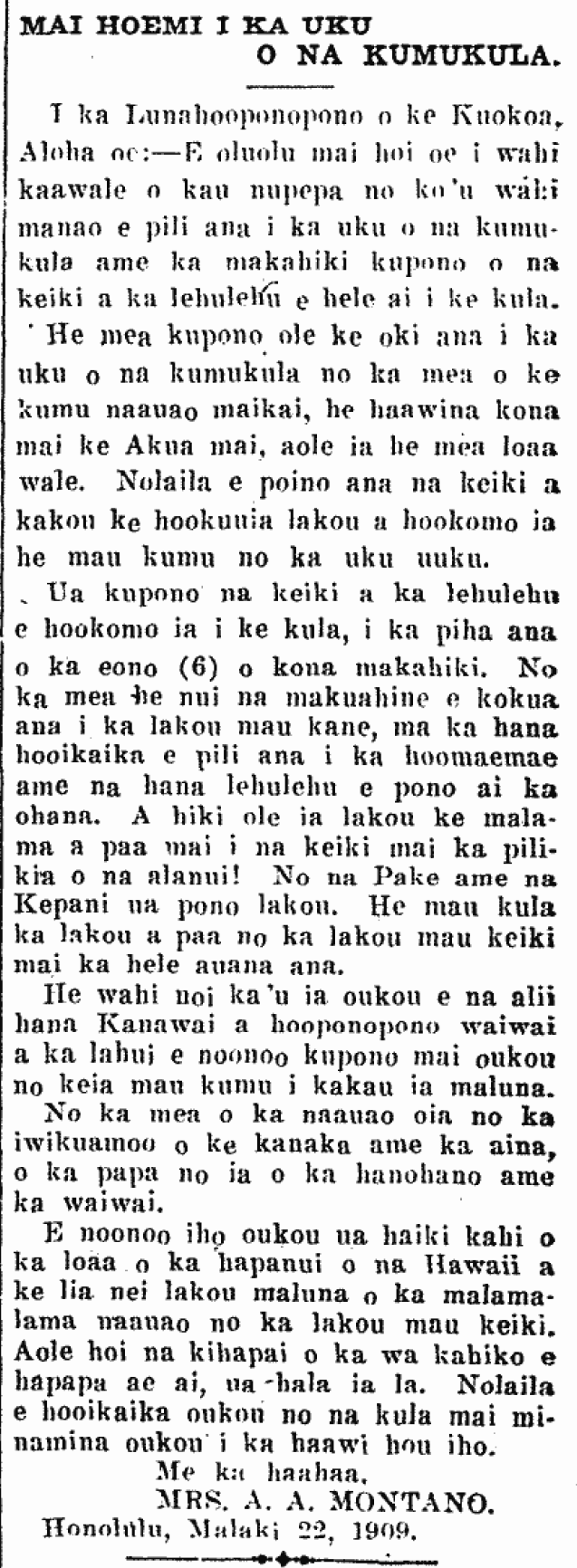
To the Editor of the Kuokoa, Aloha oe:—Please allow me some space in your newspaper for my humble thoughts dealing with the salary of teachers and the age at which children of the public should attend school.

It is wrong to cut the teachers’ pay because a well-educated teacher has a gift from God; it is not something readily gotten. And our children will be hurt should we let those teachers go and employ teachers for little pay.

The children of the people should be enrolled in school when they turn six (6) years of age. For there are many women who assist their husbands by endeavoring to take care of the many duties for the good of the family. And they are not able to care for and keep their children from the harm of the streets! As for the Chinese and the Japanese, they are fine. They have schools and their children are kept from wandering about.

I beseech all of you leaders who make Laws and who regulate public funds, do think carefully about these thoughts written above.

For knowledge is the backbone of man and his nation; it is the basis for fame and wealth.

Consider that the income of the majority of the Hawaiians is limited, and they are counting on the light of education for their children. The plantations of the old days are not to be reached out for, for those days are past. So all of you, please put effort into the schools, and don’t feel hesitant in investing more.

Sincerely,

MRS. A. A. MONTANO.

Honolulu, Malaki 22, 1909.

[Times have changed. Hopefully we learn from the past…

This letter is written by famed composer, Mary Jane Kekulani Montano.]

(Kuokoa, 3/26/1909, p. 4)

MAI HOEMI I KA UKU O NA KUMUKULA.

Ka Nupepa Kuokoa, Buke XLVI, Helu 13, Aoao 4. Maraki 26, 1909.

Ninipo Hoonipo Song, a follow up, 1999.

There was a question by MA Kaiulani Milham about a translation of an earlier post about the mele “Ninipo Hoonipo Song,” by Queen Liliuokalani. There is a very nice book of many of the Queen’s songs put out by Hui Hanai in 1999, “The Queen’s Songbook.” The lyrics are in there along with the music, a translation, and a short writeup!

A mele by Her Majesty Queen Liliuokalani, 1894.

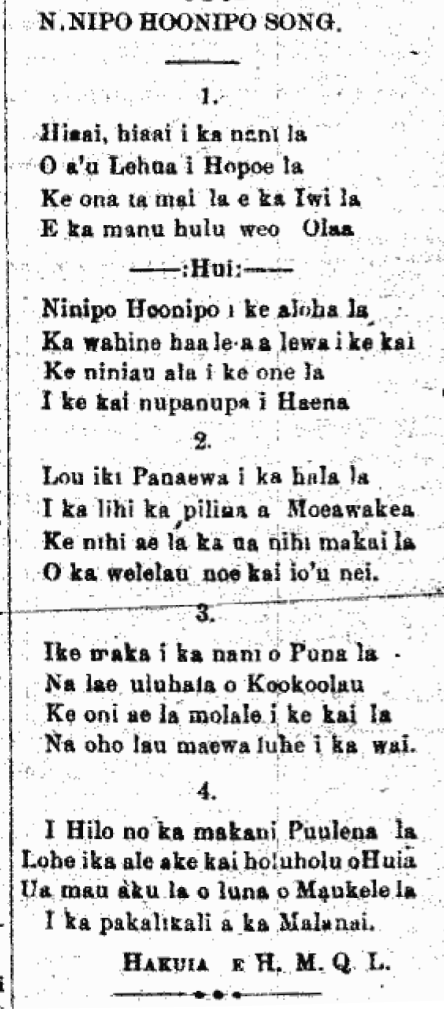
NINIPO HOONIPO SONG.

1.

Hiaai, hiaai i ka nani la
O a’u Lehua i Hopoe la
Ke ona ia mai la e ka Iwi la
E ka manu hulu weo Olaa

——: Hui :——

Ninipo Hoonipo i ke aloha la
Ka wahine haa le-a a lewa i ke kai
Ka niniau ala i ke one la
I ke kai nupanupa i Haena

2.

Lou iki Panaewa i ka hala la
I ka lihi ka pilina a Moeawakea
Ke nihi ae la ka ua nihi makai la
O ka welelau noe kai io’u nei.

3.

Ike maka i ka nani o Puna la
Na lae uluhala o Kookoolau
Ke oni ae la molale i ke kai la
Na oho lau maewa luhe i ka wai.

4.

I Hilo no ka makani Puulena la
Lohe i ka ale a ke kai holuholu o Huia
Ua mau aku la o luna o Maukele la
I ka pakalikali a ka Malanai.

Composed by H. M. Q. L.

[The newspaper “Ka Oiaio” begins in 1889, but there are only a few issues found for that year, and for 1890, 1891, 1892, and 1893, there are none! Hopefully someone is holding on to copies of these years, because they can open up a whole new picture to that period in history!!

Talk about the Hawaiian-Language Newspapers to others. The more people talk, the more likely it will be that these lost issues might once again be found.]

(Oiaio, 8/10/1894, p. 4)

NINIPO HOONIPO SONG.

Ka Oiaio, Buke VI, Helu 32, Aoao 4. Augate 10, 1894.

Beginning of line-by-line commentary of “Aia i Honolulu kuu pohaku,” 1929.

EXPLANATION OF THE FIRST LINE.

1. Aia i Honolulu kuu pohaku

Kapanookalani’s thoughts:—This land Honolulu, it is close to Nanawale, Puna, by the sea. It is a ku, a small land in between large lands.

The stone [pohaku] is Lord [Haku] of the chiefess and in this word, the important idea is chiefess [‘lii wahine].

Kahapula’s thoughts:—Honolulu is on Oahu, where King Kamehameha V dwelt and those who opposed him is the Honolulu in this first line of the mele. It was here his enemies schemed and carried out all their defiant acts against him. While they knew the wish of the King to marry the chiefess Pauahi, her teacher, Amos Cooke secretly agreed to  Bishop for him to meet with Pauahi without the knowledge of her parents. That is how Pauahi became Bishop’s, and this is how Bishop and his relative Lee [? William Little Lee] became dignitaries of the land.

Kupihea’s thoughts:—Honolulu is a fish stone called a Kuula, and was brought here to this Honolulu [on Oahu] from the Honolulu of Puna [on Hawaii]. This Kuula was placed in the tiny land of Honolulu where an Alii called Honolulu lived, who was related to the chiefess Peleula, whose younger sister was the beautiful Waikiki. This place is mauka of the old Rawlin’s Estate. There is a bank of coral where Honolulu is; the fishing altar [Kuula] for the fish ponds [loko i’a] is on the Waikiki side of Liliha Street and between Vineyard and King Streets.

The stone is related to chiefs from times immemorial [mai ka po mai]. It is a manifestation made by God.

Iokepa’s thoughts:—Honolulu is a small land and a canoe landing makai of Nanawale, Puna, between two sand dunes, one on the Hilo side and one on the Puna side, called Puu Waawaa. From this Honolulu is called the Honolulu here [on Oahu] which used to be called Kou before, and after it was called Honolulu until this day.

This is the meaning for the word Honolulu:—The wind is very calm [lulu] an the sea is serene; it is very fine and peaceful. Bay [? Hono] of calm sea; Hono that is peaceful.

Kuluwaimaka’s thoughts:—The stone is related to Kamehameha V. Honolulu in Puna is a lowland next to the sea. Its width is perhaps half a mile long between Na Puu o Pele and Waiakahiula on the Hilo side. Honolulu is a place where you pick opihi [ku’i opihi] and pick limu [hana limu]. There is a fine spring [punawai] there and there is a foot path there.

[And to think that this is but the very beginning of Kelsey’s detailed account of the explanation of the six loea of the mele “Aia i Honolulu kuu pohaku.” This is just the first line! It continues in the following issues!!

One more (huge) reason that Hawaiian-Language Newspapers are priceless!!!]

(Alakai o Hawaii, 12/5/1929, p. 2)

NA MANAO WEHEWEHE MALUNA O KA LAINA EKAHI.

Ke Alakai o Hawaii, Buke 1, Helu 32, Aoao 2. Dekemapa 5, 1929.

More on “Aia i Honolulu kuu pohaku”! 1929.

A MELE FOR KAMEHAMEHA V.

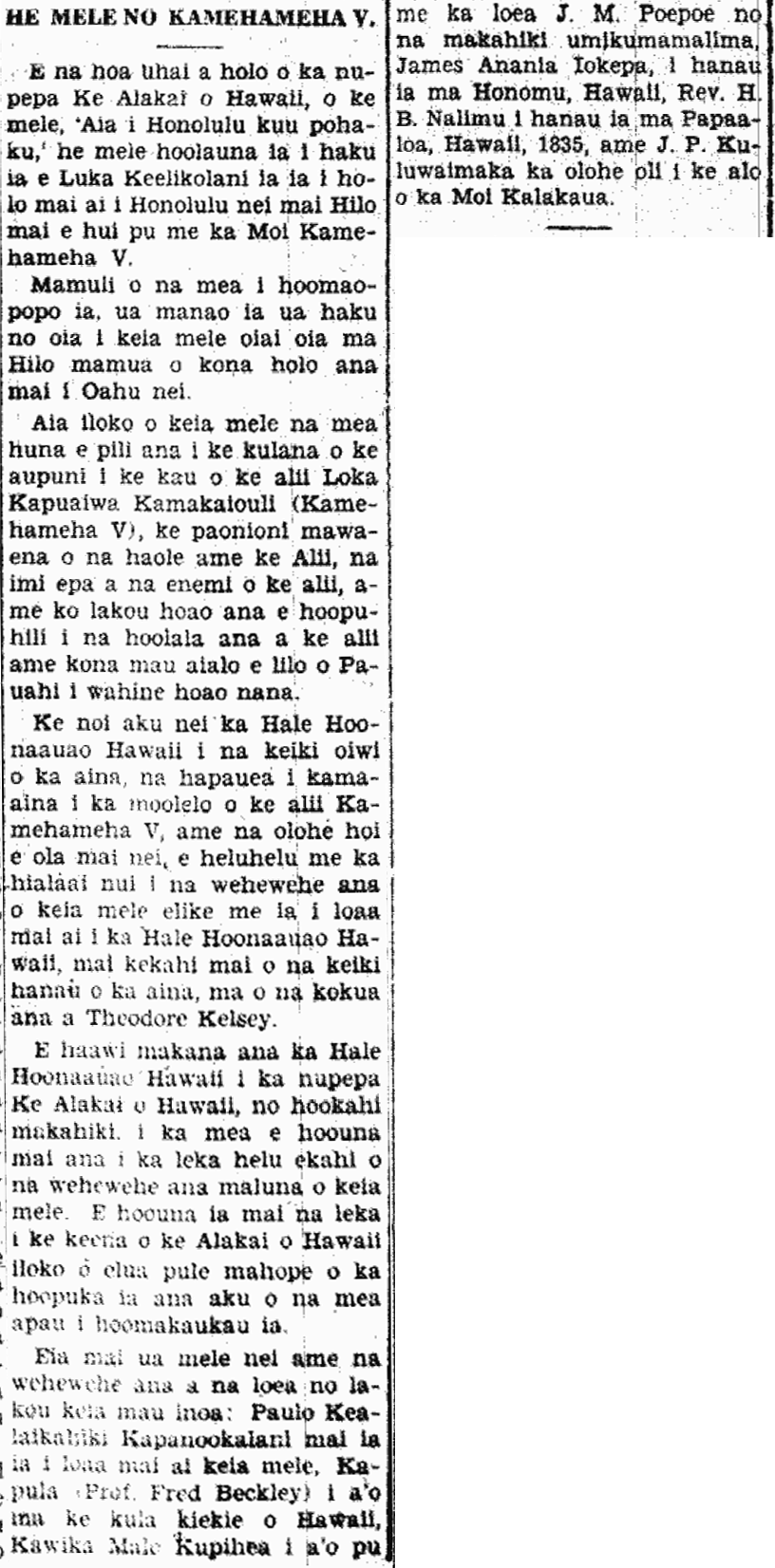
O Friends who chase after Ke Alakai o Hawaii, the mele, “Aia i Honolulu kuu pohaku,” is a mele of familiarity [mele hoolauna] composed by Luka Keelikolani when she was coming to here in Honolulu from Hilo to meet with King Kamehameha V.

From what is understood, it is believed that she composed this mele while she was in Hilo before her travelling to Oahu nei.

In this mele are hidden things dealing with the nation in the time of the alii Loka Kapuaiwa Kamakaiouli (Kamehameha V); the contention between the haole and the King, the deceit of the enemies of the King and their attempt to thwart the plans by the King and his court to make Pauahi his wife.

The Hale Hoonaauao Hawaii asks the native ones of the land, the old ones familiar with the history of King Kamehameha V, and the experts still living, to read with much pleasure the explanations of this mele as per what was obtained by the Hale Hoonaauao Hawaii from those native born of the land through the assistance of Theodore Kelsey.

The Hale Hoonaauao Hawaii will award a one-year subscription of the newspaper Ke Alakai o Hawaii to the one who sends the best letter with explanations on this mele. Send the letters to the office of Ke Alakai o Hawaii withing two weeks of the completion of the publishing of all that has been compiled.

Here is the mele and the explanations of the experts [loea] whose names are: Paulo Kealaikahiki Kapanookalani from whom we received this mele, Kahapula (Prof. Fred Beckley) who teaches at the University of Hawaii, Kawika Malo Kupihea who studied with the loea J. M. Poepoe for fifteen years. James Anania Iokepa who was born in Honomu, Hawaii, Rev. H. B. Nalimu who was born in Papaaloa, Hawaii in 1835, and J. P. Kuluwaimaka the skilled chanter [olohe oli] in the court of King Kalakaua.

[“Aia i Honolulu kuu pohaku” is perhaps the most widely studied mele i have seen, with line-by-line interpretations by experts of the day. It continues on for a number of issues of Alakai o Hawaii.

Does anyone have any details on the organization called Hale Hoonaauao Hawaii, or Hale Hoonaauao o Hawaii?]

(Alakai o Hawaii, 12/5/1929, p. 2)

HE MELE NO KAMEHAMEHA V.

Ke Alakai o Hawaii, Buke 1, Helu 32, Aoao 2. Dekemapa 5, 1929.