Honorable Lydia Kamakaeha Paki weds Adjutant General Major J. O. Dominis, 1862.

MARRIED—At the hour of 8 in the evening of Tuesday, the 16th of this month, the Honorable Lydia Kamakaeha Paki married Adjutant General Major J. O. Dominis, at Haleakala, the Residence of the Honorable C. R. Bishop and his Chiefess. The two were married in the Anglican faith.

Present were the King; Her Highness Princess V. K. Kaahumanu; His Highness Prince L. Kamehameha; the Honorable M. Kekuanaoa, the Chiefly Governor of Oahu; Colonel Peter Young Kekuaokalani; there also were the parents of the woman, and the mother of the man, and his cousins.

Rev. Samuel C. Damon was who married them. There was much appreciation for how fine and honorable it was. With the two of them is the aloha of this paper.

[It seems Queen Emma was not present at this wedding. Ka Haku o Hawaii had only passed away a few weeks earlier…]

(Kuokoa, 9/20/1862, p. 3)

MAREIA...

Ka Nupepa Kuokoa, Buke I, Helu 43, Aoao 3. Sepatemaba 20, 1862.

“Ka Nonanona,” 1841–1845.

THE ANT.

“Go to the ant, thou sluggard; consider her ways, and be wise.”

[Just as an aside, here is the masthead of “Ka Nonanona,” and you can see here why this was chosen as the title of the paper. The passage is found in Proverbs (Solomona) 6:6. It is also seen in Hawaiian as: “E ka mea hiamoe, e hele oe i ka anonanona¹, E nana i kona aoao a e hoonaauao iho.”]

¹”Anonanona” is a variant of “nonanona,” meaning ant.

KA NONANONA

“Ka Nonanona” masthead


Question put out to the public, 1843.

Here me O People of Hawaii nei; what do you all think of this cession of the kingdom? Is it fine? Your heart probably aches for the king and all the alii; That is how it should be; we are all hurting; however, do not grieve, do not revolt, do not let your resolve waver. We must remain calm and abide by the laws; don’t think that the laws have fallen, not at all, they are still totally in effect. There was a small disturbance in Honolulu the other night, and some men severely injured some of the sailors from the warship, and therefore the laws are being announced once again these days, so that the confusion of the people will end.

O Christian people of Hawaii nei, do not feel uncertain over the cession of the nation; our kingdom does not lie in this world, we have a different kingdom in the heavens; it is a great kingdom which is permanent, and unshakeable, and peaceful. Its king is good; he watches over his people, and they live forever. The nations of this world end quickly and are gone forever, but the kingdom of Jesus Christ will never end. Let us search after this kingdom and its righteousness, and we will be saved from the turbulence of this world.

[This editorial is probably by Richard Armstrong (Limaikaika), missionary and editor of Ka Nonanona.]

(Nonanona, 3/7/1843, p. 100)

Auhea oukou e na kanaka o Hawaii nei...

Ka Nonanona, Buke 2, Pepa 20, Aoao 100. Maraki 7, 1843.

Letter from Iosepa, Utah, 1913.

A VOICE FROM UTAH.

Iosepa, Toole County. Dec. 19, 1912.

Solomon Hanohano, Editor of the Kuokoa, Aloha oe:—Because I want to know the news of the land of our birth, the desire to get a subscription to the Kuokoa grew. Being the the new year is coming, it would be a means for me to see the news of our home and the progress of the political scene or its regression, as well as the victories or discouragements of our fellow makaainana.

Not because Iosepa lacks newspaper subscribers, but for me to get a personal one.

This is one of the important years regarding the nation, being that the leadership of the power of the nation went to the Democrats; the big question is just this: Will the poor makaainana really benefit, or will they be left unstable once again like during the presidency of Cleveland, but it is only time that will tell.

If those elected could follow through on what their lips pledge to the masses, then we indeed will be blessed, however if it is like what Isaiah said, thusly: “These people come near to me with their mouth, but their hearts are far from me.” [Isaiah 29:13] Then comes those famous words of that old timer of Lahaina: “Saying, when indeed will that happen.” [“I mai hoi, ahea la ka hoi.”] The big-eyed images know that the small-eyed images are not watched. [Ikeia aku la no na kii maka nunui, nana oleia iho la na wahi kii maka liilii ??]

My aloha to the few Hawaiian makaainana left who are squeezed and assimilated [i ka opaia aku ua pili pu ?] until they are totally gone from the beloved face of Hawaii, along with the increase of the other races upon the land. And so too with the various diseases of the different races whose devastation spread to our people who lack immunity. Aloha to our people.

As for our living in this unfamiliar land, this land that true Mormons know as the chosen land, and a land to foster the believers in that one faith, all of the Hawaiians are in good health as well as the Samoans, from the old to the young.

I have faith that Iosepa will become a place where Hawaiians will multiply once again, and that these valleys will become full of true Hawaiians and Samoans, when the children are born, and grow up, and marry and give birth.

Some proof of this belief is the great desire of the president of the Mormons for the youths to marry of their own race so that this land is full of Hawaiians. For according to him, it is here that the people of the islands of the ocean will spread.

The town of Iosepa is growing. The church is building homes for the people without homes, lest they live in disarray as the Hawaiians before, with two or three families in a single dwelling.

The workers are paid a dollar every Saturday. The children are taught in the school here in Iosepa. Two children graduated from the local school of Iosepa, and are attending high school, they are Joseph H. Bird and William Pukahi, both are true Hawaiians.

I have been just chosen as judge, and George K. Hubbell as sheriff of the district. We are both Republicans, which also are the majority of the Hawaiians here.

Perhaps this will do.

Charles J. Broad.

Iosepa, Toole County, Utah.

(Kuokoa, 1/10/1913, p. 6)

HE LEO MAI UTAH MAI.

Ka Nupepa Kuokoa, Buke XLIX, Helu 2, Aoao 6. Ianuari 10, 1913.

A visit to the Mormon settlement, Iosepa, Utah, 1912.

Travelling to Find Hawaiians in Iosepa, Utah.

Following the Presidential Nominating Convention in Chicago, I boarded the evening train, along with my travelling companions, on the sabbath, June 23, to return to San Francisco. We arrived at Salt Lake City at 5 p. m. on Tuesday evening, and I jumped off alone in that foreign land while my companions continued all the way.

The next day, I went to grounds of the Mormon temple and asked for the way to get to where the Hawaiians lived in Iosepa. I was told by the locals that Tempie was where the train stopped to go to Iosepa, and eight more miles and you’d reach Iosepa. I was restrained to wait for one of the Mormon teachers who lived here in Hawaii, for they knew the way to Iosepa, but I did not wait, I toured about the city until the time the train departed, and I boarded for Tempie.

I arrived there at 4:30 and saw a barren land with but two buildings, no trees, no crops, and they were just houses for the men who worked on the railroad. I was shocked, because there was no one home; I looked at the road lying to the south, to the east of the valley and I decided to walk until the houses of the locals of Iosepa, and so I went as a malihini on that lonely deserted road; I looked as far as my eyes could see, and there were no homes in sight, but I continued walking forward for eight miles and reached a hillock from which I could see four more miles, but I couldn’t see any houses, while I recalled what was told to me, that it was eight miles from Tempie to Iosepa; I was confused, thinking that maybe this wasn’t the correct road, so I turned back once again for Tempie. The sun went down, but the moon came out, so the trip on this deserted foreign land was not forlorn.

I arrived back in Tempie at eleven that night, knocked on the door, and the kamaaina, who was a Greek, awoke, and I slept there that night. He asked me about my travels, and I told him that I was headed for Iosepa, and I asked him the right way to get there, and he told me that that was indeed the road but he estimated that it was fourteen miles before reaching Iosepa.

Early the next morning, we were done with breakfast, and my kamaaina went off to work; he locked up the house, and I sat out on the lanai, waiting for for the mail truck, since the locals told me that the letter truck to Iosepa arrived at two that afternoon; I thought to walk once again, but because of swelling of my legs, I couldn’t do it.

In the afternoon, a delivery truck driven by a Hawaiian youth born there arrived first. After him arrived the mail truck driven by John Broad, the son of Charles Broad, along with three passengers headed for Salt Lake. I spent time with them until their train arrived and they left; and I waited for the train from Salt Lake; its arrival ran late, and it came at about six; we got the mail bag, and I went along with Jno. Broad to Iosepa which he said was sixteen miles from Iosepa to Tempie. We arrived at Iosepa at dusk, at eight in the evening and visited the home of Charles Broad and his queen [wife]. There I ate poi once again, that being poi palaoa [poi made of flour], and this was much tastier and better than the expensive haole food that I had in the American hotels.

I spent time with the Hawaiians living there, and asked about how their lives were;  they said their way of life in Iosepa was pleasant. Charles Broad and George Hubbel told me that when they were home in the land of their birth, they were subject to frequent bouts of rheumatism but in Iosepa they were fine and this ailment giving them sore bones disappeared. I was asked to stay back by the kamaaina to spend [seems to be a dropped line here: “hoohala i mau lakou”] so that they can properly welcome me, like by roasting a pig, joining together in celebration, and allowing time for the two singing groups to  come and entertain me with their music and Hawaiian songs that they cherish in that foreign land. But because of my very short time left before the Wilhelmina, my ship upon which I was returning, was leaving, therefore, I could not accept their invitation.

The town of Iosepa is east of Skull Valley [Awawa Pookanaka], and it is land dedicated as a home for kanaka people. Hawaiians are the majority living there, and there are some kauna [forty] samoans and the head haole and his family. There are 176 people in Iosepa. There is a school house, store, post office, church, dance hall, and a lanai for parties on special occasions.

The work people do there is farming, planting oats, wheat, potatoes, barley, and so forth. The land is flat and stretches out, and there is much space, enough for a thousand people, and there is a lot of spring water in that valley, but the land is like a salt bed, and it is by irrigation that the crops grow. Should you want a homestead, you can get 320 acres, being that there is abundant land yet few people.

Water is brought in for the town of Iosepa from the deep, grooved ravines of the mountains for many miles in canals which are lined with cement and runs out to a reservoir, and from there the water runs into great pipes reaching the roads of Iosepa and entering the house lots of the people.  The Church spent $76,000 to lay the waterway.

It is thought that it was an ultimate feat of Maui County, which spent $100,000 to lay the water system to bring the water from Puohokamoa Stream as water for the thousands of people of Makawao and Kula and the thousands of cattle of Kahikinui, however, people have to pay to get the water; as for the water in Iosepa, the Mormon Church paid $76,000 to get the water to make the life of the Hawaiians there easy, and they give it for free.

After finishing breakfast, the Head Boss, William Wadup [Waddoups], invited me to  tour the work place of the people, and so I went with him aboard his vehicle [Not sure what a “kaa bake” is, but it appeared in an earlier article i put up]. We arrived at the place of work, and I saw two men cutting grass. They sat atop the machine, guided the horses straight, and the machine was what cut the grass. And at another location, the dried grass (hay) was piled onto a large truck and taken to where it was heaped up, and the pile was as tall as a two-story building.

George Hubbel told me that pitching hay with long-handled three-pronged pitch forks was the most important job there, and the pay for that job was two dollars and a half a day for a single man, and three dollars for a married man; for other jobs, the pay was a dollar quarter and  a dollar half a day.

As I made ready to depart Iosepa that afternoon, people were let off work, they told me because it was windy that they could not pitch hay, and they all came down to see me and to give their aloha to the families in the land of their birth. There was much asking for me to visit them again should I come back to America, and from what I saw, they were very happy at the arrival of one of their own who saw and visited with them in this foreign land upon which they live.

They told me that in the twenty or more years which they lived in Iosepa, there were a great many Hawaiians who visited Salt Lake City, but I was a Hawaiian who actually went to Iosepa to see them before returning here to the sands of our birth.

Here are some people I saw there: Makaweli, the last born of the wife of Nailima of Hilo, who has many children and grandchildren in Iosepa. It was this kind Hawaiian lady who took care of Emilia Kalua (f), the grandchild of Keanini of Waikapu, Maui, because both of her parents died; the family of her father wanted to bring back this young girl to live with them. The Circuit Court of Maui appointed me as executor for her portion of the estate of her grandfather, and these are they things which made me visit Iosepa, Utah, and to see firsthand how this Hawaiian girl was living without parents in this foreign land. From what I saw and heard about her there, she was being properly taken care of, and she did not want to come to Hawaii nei.

Also, there is Naihe, a child of D. B. Mahoe of Hana; he is family there; he has eight children living. George Hubbel formerly of Honolulu, his wife, and their children, and so many more other Hawaiians gave their aloha to their family here in the land of their birth. According to some of them, it is their homeland, the treatment of the church elders is good, and the thought to return to the land of their birth is very far away, except for the fact that their aloha for Hawaii is not gone, as for their kin at home with their never-ending thoughts of them.

KALE WILIKOKI [Charles Wilcox]

(Kuokoa Home Rula, 7/12/1912, p. 4)
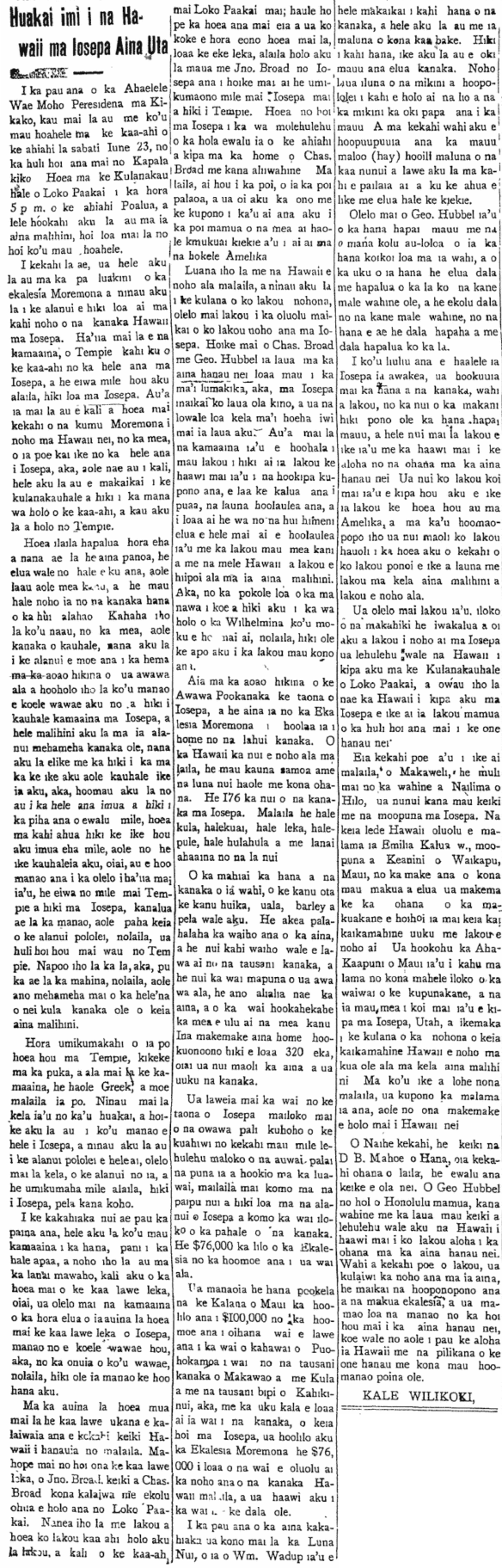
Huakai imi i na Hawaii ma Iosepa Aina Uta

Kuokoa Home Rula, Buke X, Helu 28, Aoao 4. Iulai 12, 1912.

Marriage announcement outside of the Vital Statistics Column, 1912.

BOUND WITH THE THREE-STRAND CORD OF TRUE LOVE

Within the Anglican Church of St. Andrew’s, on this past Saturday evening, the youths, Miss Annabel Low and Albert Ruddle were joined together by the Rev. Leopold Kroll. The bride was donned with a white dress and a sheer veil, and atop her head was a lei of orange blossoms. She held a bouquet of flowers in her hand as seen in all marriage ceremonies, and she held a book of prayers in her hand. It was her father, Eben Low, who gave her into the care of her new parent, her husband. Misses Glorinda and Laura Low were the bride’s maids, and they held in their hands, bouquets of lavender roses. The best man was Mr. Kinegal, and the gentlemen in charge of hospitality were Stillman and Percy Deverill.

Miss Annabel Low who married Ruddle is the eldest daughter of Mr. and Mrs. Low of this town. She was a student who graduated from the College of Kapunahou [Punahou] three years ago, and after some time in the teachers’ school, she was appointed as a teacher at a school on Hawaii Island, where she first met this man whom she wed, Mr. Ruddle, who is employed in a high position at the volcano. They will be returning to the Kanilehua of Hilo on Wednesday’s Mauna Kea where they will make their permanent home from here forth.

(Kuokoa, 7/12/1912, p. 6)

AWAIAULUIA ME KE KAULA KAAKOLU A KE ALOHA OIAIO

Ka Nupepa Kuokoa, Buke XLVIII, Helu 28, Aoao 6. Iulai 12, 1912.

Rose Kanewanui of Hanalei passes, 1912.

MY BELOVED HAS GONE.

Mr. Editor of the Kuokoa Newspaper, Aloha oe:—Please be so kind as to welcome to a free space in your paper, the words above. Being that on the morning of the Sabbath, June 9, 1912, the angel of death visited our loving home in Hanalei, Kauai, and took the breath of Mrs. Rose Kanewanui, and left behind the body to return to the earth; and the puolo¹ of love is left with the husband, the younger siblings, the children, the grandchildren, the family, the intimates, and friends who grieve after her.

She was born from the loins of Mrs. Paakiha Puniwaa and Mr. Daniela Waiolohia Paniwaa at Hanalei, Kauai, June 17, 1853, and died June 9, 1912, she lived on this earth 58 years, 11 months, and 23 days.

At age seven, she was educated in the English language at the school of Waioli, Kauai, and Miss Abe Johnson was the teacher. At 12, she entered as a brethren of the Church of Waioli, Kauai, under the direction of Rev. Johnson, and she was a member for 47 years, until she died and met with her Lord in that realm of peace where his servants rest.

At 17, she entered into the Kawaiahao Girls’ School which was under the principal Miss Bingham. At 24, in the month of January 1877, we were joined together in the covenant of marriage by Rev. R. Puuki, and from then forth until her passing, we were joined together in the embrace of love for 35 years; and from our loins came 11 children; death snatched 10 and my beloved wife, and I am left with one, and a elder brother and younger brother, along with many relatives.

She was a native and familiar of Kauai of Manokalanipo, and a mother who volunteered her time with church duties and Ahahui C. E. [Christian Endeavor] and she was a member of the Ahahui C. E. of the elders of Waioli.

She was a kind mother, inviting, and welcomed friends to visit our home, and she left me and our child [lei], a daughter and grandchildren and the family to remembering and grieving for her.

Me with sadness,

S. KANEWANUI.

Hanalei, Kauai, June 14, 1912.

¹Puolo is  a bundle, and is used here figuratively.

[One should not just stop at the regular Vital Statistics Column when looking for kupuna. Rose Kanewanui’s death does not appear in the regular column, but this sweet remembrance by her husband is filled with so much more of her life story than would be given in the Vital Statistics Column. There are so many of these throughout the pages of the Hawaiian-Language Newspapers!]

(Kuokoa, 6/21/1912, p. 6)

KUU MEA ALOHA UA HALA.

Ka Nupepa Kuokoa, Buke XLVIII, Helu 25, Aoao 6. Iune 21, 1912.

Look back at the 1867 laying of the cornerstone of St. Andrew’s Cathedral, 1906.

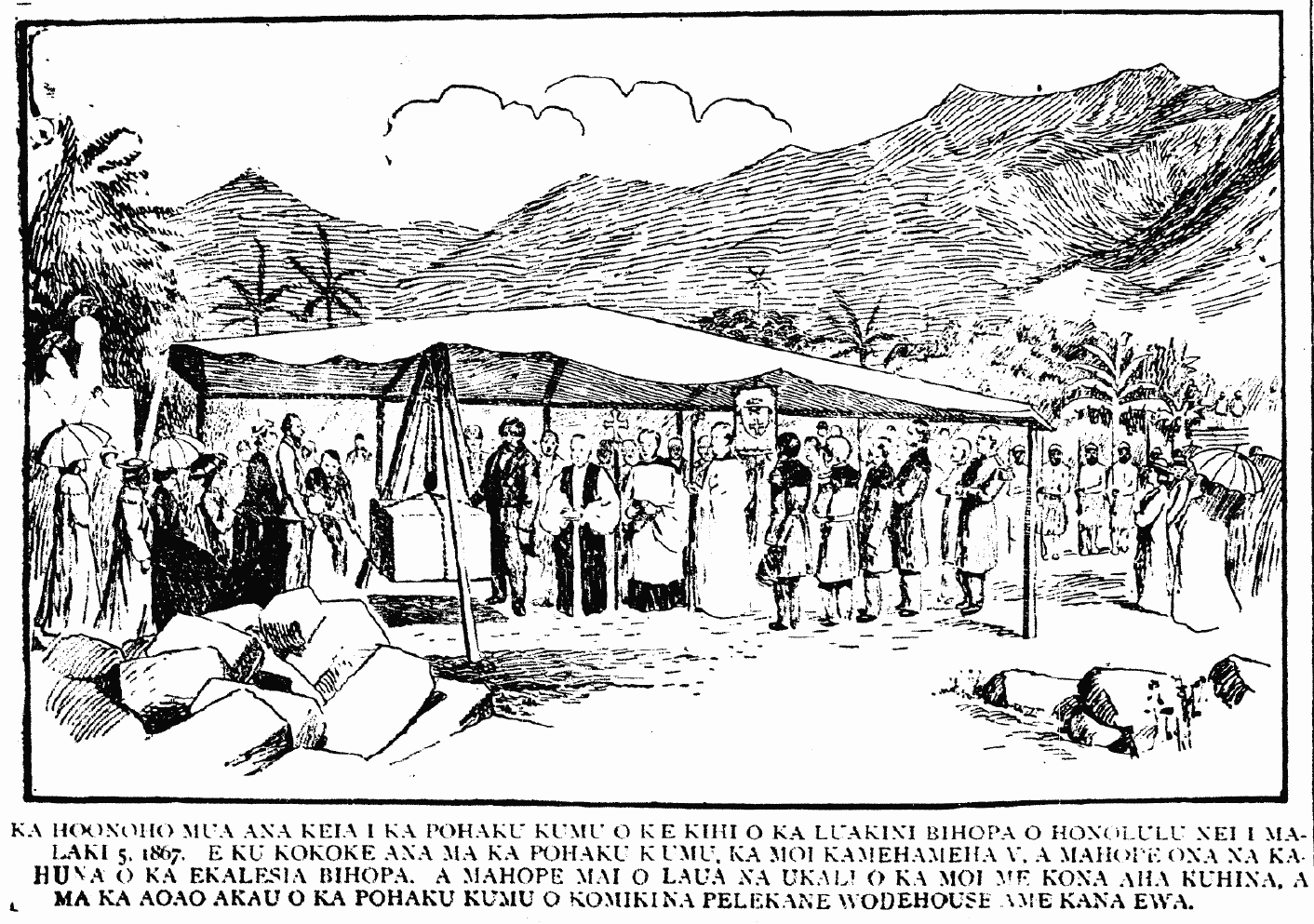
This is the first laying of the cornerstone of the Anglican Church of Honolulu, on March 5, 1867. Standing near the cornerstone is King Kamehameha V, and behind him are the priests of the Anglican Church. And behind those two are the attendants of the King and his Cabinet of Ministers, and to the right side of the cornerstone is the British Consul Wodehouse and his wife.

(Kuokoa, 11/30/1906, p. 2)

KA HOONOHO MUA ANA KEIA I KA POHAKU KUMU...

Ka Nupepa Kuokoa, Buke XLV, Helu 48, Aoao 2. Novemaba 30, 1906.

Bishop Alfred Willis Leaves for Tonga, 1902.

BISHOP WILLIS TO TONGA.

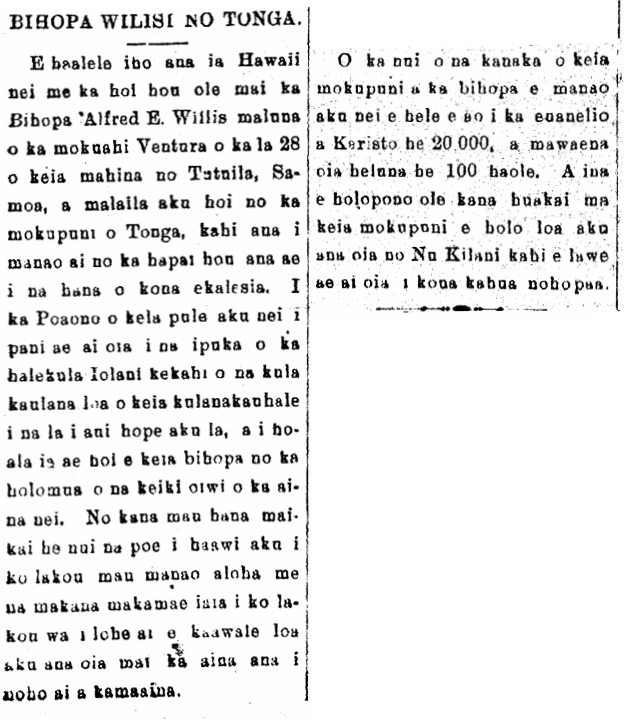
Bishop Alfred E. Willis is leaving Hawaii, and not returning, aboard the steamship Ventura on the 28th of this month for Tutuila, Samoa, and from there for the island of Tonga, where he intends to take up the work of his church. Last Saturday he closed the doors of Iolani School, one of the very well known schools of this town in days gone by,  and it was established by this bishop for the advancement of the native children of this land. For his good works, there were many people gave their expressions of aloha and precious gifts to him when they heard that he will forever leave this land that he became a local to.

The population of the people of this island on which the bishop is intending to go teach the word of Christ to is 20,000; and with this number, 100 are haole. And should this trek to this island does not go well, he will continue on to New Zealand where he will put down roots.

(Aloha Aina, 5/24/1902, p. 4)

BIHOPA WILISI NO TONGA.

Ke Aloha Aina, Buke VIII, Helu 21, Aoao 4. Mei 24, 1902.

More coverage on Liliuokalani’s baptism into Anglican Faith.

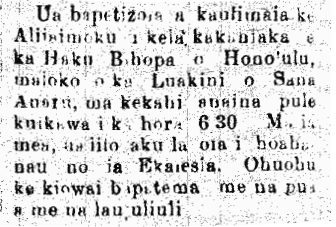
The Queen was baptized and there was a laying on of hands that morning by the Head Bishop of Honolulu, in Saint Andrew’s Cathedral, during a special prayer service held at 6:30. Through this, she became a brethren of that Church. The baptismal font was bedecked with flowers and greenery.

(Makaainana, 5/18/1896, p. 8)

Ua bapetizoia a kaulimaia ke Aliiaimoku...

Ka Makaainana, Buke V—-Ano Hou, Helu 20, Aoao 8. Mei 18, 1896.