Paaiea Pond, part 4 and final, from the pen of J. W. H. Isaac Kihe, 1914.

SOME STORIED LANDS OF KONA

Written for the Hoku o Hawaii by ka Ohu Haaheo i na Kuahiwi Ekolu¹

PAAIEA POND

Meeting with Kolomu’o and Pahinahina.

When the flames subsided, the fire disappeared, and this is why it was assumed it was the fire of the Uau Bird Catchers in the Mountains.

In the middle of that night, the lava emerged and flowed like water below a crater on the side of a peak called Kileo, and it is black, shiny pahoehoe that remains there to this day. And from there the lava dove down and resurfaced makai side and several deep fissures cracked open and remain near the village that Mr. Maguire lives at.

The lava dropped down again and on the makai side of the old road there opened up a small furrow six (6) feet wide, and from here the lava began to flow and overran everything before it.

Villages were destroyed and some people died as victims to the wrath of the Goddess of the crater, because of the denial of Pele by that Konohiki [Kepaalani] which the Alii [Kamehameha I] stationed to oversee all of his wealth. And when the Konohiki saw the lava burning everything and turning into pahoehoe and gorging away, he finally realized that the old lady was Pele that appeared before him asking for fish, palu, and then shrimp, and he regretted this filled with dread and great fear. Continue reading

John Kaina, Kamehameha senior classman, 1941.

KAMEHAMEHA SCHOOLS NEWS

(Written by Louis Agard)

JOHN KAINA

The Bishop Museum [hale hoahu o na mea kahiko o Bihopa] published picture postcards [pepa kii haleleka] showing Hawaiian pictures. Amongst the cards printed is a picture of John Kaina, a senior classman at Kamehameha. John Kaina’s picture is printed in this group of postcards. The first group is made up of twelve eleven cards. Continue reading

More on the state of taro, 1911.

Don’t Neglect the Planting of Kalo

It is to you, O Hawaiians, who we strongly encourage in regard to this question about kalo here forward, for large kalo-growing lands here in Honolulu will be dried out and put an end to by those who own them. Should those lands where kalo is being grown today truly be left to dry out, by our estimation, nearly 300 acres of kalo lands will be lost here in Honolulu, or perhaps four hundred or more acres of kalo lands will not be planted anymore. Therefore, to make up for this lost acreage, it is for all of you people outside of Honolulu to plant dry-land taro in fields and small patches, or in large loi where taro can constantly be cultivated.

If you have an abundance of kalo, then feed the sows, the hens, the turkeys, the ducks, and animals from which a person who plants a lot of taro can benefit; for you can eat the kalo, and the animals can eat the stalks [haha kalo], the leaves [luau], the watery residue from poi making [kale ai]; all these things are of great help to the farmer of kalo. Therefore, O Hawaiians, don’t be weary to grow kalo, and don’t neglect this lively endeavor on the land.

(Kuokoa Home Rula, 8/18/1911, p. 2)

Mai Hoopalaleha i ke Kanu Kalo

Kuokoa Home Rula, Buke IX, Helu 33, Aoao 2. Augate 18, 1911.

Mild hula ku’i and California Midwinter International Exposition, 1894.

DEPARTING FRIENDS.

The S. S. Australia Carries the Hawaiian Exhibit.

The departure of the S. S. Australia for the Coast was delayed until nearly 1 o’clock on account of the late arrival at the Oceanic wharf of articles to be exhibited at the Midwinter Fair in San Francisco, which has already opened. Among the numerous exhibits to be seen on the steamer were boxes of large and small coffee plants, boxes of large and small tea trees, brought from Hamakua, two wooden tanks containing different varieties of fish, including eels, a small shark, squid and crabs. The last two species were in one tank, and it is believed there will be a circus started between them when the aquarium is shaken up. There were two monster bullocks in stalls lashed near the stern. Kapahee, the famous surf rider, with his board, his wife and son, three hula girls and four other natives comprise part of the Hawaiian exhibit. Kapahee will give exhibitions in surf riding near the Cliff House, and if the water is clear he will dive and kill fish with a spear he has taken with him. He will also ride the bullocks. The girls under the management of D. Kaahanui will dance a mild hula-kui, while the others will assist about the grounds. Mr. L. A. Thurston superintends the exhibit.

Mrs. J. K. Ailau will make a first-class exhibition of Hawaiian curios at the fair in connection with the Hawaiian exhibit. She has taken with her four young ladies to act as saleswomen.

Messrs. Samuel Parker and A. P. Peterson were passengers on the Australia for the Coast on business bent.

Mr. W. P. Boyd, U. S. Vice-Consul-General, and wife were also passengers. They have gone to spend their honeymoon in the States. Both were gaily bedecked with leis and evergreens.

Miss Kate Cornwell, H. A. Widemann, Jr., F. M. Hatch and L. A. Thurston also left.

Mrs. and Miss Gerber, with their friend Miss A. Cahill, who lately returned from the Volcano, were among the departing throng. Mrs. Gerber and daughter left for home after a short and pleasant vacation on the islands.

Nearly all the passengers were covered with Hawaii’s tropical adieu, viz., wreaths and flowers. The P. G. band played previous and up to the departing of the steamer, and the scene on the wharf was one of bustle and excitement.

(Daily Bulletin, 1/6/1894, p. 2)

DEPARTING FRIENDS.

The Daily Bulletin, Volume VII, Number 924, Page 2. January 6, 1894.

Updated Elepaio Story, 1894.

DON’T WORRY.

O Hawaiian people, don’t worry and don’t be uncertain. for we have publicly shown that there are three great powers of the world who have granted independence to us in 1843, that being France, Britain, and America.

But when our land was stolen and our beloved Queen was taken from her throne and our land stood bare without any beauty remaining,

During that time, we composed our protest, along with Queen Liliuokalani, and left if for America to make right; and it for this that we wait until today. But O Nation, do recall one of the famous stories of our beloved land, this being:

The bird called Elepaio called out loudly:

“O Io, O Io, I was hit by the rock of the man.”

Io answered, “Who was at fault?”

“I was wrong for pecking at the huewai of the man,” answered Elepaio.

“You are indeed at fault for puncturing the huewai of the man; let it be judged by the many birds,” was Io’s answer.

It was so, Elepaio was judged; he came upon Oo, and his answer was the same, that it be judged by the many birds.

Elepaio arrived before Pueonuiokona, and his answer was the same.

But Pueonuiokona went on to say, “Say Elepaio, I will call our many fellow birds to come together.”

In no time, all the birds came together, and Pueonuiokona revealed the reason for them being called to assemble, like this:

“Before me appeared your younger sibling with his protest, and when I heard correctly, I knew he was wrong, however, the best thing to do would be for us to send Iwa before the man to whom belonged the huewai that Elepaio pecked, and to tell him that Elepaio was guilty, and it is for him to set the punishment.”

And it was so, Iwa went to the place of the man to whom belonged the huewai, and told him of their decision; this is what the man said:

“You are forgiven, and don’t do anymore harmful acts.”

So we compare this story with the actions carried out upon us, and we see that they are exactly the same.

For America totally blames itself for the wrong done by Elepaio to our huewai.

But it is going around being judged by the many birds, and is currently in Europe.

So therefore, O Nation, we will receive a fair judgement from Iwa, the messenger that is being sent; and that will be when the dignity shall be awarded to our side through the judgement of the crimes carried out by Stevens Elepaio.

(Leo o ka Lahui, 10/11/1894, p. 2)

MAI HOPOHOPO OUKOU.

Ka Leo o ka Lahui, Buke II, Helu 1047, Aoao 2. Okatoba 11, 1894.

Offense, Judgement, and Remorse, 1862.

The Tale of the Elepaio and the Water Gourd.

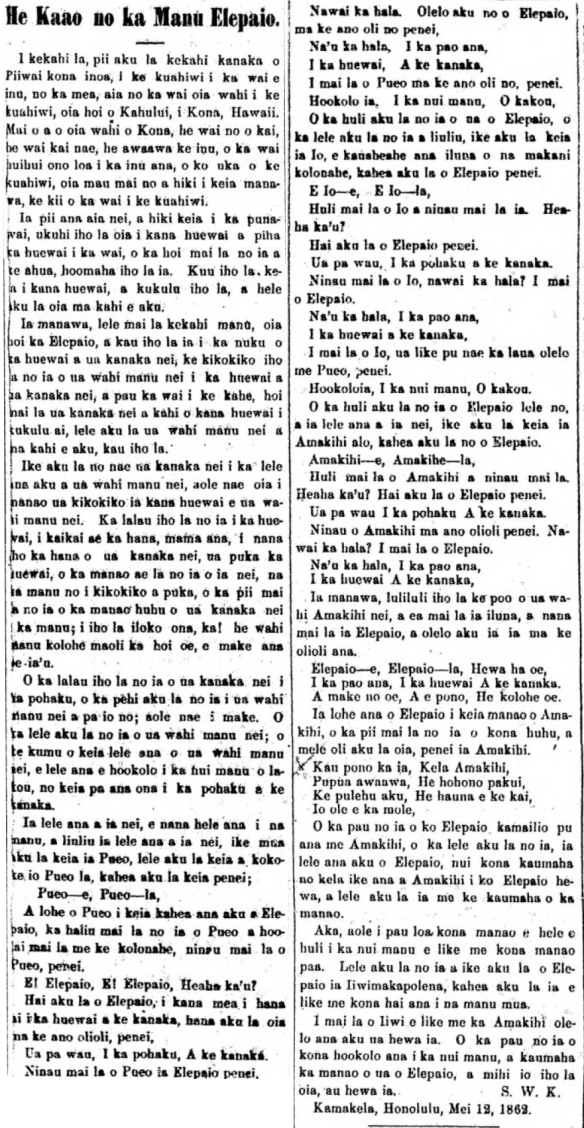
One day, a man named Piiwai went up the mountains to fetch drinking water, for the water of that area was located in the mountains, that being at Kahului, Kona, Hawaii. From one side to the other of that area in Kona, there was water by the ocean, but brackish water, and was not pleasant to drink, and the cool and very refreshing water to drink was in the uplands in the mountains; it is still this way these days, that they go into the mountains to fetch water.

When he made his ascent until this spring, he scooped in his water gourd [huewai] until it was filled with water, and he made his way back until a hill where he rested. He put down his huewai and stood it upright and went elsewhere.

At that time, a bird flew down, an Elepaio, and alighted on the spout of the huewai of that man, and the bird pecked at the huewai of the man until all the water flowed out; the man returned to where the huewai stood and the bird flew away and perched.

But the man saw the bird fly away, yet he did not imagine that his huewai was pecked on by the bird. He grabbed it and lifted it up, and it felt lighter; the man looked at it and saw that there was a hole; he figured that the bird pecked at it until making a hole; his anger at the bird boiled over and said to himself, “Ha! You are one very mischievous bird; I will kill you.”

The man grabbed a rock, and threw it at the bird, hitting it, but it did not die. The bird flew away; it flew away so that its many fellow birds could judge this stoning by the man.

When it flew away in search of the birds, after flying for a while, he first spotted Pueo, the owl; he flew by Pueo and called out like this:

“O Pueo, O Pueo,”

Pueo heard this call from Elepaio; Pueo turned and poised aloft and gently, Pueo inquired like this:

“O Elepaio, O Elepaio, What is it that you want of me?”

Elepaio told of what he did to the huewai of the man in a chanting song [olioli], like this:

“I was hit, By the rock, Of a man.”

Pueo asked Elepaio,

“Who was at fault.” Elepaio responded in chant:

“I was at fault, For pecking,
The huewai, Of the man.”

Pueo said in chant:

“Let it be judged, By the many birds, Among us.”

Elepaio went in search; he flew for a while and saw Io, the hawk, soaring atop the gentle winds, and Elepaio called out:

“O Io, O Io,”

Io turned toward him and asked, “What do you want of me?”

Elepaio answered:

“I was hit, By the Rock. Of a man.”

Io questioned, “Who was at fault?” Elepaio responded:

“I was at fault, For pecking,
The huewai of the man.”

Io said, just as did Pueo,

“Let it be judged, By the many birds, Among us.”

Elepaio took off flying and spotted Amakihi, and Elepaio called out:

“O Amakihi, O Amakihi.”

Amakihi turned and asked, “What is it that you want of me?” Elepaio said,

“I was hit, By the rock, Of a man.”

Amakihi questioned in a chanting song, “Who was at fault?” Elepaio answered:

“I was at fault, For pecking,
At the huewai, Of the man.”

At which point, the head of the Amakihi shook, and he raised his head and looked at Elepaio and said in a chant:

“O Elepaio, O Elepaio, You are indeed at fault,
For pecking at, The huewai, Of the man.
And if you die, It is just, For you are a trouble maker.”

When Elepaio heard these feelings of Amakihi, he grew angry, and he chanted this to Amakihi:

“There it stands, That Amakihi, [Kau pono ka ia, Kela Amakihi,]
Sour tail feathers, Horribly rank, [Pupua awaawa, He hohono pakui,]
If you were to broil it, The sauce would smell, [Ke pulehu aku, He hauna e ke kai,]
There is no meat to begin with.” [Io ole e ka mole,]

Elepaio was through talking with Amakihi and flew away; when he flew away Elepaio was very sad that Amakihi saw his guilt, so he flew away with a heavy heart.

But he was not through with his search for the many birds like he decided. He flew on and Elepaio spotted Iiwimakapolena, the yellow-eyed iiwi, and he called out to it as with the other birds previously.

Iiwi responded just as did Amakihi, that he was at fault. This was the end of his being judged by the many birds, and Elepaio was saddened, and he was truly remorseful in his guilt.  S. W. K.

Kamakela, Honolulu, May 12, 1862.

[It is interesting to compare this 1862 telling with the one put out by Kamehameha Schools Press in 2008 and these bilingual animated videos on Oiwi TV.]

(Hoku o ka Pakipika, 5/15/1862, p. 1)
He Kaao no ka Manu Elepaio.

Ka Hoku o ka Pakipika, Buke I, Helu 34, Aoao 1. Mei 15, 1862.

Pearls found in Heeia, 1918.

PEARLS FOUND IN OYSTERS.

According to the Japanese newspaper, Hawaii Shinpo, down in Heeia, Koolau, from six oysters [papaua] got by a Japanese who was diving in the ocean a few days ago, he found two pearls [pohaku momi].

From what was said, this is a Japanese used to diving in search of pearls, and the place he is accustomed to diving is the Seas of the South, where he spent a lot of his time searching for pearls in oysters.

When he dove at Heeia, it was not much work searching for papaua, and he found six easily; checking inside of them, two had pearls inside, and the other four did not.

In the South Seas, according to that Japanese, it is very rare to find an pearl in an oyster; from a hundred papaua, you will only find two pearls.

However he believes that the papaua here are different from the ones of the South Seas; and he is certain that if the diving for papaua continues here, a lot of pearls will be found, and this endeavor will benefit a number of people.

(Kuokoa, 2/8/1918, p. 8)

LOAA KA MOMI ILOKO O KA PAPAUA.

Ka Nupepa Kuokoa, Buke LVI, Helu 6, Aoao 8. Feberuari 8, 1918.

On Statehood, Republicans, Elepaio, and Voting Rights,1912.

STATEHOOD AND THE ELEPAIO

It has been many years during which the Republican party has held power in the governing of the Territory of Hawaii, and Hawaii has not at all been made into a state, where we’d be able to vote for our own governor, our chief justices, circuit court judges, Senators, and representatives in our legislature, and other many heads of government. However, the cry of those Republicans in their workplace to make Hawaii a State, does not cease.  It is ten years that Kuhio has been in the Legislature in Washington, and he has not put a bit of effort into making Hawaii a state. The Republicans are like the Elepaio bird who crying goes, “Ono ka ia! Ono ka ia! [I crave fish! I crave fish!]” This bird just cries out, but does not venture to the sea to catch fish. But its cry atop logs is what makes canoes bug ridden [pu-ha]. Ten years of crying “Mokuaina no Hawaii! Mokuaina no Hawaii! Mokuaina no Hawaii! [Statehood for Hawaii! Statehood for Hawaii! Statehood for Hawaii!]” But there has been no statehood at all; one session of the legislature passes by and the next comes, and then passes by, and so forth. But the Elepaio (Republican) continues to cry, “Ono ka ia! (I Mokuaina no Hawaii.) Ono ka ia! (I Mokuaina no Hawaii.) Yet they do nothing so that Hawaii would attain statehood.

(Aloha Aina, 10/26/1912, p. 2)

KA MOKUAINA AME KA ELEPAIO

Ke Aloha Aina, Buke XVII, Helu 43, Aoao 2. Okatoba 26, 1912.

Bird catching, 1866.

[Found under: “SMALL NEWS OF HAWAII NEI.”]

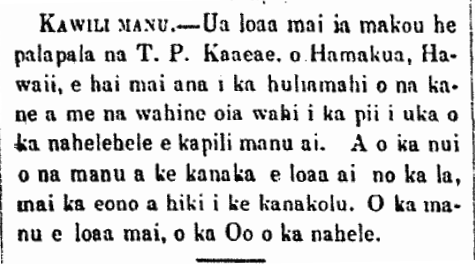
Bird snaring.—We received a letter by T. P. Kaaeae of Hamakua, Hawaii, saying that the men and women of that area are joined together in great numbers in climbing into the forests to snare birds [kapili manu; kawili manu]. And the number of birds caught by a person in a day is from six to thirty. The bird being caught is the Oo of the forests.

(Kuokoa, 3/17/1866, p. 2)

Kawili manu.

Ka Nupepa Kuokoa, Buke V, Helu 11, Aoao 2. Maraki 17, 1866.

And more on the Maori, 1920.

Comparison of New Zealand and Hawaii, the Hawaiian People and the Maori.

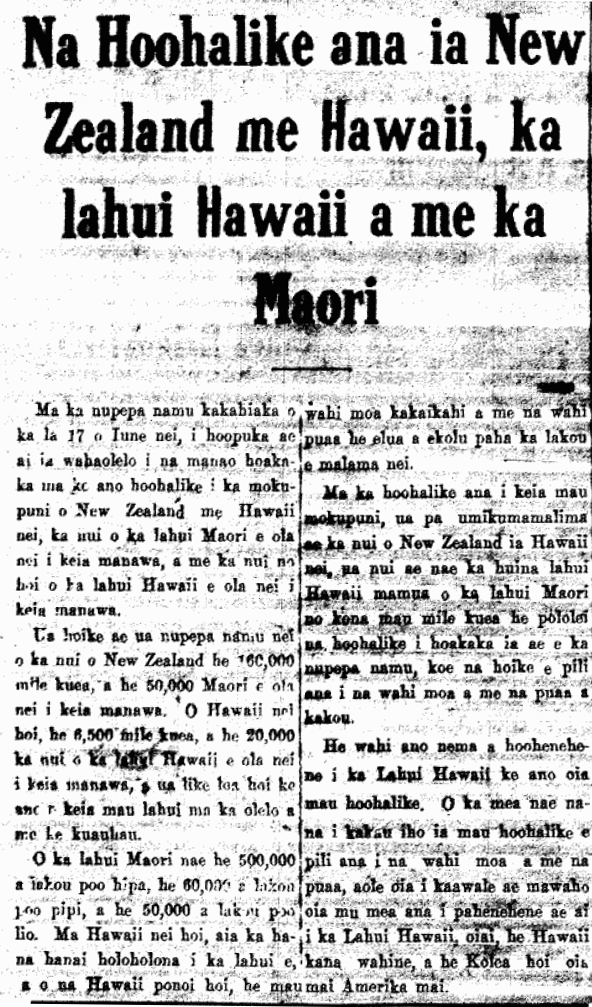
In the English morning newspaper [Pacific Commercial Advertiser] of the 17th of June, that mouthpiece published a clarification between the island of New Zealand and Hawaii, the population of the Maori lahui living today and that of the Hawaiian lahui.

That English paper said the area of New Zealand is 160,000 square miles, and that there are 50,00 Maori living today. As for Hawaii, it is 6,500 square miles, and there are 20,000 of its lahui living currently; and these two people are very much alike in language and genealogy.

However, the Maori have 500,000 heads of sheep, 60,000 heads of cattle, and 50,000 heads of horses. In Hawaii nei, the job of raising livestock is left to the other ethnicities, and the Hawaiians themselves, they raise a few chickens and a couple or three pigs.

In comparing these islands, New Zealand is fifteen times as big as Hawaii nei, but the total Hawaiians are more than the Maori per square miles; the comparisons put forth by the English paper are correct, all but what was said about our few chickens and pigs.

That comparison criticizes  and ridicules the Hawaiian people. But the one who wrote these comparisons pertaining to the chickens and pigs is not far from these things of which he mocks the Hawaiian people about, for his wife is a Hawaiian, and he is a Kolea bird¹ from America.

¹The kolea is the migrating plover, that is used to symbolize people who come to Hawaii, and like these birds, feed off of the riches only to leave after getting fat.

[I will have to check on who the writer was. Too bad the Advertiser is not online!]

(Aloha Aina, 7/4/1920, p. 4)

Na Hoohalike ana ia New Zealand me Hawaii, ka lahui Hawaii a me ka Maori

Ke Aloha Aina, Buke XXXX, Helu 43, Aoao 4. July 3, 1920.