Who is this wahine? 1909.

ENLIGHTENED DEEDS OF THE CHIEFS.

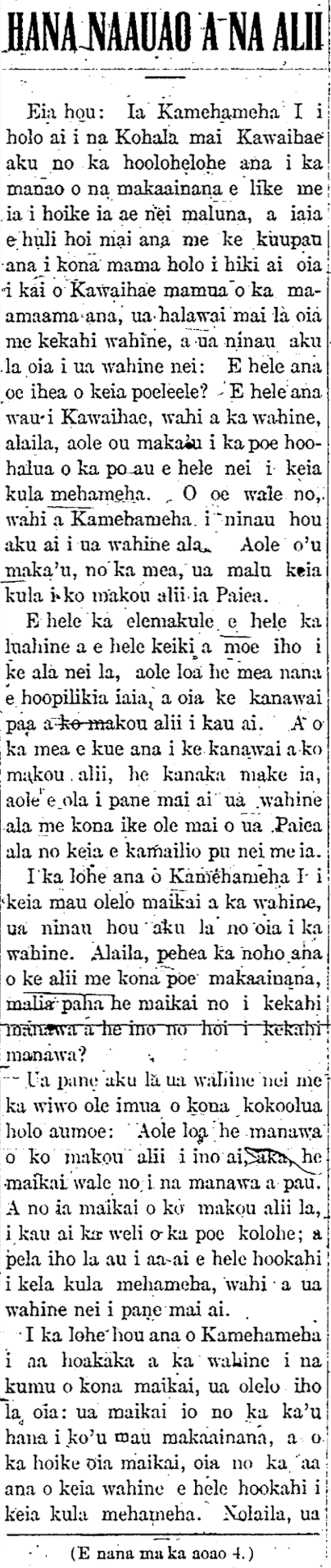
And here is something else: When Kamehameha I went to the Kohala districts from Kawaihae to hear the thoughts of the makaainana like those shown earlier, as he turned back with haste so that he would reach the seaside of Kawaihae before it was light, he came upon an old woman and asked her: “Where are you going in the darkness?” “I am going to Kawaihae,” replied the woman. “Aren’t you afraid of being ambushed at night while you walk this desolate field. Just by yourself?” Kamehameha then asked of the woman. “I have no fear, for this plain is protected because of our alii, Paiea.”

“The old men go, the old women go, and the children go and sleep on these pathways, and there is no one at all who will bother them, for that is a strict law that our alii has placed. And the person who disobeys the law of our alii is a dead man; he will not live,”  answered the woman, not knowing that it was Paiea who was talking with her.

When Kamehameha heard these fine words of the woman, he further asked the woman. “So how is the way of life of the alii with his makaainana? Is it good sometimes and bad sometimes?”

The woman answered with no fear before her late night travelling companion, “There has been no time in which our alii has been bad to us, but he has always been good. And it is because of this goodness of our alii that wrongdoers are fearful, and it is thus that I can dare to walk alone across the desolate field,” the woman replied.

When Kamehameha heard once again the woman expounding on why he was good, he said [to himself], “I am indeed beneficent to my people, and the proof of this good is that this woman dares to travel this lonely field alone.” Therefore,…

[To be continued.]

(Hoku o Hawaii, 7/1/1909, p 1)
HokuoHawaii_7_1_1909_1.png

Ka Hoku o Hawaii, Buke IV, Helu 9, Aoao 1. Iulai 1, 1909.
Thoughts for the upcoming Kamehameha Day, 1920.

THEY ARE TRUE HAWAIIANS BUT THEY CANNOT SING HAWAIIAN SONGS.

Mr. Editor of the Kuokoa Newspaper, Aloha oe:—Maybe at 3 o’clock or so in the morning of Friday, June 11, 1920, that being the birthday of the Nation Conqueror Kamehameha, there came to my home some singing boys, and this was something; it was a familiar thing where on holidays this and that person came around singing at houses lived in by Hawaiians.

Before the singers came, I got the idea that since these singers were coming to my home, I would get up and listen to the singing outside on the lanai like I was accustomed to in past years; it was not long before I heard strains of a guitar, and the singing started, but it was from my bedroom that I was listening. Continue reading

Still Our Museum Today! 1900.

OUR MUSEUM

The Bishop Collection of Curios.

One of the Most Interesting Sights In Honolulu Pleasantly Described.

HONOLULU, Feb. 8.—Above the inner entrance to the Museum of Hawaiian and Polynesian History is a tablet of polished mottled stone, in which is engraved in letters of gold the following inscription:

To the Memory of
BERNICE PAUAHI BISHOP,
FOUNDER OF THE KAMEHA-
MEHA SCHOOLS OF HO-
NOLULU.
A Bright Light Among Her Peo-
ple; Her Usefulness Survives
Her Earthly Life.

A Bernice Pauahi, she was related to the royal family of the Kamehameha dynasty, and the cousin of Queen Emma, two women who have indelibly inscribed their names upon the hearts of…

BERNICE PAUAHI BISHOP.

…all Hawaiians, whether by birth of association. She married the Hon. C. R. Bishop, and with her immense wealth and her kindly deeds through life, created a new life among the Hawaiians. Upon her death she left most of her wealth to endow the Kamehameha Schools, a separate school for boys and a separate one for girls. These schools are kept up entirely from the income of her estates, which have become so vast as to render it necessary to erect other buildings throughout the Islands in order to expend the revenue. In memory of his wife, the Hon. C. R. Bishop dedicated the museum in her name, laying aside a princely endowment. Collectors have scoured the Hawaiian Islands for curios of historical and intrinsic value and have succeeded by the most diligent effort and at great expense, in depositing in the museum an invaluable collection of ancient materials which would warm the cockles of the antiquarian’s heart beyond measure. Calabashes, large and small, ancient and modern, have come into the museum; some were in the possession of families, relics passed from one generation to another; others were found in the caves where in ancient times were buried kings and chiefs. Idols of grotesque shapes, dedicated to all the elements of nature, good and evil; some dedicated to Pele, the Goddess of Volcanoes; others to the poison god and to the fish god; some made of stone, others of the valuable koa and kou woods; one made of the trunk of the poison tree, its wood, upon being steeped in water, being a most powerful, yet undetectable poison which acts upon the heart, and which was used by the kahunas and chiefs. Beautiful feather cloaks of wonderful sheen and delicate texture, worn by Kamehameha the Great during his tour of conquest a century ago. Continue reading

Some of the battles of Kalaniopuu, 1866.

[Found under: “Ka Moolelo o Kamehameha I.”]

The battles between Kalaniopuu, the King of Hawaii, with Kahekili, the King of Maui.

The years 1775, 1776, 1777, 1778, and 1778. Kalaniopuu went to war at Kaupo on Maui, with his Alii, his war Officers, and his soldiers. Kalaniopuu first went to war at Kaupo, and he tortured the makaainana of Kaupo by clubbing their foreheads with his war club [newa]. This battle was called Kalaehohoa [“Clubbing-of-the-Forehead”] Continue reading

George Vancouver arrives once more on February 14, 1793.

[Found under: “He Moolelo Hawaii”]

Vancouver Returns

In the month of February, the 14 day, 1793, Vancouver [Vanekouwa] returned to Hawaii nei, from the northwest of America, and landed at Kawaihae.

The men pleaded for guns and powder from him. Vancouver refused and would not sell those sort things to them. There was great desire of Hawaiians for those things during those days, because it was a time of war, and Kamehameha was conquering the nation then; Oahu and Kauai remained.

And from there, Vancouver landed at Kealakekua, on the 22nd of that month and met with Kamehameha.

At that time, he gifted Kamehameha with two cattle, a bull and a cow. The cattle that Vancouver brought were from Monterey, a land in America.

These animals were greatly appreciated by Hawaiians because they were unusual, and they were called puaa pipi. It is from those pipi that the cattle which roam these days at Waimea and Maunakea and the other forests of Hawaii proliferated.

Kamehameha treated Vancouver kindly; Vancouver was facing hardship without water and took his water barrels into the uplands, and Kamehameha commanded his men to carry the barrels and to fill them with water. Continue reading

Sarai Hiwauli, 1856.

BIOGRAPHY OF S. HIWAULI II.

Sarai Hiwauli was born in Kahaluu, Koolaupoko, after the great plague here on Oahu during the time of Kamehameha I, and she was taken to Hilo, Hawaii to be raised, along with her parents and her kupuna; from Hopuola and Kalimahauna came Hiwauli, from Kahili and Napolo came Hopuola, from Kahiko and Kuanuuanu came Kahili, from Keaweikekino and Iliholo came Kahiko, from Hoou and Kamaiki came Keaweikekino, from Mahiopupelea and Kapaiki came Hoau, from Kanaloauoo and Kapulaiolaa came Kapaihi, from Kahoanokapuokuihewa and Kapahimaiakea came Kapuleiolaa, from Loheakauakeiki and Kalaniheliikauhilonohonua came Kahoanokapuokuihewa, from Kauhealuikawaokalani and LonowahineikahaleIkiopapa came Kalaniheliikauhilonohonua, from Kaholipioku and Moihala came LonowahineikahaleIkiopapa, from Lonoapii and Piilaniwahine came Moihala, and so on. Continue reading

Death of Capt. Alexander Adams, 1871.

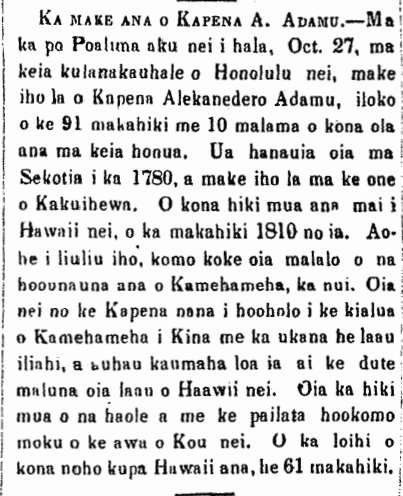
The death of Kapena A. Adamu.—On this past Friday, Oct. 27, here in the town of Honolulu, Captain Alexander Adams [Alekanadero Adamu] died at 91 years and 10 month of age on this earth. He was born in Scotland in 1780, and he died on the sands of Kakuhihewa [Oahu]. He first came to Hawaii nei in the year 1810. Not long after, he was soon under the employment of Kamehameha the great. He was the Captain who sailed the double-masted ship Kamehameha to China with a cargo of sandalwood [iliahi], and that wood from Hawaii was heavily taxed. That was the first haole and pilot who entered the port of Kou [Honolulu]. He lived in Hawaii for 61 years becoming a local.

(Kuokoa, 11/4/1871, p. 2)

Ka make ana o Kapena A. Adamu.

Ka Nupepa Kuokoa, Buke X, Helu 44, Aoao 2. Novemaba 4, 1871.

On the moving of the Na-ha Stone to Hilo Library 100 years ago, and its history (6 of 6), 1915.

….all of the districts from Hawaii all the day to Kauai, however, if Naha is shook and removed by you today from where it lies, it will be the removing of binds that secure the Districts. You will then live; your people will live; and I too will live, the Kahuna.

When the Prophetess Kalaniwahine was done speaking, it was at that point that Kamehameha traced his strong hands upon the good places to grab on to the stone, and then Kamehameha made ready to attempt to move the Naha Stone; the eyes of the all the people were fixed on him. When the hands of Kamehameha were locked onto the sides of the stone, Kamehameha spoke these words of prayer. “E! You are a Naha, the Alii who frees your kapu is a Naha Chief, and I am a Niaupio, the arching smoke of the forest. [??? E! He Na-ha oe, he Na-ha hoi ke Alii e noa ai kou kapu, a he Niau-pio hoi wau, a he uwahi pio i ka wao laau.]”

That was when Paiea pried the stone with amazing strength, and that Pohaku Alii did indeed move, and then the people surrounding the place where Kamehameha was moving the Naha Stone felt a rumbling of the land there, and some actually thought an earthquake was assisting Kamehameha. The Alii and Makaainana truly saw the moving of the Sacred Pohaku of the Naha Alii Line, and that it was shook by the amazing strength of Kalaninui Kamehameha. They realized the earlier words of the Prophetess Kalaniwahine came true, and some Alii immediately knew that this young Chief would become the person to shake the Islands of this Archipelago. This moving of the Naha Stone became something to always to encourage Kamehameha thereafter, and during heated battles on the battlefields to come, the moving and overturning of the Naha Stone was always in the fore of Kamehameha’s memories, and it was something that always bolstered his thoughts thereafter. Continue reading

On the moving of the Na-ha Stone to Hilo Library 100 years ago, and its history (5 of 6), 1915.

THE STORY OF THE NA-HA STONE

(Conclusion)

In the morning of another day, when the rays of the beautiful sun shone on Kumukahi and warmed the cold and damp earth, this young Chief of the Apaapaa winds of Kohala woke, and before taking the morning meal, they prepared for their journey to see the Naha Stone, and this journey of Kamehameha to see it was accompanied by the Chiefs of Hilo. The Chiefly Mother of the Chiefs, Ululani, also was in accompaniment, as well as her court and many of Hilo’s dignitaries. Amongst these going with the malihini Chief was Kalaniwahine, the Royal Prophet, who was escorting her hanai Chief who travelled across the sea along with her. This Prophetess was the one who instructed Kamehameha to go to Hilo to meet with his piko, the Alii in the line of High Naha Chiefs, that being Keaweokahikona, the strongest one known in those days. On this procession of Kamehameha to see the Naha Stone, Keaweokahikona also was accompanying his Chiefly Cousin, but he did not believe in the ability of Kamehameha to move the Naha Stone for it was a kapu stone of the Alii Class who had the Naha Kapu and the other lines of Alii had no rights to it; and it was this Keaweokahikona who was the only one known of who could move this Royal Pohaku.

At this time when Kamehameha folks were on the move, the Chiefly Mother of theirs spoke to him with these words: Continue reading

Naha Stone to be moved, 1916.

NA-HA STONE TO BE SKIDDED ON GIANT ROLLERS

(Special Star-Bulletin Correspondence)

HILO, March 10.—At last preparations are being made for the conveying of the famous Na-ha stone fro the John Scott property to the site selected for it on the Hilo library lot. The big stone, which must weigh several tons, is to be brought down on rollers, as it is too heavy and cumbersome to handle by motor-truck or any other kind of vehicle.

Big rollers have been procured, and they will be placed under the stone in such a way that the rock can be slid down from its present resting place to the desired location, where it will be so placed that tourists and town folk can inspect it at their leisure.A plate will be attached to the stone and on it the legend in connection with the wanderings of the historic relic will be set forth.

The stone originally came from Kauai where it was used in certain religious ceremonies after the birth of a child of high degree. The legend has it that the first Kamehameha rolled the stone over after a terrific struggle in which he used so much strength that the blood burst from his eyes.

(Star Bulletin, 3/14/1916, p. 14)

NA-HA STONE TO BE SKIDDED ON GIANT ROLLERS

Honolulu Star-Bulletin, Volume XXIII, Number 7463, Page 14. March 14, 1916.