The name of Kaumualii’s mahiole, 1906.

[Excerpt from: “He Moolelo no Kamehameha I. Ka Na’i Aupuni Hawaii.” by Hooulumahiehie.]

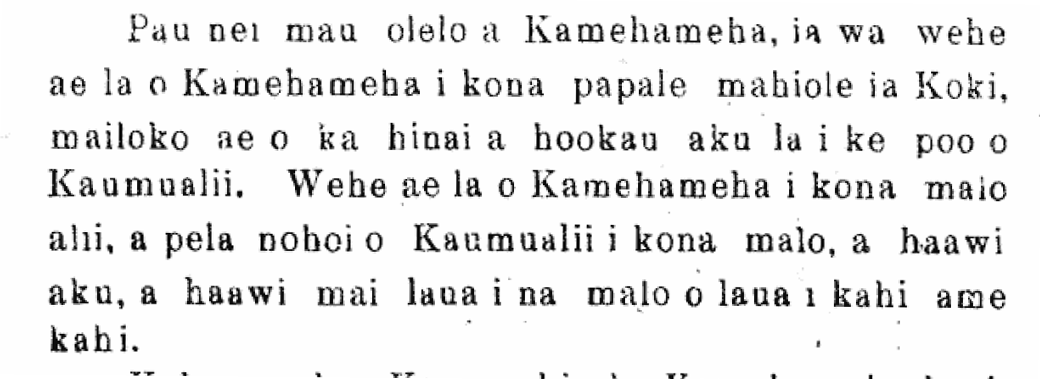
After these words of Kamehameha’s were over, he then took his mahiole, Koki, from a basket and placed it upon the head of Kaumualii. Kamehameha removed his royal malo and so too did Kaumualii remove his malo, and they exchanged them with each other.

[This account is from the meeting of Kamehameha and Kaumualii. It is just a tiny excerpt of the kind of awesome information available in the story of Kamehameha I translated by Kamaoli Kuwada, Emalani Case, and Beau Bassett, slated to come out from Kamehameha Publishing. I can’t wait.

I was informed that this priceless feathered object from the past is indeed being cared for amongst the many other antiquities at the Bernice Pauahi Bishop Museum.]

(Na’i Aupuni, 9/14/1906, p. 1)

HE MOOLELO NO KAMEHAMEHA I.

Ka Na’i Aupuni, Buke II, Helu 88, Aoao 1. Sepatemaba 14, 1906.

Kaumualii’s Mahiole, 1873.

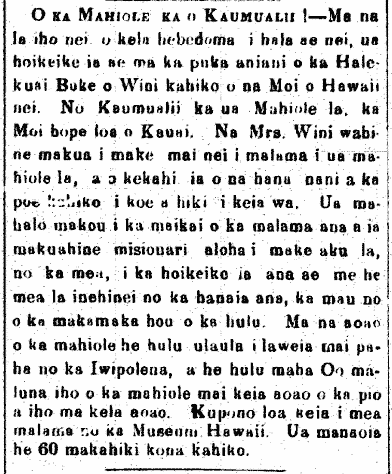
It is the Feather Helmet of Kaumualii!—During the days of this past week, displayed in the window of Whitney’s Bookstore the regalia of the Ancient Kings of Hawaii nei. The Mahiole is Kaumualii’s, the last King of Kauai. Mrs. Whitney [Wini] the elder who just passed was the one who was taking care of the mahiole, and it is one of the things remaining today of the beautiful works of the people of old. We praise the fine upkeep by the beloved missionary mother who passed, for on display, it seemed as if it was made yesterday; the feathers appeared new. On the sides of the mahiole were red feathers taken from the Iiwi polena, and feathers of the maha Oo are on top of the mahiole from this side to that of the crest. This should definitely be kept in the Hawaiian Museum. We believe that it is 60 years old.

[It is interesting to note what is not said in a similar article in English.]

(Au Okoa, 2/27/1873, p. 3)

O ka Mahiole ka o Kaumualii!

Ke Au Okoa, Buke VIII, Helu 46, Aoao 3. Feberuari 27, 1873.

More on the Hokulea, 1980.

Editorial

We should not look upon the voyage of Hokuleʻa with the thought that out ethnic pride and awareness will be re-vitalized. This type of pride we search for should emulate [emanate] from within ourselves and should be a constant part of our daily lives. We must not rely wholly upon occasional events to stir up reminders of our dignity and abilities lest we become fleeting images for display; pieces in a show case.

The importance of the upcoming voyage of Hokuleʻa lies in a different discovery: the opportunity we have to discover how our ancestors conceptualized their world, how they responded to the challenges after leaving their homelands and how they attempted to survive in this new land, today our homeland. Grasping this knowledge we too can be committed to accept the challenges before us with the same determination of our ancestors.

[Some thoughts from thirty-four years ago. How have things changed? How have things stayed the same?]

(Alahou, 2-3/1980, p. 12)

Ka ʻOlelo a Na Luna hoʻoponopono

Ke Alahou, Helu 4, Aoao 12. February/March 1980.

Kau ka pea, holo ka waa, 1980.

HOKULEʻA SAILS AGAIN

Hold on to the course! Hold on to the course! Continue On!

by Wayne Washburn, Malcolm Naea Chun and Duke Wise

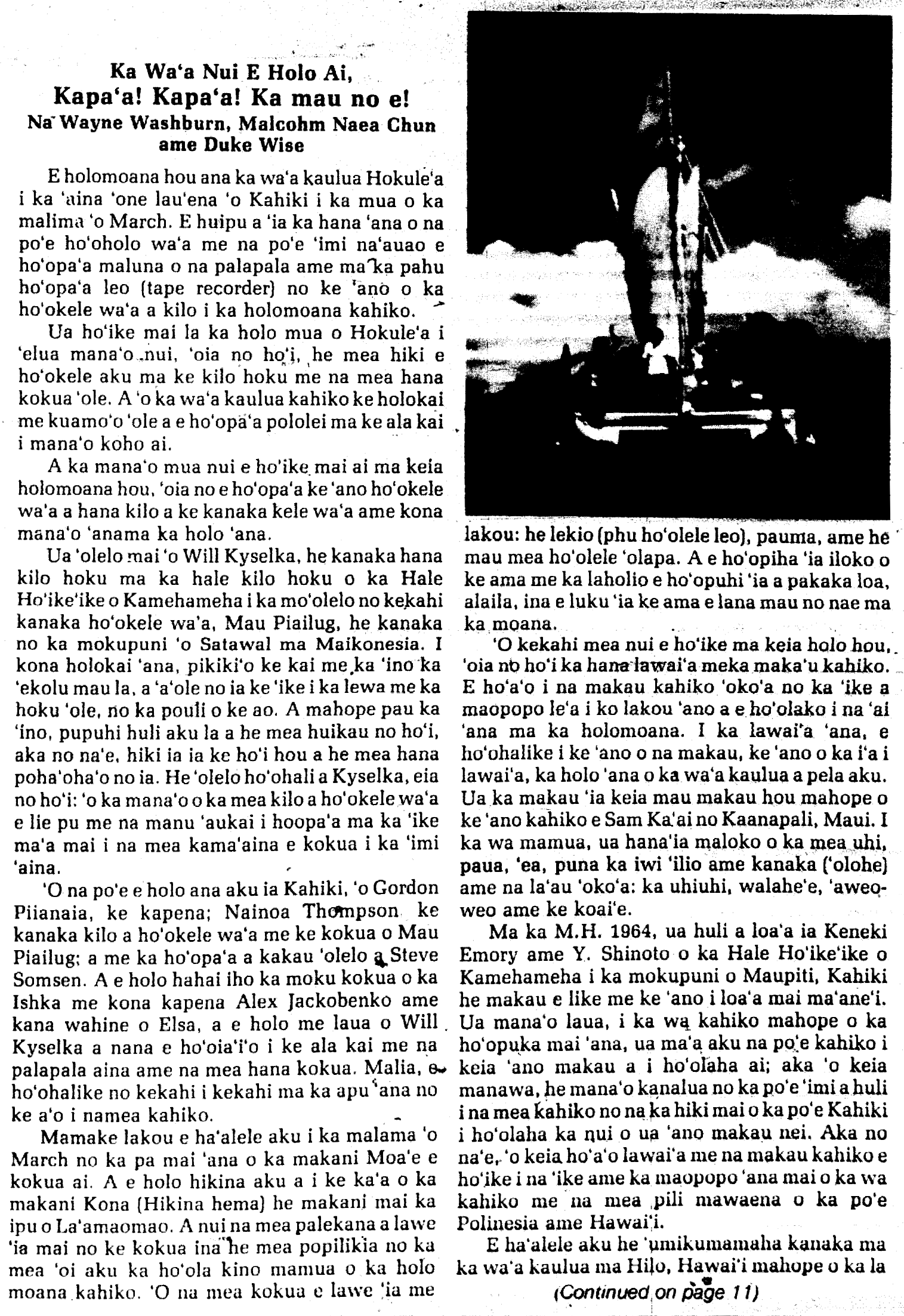
In early March the Hokuleʻa will again set sail in hopes of reaching first landfall somewhere near Tahiti. Crewmen and scientists will concentrate efforts on documenting the thinking process, and methods, which may have been used by the ancient Polynesian navigators.

Without first voyage demonstration to the modern world two important findings. First, was that navigation by the stars without use of modern navigational instruments can be successfully used when travelling between Tahiti and Hawaii. Second, a Polynesian double-hulled canoe without keels or deep centerboards is able to sail to windward, and thus maintain planned course. For the present voyage celestial navigation will once again be of primary importance. Where the first voyage showed that celestial navigation was possible, the presēnt will pay particular attention to the recording of the thought process of the navigator.

Dr. Will Kyselka of the Bishop Museum Planetarium, and an assistant to the project, cited an incident involving a highly skilled non-instrument navigator from Satawal, Mau Piailug. Once caught in a storm for three days, Mau was unable to sail or use celestial markers for assistance. After the storm, though his course direction had been turned around many times, Mau miraculously found his way home to his tiny atoll of Satawal. Dr. Kyselka suggested that maybe there are maps within some of the more skilled navigators’ minds. He mentioned that pigeons are said to find their bearings in flight by being able to sense the difference magnetic fields given off by certain structures. Using the changes in magnetic fields the pigeons are able to draw a mental map and find their way home. Did the Polynesians possess this ability or something which would enable them to find Tahiti and Hawaii with regularity?

Captaining the voyage down will be Gordon Piianaia. Navigating for the trip will be Nainoa Thompson. There to assist Thompson will be Mau Piailug, the navigator from the 1976 voyage. Crew member Steve Somsen will be documenting the navigation process. This will be done by conferring with Nainoa and Mau and then orally recording it through the use of a tape recorder. Hopefully this will shed more light on the Polynesians’ navigational thought process.

The Ishka, a sailing vessel captained by Alex Jackobenko with assistance from his wife Elsa will follow some distance behind Hokuleʻa. Dr. Kyselka will be on board to study and document the route of the Hokuleʻa using modern navigational instruments and charts. On completion of the voyage the two styles of navigation will be compared for scientific value.

March has been designed for departure because it is the season that tends to favor the northeast tradewinds which are important for the first half of the voyage. Like the 1976 voyage the canoe will travel southeasterly for about 1000 miles. Once “easting” is accomplished winds blowing from the southeast will be used to rēach first landfall or Tahiti from a windward approach. This “easting” is important in that not enough movement in that direction might cause them to sail west of Tahiti and miss the islands completely. Certain safety features have been added to the canoe in order to avoid swamping problems encountered in previous inter-island trips. The gunwales and hatches have been raised to help prevent water seepage into the hulls. Also on board will be six hand pumps, a radio and flares. The radio will be used to notify the Hokuleʻa’s escort boat in case of an emergency. Certain sections of the hulls will contain inflated rubber. In the event that the hulls are accidentally smashed these will enable the canoe to remain afloat. Although non-instrumental navigation is the paramount research project of this voyage, other projects are being encouraged on a smaller scale. One of these is to fish using traditional types of fishhooks to learn how they were used. This hopefully will also provide a supplement to the crew’s diet by adding fresh fish. While conducting the fishing experiments crew members will record how the differences of fishhooks: design, material and size; the speed of the canoe; the types of fish caught and other factors affect fishing in the deep sea. These fishhooks are being faithfully copied from authentic fishhooks under the supervision of Sam Ka’ai of Kaanapali, Maui. Ancient fishhooks were made from materials such as shell, coral, turtle shell, dog and human bones and even hard woods.

In 1964, Drs. Kenneth Emory and Y. Sinoto of the Bernice Pauahi Bishop Museum, found a Tahitian one-piece fishhook at Maupiti in the Society Islands. They proposed a theory that this type of fishhook is the same as found in various sites in Hawaii. After its initial introduction they believe it became a major type used by the ancient Hawaiians, Today, other anthropologists are not as certain if Tahitian migrations caused the popularity of this fishhook, but nonetheless, the experiments conducted by crew members of the Hokuleʻa should provide some information that may help the on going research in finding common links between the ancient Hawaiian society and the Southern Polynesians.

With a crew of fourteen, the Hokuleʻa is scheduled to depart from Hilo on…

(Ke Alahou, 2-3/1980, p. 1)

Ka Waʻa Nui E Holo Ai...

Ke Alahou, Helu 4, Aoao 1. February/March 1980.

…the first favorable day after March 2.

Editor’s comment: The projects conducted by the crew of the Hokuleʻa remind us of the legend of Hema, a pan-Polynesian legend about a great super chief.

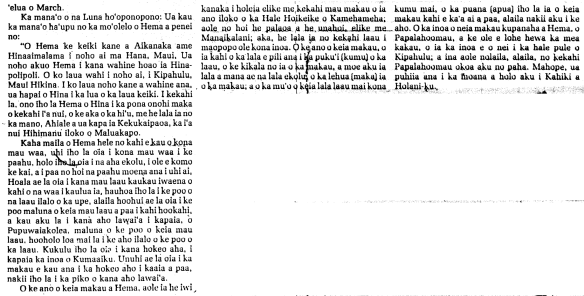
Hema was the son of Aikanaka and his wife Hinaaimalama of Hana, Maui. Hema’s wife was called Hina-polipoli and they lived at Kipahulu, East Maui. When she was pregnant with their second child, Hina craved for the eyeball of a large fish of the open, deep sea. This fish had a tail like that of the shark, Ahiale and was called Kekukaipaoa.

Hema prepared all his fishing gear and made ready the double-hulled canoe by loading enough food and water for several days. He covered his canoes with many mats, lashing them down with cords so that sea water could not seep in. When the canoe was covered securely, he hung his fishing line, Pupuwaiakolea, above the top of the poles that were between the hulls of the canoes. He put the end of the line through a knot he had tied and then he set up his cord calabash, which was called Kumaaiku. He took out the fishhook and tied the end of the fish line tightly around it fastening it to the pole.

Hema’s fishhook was not made of human bone like some of those found in the Bishop Museum, nor was it made of whale bone or turtle shell like Manaiakalani. It was made of a branch of wood whose name is not known today. The kikala or the intersection of the barbs, is found at the branch closest to the trunk of the tree. When this branch is laid flat, three other branches project from it. These branches are broken so they are short and sharp. This joint is called lehua, perhaps after the flower. The shank knob of the fishhook is called muʻo and this is where the fish line is tied. The name of Hema’s fishhook is Papalahoʻomau and still survives today as the name of the Congregational Church in Kipahulu.

It was later on in the story that Hema was blown off course and his voyage to Kahiki or Holani-ku began.

(Alahou, 2-3/1980, p. 11)
ʻelua o March.

Ke Alahou, Helu 4, Aoao 11. February/March 1980.
Z. P. K. Kawaikaumaiikamakaokaopua’s treatise on canoe building, 1922.

CANOE BUILDING AND ITS CHARACTERISTICS.

(Written by Z. P. K. Kawaikaumaiikamakaokaopua.)

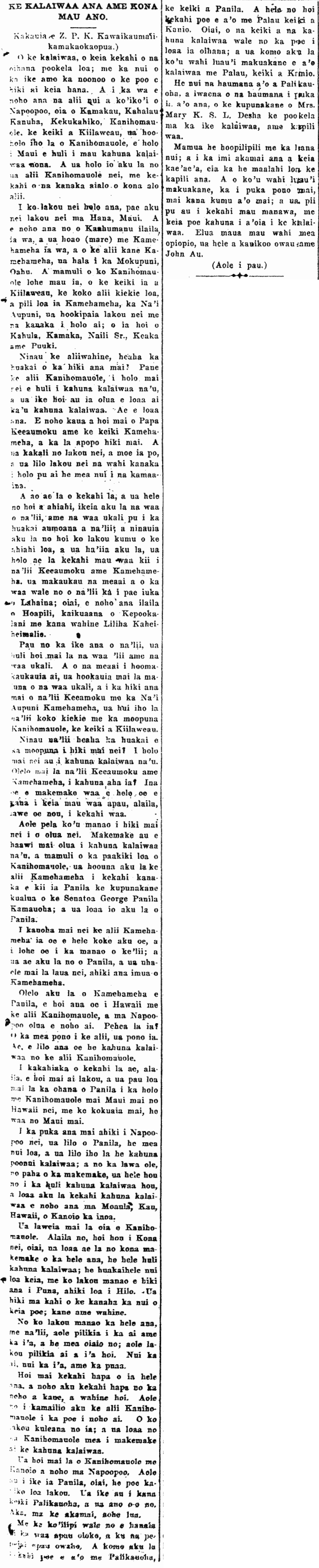
Canoe building is one of the greatest trades; it is with great knowledge and thought that this is done. And when the important high chiefs of Napoopoo were living, they being Kamakau; Kahalau; Kanuha; Kekukahiko; and Kanihomauole, the son of Kiilaweau; Kanihomauole decided to go to Maui in search of a number of canoe building kahuna for himself. And that alii Kanihomauole did indeed go with some attendants from his royal court.

When they went, they landed at Hana, Maui. Kaahumanu was there living at the time, and was married (hoao) with Kamehameha, who was away on Oahu. And because it was heard often that Kanihomauole was the child of Kiilaweau, the alii of highest blood, and that he was kin to Kamehameha, the Conqueror of the Nation, they were welcomed along with those who came, they being Kahula, Kamaka, Naili Sr., Keaka and Puuki.

The queen asked, “why have you come?” The alii Kanihomauole replied, “I have come in search of a kahuna kalaiwaa for myself, and I have come to see the two of you to get my kahuna kalaiwaa.” “Yes, you will have one. Let us remain until Papa Keeaumoku and the boy Kamehameha returns; they will be back tomorrow.” And they waited, and spent the night, and those that came were treated well by the kamaaina of the place.

[This is how the piece on canoes by Kalokuokamaile begins on 10/26/1922, and it continues on in the Kuokoa until 2/15/1923. This is one of the many priceless translations appearing in the Bernice Pauahi Bishop Museum’s Hawaiian Ethnographic Notes (HEN) Collection.  HEN: Newspapers, October 26, 1922.

Kalokuokamaile was very prolific. This series is then followed by yet another, this time on net making!]

(Kuokoa, 10/26/1922, p. 7)

KE KALAIWAA ANA AME KONA MAU ANO.

Ka Nupepa Kuokoa, Buke LXI, Helu 43, Aoao 7. Okatoba 26, 1922.

I hookahi, kahi ka manao, 1897.

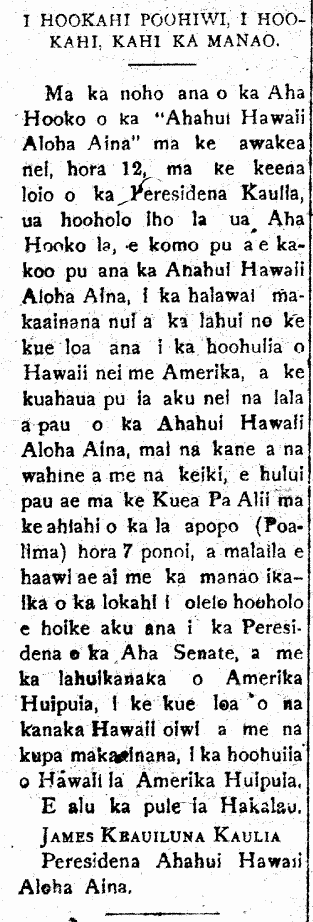
LET US BE OF ONE SHOULDER,¹ LET US BE OF UNIFIED THOUGHT.

At the meeting of the Executive Committee of the “Ahahui Hawaii Aloha Aina” [Hawaiian Patriotic League] at noon, 12 o’clock, at the attorney’s office of President Kaulia, the said Executive Committee decided that the Patriotic League will join and support the great rally of the makaainana of the lahui to absolutely protest the annexation of Hawaii to America, and it is announced to all of the members of the Hawaiian Patriotic League, from the men, to the women, to the children, to assemble at the Palace Square [Kuea Pa Alii] tomorrow evening (Friday) at exactly 7 o’clock, and there will be presented with insistence and unity, the resolution informing the President of the Senate and the people of the United States, that the native Hawaiians and the long-time makaainana protest the annexation of Hawaii to the United States of America.

Let us combine our prayers to overcome Hakalau. [E alu ka pule ia Hakalau.]²

James Keauiluna Kaulia

President of the Ahahui Hawaii Aloha Aina.

¹Hearkening to the idea of “I hookahi umauma, i hookahi poohiwi, a i hookahi puuwai.” [Let us be of one chest, one shoulder, and of one heart.] Also from earlier that year, see by Samuel K. Kamakaia, “Nai Wale no Oukou A’oe Pau.”

²According to Mary Kawena Pukui’s Olelo Noeau (115): “A sorcerer at Hakalau once created havoc in his own and other neighborhoods. Many attempts to counter-pray him failed until a visiting kahuna suggested that all of the others band together to concentrate on the common enemy. This time they succeeded.”

(Aloha Aina, 10/9/1897, p. 3)

I HOOKAHI POOHIWI, I HOOKAHI, KAHI KA MANAO.

Ke Aloha Aina, Buke III, Helu 41, Aoao 3. Okatoba 9, 1897.

Z. P. K. Kawaikaumaiikamakaokaopua’s treatise on kalaiaina, 1921–1922.

WHAT KALAIAINA IS.

(Written by Z. P. K. Kawaikaumaiikamakaokaopua).

Introduction.

God gave all men wealth [waiwai]; He gave land to grow food, He gave trees to build houses and to assist in great works, He gave all growing things to fulfill the desires of men, He gave us hands and strength to work and administer the land and all things that will bring us wealth.

But when man lived in ignorance, they were very poor. The things God gave him were not made into wealth. He lived in caves or shacks, or crude and dirty structures. His clothes were leaves, or animal hide, or tree bark; he hunted wild animals for food and plants that grew wild in the forest; he did not imitate the ant who prepared a lot of food. That is how ignorant men lived poorly. They did not know where to obtain wealth. The saw the wealth of foreign lands, and were amazed at the great wealth of other lands. They did not understand that God spread upon all lands things to make great wealth.

That is why kalaiaina is important. There are many facets of that word. The soil in which farmers farm is aina. The ocean in which fishing is done is aina. The public mart is aina. Canoe carving is aina. House building is aina. Everything done to bring wealth to many people is called aina. Administering to the different aina is how to gain wealth and it was called kalaiaina by the writers of old. Continue reading

Mele about news heard over the telephone wires, 1921.

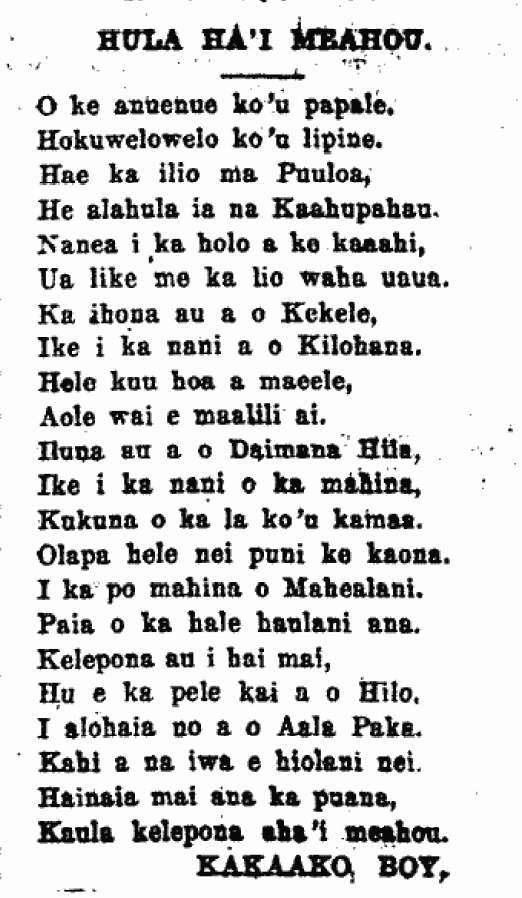
HULA HA’I MEAHOU.

O ke anuenue ko’u papale,
Hokuwelowelo ko’u lipine,
Hae ka ilio ma Puuloa,
He alahula ia na Kaahupahau,
Nanea i ka holo a ke kaaahi,
Ua like me ka lio waha uaua,
Ka ihona au a o Kekele,
Ike i ka nani a o Kilohana.
Hele kuu hoa a maeele,
Aole wai e maalili ai.
Iluna au a o Daimana Hila,
Ike i ka nani o ka mahina.
Kukuna o ka la ko’u kamaa,
Olapa hele nei puni ke kaona.
I ka po mahina o Mahealani,
Paia o ka hale haulani ana.
Kelepona au i hai mai,
Hu e ka pele kai a o Hilo.
I alohaia no a o Aala Paka,
Kahi a na iwa e hiolani nei.
Hainaia mai ana ka puana,
Kaula kelepona aha’i meahou.

KAKAAKO BOY.

[I wonder if this mele preceded or followed the song we know today as “Kukuna o ka La”.]

(Kuokoa, 11/11/1921, Section 2, p. 1)

HULA HA'I MEAHOU.

Ka Nupepa Kuokoa, Buke LIX, Helu 45, Mahele Elua, Aoao 1. Novemaba 11, 1921.

“Missionary Herald,” 1821–.

 Here is another reference available online. This publication was put out by the American Board of Commissioners for Foreign Missions (ABCFM), reporting home to America on their work throughout the world. Of particular interest to us is what they say about Hawaii. Here for instance is an article appearing in the year of the overthrow, 1893.

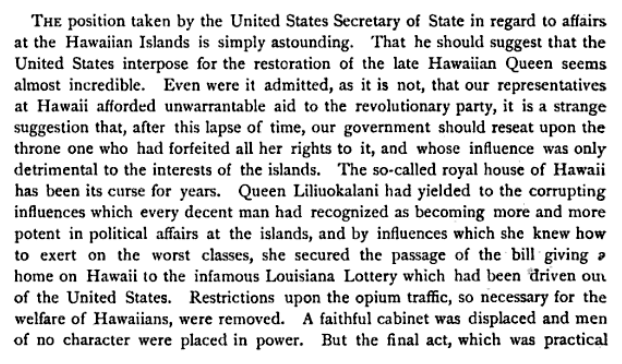
The position taken by the United States Secretary of State in regard to affairs at the Hawaiian Islands is simply astounding. That he should suggest that the United States interpose for the restoration of the late Hawaiian Queen seems almost incredible. Even were it admitted, as it is not, that our representatives at Hawaii afforded unwarrantable aid to the revolutionary party, it is a strange suggestion that, after this lapse of time, our government should reseat upon the throne one who had forfeited all her rights to it, and whose influence was only detrimental to the interests of the islands. The so-called royal house of Hawaii has been its curse for years. Queen Liliuokalani had yielded to the corrupting influences which every decent man had recognized as becoming more and more potent in political affairs at the islands, and by influences which she knew how to exert on the worst classes, she secured the passage of the bill giving a home on Hawaii to the infamous Louisiana Lottery which had been driven out of the United States. Restrictions upon the opium traffic, so necessary for the welfare of Hawaiians, were removed. A faithful cabinet was displaced and men of no character were placed in power. But the final act, which was practical…

(Missionary Herald, 12/1893, p. 510.)


The position taken...

The Missionary Herald, Volume LXXXIX, Number XII, Page 510. December 1893.

…suicide of the monarchy, was the attempt on her part to abrogate the Constitution and by sheer force establish a new one of her own making. Even her subservient ministers refused to endorse the scheme, yet she insisted upon it and sought to incite the populace to stand by her in her autocratic plans. It was then that all the better classes united as one man and deposed her. Never was there a revolution more warranted by facts, never was one more peacefully accomplished, and a queen of worthless character was set aside and the monarchy by its own act came to an end. If Minister Stevens or the commander of the Boston erred in judgment in any transaction, which we are not prepared to admit, yet there is no valid ground for the interference of our government to reverse the revolution months after it was consummated. We do not speak here of the political question as to what it is expedient for the United States to do in reference to a protectorate or to annexation. Opinions of these points may differ, but it would seem as if there were no room for difference of opinion in regard to this question of reestablishing the old monarchy on Hawaii. The best portion of her citizens have asked for some form of connection with the United States. Our government has a perfect right to say yes or no to all these proposals. And the Provisional Government at Honolulu has a right to say to us, “Either accept our proposal or hands off.” We regret to be obliged to speak in such terms of propositions that come from our national administration. We certainly should not do so did we not believe that any attempt to restore the Hawaiian Queen to her throne would be a gross outrage, and would be followed by the most serious consequences to the moral and religious interests of the islands, as well as to their material prosperity. We cannot think that our people will tolerate any intervention which has for its object the replacing upon the throne of a sovereign whose influence will be only for evil.

(Missionary Herald, 12/1893, p. 511.)

Continue reading

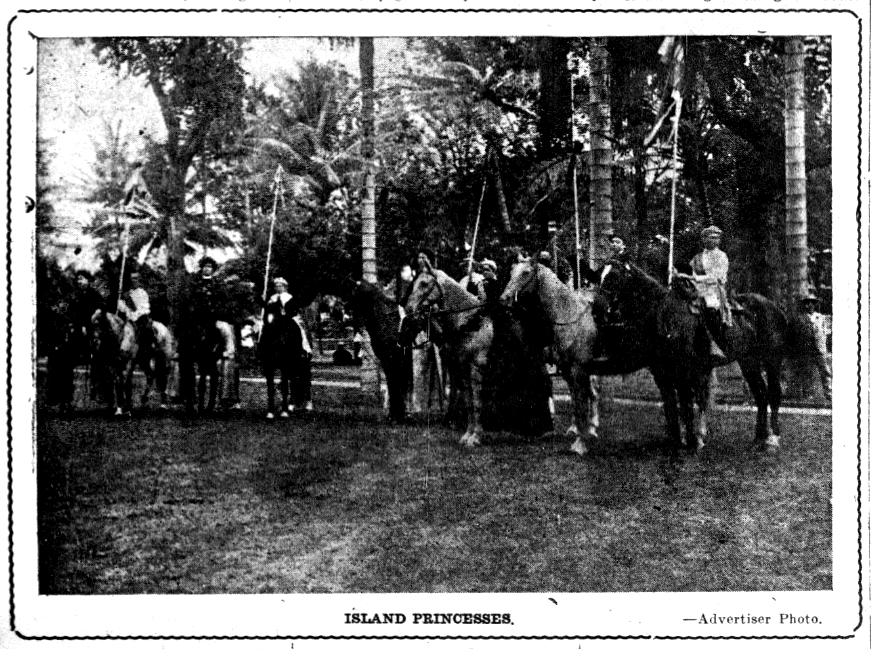
Island Princesses, 1908.

ISLAND PRINCESSES.

ISLAND PRINCESSES.

Pacific Commercial Advertiser, Volume VI, Number 269, Page 2. February 23, 1908.

THE PA-U RIDERS.

Thirty-four pa-u riders came cantering along in four sections of color: yellow, red, orange and pink, led by Judge Andrade and Mrs. Puahi. The Kaonohiokala Club sent fifteen horse women and the Wakinekona Club eighteen equestiennes. A brave sight they made with their long pa-us fluttering in the breeze and their garlands showing bright in the sunshine.

Several of the older riders were in the parade, ladies who wore the pa-u in the pleasure-loving days of the monarchy. Very dignified were these elderly dames and very well they rode. The younger women were out for fun and they certainly had it, galloping wherever there was room to and urging their steeds on with merry shouts. The riders included the following from the Kaonohiokala Club: Mrs. Puahi, Mrs. Kaumaka, Mrs. Dias, Mrs. Kaluapapakini, Mrs. Kailianu, Mrs. Nakapaahu, Mrs. Irene Silva, Mrs. Kauwa, Mrs. Haalou, Miss Lucy Woodward, Mrs. M. Hoonani, Mrs. Maluae, Mrs. Anehilo Keama, Mrs. Stahle, Mrs. Johnson; and the following members of the Wakinekona Club: Mrs. Horn, Mrs. Kapio, Mrs. Liau, Mrs. Aiwohi, Mrs. Jackson, Mrs. Pumehia, Mrs. Mahi, Mrs. Isaac, Mrs. Fairman, Mrs. Kekuewa, Mrs. Kapulani, Mrs. Tuck Williams, Miss Kekua, Miss M. Hao, Mrs. Emakai, Miss Marie Hiram, Miss Julia Lui, Miss Mary Wood. Continue reading