More on the Boston, in English, 1893.

The U. S. S. Boston Lands Sailors and Marines.

(From Daily, January 17.)

Yesterday was an eventful day in this city. At early morning groups of men could be seen about the streets talking over the present critical situation.

About eleven o’clock the following notice was handed about but it was not received with favor as it was considered but a ruse on the part of the revolutionists:

BY AUTHORITY.

Her Majesty’s Ministers desire to express their appreciation for the quiet and order which has prevailed in this community since the events of Saturday, and are authorized to say that the position taken by Her Majesty in regard to the promulgation of a new Constitution, was under stress of Her native subjects.

Authority is given for the assurance that any changes desired in the fundamental law of the land will be sought only by methods provided in the Constitution itself.

Her Majesty’s Ministers request all citizens to accept the assurances of Her Majesty in the same spirit in which it is given.

(SIGNED) Liliuokalani.

Samuel Parker,
Minister of Foreign Affairs.

W. H. Cornwell,
Minister of Finance.

John F. Colburn,
Minister of the Interior.

A. P. Peterson,
Attorney-General.

Iolani Palace, January 16, 1893.

In the afternoon all of the principal business houses closed up to allow the owners and their clerks to attend the mass meeting at the Armory. A full report of the enthusiastic meeting appears elsewhere in this issue.

After the meeting adjourned many people returned to Fort street, and stood around as if they expected some new developments, and they were rewarded when one of the most important events of the day happened.

About 5 o’clock in the afternoon, the U. S. S. Boston landed about three hundred men. Each man had two belts of cartridges around his waist and was armed with a rifle. The men marched up to the office of the Consul-General of the United States, where a halt was made.

The marines were detached and sent to the American Legation on Nuuanu Avenue, while the sailors marched out along Merchant street with two gatling guns and made a halt in front of Mr. J. A. Hopper’s residence. About sundown they moved to the grounds of Mr. J. B. Atherton’s and after a stay of several hours returned to Arion Hall, where they camped over night.

[The “Daily” here mention at the top refers to the Daily Pacific Commercial Advertiser.]

(Hawaiian Gazette, 1/24/1893, p. 6)
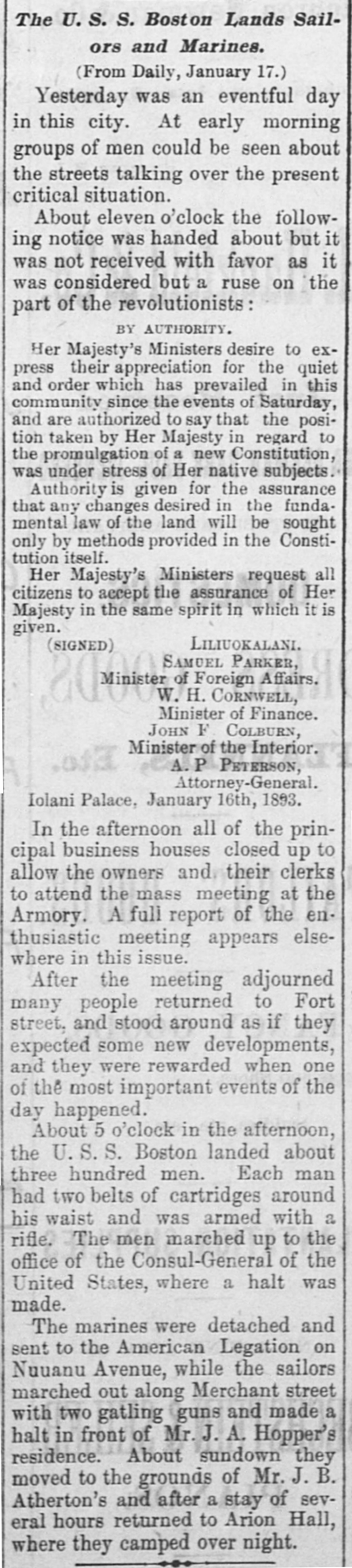
The U. S. S. Boston Lands Sailors and Marines.

Hawaiian Gazette, Volume XXVIII, Number 4, Page 6. January 24, 1893.
More on the Boston, in English, 1893.

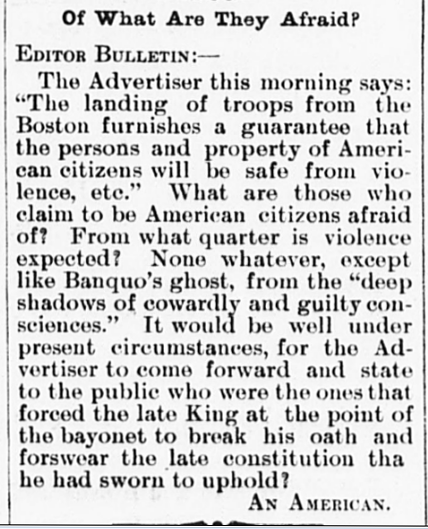
Of What Are They Afraid?

Editor Bulletin:—

The Advertiser this morning says: “The landing of troops from the Boston furnishes a guarantee that the persons and property of American citizens will be safe from violence, etc.” What are those who claim to be American citizens afraid of? From what quarter is violence expected? None whatever, except like Banquo’s ghost, from the “deep shadows of cowardly and guilty consciences.” It would be well under present circumstances, for the Advertiser to come forward and state to the public who were the ones that forced the late King at the point of the bayonet to break his oath and forswear the late constitution tha he had sworn to uphold?

An American.

(Daily Bulletin, 1/17/1893, p. 3)

Of What Are They Afraid?

The Daily Bulletin, Volume 5, Number 626, Page 3. January 17, 1893.

More on the landing of the Boston, 1893.

OPPOSED.

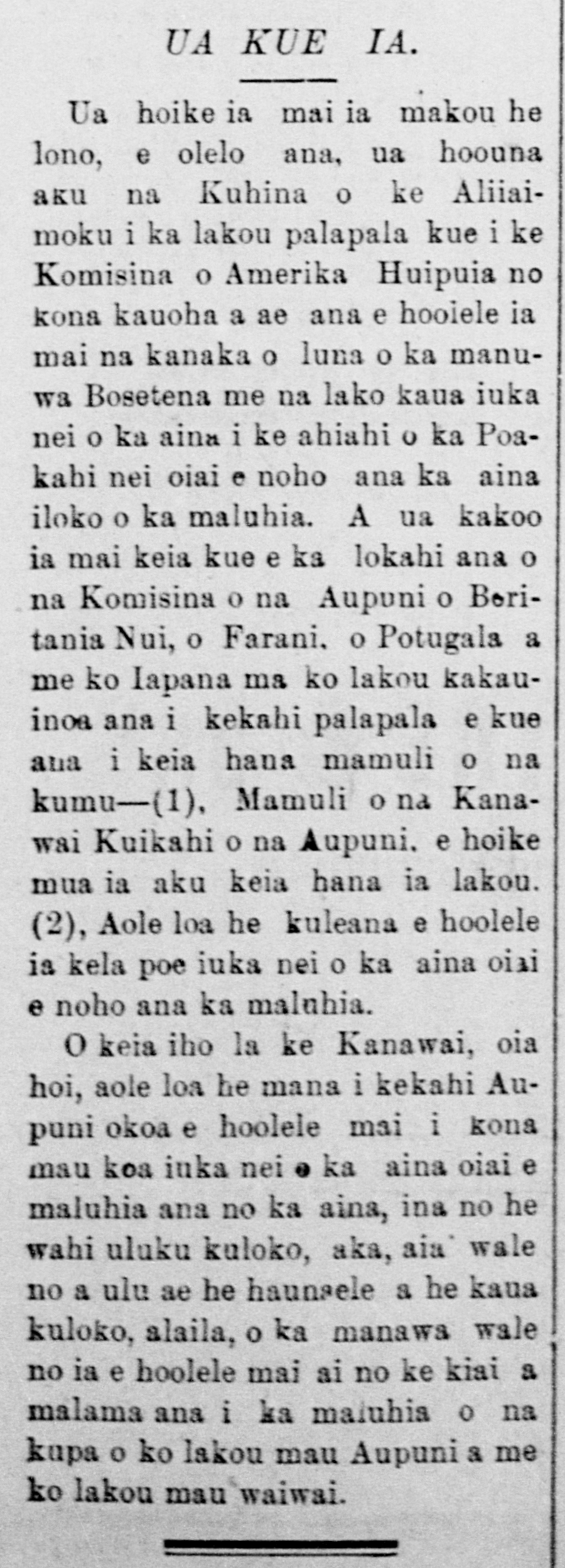
We have received news that the Ministers of the Queen sent their written protest to the Minister of the United States for his ordering the landing of the armed men from the man-of-war Boston on the evening of this Monday notwithstanding that there was peace on land. And this objection was jointly supported by the Commissioners of the Nations of Great Britain, France, Portugal, and Japan, by them signing a document opposing this action over these reasons—(1), Because of the agreement under law between the Nations to give prior notice. (2),  There was no cause to land the troops being that there was peace.

This is the Law, that being there is no other Nation that has any right to land its troops while there is peace; were there internal problems, but only if there was an uprising or a civil war, only then could there be troops landed to watch over and protect the safety of their citizens as well as their property.

(Hawaii Holomua, 1/18/1893, p. 3)

UA KUE IA.

Hawaii Holomua, Buke III, Helu 141, Aoao 3. Ianuari 18, 1893.

Competing rallies, 1893.

O HAWAIIAN LAHUI!

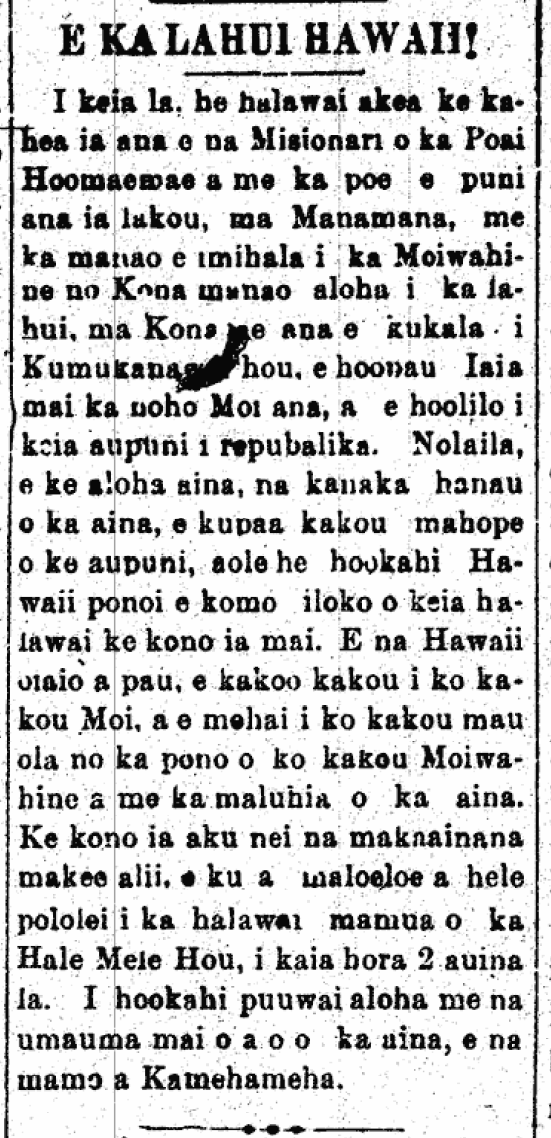
Today, there is a rally being called by the Missionaries of the Reformist Party [Poai Hoomaemae] and those who favor them, at Manamana, with the intent to bring harm to the Queen for Her aloha she has for the lahui, in Her proclaiming a new Constitution; by ending Her reign and making this nation a republic. Therefore, patriots, those born of this land, stand strong behind this nation; there shall not be a single true Hawaiian who will participate in this gathering, should they be invited. All of you true Hawaiians, let us stand behind our Sovereign and give our lives for the rights of our Queen and peace over the land. Those citizens who love their alii are called to join together to march straight to the rally fronting the Opera House [Hale Mele Hou] at 2 o’clock in the afternoon. With one heart of aloha and breasts side by side all across the land, you descendants of Kamehameha.

(Leo o ka Lahui, 1/16/1893, p. 2)

E KA LAHUI HAWAII!

Ka Leo o ka Lahui, Buke II, Helu 623, Aoao 2. Ianuari 16, 1893.

Early movie making in Honolulu, 1913.

FAKE MOVIE.

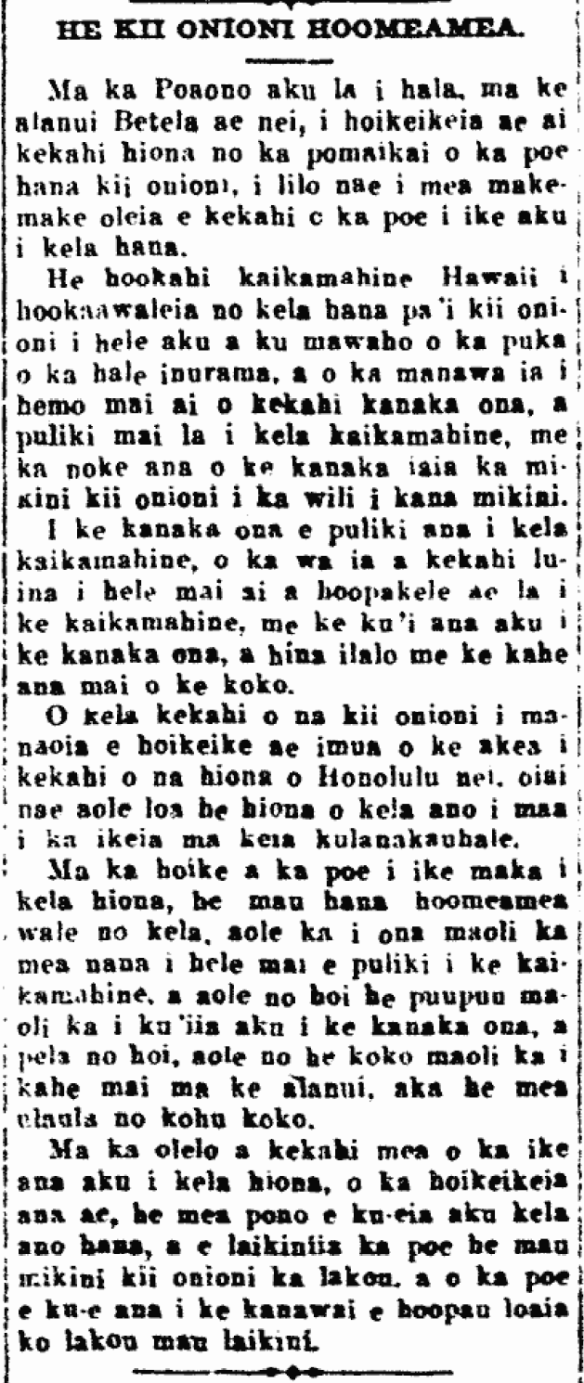
Last Saturday, on Bethel Street, a scene was put on for movie makers, which became something unappealing to some who witnessed it.

There was a Hawaiian girl set aside for the shooting that went and stood outside the entrance of a bar, and at this was when a drunk man exited and clutched the girl, while the one with the camera continued to film.

As the drunkard continued to grasp the girl, a sailor came and rescued the girl, and he punched the drunk man, who fell down as blood flowed.

This was a movie meant to show a Honolulu scene before the public, even if that type of scene is not something seen regularly in this town.

According to those who witnessed this, it was nothing but acting; the one who went and grabbed the girl was not really drunk, and he was not hit with a real punch, also, it was not real blood that flowed on the street, but it was something red that resembled blood.

One of those who saw this being staged said that this kind of thing should be prohibited, and those who own movie cameras should be licensed, and those who break the law should have their licenses revoked for good.

(Kuokoa, 1/10/1913, p. 4)

HE KII ONIONI HOOMEAMEA.

Ka Nupepa Kuokoa, Buke XLIX, Helu 2, Aoao 4. Ianuari 10, 1913.

Response to changes happening in the Kingdom, 1888.

COMMON OPINION¹

PREPARING THE MOVEMENT FOR THE GOOD OF HAWAII.

The opinion printed below this heading comes from letters received from our friends. All criticism for those opinions fall upon those who wrote the letters, and not upon us. (Editor)

O Mr. Editor:—I ask for your patience, being that I am a true Hawaiian.

Whereby two-thirds or more of this lahui are of the opinion to form an appropriate Association for the benefit of the Hawaiians and the foreigners.

Whereby the Cabinet of Ministers in power now stands upon sand, where when the rain beats down and the wind blows, it will fall, and that shall be their fate.

Whereby this Cabinet of Missionary Ministers are in government positions without the confidence of two-thirds or more of the people residing here and some who are observing from elsewhere.

Whereas the circle of Missionaries intends to long hold the power in the workings of the Government, while clearly going against the laws of this land.

And Hawaii intends to look after its own good, without fear of the opposition facing it. Whereas all enlightened Hawaiians know that they have this responsibility.

Therefore, they have no desire for the power of the Governmental offices of their beloved land to be put to waste by this circle, and to have them [the ministers] enter Hawaii into a debt that cannot be repaid.

Along with the other heads that they are appointing; and they are the major power, and they are the King. And the negligent laws they pass have power over this tiny lahui.

Whereas I speak with truth in enlightened manner. Whereas the laws not approved by the King, and not signed by him; they have no power to become law over this lahui.

Therefore, time is near for Hawaii to consider, and to discuss what is right, and of the advancement of its efforts, its land, and the King.

O Editor, I shall constantly fill your paper with delicacies, should this topic above receive your kindness.

With Appreciation

S. W. B. K.——

Manoa, Nov. 6, 1888.

[Anybody have an idea who S. W. B. K. from Manoa is?]

¹”Na Manao Laulaha” is a regular column in Ke Alakai o Hawaii.

(Alakai o Hawaii, 11/10/1888, p. 4)

NA MANAO LAULAHA

Ke Alakai o Hawaii, Buke I, Helu 45, Aoao 4. Novemaba 10, 1888.

The “Chinese Disease,” 1865.

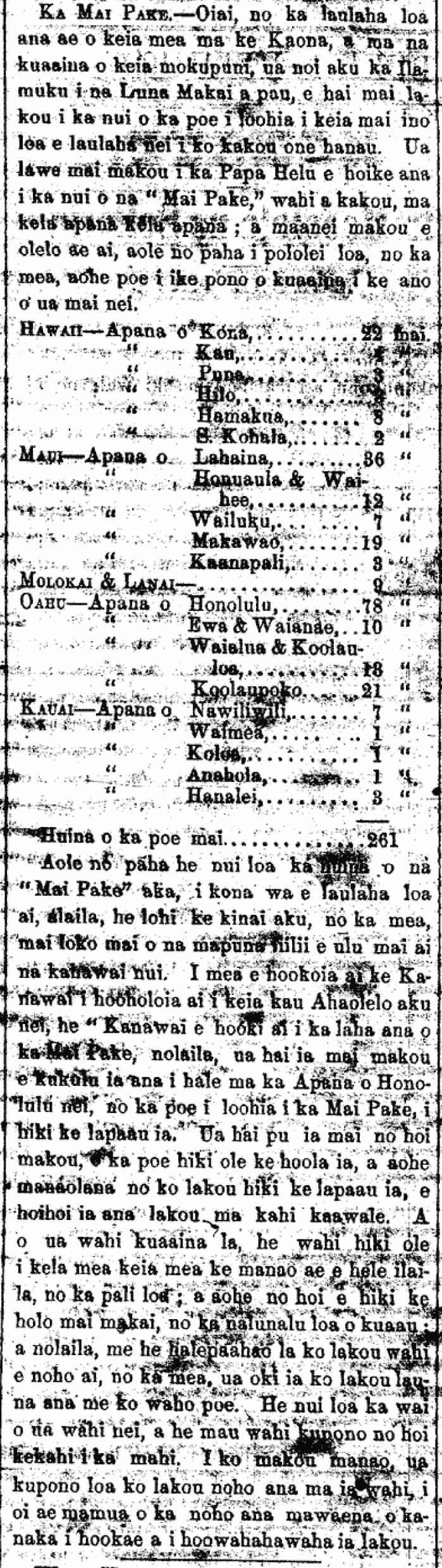
Leprosy [Mai Pake]—As this is greatly spreading about Town and in the country of this island, the Sheriff [Ilamuku ?] has requested that all of the District Sheriffs [Luna Makai ?] to report the number of people inflicted with this horrible sickness that is spreading in our homeland. We have taken the List showing the number of “Chinese Disease,” as we call it, in each district; and we say here that this is probably not accurate, because there is no one in the country who knows for certain what the symptoms are.

Hawaii—District of Kona, . . . 22 sick.
” of Kau, . . . 4 ”
” of Puna, . . . 3 ”
” of Hilo, . . . 3 ”
” of Hamakua, . . . 8 ”
” of S. Kohala, . . . 2 ”
Maui—District of Lahaina, . . . 36 ”
” of Honuaula & Waihee, . . . 12 ”
” of Wailuku, . . . 7 ”
” of Makawao, . . . 19 ”
” of Kaanapali, . . . 3 ”
Molokai & Lanai— . . . 9 ”
Oahu—District of Honolulu, . . . 78 ”
” of Ewa & Waianae, . . . 10 ”
” of Waialua & Koolauloa, . . . 18 ”
” of Koolaupoko, . . . 21 ”
Kauai—District of Nawiliwili, . . . 7 ”
” of Waimea, . . . 1 ”
” of Koloa, . . . 1 ”
” of Anahola, . . . 1 ”
” of Hanalei, . . . 3 ”
Total of sick . . . 261
Maybe the total of the number of “Mai Pake” is not so great, but when it truly spreads, then it will be too late to extinguish, for it is from tiny springs which great rivers grow forth. In order to comply with the law which was passed this last session of the legislature, “An Act to Prevent the Spread of Leprosy,” we are told that structures will be built here in Honolulu for those inflicted with leprosy so that they may be treated. We are also told that for those who are incurable, and for those for whom there is no hope in treating, they will be sent to a place set apart. And that country side will be a place that no one will think about going to, because of great cliffs; and it cannot be accessed by sea because of the rough conditions of the lagoon. So where they live will be like a prison, for their association with those on the outside will be cut off. There is much water there, and it is also a place suitable for farming. In our opinion, it is better for them to live there than for them to live amongst people who hate and scorn them.
(Au Okoa, 6/26/1865, p. 2)
Ka Mai Pake

Ke Au Okoa, Buke I, helu 10, Aoao 2. Iune 26, 1865.

On the perpetuation of the Hawaiian Language, 1911.

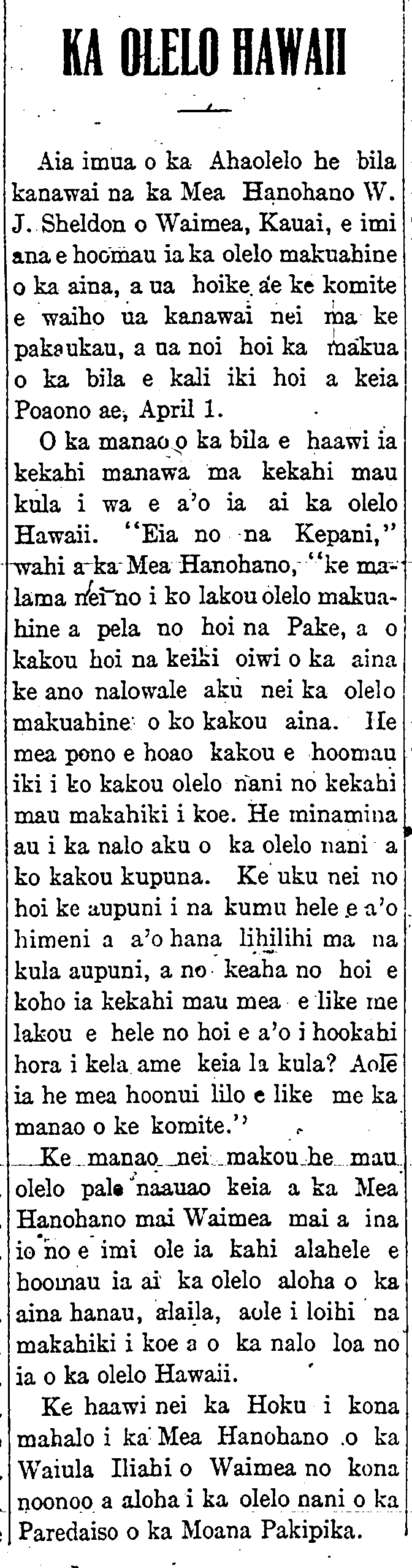
THE HAWAIIAN LANGUAGE

Before the Legislature is a bill put forth by the Honorable W. J. Sheldon of Waimea, Kauai, which seeks to perpetuate the mother tongue of this land; but the committee announced that the bill will be tabled; to which the father of the bill asked that they wait for a bit until the following Saturday, April 1.

The intent of the bill is to allow for time in some schools to teach the Hawaiian language. “Here are the Japanese,” said the Honorable One, “they are caring for their mother tongue, and so too of the Chinese; but we, the native children of this land, our native language is disappearing from our own land. It is imperative that we try to perpetuate our beautiful language even just a little longer. I feel remorse in letting the beautiful language of our ancestors go. The government pays for travelling instructors to teach singing and lace making [hana lihilihi ?] in public schools, so why not choose people like that to go and teach for one hour every school day? It will not be a great expense like what is imagined by the committee.”

We believe that these are very wise responses by the Honorable One of Waimea, and if indeed means are not sought to perpetuate the beloved language of our birth land, then it will not be long before the Hawaiian language will disappear completely.

The Hoku gives its mahalo to the Honorable One of the Waiula Iliahi¹ of Waimea for his consideration and aloha for the beautiful language of the Paradise of the Pacific Ocean.

¹Waiula Iliahi is one of the two branches of the Waimea River, and the other being Waikea, and they merge at Kikiaola.

(Hoku o Hawaii, 3/30/1911, p. 2)

KA OLELO HAWAII

Ka Hoku o Hawaii, Buke 5, Helu 47, Aoao 2. Maraki 30, 1911.

Albert Loomens of Wilcox Rebellion sentenced, 1890.

[Found under: “HAWAII NEWS”]

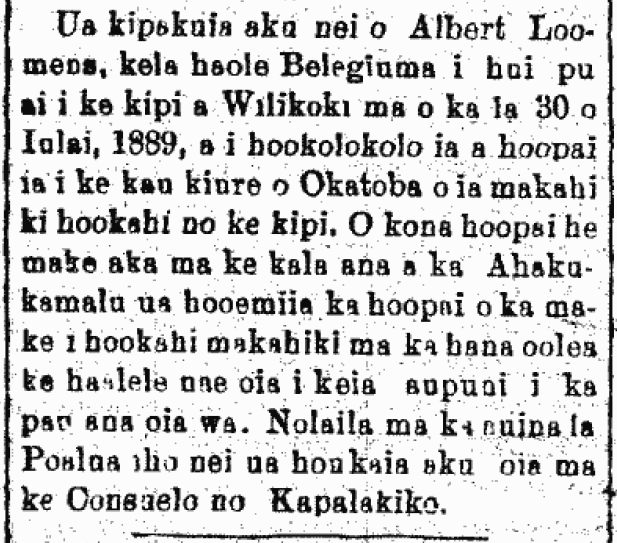
Albert Loomens is being banished, that Belgian who joined the rebellion with Wilcox and party on the 30th of July 1889; and he was tried and sentenced by jury on October of the same year for treason. His sentence was death but this was forgiven by the Privy Council [Ahakukamalu], and the death sentence was reduced to one year of hard labor on the condition that he leave this country at the end of this term. Therefore, on the afternoon of this Tuesday, he was sent aboard the Consuelo for San Francisco.

(Ko Hawaii Pae Aina, 10/18/1890, p. 2)

Ua kipakuia aku nei o Albert Loomens...

Ko Hawaii Pae Aina, Buke XIII, Helu 42, Aoao 2. Okatoba 18, 1890.

Bernice Pauahi Bishop Museum’s Government and Governance Digital Initiative, 2012.

I was at a presentation tonight by DeSoto Brown of the Bishop Museum on some of their treasures held in the Museum’s archives. Of particular interest to you all might be the number of new material that is available online and is word searchable!

Here is the search page for their Government and Governance: A Digital Initiative page.

One of the great many topics of interest is Leprosy.