Molokai correspondent, Ruby Apiki Bright, 1939.

NEWS ITEMS FROM MOLOKAI

INTRODUCTION

We, the managers of the newspaper Hoku o Hawaii, are blessed through receiving some news items from the Homestead lands of Molokai, the land which the Alii Kuhio put much effort into for the Hawaiians. This is received through the correspondence of the mother, Mrs. Ruby Apiki Bright.

Lot 2, Hoolehua

Sept. 5, 1839

To my dear patient Hoku:

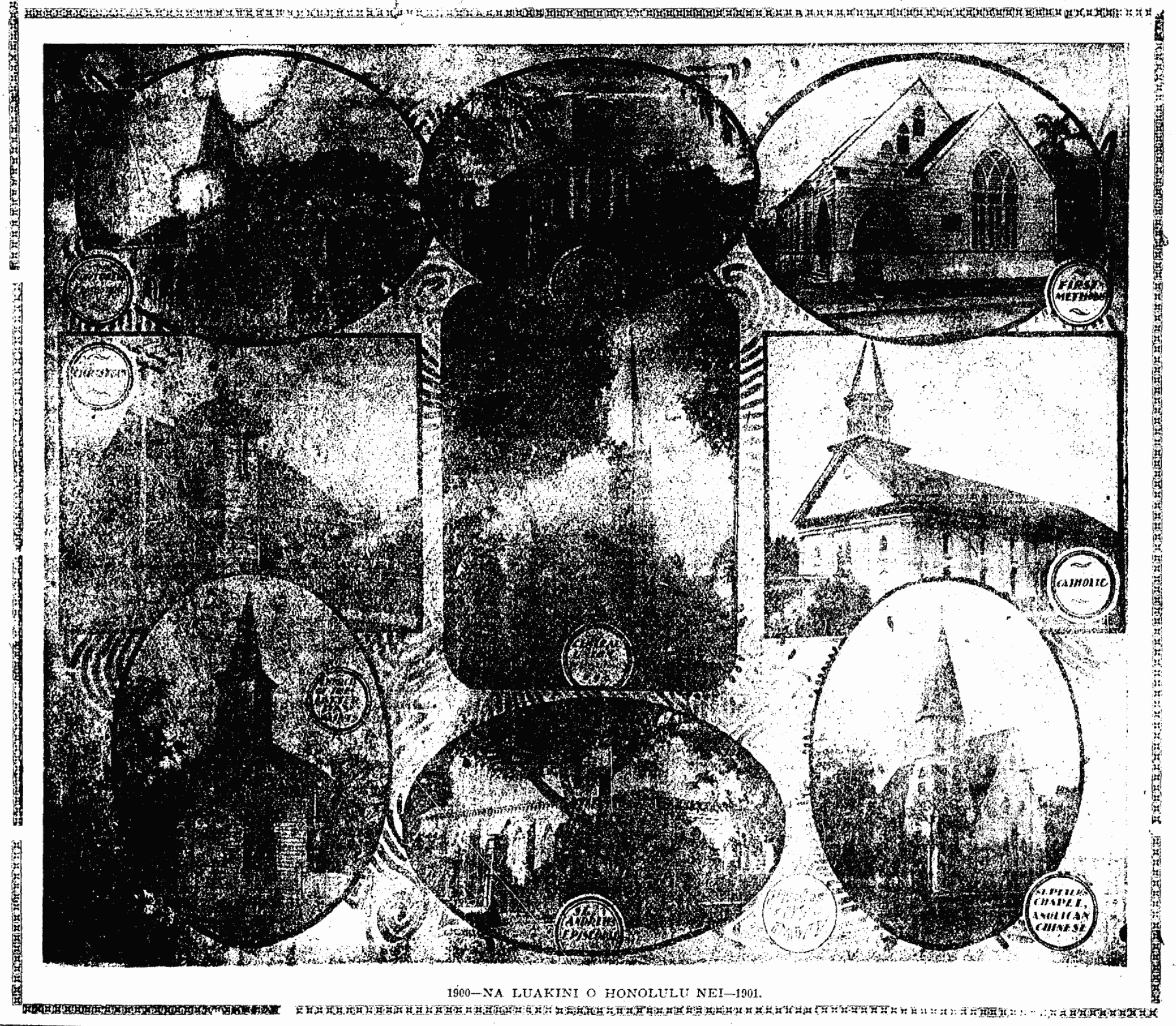
Here is some baggage for the deck of our pride, should it be kindly allowed some free space. On this past 26th of August, the Catholics of Kaunakakai held a silver jubilee in commemoration of the building of their church, St. Sophia, and there was a fair, and the activities that day went well. They gave the name of that well-to-do mother of the Island of Hina [Molokai] to their church, that being Mrs. Sophie Judd Cooke—the open-hearted mother who spread forth her helping hands for its furnishing and building in the year 1914.

The Calvinists held a Bazaar for their benefit, selling all sorts of things on this past 2nd of this month. Everything was lovely.

……..

[Ruby Apiki Bright started her regular column reporting on news from Molokai on this day, September, 20, 1939, in Hoku o Hawaii. I hope some day soon, these papers will be rescanned again clearly so they are easily read!]

(Hoku o Hawaii, 9/20/1939, p. 1)

HUNAHUNA MEA HOU O MOLOKAI

Ka Hoku o Hawaii, Volume XXXIV, Number 21, Page 1. Sepatemaba 20, 1939.
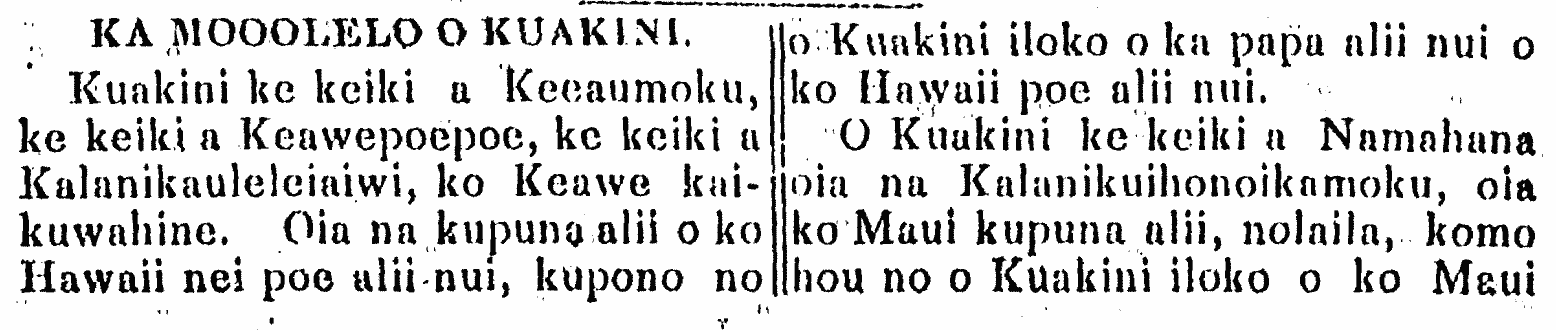
Kuakini, and Hawaiian tradition, 1845.

BIOGRAPHY OF KUAKINI.

Kuakini was the son of Keeaumoku, the son of Kalanikauleleiaiwi, the sister of Keawe. They are the royal ancestors of Hawaii Island’s high chiefs, Kuakini was befitting the class of high chiefs amongst Hawaii’s alii nui.

Kuakini was the son of Namahana who was born from Kalanikuihonoikamoku, and they are Maui’s royal ancestors, and therefore, Kuakini is amongst Maui’s…

…class of high chiefs; Kuakini was born as an alii.

Kuakini was born in the year 1792 perhaps; he was born in the year of [battle of] Kepuwahaulaula; at Keauhou in Kona in Hawaii was where he was born.

His caretaker [kahu hanai] was Kameheaiku, and Kuakini grew up at Keauhou, and he was made by his father, Keeaumoku, to pray to the wooden gods; this was Kuakini’s duties in his youth, the worship of the wooden gods.

He was the one who cared for all the temples in Kona, along with the Loulu temples, and in regard to his worshiping, one of the names Kuakini was called was Kiipalaoku, for Ku was the god for whom he would fetch pala fern.

Kuakini was a thinker from when he was small; he was meticulous; he often would sail boats with the other children in his youth, and when he grew up, he went with his parents to Maui, and thereafter he lived with Kamehameha I.

He became an aikane of Kamehameha I, because Kuakini possessed a fine body, he was skilled in English, he thought much about the way a body functions, he was sullen, and was a man of few words.

When Kamehameha I died, Liholiho them went to Oahu, and Kuakini was appointed Governor of Hawaii, and it was he that was to care for Hawaii until his recent death.

When Kuakini was assisting intently with the kingdom of God, it was he who built the great churches here on Hawaii Island.

O Armstrong [Limaikaika], please ask of Thurston [Tatina] or Bishop [Bihopa], for they know what he was like for both of them lived with him.

O Father Armstrong, I am living here on Hawaii these months, and will then return to Maui, or perhaps not. D. MALO.

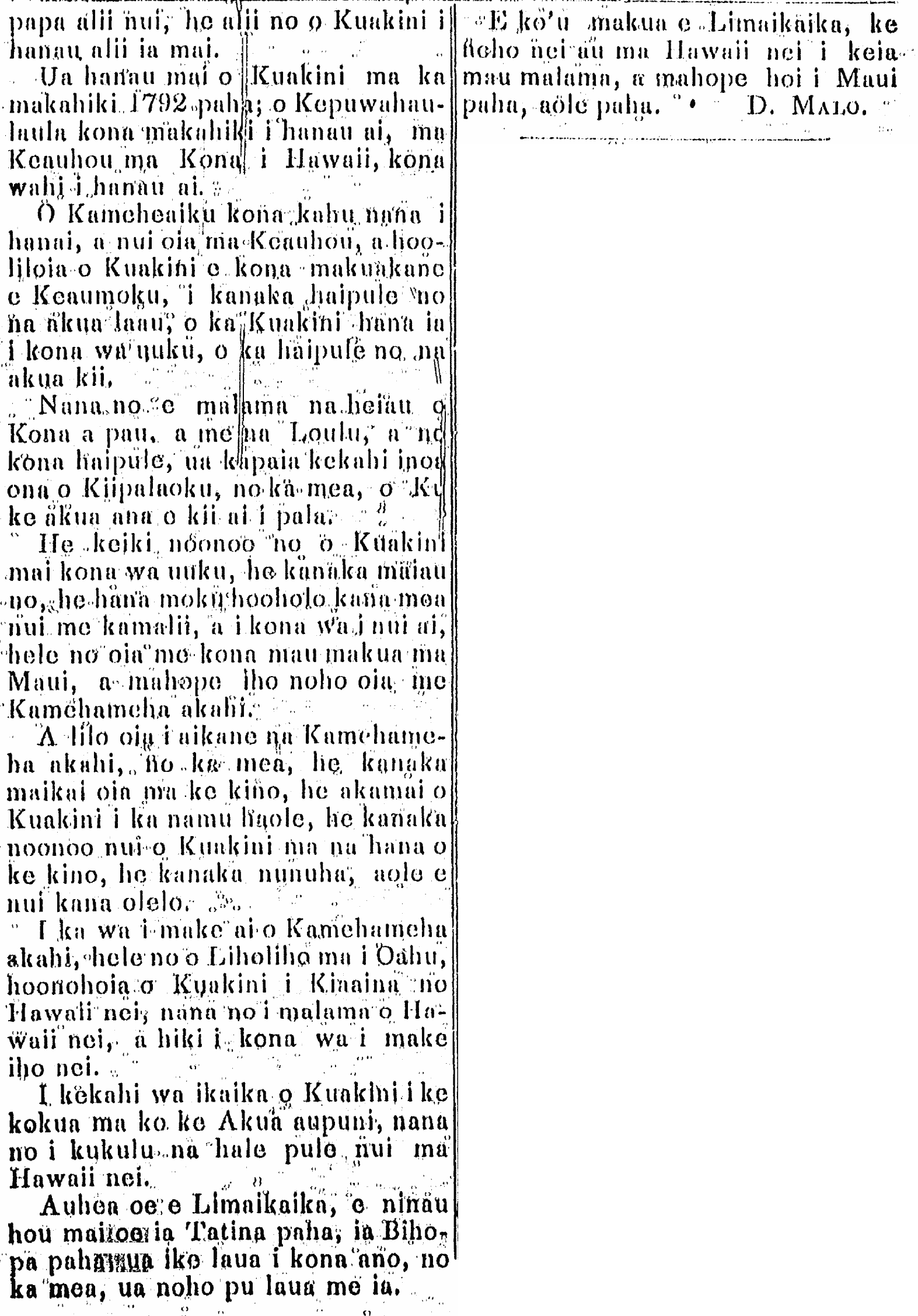
(Nonanona, 1/7/1845, pp. 89–90)

KA MOOOLELO O KUAKINI.

Ka Nonanona, Buke 4, Pepa 19, Aoao 89. Ianuari 7, 1845.

papa alii nui, he alii no o Kuakini...

Ka Nonanona, Buke 4, Pepa 19, Aoao 90. Ianuari 7, 1845

Marriage of Liliuokalani and John Owen Dominis, 1862.

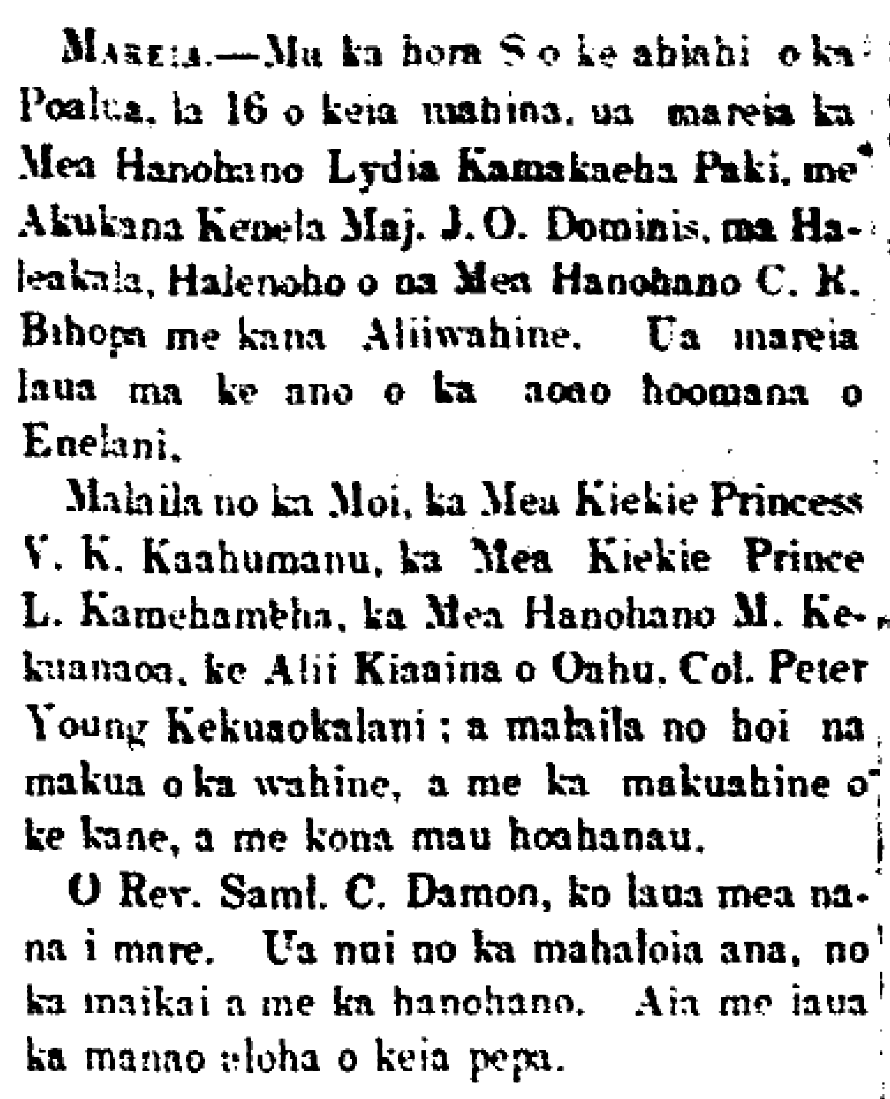
Marriage.—At 8 in the evening of Tuesday, the 16th of this month, the Honorable Lydia Kamakaeha Paki and Adjutant General Major J. O. Dominis were wed at the Residence of the Honorable C. R. Bishop and his Queen. The two were married in the Anglican faith.

Present were the King; her Highness Princess V. K. Kaahumanu; his Highness Prince L. Kamehameha; the Honorable M. Kekuanaoa, the Royal Governor of Oahu; Colonel Peter Young Kekuaokalani; also there were the parents of the bride, and the mother of the groom, and his cousins.

Rev. Samuel C. Damon was who performed the ceremony. It was appreciated for its righteousness and honor. With the two of them are the thoughts of aloha of this paper.

(Kuokoa, 9/20/1862, p. 3)

Mareia.

Ka Nupepa Kuokoa, Buke I, Helu 43, Aoao 3. Sepatemaba 20, 1862.

Fund raiser for the building of St. Augustine in Waikiki, 1901.

FAIR AND LUAU.

A fair and grand luau was held by the Catholic brethren in the armory [hale paikau] outside, this Saturday afternoon. There were many people who showed up to this fair, and we hear that they made a lot of money through the items sold and the luau. Amongst the dignitaries who appeared at the fair was Queen Liliuokalani. The Royal Hawaiian Band [bana aupuni] was there, entertaining the visitors that came, and with the coming of night there was held a dance in the armory. All the proceeds from this fair will be given to the church of St. Augustine being built outside of Waikiki.

(Aloha Aina, 7/20/1901, p. 5)

AHA FEA ME LUAU.

Ke Aloha Aina, Buke VII, Helu 29, Aoao 5. Iulai 20, 1901.

Keahu Kealiiaukai, an awesome biography, 1941.

Recalling the Days of Kamehameha V.

KEAHU KEALIIAUKAI

Keahu Kealiiaukai is one of the last Hawaiians left who is not proficient in English. He is a Hawaiian famous for his knowledge of plants, and he is 82 years old. He lives in Lahaina, Maui, the capital of Hawaii in days of yore. Kealiiaukai is now living with his daughter, Mrs. Juliette Pali.

When Kealiiaukai was born in Kaupo, Maui, on the road going to the crater of Haleakala, in the year 1859, this was the fifth year of Kamehameha IV’s reign over Hawaii nei. Kealiiaukai was 4 when that monarch died. He does not recall this.

Remembering the King.

However, Kealiiaukai does in fact remember Kamehameha V, or King Kapuaiwa, his given name; and the last of the Kamehamehas. Kapuaiwa went to Lahaina numerous times, where he was welcomed warmly by his makaainana.

In Kealiiaukai’s eighty and two years of life, he witnessed the passing of the monarchs of his homeland, closing with the overturning of the nation under Queen Liliuokalani’s protection, in 1893. Then the establishing of the provisional government and the Republic of Hawaii, and the joining of the Islands to the United States and the formation of this Territory of America, 40 years ago.

A Religious Man

Kealiiaukai is an important man in Lahaina for the kamaaina there. His wife left this world eight years ago, but she did not however leave behind children. Kealiiaukai is still strong and active. He participates often in works of this Father in Heaven. He spent his life being a member of the Faith of the Latter Day.

Perhaps he is the last medicine man living and practicing from before the times when there was licensing of those in that profession. During his time, it is said that Kealiiaukai practiced healing with plants amongst his own people and healed them due to his expertise in the use of plants growing in the forests of Hawaii, for all types of illnesses.

(Hoku o Hawaii, 3/5/1941, p. 1)

Hoomanao Ina La O Kamehameha V

Hoku o Hawaii, Volume XXXV, Number 45, Page 1. Malaki 5, 1941.

Hula and King Kalakaua’s 50th Jubilee, 1886.

THE LUAU FEAST AT THE PALACE GROUNDS.

Nov. 23, 1886.

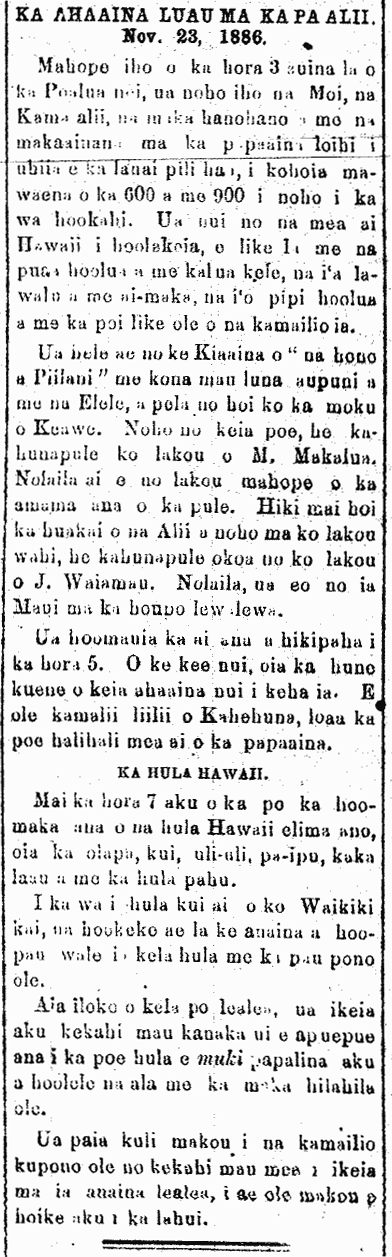
After 3 o’clock in the afternoon of this Tuesday, the King, the Princes and Princesses, the dignitaries, and the makaainana sat at a long table housed by a pavilion with corrugated iron roofing [lanai pili hao], which could sit an estimated 600 to 900 people at a time. There was much Hawaiian foods supplied, like laulau [puaa hoolua] and roasted pork [puaa kalua kele]; fish wrapped in ti leaves and baked [lawalu] and raw [ai-maka]; baked beef [i’o pipi hoolua] and all types of poi spoken of.

The Governor of the “bays of Piilani”¹ as well as his government officials and Delegates, along with those of the island of Keawe.² These people sat along with their pastor, M. Makalua. They began eating after the prayer was over. The entourage of the King and Queen arrived and sat in their area, and they had their own pastor, J. Waiamau. Therefore, Maui was victorious over their hunger [?? Nolaila, ua eo no ia Maui ma ka houpo lewalewa].

The eating continued perhaps until 5 o’clock. A big problem was the dearth of waiters for the grand feast that was boasted about. Thanks to the small children of Kahehuna [School], there were those to serve the food for the feast.

HAWAIIAN HULA.

From 7 o’clock in the night, Hawaiian hula of five types commenced, that being olapa, kui, uli-uli, pa-ipu, kaka laau, and hula pahu.

When those of Waikiki kai danced their hula kui, the audience complained, and that hula was put to an end without ending properly.

During that joyful night, some youths were seen attempting to get the dancers to kiss their cheeks, and to [?? hoolele na ala] without any sign of shame.

We were deafened by all the improper talk of some of the things seen in that partying crowd that we will not agree to tell the nation.

¹The governor of Maui was John Owen Dominis.

²The governor of Hawaii was Virginia Kapooloku Poomaikelani

(Ko Hawaii Pae Aina, 11/27/1886, p. 4)

KA AHAAINA LUAU MA KA PA ALII.

Ko Hawaii Pae Aina, Buke IX, Helu 48, Aoao 4. Novemaba 27, 1886.

Another promising brown bag from UHM Center for Biographical Research, 2013.

If you are free at noon this Thursday (4/4/2013), this sounds like an interesting brown bag. Hokulani K. Aikau talks about her new publication on Mormonism and Hawaiians. See below for more:

“A Chosen People, A Promised Land:

Mormonism and Race in Hawai‘i.”

Response to hula commentary, 1891.

THE HULA AND THE “P. C. ADVERTISER.”

Another example of the “P. C. Advertiser’s” moral attitude appears int the announcement, that a hula given by the Hon. J. A. Cummins at his resident at Waimanalo was a glorious affair.—We have no doubt, that the display was exceptionally fine, since the ex-Premier has a well earned reputation as a connoiseur in that line, and is said to use the collection of females, formerly of boat house fame, second to none in the country.—Still there is something about the hula, that has so far excluded it from the programs of church festivals and school exercises.—It has never been recommended to lure the mind to thoughts of higher and better things or to produce rigid uprightness of morals.

The hula is a graceful and rhythmic representation of certain actions of the human animal. There is no doubt, that from the earliest ages the physiology of reproduction has been the most intrinsically interesting known to man. After the question of food and personal safety, it is the most important consideration in the lives of man, savage and civilized. The Hindoos and Budhists covered their temples and public buildings with indecent pictures, which in some instances took the form of a cross. This was imported to Rome together with the worship of Isis. So every spire on a Christian Church represents a resurrection of the flesh. But civilized society has decided for good reason to cover Isis with a vail and put Osiris in a straight-jacket. It is only those, who believe in the infallibility and prerogatives derived from gold—as some of our friends—who may wish to go back to the first principles and have the hula taught as an accomplishment in our public schools, so that it might prove more attractive in catching a husband and certainly in domesticating him when caught, than the art of piano playing or embroidery. There are great posibilities in the hula! But at present it is prohibited by the law, and we are sorry to see the law violated by those who ought to know better.

(Leo o ka Lahui, 5/14/1891, p. 4)

THE HULA AND THE "P. C. ADVERTISER."

Ka Leo o ka Lahui, Buke II, Helu 193, Aoao 4. Mei 14, 1891.

The latest from Hana, Maui, 1877.

News from Hana.

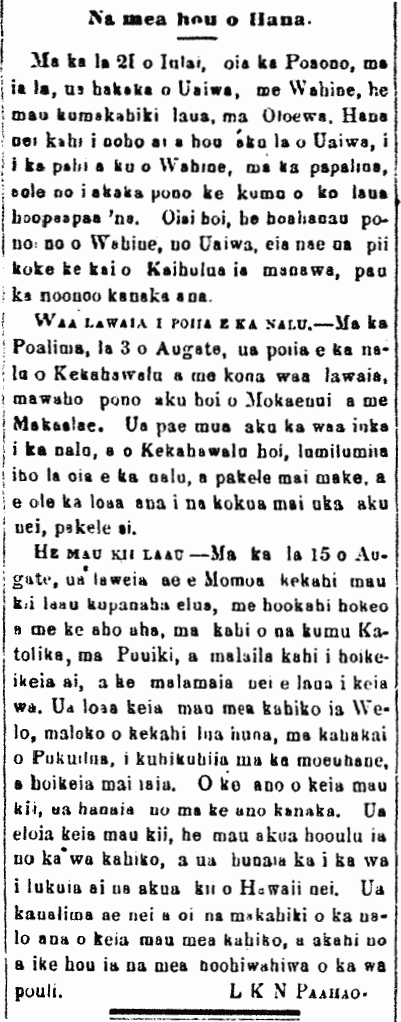
On the 21st of July, that being Saturday, on that day, Uaiwa fought with Wahine, both of them being contract laborers; they live at Oloewa, Hana, and Uaiwa stabbed Wahine with a knife in the cheek, and the reason for their quarrel is not known. Wahine is an actual cousin of Uaiwa, and here yet his temper soon flared up [pii koke ke kai o Kaihulua] and he lost his senses.

A fishing canoe pounded by a wave.—On Friday, the 3rd of August, Kekahawalu and his fishing canoe was hit by a wave right outside of Mokaenui and Makaalae. The canoe came ashore first carried by the waves, and as for Kekahawalu, he was pounded by the waves and escaped nearly dying; without receiving help from those on shore he would not have escaped.

Some wooden idols [kii laau].—On the 15th of August, brought by Momoa were a couple of amazing wooden images, along with one gourd calabash [hokeo] and some cordage [aho aha], to the Catholic teachers in Puuiki; there it was displayed, and the two of them are caring for them until this day. These old things were found by Welo in a hidden cave, seaside of Pukuilua, which was revealed to him in a dream, and was shown to him. The kii are made in the shape of people. It is said that these kii were procreative gods of the olden days, and were hidden away during the time that the god images of Hawaii nei were being destroyed. These old things have been hidden for fifty or more years, and it is the first time these revered things of the dark ages are being seen again.  L. K. N. Paahao.

(Kuokoa, 9/15/1877, p. 3)

Na mea hou o Hana.

Ka Nupepa Kuokoa, Buke XVI, Helu 37, Aoao 3. Sepatemaba 15, 1877.