Import of Snakes to Hawaii? 1902.

Snakes are Allowed to be Imported to Hawaii.

THIS NEWS WAS REPORTED TO THE HEAD CUSTOMS INSPECTOR OF HAWAII.

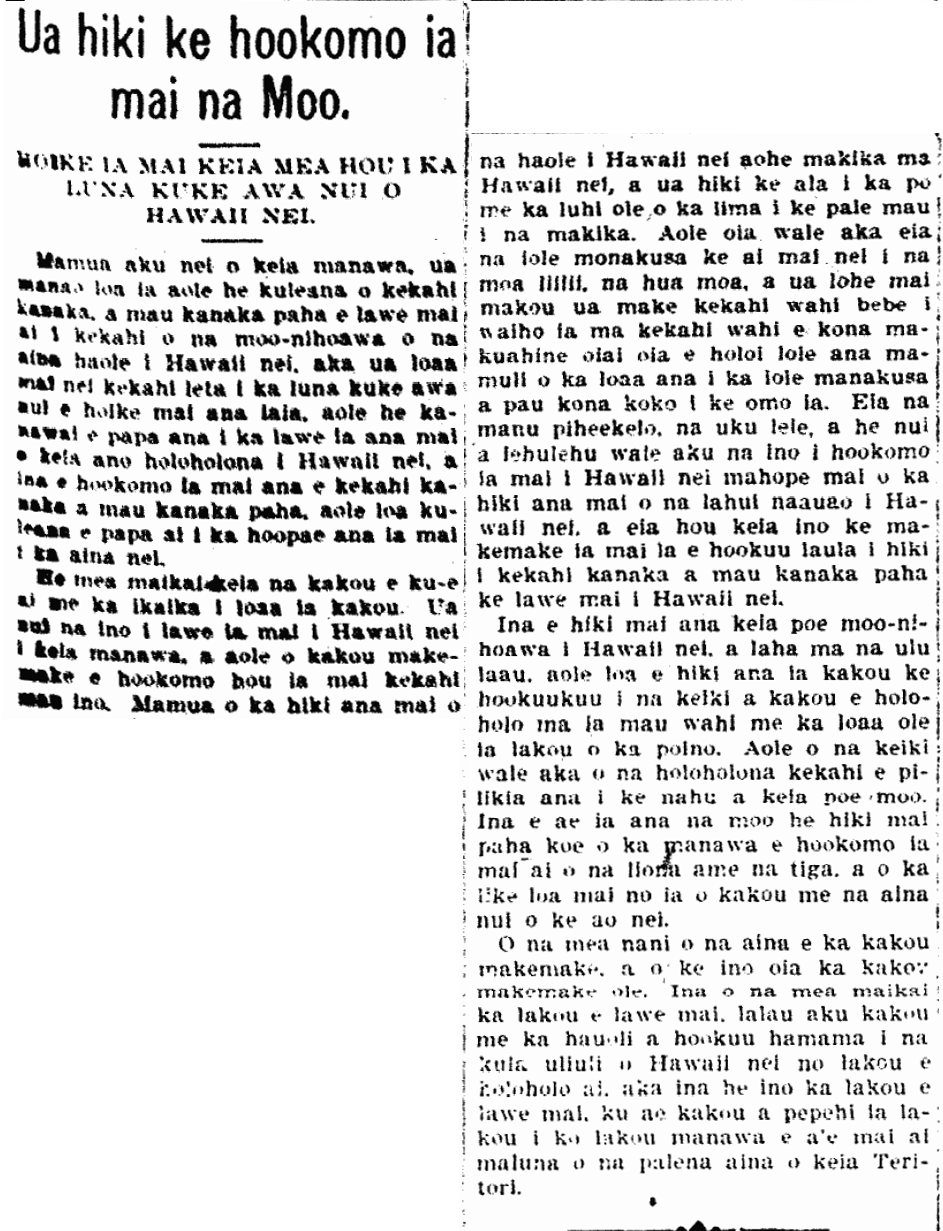
It was thoroughly believed that a person or persons could not bring in snakes from foreign lands into Hawaii, but the head custom inspector received a letter telling him that there is no law prohibiting the import of this type of animal into Hawaii, and should it be brought in by a person or persons, he has not right to prevent the bringing of it ashore.

It is right for us to oppose this with what power we have. There are many pests currently brought into Hawaii, and we do not want to bring in others. Before the arrival to Hawaii nei, there were no mosquitoes here, and they could be up at night without their hands tiring out from constantly waving them off. That isn’t all, there is the mongoose that are eating chicks, and eggs, and we hear that a baby left somewhere by its mother while she was washing clothes, died because it was got by a mongoose which sucked all of its blood. There are also mynah birds, fleas, and many, many other pests brought into Hawaii after the arrival of the enlightened races into Hawaii, and here is another thing that is wanted to be open to a person or persons to bring into Hawaii.

If these snakes come into Hawaii nei, and they spread in the forests, we will not be able to let our children go out to those places without facing calamity. Not just the children, but animals will be in danger of being bit by these snakes. If the snakes are allowed, the time will perhaps come when lions and tigers will be imported, and we will be just like most of the lands of the world.

We want the beautiful things of the other lands, but the problems are what we don’t want. If they import beneficial things, we will happily take them let them free in our verdant fields of Hawaii nei for them to run about; however, if they are to bring in pests, we will stand and exterminate them when they step within the borders of this Territory.

[That was a close one! But lately, with all the budget cuts and the resulting lack of inspectors doing inspections, who knows what is being brought into Hawaii nei. Some things are too important to let fall to the side…]

(Kuokoa, 4/11/1902, p. 1)

Ua hiki ke hookomo ia mai na Moo.

Ka Nupepa Kuokoa, Buke XL, Helu 15, Aoao 1. Aperila 11, 1902.

Heiau descriptions, lost for now, 1883.

SOME HEIAU OF OLD.

Earlier, some old temples of Hawaii were introduced: their description, and where they stand.

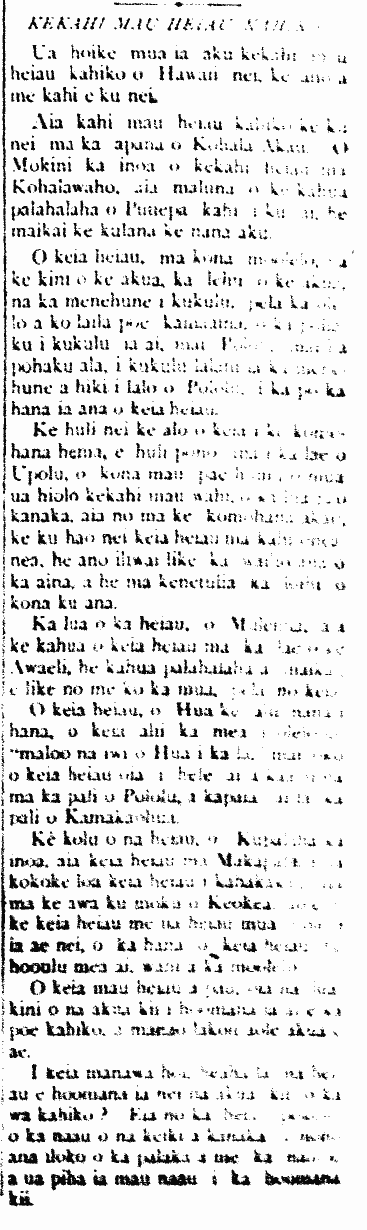
There are a number of old heiau standing in North Kohala. Mokini [Mookini] is the name of one of them in Kohala Waho, standing atop a flat base in Puuepa; it is a beautiful structure.

This heiau, according to its history, was built by the many and multitudes of gods and the menehune, that according to the natives who live there; the stones used to build it are from Pololu, and the menehune stood in a line all the way to Pololu; this heiau was built at night.

It faces the southwest, facing directly at the point of Upolu; some parts of the front enclosure have fallen, [???] are at the northwest, this heiau stands alone in a bare area, the land is level, and it has stood for centuries.

The second heiau is [Muleiula?], this heiau is located [???] Awaeli, its base is very flat like that of the earlier one, so too is the base of this one.

This heiau was erected by Hua, the one for whom is said, “The bones of Hua are dried in the sun,” [???] this heiau when he went [???] in the cliffs of Pololu, and [???] is called the cliffs of Kamakaohua.

The third heiau is named [Ku???], it is at [Maka???]; this heiau is very near to [???] at the harbor of Keokea; this heiau is like the earlier ones spoken of before, the purpose of this heiau was for agriculture, according to its history.

These heiau [???] multitudes of idol gods worshiped by the people of old, and they believed there was no other god.

In these modern days, [???] who are worshiping the idol gods of the old days? Here [???] children of men [???] in [???] and those hearts are full of idolatry.

[There are so many articles like these that are partially or totally illegible without going back to the original newspapers.

If made “word searchable” as is:

Ke kolu o na heiau, o Ku@@@@ ka inoa, aia keia heiau ma Maka@@@@@@@@ kokoke loa keia heiau i kanaka@@@@@@@@ ma ke awa ku moku o Keokea @@@@@@@@ ke keia heiau me na @@@@@ mua @@@@@@@ ia ae nei, o ka hana o keia heiau @@@@@ hooulu mea ai, wahi a ka moolelo.

The most logical thing to do would be to take new and clear images of the papers all together, so that each time someone is interested in a partial article like this one, they will not need to flip through the fragile originals just so they can see one page.]

(Kuokoa, 11/4/1883, p. 1)

KEKAHI MAU HEIAU KAHIKO.

Ka Nupepa Kuokoa, Buke XXII, Helu 44, Aoao 1. Novemaba 4, 1883.

History of the Hawaiian Flag. 1862.

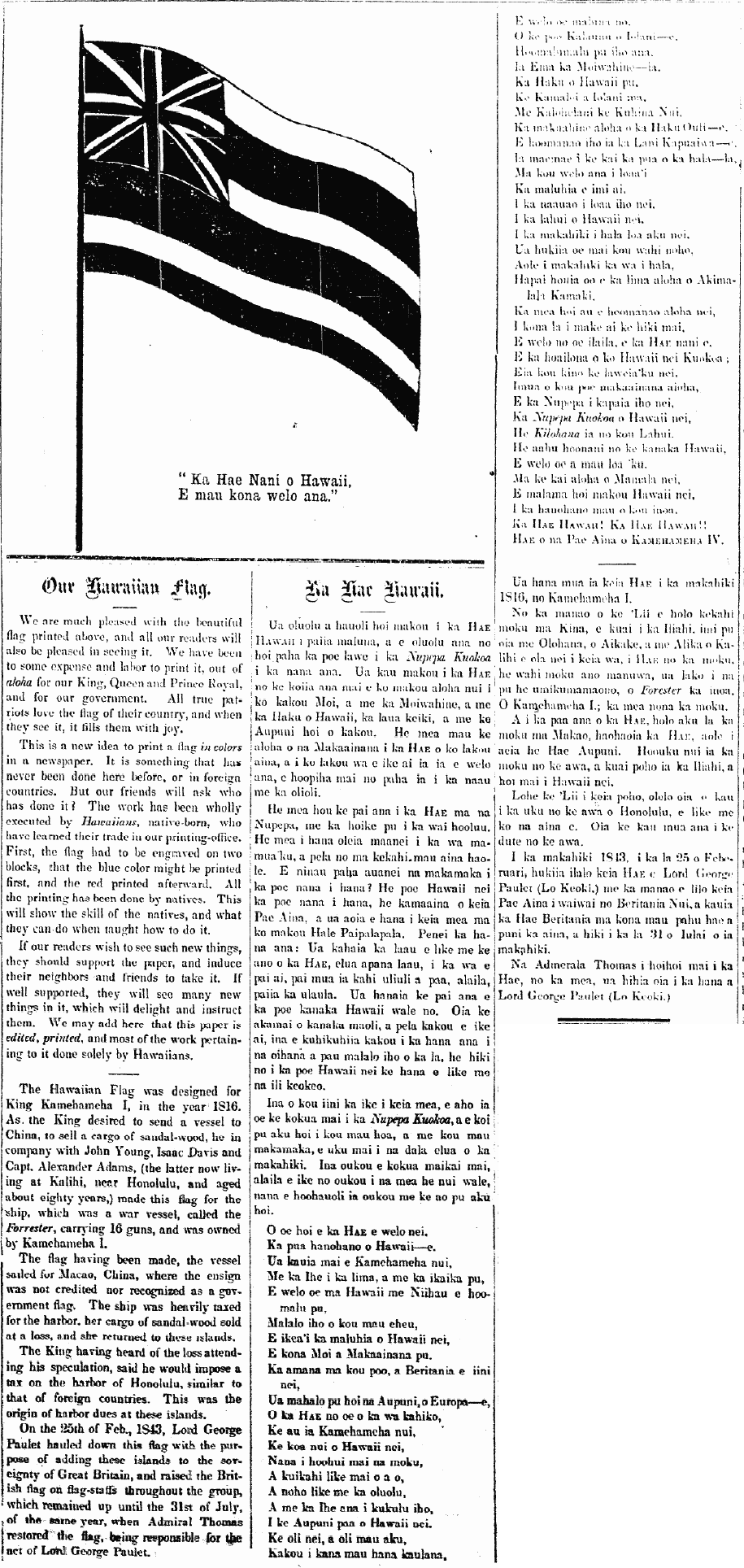
“The Beautiful Flag of Hawaii,
Let it forever wave.”

The Hawaiian Flag

We are pleased and happy about the Hawaiian Flag printed above, and the people subscribing to Ka Nupepa Kuokoa will be delighted to see it. We display the Flag, urged to do so by our great aloha for our King, Queen, and Ka Haku o Hawaii, their son, as well as for our Nation. The love by the people for their flag of their country is customary, and when they see her fluttering, it fills their hearts with joy.

The printing of the Flag in a Newspaper is something new, along with the displaying of its colors*. This is something not done previously here, as well as in some foreign countries. Perhaps our friends will inquire as to who did this work. Some Hawaiians did the work, people from this Archipelago, and they were taught to do this in our Printing Office. Here is how it was done: Woodblocks were carved in the fashion of the flag using two blocks. When it was printed, first the blue was printed, allowed to set, then the red was printed. This printing was done solely by Hawaiians. Such is the intelligence of the kanaka maoli, and that is how we recognize it. If we are instructed to do any task under the sun, Hawaiians can do the same as the white-skinned people.

If you should want to see this, you should support Ka Nupepa Kuokoa, and urge your acquaintances and friends to pay the two dollars a year. If you would kindly help, you will see many things that will gladden and instruct you.

You, O fluttering Flag,
The proud blossom of Hawaii.
Established by Kamehameha the great,
With Spear in hand, with strength,
Flutter over Hawaii and Niihau, and give protection.
Beneath your wings,
So that the peace of Hawaii be known,
By her King and the people as well.
The cross on your crest that Britain holds dear,
The Nations of Europe also give acclaim,
You are the Flag of old,
The time of Kamehameha the great,
The bravest warrior of Hawaii,
He who joined the islands,
With unity from end to end,
Living as one in contentment,
Along with the Spear upon which he erected,
The steadfast Nation of Hawaii.
We rejoice, and rejoice for all time,
His famed accomplishments,
You wave there above,
The crown of Iolani, the king
While giving shelter,
To Emma, the Queen.
Along with Ka Haku o Hawaii.
The Royal child of Iolani and Emma,
And Kalohelani, the Regent, Victoria Kamamalu.
The loving aunt of the young lord, Prince Albert,
Do remember his His Highness, Lot Kapuaiwa,
Cleansing the fruit of the pandanus in the sea,
Your fluttering has garnered
The peace that allowed us to seek,
The knowledge that has come,
To the Hawaiian populace.
That year long ago.
You were taken from your proper place.
Not a year passed,
You were raised by the loving hands of Admiral Thomas.
The one you fondly recall,
On the day of his death when it approaches,
You will wave there, O beautiful Flag.
O symbol of Hawaii’s Independence ;
Here is your body, being brought.
Before your beloved people,
By the Newspaper called,
Ka Nupepa Kuokoa of Hawaii,
The Excellence of your Nation.
A garment that adorns the Hawaiian People,
Wave forever.
Over the beloved sea of Mamala,
We, Hawaii, will cherish always,
The eternal glory of thy name.
The Hawaiian Flag! The Hawaiian Flag!!
The Flag of the Islands of Kamehameha IV.

This Flag was first designed in the year 1816 for Kamehameha I.

The King, wanting a ship to sail to China to sell Sandalwood, searched along with John Young, Isaac Davis, and Captain Alexander Adams of Kalihi, who is still living, for a Flag for the ship. It was a man-o-war, called the Forrester, carrying sixteen guns. Kamehameha I owned the ship.

When the Flag was completed, the ship sailed to Macao. The Flag was puzzled over, and was not accepted as a National Flag. The ship was charged exorbitantly for harbor fees, the Sandalwood was sold for a loss, and the ship returned to Hawaii.

The King learned of this loss, and he said that a tax should be placed on the harbor of Honolulu like those of foreign lands. That is when duty was first charged for the harbor.

In 1843, the 25th of February, this Flag was taken down by Lord George Paulet [Lo Keoki], with the intent that this Archipelago be taken as a possession of Great Britain. The British flag was raised on flag poles all around the land, until the 31st of July of that year.

It was Admiral Thomas who restored the Flag, for he disputed the actions of Lord George Paulet.

[Notice the English column to the left, which gives a translation of the Hawaiian. It seems this issue of the Kuokoa was sent to home by many a missionary, to show the progress they were making…

*A word of clarification: This is not the first time color appears in a newspaper. For more on this topic, see Hana Hou Magazine, August/September 2011: “Read All About It!” by Ron Williams.

For more flag articles, just click here!]

(Kuokoa, 1/1/1862, p. 1)

"Ka Hae Nani o Hawaii...

Ka Nupepa Kuokoa, Buke I, Helu 6, Aoao 1. Ianuari 1, 1862.

Kuhio and the Hawaiian Civic Clubs. 1918.

THE PARTY OF HAWAIIANS  WAS FILLED WITH ENTHUSIASM

Hawaiians Gathered at the Young Hotel at the Invitation of Prince Kalanianaole

HEARD WAS IDEAS FOR UNIFICATION

Desired that Hawaiians Stand Together as a People

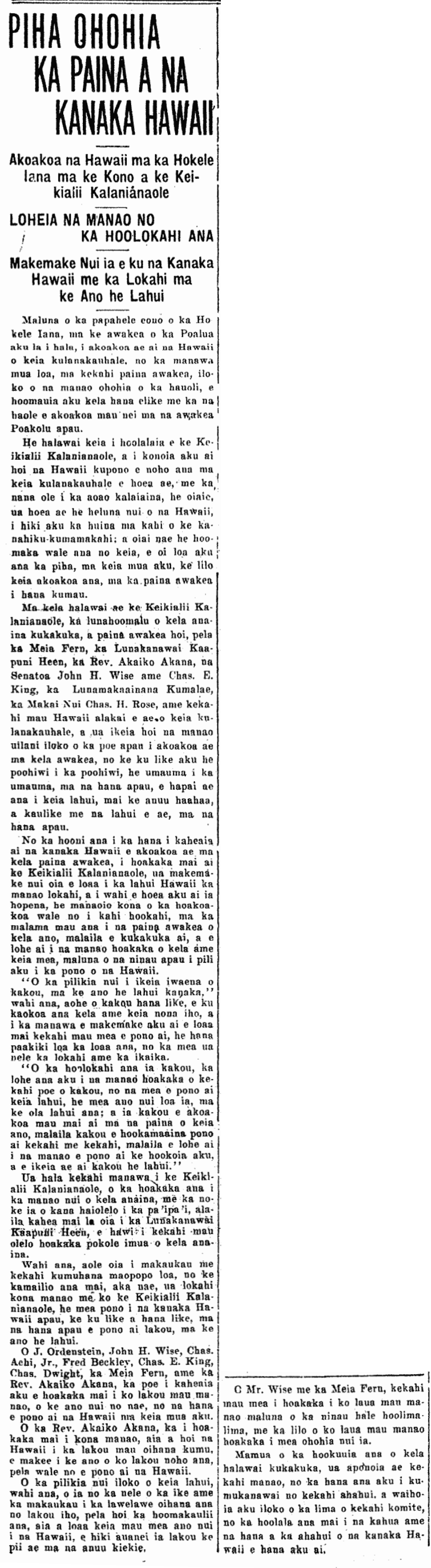
On the sixth floor of the Young Hotel, at noon this past Tuesday, the Hawaiians of this town gathered for the first time, for a luncheon amid enthusiasm and joy, and this will be a regular thing, like the haole regularly meet at noon on Wednesdays.

This was a meeting organized by Prince Kalanianaole, and Hawaiians of good standing who live here in town were invited to attend, without attention being paid to political affiliation; it is true, many Hawaiians came, and the total number was about seventy-one; and being that this is just the beginning, it will be more full in the future, should this gathering at lunch become a regular thing.

At this meeting was Prince Kalanianaole, the chairman of this meeting and luncheon, and also Mayor Fern, Circuit Judge Heen, Rev. Akaiko Akana, Senators John H. Wise and Charles E. King, Representative Kumalae, Sheriff Charles H. Rose, and some other Hawaiian leaders of town; and everyone gathered there that afternoon seemed spirited to stand shoulder to shoulder, chest to chest, in all things; to lift this lahui from the low level to be equal with the other ethnicities in all aspects.

In order to move forward the agenda for which the Hawaiians gathered at that luncheon, Prince Kalanianaole explained that he greatly wished that the Hawaiian people would think as one, and as a means to that ends, he believes that meeting together in one place by holding regular luncheons of that sort, is where you’d discuss things and hear explanation from different people on all questions regarding the well-being of Hawaiians.

“The great problem seen amongst us, as a people,” according to him, is that we don’t cooperate; we all stand independently, and when we want good works to be done, it is very hard to accomplish for we lack unity and strength.

“Unifying ourselves, and listening to people talk about things that will benefit this lahui is very important for the perpetuation of the lahui; and as we gather regularly at meals of this sort, we will become familiar with each other, and we will hear ideas that should be carried out, and we will be seen as a lahui.”

Some time was spent by Prince Kalanianaole explaining the goals of that gathering while his speech was encouraged by applause, then he called up Circuit Judge Heen to give a few words of clarification before the crowd.

According to him, he was not prepared with a clear topic to talk about, however, he was in agreement with Prince Kalanianaole; all Hawaiians must stand together and work as one in all endeavors that will better themselves as a lahui.

J. Ordenstein, John H. Wise, Charles Achi, Jr., Fred Beckley, Charles E. King, Charles Dwight, Mayor Fern, and Rev. Akaiko Akana were called to explain their overall thoughts as to what is to be done to benefit Hawaiians from here forth.

Rev. Akaiko Akana shared his thoughts; when Hawaiians go back to their traditional occupations [?] and cherish their way of life, that is the only way Hawaiians will be blessed.

The big problem with this lahui, according to him, is the lack of knowledge and readiness to go into business for themselves and so too with being economical; when these important things are acquired by Hawaiians, they will be able to climb to a high level.

Mr. Wise and Mayor Fern were some who spoke of their ideas on the question of leasing a building [?], and their ideas were heard with much enthusiasm.

Before the meeting was adjourned, one idea was approved, to draft a constitution for a club, and to place it in the hands of a committee to lay out the foundation and mission that this association of Hawaiians would carry out.

(Kuokoa, 11/29/1918, p. 1)

PIHA OHOHIA KA PAINA A NA KANAKA HAWAII

Ka Nupepa Kuokoa, Buke LVI, Helu 48, Aoao 1. Novemaba 29, 1918.

Because February shouldn’t be the only Hawaiian Language month… 1948.

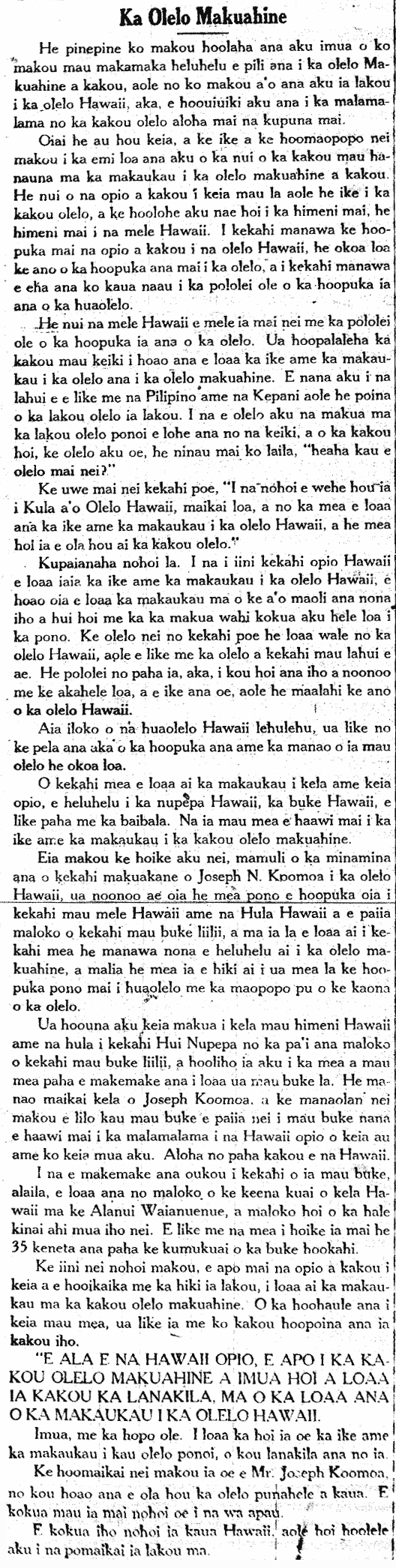
THE MOTHER TONGUE

We frequently speak to our dear readers about our Mother tongue, not about our teaching them the Hawaiian language, but that the light of our beloved language from our forefathers is being extinguished.

Being that this is a new era, and we see and realize that there is a drastic reduction in the number of our generations capable in our mother tongue. There are many of our youths these days who have no knowledge of our language, but when you listen to them singing, they sing Hawaiian songs. Sometimes when our children speak Hawaiian, their production of the language is so strange, and sometimes our naau [gut, heart] aches at their mispronunciation of words.

There are many Hawaiian songs sung with incorrect pronunciation. Our children are neglecting trying to acquire knowledge and proficiency in speaking the mother tongue. Look at the other ethnicities like the Filipinos and the Japanese, they haven’t forgotten their language. If parents spoke in their own language then the children would hear; and when we talk to them, they’ll ask, “he aha kau e olelo mai nei? [what are you saying?]”

Some people bewail, “If only Hawaiian-Language Schools were reopened, that would be a good thing because we’d get knowledge and proficiency in the Hawaiian language and it would revive our language.”

That is astonishing. Should a young Hawaiian have the desire to acquire knowledge and competency in the Hawaiian language, he should try to get this competency by studying diligently by himself and to get together with an adult for help and there would be great progress. Some say that Hawaiian can be gotten just like that, not like the languages of other people. Perhaps it is true, but if you go back and think with great seriousness, you will see that the Hawaiian language is not easy.

Within the many Hawaiian words, spellings might be the same, but the pronunciation and meanings of those words are different.

One thing that will give every youth proficiency is the reading of Hawaiian newspapers and Hawaiian books like perhaps the bible. Those things will give knowledge and competence in our native language.

We point out that because of the great love of a certain father, Joseph N. [Nihiaumoe] Koomoa, for the Hawaiian language, he thought it would be important to publish some Hawaiian songs and Hawaiian Hula and print some booklets, and through that someone could make time to read the Hawaiian language and perhaps that way the person could pronounce the words while understanding the kaona [underlying meanings].

This man sent those Hawaiian songs and hula to a Newspaper company to be printed in booklets, and it will be sold to the person or persons who want those books. This is a good idea of Joseph Koomoa’s, and we hope that your books that are being printed will become books that give knowledge to the Hawaiian youths of this age and of the future. Aloha to us, O Hawaiians.

Should you want one of those books, they will be available at the shop of that Hawaiian on Waianuenue Avenue, and also the former fire station [?] According to what was announced, the books will probably cost 35 cents each.

We want our youngsters to get a hold of this and and improve themselves to the best of their ability so that they can get proficiency in our mother tongue. Letting these go would be like forgetting our own selves.

“RISE YOUNG HAWAIIANS, GRASP OUR MOTHER TONGUE AND GO FORTH AND LET US BE TRIUMPHANT BY BEING PROFICIENT IN THE HAWAIIAN LANGUAGE.

Forge forward with no fear. So that you can get knowledge and proficiency in your own language—that will be your triumph.

We give our congratulations to you, Mr. Joseph Koomoa, for you attempt to revive the prized language of ours. You will be helping for all times [E kokua mau ia mai nohoi oe i na wa apau. ?]

Help ourselves Hawaiians, and don’t let the benefits go to those others [E kokua iho nohoi ia kaua Hawaii, aole hoi hoolele aku i na pomaikai ia lakou ma. ?]

[Anyone know of any copies of these music booklets by Joseph N. Koomoa still in existence???]

(Hoku o Hawaii, 2/11/1948, p. 2)

Ka Olelo Makuahine.

Ka Hoku o Hawaii, Volume XLI, Number 19, Aoao 2. Pepeluali 11, 1948.

Kamehameha III, Kauikeaouli’s birthday, a little late. 1907.

Day of Remembrance

of the

King Kauikeaouli

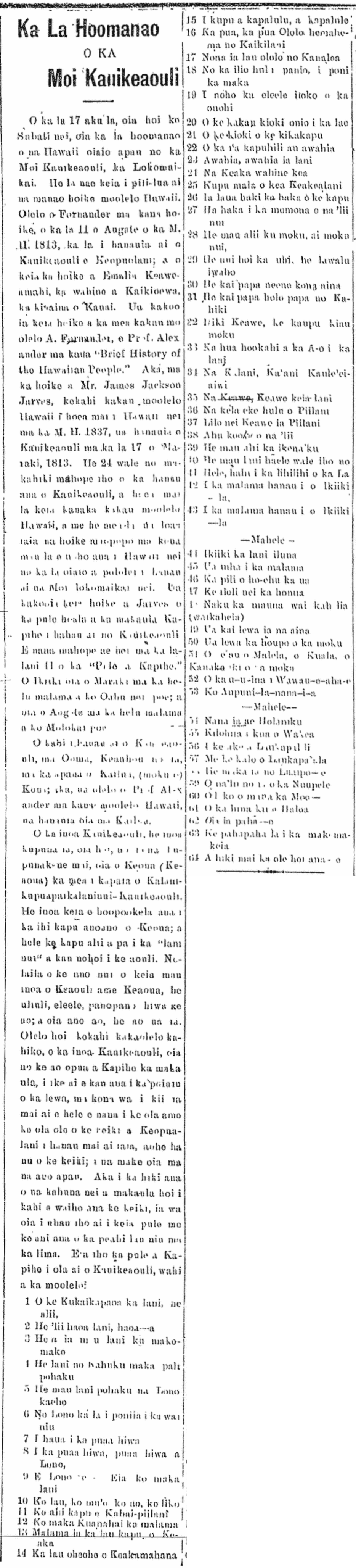
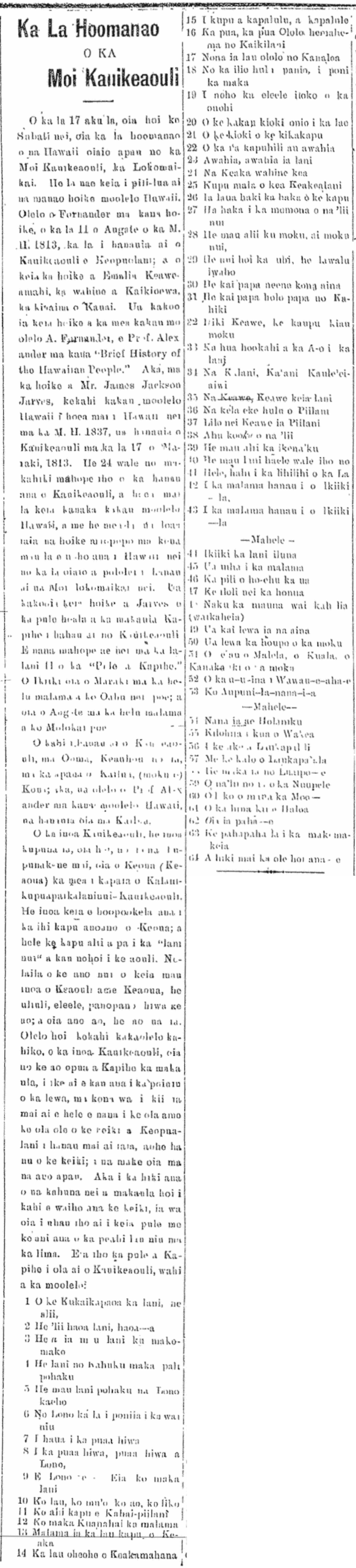
This past 17th, Sunday, was the day of remembrance for all true Hawaiians, of the King Kauikeaouli, the Benevolent one. There are two different historical accounts of this day. Fornander states in his account that Kauikeaouli was born of Keopuolani on 11 August 1813, and that this information was from Emalia Keaweamahi, the wahine of Kaikioewa, the governor of Kauai. This date of A. Fornander is supported by Prof. Alexander in his “Brief History of the Hawaiian People.” However, in the account of Mr. James Jackson Jarves, a scholar of Hawaiian history who arrived here in Hawaii nei in 1837, Kauikeaouli was born on 17 March 1813. This historian arrived here but 24 years after the birth of Kauikeaouli, and it would seem that he obtained clear information about the true birth date of the Benevolent King, while he was living here. This statement by Jarves is supported by the reviving prayer that Kapihe offered for Kauikeaouli. Look below at line 11 [42?] in the “Pule a Kapihe.” Ikiiki is the month of March according to the reckoning of Oahu people, and according to Molokai people it is August.

Kauikeaouli was born at Ooma, Keauhou, in Kailua, in the moku of Kona. However, Prof. Alexander, in his history of Hawaii, says Kauikeaouli was born in Kailua.

The name Kauikeaouli is a name from his ancestors, that being the name of his grandfather, Keoua (Keaoua), the one called Kalanikupuapaikalaninui Kauikeaouli. This name puts on high the sacred kapu of Keoua–his chiefly kapu extends above and touches the great heavens, and rests upon the dark clouds. So therefore, the importance of the names Keaouli and Keaoua, is the dark, black, thick, esteemed cloud. This cloud is a rain cloud. A Orator of the old times said that the name Kauikeaouli is the bank of clouds that Kapihe, the prophet, saw spread high in the heavens when he was called to go to see if the child that Keopualani gave birth to was alive or not alive. He was not breathing and was totally lifeless. However, when this kahuna and prophet arrived to where the child was placed, he offered this prayer while waving a coconut frond in his hand. This is the prayer by which Kapihe made Kauikeaouli live, according to the story:

1 O ke Kukaikapaoa ka lani, ae alii,

2 He ‘lii haoa lani, haoa—a

3 He a ia m u lani ku makomako

4 He lani no Kahuku maka pali pohaku

5 He mau lani pohaku na Lono kaeho

6 No Lono ka la i poniia i ka wai niu

7 I haua i ka puaa hiwa

8 I ka puaa hiwa, puaa hiwa a Lono,

9 E Lono—e. Eia ko maka lani

10 Ko lau, ko mu’o, ko ao, ko liko

11 Ko alii kapu e Kahai-piilani

12 Ko maka Kuanahai ka malama

13 Malama ia ka lau kapu o Keaka

14 Ka lau oheohe o Keakamahana

15 I kupu a kapalulu, a kapalule

16 Ka pua, ka pua Ololo hemahema no Kaikilani

17 Nona ia lau ololo no Kanaloa

18 No ka ilio hulu panio, i poni ka maka

19 I noho ka eleele iloko o ka onohi

20 O ke kakau kioki onio i ka lae

21 O ke kioki o ke kikakapu

22 O ka i’a kapuhili au awahia

23 Awahia, awahia ia lani

24 Na Keaka wahine kea

25 Kupu mala o kea Keakealani

26 Ia laua haki ka haka o ke kapu

27 He haka i ka momona o na ‘lii nui

28 He mau alii ku moku, ai moku nui,

29 He nui hoi ka uhi, ka lawalu iwaho

30 He kai papa neenekona aina

31 He kai papa holo papa no Kahiki

32 I iki Keawe, ke kaupu kiau moku

33 Ka hua hookahi a ka A-o i ka lani

34 Na Kalani Ka’ani Kauleleiaiwi

35 Na Keawe, Keawe keia lani

36 Na kela eke hulu o Piilani

37 Lilo nei Keawe ia Piilani

38 Ahu kooka o na ‘lii

39 He mau alii ka ikena ‘ku

40 He mau lani haele wale iho no

41 Hele, hahi i ka lihilihi o ka La

42 I ka malama hanau i o Ikiiki—la

43 I ka malama hanau i o Ikiiki—la

—Mahele—

44 Ikiiki ka lani iluna

45 Ua uiha i ka malama

46 Ka pili o ho-ehu ka ua

47 Ke iloli nei ka honua

48 Naku ka mauna wai kali lia (waikaheia)

49 Ua kai lewa ia na aina

50 Ua lewa ka houpo o ka moku

51 O e au o Malela, o Kuala, o Kanaka ki o a moku

52 O ka u-u-ina i Wawau-e-aha-o

53 Ko Aupuni-la-nana-i-a

—Mahele—

54 Nana ia ae Holaniku

55 Kilohiia i kua o Wakea

56 I ke ake a Laukapalili

57 Me ke kalo o Laukapalala

58 He maka ia no Luaipo—e

59 O na ‘lii no ia o ka Nuupele

60 O I ko o maua ka Moo—

61 O ka hina kai o Haloa

62 Oia ia paha—e

63 Ke pahapaha la i ka makemakeia

64 A hiki mai ka ole hoi ana—e

[Amazingly, this is the only issue of this entire year that seems to have survived! If this newspaper could be reshot nicely, we could get a clear/clearer reading of this important mele!

And I put up the mele as is (although the image is not clear in some areas, so there are some questionable lines), so that words and phrases will be searchable on this blog or on google right now, instead of having to wait for some time in the future…]

(Kuokoa Home Rula, 3/22/1907, p. 4)
Ka La Hoomanao O KA Moi Kauikeaouli

Kuokoa Home Rula, Buke V, Helu 12, Aoao 4. Maraki 22, 1907.

True Hawaiian? 1893.

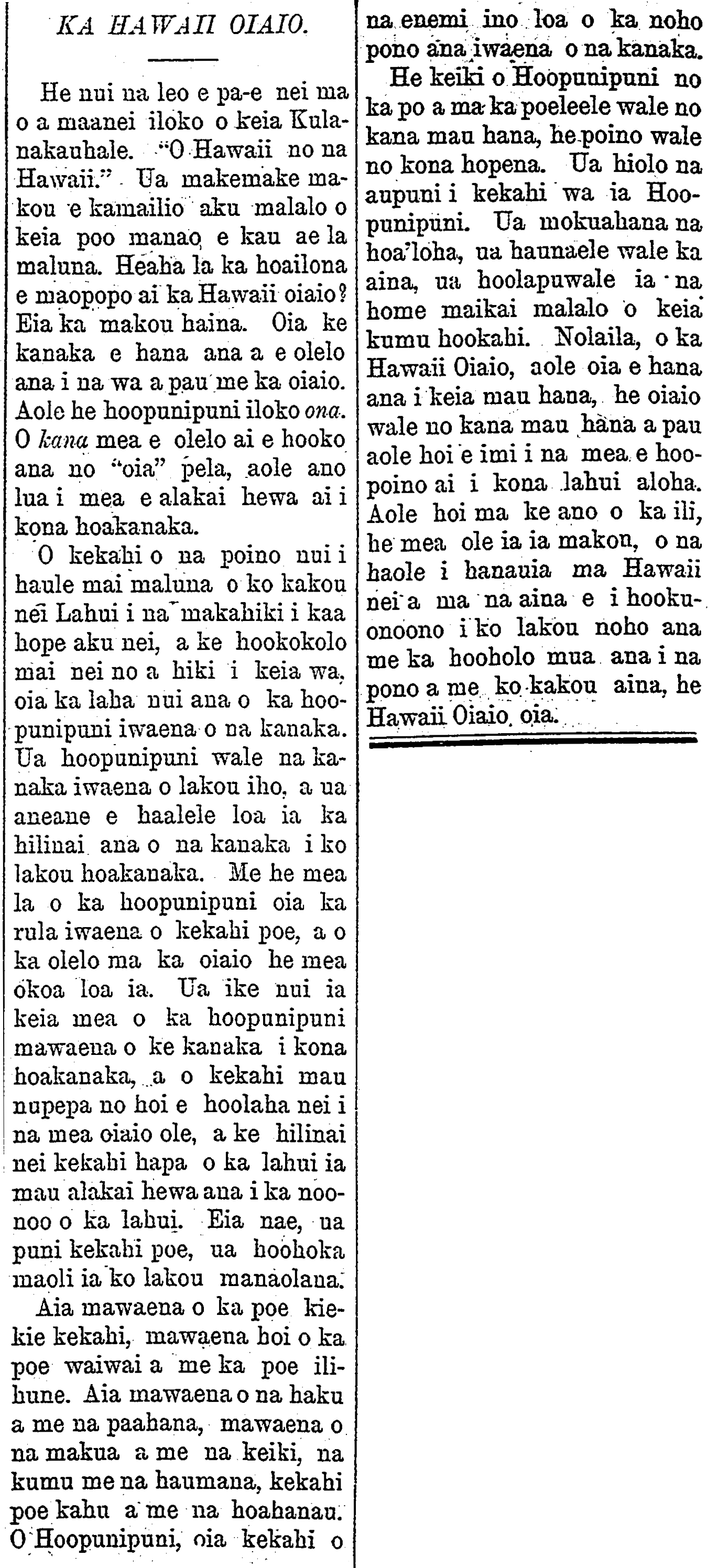
True Hawaiian.

There are many voices ringing out here and there in this Town. “Hawaii for Hawaiians.” We wish to discuss the topic above. What in the world are the signs that distinguish a true Hawaiian? This is our answer. It is a person who acts and speaks at all times in truth. He has no falsehood within him. What he says, he follows through on, and does not speak to mislead his fellow man.

One of the great misfortune which fell upon our Lahui these past years, and creeps on to the present, is the rampant promulgation of lies amongst the people. People tell falsehoods amongst themselves, and it is almost to the point where people have lost faith their fellow man. It is as if lying is the norm with some people, and telling the truth is something terribly odd. This telling of falsehoods is often seen among people to his fellow man, and some newspapers are spreading things that are not true; and a part of the lahui believes this misleading of the minds of the lahui. And still some people were taken by it, and their hopes dashed.

Amongst the prominent people, amongst the rich and the poor. Amongst the bosses and the laborers, amongst the parents and the children, the instructors and students, some pastors and church members. Falsehood is the most vile enemy of righteous living amongst people.

Falsehood is the spawn of night, and it only works in darkness, and misfortune is its outcome. During some ages, nations have fallen to Falsehood. Friends have been torn apart, the land grew tumultuous, and good homes became retched, all because of this one reason. Therefore, the True Hawaiian does not act in such a manner, he only acts truthfully, and he does not seek to cause harm his own beloved lahui. It is not skin color, that means nothing to us; those haole born in Hawaii nei  and elsewhere who prosper while moving well-being and our land forward, he is a True Hawaiian.

[Notice that this editorial came out soon after the overthrow, and was in response to the many articles anticipating the return of the crown.

There were many types of Hawaiian-Language Newspaper owners and editors as well, and it is important to understand the slant of a paper when reading its articles. It is important also to remember that a newspaper might not always have the same goals and objectives throughout its existence, especially if its leadership changes. J. U. Kawainui was editor and J. K. Iosepa was assistant editor of the Daily Kuokoa when this article appeared.

This is one of those papers that are not available online yet (images or text). Also, they are not available at the usual places on microfilm. Hopefully they will be made available soon!]

(Nupepa Puka La Kuokoa me Ko Hawaii Paeaina i Huiia, 3/9/1893, p. 2)

KA HAWAII OIAIO.

Nupepa Puka La Kuokoa me Ko Hawaii Paeaina i Huiia, Buke I, Helu 28, Aoao 2. Maraki 9, 1893.

Lunalilo’s Crypt overgrown by weeds? 1894.

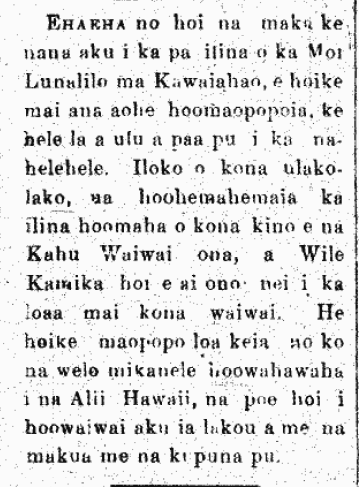
It is painful to see the cemetery of King Lunalilo at Kawaiahao, showing that it is not remembered, for it is overgrown by weeds. In its wealth, the crypt where his body is laid to rest was left to waste by his Trustees, along with Wile Kamika [William Owen Smith] who feasts off of his pay from the trust. This is proof of the missionary descendents’ [welo mikanele] contempt for the Alii of Hawaii, the people who made them wealthy and also their parents and grandparents.

(Makaainana, 3/19/1894, p. 4)

Ehaeha no hoi na maka...

Ka Makaainana, Buke I----Ano Hou, Helu 12, Aoao 4. Maraki 19, 1894.

Renovation of Kawaiahao Cemetery, 1867.

[Found under: “LOCAL NEWS”]

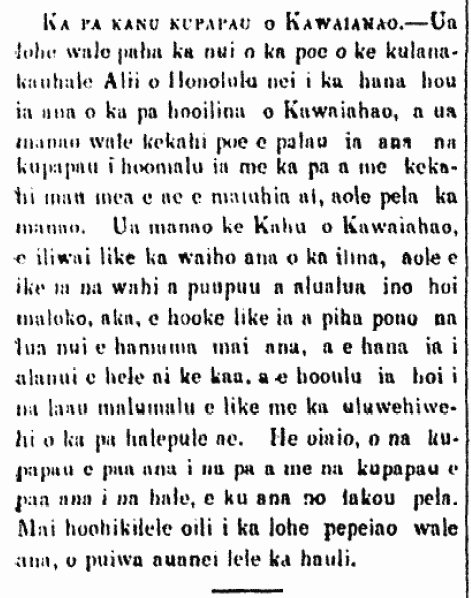
Graveyard of Kawaiahao.—Most of the people of the Capital City of Honolulu have perhaps heard that the cemetery of Kawaiahao is being renovated, and some people have imagined that the bodies laid there to rest, along with the yard and other things at peace there will be plowed up, but this is not the case. The Kahu of Kawaiahao wants to flatten out the graveyard so that there are no humps or holes, to flatten out and fill in the depressions that lay open, and also to make a road for carts to travel on, and to grow shade trees like the greenery of other church yards. It is the truth, the bodies that lay in the yard and the bodies in the crypts will remain as is. Don’t get worked up over what you hear, lest you be shocked.

(Kuokoa, 4/27/1867, p. 3)

Ka pa kanu kupapau o Kawaiahao...

Ka Nupepa Kuokoa, Buke VI, helu 17, Aoao 3. Aperila 27, 1867.

More criticism of hula, 1874.

[Found under: “Local News”]

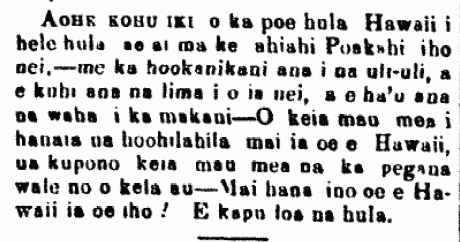
Not appropriate at all were the Hawaiian dancers who went around doing hula on this Monday evening—rattling their uliuli, their hands pointing this way and that, and their mouths huffing away in the wind—These things that were done shame you, O Hawaii; this kind of thing is appropriate only for the pagan of the past—O Hawaiians, stop hurting yourselves! Hula is strictly banned.

(Kuokoa, 3/21/1874, p. 3)

Aohe kohu iki...

Ka Nupepa Kuokoa, Buke XIII, Helu 12, Aoao 3. Maraki 21, 1874.