On the decline of native birds, 1871.

Locals of the Tuahine Rain are no more.

O Ke Au Okoa:—Aloha to you:

I am sending you a small gift atop your outstretched foundation, should your captain and Editor be so kind, and it will be for you to take it to the shores of these islands so that my newspaper-reading companions may see it, it being the letters placed above: “Some Locals of the Tuahine Rain¹ are no more,” and it has been ten or more years which they have not been seen.

And my friends are probably puzzled about these locals that have gone missing, and you, our old-timers, are all likely saying, not them, here they are, and some people have passed away, but we knew of their passing; but the departure of these kamaaina which I speak of was not witnessed. And this is it, the kamaaina birds of our uplands: the Iwi, the O-u, the Akakane, the Amakihi, the Oolomao, the Elepaio; these are the native birds of these uplands who have disappeared.

And some of you may be questioning, what is the reason for this disappearance? I tell you, it is because of the spread of the evil birds from foreign lands, in our plains, mountains, ridges, valleys, cliffs, forests, terraced taro patches, seashores, and rivers; that is why these kamaaina have gone, because of the spreading of these evil birds among us, and they are damaging the crops, and the food from the forests; rice planted by some are being eaten by these evil birds; and the bananas of the forests are all eaten up by these birds.

What do we gain from these evil birds being spread in Hawaii, and protecting them so that they are not killed? I say that we gain nothing from these evil birds which are hurting our native birds and crops and foods from the forests; because in the past, before the spread of these birds, if a kamaaina of this land wanted to go into the mountains to get thatching or some shrimp, or some oopu, they did not pack food with them, because they thought that there was food in the mountains, like banana, hawane fruit, and uhi; banana would ripen on the plant and then fall, without anything damaging them, but now, the bananas don’t ripen on the plant; they are eaten by these banana-eating mu [mu ai maia] of the forest; bananas don’t ripen, and [now] when you go into the mountains, there is just the oka-i [blossom container of bananas] left and the bananas are lost to these birds; and the kamaaina birds are gone. Where to? Perhaps they all went to Hawaii island.

And I say without any hypocrisy, the decrease of this people was because the arrival of the evil haole to Hawaii nei; it was they who spread the evil sicknesses: gonorrhea [pala] and syphilis [kaokao]. Smallpox [hepera] and leprosy [mai pake] are the reasons that our lahui was decimated, because of the arrival of the evil haole; if all the people who came to Hawaii were like the people who brought the light [missionaries],  then this lahui would not have decreased in number; so too with the arrival of the evil birds to Hawaii nei, which hurt our native birds and plants; this is like the decrease of our lahui with the arrival of the evil haole who spread gonorrhea and syphilis and similar diseases.

Therefore, I feel aloha for the kamaaina birds of my beloved land because they are all gone, and the youngsters of these days question, what are those birds like? They are tiny birds with beautiful voices, and their feathers as well, and they were an enjoyment in our childhood; when times of strong winds arrived, all the birds of the mountains would alight and show up at the doors of the houses which was entertaining for us to watch them flitting amongst the leaves of the ilima in our childhood and they were a playmate in our youth.

Before the arrival of these birds, there was a great abundance of Iwi, Amakihi, Akakane, O-u, Oolokela, and Elepaio, right here above us, atop the clumps of aliipoe, bushes of hau, noni trees, and more upland, the number of birds was amazing, atop the flowers of lehua of the mountain apples, and on the Ahihi and the Lehua Kumakua;  those uplands were so enjoyable but these days, they have all vanished, maybe because there were aggravated by these evil birds.

Here is another thing; if only the coming session of the Legislature could revise the law pertaining to birds from foreign lands, for there are destructive birds that have been imported as well from foreign lands.

And this is a supplication to you, O Ke Au Okoa. With aloha to the one who steers you, and also to the boys of the Government Printing Press. The boy from the uplands is turning back for the Tuahine rain of the land is spreading about.

T. N. Penukahi.

Manoa, June 24, 1871.

¹Tuahine [Kuahine] is the famous rain of Manoa.

(Au Okoa, 6/29/1871, p. 3)

He mau wahi kamaaina no ka ua Tuahine, ua nalowale.

Ke Au Okoa, Buke VII, Helu 11, Aoao 3. Iune 29, 1871.
Population of Niihau and more, 1864.

The Population of Niihau.

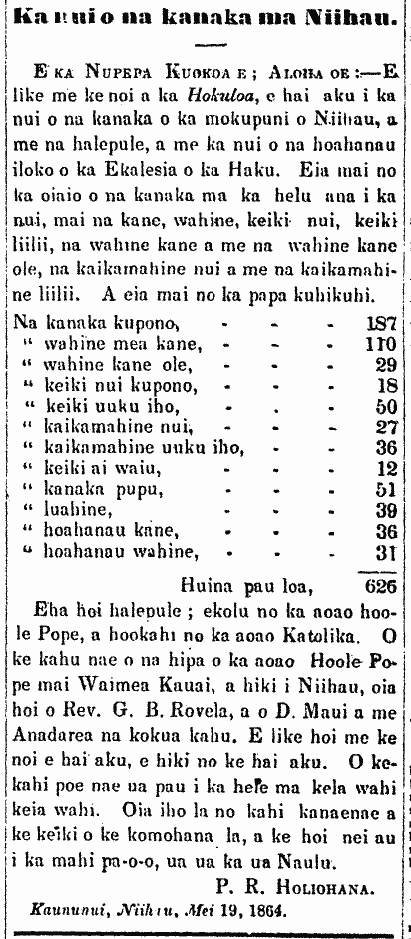
O Kuokoa Newspaper; Aloha oe:—In response to the request by the Hoku Loa [newspaper], to tell the population of Niihau, and the number of houses of worship and members of the Lord’s church. Here is the actual figures of the population, from the men, women, older boys, younger boys, married women, and single women, the older girls and younger girls. Here is the chart.

Good-standing men, 187

Married women, 110

Single women, 29

Older boys [that can work?], 18

Younger boys, 50

Older girls, 27

Younger girls, 36

Breast-feeding children, 12

Old men, 51

Old women, 39

Male church members, 36

Female church members, 31

Total, 626

There are four houses of worship; three for the Protestants, and one for the Catholics. The shepherd of the sheep of the Protestants from Waimea, Kauai to Niihau, is Rev. G. B. Rovela [Rowell], and D. Maui and Anadarea are the assistant kahu. As per the requests for answers, will be responses. But there are some people who have gone here or there. This is the supplication of the boy from the west, and I am returning to my gardening of sweet potato scraps, as the Naulu rain came down.

P. R. Holiohana.

Kaununui, Niihau, May 19, 1864.

(Kuokoa, 6/11/1864, p. 4)

Ka nui o na kanaka ma Niihau.

Ka Nupepa Kuokoa, Buke III, Helu 24, Aoao 4. Iune 11, 1864.

Niihau purchased for $10,800. 1864.

The Haole are Really Working Niihau.

O Kuokoa Newspaper; Aloha to you:—I met up with the newspaper article under News of Hawaii, in Issue 15 of the 9th of April, about the selling of Niihau to Mr. James Francis Sinclair, for $10,800, along with the lands of Kuakanu, which are the konohiki lands of Halewela and Kahuku, which the Government sold to the one named above, along with the konohiki lands, and this whole island has gone to the haole; perhaps you all and those others as well have heard that Niihau was sold, along with those penny-pinching folks who don’t get the shining beacon of Hawai nei through the Kuokoa Newspaper. And it is we who know of the great, who know of the small, and who know of the wide, that knows of the selling from Kii to Kawaihoa, from the Makahuena Point to Pueo Point; everything upon the land is bought and there is nothing left for us, the Hawaiians, under the haole owners.

Their Way of Living: They are pleasant and good, and speak nicely with the people, but they are not very proficient in the Hawaiian language. The haole say, “mahope aku kumaki” [?] There are ten Hawaiians, caretakers [hoaaina] of the land, chosen from amongst the locals, but two are from elsewhere, they are newcomers, one from Hawaii and the other from Maui, and including them there are ten caretakers. Here are each of their names which the haole selected: A. Puko, D. Kauki, Hetesia, J. H. Kanakaiki, P. R. Holiohana, H. Haokaku, Mose Kanohai, Ioela, Kapahee and Pouli; Kanakaiki is from Napoopoo, Hawaii, and Holiohana is from Hana, Maui, and are locals from there. Those caretakers are in charge of the three work days every month just like the konohiki of the chiefs, should there be work by haole owner to be done.

Their Number: Mr. James Francis Sinclair them total twelve in number; two brothers, three sisters, five children, one mother, and one in-law, which totals twelve; they live in Kununui; they are religious, with one God, but their religion is very different; their houses were constructed in Britain and brought to Niihau: three houses, one currently stands, and two more to follow; we appreciate how nice and beautiful it is to see.

Dealing with the Animals: There are two horses per man and woman, and should there be three, it is killed, and so forth; as for dogs, there are none left, they were all killed, from the big ones to the small ones because sheep were being killed, and so the government is without money from the dog tax, also the goats were all killed. You Kauai people who own horses and sheep, get them quick, don’t dawdle, or they will be taken by the haole.

Things Grown by the People.

The Hawaiians consume what they produce, and they also assist with the land owners in the watering of the sweet potato, ke pola akaakai [?], and chickens, as long as they were pleasant, or else that was that.

On the Number of Sheep

Set loose on Niihau are the sheep which you have perhaps seen in our Newspaper; as for the count, you probably have not heard; this is the truth as to the abundance or dearth: the number of sheep is 3,400, with 1,400 belonging to the Hon. W. Webster and 2,000 belonging to the King; there is no end to their desire for sheep.

Sugar Cane Cultivation.

Niihau will be planted with sugar cane if the test on one acre goes well; and if the cane grows nicely, then planting will commence, but if it doesn’t grow, that’s it, because it is an arid land.

This is an undesirable land for those foreigners seeking to make money because it is dry and scorched by the sun, and crops die; but here are people who are after wealth, and they tell us, the locals, that this is very valuable land for sheep and cane; our good friend, H. M. Whitney, the local of Waimea and Niihau, along with his parents, are familiar with this island and its extreme heat in the Makalii months [summer]. I will stop writing as the Naulu rain of Niihau is falling. With aloha.

P. R. Holiohana.

Kihalaui, Niihau, May 2, 1864.

[This P. R. Holiohana (later it seems he goes by the name P. R. Holi) writes in to the newspapers often from Niihau on a number of subjects.]

(Kuokoa, 6/4/1864, p. 1)

Hana io ka Haole ia Niihau.

Ka Nupepa Kuokoa, Buke III, Helu 23, Aoao 1. Iune 4, 1864.

Pauli K. Hosea Iwiula, 1912.

My Beloved Husband Has Gone, Undoing Our Bond

PAULI K. HOSEA IWIULA.

O Kuokoa Newspaper, Aloha to you:—Please extend your patience and allow me space in one of your columns for my parcel of my parent in my youth, and perhaps many of our friends will see it, and our companions in the Lord living from where the sun rises at Kumukahi all the way to where it shimmers into the sea of Lehua.

Pauli Kaoleiokukaiakauilani Hosea Iwiula was born in Kamoiliili¹, Oahu, on the 26th of June, 1862, from the loins of Iwiula (m) and Kapolei (f); according to the history of Iwiula, he was a descendant of the chiefly family of Kamalalawalu of Maui, and of kaukau alii rank in the court of the fathers of kings [Makualii, Makua Alii], Kekuanaoa and Kanaina, and the monarchs of the time; and the line related to Pauahi Kaoleioku Hosea Iwiula’s mother, that being Kapolei, she was closely related to the chiefly blood of Kekaulike Nui of Molokai, and being that Molokai is where Kapolei (f) was born, it is believed by the locals here in Kamoiliili that Hosea Iwiula is a chief for whom this eulogy is for.

While Kapolei was young, following the death of Kahuloa, her first husband, she married the aforementioned Iwiula. At that time, Kapolei’s was regularly a singing teacher for the young chiefly women of those days. And Kamoiliili’s handsome prince and gentleman of the time was Pauli Kaoleioku, the first born of the alii Haumea of the serene lands of Ehu, the land where water lies in the face of the cloud banks [epithets for Kona, Hawaii]. And as what happens when people grow up, there is a craving for the great fish that passes before one’s eyes, and that is perhaps why Kapolei and Pauli Kaoleioku were mixed up together, and Hosea was conceived, a son from the loins of Kapolei, and thus Hosea Iwiula was said to be a child of Pauli, and an alii.

During the days when we lived as man and wife, he became a parent to me, and so also me for him. My dear husband was very skilled in singing, and it was he who always lead the Sunday School classes of Kamoiliili for almost thirty or more years, and he was the elder [luna kahiko] of the Kamoiliili Church for almost twenty-four years and also is a long-time member of the Kawaiahao Church, then he left that position in the hands of Hiram Kaaha who is still there now. Hosea was a member of the leaders of Kawaiahao Church from his branch church of Kamoiliili. During the days when he was the leader of the Sunday School for Kaawili, he assisted his Sunday School students immensely, by clothing them with their uniforms, shoes and hats; he helped the children a lot.

I was joined with him on the 16th of January, 1882, at Kamoiliili, and we had ten children, and six of them are still living: one daughter and five sons; and four of them have gone before and he has gone in search to be with them.

On Tuesday, the 25th of January, he went to Kauai for the building of the home of Sam Kaeo, the Kauai county attorney, which he would be painting; and in the last week of December, the 29th, he returned to Kamoiliili, and joined in to lead the Sunday School class of Kamoiliili at the last quarterly congregational convention of 1911, and on January 25, he went back to Nawiliwili where his job was, and there after a few weeks began a sickness in his body, and it progressed until he passed from me in that unfamiliar land, on April 29, 1912, and he and I travelled over the great Kaieie Channel for here in Honolulu aboard the Malulani on the 30th of April, and my beloved lei, my husband was left at the funeral home of M. E. Silva, and on the following Thursday, he was carried to Kamoiliili, and within this church where the two of us along with the friends of this place would always gather to worship God, his funeral service was held and he was returned to the place of all men, and the saying was fulfilled: “Man goes to his eternal home, and the spirit returns to its maker.” For “He gave and He hath taken away, blessed be the name of Jehovah.”

O Lililehua Rain of Palolo, you shall no more buffet the cheeks of my beloved; and you as well, O Kuahine Rain which treads upon the fringes of the lehua of Manoa, you will no more soak him and his lashes; O Royal Capitol of Honolulu, he shall not see your fairness; and O Shores which I was with my beloved, your rocky banks will never again be glided over by his loving feet, and O Seas of Kaalawai and Keauau where me and my loving husband were as one, you will not see him again passing by with me.

Alas, there is only love for my husband of my youth, my parent of my uneducated days. I am yours, O My Beloved, that did [lueuele?], wandering the streets in tears.

Me with sorrow,

MRS. RAHELA [Rachael] HOSEA.

Kamoiliili, May 11, 1912.

¹Kamoiliili is known today generally as Moiliili.

[I have found no other usages of the word “lueuele”. Unless the newspapers are accurately typescripted, we won’t know if lueuele is a typo, or if it is indeed a word. The more examples of usages and context found, the clearer the meaning of the word will be. Does the acceptance of inaccurate typing indicate that these words are not important?]

(Kuokoa, 5/17/1912, p. 4)

KUU ALOHA HE KANE UA HALA, UA WEHE MAI I KA MAUA PILI

Ka Nupepa Kuokoa, Buke XLVIII, Helu 20, Aoao 4. Mei 17, 1912.

Here you’d be looking at a long strings of @@@@@@@@@ instead of information on Queen Kapiolani and Puna. 1876.

NEWS ITEMS FROM PUNA.

Please let us shake hands, your Captain and I, and insert my small contribution in an empty space of your delicate body.

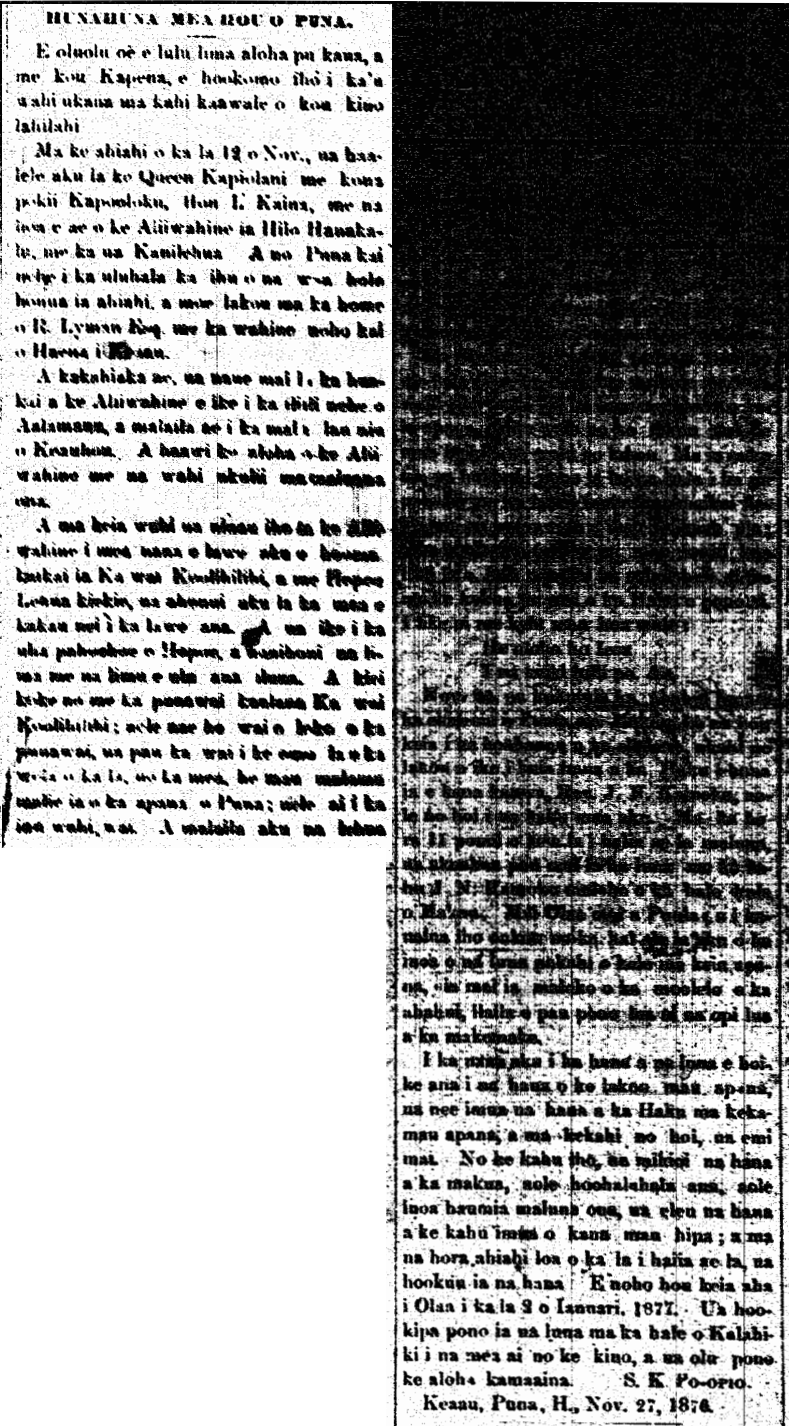
On the evening of the 12th of Nov., Queen Kapiolani and her younger sister Kapooloku, Hon. L. Kaina, and the other companions of the Queen left Hilo Hanakahi and the Kanilehua rain. And the land travelling canoes that evening were pointed towards the seas of the rustling pandanus groves, and they reposed at the home of R. Lyman, Esq., along with the woman who lives in the sea of Haena in Keaau.

And the next morning, the entourage of the Queen travelled on to see the sounding pebbles of Aalamanu, and from there, to Keauhou and the shelter of coconut fronds. And aloha was shown between the Queen and her humble subjects.

And here the Queen asked for someone to take them to see the Waikoolihilihi and and the tall Hopoe Lehua, and the writer of this article patiently took them. We saw the hollow pahoehoe [uha pahoehoe?] of Hopoe, and inhaled the lima [?] and the seaweed growing upon it. And we soon looked upon the famous pool Ka Wai Koolihilihi; but there was no water in the pool as it was sucked up by the heat of the sun, for it has been months of nice weather here in Puna; there was no water to drink. There too were the lehua @@@@
@@@@@@@@@@@@@@@@@@@@@@@@@@@@@@@@@@@@@@
@@@@@@@@@@@@@@@@@@@@@@@@@@@@@@@@@@@@@@
@@@@@@@@@@@@@@@@@@@@@@@@@@@@@@@@@@@@@@
@@@@@@@@@@@@@@@@@@@@@@@@@@@@@@@@@@@@@@
@@@@@@@@@@@@@@@@@@@@@@@@@@@@@@@@@@@@@@
@@@@@@@@@@@@@@@@@@@@@@@@@@@@@@@@@@@@@@
@@@@@@@@@@@@@@@@@@@@@@@@@@@@@@@@@@@@@@
@@@@@@@@@@@@@@@@@@@@@@@@@@@@@@@@@@@@@@
@@@@@@@@@@@@@@@@@@@@@@@@@@@@@@@@@@@@@@
@@@@@@@@@@@@@@@@@@@@@@@@@@@@@@@@@@@@@@

@@@@@@@@@@@

@@@@@@@@@@@

@@@@@@@@@@@@@@@@@@@@@@@@@@@@@@@@@@@@@@
@@@@@@@@@@@@@@@@@@@@@@@@@@@@@@@@@@@@@@
@@@@@@@@@@@@@@@@@@@@@@@@@@@@@@@@@@@@@@
@@@@@@@@@@@@@@@@@@@@@@@@@@@@@@@@@@@@@@
@@@@@@@@@@@@@@@@@@@@@@@@@@@@@@@@@@@@@@
@@@@@@@@@@@@@@@@@@@@@@@@@@@@@@@@@@@@@@

When you look at the works reported by the church officials accomplished in their districts, the work of the Lord has progressed in some places but regressed in others. As for the pastor himself, the father’s work has been deft, there is nothing to fault, there is no obscene names to apply, his actions before his flock has been lively; and during the late evening hours of the day mentioned above, the meeting was adjourned. This group will meet again at Olaa on the 2nd of January, 1877. The church officials were hosted well at the home of Kalahiki with food for the body, and the aloha given by the locals was splendid. S. K. Po-opio

Keaau, Puna, H., Nov. 27, 1876.

[This paper was not typed from the unclear images available online, but from the originals. So luckily, all of those @@@@@@@@@@ portions have been transcribed and are available online. Still, it would still be worth getting the best images even of these pages, so that the typescript can be compared to the original for questionable phrases.

Now consider all of thousands of pages of newspaper with bad images that are being typescripted today. Now is the time to take clear images of them. Before typescripts are done. Why do double or triple the work? And perhaps more important, why risk having the pages touched again and again by people wanting to know what this @@@@ and that @@@@ are… Once the papers fall apart, it will be too late.]

(Lahui Hawaii, 12/21/1876, p. 2)

HUNAHUNA MEA HOU O PUNA.

Ka Lahui Hawaii, Buke II, Helu 52, Aoao 2. Dekemaba 21, 1876

One more on the passing of Ioane Ukeke, 1903.

IOANE UKEKE HAS DIED.

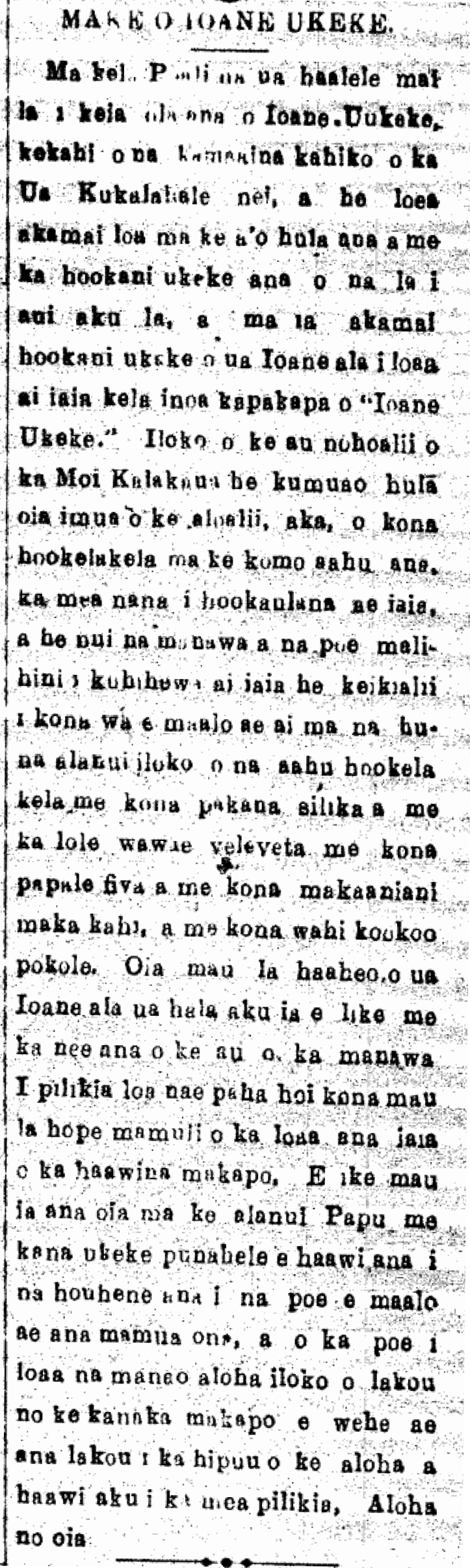
Last Friday, Ioane Ukeke left this life, he was one of the old-time kamaaina of the Kukalahale Rain [famous rain of Honolulu], and he was a skilled expert at teaching hula and playing the ukeke in the days gone by, and it is because of Ioane’s skill at playing the ukeke that he received the nickname “Ioane Ukeke.” During the reign of King Kalakaua, he was a hula teacher [kumuao hula] in the royal court, but what made him famous was his showing off in costume, and there was many a time when foreigners mistook him for a prince when he passed by the street corner [huna alanui? huina alanui?] in his stylish attire and his silk waist [pakana ?] and velvet slacks with his beaver hat and monocle, with his short cane. Those proud days of Ioane have gone with the flow of time. He faced difficulties in his latter days, because of blindness. He was always seen on Fort Street with his favorite ukeke serenading those passing by before him, and those who felt aloha for this blind man would undo the tie of aloha and gave a helping hand to the impaired one. Aloha for him.

(Aloha Aina, 5/9/1903, p. 6)

MAKE O IOANE UKEKE.

Ke Aloha Aina, Buke IX, Helu 19, Aoao 6. Mei 9, 1903.

More from Kalaupapa, 1912.

A REMEMBRANCE OF THE ONE WHO HAS GONE.

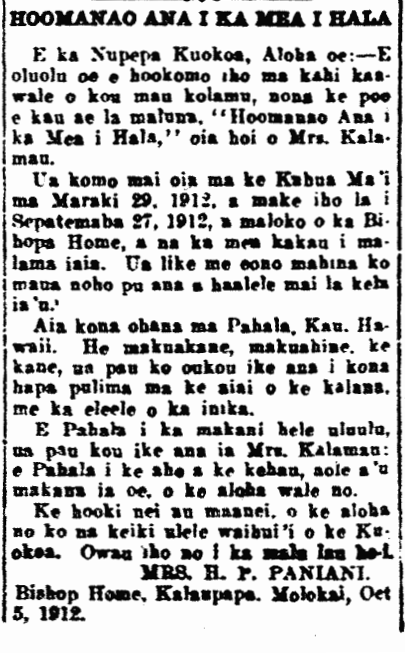
O Nupepa Kuokoa, Aloha oe:—Please be so kind as to include in an empty space of your columns the article with the title above, “A Remembrance of the One Who Has Gone,” that being Mrs. Kalamau.

She came to the leprosy settlement on March 29, 1912, and died on September 27, 1912 in Bishop Home, and it was your writer who took care of her. We lived together for about six months when she left me.

Her family is in Pahala, Kau, Hawaii. Her father, mother, and husband, you will no longer see her hand on white stationery with the black of ink.

O Pahala in the blustery winds, you shall no longer see Mrs. Kalamau; O Pahala in the soft blowing Kehau, i have no gift for you, only aloha.

I end here; my aloha to the type setting boys of the Kuokoa. Me, in the shade of the hoi [ho’i?] leaves.

Mrs. H. P. Paniani.

Bishop Home, Kalaupapa, Molokai, Oct. 5, 1912.

(Kuokoa, 10/18/1912, p. 7)

HOOMANAO ANA I KA MEA I HALA

Ka Nupepa Kuokoa, Buke XLVIII, Helu 42, Aoao 7. Okatoba 18, 1912.

More news out of Lahainaluna, 1874.

[Found under: “Local News”]

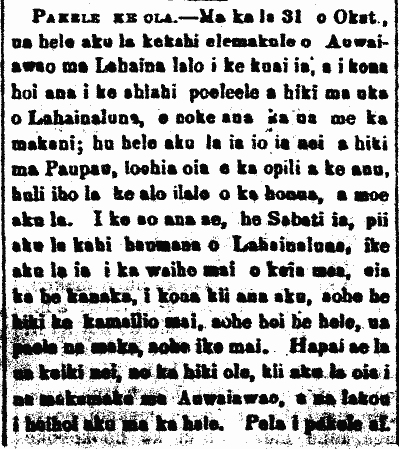
Life is saved.—On the 31st of Oct., an old man from Auwaiawao went to Lahainalalo to go shop, and when he was returning in the evening, it was dark and he reached Lahainaluna; the rain kept falling and the wind kept blowing; the old man wandered here and there until Paupau, and he was numbed with cold and fell face down to the ground and slept. In the morning, it was a Sunday, a student from Lahainaluna was walking up and spotted this thing, come to find out it was a man; when he went to fetch him, the man couldn’t speak, or walk, his eyes were blackened and he couldn’t see. The boy went to carry him, but because he couldn’t, he went to get friends from Auwaiawao, and they carried the man back to his home. That is how he survived.

(Kuokoa, 12/5/1874, p. 2)

Pakele ke ola.

Ka Nupepa Kuokoa, Buke XIII, Helu 49, Aoao 2. Dekemaba 5, 1874.

Death Announcements and the importance of checking all available sources.—1912.

GEORGE NAALEHU SHAW PASSED AWAY.

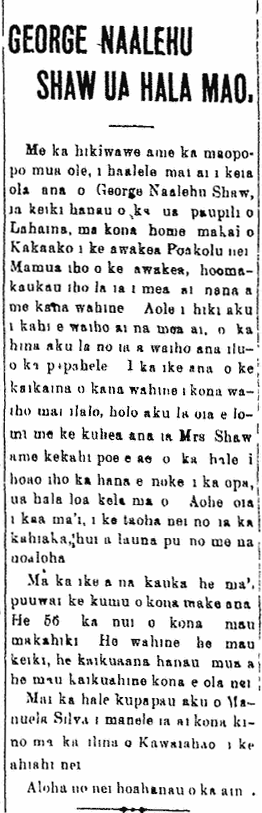
Quickly, without any previous knowledge, George Naalehu Shaw left this life, that native son of the Paupili rain of Lahaina, at his home makai of Kakaako, at noontime on Wednesday. Before noon, he was preparing food for him and his wife. He did not reach the place to put the food, when he collapsed and lay on the floor. When the younger sister of his wife saw him lying there, she went to massage him and called out to Mrs. Shaw and others in the house who continued to massage him; but he passed on. He was not sickly, and was in town in the morning meeting with friends.

According to the doctors, he died of heart disease. He was 56 years old. Surviving him are his wife, children, an older brother, and sisters.

His body was carried from the mortuary of Manuel Silva to the cemetery of Kawaiahao yesterday evening.

Aloha to this brother of the land.

(Kuokoa Home Rula, 3/1/1912, p. 1)

GEORGE NAALEHU SHAW UA HALA MAO.

Kuokoa Home Rula, Buke X, Helu 9, Aoao 1. Maraki 1, 1912.

[It is important to check all available sources and not just one! Look at this announcement of George N. Shaw’s death in Aloha Aina. Although it may seem short and uninformative, it adds to the information given above!]

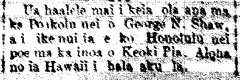
George N. Shaw left this life on this past Wednesday; he is well known to Honolulu’s people as Keoki Pia [George Pia]. Aloha to that Hawaiian who has gone.

(Aloha Aina, 3/2/1912, p. 1)

Ua haalele mai i keia ola ana...

Ke Aloha Aina, Buke XVI, Helu 9, Aoao 1. Maraki 2, 1912.

[Even the Vital Statistics column from the Kuokoa that we posted earlier this week, although just two lines, gives added information!]

Vital Statistics column from Kuokoa, 3/1/1912, p. 8.

[I just did a search for “George Shaw” in the Hawaii papers in 1912 on Chronicling America, but found nothing. This does NOT mean that there are no announcements there, because sometimes words and names come out garbled and are not findable using the word search. If you have the luxury of knowing when an event occurred, it is always best to do a manual search of the newspapers around that date!]

“Kaua i ka Nani o Hilo”. 1892.

A MELE FOR HULA.

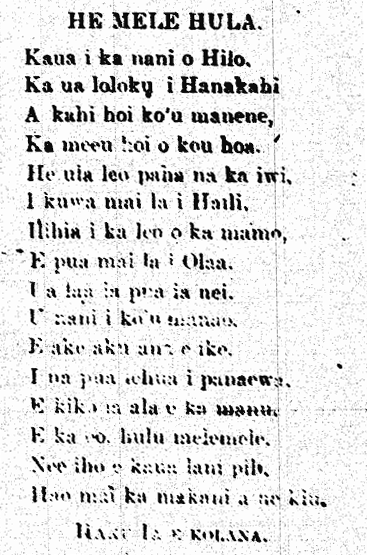
Kaua i ka nani o Hilo
Ka ua loloku i Hanakahi
A kahi hoi ko’u manene,
Ka meeu hoi o kou hoa.
He ula leo paha na ka iwi,
I kuwa mai la i Haili,
Ilihia i ka leo o ka mamo,
E pua mai la i Olaa.
Ua laa ia pua ia nei,
U nani i ko’u manao,
E ake aku ana e ike.
I na pua lehua i panaewa,
E kiko ia ala e ka manu
E ka oo, hulu melemele.
Nee iho e kaua lani pili,
Hao mai ka makani a he kiu.

Composed by Kolana.

[Here is another version of “Kaua i ka Nani o Hilo”, and here it is attributed to Kolana.]

(Leo o ka Lahui, 7/18/1892)

HE MELE HULA.

Ka Leo o ka Lahui, Buke II, Helu 501, Aoao 2. Iulai 18, 1892.